-
2022-05-23
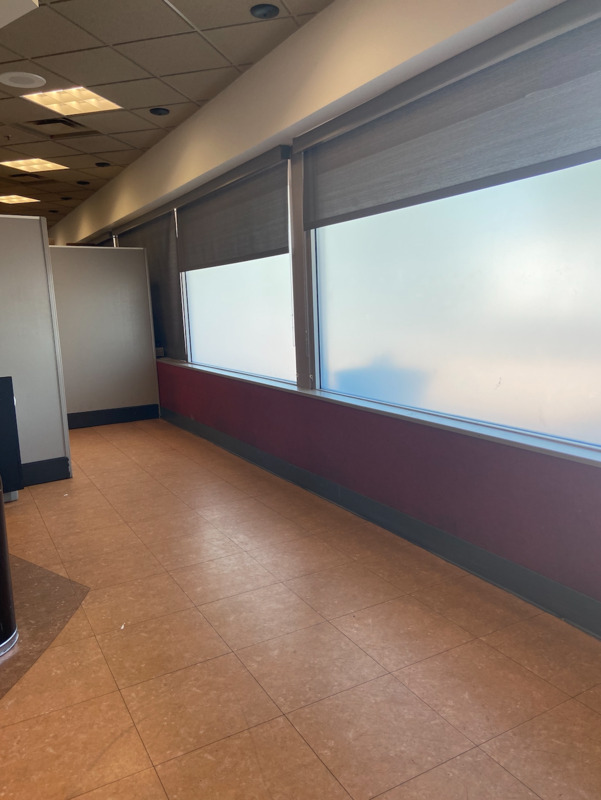
I have been to this Starbucks a few times over the years. This is a Starbucks inside Target. When I went there years ago, there used to be seating available for people to enjoy their beverages at leisure. Due to COVID, those seats are gone. I hope they get brought back eventually, because while I don't order from Starbucks that often, it was a nice place to sit while waiting for other people to get done shopping.
-
2022-05-23
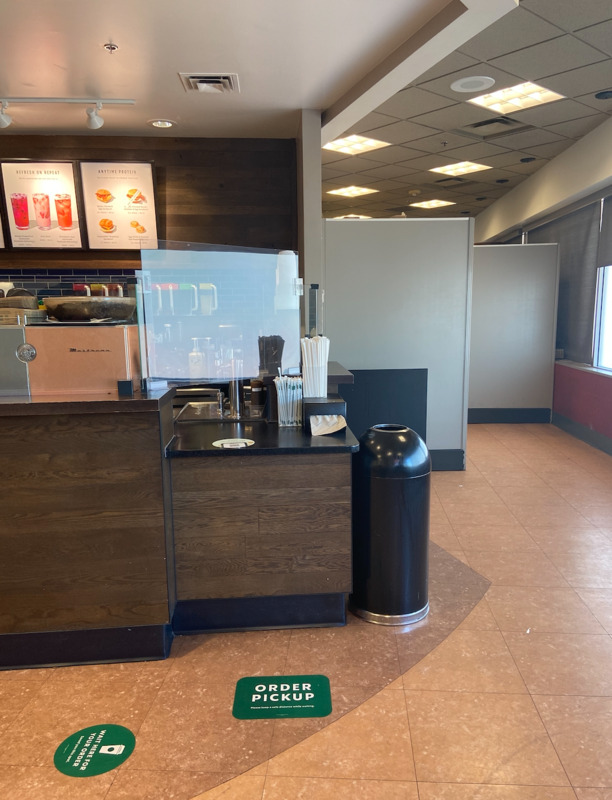
While at Target, I noticed a sneeze guard at the Starbucks inside it. I can't remember if the staff were wearing masks, but that is one COVID-era precaution I saw that is still in use. My sister was ordering something from there, so I took a picture while I was waiting for her to be done.
-
2022-05-23
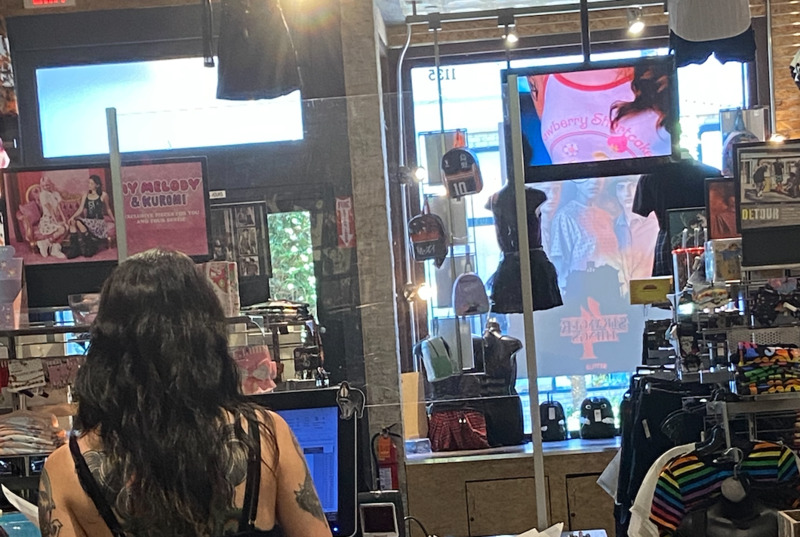
This is a sneeze guard at Hot Topic. The staff themselves were not wearing masks, but the sneeze guards were still up. Since both cash registers were being used, I took a picture from the back for privacy reasons.
-
2022-05-23
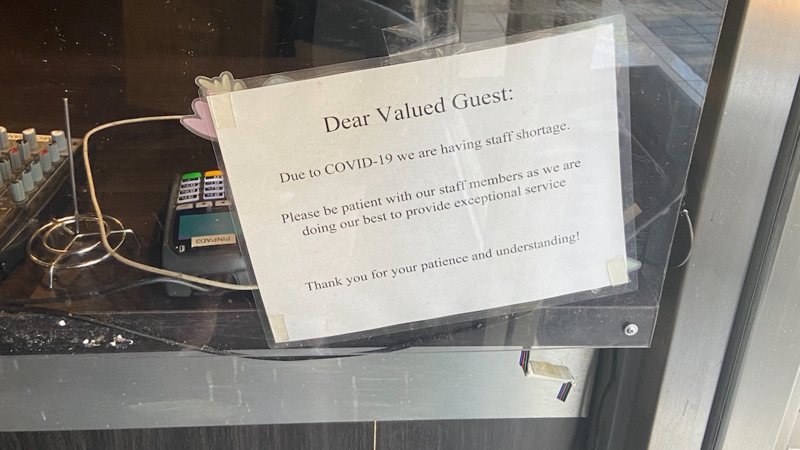
Due to COVID-19, Gen, a Korean barbecue place, has had a staff shortage. Today I went there for lunch and noticed that there was fewer people working many tables than in times I have gone in the past. This speaks to the bigger labor issues that have come about since COVID. Some of it may be realizing that jobs like this aren't offering nearly enough to work there. Another possibility is that staff shortages might be happening from vaccine mandates, which depending on how many vaccines some place require, would be less appealing. The sign says that it is only due to COVID-19, but there are many components to that, so narrowing down the reason there are staff shortages could be difficult unless I asked the manager.
-
2022-05-23
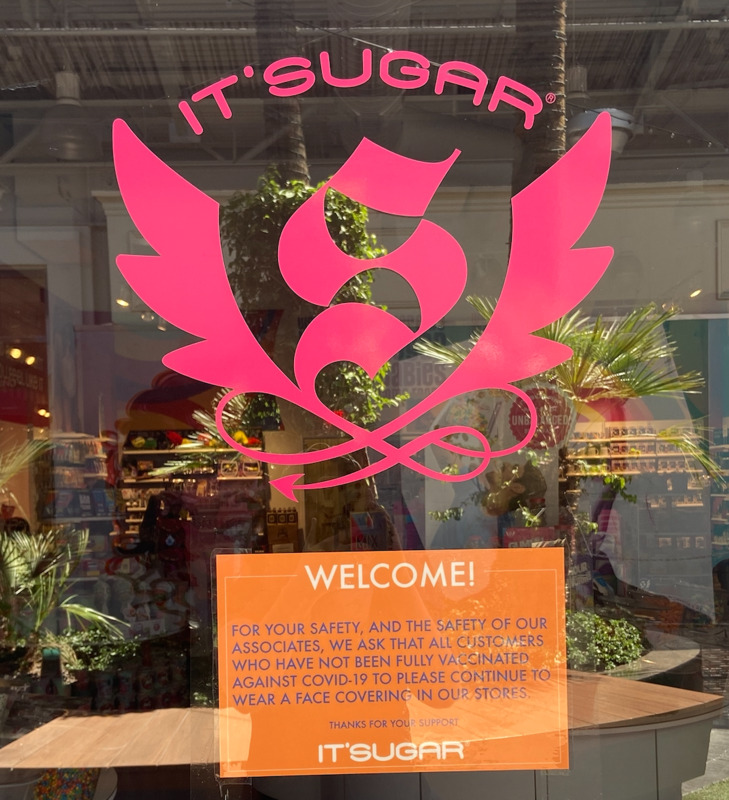
This is a sign on the front door of It's Sugar. It's Sugar is a chain candy store. Here, it is saying that those who have not been vaccinated should continue to wear a mask while inside the store. I went in there today, and no employee asked about my vaccination status, and the employees weren't masked. Arizona as a whole has been pretty light on COVID restrictions, but I imagine that other locations of this store might react differently.
-

2022-05-23
This is where you can get cart wipes at Target while shopping. In addition to the thing itself, it gives you information on where to get a COVID vaccine. Wiping down surfaces has become a bigger thing since COVID, as it would help reduce the spread. COVID itself can't survive on surfaces for very long, but it can be there for a short amount of time. Using things like cart wipes is a way to prevent COVID and other diseases.
-
2022-05-23
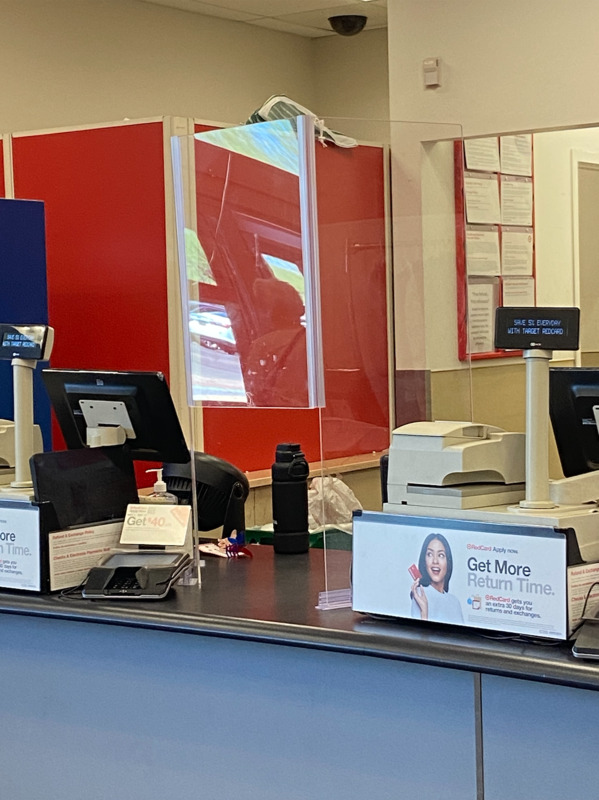
This is a sneeze guard seen at Target. This is a COVID-era restriction meant to prevent the spread of COVID. Even though most restrictions are gone, these are still up.
-
2022-05-23
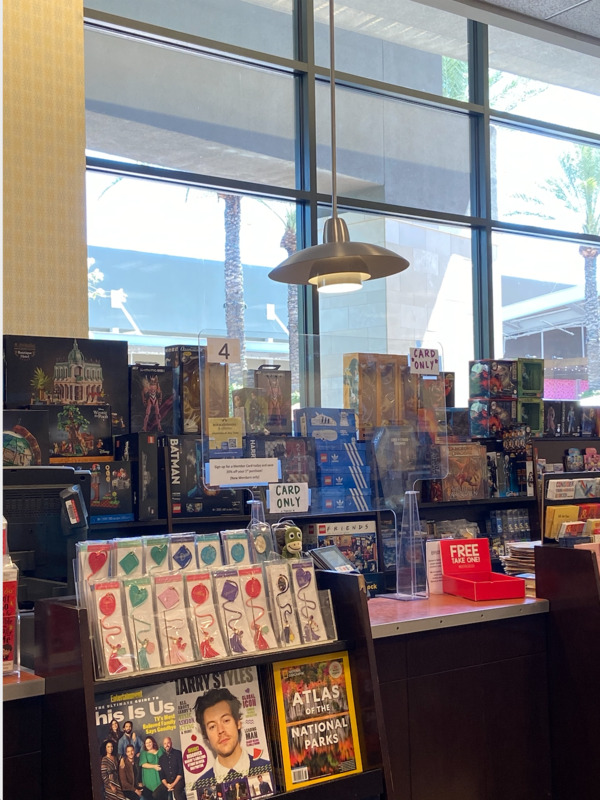
This is a picture of a COVID-era restriction put in place at some stores. The store this was seen in was Barnes & Noble. Not pictured, but employees were also wearing masks in addition to the sneeze guards.
-
2020-04
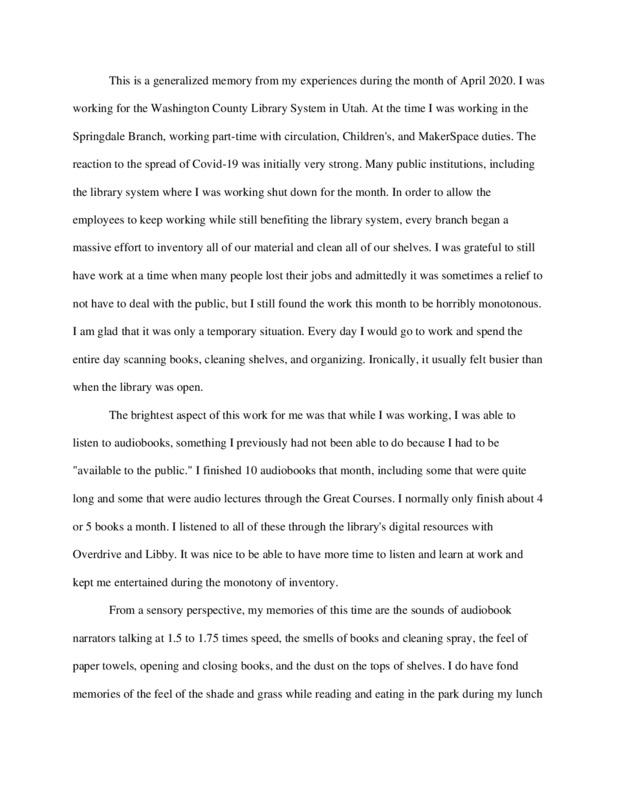
This story shows how pandemic radically changed workplace experience, including sensory memories, for my occupation as a library worker in Washington County Utah in April 2020.
-
2020-05-23T09
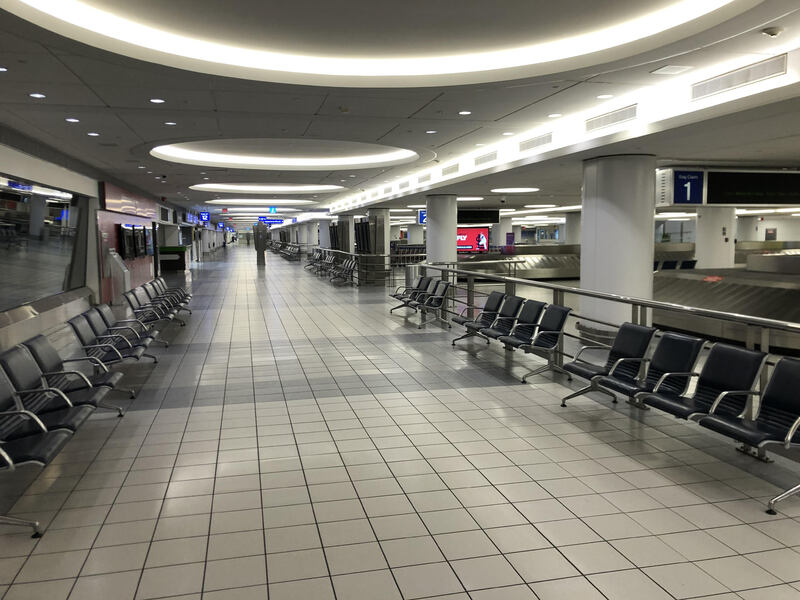
We lived in a very town in western Illinois as the pandemic arrived in America. Covid-19 seemed abstract until circumstances caused us to travel to a major international airport. The eerie quiet, in place of what should have been a noisy, madcap atmosphere, elevated sounds I normally would not have heard. It was as if a scene from a science fiction film had jumped off the screen and into my life. The experience had a nightmarish quality that has stayed with me two years later.
-
2020-05-01
Covid-19 for me was difficult as a high school senior at the time and graduation coming. My class kind of lost the fun trips and experiences with teachers and classmates that graduates look forward to. We did not see our classmates till the day of graduation. I felt that Covid-19 allowed me the opportunity to better myself as I lost 18 pounds and wished I took more advantage of that time at home to learn new skills and offered me an opportunity to think and plan the future. At the end of the day. It taught me many lessons and ways to prepare for disasters.
-
2020-05
Covid-19 had more of a positive effect than negative on my life in the spring/summer of 2020. I am a teacher in the small community of Anson, Texas, population 1,884; we are social distanced by default. Following the spring break of that school year, Anson ISD shut down and went wholly online. It was already a time of great transition for me, I was leaving the world of coaching in favor of becoming a regular classroom teacher and I had just been given five months to reflect on my new role. That time was spent with family and friends in an almost semi-retirement doing the things I never had time for because of my demanding schedule. As a teacher and coach, 60-hour work weeks were a norm, and during football seasons you could expect those hours to creep to the upper 90’s. There were also no “real” summers like other teachers. A coach’s summer is spent in morning workouts and summer camps with the occasional week off to visit family and decompress. That is why the “covid summer,” as I remember it, had such a profound impact on my life. Those five months were spent with family and friends playing dungeons and dragons, golfing, and remodeling a good friend’s house.
My younger brother is an avid dungeons and dragons player, a hobby that I never found myself with enough time to delve into. The collaborative story-based tabletop role playing game known as dnd requires several people, a few hours, and a lot of reading to play. My covid summer left me with ample free time to do just that. The sound of dice on hard tabletops rang throughout our houses as we held a regular weekly gaming session for five months. One unique thing about dungeons and dragons is the diversity of dice required to play the game, from four sided up to twenty sided and almost every even number in between, were required to effectively play the game. Most sets came with every dice, but the variety of color, size, and material quickly made collection a side hobby. Before long, I had a large bag full of dice and special black and gold metal set saved for only the most special of encounters. That is what I remember most, the cool touch of those dice as I contemplated the best course of action for my character to take against the hordes of enemies by brother could conjure up.
While the hottest days were spent in the air conditioning playing games, the pleasant ones were spent golfing. At the time, state health officials had mentioned golf as an almost perfect sport to play during covid because it was easy to social distance and the vitamin D from the sun helped to boost the immune system. I played a lot of golf with much of the same friends I played dnd with. Many of the golf courses we played at threw their doors open and welcomed golfers with open arms to try and keep the business afloat through the troubling times; we never once were denied a t-time. We played golf at least twice a week for five months and I don’t think my hands have recovered yet. The feel of those club handles wore out two gloves and countless blisters across both hand and I wouldn’t change it for the world.
While my other two hobbies offered little in the form of vocational skills, my third allowed me to learn the most. My good friend purchased his first home in May of 2020. A quaint 3 bed 2 bath home on a third of an acre just outside of Abilene, a larger town about 20 minutes south of Anson. The home was a product of the 60’s and while it had been well maintained by its previous owners, it needed quite a bit of updating. My friend had some experience in construction from a previous job, but we were all learning on the fly as we decided to remodel his home. Roughly a dozen power tools across four friends, we tore out walls, updated electrical, redid flooring, framed, drywalled, painted, and wired his 1500 square foot house for the better part of three months. There were a lot of late nights, beverages had, and good laughs shared. We all had some know how, but YouTube and google became our best friends. I had always heard the saying that rough hands meant hard work, but the feeling of my hands covered in drywall dust gave a much more visceral connection to it.
I think all these feelings for me were so profound during this time because the pandemic had placed a warning label on touch. My mom is a thirty-year veteran nurse, directed an ER during swine flu and bird flu, and still received Christmas cards from high-ranking officials of the CDC; I was well informed on the virus. In the early days, we didn’t know how long it lasted on surfaces, the severity of the virus, or its communicability. Touch was one thing that had to be eliminated. A six-foot bubble was placed on the world and people feared handshakes, hugs, and human embraces foundational to the species. One knows the dangers of the everyday world, but rarely to we expect a loving hug to potentially carry death to a dear loved one. This notion changed how we, as a species, saw each other. Some embraced the struggle to soldier on with courage and others gave into fear as new information came out hourly. Two years later, after mask mandates have been lifted across most of the country, people are still trying to heal. Fist bumps taken over handshakes, hands free pay at most supermarkets, automatic doors becoming a priority are all examples of how Covid-19 changed our perception of touch as a human race.
With all the activity I had during my covid summer, I did eventually contract the novel virus on my birthday in June. My only symptom was a loss of smell, one of the weirdest sensations I’ve ever had. I count myself extremely lucky that that was the only symptom I had. Aside from my ten days of self-quarantine, my life was affected in very much a positive way. I cherish the memories of my covid summer and count myself incredibly lucky to have experienced the pandemic the way I did.
-
2020-05-29
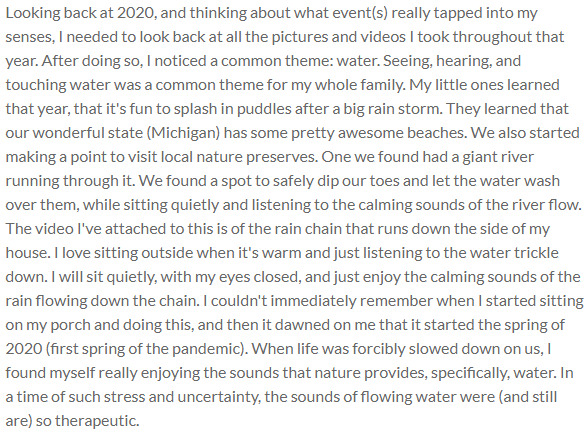
Looking back at 2020, and thinking about what event(s) really tapped into my senses, I needed to look back at all the pictures and videos I took throughout that year. After doing so, I noticed a common theme: water. Seeing, hearing, and touching water was a common theme for my whole family. My little ones learned that year, that it's fun to splash in puddles after a big rain storm. They learned that our wonderful state (Michigan) has some pretty awesome beaches. We also started making a point to visit local nature preserves. One we found had a giant river running through it. We found a spot to safely dip our toes and let the water wash over them, while sitting quietly and listening to the calming sounds of the river flow. The video I've attached to this is of the rain chain that runs down the side of my house. I love sitting outside when it's warm and just listening to the water trickle down. I will sit quietly, with my eyes closed, and just enjoy the calming sounds of the rain flowing down the chain. I couldn't immediately remember when I started sitting on my porch and doing this, and then it dawned on me that it started the spring of 2020 (first spring of the pandemic). When life was forcibly slowed down on us, I found myself really enjoying the sounds that nature provides, specifically, water. In a time of such stress and uncertainty, the sounds of flowing water were (and still are) so therapeutic.
-

2020-04-12
Easter 2020 was very different, but as it turned it out different in a good way
-

2022-05-20
This is a news story from The New York Times by Catherine Pearson. Due to the nationwide baby formula shortage, new methods of obtaining milk have come about. One of those ways is sharing extra breast milk.
There is some risk involved in getting donor breast milk. Informal sharing means that it won't get checked for things like HIV or hepatitis B.
There are some health benefits to using donor milk though. One of them is immunity to COVID. For example, mothers who have been infected with COVID or have received the vaccine can pass down those antibodies to babies through their milk.
-

2022-05-19
This is a news story from Metro Weekly by Joseph Reberkenny. For the first time since COVID started, DC Black Pride will be back in-person. It is organized by the Center for Black Equity and it includes over 25 events highlighting the Black LGBTQ community in Washington. During the height of the COVID outbreak, the Center for Black Equity held events online instead.
The organizers say that in-person events are special for this community and has planned safety precautions for people attending. There will be things like masks available at the event in addition to rapid test kits.
-

2022-05-21
This is a news story from NBC News by Tara C. Smith. This is comparing COVID to the recent monkeypox outbreak. Unlike the COVID, Smith says that monkeypox has had more understanding due to it being related to smallpox. Monkeypox is milder than smallpox and is more difficult to spread compared to something like COVID.
However, monkeypox and COVID do have some things in common. One of them is that both are respiratory viruses, meaning that they can be spread through cough, sneeze, and sometimes breathing.
One very good thing about monkeypox is that there are already vaccines available that can work against it. The smallpox vaccine is similar enough to monkeypox that it can help prevent both.
-

2022-05-03
This is a news story from Vice by Joseph Cox. The CDC bought access to location data harvested from millions of phones in the United States. Although it was originally purchased for lockdown related reasons, it is intended to be used for non-COVID purposes too. The way they did this was through purchasing data from SafeGraph. The author of this piece mentions how the decision to do this was not without controversy, as it brings into question the freedom of movement and the rights to privacy. Google has banned SafeGraph from its app store in June.
-
2022-05-21
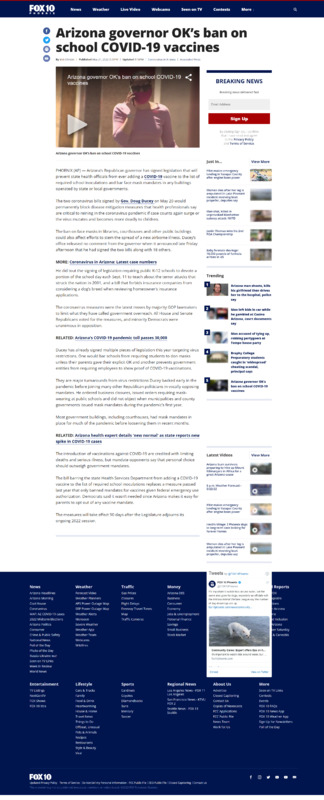
This is a news story from Fox 10 News by Bob Christie. Governor Doug Ducey has recently signed legislation that would prevent state health officials from adding COVID-19 vaccines to list of required school vaccines. This legislation was done by the GOP to prevent government overreach.
-

2022-05-19
This biography was created out of a self-directed project from the HST580 class. This biography will be linked to the submissions of the person mentioned in the document and title.
-
2022-05-20
Having such a difficult school year before the pandemic hit, I initially couldn’t be more excited for this break from those all nighters. After getting the opportunity to recharge for a few weeks, finishing the school year was relatively easy. Summer flew by, and I soon realized that my entire junior year would be online as well.
I quickly found the homogeneity to be unavoidable; I could sleep and attend school without moving more than a few feet. Each day was the same, a mechanical routine of jumping from Zoom meeting to Zoom meeting. Countless students would log into these meetings for roll call, and simply tilt the camera at the ceiling fan as they went out with friends or took a nap. It was easy to think this situation was just an obstacle to get past, another building block for the vision I had put in place for the years after high school. For me, this vision was about college, building knowledge towards my future career, and compiling a worthy resume. However, there was no reason I couldn't give value to this time period, to give meaning to each day such that they didn’t all blend together. From the daily differences in curriculum to the unique interactions of each period, I found these minute contrasts to be more significant. Realizing the importance of being mindful, even when little to no dynamic quality existed, allowed me to continue furthering my studies and interests.
Looking back now, during a time when I have gotten accepted to one of the best schools I could’ve ever asked for, I think about how difficult that year and a half was for me, and how much harder the situation was for many other individuals. Again, the biggest lesson I learned was the importance of mindfulness. Whether it be a triumph or a tragedy, these life events should not be skimmed over like a mountain or trough to pass through. They are all lessons in some form, pieces of knowledge that should be taken with thought.
-
2022-05-20
Having such a difficult school year before the pandemic hit, I initially couldn’t be more excited for this break from those all nighters. After getting the opportunity to recharge for a few weeks, finishing the school year was relatively easy. Summer flew by, and I soon realized that my entire junior year would be online as well.
I quickly found the homogeneity to be unavoidable; I could sleep and attend school without moving more than a few feet. Each day was the same, a mechanical routine of jumping from Zoom meeting to Zoom meeting. Countless students would log into these meetings for roll call, and simply tilt the camera at the ceiling fan as they went out with friends or took a nap. It was easy to think this situation was just an obstacle to get past, another building block for the vision I had put in place for the years after high school. For me, this vision was about college, building knowledge towards my future career, and compiling a worthy resume. However, there was no reason I couldn't give value to this time period, to give meaning to each day such that they didn’t all blend together. From the daily differences in curriculum to the unique interactions of each period, I found these minute contrasts to be more significant. Realizing the importance of being mindful, even when little to no dynamic quality existed, allowed me to continue furthering my studies and interests.
Looking back now, during a time when I have gotten accepted to one of the best schools I could’ve ever asked for, I think about how difficult that year and a half was for me, and how much harder the situation was for many other individuals. Again, the biggest lesson I learned was the importance of mindfulness. Whether it be a triumph or a tragedy, these life events should not be skimmed over like a mountain or trough to pass through. They are all lessons in some form, pieces of knowledge that should be taken with thought.
-
2022-05-20
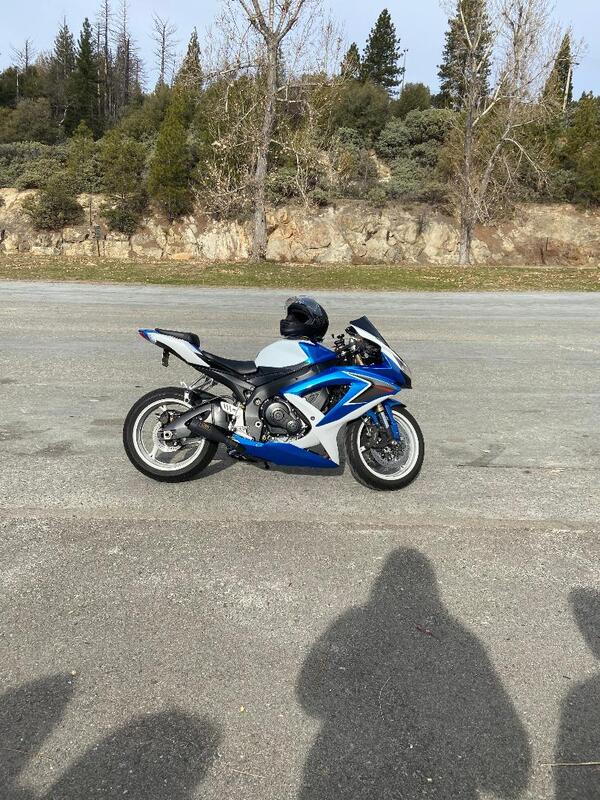
My name is Kasper, I live in the U.S. and I was 24 at the time the novel corona virus first started to cause shutdowns nation wide and world wide. I did not have the luxury of staying sheltered in place as I worked for a company that was deemed necessary to operate no matter what. My co-workers and I were basically told that our company will close when the federal government completely shuts down. That never happened. All throughout the pandemic I did not notice many changes to my life other than lack of major social events. I still hung out with friends and didn't really take the whole shut down seriously. I never had anything major happen to anyone I knew until the second year. That being said I never felt that hiding was going to solve the whole pandemic issue as many people believed it would. I spent a lot of time riding motorcycles with my wife and friends living my life to the best of my ability. One thing that did change was the whole mask dilemma. I wasn't someone against masks but I do wish the whole situation would have been handled differently. I feel that the picture above can illustrate that I did not nor will I ever let anything stop me from living and enjoying my life
-
2022-05-19
This biography was created out of a self-directed project from the HST580 class. This biography will be linked to the submissions of the person mentioned in the document and title.
-
2022-05-19
This biography was created out of a self-directed project from the HST580 class. This biography will be linked to the submissions of the person mentioned in the document and title.
-
2022-05-19
This biography was created out of a self-directed project from the HST580 class. This biography will be linked to the submissions of the person mentioned in the document and title.
-
2022-05-19
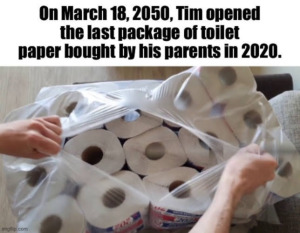
This meme is related to what I observed at the early stage of the pandemic-- everyone rushed into grocery stores, hoarding toilet paper. This phenomenon really shows how human action is likely to be controlled by the fear and uncertainty about the future and can question about the true human nature.
-
2020-05-26
C19OH
-
2020-12-10
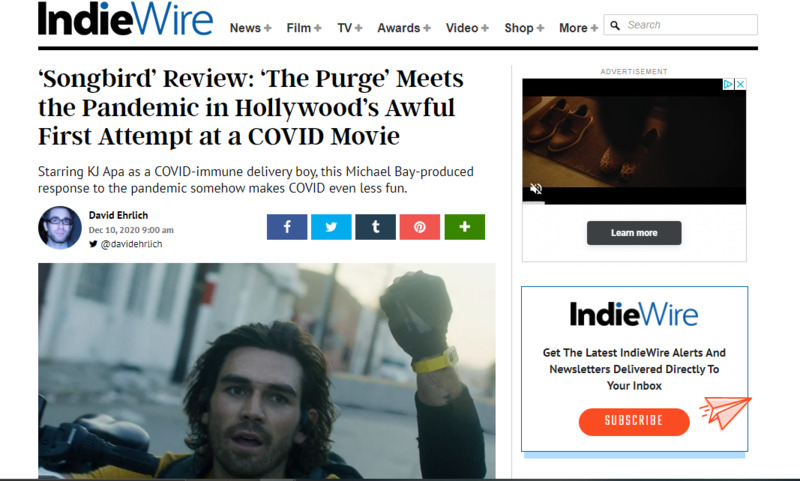
This is a review of the movie "Songbird". I watched it when it came out, closer to the start of the Covid pandemic and my partner reminded me of it recently. This review does a much better job at summarizing the issues of the film. It was so bad, not even from a movie and writing standpoint, but it just felt incredibly way to soon to create and release something that feels almost mocking of the pandemic. Big thumbs down.
-
2022-05-16
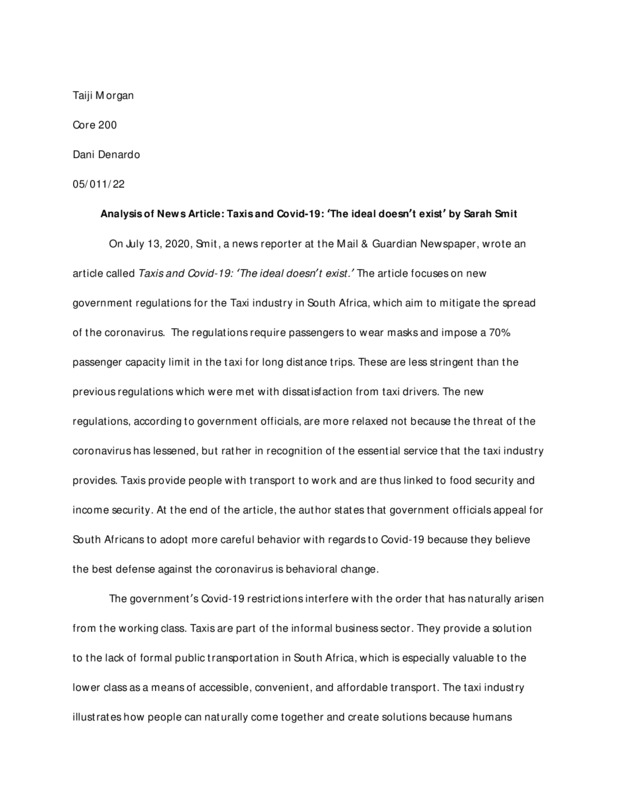
I am from South Africa. I wrote this analysis of a news article about Covid-19 regulations on the taxi industry in South Africa because during the pandemic I have heard many middle class people complain that working class people are irresponsible for traveling in crowded taxi's to work. My analysis pushes against this narrative, and illustrates how restricting the taxi industry is unjust, oppressive and unhelpful. Moreover, I suggest some alternative ways government can be helping.
-
2022-05-16
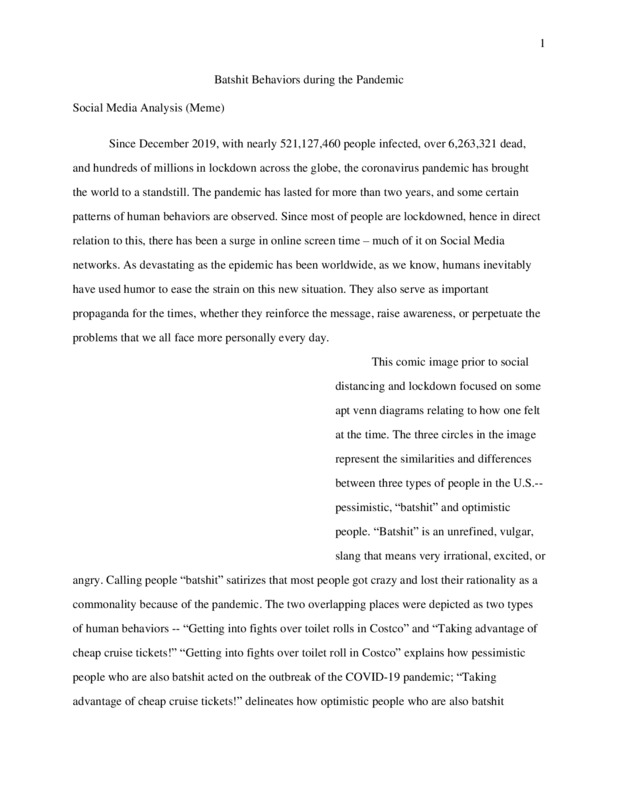
In class, we analyzed the meme related to COVID-19 and hope this will contribute to something.
-
2022-05-16
At the beginning of 2021, I spent one of the most memorable fun time in my life with my friends at the Coming of Age ceremony. Two days later, I had one more memorable days in my life, but in a negative mode: I got Covid-19, and it transferred to all my family members. During that time, I felt fear of being perceived as Covid-19-infected by others since a lot of prejudice led by Covid-19 was happening in the world and even in my neighborhood. In this essay, I would like to use my experience to analyze the human selfish and altruistic reactions to the Covid-19 pandemic.
When I got infected with Covid-19, I had a high fever of 103 degrees, had difficulty breathing, and could not eat properly for several days. My father was hospitalized for about a week because he kept coughing and had difficulty breathing. The whole family was infected with Covid-19and had to be treated at home and quarantined at home, so we could not go out to buy daily necessities and food. The food that was in the refrigerator was running out with each passing day. At that time, I was afraid to confess to anyone outside my family that I had Covid-19 even though I was cured. The reason for this was that I saw on the news that there was a hate movement against Japanese and Asians living in European countries and the United States around the spring of 2020 when the Covid-19 pandemic began. Later on, as the Covid-19 damage grew, President Trump called the coronavirus the “Chinese virus,” and there were many Asians, including Chinese, who were labeled and discriminated against in the daily news. Even around my home, there were people who looked harshly at people labeled as "corona-infected," "pathogens," or "dangerous people," even if they had been infected with Covid-19 and had already recovered completely. I was afraid that if my neighbors and friends found out that I had Covid-19 and labeled me dishonorably.
I thought that the distrust and inter-personal level of hatred that people possess for people who have actually been infected with Covid-19 comes from the “state of nature” that Thomas Hobbes advocated in his writing. Hobbes explains that the state of nature is when humans “seek peace and follow it… by all means [humans] can to defend [themselves]”. The state of war, in which men fight what men perceive as a target (in this case, the threat of the Covid-19) in order to protect themselves, seems to have given rise to this discrimination. And that discriminatory view grew socially and led to the Asian Hate of the time. In addition to the fear held by individuals, I guess the manipulation of social impressions at the time also led to Asian hate. The world was under a medical crunch in all countries following the explosive spread of the Covid-19, and there was a shortage of hospital beds and respiratory equipment. This could be attributed to policies and measures in the medical field that could not respond well to the sudden pandemic or the failure to provide the public with the correct information. However, medical policies and government thinking of the time shifted the blame. They tried to deflect public anger and attention with a different vector, trying to place the responsibility for the entire pandemic on the "Chinese virus" and the Asians. Public opinion, not medical evidence, established the cause of the pandemic, which was similar to what happened in San Francisco, California, hundreds of years ago during a plague epidemic, according to Joan B. Trauner's article. Chinatown in San Francisco was created to isolate immigrants from China during the plague epidemic, and the health office regarded them as the cause of the disaster. The government and the health officer did not want to be responsible for the existence of a plague epidemic. Trauner, in his writing the Chinese as Medical Scapegoats in San Francisco, describes the perspective of the medical officer in San Francisco at the time: "the pronouncements of the board and the health officer were often characterized by political or social expedience, rather than by scientific insight”. The government and the health department utilized the presence of Chinese immigrants for social expediency. The fear, the anger born of fear, and the desire to protect oneself have not changed from the time Hobbes wrote The Leviathan, through Trauner, to the present day in the 21st century. Especially in extraordinary situations like a pandemic, it will lead to new discrimination and more people being treated unfairly.
But I have found one hope during this pandemic. During the time my family was homebound, when we had nowhere to go shopping and were finally running out of food, friends of my parents cooked and brought us meals for a few days, bought fruits and household items and delivered them to us. There were even heartful letters written by them. They did not avoid us as "dangerous people" but treated us with compassion. When humanity makes a positive turnaround from looking for the cause of this situation and shifting blame, to working together to overcome the situation that is happening now, we could overcome our fears, become altruistic, and strive to protect humanity as a whole.
-
2022-05-16
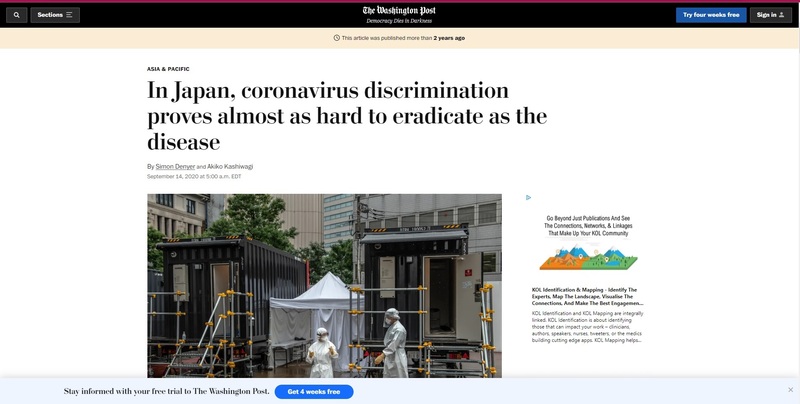
During the COVID-19 pandemic, healthcare workers and patients in Japan suffered from the stigma. According to the article, “In Japan, coronavirus discrimination proves almost as hard to eradicate as the disease,” healthcare workers and their families are discriminated against as if they are “germs” that people need to avoid contact with. The patients of the virus are also stigmatized, and such a phenomenon of blaming victims has been seen many times throughout Japanese history.
As this article represents, health care workers in Japan were stigmatized and discriminate against because of the potential risks of COVID-19 infections. According to Goffman, the greek definition of stigma “[refers] to bodily signs designed to expose something unusual and bad about the moral status of the signifier” (131). Nowadays, its definition has expanded to negative images of physical and social attributes and their interpretation in a social context. The stigma of healthcare workers in Japan is peculiar to this pandemic, and this could be because the situation overturned the expectations people had about healthcare workers. Healthcare workers are supposed to help people with diseases, but because of the pandemic, they are seen as the ones with higher risks of carrying the virus as they have more interaction with those who have been infected. As a result, people become afraid of interacting with healthcare workers, which made this job stigmatized.
The article shows that Japanese people reject to interact with healthcare workers and their families during the pandemic. One of the common consequences of being stigmatized is that stigmatized people become separated from other people as they are treated differently. According to Goffman, “[the] responses of the normal and of the stigmatized that have been considered so far are ones which can occur over protracted periods of time and in isolation from current contacts between normals and stigmatized" (135). As Goffman illustrates, health care workers were stigmatized and separated from society at the beginning of the pandemic. Some people even believe that “the person with a stigma is not quite human” as Goffman states, which lead to an extreme reaction by people around health care workers. For instance, healthcare workers have been receiving death threats because other people see them as if they are the potential source of the disease rather than the same humans who are fighting the pandemic together. Such a reaction is similar to how children bully other children based on differences in attributes. One of the typical ways of bullying is to call someone “germs” and avoid interactions, which is the same as the situation in this article. This pandemic revealed our natural tendency of staying away from others who have negative attributes, which indicates that a pandemic is not an equalizer but a source of discrimination.
Another factor that could have contributed to the situation in Japan is social pressure existing in the country. The article mentions that there is strong social pressure in Japan to follow coronavirus directives and to cooperate for stopping the spreading of the virus; if people do not comply, they are strongly criticized or blamed by other Japanese people. In addition, surveys have shown that compared to Americans or Britons, more Japanese people agree with the idea that “If someone is infected with the coronavirus, I think it is their fault” (Denyer and Kashiwagi). According to Fei, there are behavioral norms that are maintained by tradition, called “ritual norms” (97). This kind of norm is regarded as moral behavior by people of the community so that they follow the norms regardless of laws or punishments (99). Although Fei discusses Chinese rural society, such norms have been established in Japan as well because Japanese society developed as an agricultural society where people in a community need to cooperate with each other. There used to be a tradition called murahachibu, which means excluding those who break the rules from 80 percent of social activities in the village with the exception of funerals and fires. Even though this practice is rarely seen in modern society, people still have a strong pressure to behave for the sake of society in order to maintain harmony. For example, Japanese people still feel obligated to wear masks after vaccines have been promoted even though there is no rule or punishment for not wearing masks. This feeling may occur because they believe it is moral or correct to refrain from doing something that possibly spreads the virus.
Healthcare workers were not the only people who suffered from stigma, but COVID-19 patients were also blamed for their behavior that possibly contributed to their infection. In the article, a Japanese psychology professor mentions “a low tolerance for uncertainty” in Japanese people, indicating that they blame the patients to reduce their own fears derived from the uncertainty of the pandemic. This implies that COVID-19 patients become scapegoats for the pandemic itself. In the reading, Trauner writes that “the general acceptance of the germ theory in the 1880’s did little to dispel the popular belief that epidemic outbreaks were directly attributable to conditions within Chinatown” (73). This indicates that when people are uncertain about something scary, they try to identify what or who causes that disease or threat. Although people know that coronavirus is the cause of this pandemic, most people are afraid of germs and viruses because they are invisible. The article also demonstrates some cases of blaming victims in Japanese history, including leprosy patients, survivors of the 1945 atomic bombings, and evacuees of the 2011 Fukushima disaster. Such diseases and disasters involve complicated factors, so it is difficult to blame the causes directly. Therefore, individuals tend to blame patients or carriers of the virus during the pandemic instead of blaming the virus itself because they are visible and easy to avoid.
References
Erving Goffman (1976) “Stigma” :Chapter 10 “Selections from Stigma”
Fei Xiaotong (1947) “From the Soil: the Foundations of Chinese Society”
Joan B. Trauner, (1978) “The Chinese as Medical Scapegoats in San Francisco, 1870-1905
Simon Denyer and Akiko Kashiwagi (2020) “In Japan, coronavirus discrimination proves almost as hard to eradicate as the disease”
-
2020-05-16
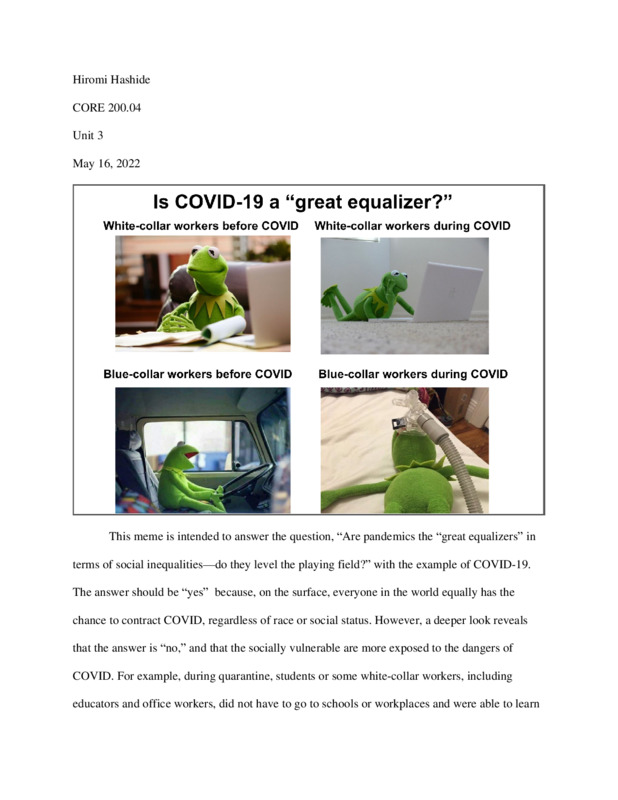
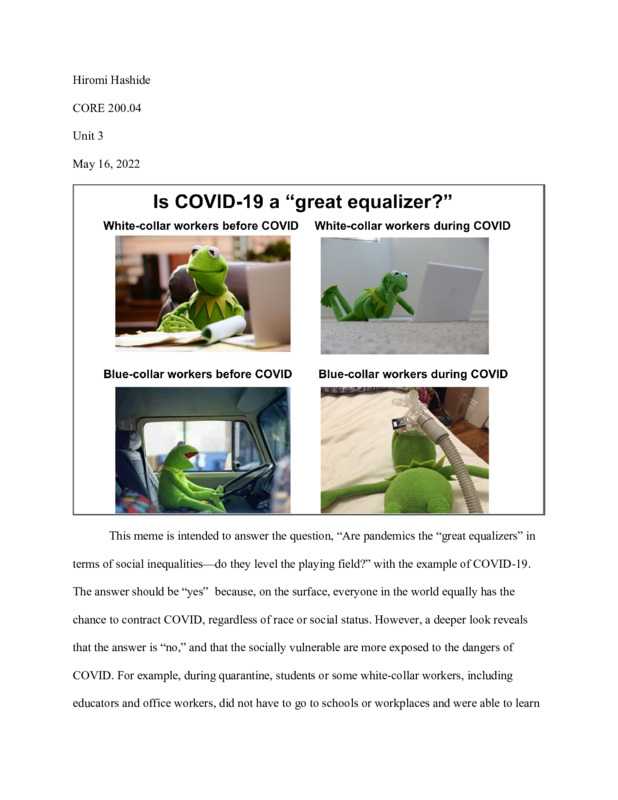
I made two memes. The first meme is intended to answer the question, “Are pandemics the “great equalizers” in terms of social inequalities—do they level the playing field?” with the example of COVID-19. And the meme says the answer is “no,” and that the socially vulnerable are more exposed to the dangers of COVID. The second meme is intended to answer the question, “Have you observed any patterns of human behavior with the Covid-19 pandemic?” Former President Trump called COVID the “China Virus” and fueled people’s hatred of Asians. This meme tries to remind the audience of his negative remarks but in a humorous way without offending Asian populations. It also illustrates how words can magnify feelings of racism, fear, and uncertainty, which can result in scapegoating. This meme gives the audience an opportunity to learn more about the unfair treatment of Asians during the pandemic and why it happened.
-
2000-05-16
I made two memes. The first meme is intended to answer the question, “Are pandemics the “great equalizers” in terms of social inequalities—do they level the playing field?” with the example of COVID-19. And the meme says the answer is “no,” and that the socially vulnerable are more exposed to the dangers of COVID. The second meme is intended to answer the question, “Have you observed any patterns of human behavior with the Covid-19 pandemic?” Former President Trump called COVID the “China Virus” and fueled people’s hatred of Asians. This meme tries to remind the audience of his negative remarks but in a humorous way without offending Asian populations. It also illustrates how words can magnify feelings of racism, fear, and uncertainty, which can result in scapegoating. This meme gives the audience an opportunity to learn more about the unfair treatment of Asians during the pandemic and why it happened.
-
2022-05-15
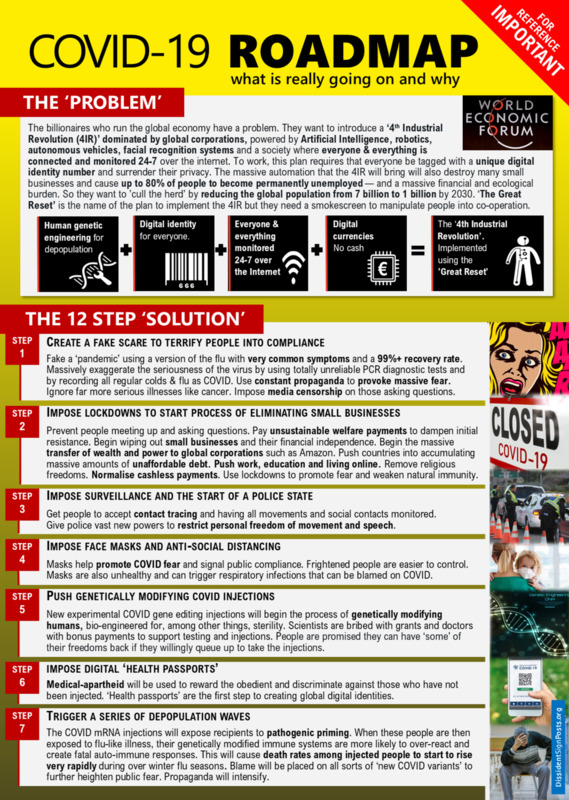
This double-sided A4 leaflet provides an extended summary overview of the supposedly 12-step plan behind the COVID. This leaflet was taken from the dissidentsignposts.org, and they hope to inform people about the “real” reason behind the COVID pandemic. This leaflet says that the billionaires want to impose new ways for global corporations but for their plan to work, they need to acquire everyone to be tagged with a unique digital identity number and surrender their privacy. As this leaflet points out, the “New Normal” that billionaires want to accomplish is to be depopulated, cleaned-up, high-tech, dehumanized, totalitarian dictatorship, genetically modified, digitally tagged, nano-chipped, etc. this leaflet tries to persuade the audience by pointing out that the COVID pandemic is just a big scheme in hopes of taking control of the total population. The 12 step that is mentioned explains the different reasons why the government is pushing for people to take COVID and the vaccines seriously. I have heard of this idea before from my friends. They were talking about it, but to me, I believe that COVID is real. I have seen my family members getting infected by the virus. I will never believe things like this and I will never let anybody put a chip or something within me. Although our world is getting more and more highly advanced, I believe that this so-called “Great Reset” will not take place.
-
2022-03-09
This is a video regarding the safety of the Covid-19 Phizer vaccine reports that were recently released as of the making of both the video and this submission.
It details the adverse events, the safe deliveries of the vaccine amongst an assortment of disorders, and the unhappiness of both the video creator and the viewers in the comments at the lack of transparency regarding the information surrounding the vaccine.
-
2020-04-01
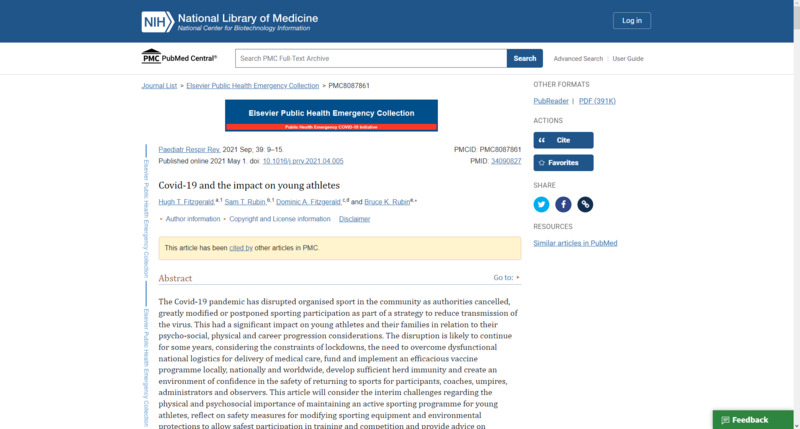
High school sports for many students such as myself were drastically affected because of the Covid-19 Pandemic. As an avid golfer and college golf prospect from Michigan, the pandemic hurt me and my fellow athletes in many different ways. In my Junior year of high school, my golf season was canceled entirely because of the pandemic after being one of the state's higher-ranked teams. This took away the most important season for college golf recruiting as the most important year for junior golfers is your senior year of high school. The pandemic also temporarily closed courses and facilities, meaning that I could not practice my skills to become a better athlete. The pandemic affected all different kinds of athletes, not just golfers like myself. In the end, I was able to battle against the pandemic and persevere as I am now a College Golfer at Elmhurst University in the suburbs of Chicago.
-
2022-05-11
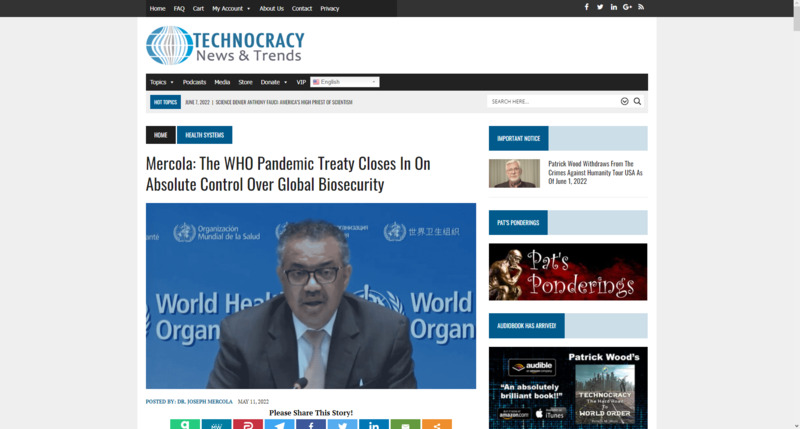
American alternative medicine proponent, Joseph Michael Mercola, stated that the World Health Organization (WHO) has started drafting a global pandemic treaty in preparation of a global takeover. in biosecurity. This treaty would grant WHO absolute power over digital identities, vaccine passports, mandatory vaccinations, travel restrictions, standardized medical care, and more. Although the World Health Organization does not currently have absolute authorization over international public health, Mercola argues that the agency is working with the United Nations to pass this treaty on June 16th and 17th so that they may seize absolute control over these entities in order to strip civilians of their basic rights and freedoms based on claims and statistics that seem to exaggerate the climate of the pandemic and its transmissions. As a reader, I am somewhat amused and concern with this information, not because I believe it to be true but because I know that it is heavily misguided. For starters, Mercola tries to persuade readers that the WHO "is not qualified to make global health decisions," but stressed how the agency is tied to international public health and has advocated the public health risk of COVID-19 throughout the whole entire pandemic. Secondly, "The Corbett Report" mentions that the treaty is not expected to be carried out until 2024 which is less urgent of a matter than what Mercola stated in his article (that he mentioned would transpire in mid-June of this year.) Finally, I do not feel that Mercola takes nations and state legislations into account of this treaty and proposal. Although the US federal government mandated the shutdown, it is still up to state legislators to decide the curfews and times the shutdown would commence. Therefore, I think this article, "The WHO Pandemic Treaty Closes in on Absolute Control over Global Biosecurity," offered more conspiracy than tangible evidence, being that this proposal has been drafted or commenced.
-
2020-03-10
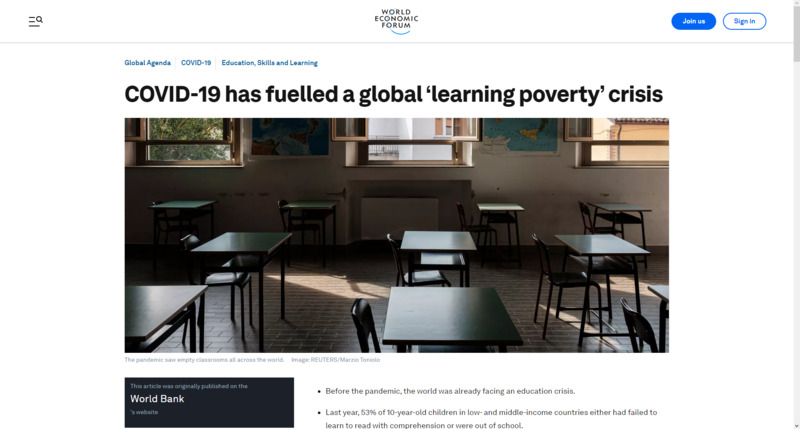
The Covid-19 pandemic affected me in numerous kinds of ways all trending to be negative. Most specifically the pandemic put a damper on my academic experience. When the pandemic spread to Michigan in March of 2020 and was highly infectious, learning in schools became extremely difficult for my classmates and me. Learning became online synchronous and the whole way of learning changed for everyone. For me, it was extremely difficult to adapt to completely online learning and instruction after being in classrooms for fifteen years of my life. After some time I was able to adapt and continue to be successful but for some of my classmates, the freedoms of online learning took a toll on their academic success. Luckily I stayed focused and put the task at hand to be the best student that I could possibly be. The rest of my high school experience was overwhelming and difficult as well due to the pandemic as the pandemic really never reduced during my time in high school. Regardless of the obstacles that I was faced with, I was able to persevere and place in the top thirty of my graduating class.
-
2021-03-01
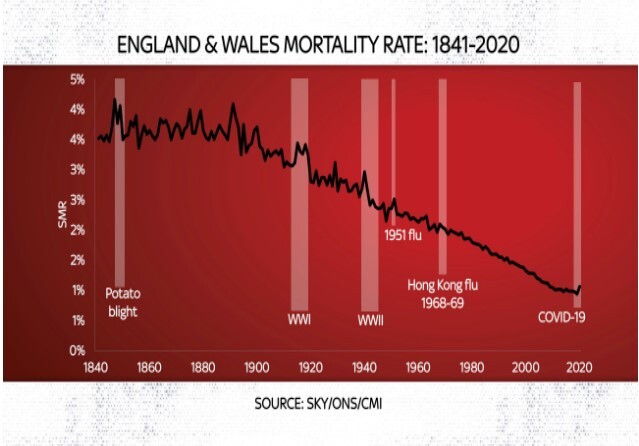
The attached image was used as evidence in an article for pandemic skeptics to make a "realistic risk assessment" of their danger during the COVID-19 pandemic in an article originally published in March 2021. The image utilizes only the mortality rate of England and Wales over the last century to visually "show" that COVID-19 is just a "blip" on the map. They are seemingly hinting through an image that this pandemic is fake news compared to world wars or influenza, using data to propagandize skepticism. What is misleading about this data is that they are using numbers of today against nearly one hundred years ago and are not contextualizing the numbers at all. At first glance one can see the overall mortality rate is going down. Of course, this is due to improved science, sanitization, water, and medicine over this time period. We must not also forget that this rate has gone down because the number of people in England and Wales, as in all life on our Earth, has increased. Like all math problems, the larger the denominator the small the rate. For example, if 100 people died out of a population of 1,000, the mortality rate is 10% (100/1000x100). But, if 100 people died in a population of 10,000, the mortality rate is only 1 percent (100/10000x100). Trying to compare numbers in a situation where the world population is much different and globalized, is not an equal comparison. I believe this is misleading persuasive propaganda that skeptics used to make COVID look like not a big deal. However, the risk factors have much more to do with your age, location, health history, interaction with other people, and how your surrounding areas respond to a pandemic, none of which is contextualized in this vague graph.
-

2022
826 National is a non-profit organization focused on helping students with their writing skills.
In this post, they highlight statistics related to teacher burnout and stress during the second year of the pandemic. One of the most alarming statistics is that 90% of teachers that participated say that teacher burnout is a serious issue. The pandemic has exacerbated the stress put on educators and they have received little support in return.
-
2022
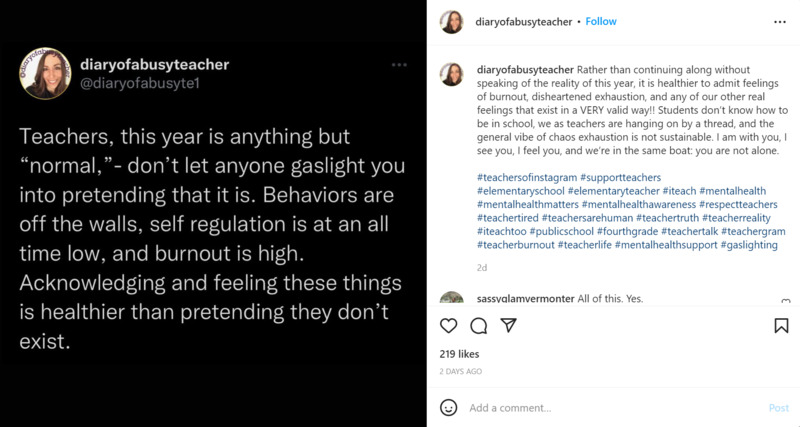
This post shows an example of teachers supporting each other through the end of the 2022 school year. In many different places, people are acting as if life is "normal" again. Schools are not requiring masks or sanitation procedures, school is in session like normal, in-person assemblies, activities, and sports are occurring. However, teachers can definitely tell that everything is not normal, and our job continues to be increasingly more difficult.
-
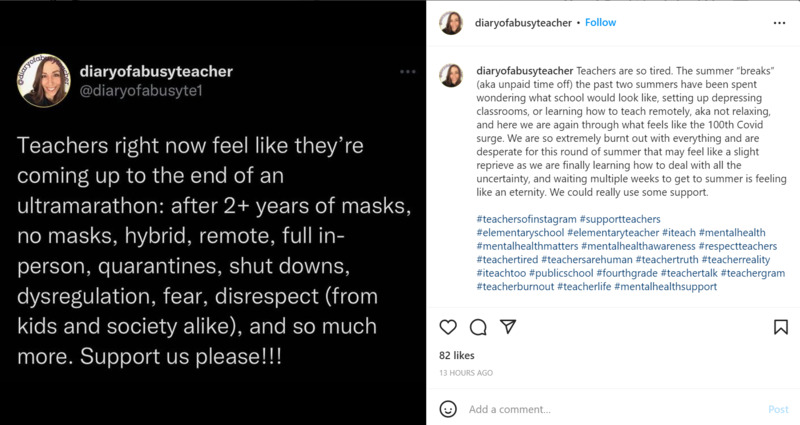
2022
Now that we are ending the 2022 school year, many people have "returned to normal". Most students no longer wear masks in schools. However, we are still working through the pandemic. Teachers are still at risk for contracting COVID and are navigating the severe behavioral problems of students. With summer approaching, everyone is looking forward to a break from an extremely stressful year.
-

2022-01-10
Even before the pandemic, many teachers have felt that they are underappreciated. During the pandemic, the number of responsibilities on teachers increased. They have been forced to teach during a health crisis, putting themselves at risk. When teachers are sick, the remaining teachers are forced to pick up the work without any empathy if they are not able to fulfill all obligations. The expectations have increased as teachers are also battling increasing behavior issues.
-
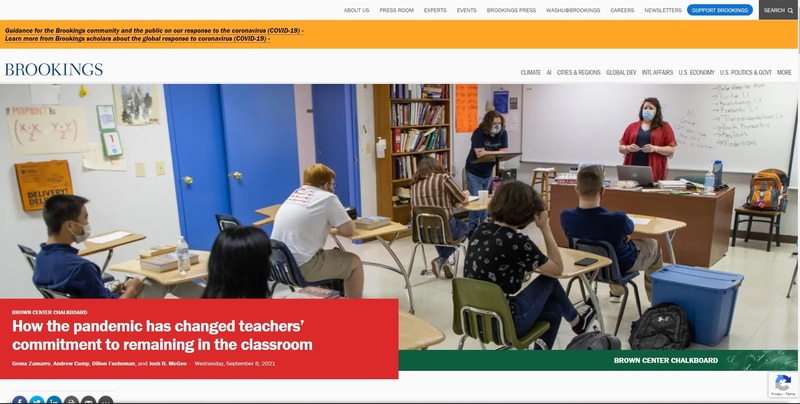
2021-09-08
According to the article, there was a 16% national turnover rate for teachers before the pandemic. A survey given in January 2021 shows that almost 25% of teachers stated that they wanted to leave teaching. Pre-pandemic surveys and surveys given during the pandemic also show that less teachers believe that they will stay in education until retirement.
The pandemic has required that teachers maintain the same responsibilities, while also piling on constant communication with parents (even without a response), social-emotional lessons, plans for asynchronous and synchronous learning, teaching students virtually and in-person at the same time, keeping up with changing health and safety regulations, and having to deal with increasing behavior issues.
-
2022-05-07
An ASU graduate student reflects on her career, school, and life throughout the COVID-19 pandemic and its aftermath.
-
2022-05-10
Anasitasia Viatele is from Kent, Washington. She recounts her life during the pandemic and the struggles she has faced during that time. She discusses her family in American Samoa and touches on their struggles as well.
-
2022-05-15
This is an interesting article I have found detailing 20 "facts" about the Covid-19 pandemic. This article largely attempts to refute the "overreaction" of the world when it came to the covid-19 pandemic. While criticism of conduct and policy is valuable and necessary for an open and clear discussion, attitudes of pandemic skeptics largely negate the vulnerable populations of the world and feed on the ignorance of the global population. This is one such article.
1. This article claims the lethality of covid is generally less than 1% of the population. While I seriously question that number, it still does not negate the extreme death seen by the world. The United States of America has roughly 331 million people living within their boarders. 1% of 331 million is still 3.31 million deaths. Is this a number in which it is appropriate to have an "it is what it is" attitude? Particularly when the people most impacted by the pandemic are those with health issues and the elderly? This attitude, which is shared by many skeptics borders on ageism and ableism.
2. This article claims that those most adversely impacted by covid are those over the age of 80 (78 in the US). But I ask again: is this a valid reason to not take the pandemic seriously? Are we supposed to let the elderly population simply waste away under the boot of covid?
3. This article claims that the covid-19 vaccine is ultimately ineffective in protecting against infection or transmission. The plain truth is that nothing is 100% effective. Seatbelts are not 100% effective in preventing deaths in the event of car accidents, so should we stop wearing them? Additionally, once the vaccines began rolling out, we have seen a decline in covid cases. Indeed, that is not to say vaccinated people don't get covid, I myself being one of them, but it has certainly made covid much more manageable, particularly on the already strapped healthcare industry.
4. This article claims that the vaccine can cause fatal reactions. As can the flu vaccine, or the polio vaccine, or any vaccine. It varies from person to person.
5. This article lays blame for increased mortality on the feet of covid lockdown procedure. I would simply say that correlation does not equal causation and I am certain the increased mortality rate can more accurately be attributed to the millions who have died from covid-19 across the globe.
6. This article mentions that in most cases, individuals were asymptomatic or only had mild to moderate symptoms and that obesity played a major part in whether or not symptoms were severe. While I doubt the validity of this, even so it does not negate the precautions the world took. Should asymptomatic people not take precautions and isolate? Should they be free to wander and infect those who could be vulnerable and perpetuate death? I feel this attitude, again, negates the vulnerable population.
7. This article claims that early treatment of the disease prevented hospitalizations. I feel this point negates the rapidity of covid's effect on people. Indeed, it also assumes that everyone has equal access to early-stage treatment.
8. This article claims that 10% of symptomatic people may experience long-term health related issues following covid. This appears to be about the only accurate point of this article, the only thing i question is the percentage of the population.
9. This article claims that the ability of transmission is very limited. This is very inaccurate, particularly when one looks at the extensive number of the population who received a positive test.
10. This article claims that masks had zero impact on limiting transmission. There are countless studies disproving this point. Often times this attitude is held by individuals who care only about their own comfort rather than the people around them.
11. This article claims that lockdown's were ineffective and only perpetuated economic issues across the globe. I think New Zealand is a prime example of why this is a moot point. New Zealand locked down early in the pandemic and did not have a single case of covid for nearly a year. It was only when their borders reopened that new Zealand began to experience covid.
12. This article claims that the impact of the virus on children is miniscule and that school lockdowns did nothing to help stop the spread. It is idiotic to think that children cannot contract covid. Indeed it is further selfish to not factor in teachers and staff and their health.
13. The article claims that PCR tests often returned false positives which artificially increased the number of cases. This is deeply inaccurate as there are numerous studies highlighting the effectiveness of PCR tests.
14. This article claims that contact tracing is ineffective and cites a WHO 2019 paper on influenza tracing. Contract tracing is valuable in informing the population that they have been exposed so that they may get tested and limit their contact with others to limit the spread, it is most certainly effective. As for the 2019 WHO paper on the ineffectiveness of contact tracing for the influenza: different disease, different way of managing it.
15. The article claims that vaccine passports are ineffective as the vaccine is ineffective and are used for tracking the population. Again, the vaccine has proven to be effective. And if the government wanted to track the population, it can be far more easily be done via phones and computers than via vaccinations.
16. This article claims that mutations of covid occur frequently and that new variants decline in lethality. While I agree that the virus mutates, I seriously doubt the decline in lethality. Indeed, I think because the virus can mutate so effectively, it is another justification in taking the pandemic seriously.
17. This article cites Sweden as a case where a full lockdown did not occur, a small number of deaths, and deaths being largely attributed to the elderly population. I think the primary effectiveness of Sweden this article cites is due to the Swedish taking the pandemic seriously, wearing masks, rapid vaccinations, social distancing, and not perpetuating misinformation.
18. This article claims that seasonal influenza largely disappeared during the pandemic and that covid has displaced it as the seasonal virus. Seasonal viruses aren't displaced. Indeed, the reason for the decline in flu cases is due to the population wearing masks and social distancing. Seasonal flu returned to pre-pandemic numbers in fall and winter 2021 when many of the covid protocols had been removed.
19. This article claims the media blew the pandemic out of proportion, spread fear, and distorted information. I disagree. It is the job of the media to make the population aware of global issues such as this. Indeed, the only distortion of facts that I found during the pandemic were from pandemic skeptics who were too selfish and uncomfortable to consider their fellow humans.
20. This article claims that the virus was lab-created. Whether or not the virus was lab-created is irrelevant. The point is: it exists, it is here, and it is vital that it be taken seriously.
-
2022-05-10
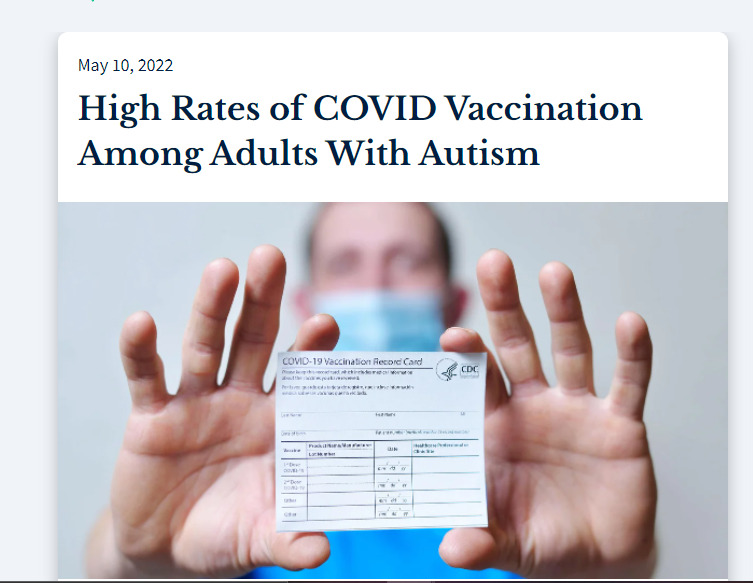
This is a news story from Health Day. Adults with autism have been shown to have higher rates of vaccination according to a new study. Those with autism are more at-risk for severe illness if they contract the disease, say researchers.
To get the data, researchers sent online surveys to 431 autistic adults in Pennsylvania. They showed that about 78% of survey respondents said they had received or intended to get a COVID-19 vaccine, and more than 55% said that they had received at least one dose.
In comparison, 42% of the overall adult population in Pennsylvania had received at least one dose of a COVID-19 vaccine as of the median response date for the survey (April 2, 2021), according to the study. The findings were published in the journal Vaccine.