-
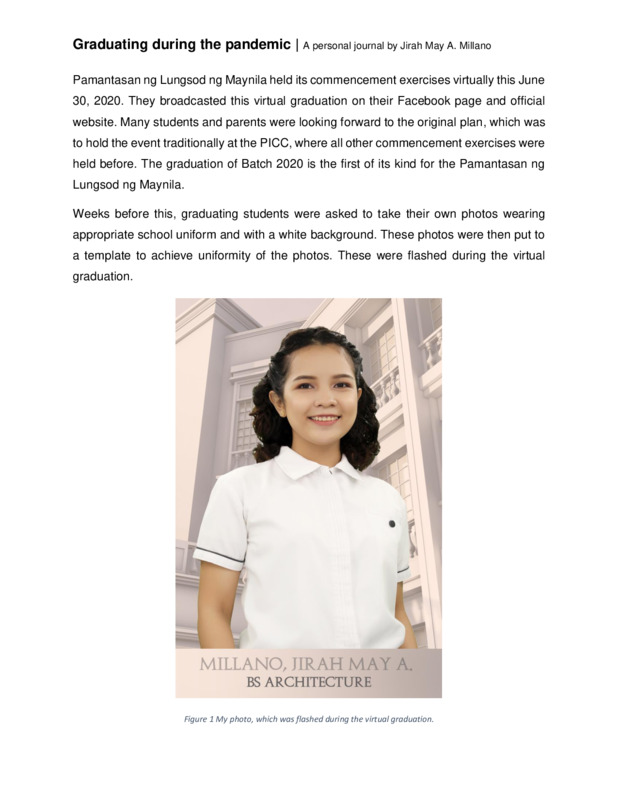
2020-07-12
This personal journal tells what is it like for me, graduating during the pandemic. With ways of celebrating this milestone totally changing, and with my mother having to work at the health center on that day, this virtual graduation experience was really different.
-
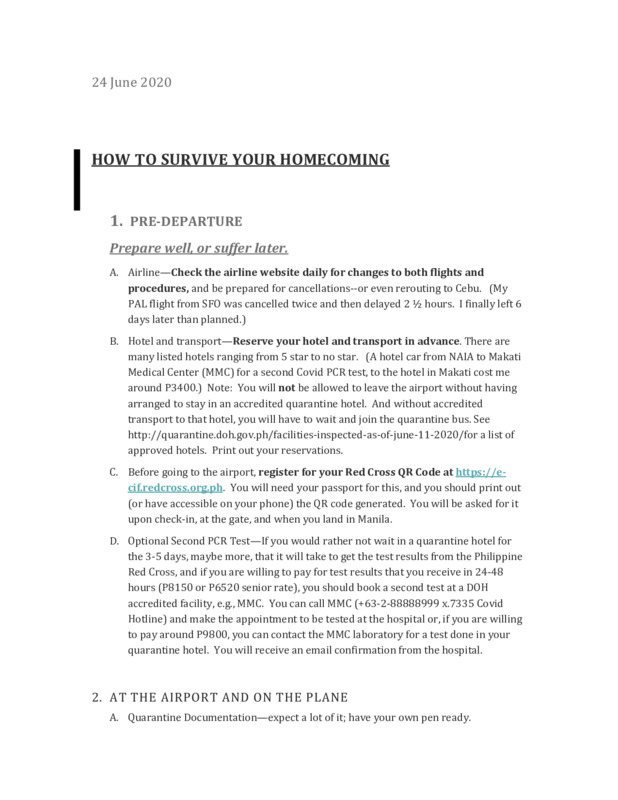
2020-07-20
The world practically shut down for 3 months, and we are just now beginning to learn how to travel within the harsh parameters set by Covid-19.
-
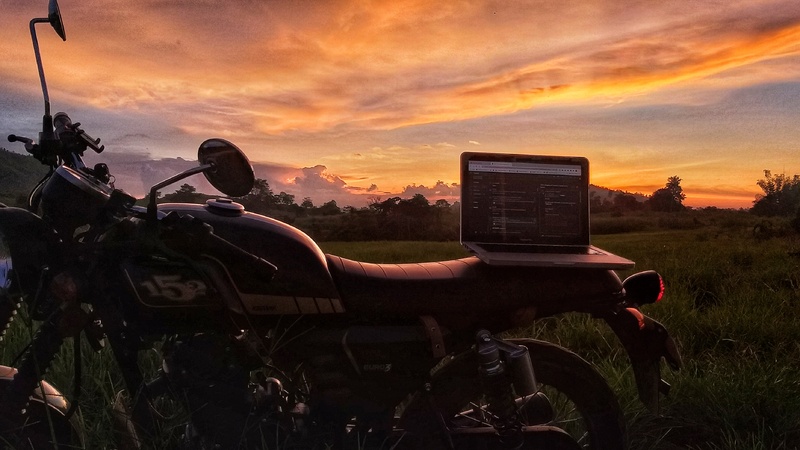
2020-07-02
Being in the province during the community quarantine is both an advantage and a challenge. Advantage that I was able to be with my family during the pandemic, moreover, being in an island and rural area in this kind of crisis lessens the possibilities of exposure to the virus. Also because of the abundance of natural resources, food supply was not as horror as to those who are in the urban areas. It was then a challenge if you are working far from your head office especially in the times of following the work from home system. Mobile network provider isn't always present in all areas. Unfortunately we are located at the place where barriers are abundant. The low land area and trees are just among them and not to mention the congestion of the users in the area where a tower can supply. In situations like this, creativity is the key to fulfill the commitments you promised to your work. With my motorcycle, I was able to go to the places where there is a stable signal for a certain period of time and locate another place depending on factors affecting move such as heat, wind, rain and time. Finally, it is a beautiful dishevelment when time is your enemy. It compensates all your effort to reach the places you think are impossible to walk by the wheels. These photos are just a few of the many creative stories crafted by this pandemic.
-
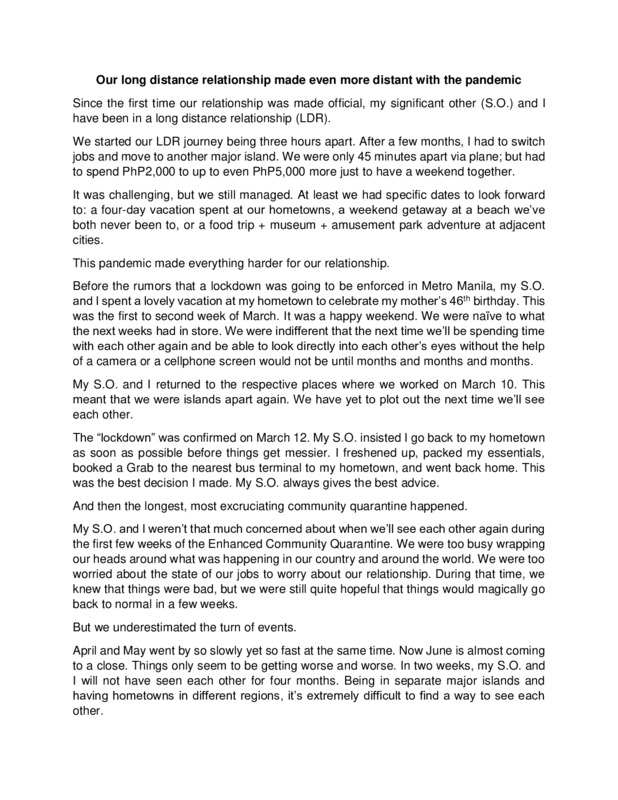
2020-07-04
The pandemic has made long-distance relationships even more difficult to maintain -- for lack of a better word. I'm sure a lot of other people in long-distance relationships will be able to [relate to] me and my S.O.'s story. I want these people to know that they are not alone in their struggle of longing for their loved ones; and that even if things seem very bleak right now, sometimes, the only thing we can do to feel better is to hope.
-

2020-07-08
It tells a story of how it is to live in the convent compare to the life I lived now with this pandemic.
-
2020-07-13
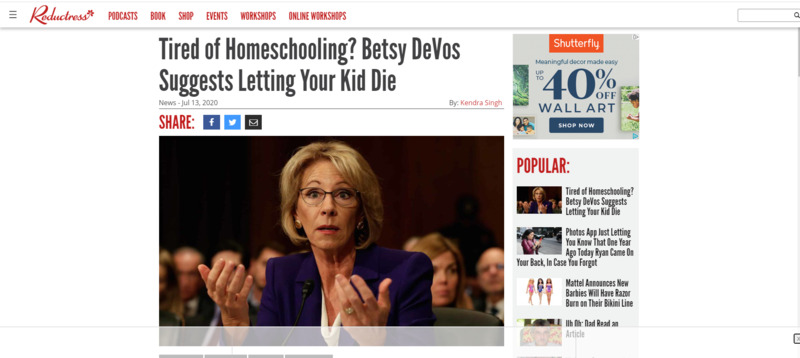
As the United States continues to experience record breaking numbers of new coronavirus cases, the Trump Administration is pushing for schools to reopen. Reductress, a feminist satire news website, offers a dark humor take on the push to reopen schools. In this satirical article, Secretary of Education Betsy DeVos is fictitiously quoted as saying "I don’t want you to think we’re going to lose all the kids, or that I don’t care about kids dying. I just think over 14,000 kids dying isn’t that big of a deal, and on the bright side that’s like 28,000 parents who no longer have to deal with homeschooling!” Relying on morbid humor, this article underscores the fear that reopening schools will lead to mass illness, hospitalization, and death.
-
2020-07-13
One problem the United States is facing during the pandemic is a fragmented health care system that is reliant on outdated technology, like the fax machine. This article goes into detail about why we are in this situation and the effects it is having on the nations response to the virus.
-
2020-07-14
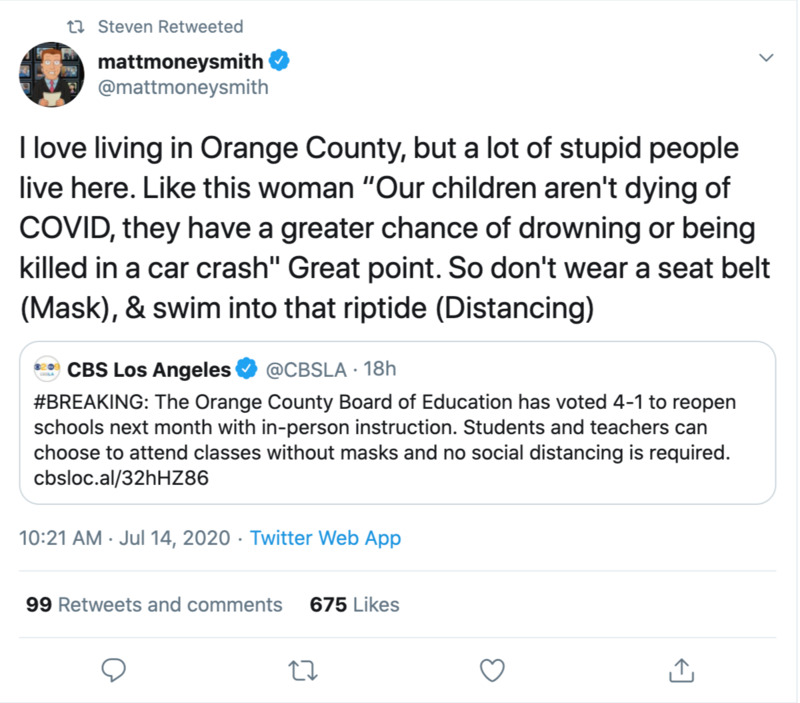
Orange County has been one of the cultural battlegrounds in the U.S. over all issues surrounding the coronavirus. As reopening the economy and the mask debate have somewhat receded, the next major issue is how schools will go about returning to classes in the Fall. Despite the existing health concerns, the school board voted to proceed with suggestions concerning health concerns, but no mandates.
This item was added TAGS v6.1.9.1. I originally searched under the hashtag #orangecounty. Within that search, I have chosen to add the following tweet because it highlights the public reaction to the ongoing debate on how to successfully get students back to school.
Link to the CBSLA article: (https://losangeles.cbslocal.com/2020/07/13/oc-school-board-classes-fall/)
-
05/27/2020
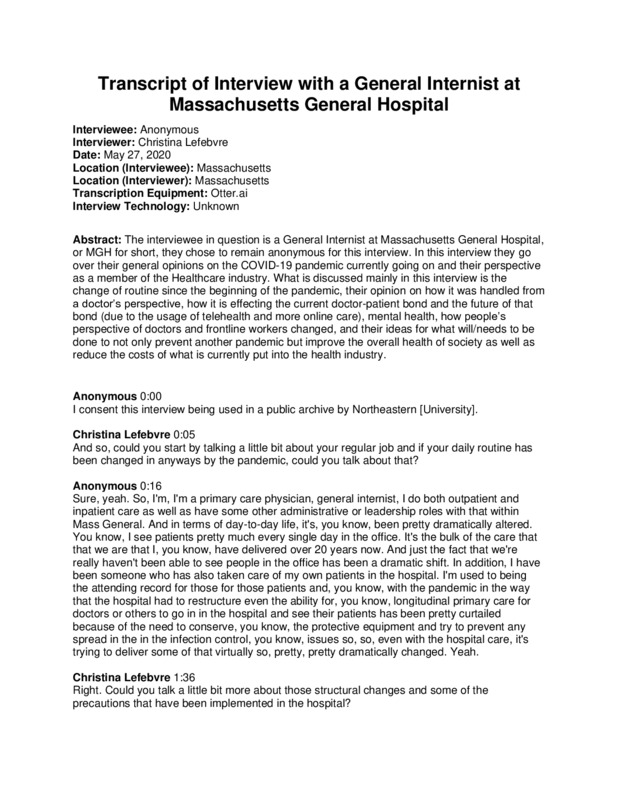
Christina Lefebvre interviews an anonymous general internist at Massachusetts General Hospital about their experience with COVID-19 and the global impact of the virus.
-
05/29/2020
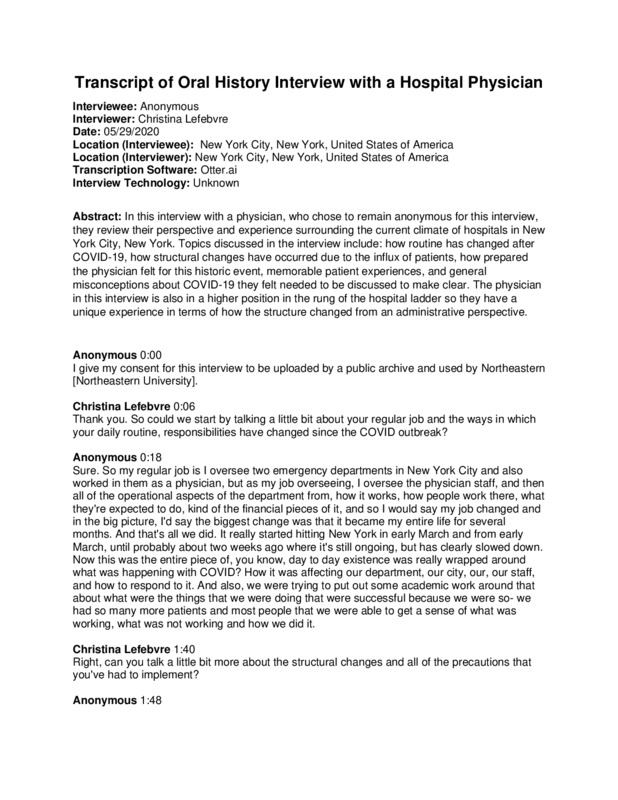
Christina Lefebvre interviews a physician from New York City about the city's response to COVID-19 and the impacts of the virus on the medical field.
-
05/27/2020
-
05/24/2020
An incomplete interview with Malesia. Malesia Lyles tells the story of the illness in her family from November 2019 through March 2020, and the steps she went through to get medical help. This involves themes of racism, homelessness, shelters, education, and children.
-
05/12/2020
An interview with a practicing physician in a hospital, discussing changes in protocols and practices due to the Covid 19 Pandemic.
-
05/23/2020
This interview is the fourth in a collection compiled by Glennda McGann for the COVID-19 Oral History Project
-
05/22/2020
University of Wisconsin Eau Claire Public History Seminar Covid-19 Project
-
05/22/2020
University of Wisconsin Eau Claire Public History Seminar Covid 19 Project
-
05/07/2020
This interview was part of the University of Wisconsin- Eau Claire Public History Seminar course and UWEC COVID-19 Archive Project led by Dr. Cheryl Jimenez Frei and Greg Kocken.
-
05/20/2020
Abigail interviews Dang Yang on the Covid-19 Pandemic and how it has affected Asian American students through his important role as the Director of the Office of Multicultural Affairs at The University of Wisconsin-Eau Claire.
-
05/15/2020
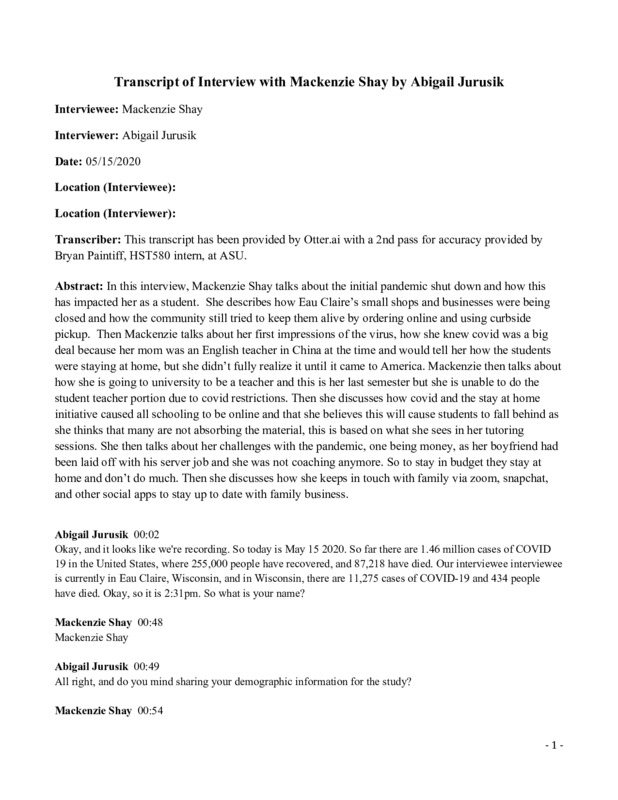
In this interview, Mackenzie Shay talks about the initial pandemic shut down and how this has impacted her as a student. She describes how Eau Claire’s small shops and businesses were being closed and how the community still tried to keep them alive by ordering online and using curbside pickup. Then Mackenzie talks about her first impressions of the virus, how she knew covid was a big deal because her mom was an English teacher in China at the time and would tell her how the students were staying at home, but she didn’t fully realize it until it came to America. Mackenzie then talks about how she is going to university to be a teacher and this is her last semester but she is unable to do the student teacher portion due to covid restrictions. Then she discusses how covid and the stay at home initiative caused all schooling to be online and that she believes this will cause students to fall behind as she thinks that many are not absorbing the material, this is based on what she sees in her tutoring sessions. She then talks about her challenges with the pandemic, one being money, as her boyfriend had been laid off with his server job and she was not coaching anymore. So to stay in budget they stay at home and don’t do much. Then she discusses how she keeps in touch with family via zoom, snapchat, and other social apps to stay up to date with family business.
-
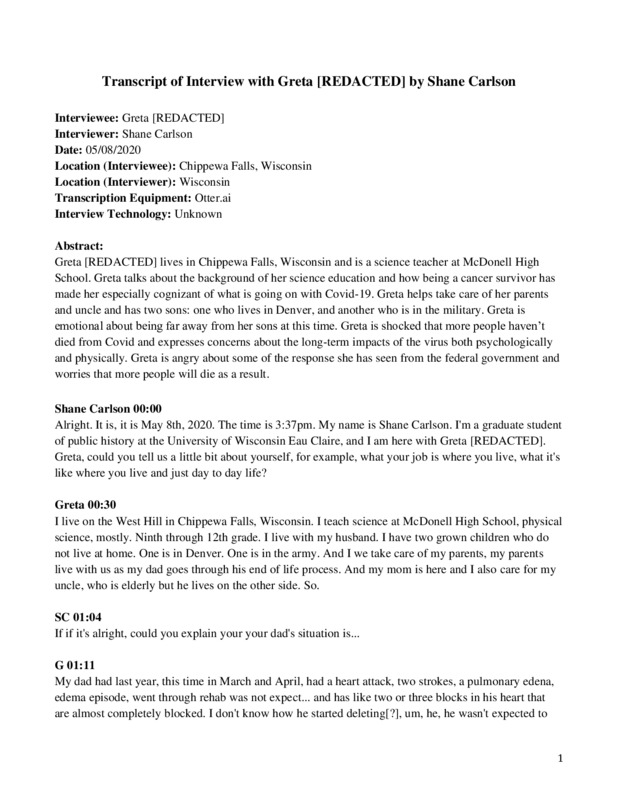
05/08/2020
-
05/14/2020
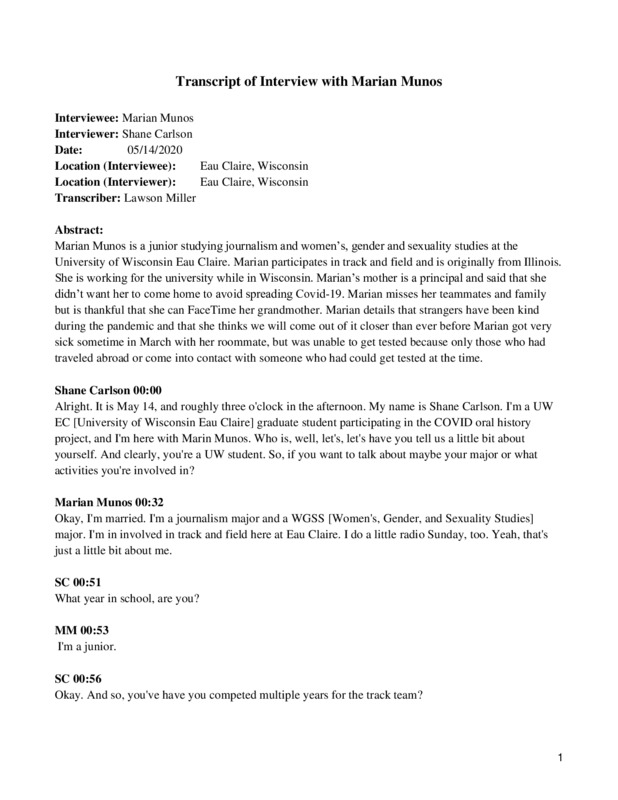
Marian Munos is a junior studying journalism and women’s, gender and sexuality studies at the University of Wisconsin Eau Claire. Marian participates in track and field and is originally from Illinois. She is working for the university while in Wisconsin. Marian’s mother is a principal and said that she didn’t want her to come home to avoid spreading Covid-19. Marian misses her teammates and family but is thankful that she can FaceTime her grandmother. Marian details that strangers have been kind during the pandemic and that she thinks we will come out of it closer than ever before Marian got very sick sometime in March with her roommate, but was unable to get tested because only those who had traveled abroad or come into contact with someone who had could get tested at the time.
-
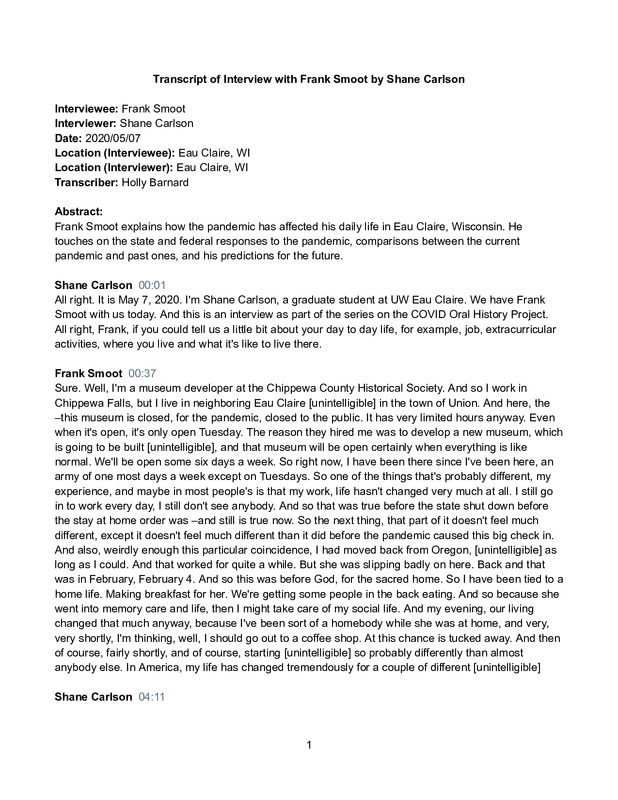
05/07/2020
-
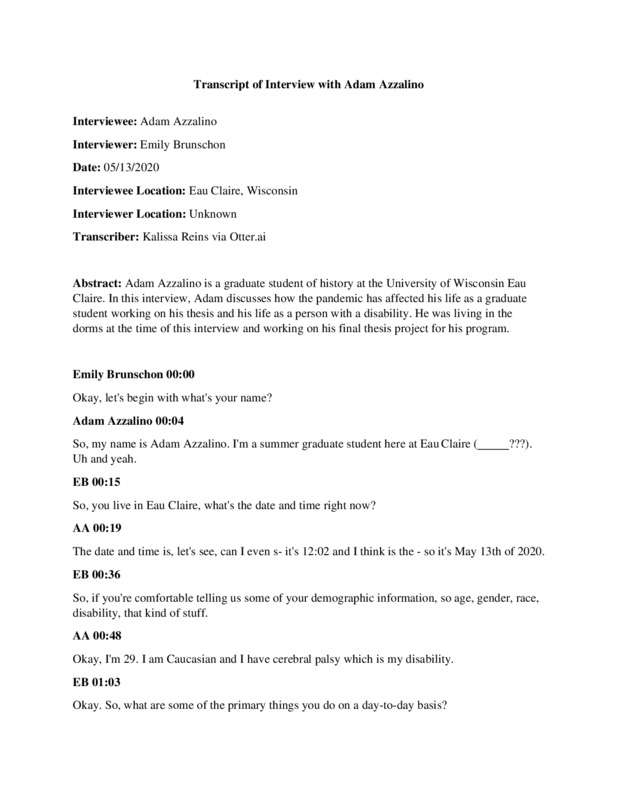
05/13/2020
Adam Azzalino is a graduate student of history at the University of Wisconsin Eau Claire. In this interview, Adam discusses how the pandemic has affected his life as a graduate student working on his thesis and his life as a person with a disability. He is living in the dorms at his university and working on his final thesis for his program.
-
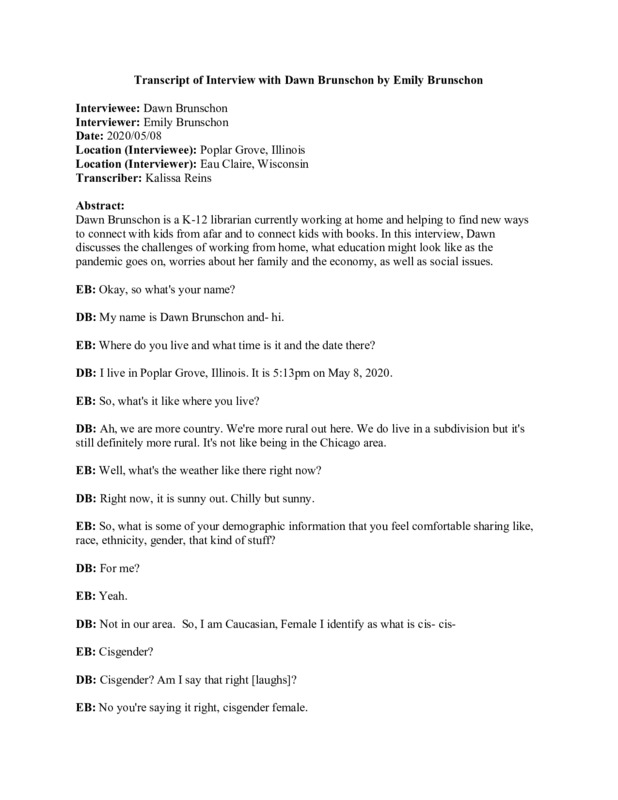
05/08/2020
Dawn Brunschon is a K-12 librarian currently working at home and helping to find new ways to connect with kids from afar and to connect kids with books. In this interview, Dawn discusses the challenges of working from home, what education might look like as the pandemic goes on, worries about her family and the economy, as well as social issues.
-
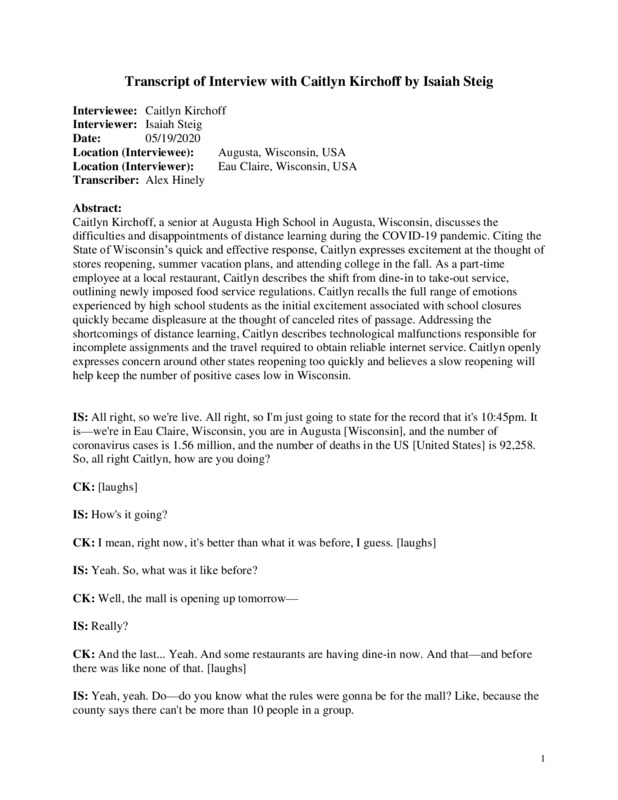
05/19/2020
Caitlyn Kirchoff, a senior at Augusta High School in Augusta, Wisconsin, discusses the difficulties and disappointments of distance learning during the COVID-19 pandemic. Citing the State of Wisconsin’s quick and effective response, Caitlyn expresses excitement at the thought of stores reopening, summer vacation plans, and attending college in the fall. As a part-time employee at a local restaurant, Caitlyn describes the shift from dine-in to take-out service, outlining newly imposed food service regulations. Caitlyn recalls the full range of emotions experienced by high school students as the initial excitement associated with school closures quickly became displeasure at the thought of canceled rites of passage. Addressing the shortcomings of distance learning, Caitlyn describes technological malfunctions responsible for incomplete assignments and the travel required to obtain reliable internet service. Caitlyn openly expresses concern around other states reopening too quickly and believes a slow reopening will help keep the number of positive cases low in Wisconsin.
-
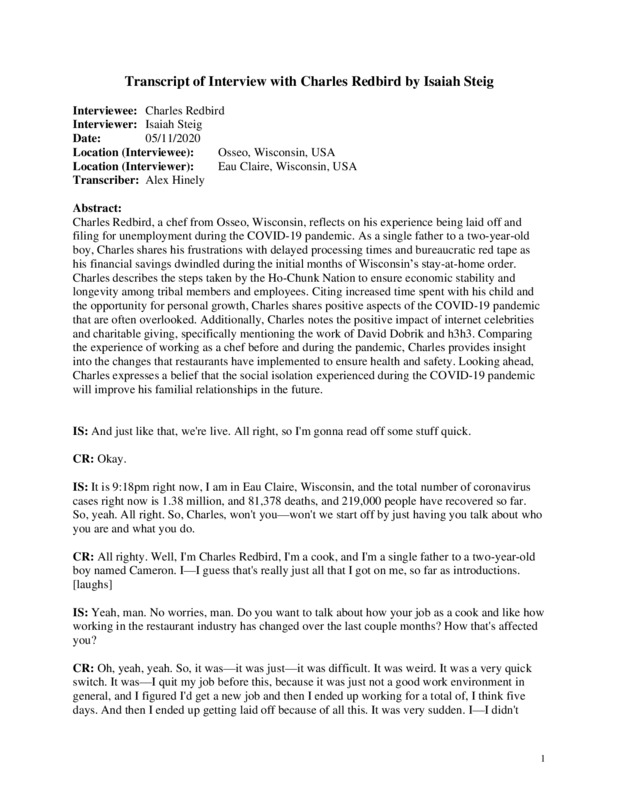
05/11/2020
Charles Redbird, a chef from Osseo, Wisconsin, reflects on his experience being laid off and filing for unemployment during the COVID-19 pandemic. As a single father to a two-year-old boy, Charles shares his frustrations with delayed processing times and bureaucratic red tape as his financial savings dwindled during the initial months of Wisconsin’s stay-at-home order. Charles describes the steps taken by the Ho-Chunk Nation to ensure economic stability and longevity among tribal members and employees. Citing increased time spent with his child and the opportunity for personal growth, Charles shares positive aspects of the COVID-19 pandemic that are often overlooked. Additionally, Charles notes the positive impact of internet celebrities and charitable giving, specifically mentioning the work of David Dobrik and h3h3. Comparing the experience of working as a chef before and during the pandemic, Charles provides insight into the changes that restaurants have implemented to ensure health and safety. Looking ahead, Charles expresses a belief that the social isolation experienced during the COVID-19 pandemic will improve his familial relationships in the future.
-
05/08/2020
Lisa Steig, a guidance counselor at Memorial High School in Eau Claire, Wisconsin, reflects on the social, economic, and political impacts of the COVID-19 pandemic. As students were required to learn from home, Lisa recalls the efforts made by local school districts to ensure access to adequate technology and educational resources. Lisa expresses concern with the shortcomings of the economic stimulus plan, sharing stories of local families in need of support. Turning to family life, Lisa shares the difficulties associated with having her mother-in-law located in an assisted living facility where physical contact with outsiders is prohibited and discusses the outlook for her daughter’s upcoming wedding. Lisa also discusses several articles and news pieces featuring positive stories of hope, encouragement, and support during challenging times, expressing her pride in the American spirit and gratitude for living in the United States of America. With great optimism, Lisa looks forward to finding a cure for the virus and returning to regular life once the pandemic is under control.
-
05/19/2020
Jeffery Scanlon edits and directs local news channel 18 WQOW in Eau Claire, Wisconsin. He thinks that some people in the US may have a lack of seriousness towards the pandemic. He elaborates on this by explaining how he sees people not social distancing and not wearing a mask. He then explains how Covid has affected his job working for a news channel as it’s all that they cover. He then expresses challenges of the pandemic, one being how his parents not being able to see his daughter as often, as they have underlying health conditions. He then describes how he plays video games to pass time as you are not able to go out and do things. He then brings up a frustration of people posting conspiracy information about the pandemic on social media and spreading misinformation. His job is his main source of news. Jeffery believes that his local government handled initial outbreak well, but may be opening up prematurely and specified “no comment” on how the federal government handled the situation. He then ends with that mask wear in public should not be a political statement, instead people should be wearing them to protect their health and the health of the people around them.
-

05/11/2020
The interviewee, Nate Hayner, describes his experience moving from his apartment in New York City to his parent’s house in Wisconsin. Initially, Nate believed covid was going to be like SARS and other virus outbreaks and only affect countries overseas, then he saw firsthand how bad it got New York City and moved out. He tells of how him and his parents took it seriously as he quarantined for two weeks in their basement. Next, Nate says that his biggest concern is that the pandemic appears to be driving a wedge in society. He elaborates on this by telling how he got tired of watching the news as it was so absurd and frustrating the inaccurate things they would report. Additionally, he expressed his concern on how people were believing in conspiracy theories and not following safety recommendations from local governments and spreading inaccurate information on social media. Then Nate describes how Covid made it hard to stay in contact with casual friends but easier to contact good friends via technology. He also explained how isolation being hard for extroverts and people who are not able to work and do not have a emergency fund to fall back on. Nate ends the interview by stating how the government should have taken planning for events like this more seriously and that in the future we need to be more prepared, the government should stockpile PPE and medicine and people should have a food stockpile and emergency fund as he feels we will probably see another pandemic in our lifetime.
-
05/06/2020
Chippewa Valley COVID-19 Archive
-
05/02/2020
This is an oral history interview conducted with a RN during the Covid-19 Pandemic.
-
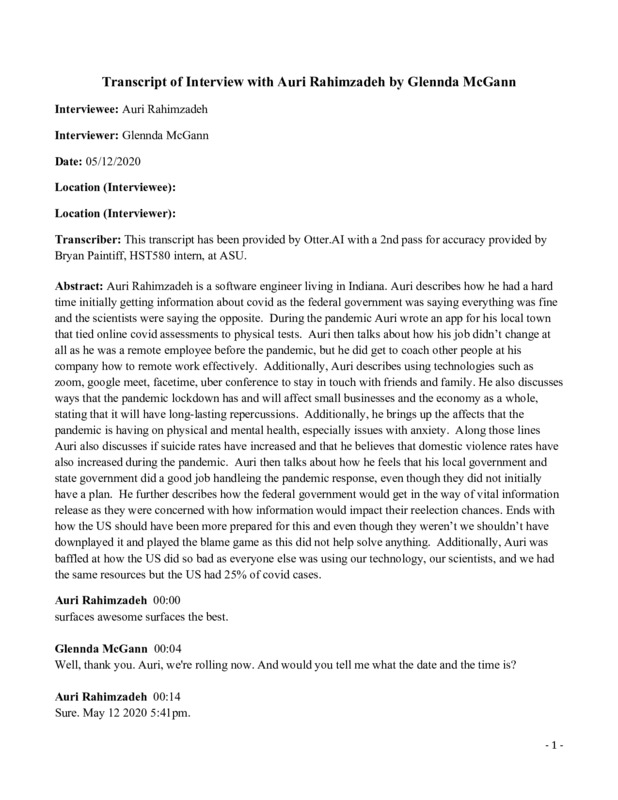
05/12/2020
This is the second interview in a collection by Glennda McGann
-
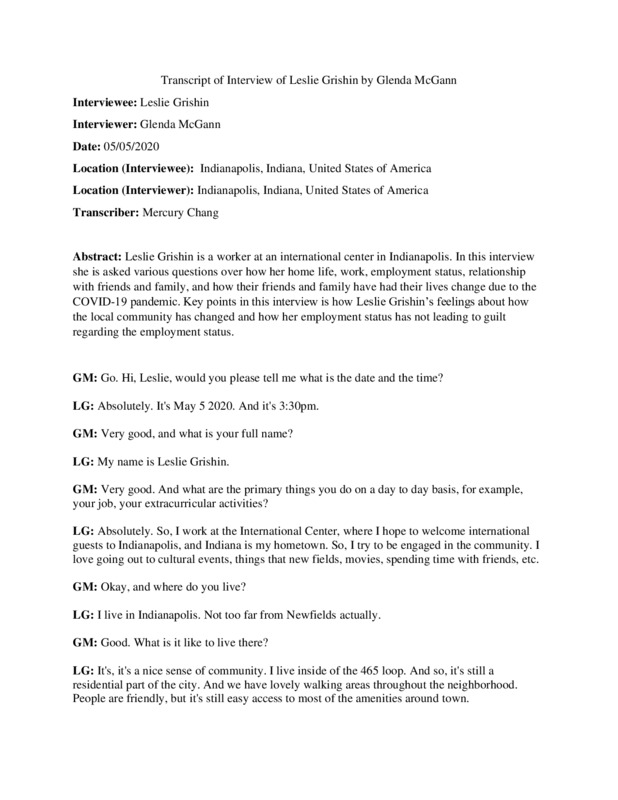
05/05/2020
This interview is part of a collection compiled by Glennda McGann for the COVID-19 Oral History Project
-
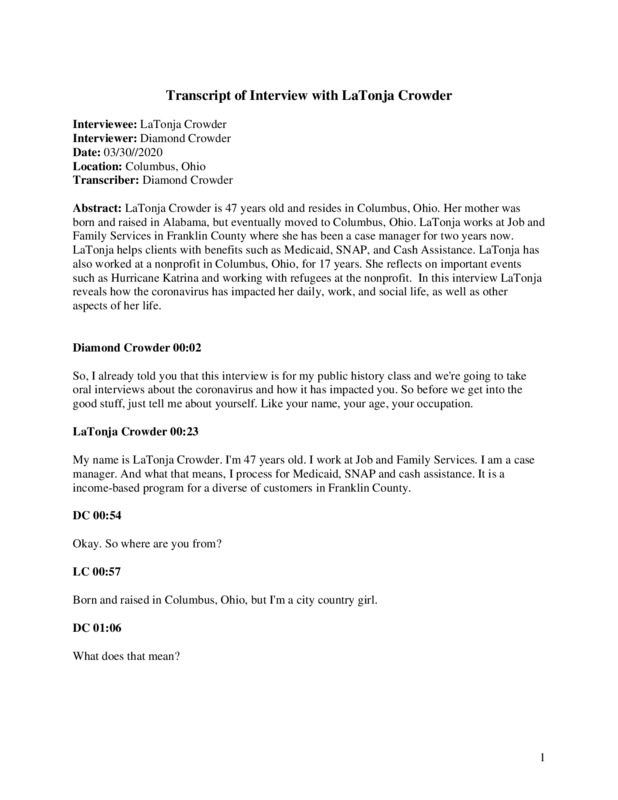
03/30/2020
Description from the interviewer: LaTonja Crowder reveals how the coronavirus pandemic has impacted society and her day-to-day life. The interview also reflects how LaTonja witnessed other catastrophic events such as Hurricane Katrina and refugees migrating to Columbus.
Subject Heading(s): Family Life, Food & Drink, Social Issues, Business & Industry
Tags: Non-Profit, Walmart, Hurricane Katrina
This submission is in partial fulfillment of course requirements for Dr. Rebecca Wingo at the University of Cincinnati.
-
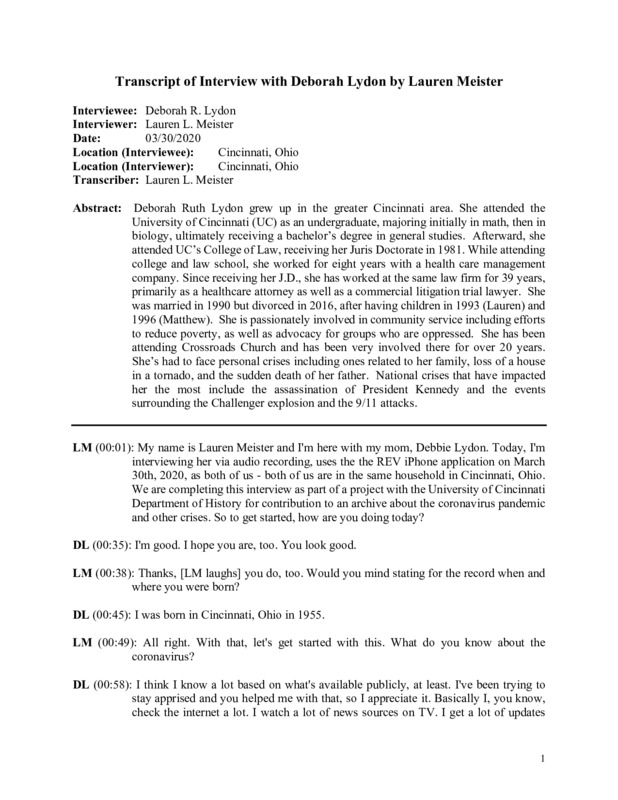
03/30/2020
Title: Interview with Deborah Lydon by Lauren Meister Creator: Deborah Lydon and Lauren Meister
Date: 03/30/2020
Description: This interview from Deborah Lydon highlights the response to the coronavirus (or COVID-19) pandemic within the context of the Midwest. Her insight as a healthcare lawyer with a background in biology gives a different perspective to her evaluation of the situation compared to someone in a different field of study. This interview was conducted during the second week of required social distancing as required by Mike Dewine, the Governor of Ohio.
-
03/21/2020
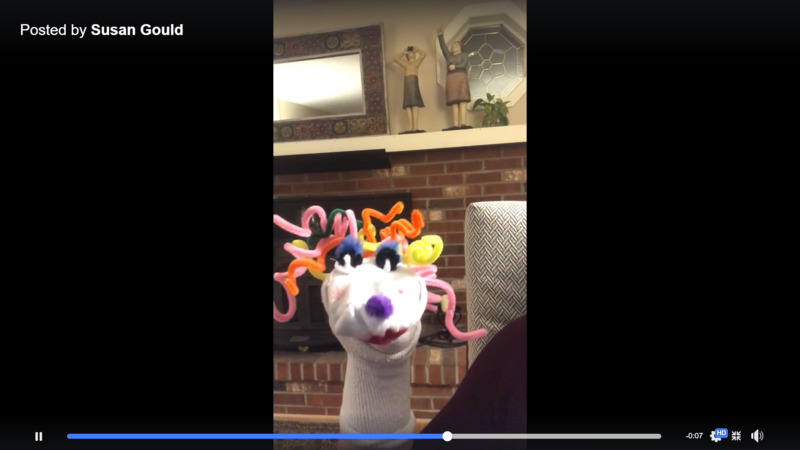
Susan Gould describes her preparations for COVID-19 and what everyday life is like in a state mandated lockdown. She also explains how her employer, Menorah Park, a nursing home located in the epicenter of Ohio’s Covid-19 outbreak responded to the pandemic.
-
03/30/2020
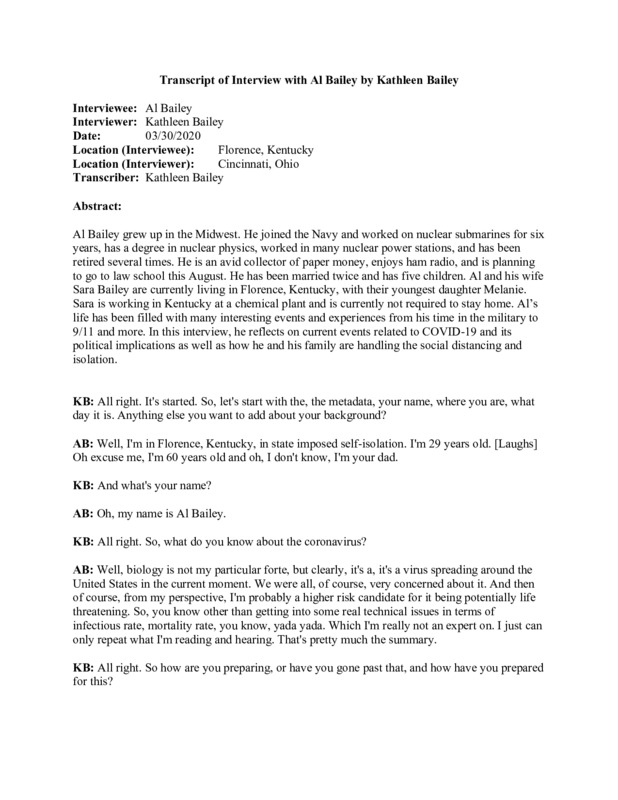
Al Bailey grew up in the Midwest. He joined the Navy and worked on nuclear submarines for six years, has a degree in nuclear physics, worked in many nuclear power stations, and has been retired several times. He is an avid collector of paper money, enjoys ham radio, and is planning to go to law school this August. He has been married twice and has five children. Al and his wife Sara Bailey are currently living in Florence, Kentucky, with their youngest daughter Melanie.
Sara is working in Kentucky at a chemical plant and is currently not required to stay home. Al’s life has been filled with many interesting events and experiences from his time in the military to 9/11 and more. In this interview, he reflects on current events related to COVID-19 and its political implications as well as how he and his family are handling the social distancing and isolation.
-
3/22/2020
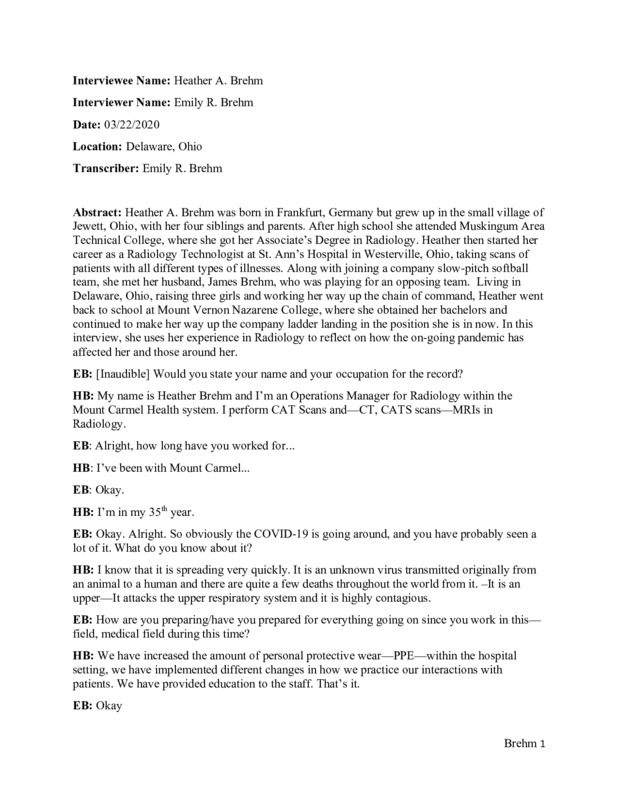
This was for Dr. Wingo's Public History Practicum class at the University of Cincinnati to contribute to the COVI-19 online archive.
-
04/01/2020
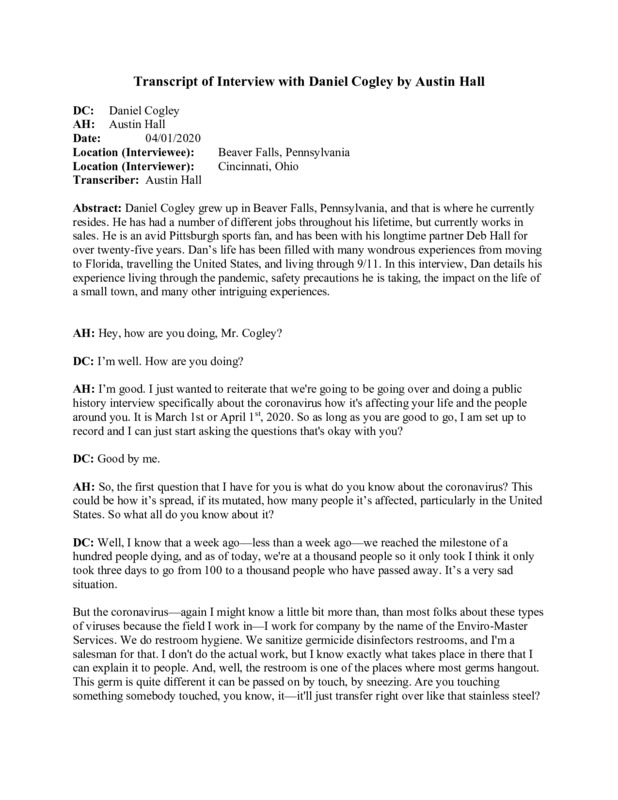
Daniel Cogley discusses his experience with the COVID-19 pandemic. Daniel is a salesman for a sanitization company that provides products and services to primarily restaurants and bars. Daniel was furloughed during the crisis and discusses his experiences with money, food, the response of government officials to the pandemic and his hopes that people will take the disease more seriously.
-
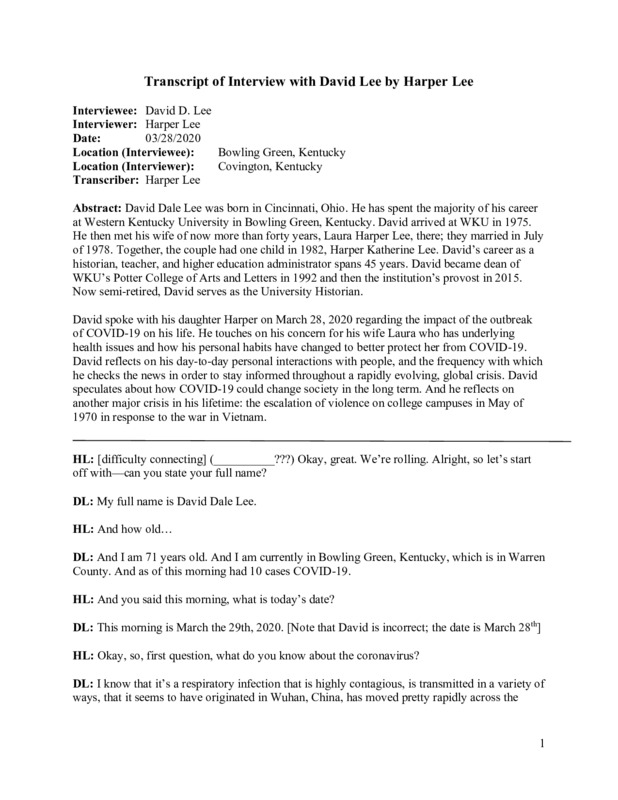
03/28/2020
David Dale Lee spoke with his daughter Harper Lee on March 28, 2020, regarding the impact of the outbreak of COVID-19 on his professional and personal life.
David is a semi-retired professor of history at Western Kentucky University in Bowling
Green, Kentucky. David primarily discusses the impact of the pandemic on his teaching
and research projects, but he also touches on changes to personal life, particularly
shopping and connecting with friends via Zoom. David also reflects on other crises that
have shaped his life.
-
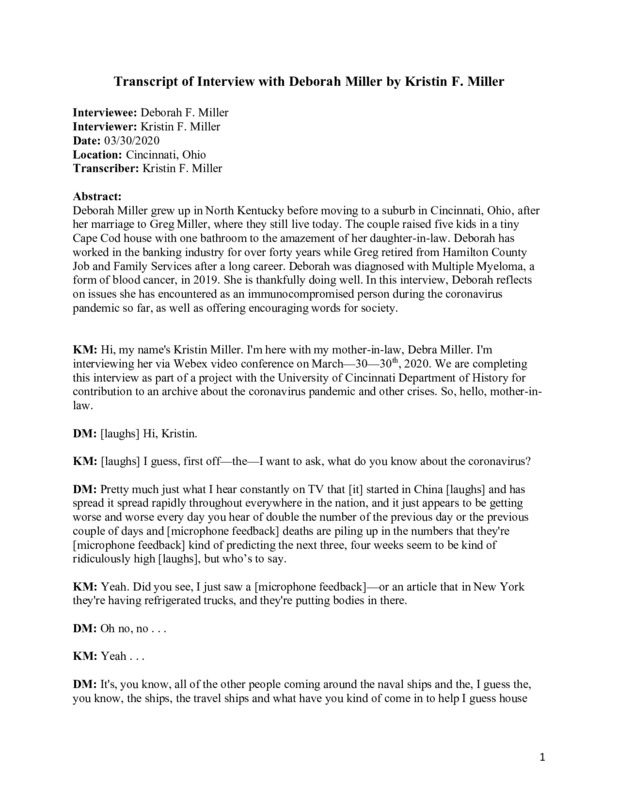
03/30/2020
Title: Interview with Deborah Miller by Kristin F. Miller
Creator: Deborah Miller and Kristin F. Miller
[the following was added by the transcriber and curator of this item]
Deborah Miller, long time resident of the northern Kentucky, Cincinnati area discusses her knowledge of the Coronavirus pandemic and how she feels being immune compromised herself due to recently undergoing treatment for cancer. For this reason, she was happy to be told to work from home at the end of March and talks about social distancing, masks, and cleaning at the office. She does not see society undergoing long term change as a result of the pandemic.
Date: Interview Date – 03/30/2020
Description: Deborah is a tri-state area native born in Northern Kentucky and currently residing in Cincinnati, Ohio. Deborah was diagnosed with multiple myeloma, a form of blood cancer, in 2019. In this interview, Deborah reflects on issues she has encountered as an immunocompromised person during the coronavirus pandemic so far, as well as offering encouraging words for society.
Type: Oral History
Geography: Location – Cincinnati, Ohio
Additional Information:
This submission is in partial fulfillment of course requirements for Dr. Rebecca Wingo at the University of Cincinnati. Additional metadata fields include:
Interviewer: Kristin F. Miller
Interviewee: Deborah Miller
Duration: Sixteen minutes and fifty-nine seconds
Subject Headings: Illness, Work-From-Home, Family Life
Tags: shopping, grocery, toilet paper, work, good deeds, helping, Contagion, change, Vietnam, relationships
-
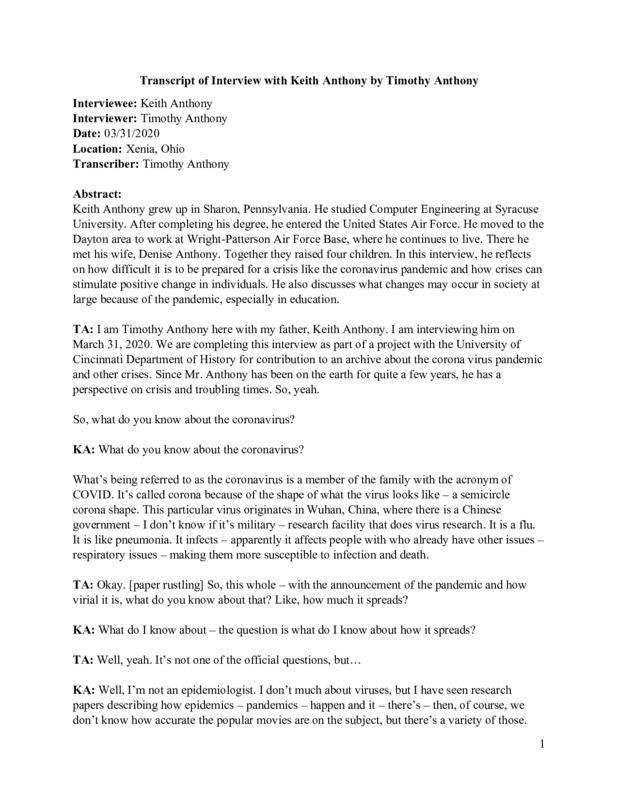
3/31/2020
This interview discusses the experience of Keith Anthony during the COVID-19 pandemic in 2020. The interviewee discusses how the pandemic impacted his personal life as he reflects on the pandemic’s larger impact. He also speculates on how society will look moving forward.
-
2020-05-20
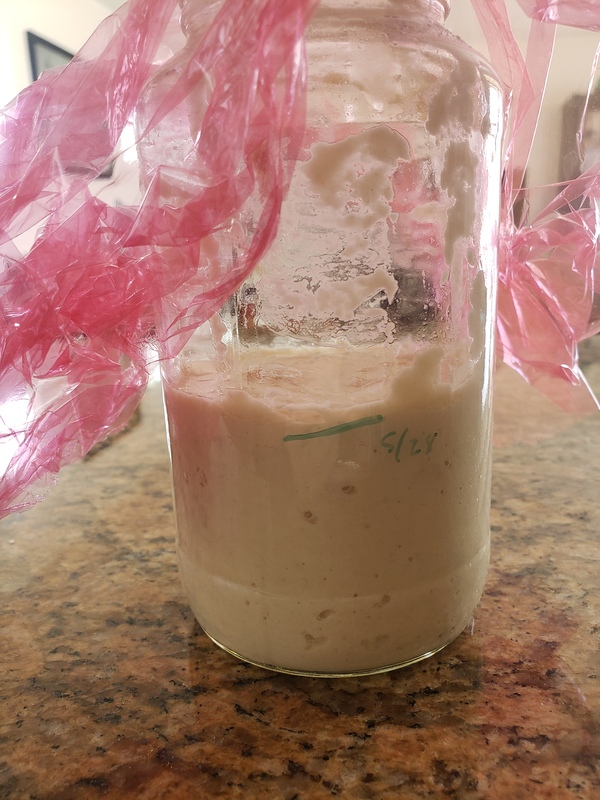
I decided to start making a sourdough starter a couple months into quarantine like just about everyone else. I had a fairly large stockpile of flour in my cupboards because I bake fairly often, so I didn't have to worry about dwindling supply at the supermarket too much. My grandma taught me how to bake from a pretty young age, and my mom made bread with an electric bread maker for years, but I'd never attempted my own loaf without a bread maker, let alone a sourdough starter. A starter always seemed like something out of reach and far too difficult for an inexperienced bread maker, but with armed with encouragement and tips from some friends via Discord, I set out to make my own. These are photos of my process, from my beginning mixture of flour and water to my first sourdough loaf (and my starter's permanent 'home'). I'm fairly proud of it. It took me about 2 weeks to get the starter to really start; I'm guessing in part because I only had all-purpose flour and not the suggested rye flour. There was a lot of troubleshooting involved before it really started to mature. It's been an interesting process, and I'm really glad I tried it. Starters are far more resilient than I had previous believed, and the bread is fantastic. It's been a somewhat calming respite from everything, even though I feel fairly selfish giving myself that with everything that's happening.
-
2020-07-12
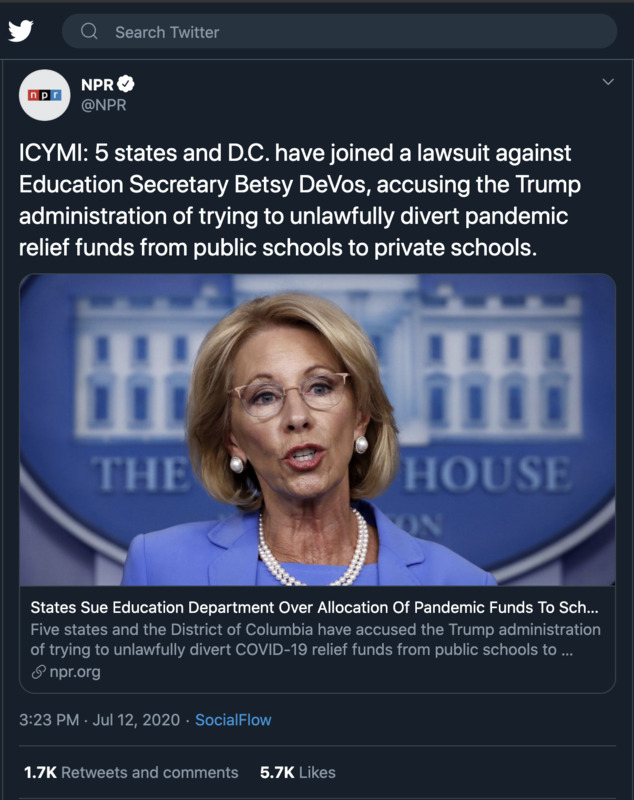
As a teacher, I am concerned about having to go back into the classroom. I have preexisting conditions, live with at risk individuals, and don't want to die. While I know that private schools tend to be better funded than public schools, I was shocked and confused as to why the government would choose to prioritize institutions that are able to support themselves better in these trying times.
This item was added TAGS v6.1.9.1. I originally searched under the hashtag #schools. Within that search, I have chosen to add the following tweet because it discusses the opening salvos in an ongoing battle between States and Individuals vs the Federal Government over the allocation of relief funds.
Link to the NPR article: (https://www.npr.org/sections/coronavirus-live-updates/2020/07/07/888793021/states-sue-education-department-over-allocation-of-pandemic-funds-to-schools?utm_campaign=npr&utm_source=twitter.com&utm_term=nprnews&utm_medium=social)
-
2020-07-12
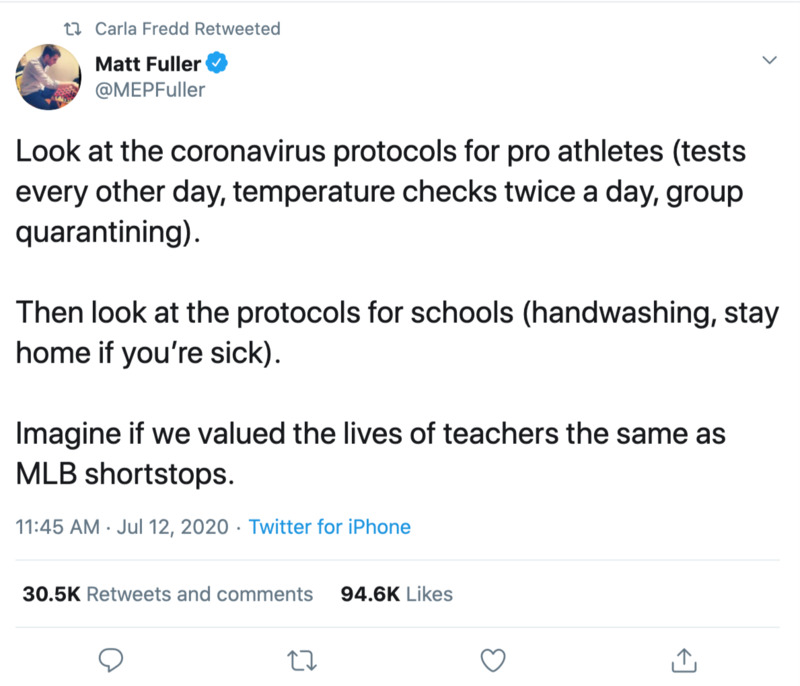
When the schools originally shut down back in March, professional sports league were quick to follow congruently. Distance learning doesn't necessarily carry over to sports. As Summer reaches its height, everyone is itching to return to school and get sports back on as quickly as possible. What this looks like is playing out differently in various job spheres.
This item was added TAGS v6.1.9.1. I originally searched under the hashtag #schools. Within that search, I have chosen to add the following tweet because it highlights the priority levels in the United States for different types of workers.
-

2020-07-12
Screaming is not allowed on Japanese roller coasters in order to slow the spread of the coronavirus. The instructions to riders are "Scream in your heart" instead. Then they attached a video of two solemn-faced men taking a "fun" ride on the roller coaster. They wear masks and don't crack a smile or show any emotion at all. Yet this is the example visitors are supposed to follow.
(I edited the video down to about half its original length.)
-
2020-07-03
"True Talk in Ten" is podcast about climbing out of 2020 with hope, gratitude, and authenticity. Judy shares interviews, stories, books, music, and mindful ways to approach the hard truths about our past, present, and future in the era of Covid-19 and Black Lives Matter. Judy Brewster is a 30 year educator and is currently an Elementary School Principal in Westchester County, NY. She is also a performing artist and community theater junkie. Give her 10 minutes, and she'll give you something to ponder in your classroom, at the office, in the green room, or around the fire pit! Stories are posted weekly.
-
2020-04-14
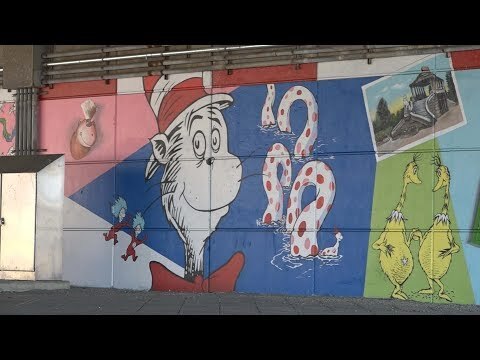
Video produced by WGBY discussing museums throughout Massachusetts as they transition to a digital environment. The video highlights commemorations of Dr. Seuss, including programs at the Springfield Museum, as well as other programming at the Eric Carle Museum and the Institute of Contemporary Art/Boston. The video highlights the thoughts of museum staff as they transition to an online environment, and shows some of the approaches that different cultural heritage sites are undertaking to continue engaging with their audiences.
-
2020-05-13
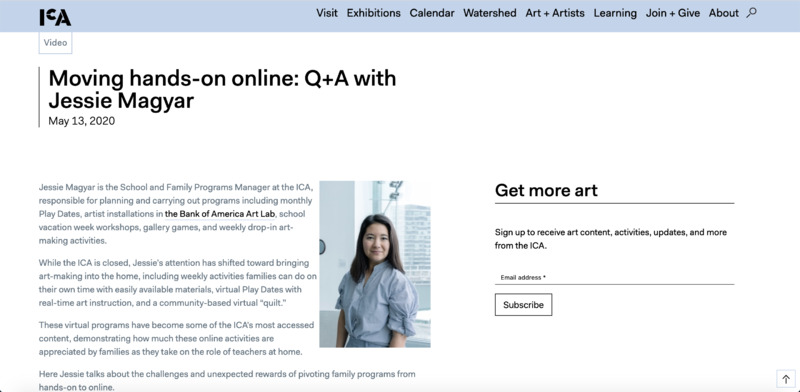
Online Question and Answers session done with the School and Family Programs Manager at the Institute of Contemporary Art in Boston. The piece reflects on the Virtual Quilt Project, as well as the experiences of being an arts and cultural heritage professional during the CoVid-19 pandemic. This object highlights how museums have been forced to change their practices in response to the pandemic, and the unexpected benefits from some of those changes at the Institute of Contemporary Art.
-
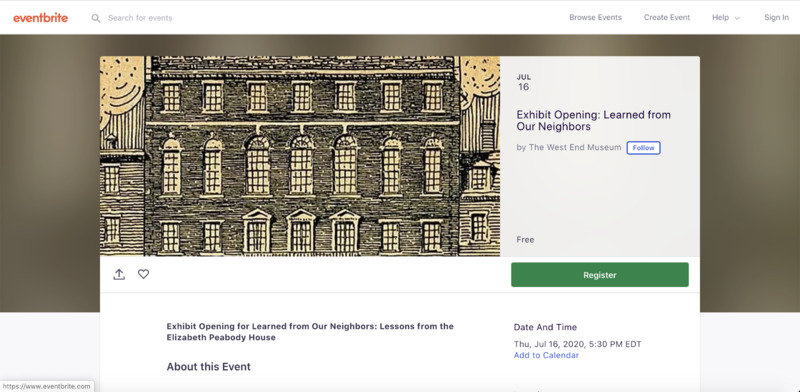
2020-07
Eventbrite webpage for the virtual exhibit opening of Learned from Our Neighbors: Lessons from the Elizabeth Peabody House, which is housed at the West End Museum in Boston. The page lists what the event will include and how the exhibition was created. This object highlights how museums are attempting to engage with their audiences during social distancing, including community cultural heritage institutions.