-
12/17/2020
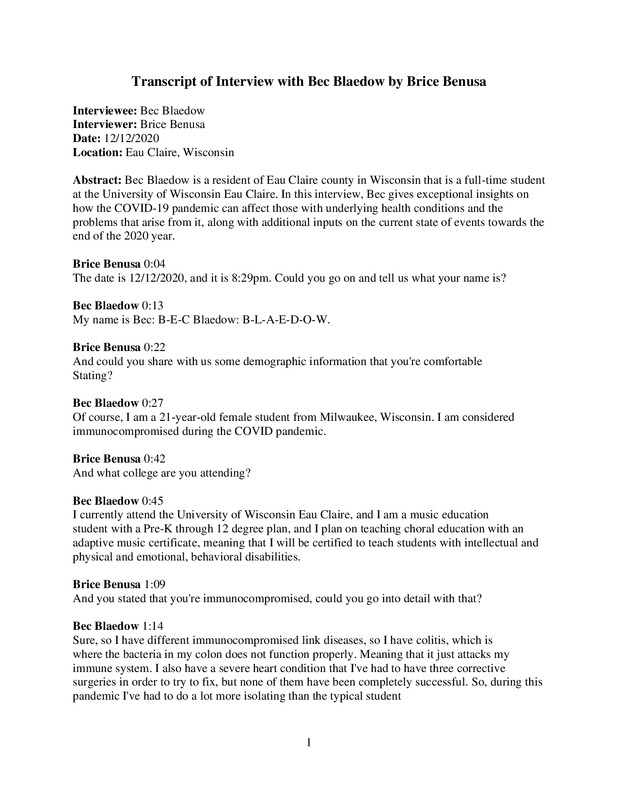
Bec Blaedow is a resident of Eau Claire county in Wisconsin that is a full-time student
at the University of Wisconsin Eau Claire. In this interview, Bec gives exceptional insights on how the COVID-19 pandemic can affect those with underlying health conditions and the problems that arise from it, along with additional inputs on the current state of events towards the end of the 2020 year.
-
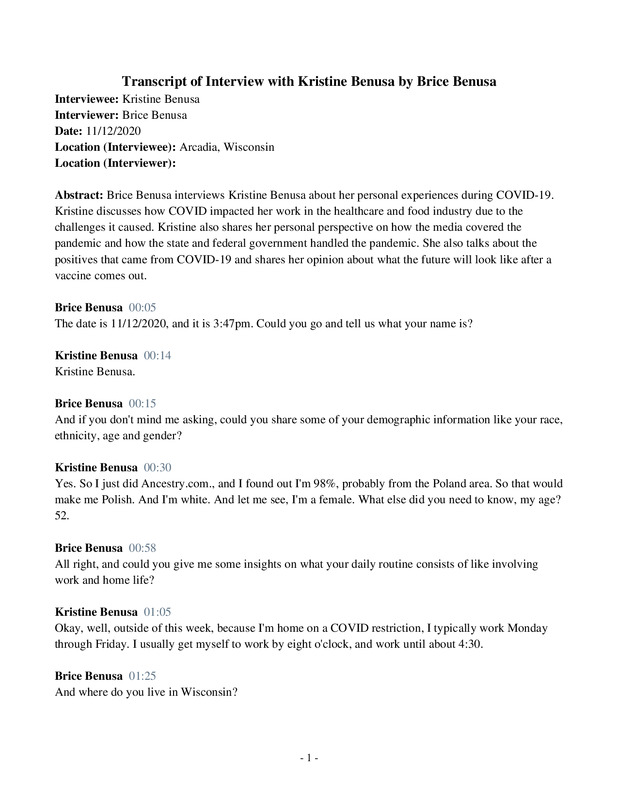
11/12/2020
-
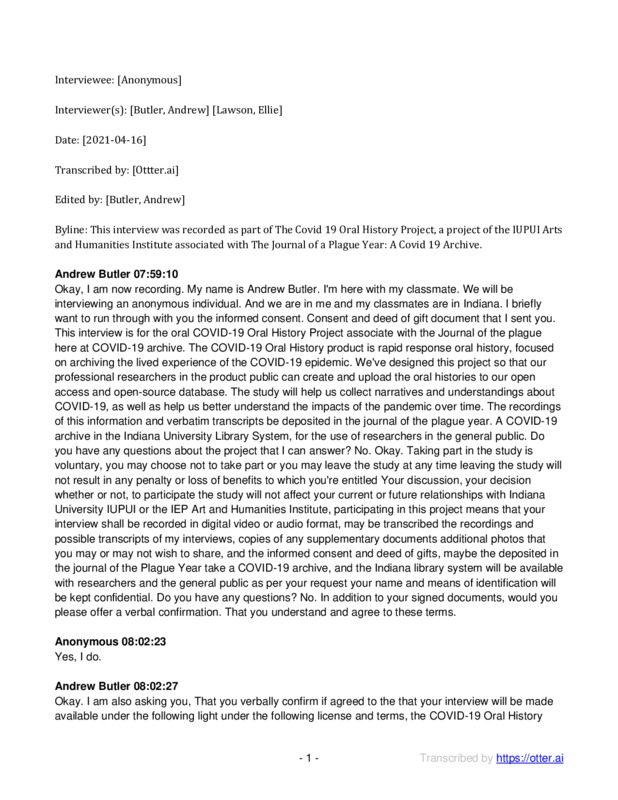
04/30/2021
C19OH
-
04/22/2021
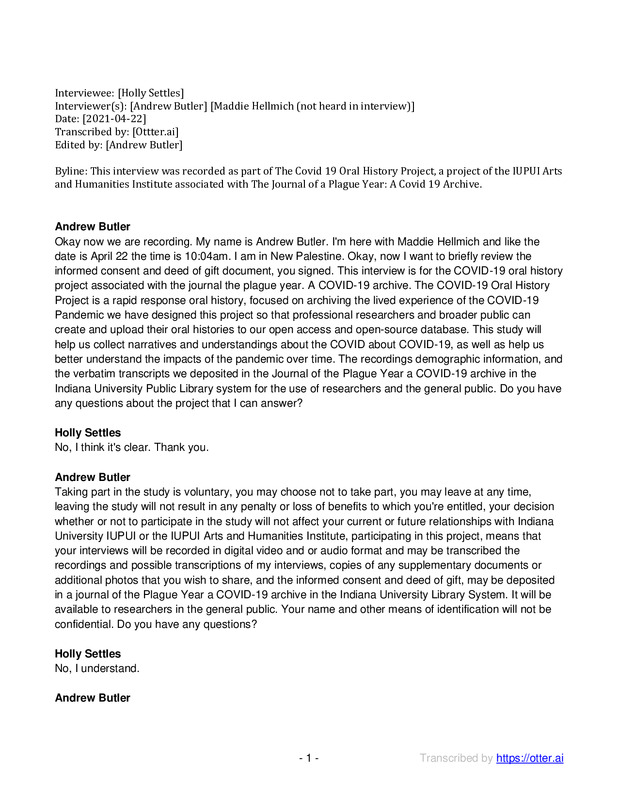
Andrew Butler conducts this interview Holly Settles, on April 22 at 10:04am. This is a part of the Covid 19 parject by Indiana University–Purdue University Indianapolis. This oral history interview discusses their experience through the covid 19 pandemic.
-
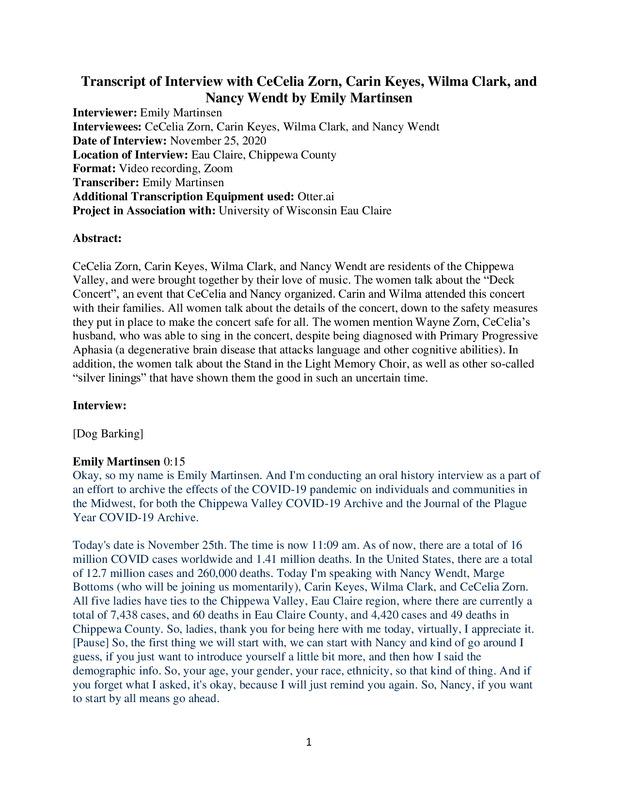
11/25/2020
CeCelia Zorn, Carin Keyes, Wilma Clark, and Nancy Wendt are residents of the Chippewa Valley and were brought together by their love of music. The women talk about the “Deck Concert”, an event that CeCelia and Nancy organized. Carin and Wilma attended this concert with their families. All women talk about the details of the concert, down to the safety measures they put in place to make the concert safe for all. The women mention Wayne Zorn, CeCelia’s husband, who was able to sing in the concert, despite being diagnosed with Primary Progressive Aphasia (a degenerative brain disease that attacks language and other cognitive abilities). In addition, the women talk about the Stand in the Light Memory Choir, as well as other so-called “silver linings” that have shown them the good in such an uncertain time.
-
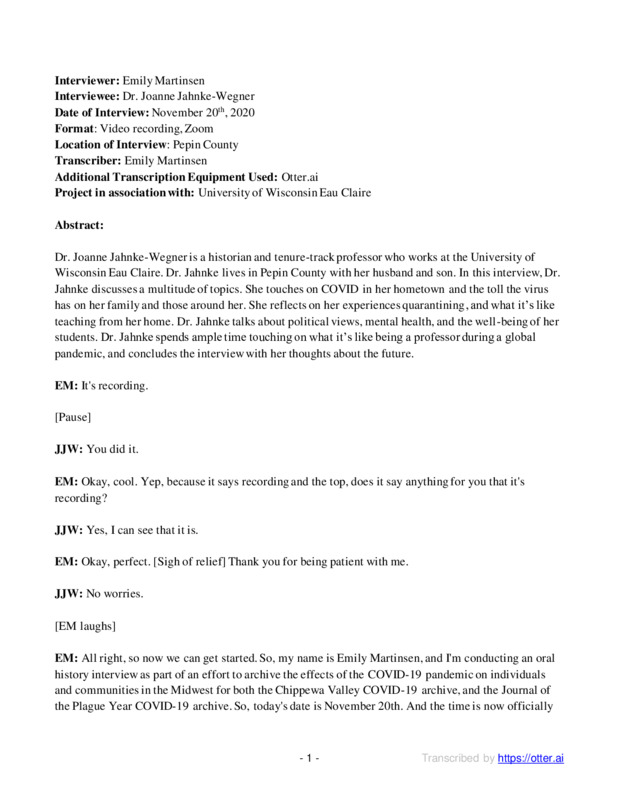
11/20/2020
C19OH
-
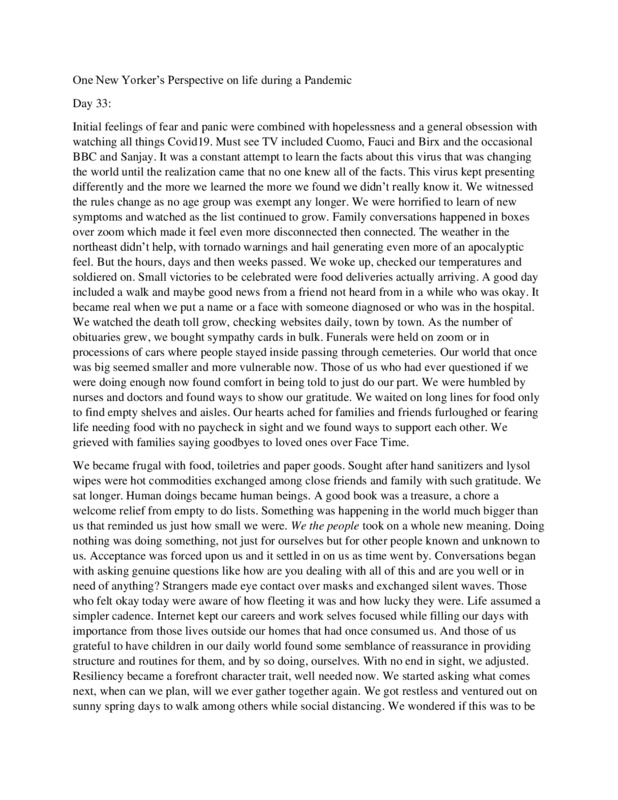
2020
I wrote because I felt compelled to, to chronicle what was happening to try and make sense of it and help me process it.
-
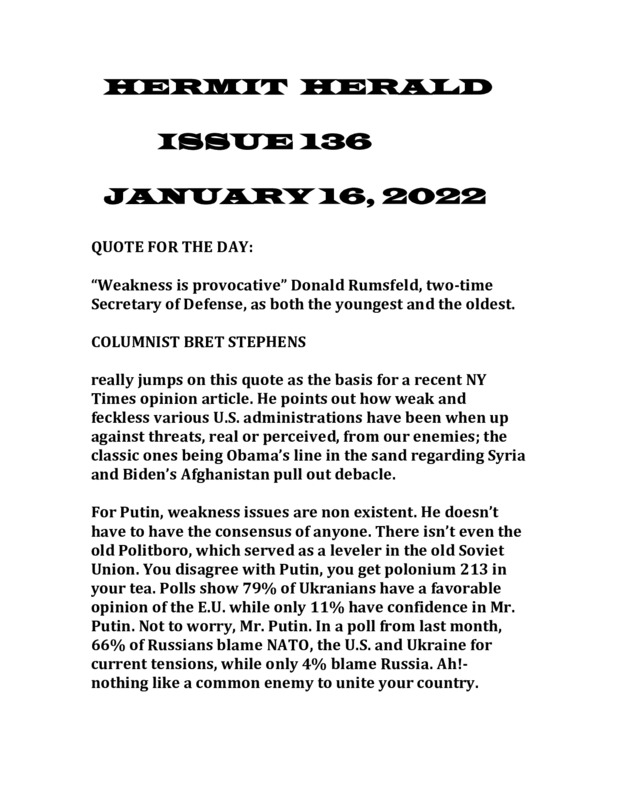
2022-01-16
U.S. taking a knife to a gunfight
-
2021-08-28
At the beginning it was different.
April and May of 2020 was not the later, divisive and hate-filled environment that would allow the Covid virus to flourish, not the largely “every-man-for-himself” climate whose popularity grew to mirror the surge of the pandemic itself. Back then, everyone was hunkering down, the streets were empty, and Santa Monica was more like the city I had seen in pictures from the 1940's.
The light even seemed different. Despite the specter of certain death, or at least alongside it, was an almost relaxed feeling: we were all in this together, against a common (if mysteriously deadly) enemy, and there is nothing we could do. Well, except stay indoors, and avoid contact with other humans at all costs.
I know that during WWII, Santa Monica hummed with activity, with defense plants working three shifts, and Clover Field roaring with warbird take offs and landings almost continuously, and in the Spring of 2020, Santa Monica was still largely of the “we did it once, we'll do it again” mindset—everyone had a job to do, and it was actually an easy one: all you had to do was to keep to yourself. Loose lips may not sink ships anymore, but uncovered ones (especially in public) could spew a deadly toxin—the origins and makeup of it almost completely unknown—and leave devastation in its wake.
This feeling couldn't, and wouldn't, last long; humans being what they are. With a national figurehead in a leadership position that was unable to understand complexities, and that largely and specifically promoted failure, the home front grew distrustful of the concept of a “common good”. Citizens quickly grew weary of making sacrifices, of doing without the niceties to which they had become accustomed. Under the guise of individual freedoms, all suffered. “It will all just go away very soon”, we were told, and eventually it did.
Not the disease. Our American way of life.
-
2020-12-10
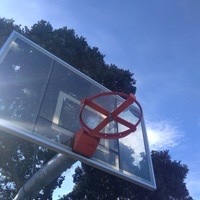
Playing basketball at Virginia Park was one of my favorite things to do before the pandemic hit; I have been playing there weekly for years, until Covid broke out. While I totally understand the reasoning behind locking up the rims (and I'm still not playing even though they are now open because I don't feel comfortable doing so), it still makes me sad to see a court and not be able to use it.
-
2020-05-06
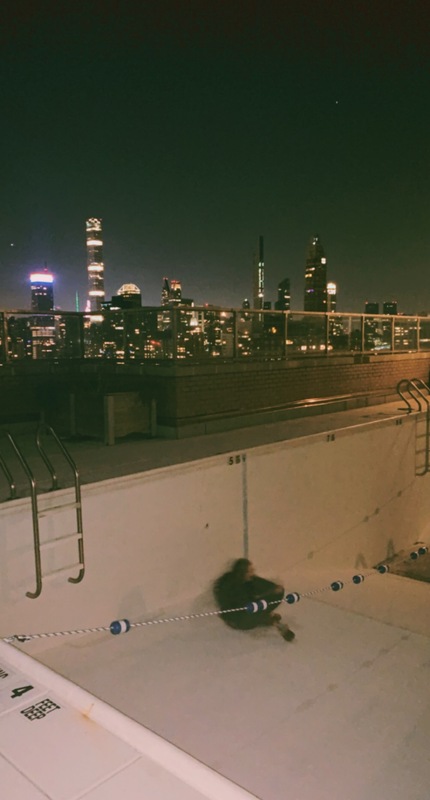
This shows how facilities in buildings that we took for granted were taken away because of the risk of covid
-
2022-01-01
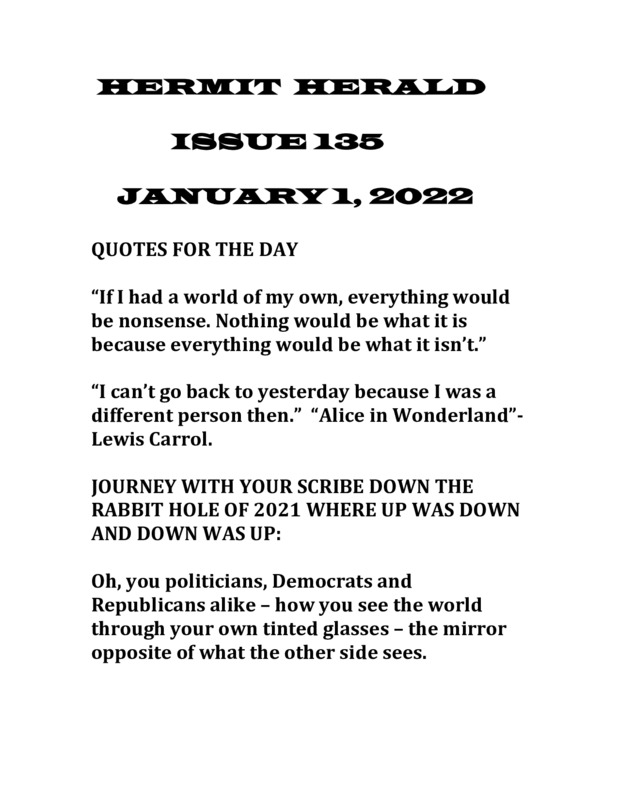
Dems and Republicans, down the rabbit hole
-
03/24/2020
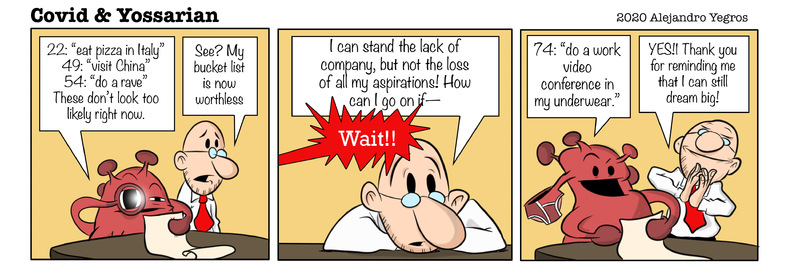
A comic strip about Covid-19
-
03/22/2022
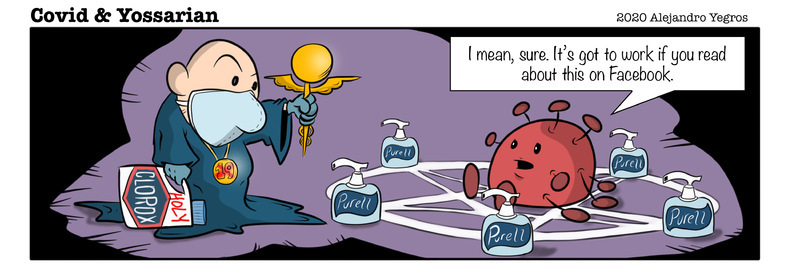
A comic strip about Covid-19
-
March 22, 2020
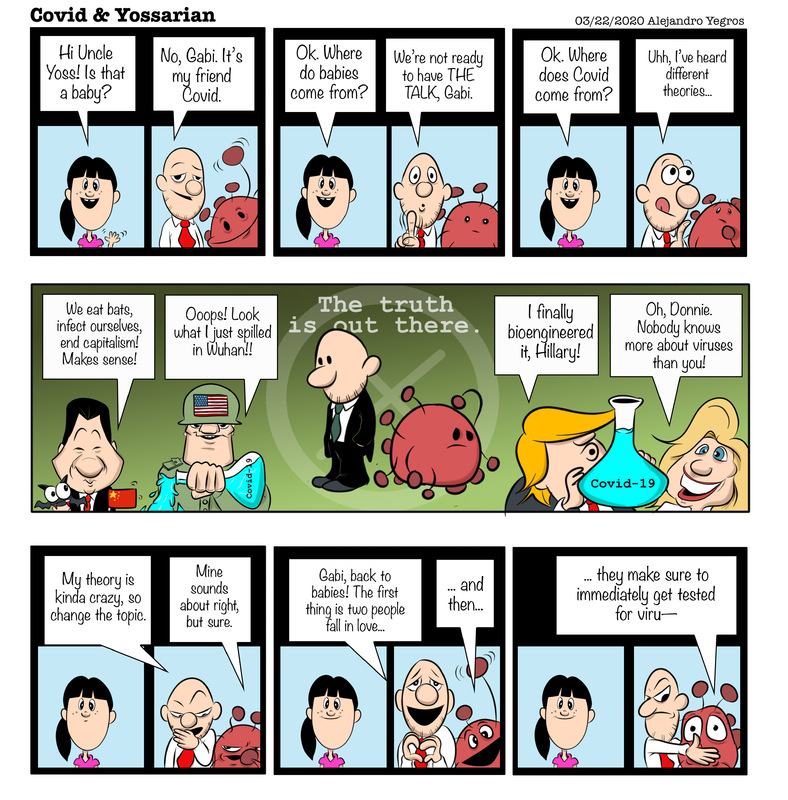
A comic strip about Covid-19
-
03/22/2020
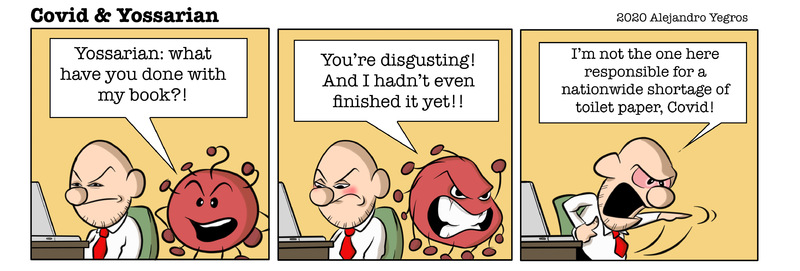
A comic strip about Covid-19
-
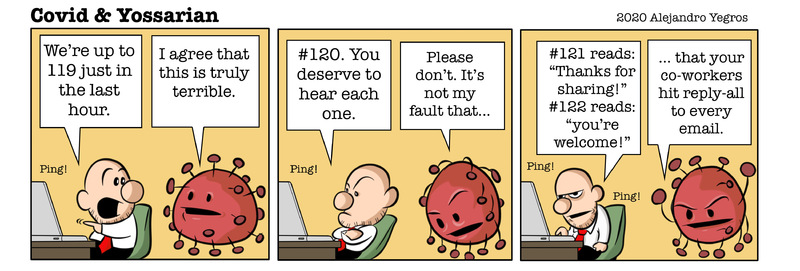
2020-03-22
A comic strip about Covid-19
-
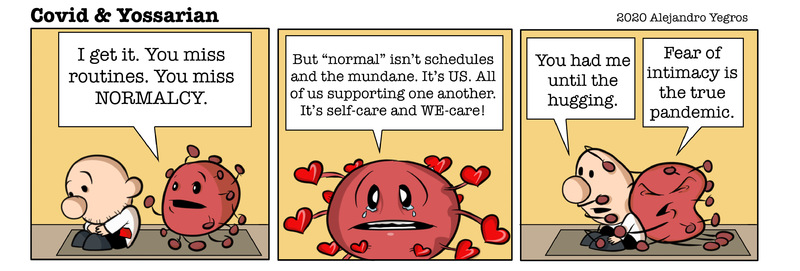
2020-03-22
A comic strip about Covid-19
-
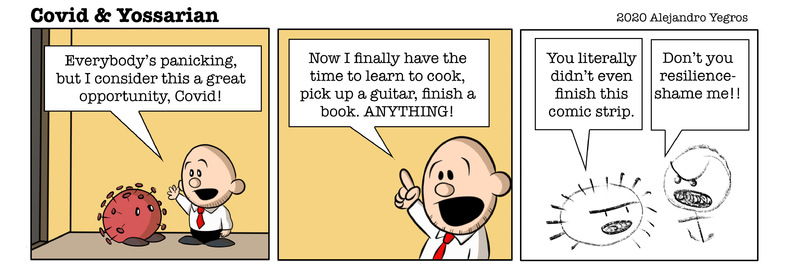
2020-03-22
Covid and Yossarian Episode 1, A comic strip about Covid-19
-
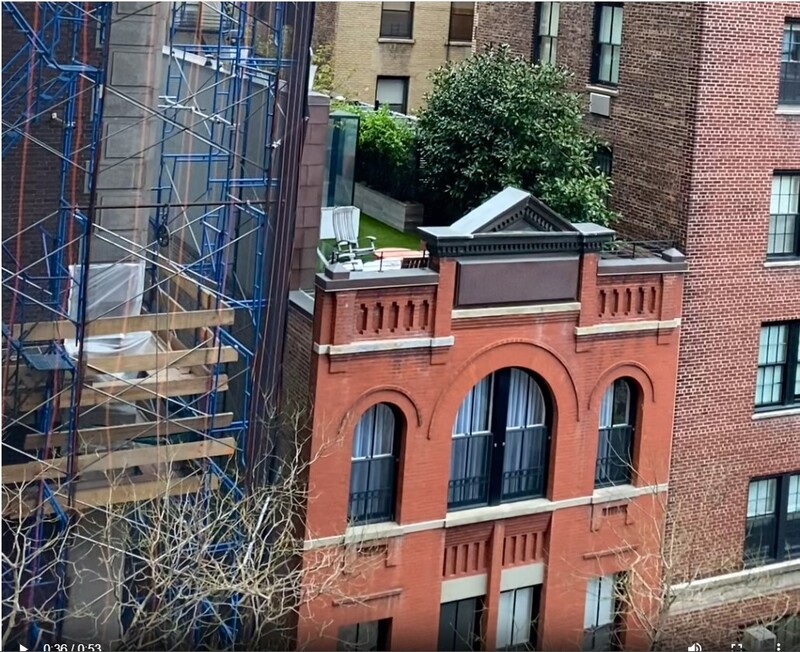
2020-04-16
Every day at 7:00 pm, people in my neighborhood would cheer for the healthcare workers from their windows. Shortly after, people blasted the famous song "New York, New York" in the streets while everyone sang along. This strengthened the optimism and togetherness in my neighborhood during a very difficult time.
-
2022-01-03
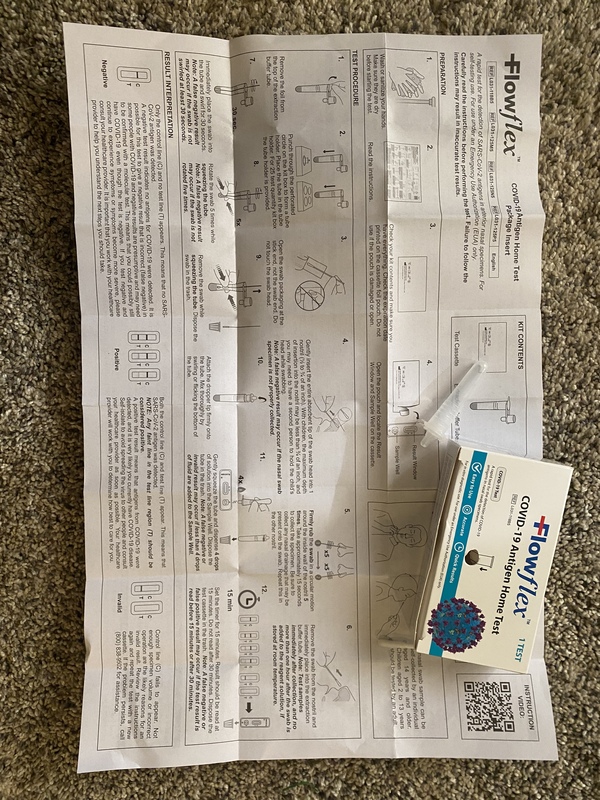
We’re two months short of the two year anniversary of the Covid outbreak here in the US. My family of four followed the rules, masked up, quarantined and my husband and I were vaccinated as soon as we were able. This holiday season we found ourselves living life as we had before Covid, we got too comfortable. Our children are small and we were still unsure if we wanted to get our six year old vaccinated. We went into public spaces unvaccinated, participated in all the family Christmas festivities and then we got sick. I thought it was a cold at first and then one day it dawned on me that my sense of smell and taste were gone. Then the guilt and shame set in. We got too comfortable, we lost sight of the fact that Covid is not gone. People are still dying. My husband and I are fine, it’s like a cold with the added adventure of not being able to taste anything. I worry for my kids though. I feel guilty that we didn’t get my oldest vaccinated. I hate to watch her fight this with only over the counter medication to help her. I feel for my three year old. I hope they don’t get worse. This was a rude awakening for us all, Covid is not gone.
-
04/06/2021
Personal narrative towards understandings about Covid-19 to further the understanding of the impacts of the pandemic over time.
-
04/06/2021
-
03/30/2021
An oral history between three students from Indiana University–Purdue University Indianapolis concerning the Covid 19 pandemic
-
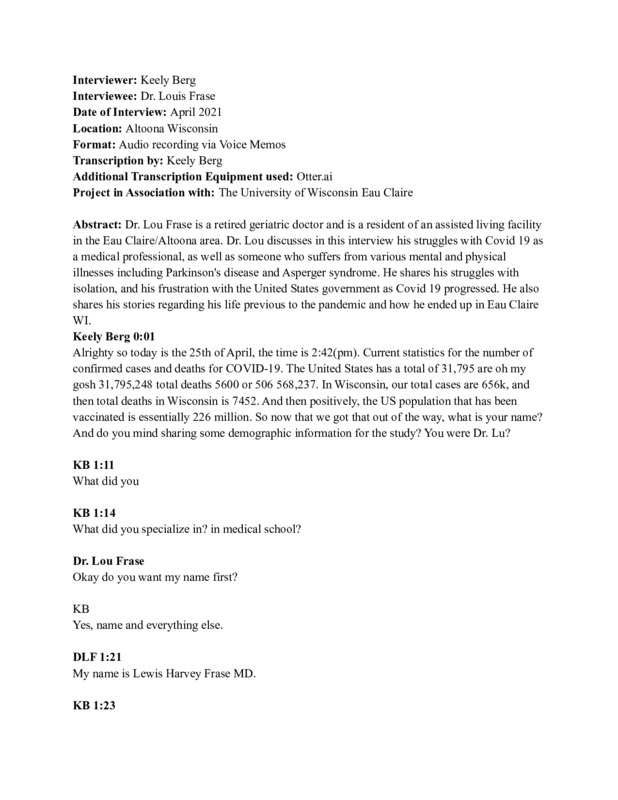
04/25/2021
Dr. Lewis Fraise details his service as a geriatric doctor during the Korean War and Vietnam War. He mentions his service in both Washington D.C. and Korea and continues to break down how the Coronavirus actually infects one's body and the response of the government as the pandemic ensued. Dr. Fraise criticizes the actions of Donald Trump and states that the spread of more medically-accurate information would have led to a better outcome in terms of the early stages of the pandemic.
-
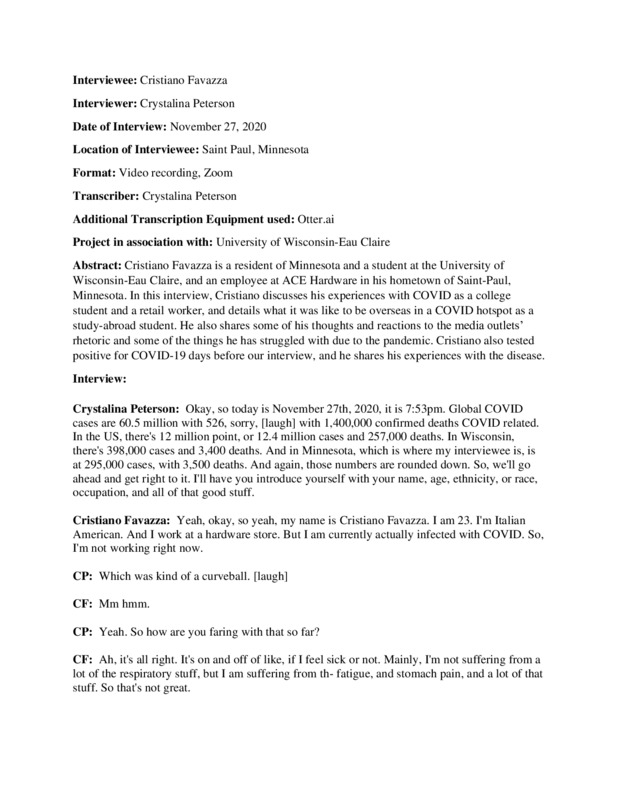
11/27/2020
C19OH
-
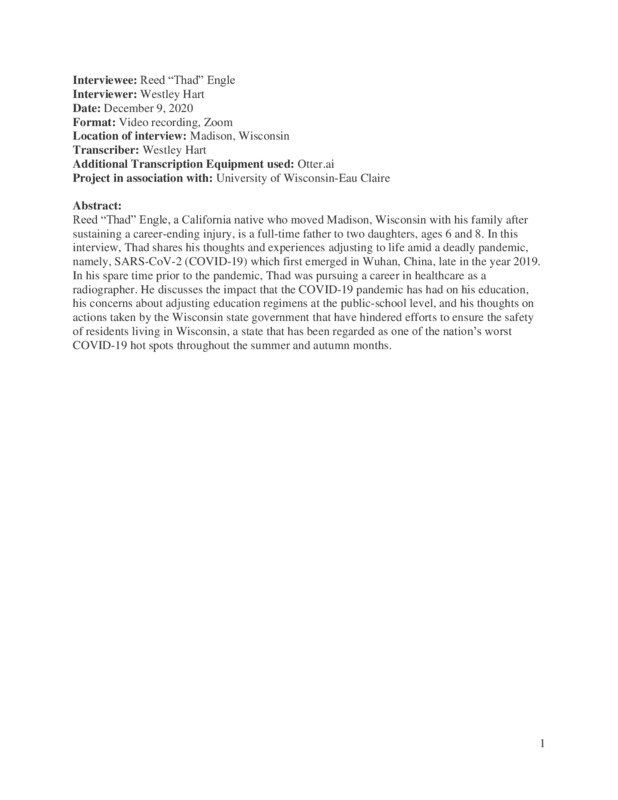
12/09/2020
C19OH
-
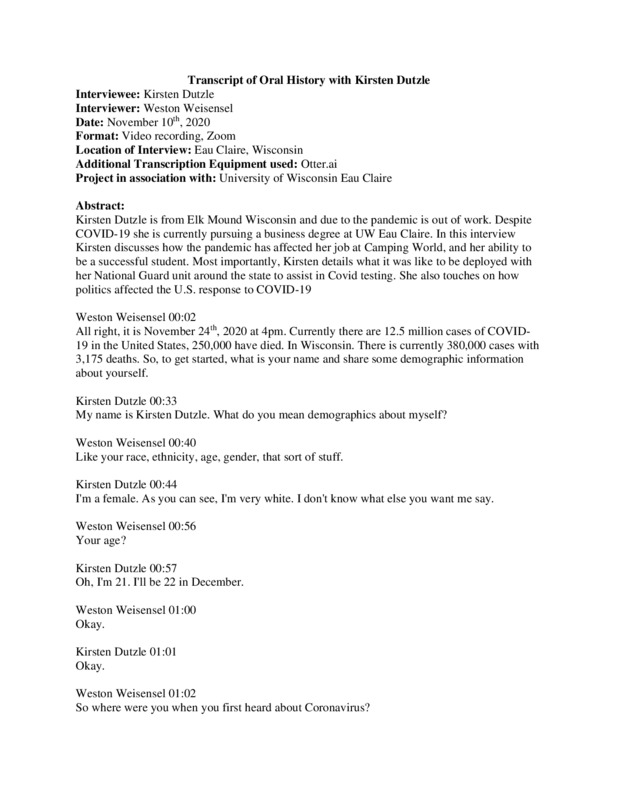
11/24/2020
C19OH
-
05/03/2021
-
12/13/2020
C19OH
-
11/23/2020
C19OH
-
04/01/2020
C19OH
-
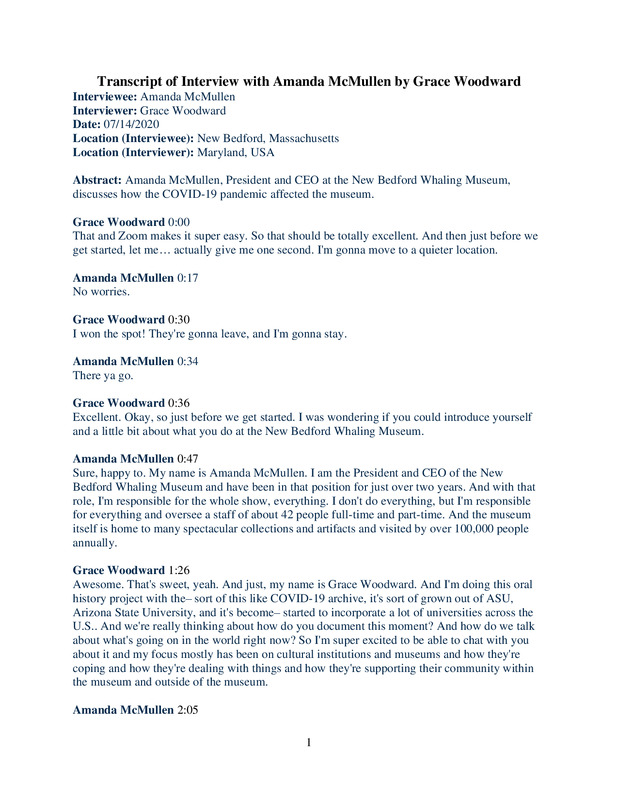
07/14/2020
C19OH
-
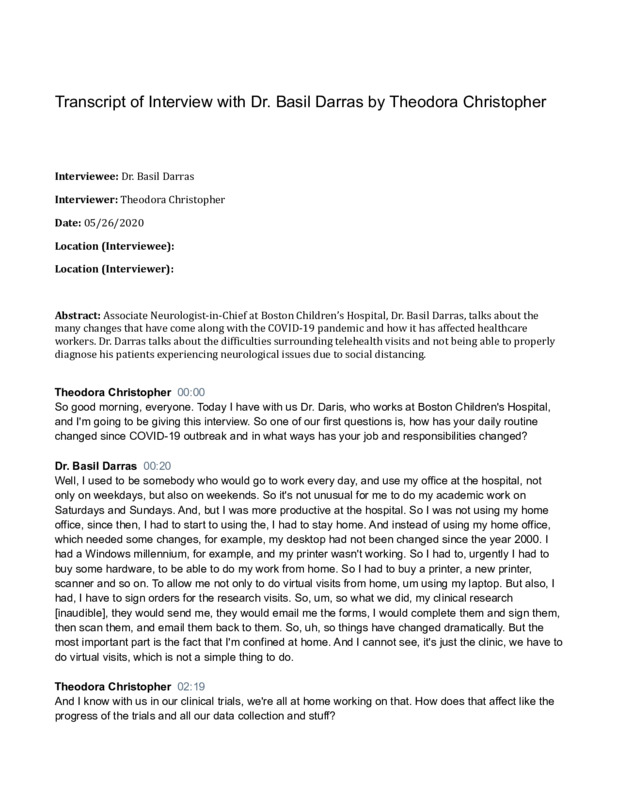
05/26/2020
Associate Neurologist-in-Chief at Boston Children’s Hospital, Dr. Basil Darras, talks about the many changes that have come along with the COVID-19 pandemic and how it has affected healthcare workers. Dr. Darras talks about the difficulties surrounding telehealth visits and not being able to properly diagnose his patients experiencing neurological issues due to social distancing.
-
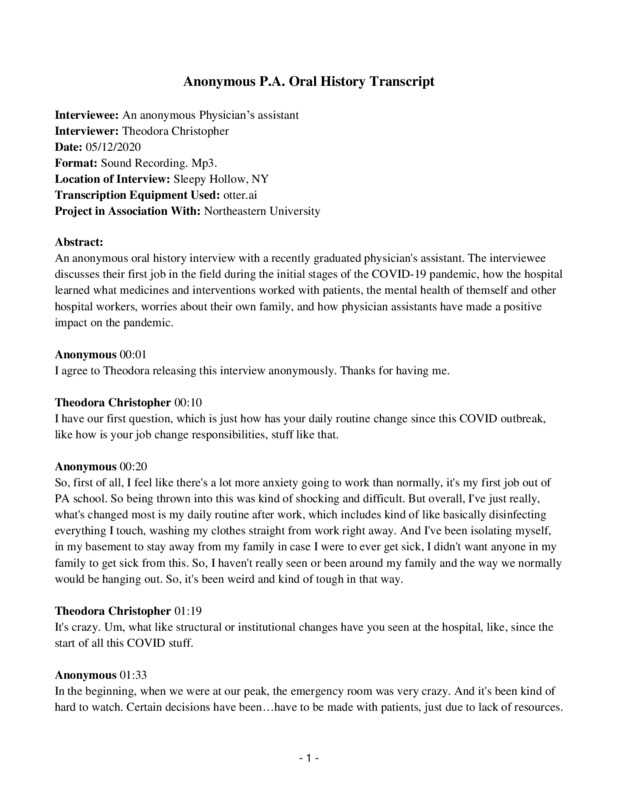
05/26/2020
An anonymous oral history interview with a recently graduated physician's assistant. The interviewee discusses their first job in the field during the initial stages of the COVID-19 pandemic, how the hospital learned what medicines and interventions worked with patients, the mental health of themself and other hospital workers, worries about their own family, and how physician assistants have made a positive impact on the pandemic.
-
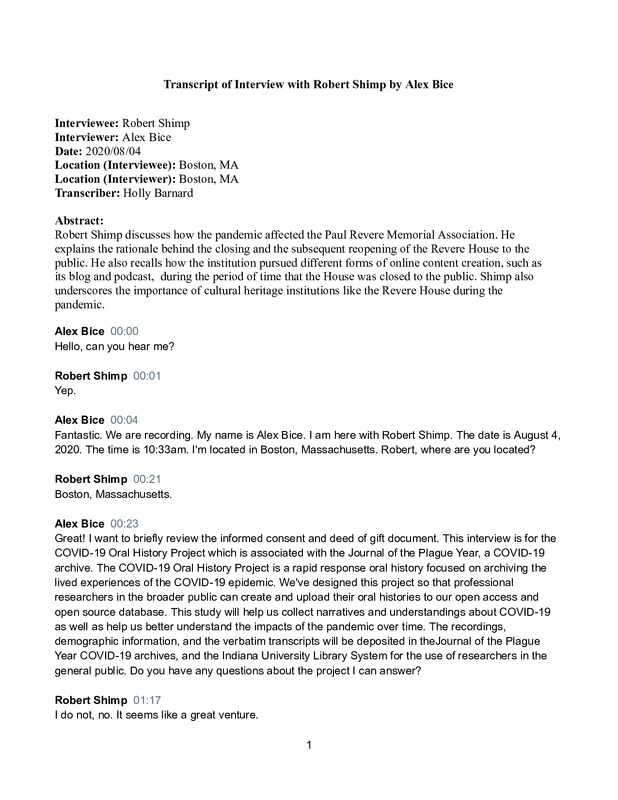
08/14/2020
In this interview, Robert Shimp discusses how the pandemic has affected the Paul Revere Memorial Association
-
07/30/2020
Northeastern University student Alex Bice interviewed the Director of Communications at Fenway Health Christopher Viveiros. In this interview, they discuss what Fenway Health does for its community and how the COVID-19 pandemic has affected their interactions with the community. Fenway Health has been able to create signage, update its website, send out emails, and resort to telehealth appointments to help the people in the community that doesn’t to be seen in person. Viveiros is concerned that the voices of many minority communities are not being heard, but is glad that some health officials have been able to speak the truth.
-
11/24/2020
C19OH
-
12/01/2020
Brooke Dusk is a Senior Business Loan Officer at WESTconsin Credit Union. Her job is to help businesses in their time of need. That being said, her whole world has gotten flipped upside-down. She worked first hand with helping businesses apply for the Federal Grant known as the Paycheck Protection Plan, as well as other state grants and loans that businesses could take out. Brooke also has a science background and gives some amazing insight into the pandemic and what she foresees for the future.
-
12/08/2020
Lindsey Jo Boehm is a full-time student that attends the University of Wisconsin-Eau Claire where she studies Nursing. Lindsey is a very busy student who balances work and school, and still finds time for spending time with her friends and family. In addition to a heavy school load, Lindsey works as a nurse’s aide in a critical care unit at Mayo Clinic Hospital in Eau Claire, Wisconsin, as well as being a research assistant for a nursing professor at the University. In this interview, Lindsey illustrates how the COVID-19 pandemic has affected her employment, her relationship with her friends and family, her health, and her community. She provides meaningful insight as somebody who interacts with the healthcare field, and explains how the world can better prepare for a future viral outbreak.
-
12/12/2020
Shawn Berg was born in Milwaukee Wisconsin, and raised in La Crosse Wisconsin. Recently he moved to Altoona Wisconsin to begin his job as a service manager at Texas Roadhouse in Eau Claire. In this interview, Shawn discusses how COVID – 19 has affected his life personally along with how it has effected the local Texas Roadhouse regarding their employees as well as their guests that come in. Not only does he discuss the consequences for the employees, but he also talks about how the guests have reacted to the mask mandate and how the restaurant has handled it all.
-
12/07/2020
The contributor of this item did not include verbal or written consent. We attempted to contact contributor (or interviewee if possible) to get consent, but got no response or had incomplete contact information. We can not allow this interview to be listened to without consent but felt the metadata is important. The recording and transcript are retained by the archive and not public. Should you wish to listen to audio file reach out to the archive and we will attempt to get consent.
-
2021-12-21
Anger devours the angry
-
03/28/2020
David Dale Lee spoke with his daughter Harper Lee on March 28, 2020, regarding the impact of the outbreak of COVID-19 on his professional and personal life.
David is a semi-retired professor of history at Western Kentucky University in Bowling Green, Kentucky. David primarily discusses the impact of the pandemic on his teaching and research projects, but he also touches on changes to personal life, particularly shopping and connecting with friends via Zoom. David also reflects on other crises that have shaped his life.
-
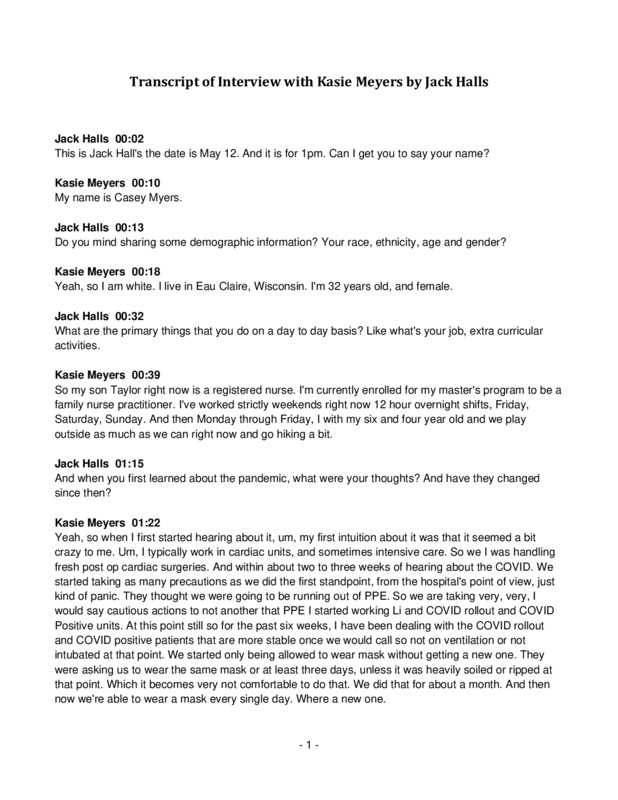
05/12/2020
Interview with Kasie Meyers by Jack Halls. In this interview, Kasie Meyers discusses how COVID has impacted her role as a nurse and the changes she and her colleagues face. She also discusses her journey as a student and how covid has impacted her studies, she touches on her role as a mother and the difficulties that have been heightened because of the pandemic. She expresses how her relationships with friends and family have changed and also discusses her view on the government and its handling of the pandemic.
-
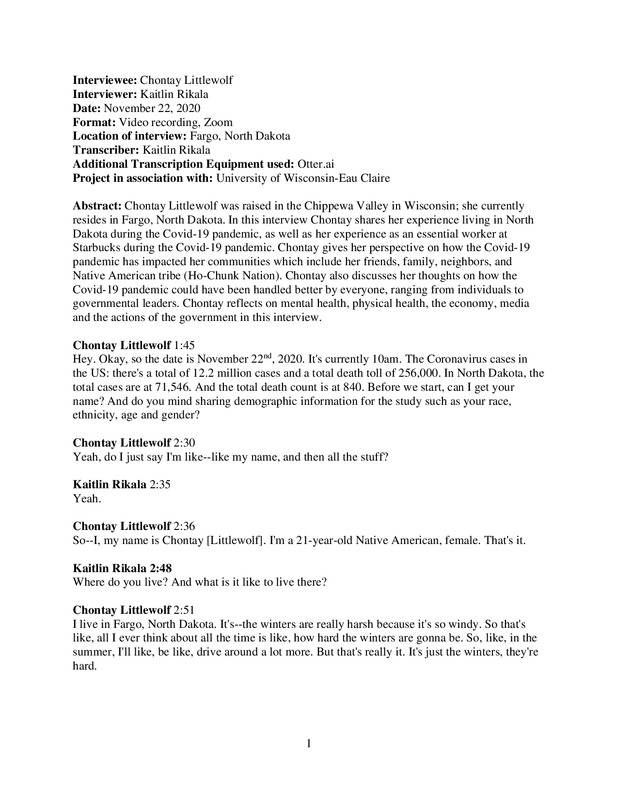
12/09/2020
Chontay Littlewolf was raised in the Chippewa Valley in Wisconsin; she currently resides in Fargo, North Dakota. In this interview Chontay shares her experience living in North Dakota during the Covid-19 pandemic, as well as her experience as an essential worker at Starbucks during the Covid-19 pandemic. Chontay gives her perspective on how the Covid-19 pandemic has impacted her communities which include her friends, family, neighbors, and Native American tribe (Ho-Chunk Nation). Chontay also discusses her thoughts on how the Covid-19 pandemic could have been handled better by everyone, ranging from individuals to governmental leaders. Chontay reflects on mental health, physical health, the economy, media and the actions of the government in this interview.
-
04/15/2021
-
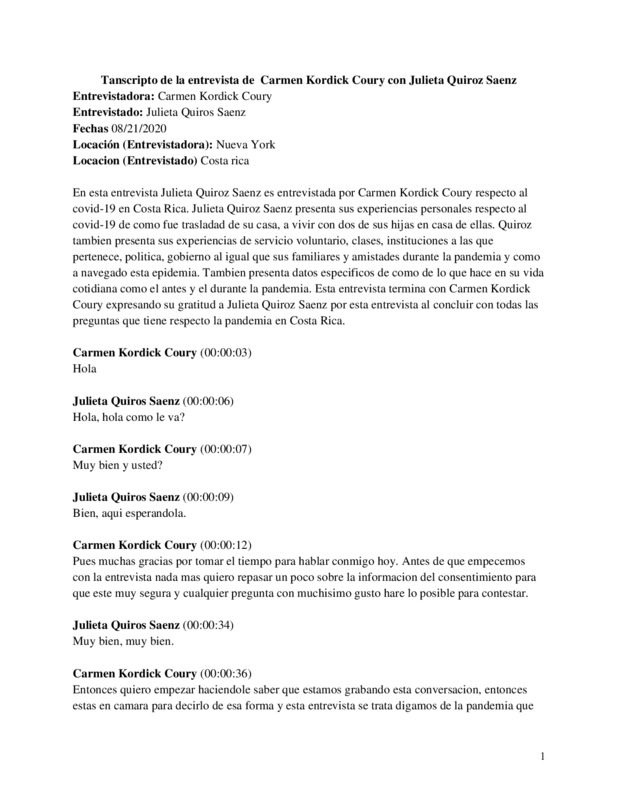
05/07/2020
En esta entrevista Julieta Quiroz Saenz, 91 años de San Jose, es entrevistada por Carmen Kordick Coury concerniente al covid-19 en Costa Rica. Julieta Quiroz Saenz presenta sus experiencias personales respecto al covid-19 de cómo fue trasladad de su casa, a vivir con dos de sus hijas en la casa de ellas. Quiroz tambien presenta sus experiencias de servicio voluntario, clases, instituciones a las que pertenece, política, gobierno al igual que sus familiares y amistades durante la pandemia y como a navegado esta epidemia. También presenta datos específicos de como de lo que hace en su vida cotidiana como el antes y el durante la pandemia. Esta entrevista termina con Carmen Kordick Coury expresando su gratitud a Julieta Quiroz Saenz por esta entrevista al concluir con todas las preguntas que tiene sobre la pandemia en Costa Rica.
-
05/01/2020
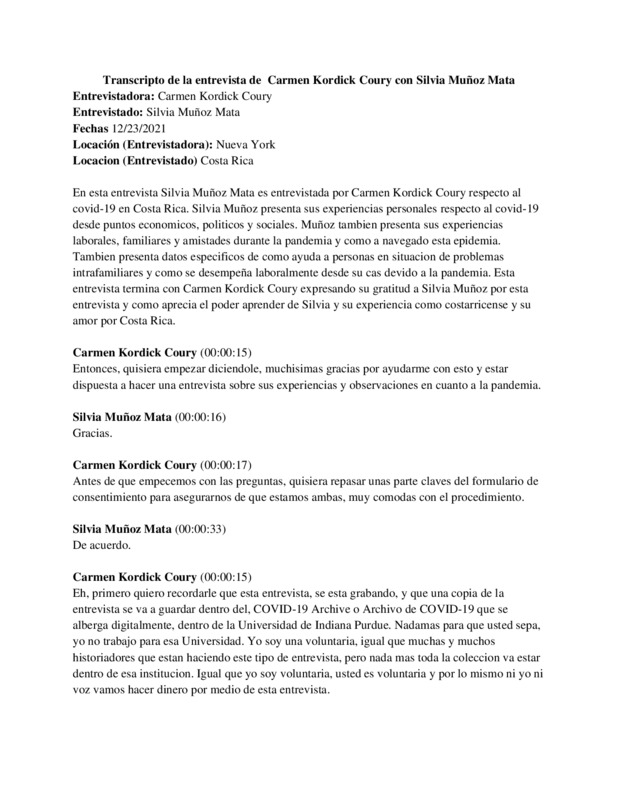
En esta entrevista Silvia Muñoz Mata es entrevistada por Carmen Kordick Coury concerniente al covid-19 en Costa Rica. Silvia Muñoz tiene 45 años y vive en Heredia. Ella presenta sus experiencias personales sobre la pandemia del covid-19 desde puntos económicos, políticos y sociales. Silvia también presenta sus experiencias laborales, familiares y amistades durante la pandemia y como ha navegado está epidemia. Ella presenta datos específicos de cómo ayuda a personas en situación de problemas intrafamiliares y como se desempeña laboralmente desde su casa devido a la pandemia. Esta entrevista termina con Carmen Kordick Coury expresando su gratitud a Silvia Muñoz por esta entrevista y como aprecia el poder aprender de Silvia y su experiencia como costarricense y su amor por Costa Rica.
-
05/21/2020
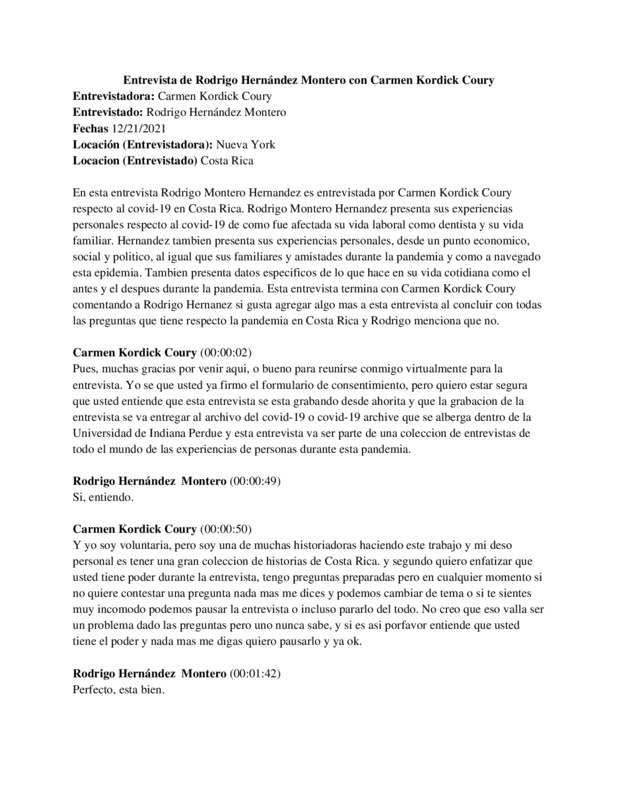
En esta entrevista Rodrigro Hernandez Montero es entrevistado por Carmen Kordick Coury concerniente al covid-19 en Costa Rica. Rodrigo trabaja en odontología tiene 40 años y vive en Heredia. Trabaja en un hospital donde empezó a escuchar del virus por primera vez. Habla sobre el cambio que ocurrió en su trabajo y del protocoló de la cirugía oral. Describe los cambios de su rutina diario, reacciones de sus pacientes y el cambio de protección que empezó a usar, como la máscara N95. Rodrigo habla de cambios de la economía y como la pandemia afecto el negocio de su papá. Habla sobre su familia y las preacauciones que ha tomado al llegar del trabajo para proteger a sus ser queridos. Rodrigo habla del cambio del dinámico familiar y los sentimientos de aislado que siente en no poder ver a su familia y sus amigos. Habla de los fuentes principales de información donde el se mantiene informado. Para terminar, Rodrigo habla del gobierno, de la xenofobia y el miedo que existe en Costa Rica.