-
2020-07-24
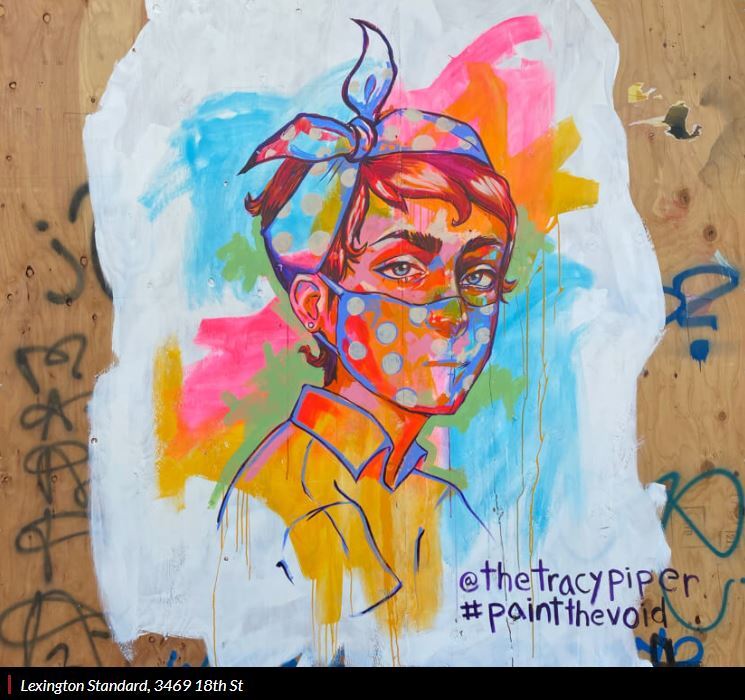
Street art has proliferated across the San Francisco Bay Area in the wake of the COVID-19 pandemic. News outlet, Broke-Ass Stuart, featured a map of the street art that is popping up in San Francisco's public spaces. As the article states, the art is "turning many of [San Francisco's] empty, commercial corridors into actual art walks." The specific map highlights art created by artists involved in the Paint the Void initiative.
-
2020-08-21
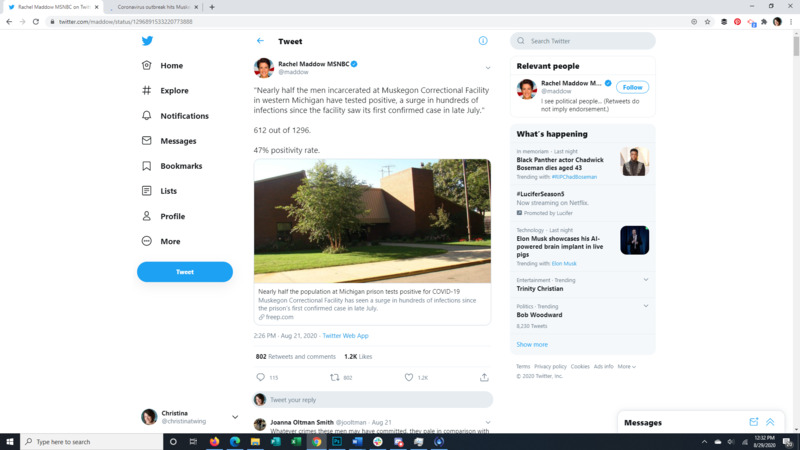
This Tweet and it's responses show how the public feels about the Covid-19 outbreak within one of Michigan's prisons. The article referenced also explains how this particular facility had spent months with no cases and then had a sudden outbreak, illustrating how dependent prisons and the communities they are a part of are when it comes to the spread of Covid=19.
-
2020-08-22
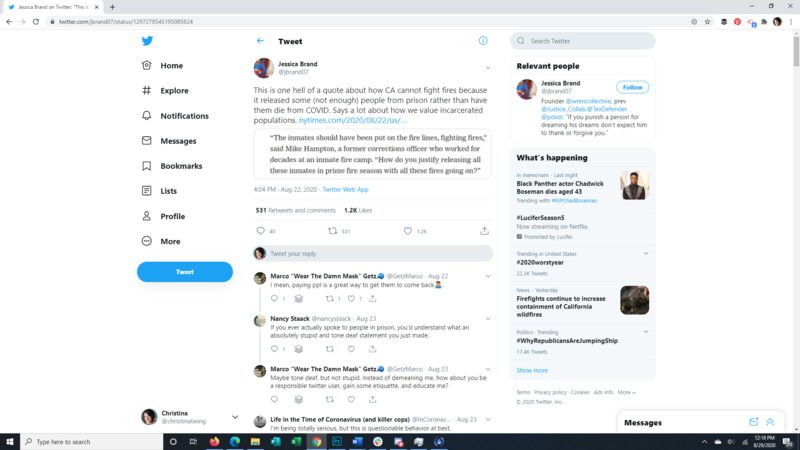
In an effort to slow the spread of Covid-19 incarceration facilities across the nation have released a small number of people earlier than they would have been otherwise. This has created a unique situation in California, a state that relies on prison labor to combat wildfires every year. As the writer of this Tweet calls out, much of the general public and the nation's politicians believe "if you do the crime, you do the time" and feel this extends to using inmates for fighting fires.
-
2020-08-21
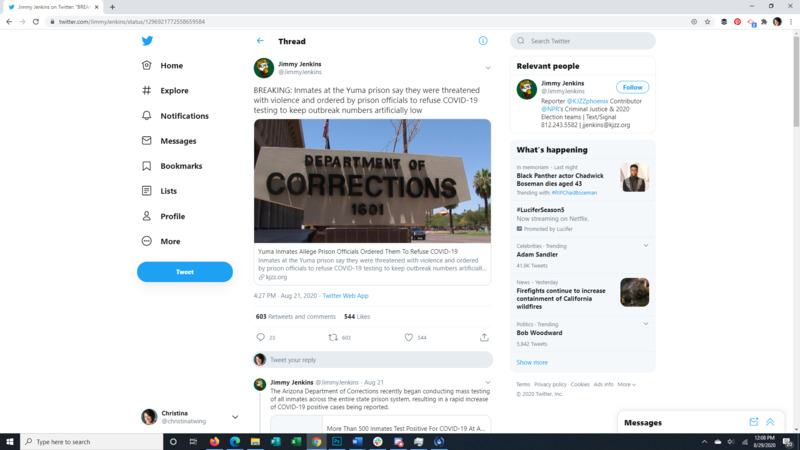
This Tweet and linked article explain a haunting story. Inmates at the Yuma prison in Arizona were threatened with a "beat down" unless they refused to take a Covid-19 test in an effort by the administration to keep the case count down. The replies to this Tweet show the public's response to this allegation.
-
2020-08-24
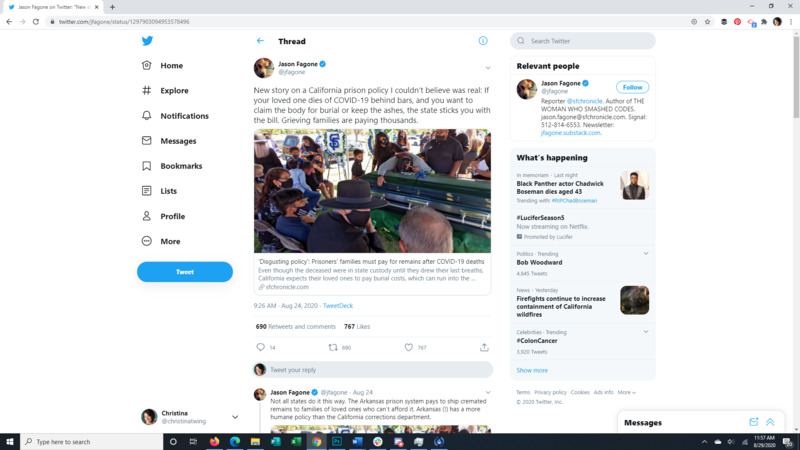
In California if your loved one dies from Covid-19 you have to pay to have their remains sent to you as this Tweet explains.
-
2020-08-21
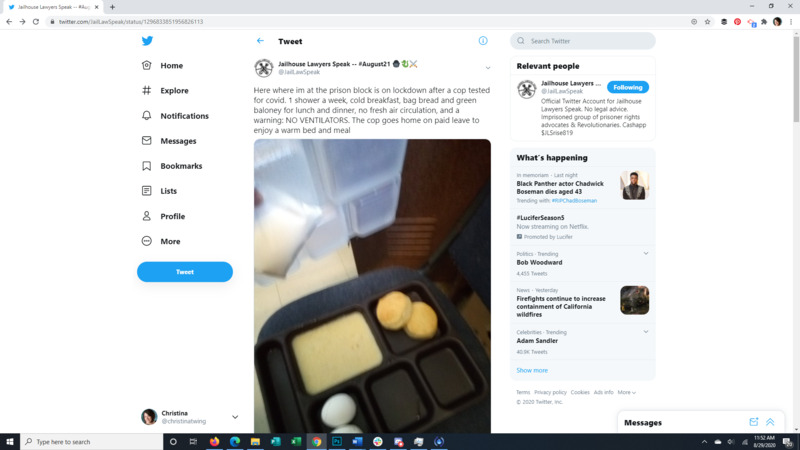
This Tweet, from an incarcerated person, shows and expresses the conditions and treatment inside of a correctional facility with a Covid positive employee. The replies show what the public thinks of the situation.
-
2020-08-28
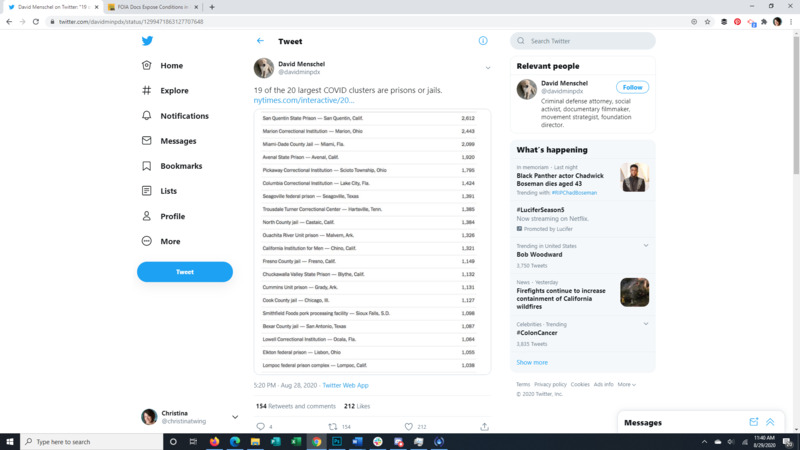
This Tweet draws attention to the huge outbreak of Covid within the correctional facilities of the US. The accompanying article explains where the outbreaks started, have traveled to, and where they are now. It also states that the largest outbreaks have been in nursing homes, correctional facilities, and food processioning plants.
-
2020-08-20
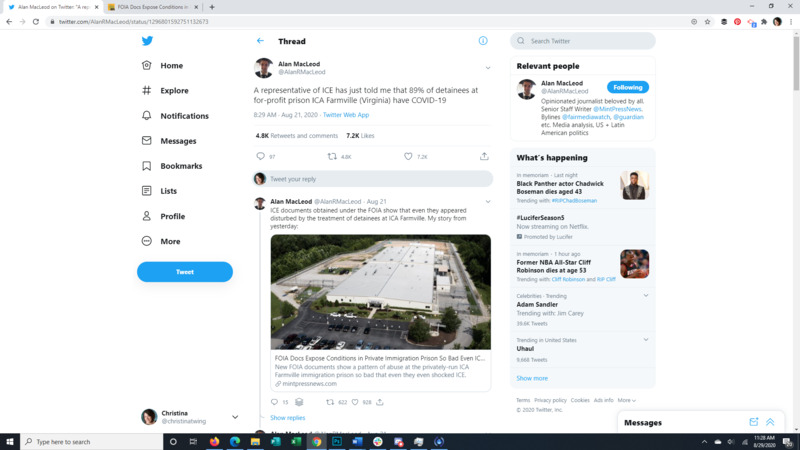
This Tweet brings to light that almost all detainees at the Farmville Detention Facility, a for profit prison in Virginia, have Covid-19. The attached article discusses long running complaints of mistreatment at this facility, some so egregious that even ICE itself was appalled. It also points to the spread of Covid through facility transfers all over the US. The replies to the original Tweet give a good representation of the American public's response to the situation.
-
2020-08-27
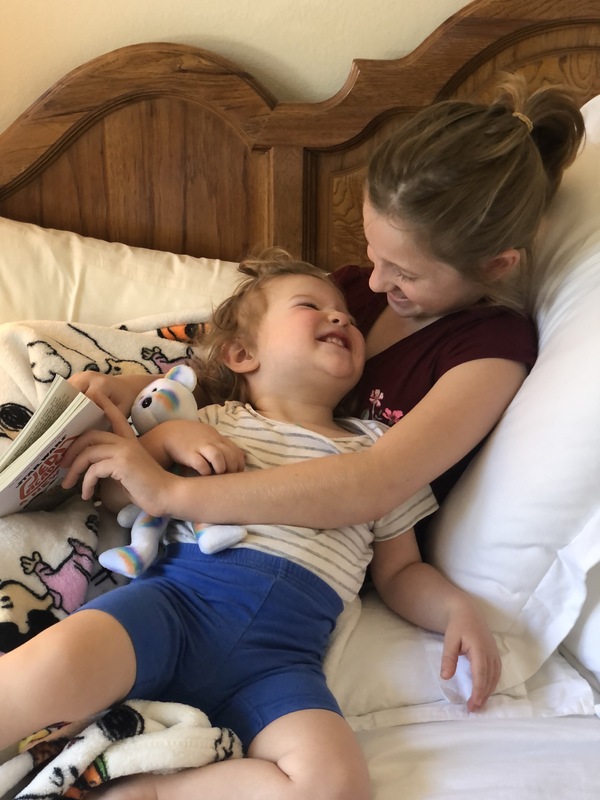
The COVID-19 pandemic has rocked our world. We face new and unprecedented challenges daily. Amidst the chaos, I am doing my best to remind myself to lean into little moments of joy. I am a teacher with 2 elementary school aged children and a baby. Teaching my own classes, while facilitating remote learning for my children, and caring for a baby is difficult to say the least. Did I mentioned that I'm in graduate school? This past week, just when I felt that it was all more than I could handle, I captured the sweetest moment between sisters. While I can't wait to get back to life and school in actual classrooms, I know there are parts of this experience that I will miss. Moments like this are definitely one of them.
-
2020-08-21
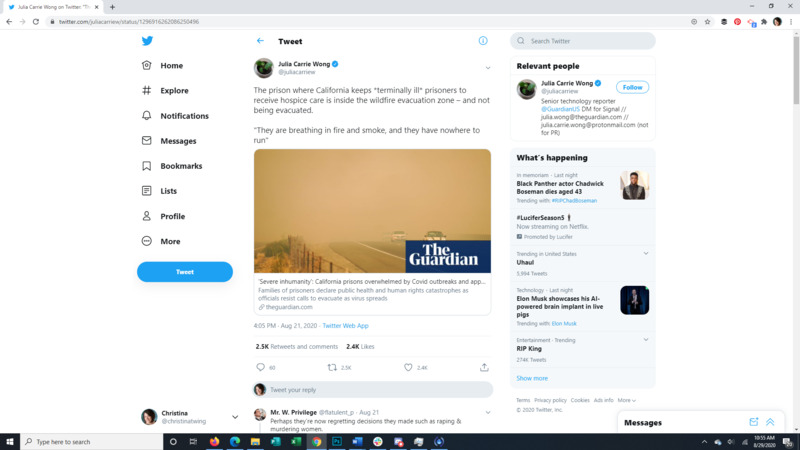
This Tweet and article concern the conditions inmates in California's prisons are experiencing. First they had to deal with Covid-19 and figure out how to slow the spread of the disease within overcrowded facilities where social distancing is impossible and mask wearing presents its own set of issues. Second incarcerated people are living in a near constant state of lockdown, visitation and even communication with family and friends is gone. Third they are facing the threat of wildfires within a few miles of several prisons causing the people inside the buildings to breath air filled with smoke. To add insult to injury the state of California uses prison labor to fight these same fires.
This article illustrates how we as a society treat those most at risk among us. Even those in a correctional facility for the terminally ill in hospice care are not being evacuated.
-
2020-08-15
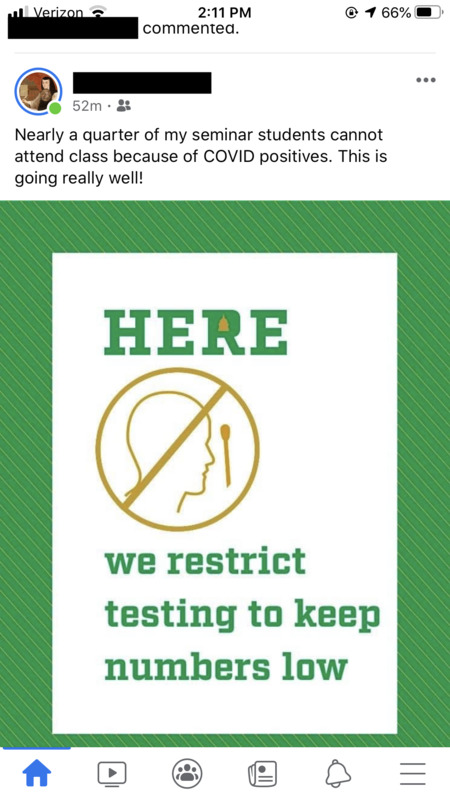
Notre Dame proudly declared months ago, that opening up campus was the right thing to do and "worth the risk." When campus opened, one of my previous advisors posted this meme inferring that the university is not widely testing, so COVID-19 cases are low. This was, of course, before there was a widespread outbreak and the U decided to force all students to stay in their dorms and learn virtually.
-
2020-08
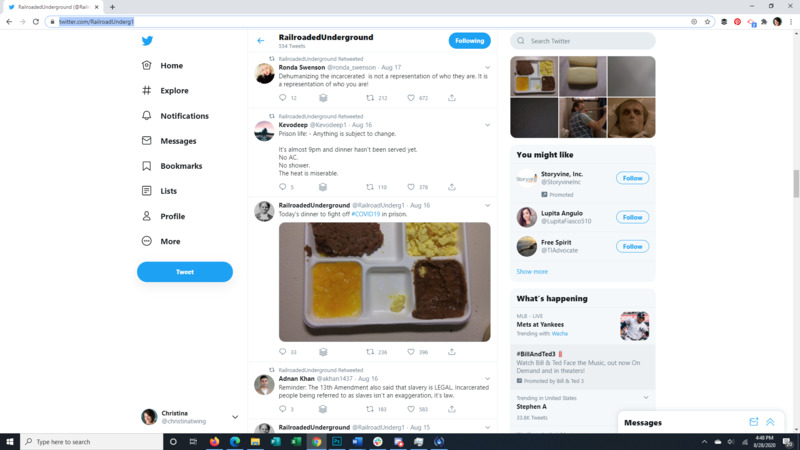
These Tweets were posted by a man inside a prison using a contraband cell phone. This week he talks about their nutrition, lack of air conditioning, lack of showers, the wildfires near Vacaville Prison in California and the lack of plan for evacuation, a friend that recently died of Covid, and how good it felt to finely be allowed to go outside for a bit.
-
2020-08
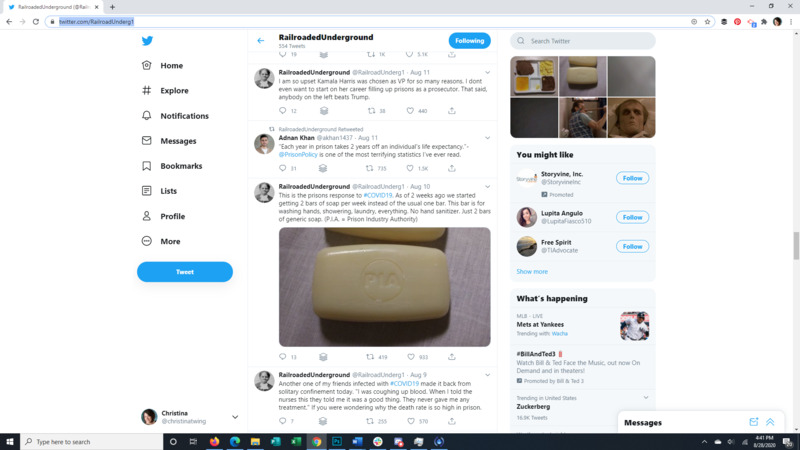
These images show the Tweets of an incarcerated person using a contraband cell phone. This week he Tweets about politics, specifically Kamala Harris being chosen for VP and her role in incarcerating so many people while she was a prosecutor, another friend returning from solitary confinement, an unsanitary kitchen prison laborers were forced to prepare food in, the number of incarcerated crime victims, prison population reduction, getting more soap, and having to share a shower head with three or four other people because the prison removed several shower heads.
-
2020-08
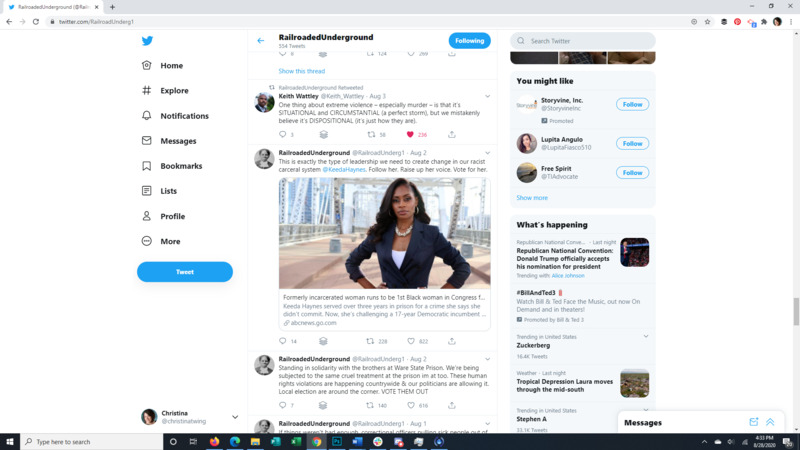
The images show Tweets from a person incarcerated in a US prison using a contraband cell phone. These week he mentions politics, retweets several people including one person discussing who is worthy of release, people being sent to solitary confinement to quarantine, and the people at his facility being told they must cooperate with rehousing assignments or be punished.
-
2020-08-26
After working on stories that would appear on this archive, I reflected what it was like report during this pandemic.
-
2020-08-26
By Sarandon Raboin/Luce Foundation: Southwest Stories Fellowship
-
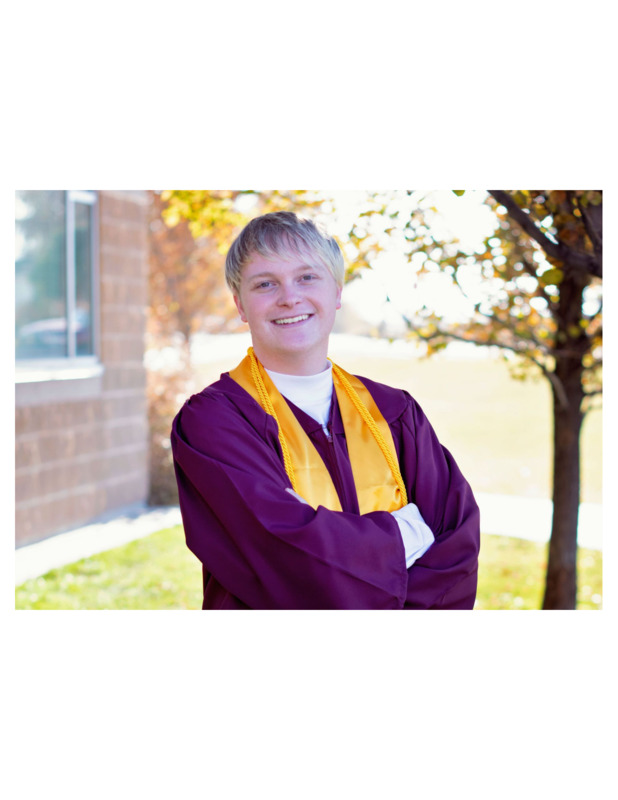
2020-08-27
I decided to embark on this internship despite no previous experience in public history, and it has afforded me the opportunity to learn many things about the practice of public history and historical collection more broadly. Having worked on the internship in tandem with a fellowship role on the same project had challenged and pushed me in ways I hadn’t imagined. Having begun the project as a volunteer, a fellow, and then an intern placed me at the apex of an entirely new experience, and is part of my drive to challenge myself, to learn, to be part of something larger than myself, and to grow. In my first semester of graduate school, I became deeply immersed and personally invested in a project that had become bigger than I may have initially anticipated. This project has taught me, among other things: leadership, patience, collaboration, how to be adapt quickly, as well as the concept of shared authority.
The skills and growth I have received over this journey has been invaluable. In addition to learning important skills and practices relating to history, the internship has given me practical experience in being a leader among my peers, communicating effectively through press releases and social media, and developing effective standardized practices. These skills will be invaluable in whatever I pursue, as well as in my life more broadly. Getting lost in the work of the internship regarding the historical curation of the pandemic, has ironically distracted me from the pandemic itself to an extent, in my personal life. I have paused many times during the course of this internship to reflect on the significance of our work and the significance of this moment in history. The friends and professional relationships I have created through this experience will follow me throughout my life and academic career.
-
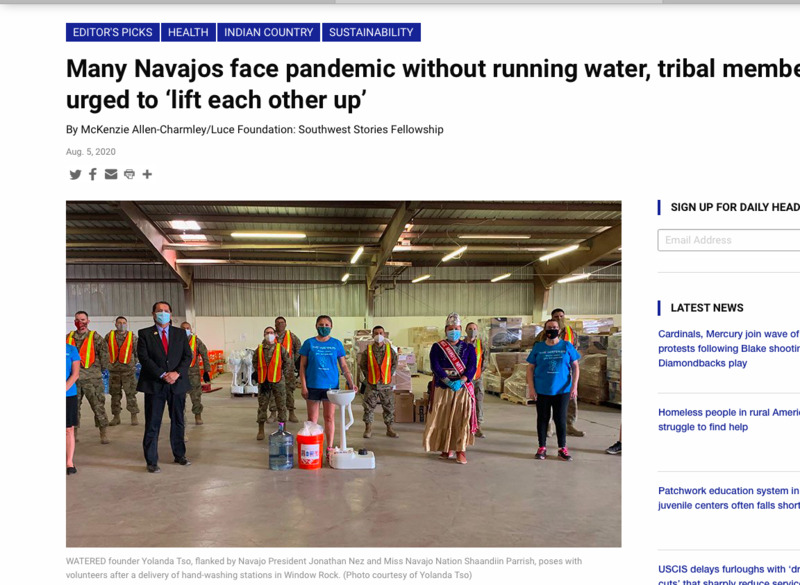
2020-08-05
By McKenzie Allen-Charmley/Luce Foundation: Southwest Stories Fellowship
-
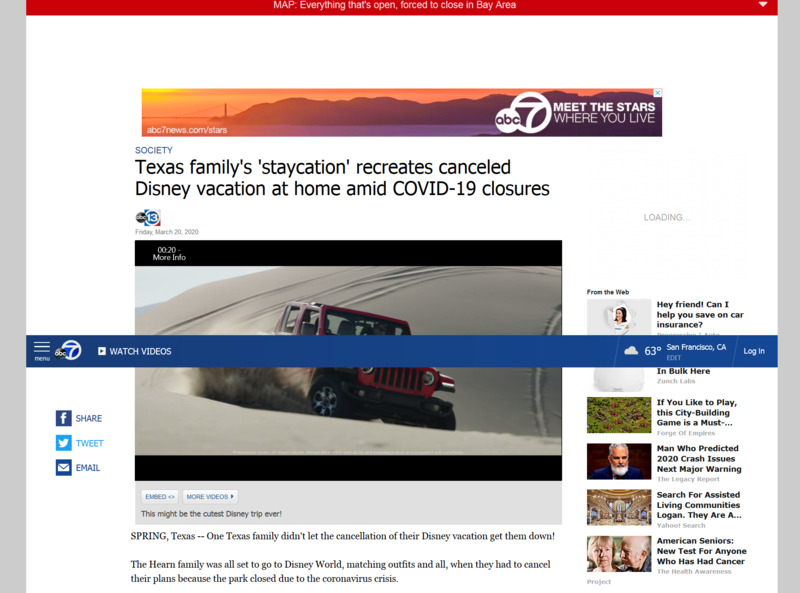
2020-03-20
I think this is a great article that shows the resilience of people during trying times. The Hern family in Texas was all ready for their trip to Disney when Covid struck and cancelled their trip. They would not let that get them down through, this video shoes not only their love for Disney but their creativity and positive attitude while they recreated what their trip might have looked like. This is such a great depiction of not allowing social distancing to change your positive life, of going with the flow and making the best of a tough situation.
-
2020-08-25
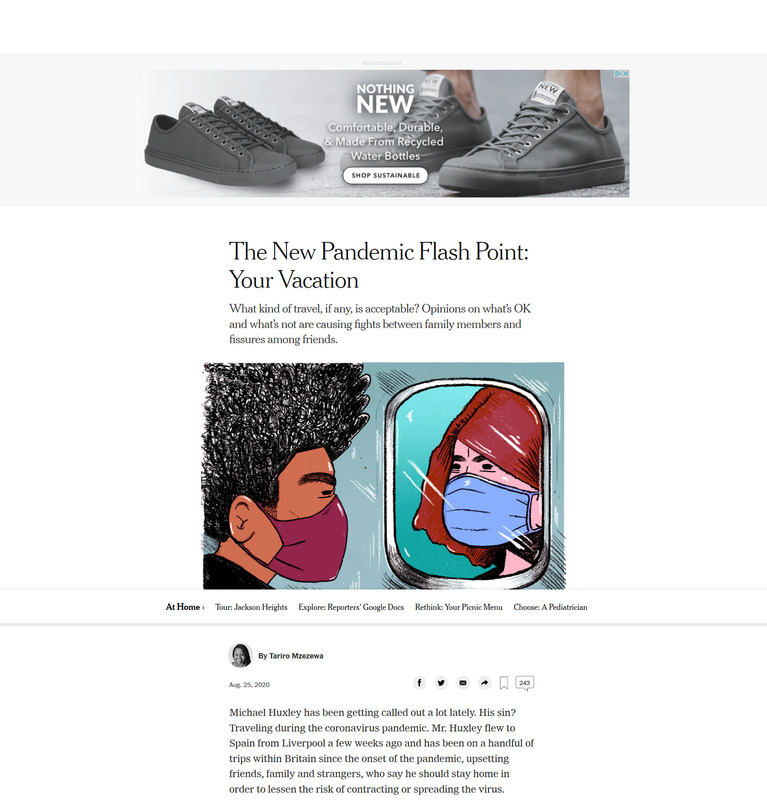
This story explores the question of whether or not there is an acceptable form of travel in the midst of Covid. It is an opinion piece focusing on a man who travels regardless of regulations and shut downs. He tells his story of the backlash he is receiving from both his professional and personal life. He is skeptical about the severity of the pandemic and does not realize the impact this traveling could cause. This is an important piece because is shows the world through the eyes of a traveling skeptic. Someone who may be spreading the virus while being asymptomatic. This article explores the realms of acceptability in travel and asks the reader if there is any form of travel that is acceptable these days.
-
2020-08-26
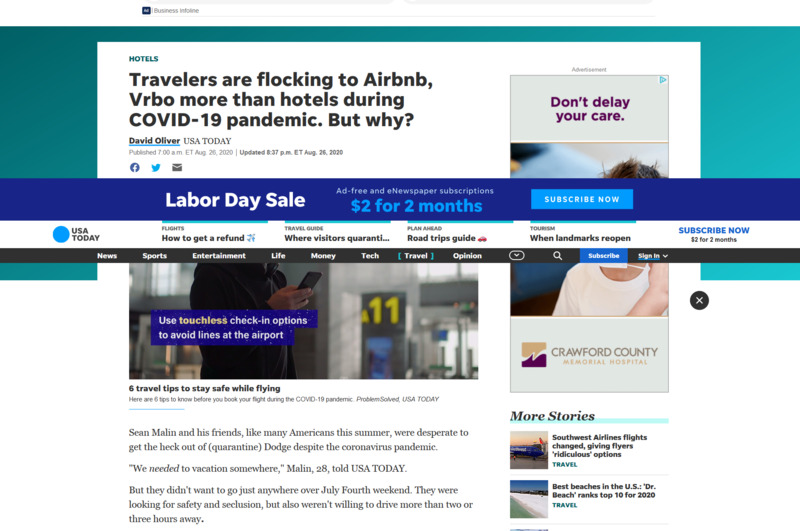
This article claims that people are so desperate to go on summer vacations that they are flocking to AirBnBs and Vrbo spaces. I see importance in this article because it shines light to the ways people are finding loopholes to social distancing and closed boarders. Many people need to get away for their mental health, and some use these opportunities to throw parties and blatenly break the rules. What ever their reasons may be this article highlights the surge in AirBnB and Vrbo usage.
-
2020-08-26
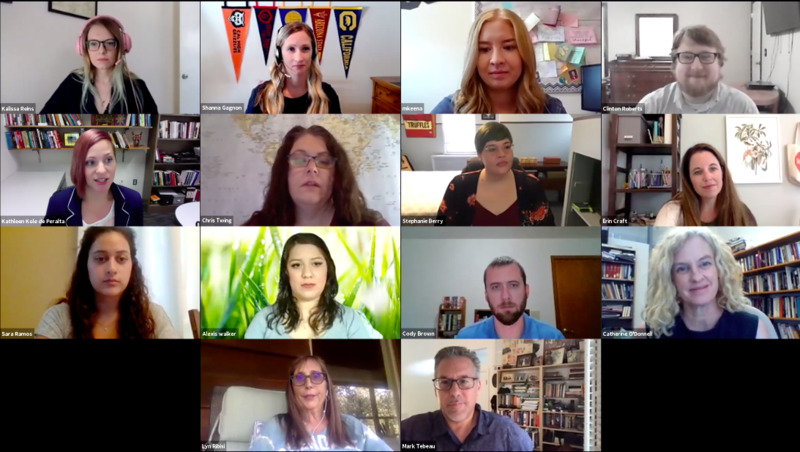
Why is it so hard for me to say goodbye to this group of interns? I’ve taught face-to-face classes, I’ve taught online, and I’ve never had this reaction at the end of a class. HST580: Professional Experience is done. Normally this is the point where I turn in grades and post a meme or giphy about grading. But I didn’t do that, because I don’t want to want to look at their portfolios and I don’t want to read their last journal entries. When I do that, it’s really over. The oh so experimental 15 week internship completed remotely and asynchronously proved to be one of the most fulfilling experiences of my higher ed teaching career.
Today, as the dust began to settle after their last meeting, I asked myself. What is the big deal? Why did you cry (again) when saying goodbye to this group of students on Zoom? I think there are a lot of factors at play. One is that we all took a crash course on rapid response archives together. I had barely a hair and sometimes no more expertise than the interns, and their critical analysis of curation, best practices, and ethics helped the team solve problems in real time. Second, although I love teaching online, like many I’ve felt very isolated with the shelter in place rules. Even though I have a wonderful family and a less than wonderful dog, I looked forward to our weekly meetings quite earnestly. It felt like my one or two moments of the week that I got to connect with people and talk about really interesting things, even if sometimes I was just venting. We all got to vent. We vented about the pandemic’s effect on our mental health, the almost overwhelming feeling some days that we just can’t stand it anymore, and the frustration that it feels like things aren’t getting better and normal is so ephemeral we fear we might never know it again. Third is that the interns were true to themselves and authentic. No two were exactly the same, but they were willing to push themselves and evolve with a constantly moving target. What more can one ask for than to work with genuine people, who took on a huge project and found the path of collaboration instead of competition.
Today’s meeting culminated in a recorded conversation with a representative from CBS. Potentially, some of the conversation could wind up the program “60 Minutes.” The conversation was so rich, diverse, and truly heartwarming that the entire meeting needs to be a part of the archive. I wouldn’t trade this experience for anything, and I feel so lucky to have worked with such an incredible team.
-
2020-08-18
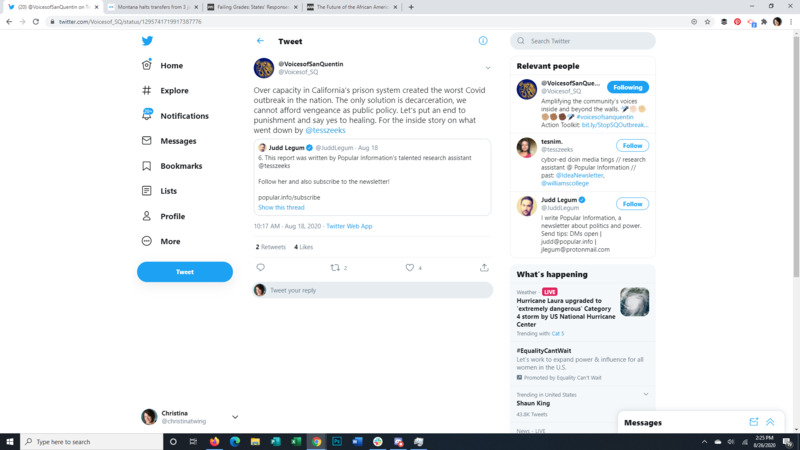
While this Tweet specifically addresses the responsibility overcrowding in California prisons has played in the Covid outbreak, other states have the same problem. Overcrowding in prisons and jails is a nationwide epidemic.
-
2020-07-07
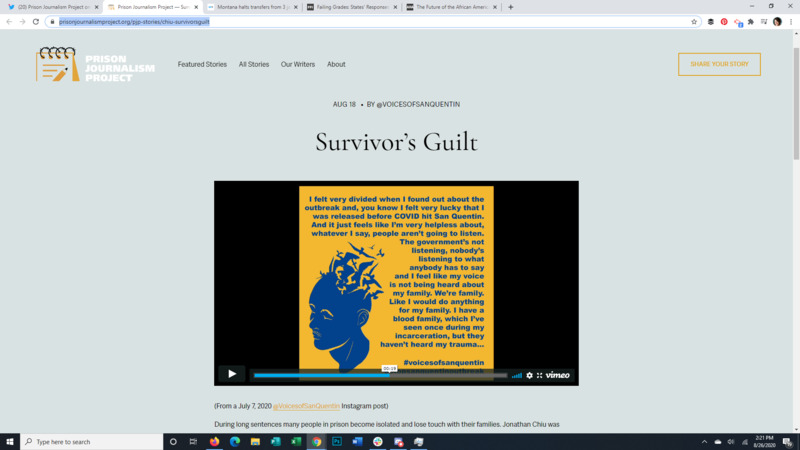
One man who was released from San Quentin Prison in California explains his feeling of survivors guilt. He was released in May 2020, before the outbreak in the prison began.
-
2020-08-18
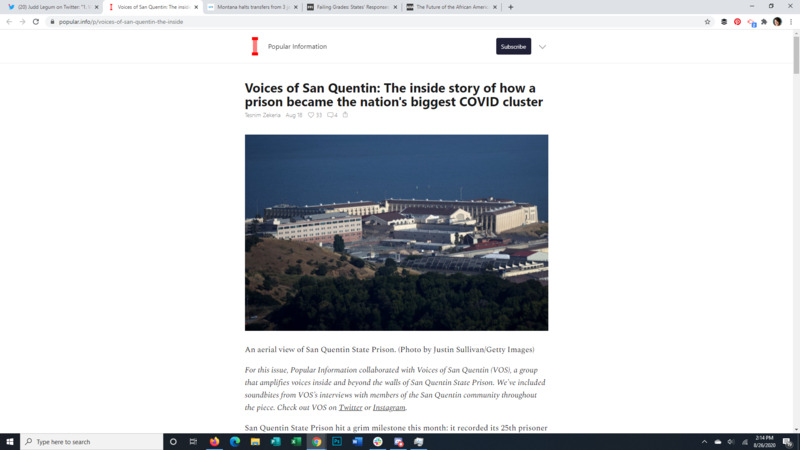
This article was co written by Popular Information and Voices of San Quentin. It explains how a major California state prison managed to stave off covid-19 until inmates from another prison were transferred into the facility. . . and they were carrying covid, what they did to deal with the outbreak, and how it effected incarcerated persons.
-
2020-07-09
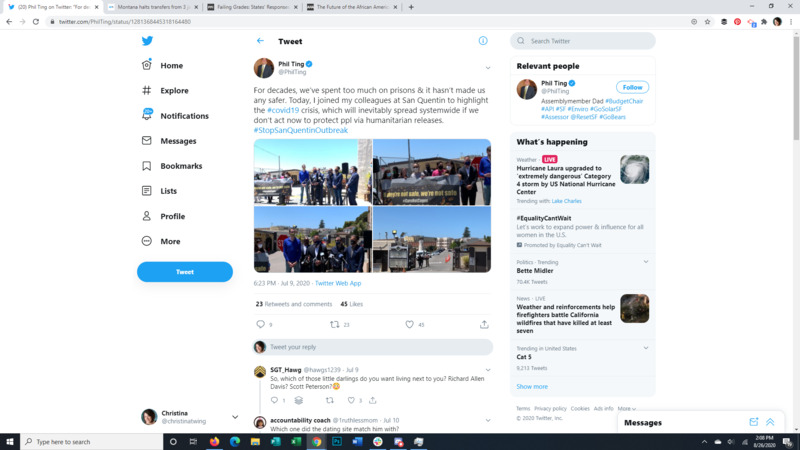
This Tweet highlights the activism around releasing incarcerated people to prevent the spread of covid and any sentence from turning into a death sentence.
-
2020-08-25
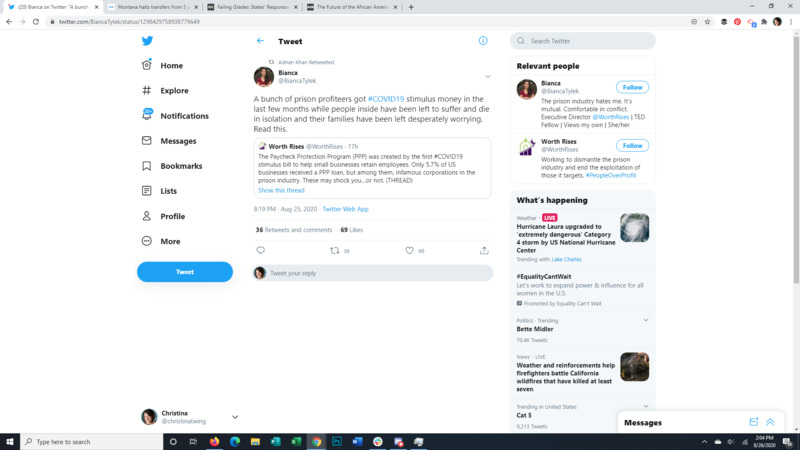
This Tweet poses a good question for investigation. Did prisons and other incarceration facilities receive PPP loans that were meant for small businesses?
-
2020-08-26
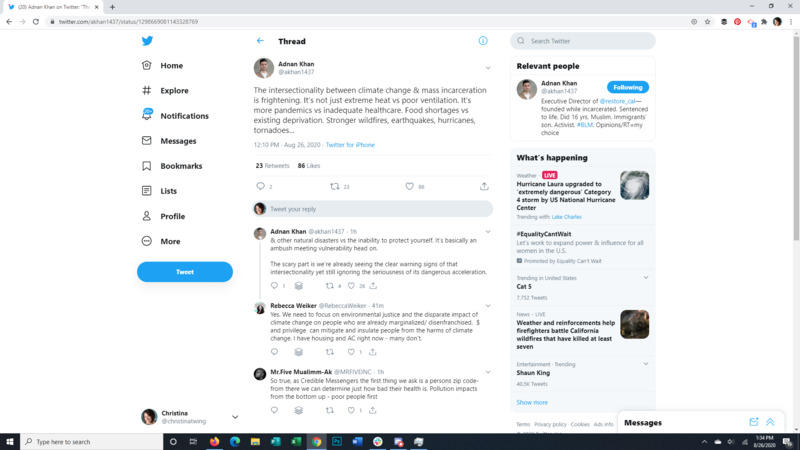
This Tweet brings up a point many may not have thought of. Climate change and it causing more pandemics which greatly effect incarcerated populations.
-

2020-03-25
Tiger King started an uproar of things during the pandemic. The outbreak of this show and the people who believed that Carol Baskin killed her second husband and fed him to tigers reopened the case. This submission is important to me because I really think that Carol killed her husband.
-
2020-06-10
so it all started when Bill Gates met the lizard people when facebook stared poping off. Mark Zuckerberg formed a plan to hand the human race over to the lizard people. This of course was a long term plan since the needed 5g technology wasn't around yet. Fast forward to 2019 and 5g starts to roll out as more towers are built and then 2020 come around and they try and convince us theres a virus and we should wear masks. Do you think a mask can save you from 5g? NO!! once the 5g mind control takes over Bill Gates will take over as the human representative for the lizard people. "covid 19" is slowly turning us over to the lizard people as we flawk to hospitals where they place microchips in the back of necks. Before you know it there will be lizard money everywhere and human life as you know it never be the same.
-
2020-08-20
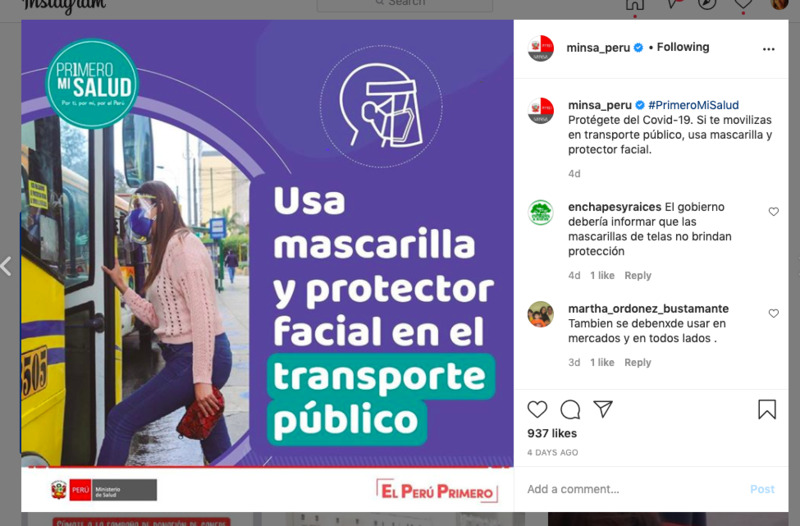
There's so much that Peru is doing right in terms of public health measures. This campaign is one more example, "Primero mi salud," (First my health), which is encouraging people to wear a mask and face shield on public transportation. The Ministry of Health has done a great job of creating campaigns and promoting sound public health measures. A commentator says...and people should wear them in markets, and everywhere, which is true. Infection rates will go down if more people follow these protocols.
-
2020-08-22
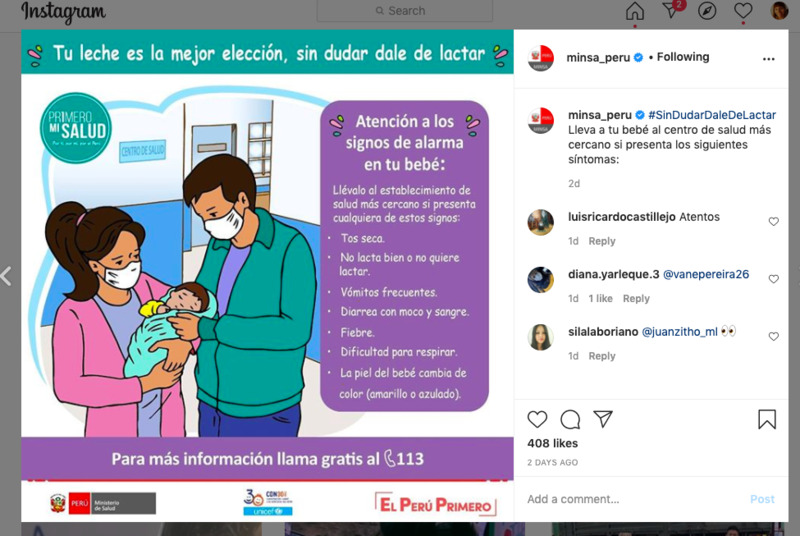
It’s really interesting to me that this recent public health promotion is advocating for nursing and responding to your baby’s changes. The parents are wearing face masks, so it’s clearly tying into the Coronavirus pandemic and larger public health concerns. From the Instragram account of the Ministerio de Salud del Perú.
-
2020-08-23
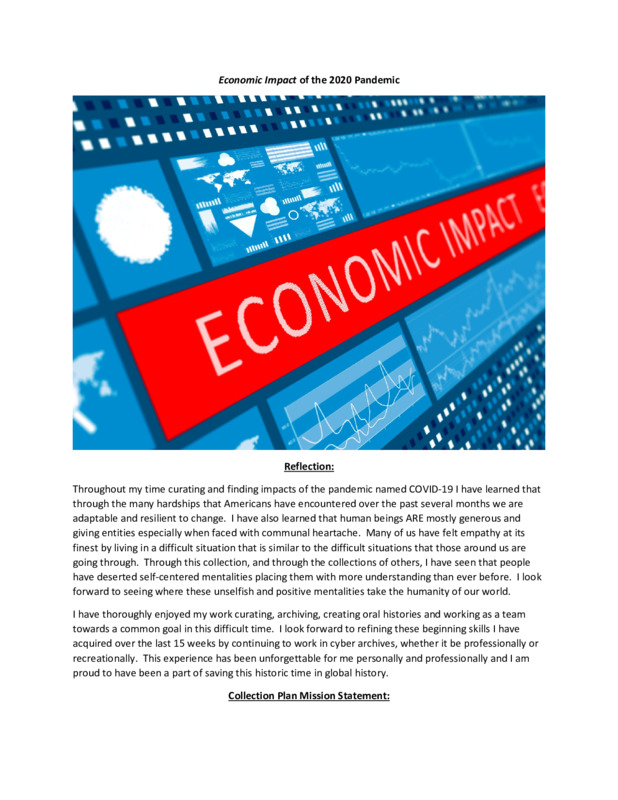
Throughout my time curating and finding impacts of the pandemic named COVID-19 I have learned that through the many hardships that Americans have encountered over the past several months we are adaptable and resilient to change. I have also learned that human beings ARE mostly generous and giving entities especially when faced with communal heartache. Many of us have felt empathy at its finest by living in a difficult situation that is similar to the difficult situations that those around us are going through. Through this collection, and through the collections of others, I have seen that people have deserted self-centered mentalities placing them with more understanding than ever before. I look forward to seeing where these unselfish and positive mentalities take the humanity of our world.
I have thoroughly enjoyed my work curating, archiving, creating oral histories and working as a team towards a common goal in this difficult time. I look forward to refining these beginning skills I have acquired over the last 15 weeks by continuing to work in cyber archives, whether it be professionally or recreationally. This experience has been unforgettable for me personally and professionally and I am proud to have been a part of saving this historic time in global history.
-
2020-08-23
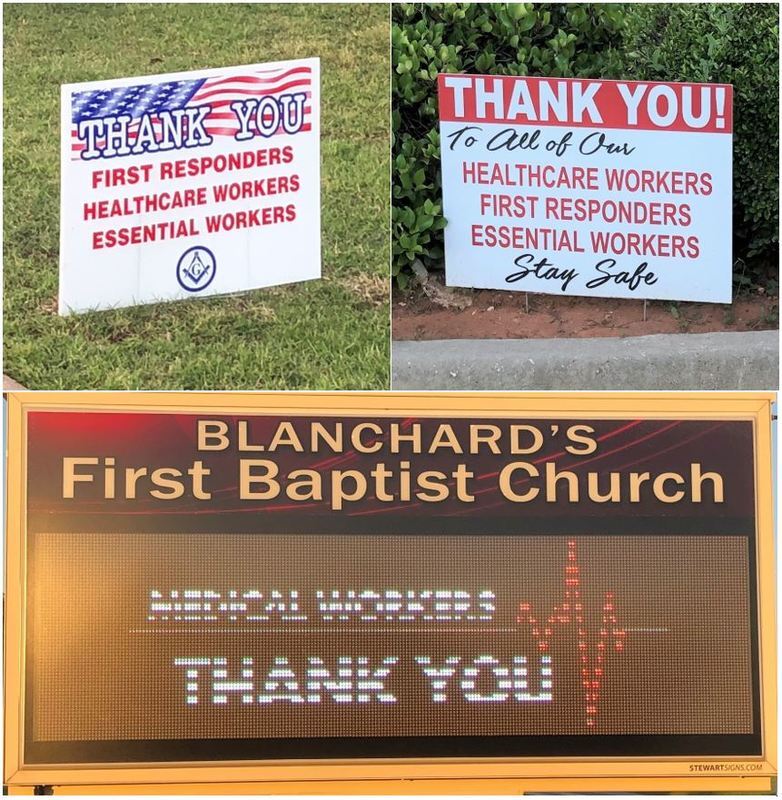
When I first began the Journal of the Plague Year internship, I wasn’t completely sure what to expect. I wanted to be part of something impactful and important during the pandemic and was hoping to learn some new skills that could be applied in furthering my academic studies or in future job pursuits. What I discovered as the internship went on is that I was going to get to do all of that and so much more. What I thought was going to be a “standard” internship was instead a fast-paced, jump in with both feet without looking, rollercoaster ride. I had no previous experience doing public history work beyond conducting an oral history interview with my great-grandmother for an “Aging in Rural America” course during my undergraduate studies. What I discovered was the entire behind the scenes effort that makes these pieces of information readily accessible to the public. As the internship progressed, not only was I adjusting to constantly changing best practice regarding curation, but I was also learning new skills that I would have likely not learned anywhere else in my academic career. What started, in my mind, as a simple internship turned into one of the greatest learning experiences of my academic career, to date.
Never had I imagined that I would learn, let alone use, some of the skills that were cultivated during this internship. While I am not a fan of the redaction portion of public history, likely because I don’t feel very adept at it, many of the other skills introduced and learned during this internship appealed to me greatly. During the blog post writing assignment, I discovered the challenge of attempting to write an attention-grabbing piece that was interesting to read to a general audience yet informational enough to convey the necessary information while maintaining a condensed length so as not to lose a reader’s interest. This was extremely challenging for me as I tend to be long-winded and include to much “fluff” in much of my writing. I, however, found the challenge enjoying and plan to continue to hone my blogging skills; maybe even someday start my own history related blog. One of the most enjoyable skills that I learned was the entire range of conducting and polishing an oral history. The development of questions, the interview itself, the transcription (the first few attempts were very rough), and even the cataloging and archiving of the history were a joy once I understood and was comfortable with the process. Finding new tools to use as part of the oral history portion of the internship such as otter.ai was also an extremely rewarding aspect of the process. This skill will likely prove itself especially useful in my further academic and professional pursuits.
Finally, the experience of interaction between the interns was unique in my experiences working with others. Never have I participated in an entirely digital project or team experience before the JOTPY internship. The experience was unique and very rewarding, and the interaction between the interns was exceptional. Not only did we conduct weekly meetings regarding the archive and internship and work remotely within groups using digital tools within the internship group, but we connected, interacted, and worked with other groups and individuals associated with the archive using the same tools (Zoom, Slack, etc.) I have had some of my fellow interns in other classes during my program, but being able to actively see, speak, and work with my colleagues was a wonderful experience and I was lucky to be part of such a great group of historians.
-
2020-08-21
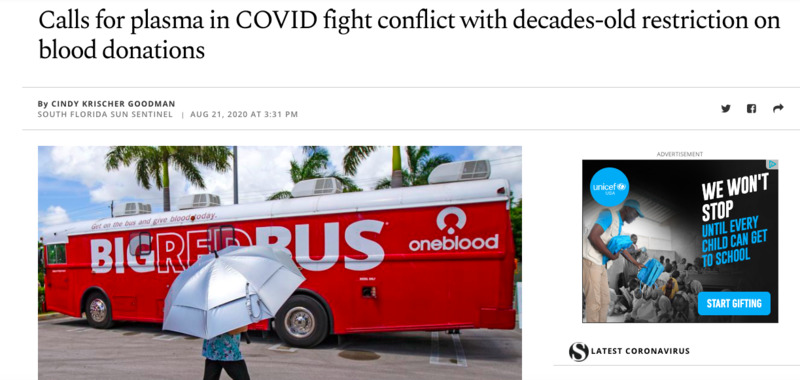
The frustration of many within the LGBTQ+ community over blood donations has been especially pronounced in the middle of the pandemic. The FDA recently moved the requirements for gay men to be abstinent from 12 months to 3 months. Activists and others point out that because blood can be screened for HIV, and that the rules are outdated and don't make sense. It is tragic that those who are capable of donating blood in this moment of crisis are unable to do so based on these current regulations. It brings back images of gay men that tried to donate blood after the Pulse nightclub massacre, but were turned away.
-
2020-08-23
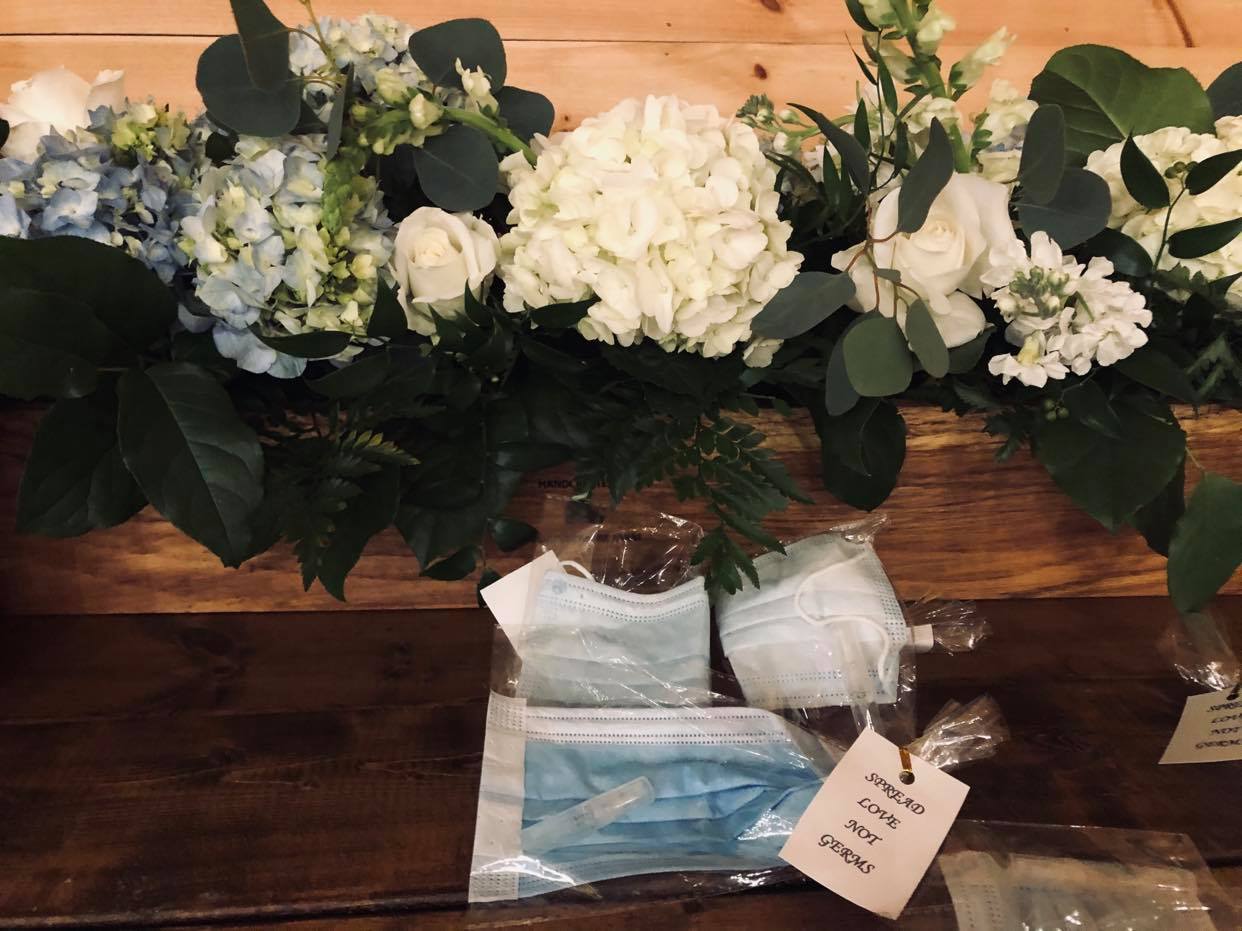
When I embarked on the journey that was the JOTPY internship, I was unsure of what it would entail. I knew there would be assignments centered around collecting information in regards to COVID-19, but I did not know the extent. I was very surprised to learnt that we would be in fact completing our own oral histories.
At the beginning, it was easier to contribute items to the archive, and extremely fun. But, as the work got more in depth, things got tougher. I had dabbled in oral history before, but had only done it to the extent of transcribing myself. By being introduce to Otter AI, my job got a lot easier. However, I'm still not a fan of oral history transcription.
This course/internship taught me a plethora of skills. These included working with a team, curating fro an archive, software skills and more which I hope to incorporate in my future classes and career. Overall, I thoroughly enjoyed the course and look froward to seeing it come full circle.
-
2020-08-20
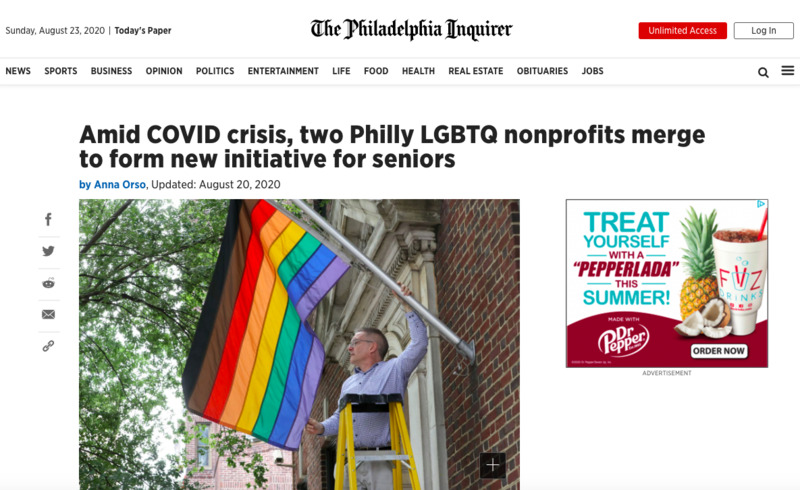
It seems that LGBTQ+ seniors are often overlooked within the community. In a pandemic that disproportionately impacts older Americans, this is especially problematic. In addition to the unique issues faced by LGBTQ+ people, being a LGBTQ+ senior makes that position especially precarious. It's relieving to see that there are organizations dedicated to protecting LGBGTQ+ seniors and I hope that this merger proves to be effective.
-
2020-08-20
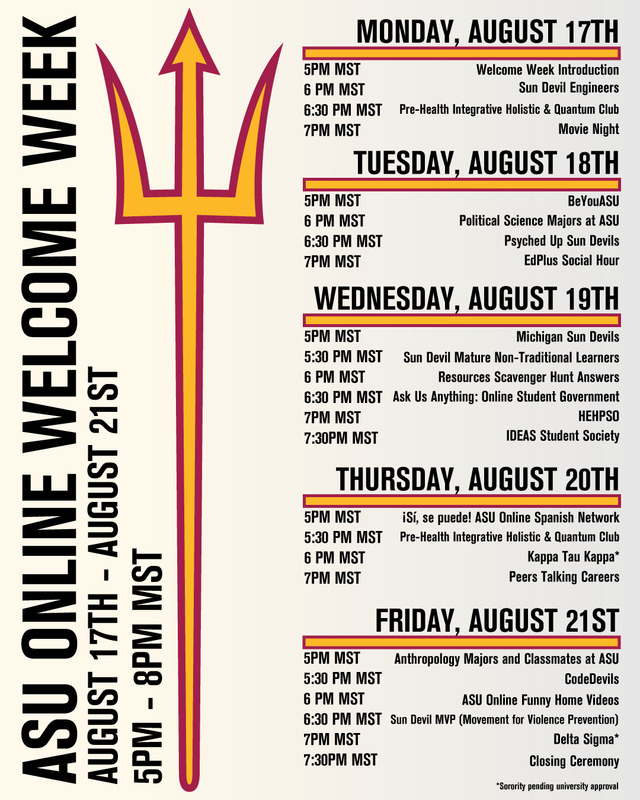
The COVID-19 pandemic has drawn more attention to online students, and given some people more time. ASU Online students have been working to develop one of the first online student governments in the nation, to represent Arizona State University's online campus. As part of this, ASU Online hosted its first ever Welcome Week via Zoom and is building rapport and establishing connections with the online community. It can be difficult to interact with your peers online in a social context, and this has provided many students the opportunity to connect and build new friendships. The community that has been built by online students, has provided myself, as well as others, the feeling that we are not alone during these unprecedented times.
-
2020-08-21
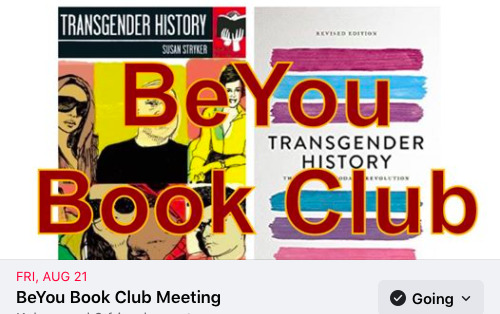
BeYouASU is a LGBTQ+ student organization that welcomes students from all of Arizona State University's campuses. BeYouASU kicked off its first book club for fall semester, which was held over Zoom. The return to school this fall feels much different than years prior, but BeYouASU is providing students the opportunity to connect with each other during this difficult time. Making new connections and friendships in a welcoming environment is something that is especially important in these unprecedented times. For book club, we are reading Susan Stryker's "Transgender History."
-
08/23/2020
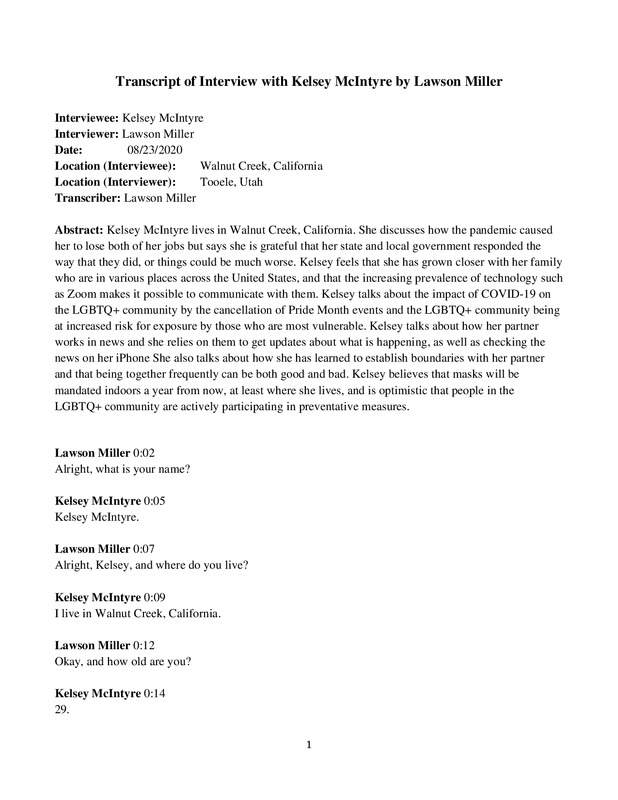
Kelsey McIntyre lives in Walnut Creek, California. She discusses how the pandemic caused her to lose both of her jobs but says she is grateful that her state and local government responded the way that they did, or things could be much worse. Kelsey feels that she has grown closer with her family who are in various places across the United States, and that the increasing prevalence of technology such as Zoom makes it possible to communicate with them. Kelsey talks about the impact of COVID-19 on the LGBTQ+ community by the cancellation of Pride Month events and the LGBTQ+ community being at increased risk for exposure by those who are most vulnerable. Kelsey talks about how her partner works in news and she relies on them to get updates about what is happening, as well as checking the news on her iPhone She also talks about how she has learned to establish boundaries with her partner and that being together frequently can be both good and bad. Kelsey believes that masks will be mandated indoors a year from now, at least where she lives, and is optimistic that people in the LGBTQ+ community are actively participating in preventative measures.
-
2020-08-23
I had planned to take the summer off from classes but when I saw an opportunity to be part of real time archiving in relation to the crisis I was living through I eagerly jumped at the opportunity. While I was initially worried, we, as interns, would get stuck doing the repetitive tasks no one else wanted, I was thrilled to be part of the creation and problem-solving process of a real time archive.
While most students in my program focus on American or Global history my focus has been on public history. One of the tenants of public history is involving everyone. The archive became a place to see this in real time. We weren’t collecting only around famous people, important people, or large movements. We wanted to collect the stories of everyday people and also took the time to figure out whose voices were missing and attempt to remedy that problem. To that end I took on an extra project to add Black voices to the archive. I collected a list of all the historically black colleges and universities and also searched for museums and cultural or heritage centers across the country that we could contact in hopes they would want to work with us to add those voices to the archive.
In addition to curating and adding items to the archive each week we focused on learning a particular skill set related to the archive. The one I struggled with the most was oral history. Though I am fine speaking in public and am not an introvert, I found conducting my first two oral history interviews exceptionally unnerving. However, I also discovered how important they are and what an incredibly rich source of information oral histories represent. What I learned from oral histories was so impressive that I have plans to conduct an oral history program in conjunction with my local historical preservation commission in the future. I am also no longer nervous about conducting oral histories.
By the end of our fifteen-week internship we had become even more than a team, we had become a family. I believe this was partially due to a shared crisis. We were living through the Covid-19 pandemic together. For many of us, our weekly Zoom (online meeting platform) was nearly the only face to face contact, though virtual, we had with anyone. This was the case for me. Another intern joked he was going to rename his journal about the project, “The Summer I Distracted Myself from a Pandemic by Thinking about the Pandemic”. I realized that is exactly what happened. The pandemic really started in mid-March for me. I spent the initial month or so sewing face masks and that was how I kept myself focused and sane. Once the internship began in May I began processing my experience of the pandemic by working on the archive. I believe this summer will have been one of the defining moments of my life.
-
2020-06-20
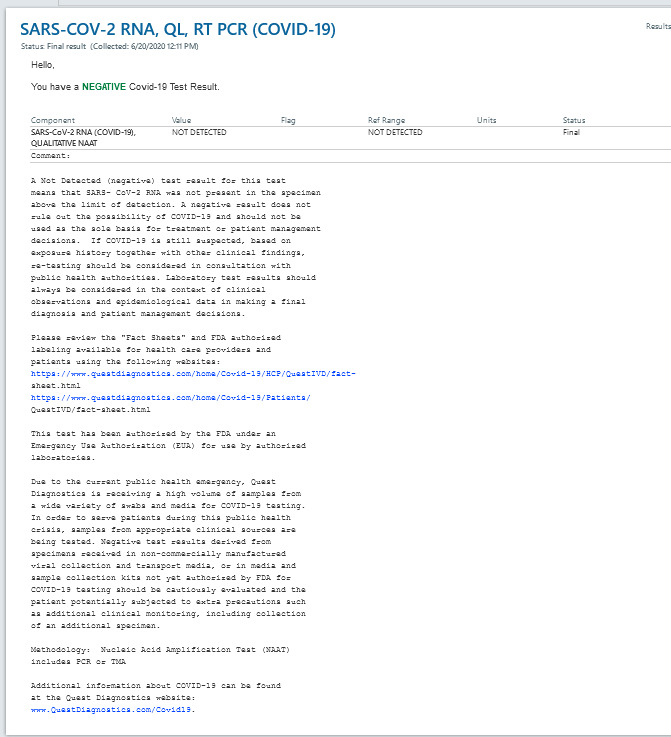
In June, the tutoring company I worked for decided to bring us back into the office to work in-person after we'd worked remotely for a few months. About two weeks after starting back, I nearly failed a pre-work temperature check, started having a bad cough, and developed other symptoms of COVID-19. Thankfully this was the last day I had to work in person for a few days. I decided to go to CVS to go get tested for the virus when I hadn't improved the next day.
My mom ended up driving me to the CVS. The branch that I went to had drive-thru testing, and I ended up not being able to take my test until 30 minutes after my appointment because of the influx of people getting tested. When it was my turn, the pharmacist handed my mom the test through the dropbox where they usually pass medicine through. The test kit had two disinfectant wipes, a pair of disposable gloves, the swab, a plastic bag with my name on it, and a test tube. The first wipe was for me to disinfect my hands before touching anything else in the bag. Then, I put on the gloves and grabbed the swab. This swab was long and pointy, and when I inserted it into my nose it made me sneeze. Once I finished swabbing both sides of my nostrils, the swab went into the test tube and the test tube went into the plastic bag. I used the final wipe to wipe down the outside of the bag before handing it to my mother to put into this biohazard box the CVS had installed outside.
It took a week to get my results back, despite the estimated 3-day timeline. Though my test was negative, it still changed my life for the next months. My grandfather had chronic respiratory problems, and since social distancing was near-impossible in my tutoring job, I took cut hours in order to go back to working remotely.
Arizona State University, HST 580
-
2020-08-10
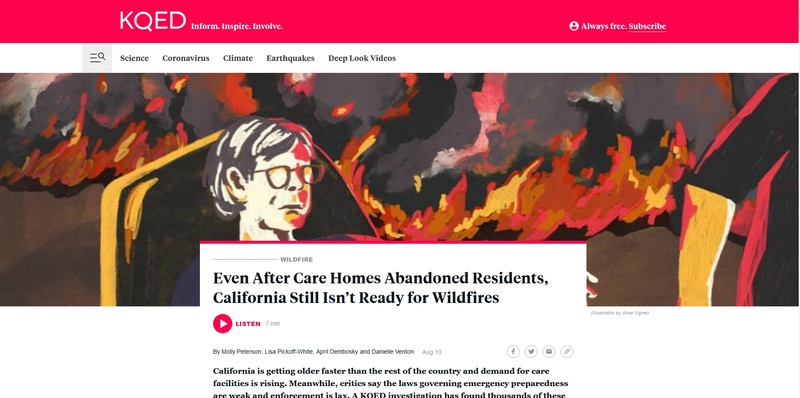
Emergency preparedness for California after care homes is lacking in the face of increasingly devastating wildfires, causing pain, trauma, and loss of life for the state's elderly citizens.
-
2020-08-22
Before starting this internship, I had little to no knowledge of working behind the scenes in public history. My focus is on public history, but I am still learning the ins and outs. I learned many valuable lessons on not only public history but also working with the public in an academic field. For me, some of the most useful parts of the internship were the oral histories and the ethics of the archives. I learned about the importance of transcripts and how much work goes into recording oral history. When it comes to ethics, I am still learning, but I am grateful to have experienced how JOTPY protects people's privacy and sensitive information. I am now aware of when and how to redact sensitive information and the best practices for redacting in an archival setting. I am more aware of the best file types to use when preserving digital items. I am eager to learn more about the digital side of public history from Omeka to apps.
I chose to preserve the impact of the pandemic on the food industry, food habits, and body image because of my tie to the industry, my interest in food history and fat studies. It has been a difficult topic to work on, but the experience I gained working on the Foodways collection has been priceless. In hindsight, I wish I had chosen a more relatable collection because I often felt like I was alone in left field. Other interns were able to share and exchange items, that did not happen with my collection as much as others. Besides a couple of interns, I did not get the chance to network with others. Food is a relatable subject, but the industry is not. I found areas that I need to develop, including my networking skills and being confident in what I bring to the academic table. I gained a lot of confidence in my abilities through this internship, and I am grateful for the areas; it helped me see where I have room to grow. As a student with learning disabilities from a non-academic background, I was the fish out of the water, but so many of my skills did translate. The internship also gave me the push I needed to leave my comfort zone and view myself outside of the industry I've been working in for decades. If I could keep working on this archive, I would in a heartbeat, I am grateful for all that I have learned this summer.
-
2020-08-20
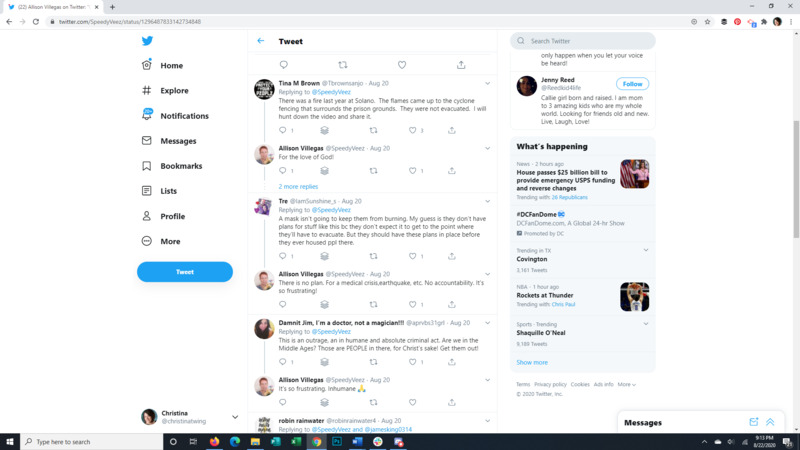
While California depends on prison labor for wildfire firefighters this Tweet brings attention the state refusing to evacuate prisons in threat of wildfire danger. Other Twitter posts have mentioned speaking to inmates at Solano and them mentioning guards coming in with ash on their uniforms. The fires are that close!
It seems that many people once incarcerated are at risk for a possible death sentence due to Covid and wildfires. What else?
-

2020-08-20
This Tweeter, Phil Melendez, expresses his horror at more than fifty inmates in the care of the California Department of Corrections and Rehabilitation having died already from Covid-19 and now a wildfire is within blocks of California prisons with no plans for evacuation.
-
2020-08-22
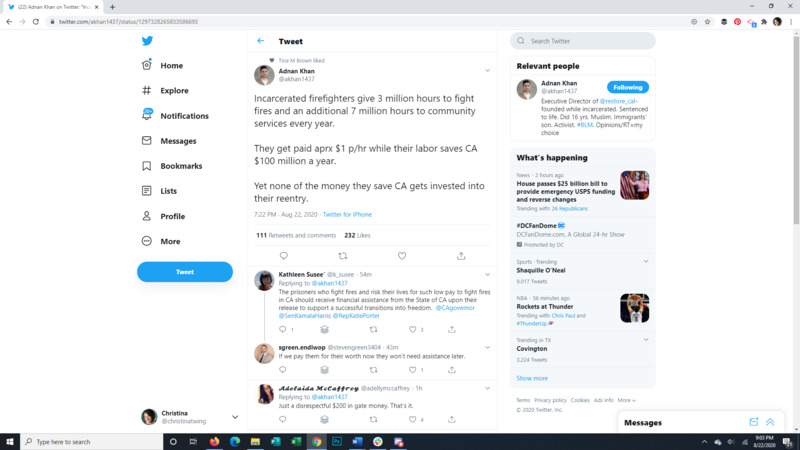
This Tweet expresses dissatisfaction with incarcerated firefighters who give so many hours and save the state of California millions of dollars every year, but none of that savings is put into supporting them with re entering society.
-
2020-08-20
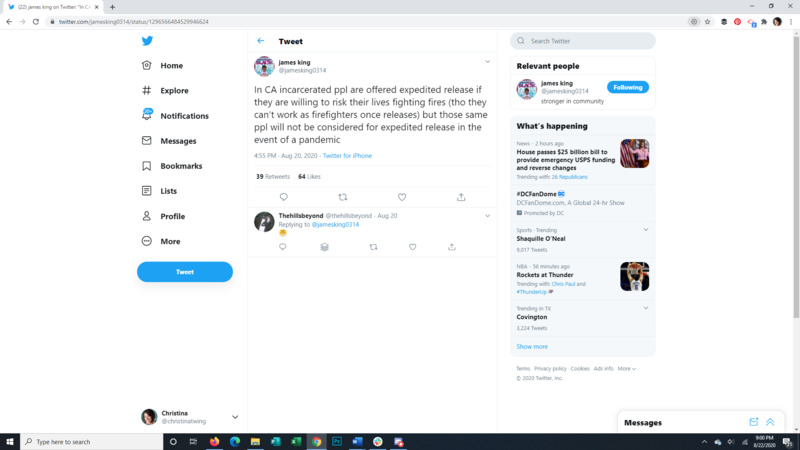
This Tweet shows that while California depends on prison labor for their wildfire firefighting, these same people are not eligible to work as firefighters once they are released from incarceration.
-
2020-08-21
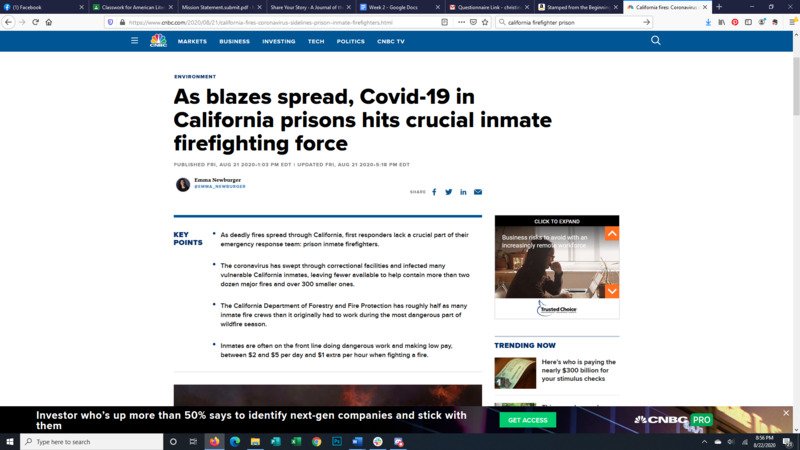
California depends on prison inmate firefighters to be part of their wildfire defense teams. This year, due to illness and early release, they are missing half of their prison inmate firefighters. To help alleviate the shortage the Governor, Gavin Newsom, has called in the National Guard.
-
2020-08-20
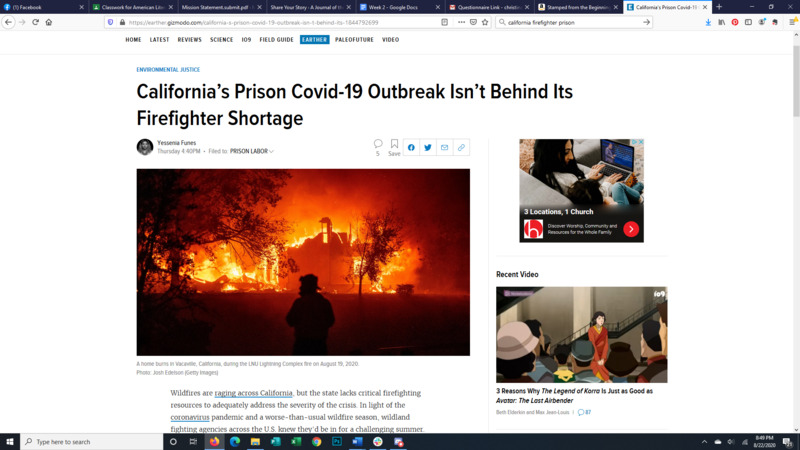
California, one of the most fire prone states in the nation, still relies on prisoners as firefighters. With a particularly bad fire season and a viral pandemic still raging through the country they find themselves in a precarious situation. In an effort to slow the spread of the virus correctional facilities have been releasing some incarcerated persons early. In California over three hundred of their prison labor firefighters have been released since July. This article explains more of the details.