
Items
topic_interest is exactly
Ukraine
-
 2022-06-10
From Sourdough to Inflation: How the Pandemic Changed the Way We Eat
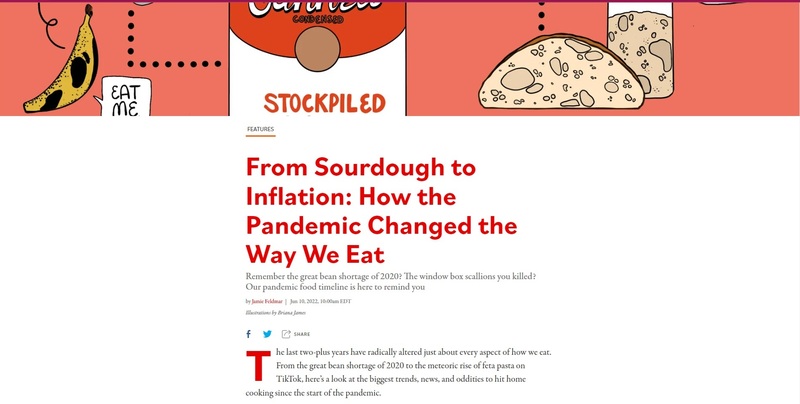
This is a news story from Eater by Jamie Feldmar. This chronicles the changing food habits of people throughout the pandemic. In 2020, there was a wave of panic buying for things like flour, canned soups, and frozen vegetables. The use of grocery store delivery apps also increased that year. Instacart, a grocery delivery app, saw a 229% sales increase. With the panic buying came people looking for ways to use up things like canned goods and dried pasta. Things like sheet pan dinners, salads, and other easy meals became sought after in that time. Another change that occurred was people trying food trends popular during the pandemic. Things such as sourdough and whipped coffee were major food trends of that time. Meal kit delivery rose during the pandemic. Blue Apron had subscriptions to their food service skyrocket. Hello Fresh did as well, and was forced to close down temporarily to hire 3,000 extra workers to tackle the rising demand. In 2021, other food trends occurred while many restaurants and other dining establishments could not operate at full capacity. Things like espresso martinis and the dalgona candy, and candy made popular by the TV show Squid Game, were just some of those food trends. The food trends were not without labor issues though. In October 2021, Kellogg's workers went on strike, which affected the supply chains of that brand. Supply chain issues have become an ongoing problem since the beginning of the pandemic. In February 2022, the US temporarily shut down avocado imports from Mexico, making the food more expensive. With supply chain issues comes rising inflation. According to the USDA, food prices in 2022 were expected to rise between 6.5% to 7.5% increases. The Russian war with Ukraine cited as one of those causes. May 2022 saw a baby formula shortage, where 40% of baby formula was out of stock. Today, the USDA is looking to learn from the pandemic and the food issues that are occurring. One way they are doing this is through "a framework to transform the food system," which has the focus on building a more resilient supply chain while providing for rural and underserved communities. My own prediction is that the supply chain issues will mean more local food and less imported food overall in the United States. This means opening more food processing plants and increasing work domestically within the food industry to meet demands. The global food system is very fragile to things like pandemics and war. If food prices are to ever get lowered as well, it is important that more food gets produced and used locally. It would have the added benefit of being more environmentally friendly too, as the food would not have to be shipped as far away to where it gets used. -
 2022-04-22
The Shanghai Lockdown. Seen from Another Angle
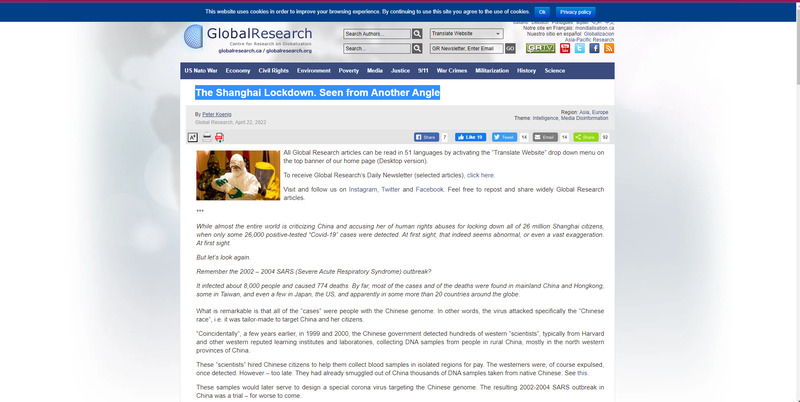
This is a screenshot of an article from globalresearch.ca about looking at the most recent Shanghai Lockdown. Yet, the article does not talk about the Shanghai lockdown until maybe halfway through the article. It goes on a tirade about how the 2002-2004 SARS outbreak went after the "Chinese race" and how it became an early trial for China before COVID. Then the author states that China has "mastered the disease" and managed to reopen its economy by the end of 2020, which leads to the conclusion that China's economic growth hardly suffered during the newest outbreak. The author asserts that China will surpass the U.S. economy in 3-4 years and then launches into a world history lesson about Cold War politics. The author tends to wander in the article, going from pandemic skepticism on vaccines sterilizing women, being lied to the government, or having HIV ingredients. Then somehow, Ukraine has virus labs...I don't know. Somehow, Russia is involved in this article, but I'm not sure why. I don't know how this is supposed to persuade its audience because the author goes all over the place with his points. I suppose skeptics will like the fact that the vaccine is being questioned here? Personally, I don't even understand why skeptics would want to read this because I think they would lose even more brain cells from just trying to read it. I think this article is just a gigantic mess and it makes my brain hurt. I find myself just not understanding a single thing that is being written in this article. I don't understand why anyone would even understand or like this article. It literally makes absolutely no sense and there are even typos in it. The look of this website and article makes me want to run my virus protection at least three times because I feel like they're going to infect my computer with a Trojan horse. -
 2022-04-29
Pelosi endorses strategy to combine Ukraine, COVID aid
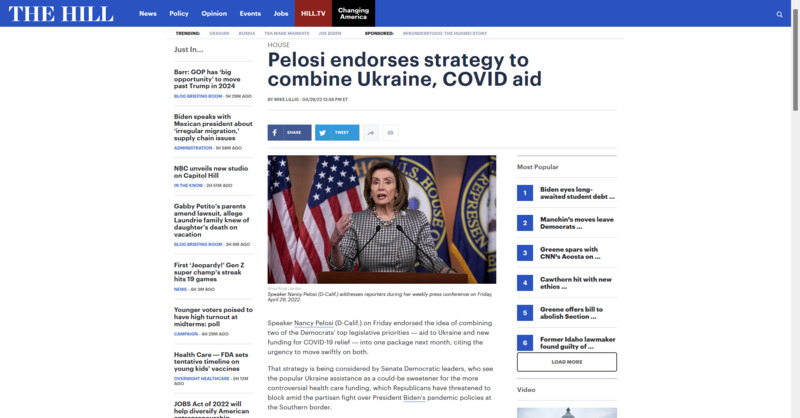
This is a news story from The Hill by Mike Lillis. This is about House Speaker Nancy Pelosi combining COVID aid with Ukraine aid into one package. This strategy is intended to help Congress pass the spending needed for Ukraine for the war. Currently, the CDC has said that overall need for aid has diminished as cases keep going down, with more guidelines being removed. House Majority Leader Steny Hoyer (D-Md.) said the prospect that combining the two bills could delay them both is “a real consideration” that will likely influence the ultimate strategy. -
 2022-04-14
Biolabs
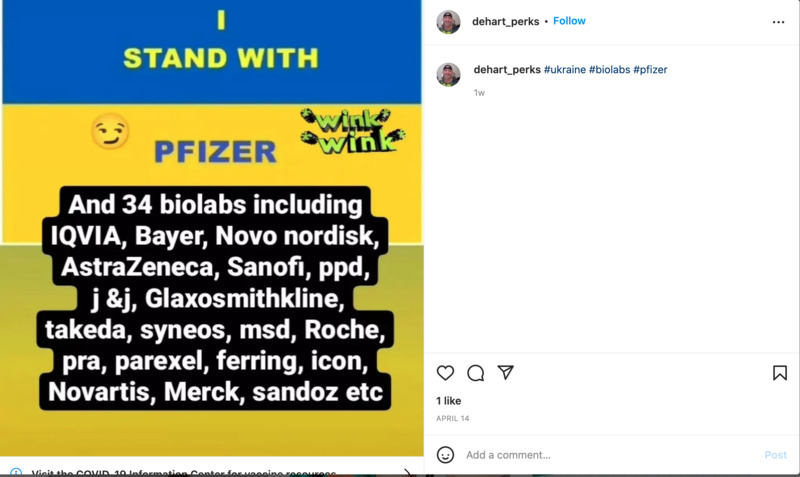
This is an Instagram post by dehart_perks. This is a parody of the "I Stand with Ukraine" social media trend that became popular with the Russian invasion of Ukraine. It is making fun of people that follow the media narrative, whether it is for which side to support in a war, or getting vaccinated. The extra things that are added, are biolabs, which some believe are responsible for helping create COVID itself. -
 2022-04-15
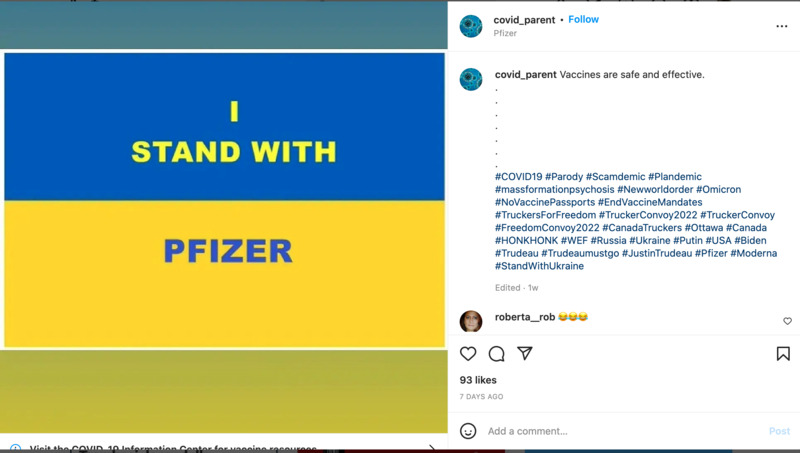
I Stand With Pfizer
This is an Instagram post by covid_parent. This is a parody of "I Stand with Ukraine" posts that have become popular over social media since the Russian invasion of Ukraine. Instead of saying that they stand with Ukraine, it is saying they stand with Pfizer, a pharmaceutical company. It is mocking the type of people that just follow any trend, whether it is vaccines, or which side to support in a war. The hashtags call the pandemic a "scamdemic" and references the "New World Order." These tags indicate the overall feeling that the pandemic is partly, or completely planned, in order to exert more control over people and limit their freedoms. -
 2022-03-03
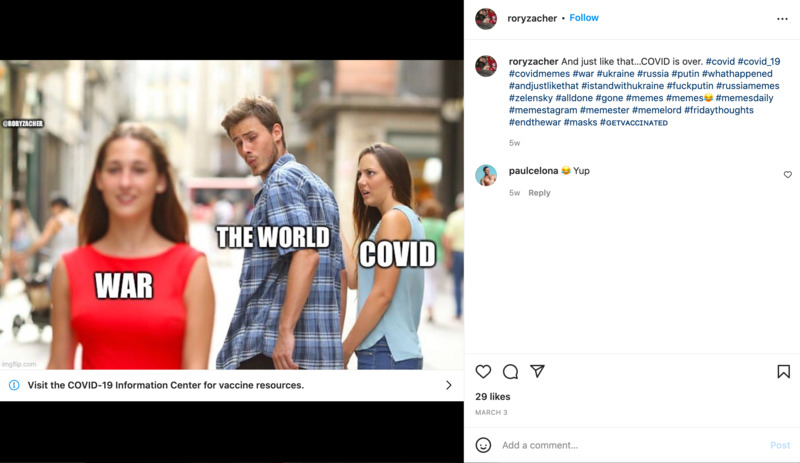
And just like that...COVID is over
This is an Instagram post by roryzacher. This is a meme showing what they think about the virus. This is a popular meme of a guy looking back at a girl in red, with his angry girlfriend in blue to the side of him. This meme became popular in the mid-2010s and has retained its popularity. In this context, it means now that there is a war, the COVID narrative is gone. This is commonly used by pandemic skeptics since they believe many of the COVID restrictions were more political rather than for health reasons. The war this is referencing is the Russian invasion on Ukraine. -
 2022-03-02
I Support the Current Thing
This is an Instagram post by waking.the.dead. This is an NPC meme of people claiming they have a healthy distrust of authority, while supporting things imposed by authority. The NPC meme is a meme that gained popularity in the late 2010s and has had continued popularity in the 2020s. NPC stands for "Non Playable Character", which is a term used in gaming for pre-programed characters that have a set script for when the players interact with them. This has expanded to apply to people, with it being used as a slight towards any and all political sides, and portraying the side they don't agree with as having no original thoughts of their own. The context of the NPC meme with the "I have AIDS" thing at the bottom is a reference to the claim that some of the COVID vaccines actually weaken immune systems and sometimes give people AIDS. The mask with the Ukraine flag refers to the current war between Russia and Ukraine, and support of Ukraine in some circles has been seeing as "following the herd because the media/government said to." The top part of "I have healthy distrust of authority" is meant to be ironic, as the NPC has fallen for all the current narratives without question. -
 2022-04-11
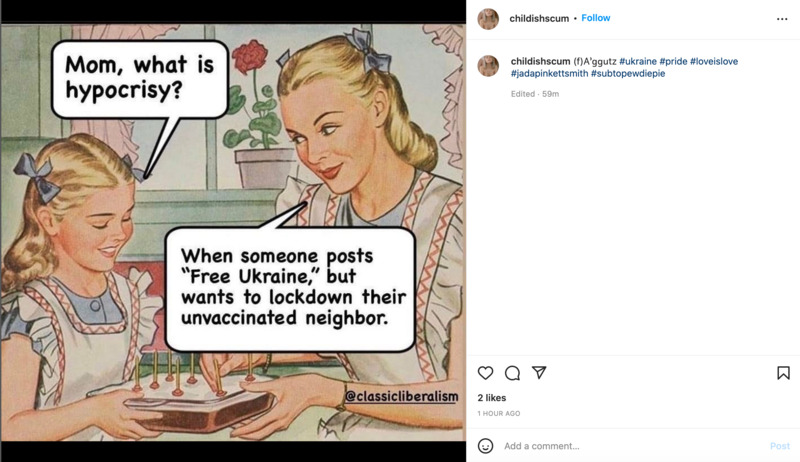
Mom, what is hypocrisy?
This is an Instagram post by childishscum. This is a meme where someone has overlaid a fake conversation in order to show a point. What the poster is arguing is that the same people saying "Free Ukraine" are also the ones wanting more lockdowns in their own cities and towns. "Freedom" in this case is taken very broadly, where fighting against an invasion for freedom is being conflated with wanting lockdowns lifted. -
 2022-04-11
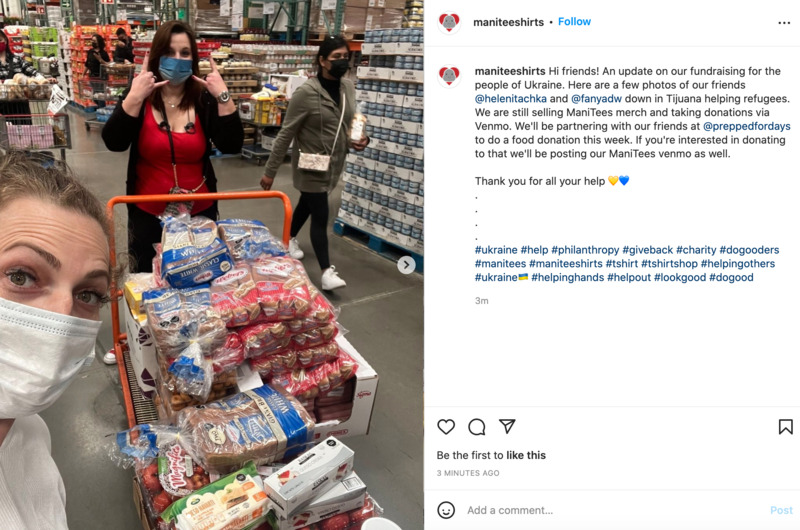
Fundraising for Ukraine
This is an Instagram post by maniteeshirts. This post is about people fundraising for Ukraine since they have been hit hard by the Russian invasion. Noticeably, all of the people posted in this picture are all wearing masks. This picture helps show that where some places might not require masks, some people are still wearing them. Due to not being given a location, I am not sure on the status on masks where this was posted. Since everyone is wearing them though, I am at least guessing it is a store that requires masks to enter. -
 2022-04-03
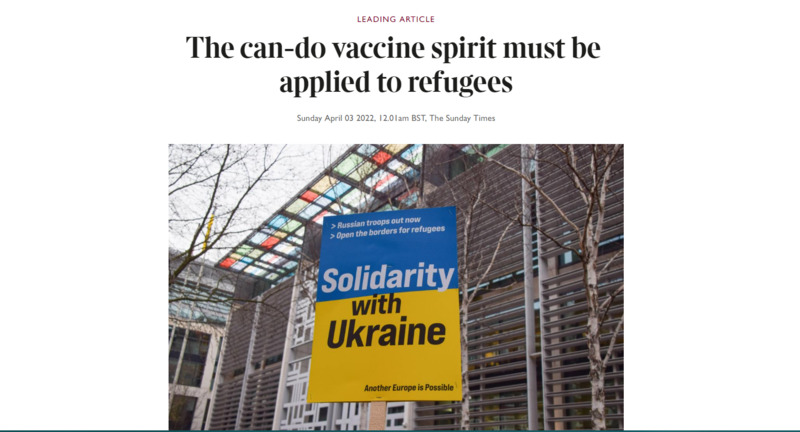
The can-do vaccine spirit must be applied to refugees
This is a news story written by The Sunday Times (cannot find author). The Sunday Times is a British paper and this is detailing the contrast between the generosity of the British citizens towards Ukrainian refugees, but the lack of care from the British federal government. It says that over 200,000 people and organizations have registered to sponsor refugees in the Homes for Ukraine scheme. The overall story is not about the vaccines themselves, but the author is wishing for the can-do attitude of distributing vaccines in the UK to be applied to the refugees. Of the visas applied by refugees, for families, 32,300 applied for a scholarship, but only 4,700 were issued. I think that during the pandemic, the author that wrote this got more used to the government being lenient in helping, but now when faced with a refugee crisis, lacks that same helpful spirit. -
 2022-03-26
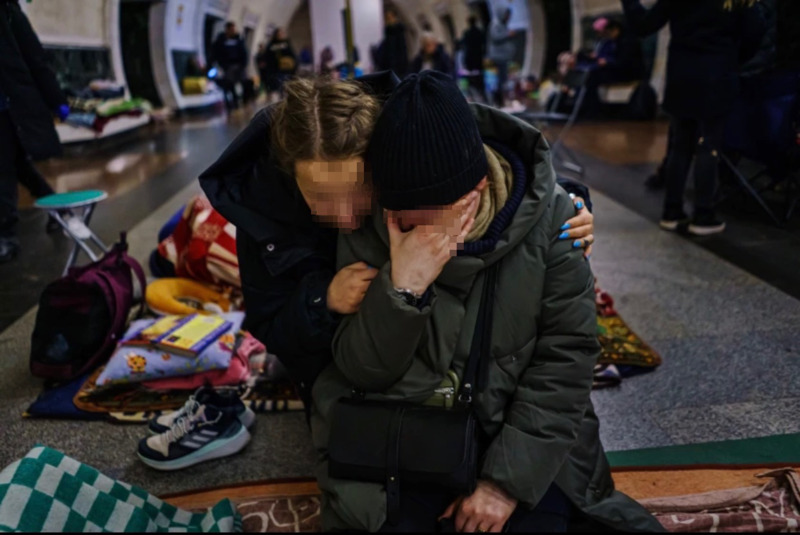
Russia spread anti-vax lies in Ukraine. Will it cause a COVID crisis for Europe?
This is a news story from the Los Angeles Times by Melissa Healy and Emily Baumgaertner. The authors claim that even prior to Russia's invasion of Ukraine that Russia has been working to undermine the confidence of Western vaccines. It says that these messages were encouraged by President Vladimir Putin and shown on Russian TV and social media. In Ukraine, only 35% of residents are fully vaccinated, some of the lowest in all of Europe. This makes the refugee crisis in Ukraine more dire, as people needing to leave will risk spreading COVID more places. The authors assert that with the low vaccination rates of Ukrainian refugees that it will cause another surge in COVID cases throughout Europe. The CDC has advised countries accepting refugees to offer them the vaccine upon entry. This article details that this is not the only vaccine that Ukrainians have not accepted as much compared to the rest of Europe. In 2021, only 53% of Ukrainian babies were vaccinated against polio. That number has now risen to 76% of infants being immunized against polio. Though, the likelihood of these diseases spreading as far as COVID are fairly low. The vaccine hesitancy, the authors say, is rooted in deep distrust of the government. In December 2020, only 14% of Ukrainians reported having trust in their government in a poll. -
 2022-03-05
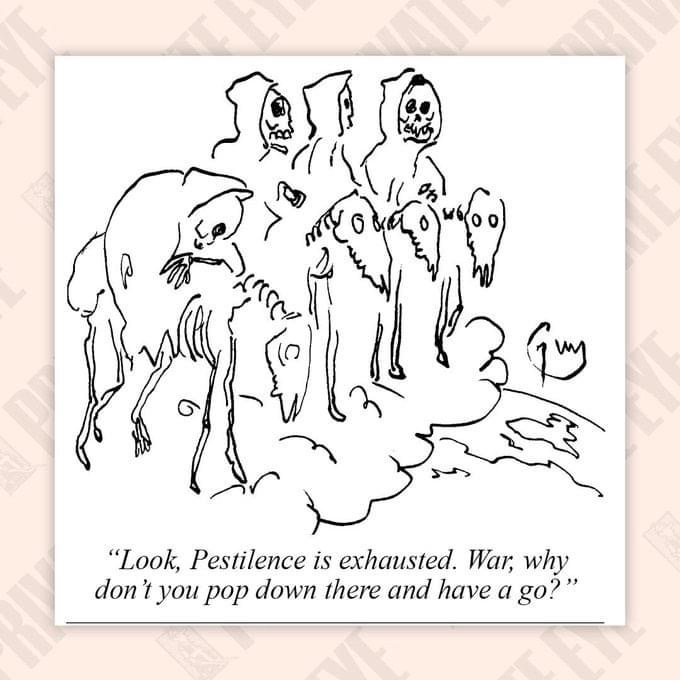
War and pestilence
I saw this on facebook. In most people’s minds, Russia’s invasion of Ukraine is just a continuation of the rolling crises marked by the pandemic. -
 2021-04-17
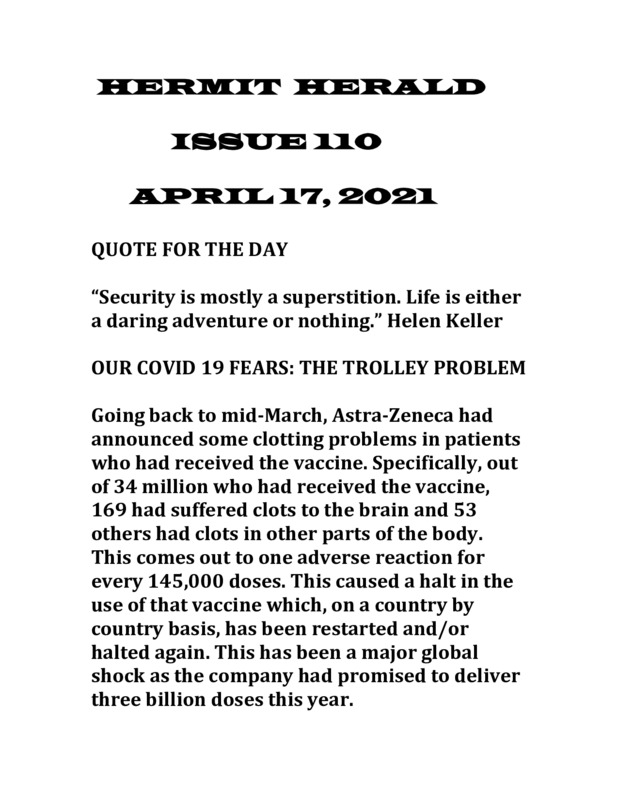
hermit HERALD, ISSUE 110
VACCINE FEARS, THE TROLLEY PROBLEM -
 11/19/2020
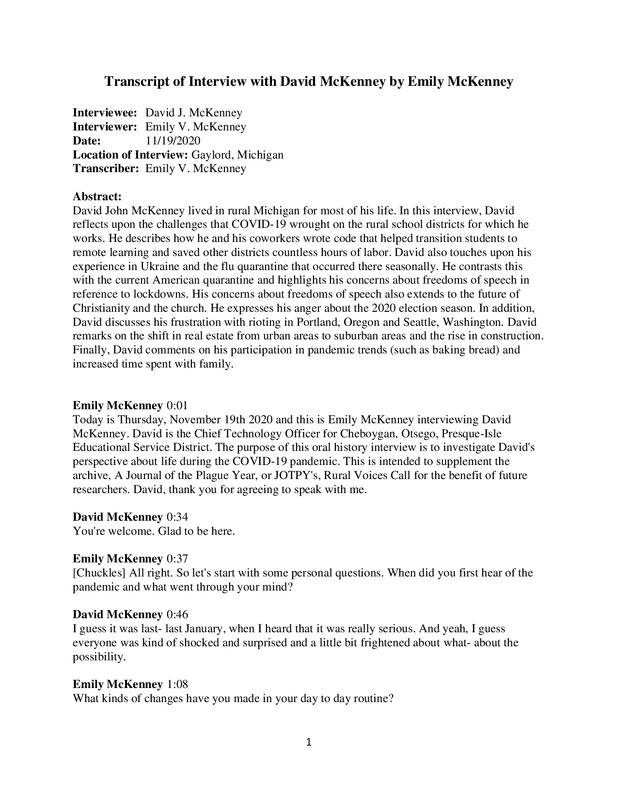
David McKenney Oral History, 2020/11/19
David John McKenney lived in rural Michigan for most of his life. In this interview, David reflects upon the challenges that COVID-19 wrought on the rural school districts for which he works. He describes how he and his coworkers wrote code that helped transition students to remote learning and saved other districts countless hours of labor. David also touches upon his experience in Ukraine and the flu quarantine that occurred there seasonally. He contrasts this with the current American quarantine and highlights his concerns about freedoms of speech in reference to lockdowns. His concerns about freedoms of speech also extends to the future of Christianity and the church. He expresses his anger about the 2020 election season. In addition, David discusses his frustration with rioting in Portland, Oregon and Seattle, Washington. David remarks on the shift in real estate from urban areas to suburban areas and the rise in construction. Finally, David comments on his participation in pandemic trends (such as baking bread) and increased time spent with family.