Items
Tag is exactly
empathy
-
 2021-09-11
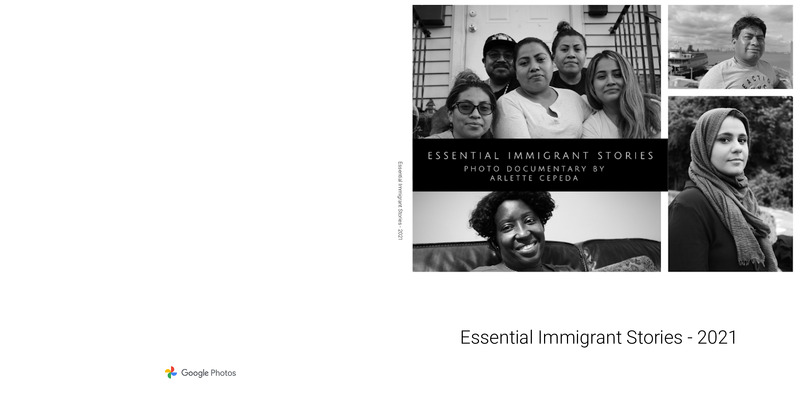
Essential Immigrant Stories - Photo Book 2021
Essential Immigrant Stories is a photo-documentary project by visual artist and photographer, Arlette Cepeda, that focuses on highlighting the challenges and opportunities the COVID-19 pandemic has created for Staten Island’s immigrant community members through portraits and accompanying stories. The goal of this project is to elevate and validate the immigrant experience and their impact in our Staten Island community. “Through portraits and accompanying short stories, I'm interested in documenting the experiences of the often neglected, silenced or omitted immigrant population of this particular north-shore neighborhood.” “It is my hope that this project can help create awareness, increase empathy, acceptance and understanding of our otherness, narrowing the divide and discrimination often faced by immigrants.” - Arlette Cepeda -
 2020-03-21
Education changed
It was my first year teaching middle school history. I was bright-eyed, excited, and felt like I had finally found my calling in life. I went into spring break with such an excited feeling about my new career path. Coming from retail, I could finally have time to spend with my family and not have to worry about making a quota. Then the email came. We would be moving to distance learning and I would not get the chance to finish my first year as an educator with my first group of kids. The sound I most remember was the Google Meets login when someone joined. That sound will forever be associated with the pandemic. The sound I had never heard before became the sound that brought me joy as I was finally able to make sure my students were okay. I remember that sound and immediately checking to see who was logging in. It brought mixed feelings of compassion, empathy, and sadness. Even as we started to get back into the classroom, nothing would ever be the same as it once was. But that sound, that one quick sound, brought on the emotions of this educator. And I hope I will never have to hear that sound again. -
 2022-03-13
The Virus That Slowed Us Down
I was worried before the virus as to what would happen to the world if we just kept moving forward like we were. It seemed that the world was in the motion of forward, keep going going going going. Do not stop, do not stop, keep moving forward. In a way the virus showed us more than we could have ever asked for. Once we were all stripped of the things we all enjoyed and loved, things changed. We were introduced to new things that we did not feel or experience again because we left them behind in our continuously moving forward lifestyle. The people that needed to do some internal viewing was able to stand back, and work on themselves. The people that did not know where they were going in life had a chance to breathe and catch up with the state of the world. Do not get me wrong, the virus was the worst thing to happen to our society...but it also showed us that we are all not different. Sadly some aspects of it were politicized and given a merit for your views, but in the end, the people that took it for what they could .. learned. We become better fathers, better mothers...better friends, better siblings,, a better us. We seen the things we were missing that were in-front of us all along and that was each other. The virus forced empathy upon us and everyone around us. The world will forever be changed by the one thing we could never fight against and that was ourselves. -
 2021-11-09
Professor Perspective on University Changes
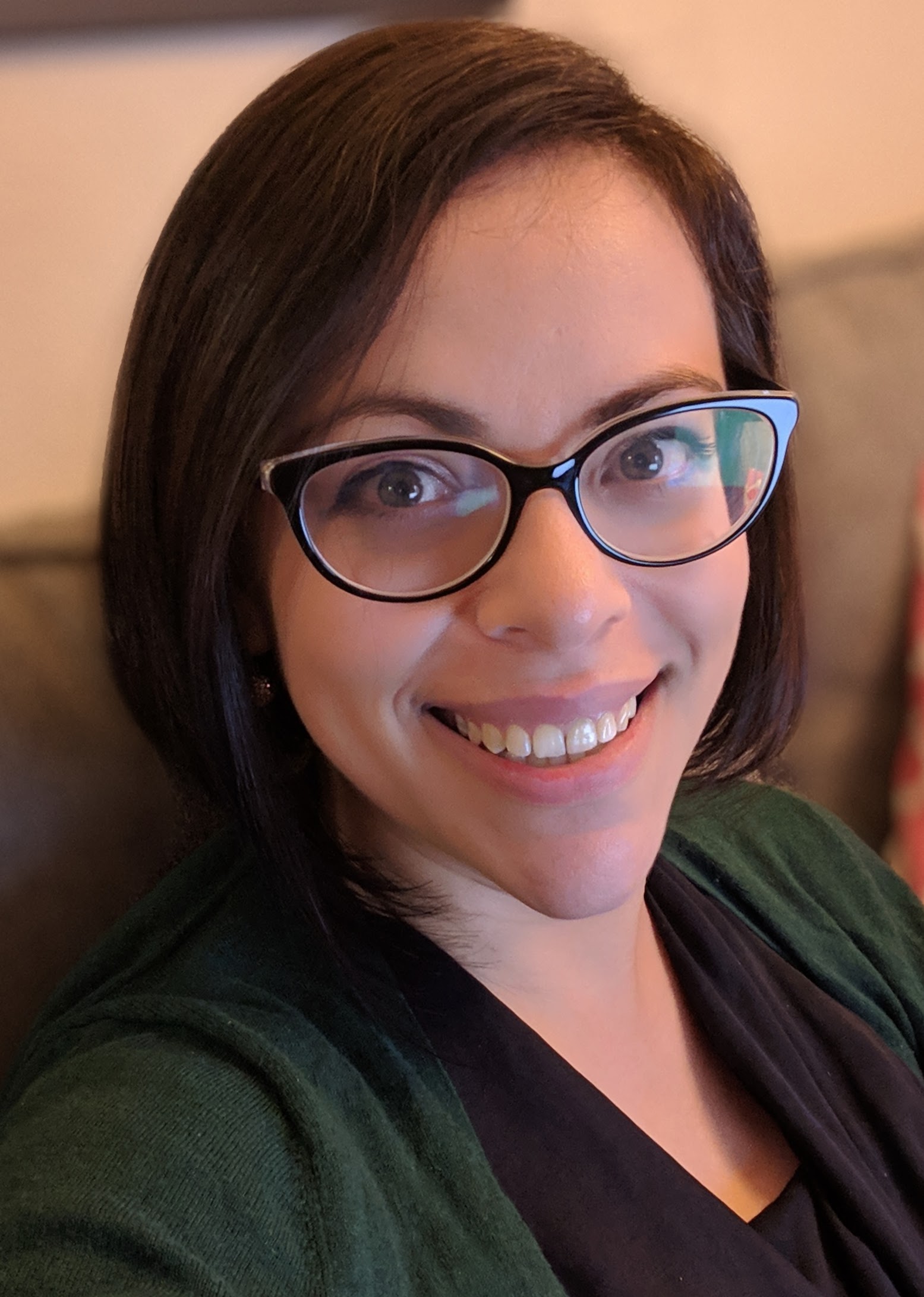
Dr. Sara Ronis, a theology professor at St. Mary’s University, gives us a faculty perspective on how she believes the university handled the COVID-19 pandemic. She feels that despite being in such difficult positions, the university made the decisions they knew would be best for the St. Mary’s community. As a professor, she immediately thought of her students when COVID cases began to rise and the possibility of being sent home became an even more real possibility. She admires how St. Mary’s students, new and returning, have adapted to these new learning environments. -
 2021-03
How to Survive a Plague with a Disability
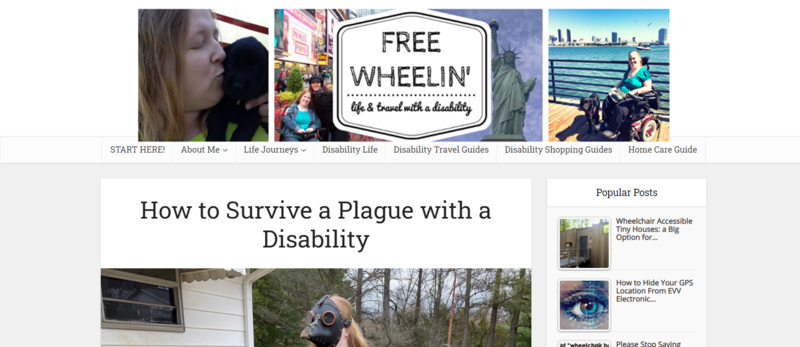
As I’m writing this, it is March 2021 and it’s been a year since I’ve updated this blog. Although I don’t only write about travel here, it’s been depressing to look back on my past trips and have to wonder when I could be in the world again. But I’ve been far from silent during this time. You can read many of my reflections on the pandemic and other topics over at The Mighty, where I have been an editor for the past five years. One year ago, when the pandemic was just beginning in the United States, one of my good friends posted a social media message about supporting each other during what most people thought would be a strange, scary, but ultimately short period of our lives. Part of it went something like this: My mask protects you. Your mask protects me. It’s a nice sentiment. Wearing a few layers of cloth over your face may not help you much, but it helps to prevent other people from getting sick. It’s a kind, visible act we can all do to show we care during a difficult time, to protect others who are at risk even if we may think we would not become seriously ill. It seems so simple, right? How could people not do this? But we all know what happened. “My mask protects you. Your mask protects me,” only works if the other person values your life enough to consider it worth protecting. I’ve been horrified by the number of government officials and online commenters who have viewed the deaths of elderly and disabled people as “acceptable losses” in exchange for keeping non-essential gathering spaces open. My life, and the lives of people with high-risk conditions, are more important than your trip to Disneyland. Don’t you think we want to go to Disneyland too? I’ve also noticed that able-bodied people often assume disabled people will be provided for in emergencies, and in general. They believe there are a lot of government programs and charities to help us, and that such programs are run well and meet our needs. This widespread — but utterly false — belief in a functioning safety net for “the vulnerable” gives people an excuse to behave selfishly while convincing themselves they’re not doing anything wrong. “Of course, there will be a plan to protect nursing home residents, and immune-suppressed people can stay home, so we can throw parties and go without masks if we don’t like them.” In reality, the needs of people with disabilities are often disregarded, misunderstood, ignored, and even actively opposed. We have to fight for access to everything, and sometimes end up on multi-year waiting lists for housing assistance, in-home care, and other essential programs and services. We must battle with government and private insurance to get the mobility equipment we need. We are GPS tracked like criminals if we need personal care assistants, with “fraud prevention” used as an excuse. We often depend on programs with ridiculously complicated requirements, and one missed deadline, one paperwork error, one month where we made “too much money” can cost us everything. -
 2021-03-10
#JOTPYSilver from mszneyugn
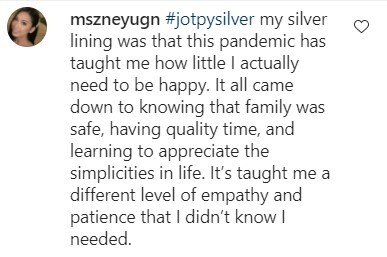
#jotpysilver my silver lining was that this pandemic has taught me how little I actually need to be happy. It all came down to knowing that family was safe, having quality time, and learning to appreciate the simplicities in life. It’s taught me a different level of empathy and patience that I didn’t know I needed. -
 2020-06-18
Hearing Floyd Breathlessly Call for his "Mama"
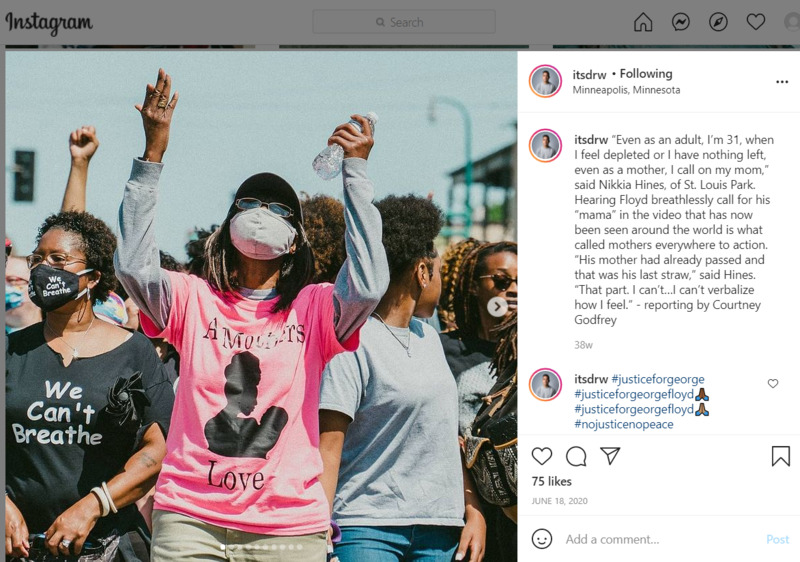
“Even as an adult, I’m 31, when I feel depleted or I have nothing left, even as a mother, I call on my mom,” said Nikkia Hines, of St. Louis Park. Hearing Floyd breathlessly call for his “mama” in the video that has now been seen around the world is what called mothers everywhere to action. “His mother had already passed and that was his last straw,” said Hines. “That part. I can’t…I can’t verbalize how I feel.” - reporting by Courtney Godfrey -
 2020-04-23
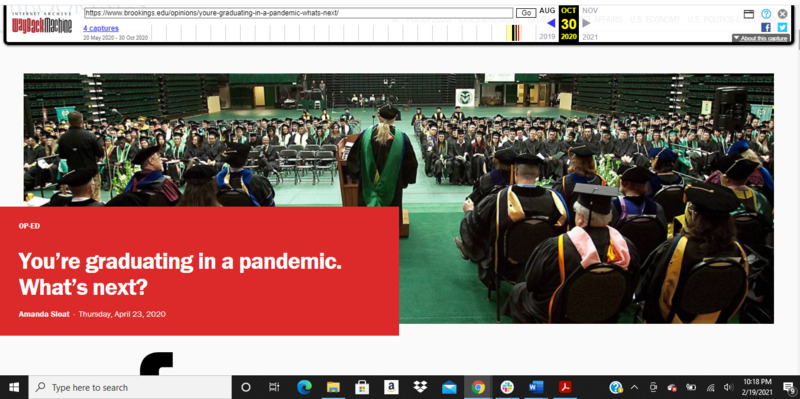
what to do after you graduate in a pandemic
This is an article talking about what someone should do after graduating from college in a pandemic. I felt this was an important article to include in this collection because not only is it important to know what the graduations were like but it is also important to know what someone did after graduation. Jobs were very hard to come by and unemployment was at an all time high during these times and after graduation usually someone goes and gets a job with that degree but with businesses closing it is hard to find one. This article gives tips and tricks on how to obtain a job during this pandemic as well. This article explains how any job is a good job in a pandemic which is very true. The article also explains that it is normal to feel discouraged at this time and to not give up. The pandemic will end and jobs will come back. -
 2021-01-17
Stress Continues After Death
As if the mounting deaths aren’t enough I’ve read stories of mortuaries having to turn loved ones away. It’s hard enough to lose someone, made worse by not being able to be with them, and then finding that you can’t even plan their memorial. I’ve noticed the obituaries section in the paper growing. When I saw this one it just made me so sad. I have such empathy for what families must be going through. So thankful that I am not experiencing the same. -
 2020-07-27
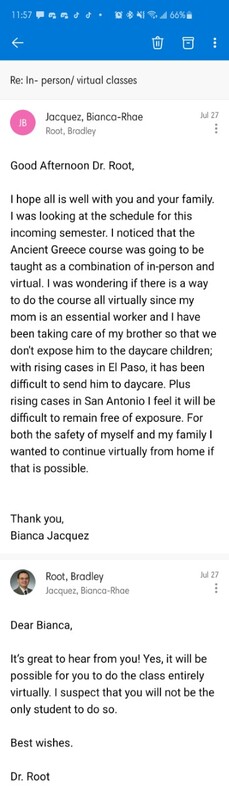
Student reaches out to Professor asking to take Fall 2020 course remotely
When the Fall 2020 course schedule was announced at St. Mary's I ran to see what type of classes I was going to have. There were 3 options either online, virtual, or a combination of virtual/in-person. My course with Dr. Root was scheduled to be a combination class. I had a lot of fear about going back to campus and especially going to class in-person. I reached out to Dr. Root with the hope that he would allow staying full virtual. Thankfully he was understanding of my situation. This email is the conversation that we had over the situation Screenshot of an email by Dr. Root -
 2020-04-16
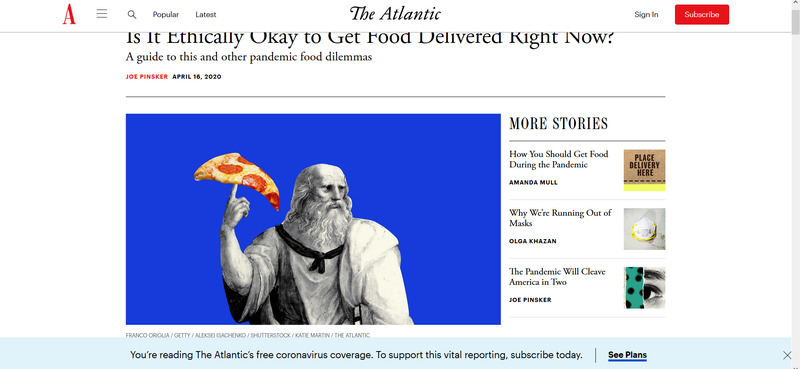
“Is It Ethically Okay to Get Food Delivered Right Now?”
With the advent of the COVID-19 pandemic, people began to grapple with moral dilemmas about the new, deadly situation that they found themselves in. These ethical dilemmas, which are the focus of a brief Atlantic Monthly article by Joe Pinsker, concerned the basic, but important issue of procuring food and drinks, which now ran the risk of infecting and possibly killing innocent essential workers and delivery drivers. To help soothe the troubled consciences of the general public, Pinsker consulted a variety of medical professionals, food scientists, ethicists, and moral philosophers to come up with answers to the ethical questions raised by these new circumstances. These questions included, but were not limited to: “How often should I go to the grocery store?”; “Is it ethical to get delivery?”; “How hard is it to figure out which businesses take good care of their workers?”; and “Is there anything I can do to help the people working at grocery stores, restaurants, and delivery companies?” In his answers to these questions, Pinsker implored readers to listen to the sound medical advice given by local health officials to reduce the risk of transmission and death, as this would protect both service workers and the readers. He also informed readers that it was better to reduce shopping trips to a once a week affair, as the more shopping trips one takes increases the risk of infection and transmission to innocent people. Furthermore, Pinsker advised those concerned about a restaurant or corporation’s treatment of their workers to research online if they provide workers with paid sick leave, and to tip workers a significant amount of money if they do not. Finally, Pinsker told readers that ordering delivery was not inherently unethical, as the money spent on delivery was money that would go into the pockets of workers, who especially need any help they can get during the current pandemic-induced economic recession. In brief, the questions presented and Pinsker’s responses provide an illuminating snapshot of how people grappled with the new moral dilemmas created by the COVID-19 pandemic. They display considerable consideration for the vulnerability of service workers, who are more exposed to COVID-19 than those working from their homes. -
 2020-06-03
Listen and Learn
In the midst of the pandemic, much deeper issues have risen. I believe it is about time we faced the issue of racial injustice. It is important for me to take the time, quarantine has provided, to learn of its history and to listen to those who have been hurt. "I understand that I will never understand" reads one of the protester's posters, to be educated is a step in the right direction. -
 2020-04-26
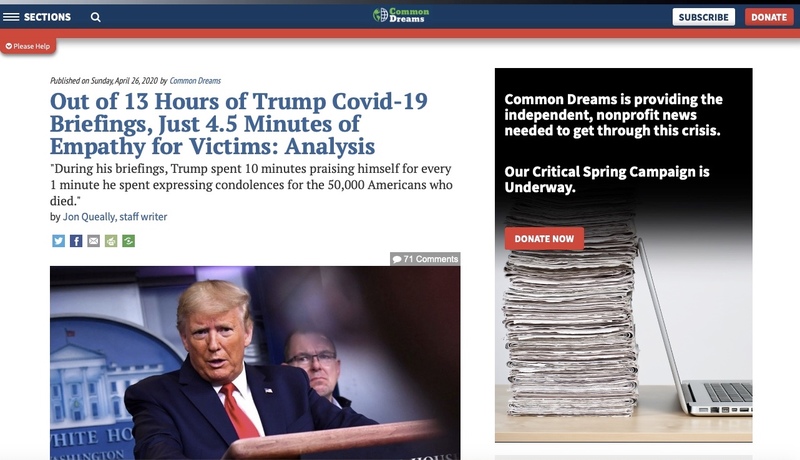
Trump and COVID-19
Out of 13 Hours of Trump Covid-19 Briefings, Just 4.5 Minutes of Empathy for Victims: Analysis -
 2020-04-03
It's the end of the world as we know it.
Not being able to see friends from college, and being isolated during quarantine takes a toll on ones mental health. Everything going on in the world really feels like the apocalypse. -
 04/01/2020
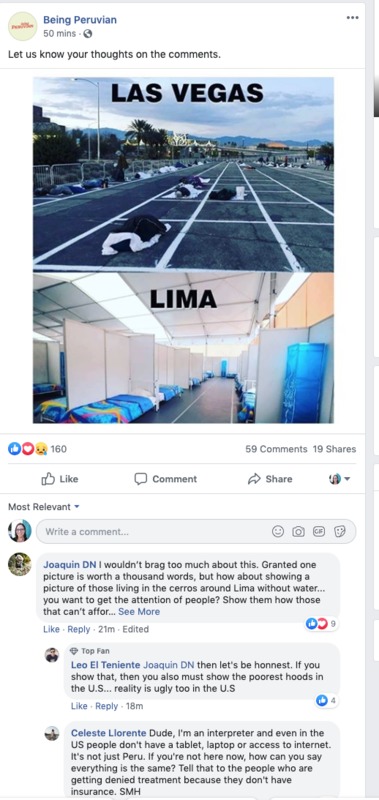
Social distancing for the homeless: Las Vegas, NV vs. Lima, Peru (Meme)
Meme compassion and care for vulnerable (ie homeless populations) in Las Vegas vs. Lima Peru. Some of the discussion on the Facebook page indicates that this meme oversimplifies income inequality and CoVid19 care.