Items
Search full-text
free fc 26 coins ps4 Visit Buyfc26coins.com Zniżki na duże ilości..C10x
-
 2021-08-14
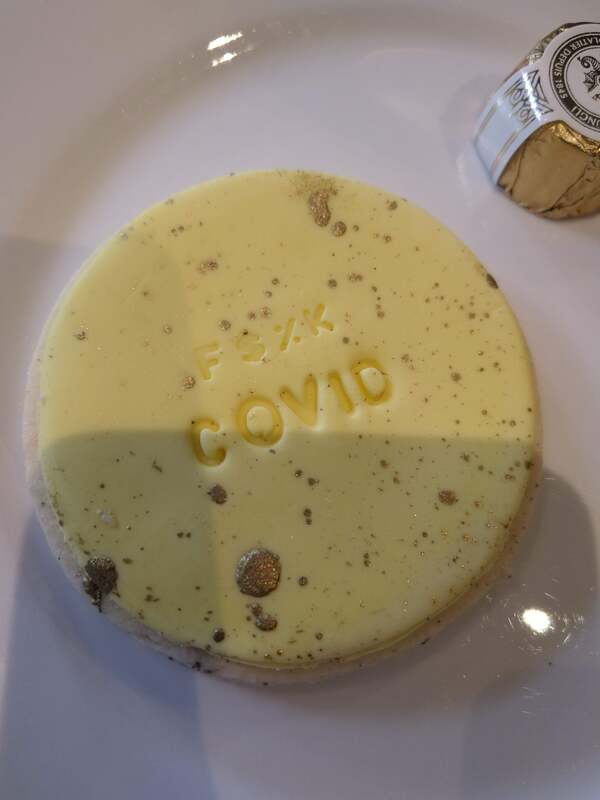
F$%K COVID cookie
I bought two of these cookies to take to my friend's house when I went to visit her under the 'single bubble' program during Melbourne's lockdown 6. They're from a store called Mad About Cake in Caulfield South. -
 2021-07-16
A Tale of Two Regions
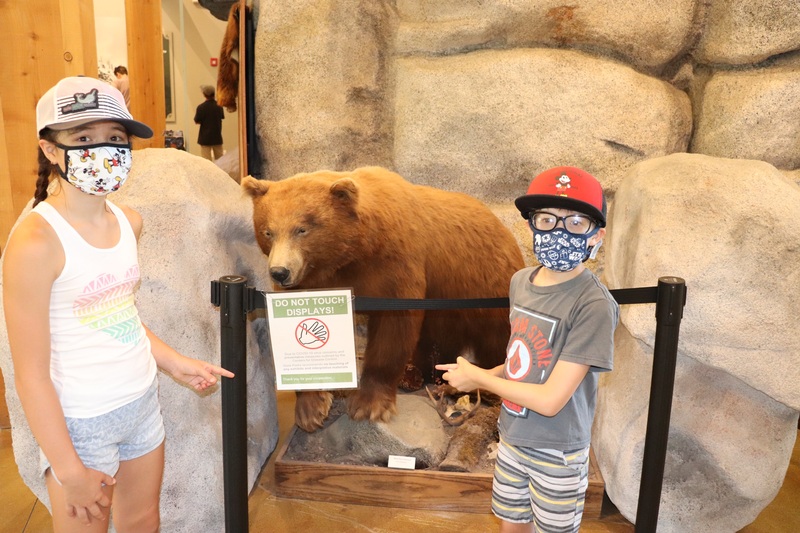
Since we aren’t getting on a plane any time soon, we road tripped it up to Tahoe. Taking advantage of having our car, we decided to drive out to places we would normally never visit, such as Sutter’s Mill and Donner Pass. As my husband called it, it was the Huell Howser California Gold tour. Something that was immediately noticeable was the rarity of people wearing masks around Tahoe and through the desert. Though mask mandates were lifted in CA June 15 for the vaccinated, I’d say about 50% of people still wear them (including my family) where we live. However, out in the more rural deserts and mountain areas, there was not a mask to be seen. I thought it was extremely interesting at Sutter’s Mill, which is a state park a couple of hours from Sacramento. The Park Rangers all wore masks indoors, and signs indicated unvaccinated must wear masks indoors. However, the tour of Sutter’s is all outdoors, with the exception of going into some of the historic buildings. I was a little nervous because I worried about my unvaccinated children going on a tour with possibly unvaccinated strangers who wouldn’t have to wear masks. However, when the tour began, I noticed all the families (all strangers to us) on the tour were wearing masks. Our docent asked each family where they were from and we were all from Los Angeles or Orange County. We all remained masked the whole tour. Our docent even commented “you know you can take off your masks outside?” He said it really nicely, but everyone remained masked. This regional difference was extremely interesting to me. I suppose Southern Californians may have a different way of thinking because our case counts were so incredibly high during the winter that they built field hospitals and ambulances were unable to pick up patients. Maybe that has made us more cautious. It was a literal war zone with the enemy being an invisible virus. Or maybe it’s just that every family on our tour took the same kind of vacation we did for the same reason - wanting a vacation but wanting to be outdoors, avoiding planes, and being able to safely distance. Donner State Park also had COVID protocol still in effect, with their interactive displays turned off. -
 2020-04-21
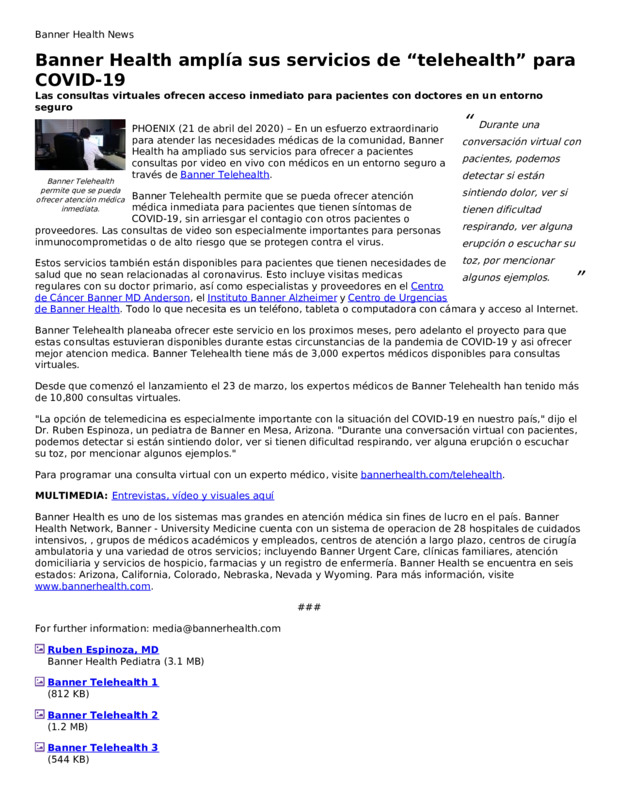
Banner Health amplía sus servicios de “telehealth” para COVID-19
En un esfuerzo extraordinario para atender las necesidades médicas de la comunidad, Banner Health ha ampliado sus servicios para ofrecer a pacientes consultas por video en vivo con médicos en un entorno seguro a través de Banner Telehealth. -
 2020-04-21
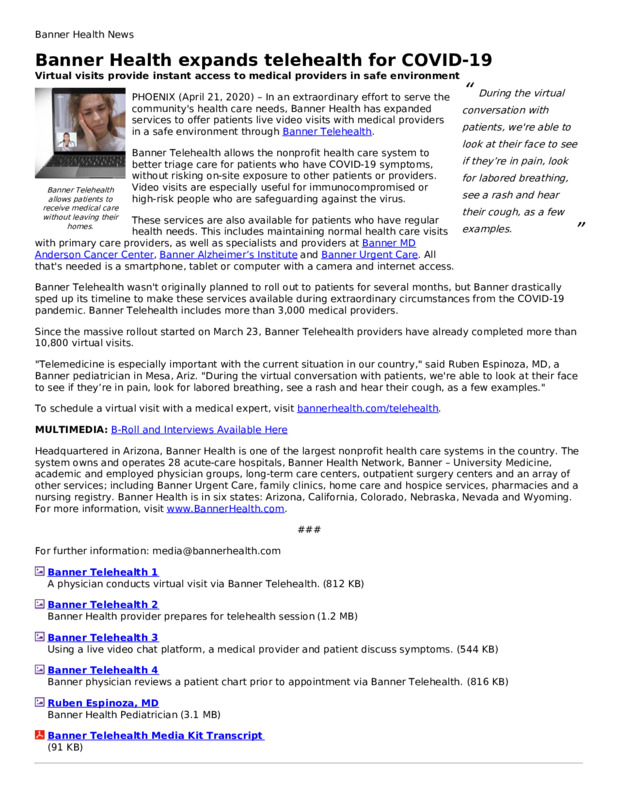
Banner Health expands telehealth for COVID-19
A press release from Banner Health announcing that in an effort to serve the community's health care needs, Banner Health has expanded services to offer patients live video visits with medical providers in a safe environment through Banner Telehealth. -
 2020-06-09
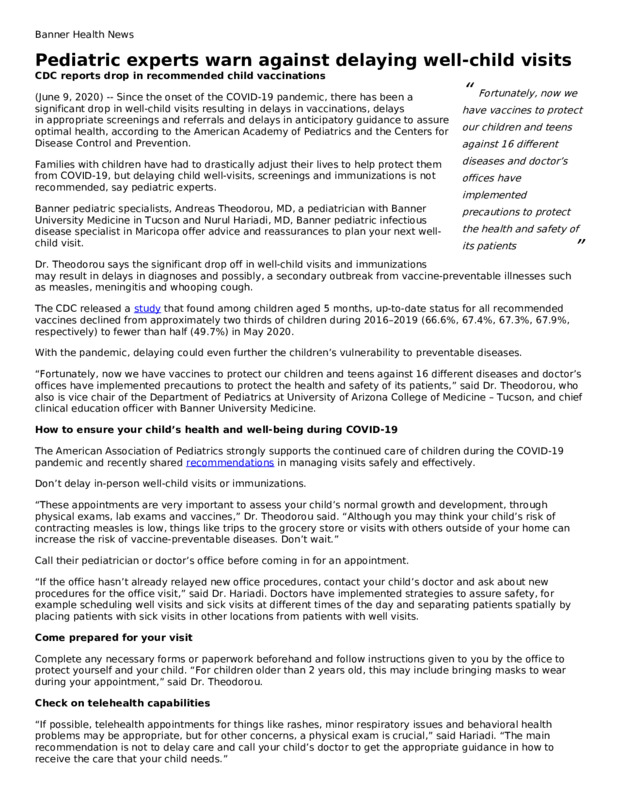
Pediatric experts warn against delaying well-child visits
A press release from Banner Health encouraging people to not delay well-child visits due to COVID 19 -
 2020-10-01
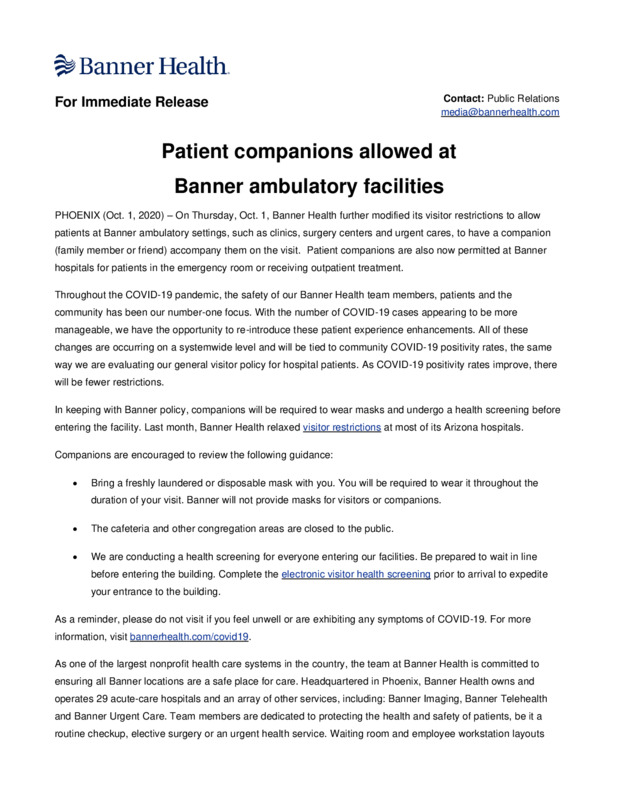
Patient companions allowed at Banner ambulatory facilities
A press release describing how " Banner Health further modified its visitor restrictions to allow patients at Banner ambulatory settings, such as clinics, surgery centers and urgent cares, to have a companion (family member or friend) accompany them on the visit. Patient companions are also now permitted at Banner hospitals for patients in the emergency room or receiving outpatient treatment." -
 2021-07-28
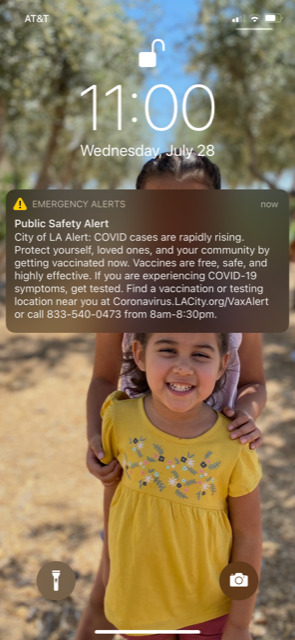
Public Safety Alert
I always get a reality check of how different Arizona is handling the pandemic when I visit my family in California. Life has been back to "normal" here in Arizona for a while now. Masks are rarely seen, the number counts are not reported as much and coverage of vaccination sites is rare. In California, it is obvious that life has not yet returned to normal. There is no distinction between vaccinated and unvaccinated, since no one is allowed to ask, everyone is asked to still wear masks. I was surprised to get this public safety alert while at my cousin's house last week. I feel like it was a reminder that life shouldn't be "normal" that we are still living through a pandemic and the storm has not yet passed. I wonder how people in Arizona would react to public safety messages like this one. -
 2020-11-30
Creating New Traditions in a Pandemic
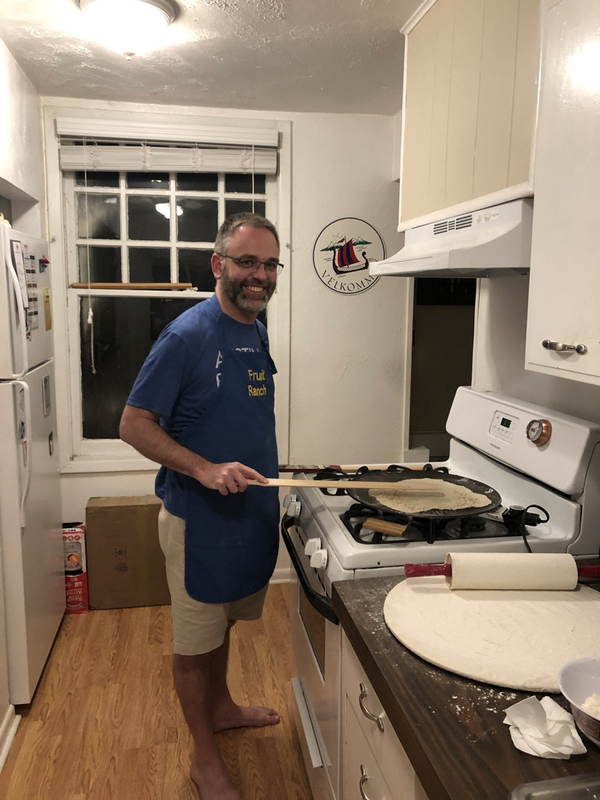
One of the traditions in my family is to make lefse, a type of Norwegian flatbread, at Christmas time. This tradition was started by my grandmother, because it was one of the foods that she associated with her childhood Christmases as the child of Norwegian and Swedish immigrants. Every year, no matter what was going on, we gathered together as a family at the start of the Christmas season to make lefse. If you’ve made lefse before, you can attest to it being a labor-intensive process, which involves ricing pounds of potatoes, rolling out dozens of balls of dough until they are paper thin, and frying them one by one on a hot griddle. It’s one of those recipes that works better if you have several people to help. In my family, everyone had a job to do. The youngest children of the family were put in charge of popping air bubbles that rose from the dough while it cooked. The older kids took turns flouring the rolling boards and rolling out the dough. The adults were responsible for cooking the lefse, a process that involved transferring huge rounds of dough to the hot griddle using long turning sticks. Even family members who were not culinarily inclined were put to work, folding the finished lefse and packaging it up so that it could be frozen, so that it was available for Christmas morning. It was a family affair, that filled the kitchen up with laughter and stories and more than one flour fight. Family lefse day is one of the most enduring memories of my childhood. When the pandemic made it unsafe to travel or even to visit my family, I found myself facing a Christmas without being able to participate in my family’s lefse making tradition. There were many teary video calls to family members as we all came to terms with the fact that we would be missing this tradition for the first time in nearly 40 years. At this point, after enduring months of isolation because of COVID-19, I was devastated. It didn’t feel like the holidays without this tradition and making lefse by myself felt overwhelming. I was telling my friend Mike about how sad I was over missing out on this tradition, when he offered a solution. We would both quarantine for 14 days, purchase all the ingredients we needed and have them delivered, and then he and I would make as much lefse as we could. I was stunned by his generosity. After all, this was not his tradition. In fact, he’d never even eaten lefse before. But he saw a way that he could help a friend feel better after such a trying year. So, we did just that. With only two of us, it took us about six hours, but we ended up with nearly thirteen pounds of lefse that eventually got sent to family members in four different states. The best moment came when we all video chatted from our homes on Christmas morning, just to eat the lefse together. It was different than normal, but it was a joyous moment. Mike joined us on the call and shared some of the challenges we had making thirteen pounds of lefse in a tiny apartment in the middle of a pandemic. This year, he’s been invited to my parents’ house to join in on the family lefse making day. After all, it’s tradition. -
 2020-03-23
Mental Health and COVID
During the start of this year the country went through something extremely frightening and new to everyone. The lockdown was something that cause a lot of teens and people get into a really bad state of mind. Being told you weren’t allowed to go out for groceries, see friends, go to the gym, or even visit your local gas station. People were scared and worried about their health and the health of their family members. For myself, having the lockdown meant I couldn’t go to school nor could I participate in my first year of college soccer. It had a really negative impact on my mental health and I started to do things that I would never see myself doing. I was relying on alcohol a lot to get me through the days of just binge watching tv shows and movies. Because I was binge drinking, I would then binge eat and not be active at all. Growing up as an athlete and just as a very active person in general I would never binge eat or binge drink. I started to gain weight and look down on myself a lot. A lot of people don’t realize the impact that the lockdown had on people who really relied on structure to get them through the days and hold them accountable. It wasn’t until September that I really looked at myself and was disgusted with who I became and what I was relying on. I started to run and exercise outside. I have now lost 15 lbs and go to the gym 5 times a week for pleasure instead of punishment. It has been the best journey for my fitness lifestyle and I am so grateful that COVID brought that to me. -
 2020-05
Roses are red
My grandmother's birthday is in May, so last year, during the beginning of the pandemic, we were unable to visit her and celebrate her birthday or Mother's Day. So, we sent her a nice card, and in it, my brother and boyfriend made up the poem. It reads "roses are red, violets are blue, when coronavirus is over, we'll come see you! xoxo Owen + Andrew" -
 2020-07
Diminished Quality of Veterinary Care During the Pandemic
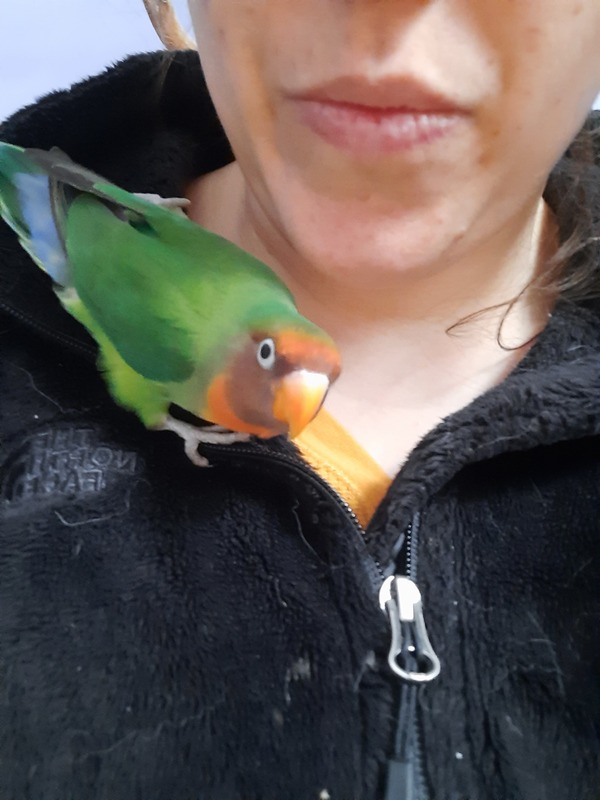
Our pets are a part of our family. So when their health is in jeopardy, it affects us all greatly. Early on in the pandemic, we had an emergency with our lovebird, Kermit. Our larger bird, an African Grey named Greycee, landed on top of Kermit's cage. Kermie proceeded to bite her toe through the cage bars, and Greycee bit back. Luckily we heard the scuffle and intervened immediately, but Greycee had created quite the puncture wound on Kermit's upper beak/nares. Normally these two are best buddies, so this was a suprising freak incident. I cleaned off Kermit's beak, but it looked bad and her breathing was shallow and rapid. Birds in respiratory distress can die rapidly. I rushed her to the emergency vet who told me that there was a 4 hour wait to be seen. I told them that Kermit wouldn't last 4 hours, so they agreed to see her immediately (for an additional fee of course) but I had to wait in the car. My already stressed and injured baby had to go into a strange place with strange people without her mom because of Covid. They stabalized her and sent her home for the night. I feared she wouldn't make it until the morning. Luckily, she pulled through the night. I called our vet immediately the next morning. It took several tries. Since you also had to wait in the car while there, and all conversations with the vet were over the phone, their phone lines were constantly busy. I finally got through, but they told me that despite the gravity of her condition there was no way they could get her in that day. Under normal circumstances they could, but with the new covid protocols every minute of every day was totally overbooked. I tried the emergency vet again and they had a 6 hour wait. You had to wait on site in your car too, which I couldn't do with my 4 year old daughter. Since Kermit is a bird, she cannot just go to any vet. There are only 2 avian vets in my area. I took a chance and called the other one and explained the situation. They were able to squeeze us in. Again I had to wait in the car and hand my baby off. She ended up staying the night. The blood from her wound had entered her lungs causing her breathing issues. She had recovered quite a bit by the next day, and the vet even allowed me in with social distancing and masks in order to show me how I needed to hand feed her for the next two weeks until her beak healed. At least because of the pandemic I was working from home at the time, so I could care for and monitor Kermit all day. Within a week she was back to her normal self. In the fall, our Dog Evie went to the vet because a suspicious lump had grown on her toe. Evie is absolutely terrified of the vet. She is also deaf and has limited vision, so it is harder to comfort her. She needs our touch and our smell for reassurance. Of course, jsut as with Kermit, we could not go in with her. The vet techs had to carry her in because she was shaking so badly in fear. She needed to be sedated to do the biopsy of the lump. The report came back positive for cancer. She had to go back in again to have the whole toe removed as the biopsy had not gotten it all. This time she had to stay nearly all day and be pumped with anxiety meds to keep her asleep until the procedure. It was thankfully successful, but she also needed a follow up visit, so more meds. The whole experience was traumatizing for both our animals and us. What's even worse is people were treated the same way. -
 2021-06-28
My Pandemic Experience
When the pandemic was coming, I was initially relieved. I was supposed to fly to Chicago to visit my sister and go to our favorite band’s (Keane) concert, but as a person with anxiety and panic disorder who is terrified of airplanes and crowds it allowed me to back out. The concert was cancelled. It was the excuse I needed to back out without shame or blame. It seems silly now, but at the time covid seemed more like a bad cold or flu to me. It seemed like another Swine Flu or Avian Flu or other scare in recent memory which hadn’t amounted to a plague style pandemic. Lockdown was even kind of nice at first. My husband, daughter, and I got to spend a lot of family time together. I had taught ESL online for a number of years previously, so converting my in school classes to online was easy. I had no problems teaching over Zoom. I’m a homebody anyway, by habit and by anxiety, so this was great… until the body count started. I was horrified and sickened to hear about the freezer containers being used in New York City to store the overflow of bodies. The germaphobia that had plagued me in childhood, that I had gone to years of therapy to overcome, came roaring back with a vengeance. Like everyone else, I went to the grocery store to stock up so I wouldn’t have to leave me house for awhile, only to find shelf after shelf empty. As a super health conscious, organic, vegan my choices were extremely limited. My husband and daughter aren’t vegan, but they do eat only organic, which became impossible. Soap, disinfectant, cleaners, and hand sanitizers were nowhere to be found. At a time when it was so important to be as clean and healthy as possible all those modern conveniences were utterly gone. I felt helpless. I imagined that people living during pandemics like the bubonic plague and Spanish flu must have felt similarly. After a couple of weeks, quarantine started to feel more like a claustrophobic prison sentence than a family vacation. I missed my sister, my parents, my friends, my colleagues, and my students. On my birthday and Easter I just had to wave at my parents through the glass door. My favorite hobby- taekwondo, which I had started in order to relieve stress and help with my anxiety was taken from me. I had to do the classes online from my living room, which was nearly impossible. I felt trapped. A raging epidemic across the planet from which there was no escape. If I spent too much time thinking about it, I would start to feel the claw of panic. By the time summer arrived I was at breaking point. Luckily with summer we had some reprieve. Case loads declined, and I started meeting my best friend outside. We socially distanced ourselves and wore masks, but we were together and that was a start. By the end of summer she and her boyfriend were on our “quaranteam” that is we decided we could see each other since we weren’t seeing anyone else. In the fall school started. Since I teach at a Catholic school we were able to have school in person full time, though we had students in every grade who opted to go remote. But my bestie and I were back in the building with most of the kids, and I started to feel less trapped. I was going to stores masked and my daughter was also in school. But as soon as Thanksgiving hit everything changed again. So many people ignored all of the recommendations and restrictions and got together with family and friends. It made me so angry that people were so careless. A friend of mine had a large family in Pennsylvania who all got together for Thanksgiving. She didn’t go because she thought it was reckless. 8 out of 14 people at the family dinner got covid and 2 of them died. Then at Christmas, my great uncle passed. No funeral. No wake. Nothing. Schools shut down again. We were trapped. Then the vaccines came. It was nearly impossible to get one for a long time even if you were eligible. Slots filled as fast as they were posted. You needed to present a lot of proof of eligibility in order to get one. As a teacher, I was able to get mine earlier than many others. I got the Moderna. The first shot made me feel a little sick for a few hours, but with the second I had a fever of 103.5, aches, chills, nausea for 12 hours and a general malaise for 3 days. A friend of mine in taekwondo, who has some autoimmune problems, had a severe reaction after her first Moderna vaccine. She has had side effects for a few months now that are not going away. She has dizzy spells and heart palpitations regularly. She is undergoing testing and being monitored by the CDC. Despite some horror stories, the vaccine is still the absolute best thing that we could have hoped for. I would like my daughter to get it as soon as they open it to the under 12 population. A lot of people won’t get the vaccine because they are in the “Science is fake, I’m a Trump supporter” camp. In my opinion, Trump’s misinformation and mishandling of the pandemic cost tens of thousands of American lives, and his diversive legacy is going to cost us dearly for many years to come. It is now June again. School just finished. New York State is allowing people to enter buildings unmasked if they are vaccinated, but few people are actually requiring any proof. Given that the people with a cavalier attitude toward wearing masks are many of the same people who are against getting vaccinated, an honors system policy towards wearing masks is really just a no-mask policy. It is very frustrating to me that people can’t just deal with masks for a while longer to fully insure this disease’s eradication before we have another relapse and find ourselves back in quarantine again. -
 2021-07-27
Out of Touch
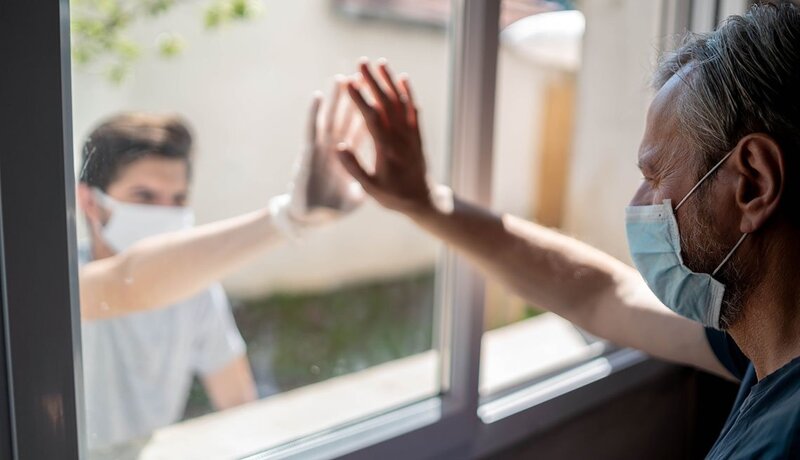
When I spent the Thanksgiving 2019 holiday with my family at my grandparent’s house, I had no idea that my hug goodbye would be the last hug I could share with my grandmother for a very long while. With the onset of the coronavirus pandemic, the CDC pushed multiple changes to prevent the spread of the virus which included social distancing. Both my grandparents are at high risk with underlying health conditions, so possible exposure to the virus was not an option for them. For us, social distancing also meant family distancing. Thankfully, I was able to have regular meetings with them on their front porch. We kept one of the front doors closed to separate us, and we talked from a safe distance. It was not the same as what I was used to and I missed the closeness that we once had, but they were moments to cherish as I did not know when I would get to hug them again. Sadly, I was not the only individual forced to find new ways to stay in touch with family members. All over the internet, heartbreaking pictures and videos surfaced showing families separated by hospital windows, mothers giving birth without family in the delivery room to support them and hold their new baby, and people ‘touching’ their loved one’s hands through glass barriers. These moments showed how the coronavirus left many families out of touch. Once the virus started to slow down and vaccines became accessible, I was finally able to spend more time with my grandparents without the physical barrier. Lots of people are talking about a ‘new normal’ now that cities are reopening and people are getting to go back to their lives. For me, getting to hug my grandmother again was a sign that everything would be okay, and life finally felt normal. -
 2020-07-16
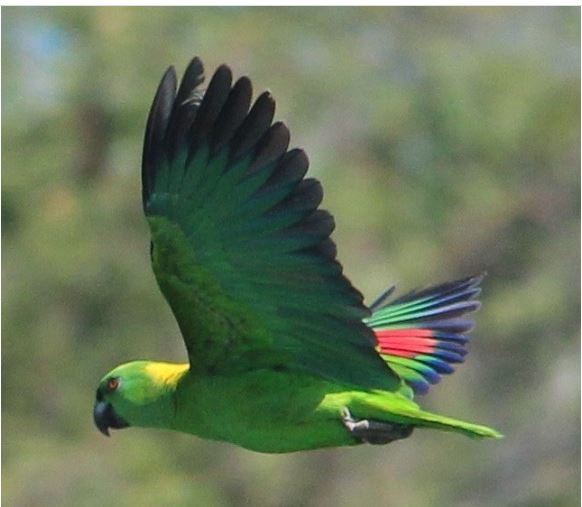
How Have Pet Birds Been Affected by Covid-19?
Northern Parrots, a bird blog and store in the UK, writes that pet owners are worried that their feathered babies could contract COVID-19. All the evidence shows that is highly unlikely. The blog post also mentions that birds are also affected by lockdown and quarantine in both positive and negative ways. One positive is that their owners are spending more time at home. On the flip side, favorite friends and visitors aren't coming to visit, and sometimes it is hard to find the foods they want. The article mentions Madeira cake, but in my personal experience it was often difficult to find fresh organic produce for awhile. The article goes on to talk about parrot conservation during the pandemic, particularly in Central America. There are fears that people out of work may turn to poaching as a resource for quick cash. Also a beloved ornithologist, Luis Fernando Díaz Chávez, who was important to Paso Pacifico's conservation efforts passed away from COVID-19. -
 2021-06-18
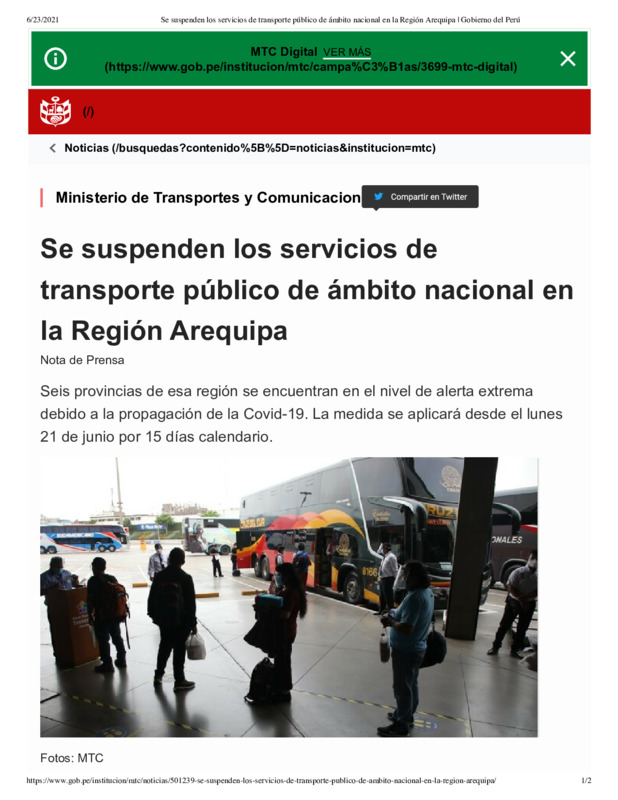
Air and land travel suspended to Arequipa, Peru
My mother-in-law has been here since last February (2020). She came for a visit from Peru and got stuck by the pandemic. She's traveling home July 1st, but Arequipa, Peru just initiated another lockdown. There's no land or air travel into Arequipa starting June 21 and lasting at least 15 days. Essentially, she'll get to Lima, Peru, and have to wait until she can travel. We considered postponing her return, but the changes in airfare are prohibitively expensive. Also, I'm pretty sure she's more than ready to get home after such an extended stay. The reason for the lockdown is the high mortality rate in Arequipa. -
 2020-05
Masked Visitors
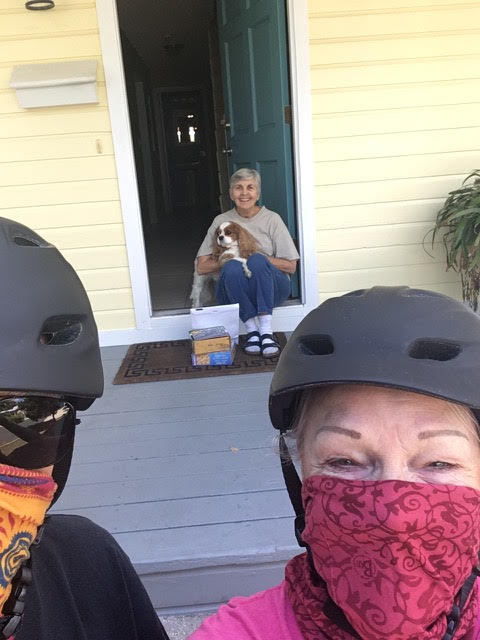
How has Covid-19 changed your daily life? My husband and I moved here in 2014 so I could volunteer with the city archaeologist, Carl Halbirt, and I have been doing that most every day since then. We have two new archaeologists now, but volunteers aren’t allowed until the virus social distancing is lifted. In November my husband died and after a short hiatus from volunteering I started again. Now, I am in my house with my dog every day. I miss being with people. Even our church is doing online services now. On Easter the priest printed large photos of many of our congregation and taped them to the pews, so it looks like we were in church. I saw myself, and right where I usually sit! How is your neighborhood and/or social circle responding to the crisis? My neighbors are all staying home like I am except for a few Flagler students who went to their parents homes. Some are furloughed, others are working from home. Since I’m retired, I’m just missing my volunteer work. Several of my friends and I have a group text several times a week so we can keep up with each other. My Community Hospice social worker is staying in touch with each of our grief support group members by phone, and several of us have exchanged phone numbers so we talk occasionally. The Tolomato Cemetery group is planning a Zoom visit on the third Saturday, which is the day we have the cemetery open for visitors. It will be my first Zoom conversation. I’m looking forward to that. My church, St. Cyprian’s is open each day for individual prayer and the commons and labyrinth are open as well for anyone who wants to pray or just sit in a peaceful place. How has Covid impacted your perspective of St. Augustine? I am happy that our city leaders have been proactive in closing so many businesses. I feel so sorry for the small business owners and workers who have lost their jobs, and I hope when the danger has passed we can get to a new normal. I don’t thing everything will be the same. I am hopeful the city will be able to help the businesses and workers with tax relief or some other means. I am proud of the way the police and firefighters are connecting with us by social media. How has Covid-19 impacted your use of social media? I’ve used it much more to keep up with friends near and far. I have also been using FaceTime with my daughter and son who live in other cities. I’ve been using Shipt to order my groceries for delivery to my house. What practices have you implemented to mitigate the impact of social distancing on your mental health? I’ve tried to make a small list of things I want to accomplish each day, but if I don’t finish it, I don’t beat myself up about it. It helps to keep me from sitting around watching mind numbing Hallmark movies. I’ve tried to walk most evenings around my neighborhood, just to be outside. I am reading books and doing jigsaw puzzles as well. I’ve cleaned/organized several cedar chests and drawers and I am working on bookshelves now. I am also writing a Corona Virus Journal describing my feelings (and there have so many emotional times during this quarantine) and making note of things I’m doing and friends I am talking with. It’s on my computer and I have no idea what I will do with it, but maybe my children will read it someday and maybe I will too. -
 2020-03-12
COVID 19
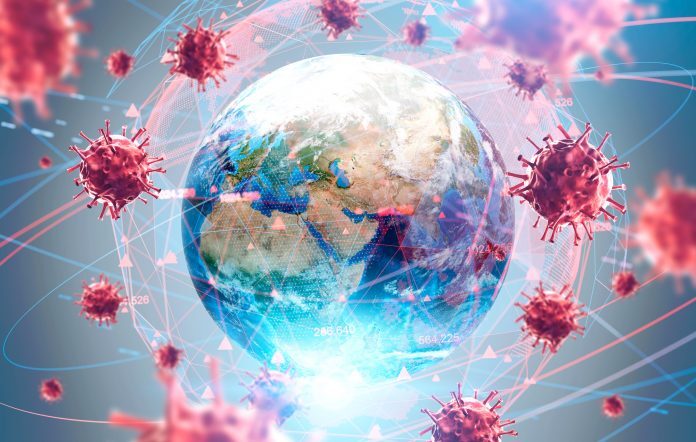
COVID 19 I decided to choose as a source an image related to the COVID 19 virus. The image belongs to https://www.pharmaceutical-technology.com/news/coronavirus-countries-cross-100-covid-19-world-update/. This website provides information about the virus and was last updated on March 12, 2020. The image shows the virus spread around the planet earth. This image helps me explain what the virus is and how it spread. I select this type of source because I consider that it expresses a simple but concise message. I consider that it is something that everyone can understand and from which they can learn. By looking at the image people can get an idea of what the spread of the virus really meant. They can observe that its spread was not in a specific area, but rather that it spread around the entire world. Since the virus made its first appearance in Wuhan China, everything has turned into a catastrophe. The virus began to spread rapidly around the world. People were really not prepared for the COVID 19 virus. Many people died from this virus and those who were infected and survived did not have a good time. The virus isolated everyone and everything stopped being what it always was. People could no longer visit their loved ones or spend time with them. Many businesses closed, and as a result many people lost their jobs. Now everyone had to wear masks, they had to keep their distance from each other, and they also had to constantly wash their hands. This was somewhat frustrating, as people searched for gloves, masks, and disinfectants in stores. However, because everyone was looking for the same items there was a shortage of them. Sometimes when people found such items they could only buy one per person, especially alcohol and disinfectants. People really felt desperate. Things had changed a lot. Now many people had to work from home. The same thing happened with the students. Students had to take classes from home through a computer. This was something that didn't seem right to everyone. Many students lost interest. I consider that both historians and everyone in the future should be aware of what the COVID 19 virus was. Although the COVID 19 virus is a new virus that arose suddenly, it is not the first time that humanity experiences something like this. Previously around a hundred years ago something similar had happened with the Spanish flu. The Spanish flu like COVID 19 had also become a pandemic. Because of this, millions of people died. However, this was something that remained in the past as no one spoke of this event. I consider that people could have learned something from the history of the Spanish flu and applied that knowledge during COVID. However, few people are aware of what the Spanish flu was. Therefore, it is necessary to take into account everything related to COVID 19. Although it is likely that the appearance of a new virus cannot be prevented, at least people will know how to protect themselves and thus prevent the spread. The virus spread around the world rapidly for various reasons. However, one of these reasons was that people had no idea how to react to the virus. If people had had an idea of how to protect themselves at that time, perhaps the virus would not have spread the way it did. I believe that acquiring the necessary knowledge about the virus will be of great help in the future. -
 2020-04-09
Covid-19
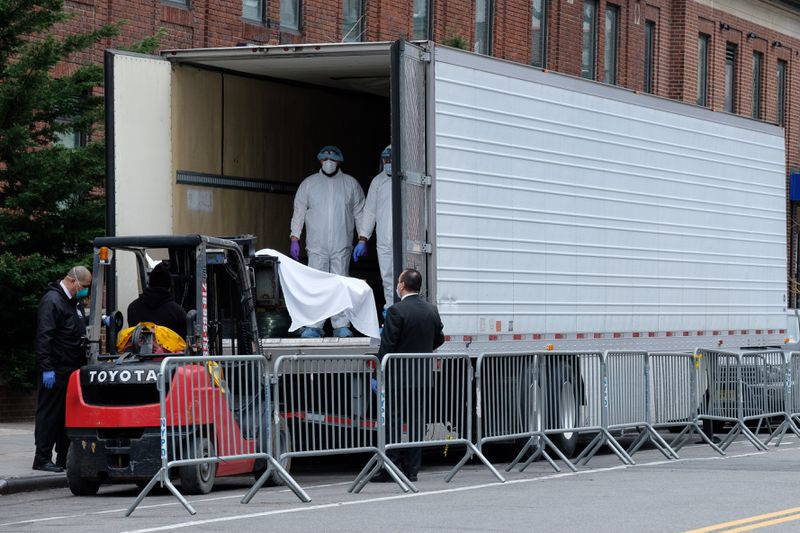
As my primary source I decided to choose a picture from the NY Daily News, and it was published on Apr 09, 2020 at 1:17 pm by Gardiner Anderson. I selected this picture, because in my opinion it has the ability to show how badly the Corona virus affected New York city and the entire world. This image documents how there were so many people dying from the Covid-19 virus and how there was not enough space in the morgue to keep the bodies. The situation was so horrible that people were dying alone in the hospitals without their family members in their bed side. Let’s stop for a minute and think how difficult it is to know your family member is in the hospital dying alone, and you cannot go to the hospital and hold their hand for them not to feel alone while they take their last breath. This was never seen before, at least not in the United States. Historians will have the chance to see how Covid-19 did not just affect the economical part of my community and the entire world, but how it also affected the people in a psychological level. While a lot of people was died during Covid- 19. A lot of people lost their jobs, and they did not have money to buy food. Also, a lot of people did not have money to pay their rental or bills. While this people were going through a financial crisis, maybe member of their family was in the morgue or hospital or maybe they were in quarantine because they had Covid-19. What it means for this picture to be in the newspapers is how big was the impact of Covid-19. It shows how bad the situation was at the moment. Millions of hospitals did not have space in the morgue. Therefore, it connects to the picture because it shows how they had to deposit the corpses in the refrigerated trucks. I selected this source because I want historians of the future to understand what was going on at the time. The readers are going have the chance to see with their own eyes what was going on at the time. They can see how horrible the virus was. In other words, this picture will explain and demonstrate what was going on at the time. For me to see this image during the pandemic was very hard and traumatizing because I felt so bad to see how they deposited corpses in the trucks. When I saw this image, I thought about my father and my friend because they had Covid-19, and they were in the hospital. I was nervous because I did not know what was going on with them if they were going to die or survive. At the same time, I was nervous because the economy was falling, and my family and others were being affected. My family was forced to reduce the amount of food we were eating. While my father and friend were at the hospital and my sister and brother were not working. Just my mother and me were working. We needed to pay the rent, buy food, and pay bills while my sister and brother were waiting for unemployment. My mother and I were forced to continue working during the pandemic to support our family. Every time I went to work, I was extremely scared about getting the virus and getting my family sick, especially my sister was pregnant at the moment. In the other hand I was worried about my father and friend who were fighting to survive Covid-19. Sadly, my friend died, but my father survived, and I am grateful he was able to survive this horrible virus. I just do not want to focus on how my family was affected, but how this virus affected the entire world. A lot of people died, some people did not have enough money and were waiting for unemployment, other were not even able to get unemployment and other people were not able to visit their family members who were sick in the hospital. This pandemic was catastrophic. -
 2021-05-29
COVID-19 and Mental Health
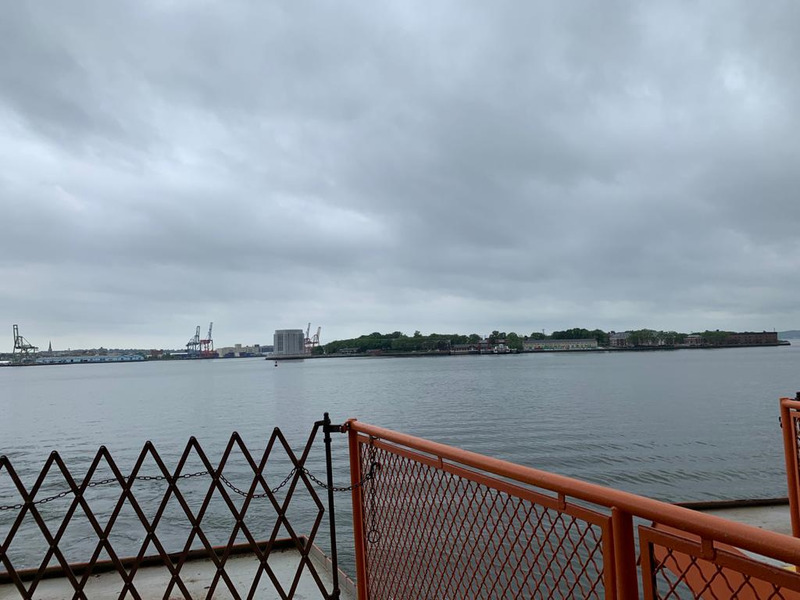
I took this picture on May 29, 2020, at 10:35 am. Why I choose this picture? This picture reflected my feeling in 2020. After months without going outside, I was heading to Staten Island to visit my aunt. I remember that I had anxiety even to open the door of my apartment. Whenever I went outside, it was close to my apartment, and my skin started to itch for no reason. My family used to watch the news the whole day. I was tired of listening to the report. Besides, during COVID-19, I was having an awful time. A few months ago, one of my friends died, and It was depressing for me. Before she died, I let my ego break the relationship between us. I refused to call her or text her because I was tired of looking after her. I remember my father told me to call her because I did not know what was happening with her. I ignored him. Riding to Staten Island that morning made me remember the hard time that I was going through. The day that I went to Staten Island, it was cloudy and dark. I thought that the ferry would sink into the water. When I got to Staten Island, it started to rain, and I did not bring an umbrella. I was mad, but it was my fault for not checking the weather. I compare that dark and desperate day with the mourning of my friend and the pandemic. For months, I felt guilty and thought that I did not deserve anything good in my life. The worst of all of this is that I did not have anybody to talk to. I was in quarantine for months, and it affected my mental health. I had no desire to continue college and my business. I used to cry a lot, and all I wanted was to talk to someone about how the pandemic and the death of my friend affected me. I had desired to go to the Dominican Republic, but I could not go. I think that this source can help historians because they can get to know about different perspectives of people during the COVID-19 pandemic. They would notice the anxiety that not only I went through, but everybody around the world had been through. My neighborhood was affected significantly. Some of my neighbors got COVID and died from it. I know that many people saw themselves as the picture. They thought that everything around them was going to end. They thought that they would be stuck in the pandemic forever. -
 2021-04-12
Lizza Weir Oral History, 2021/04/12
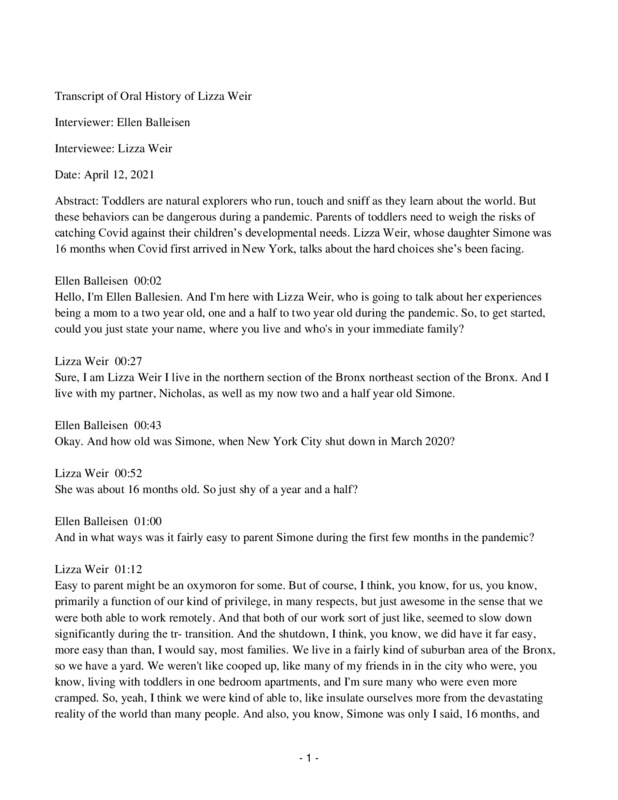
Toddlers are natural explorers who run, touch and sniff as they learn about the world. But these behaviors can be dangerous during a pandemic. Parents of toddlers need to weigh the risks of catching Covid against their children’s developmental needs. Lizza Weir, whose daughter Simone was 16 months when Covid first arrived in New York, talks about the hard choices she’s been facing. -
 2020-07-12
A Nurse at Tucson Medical Center
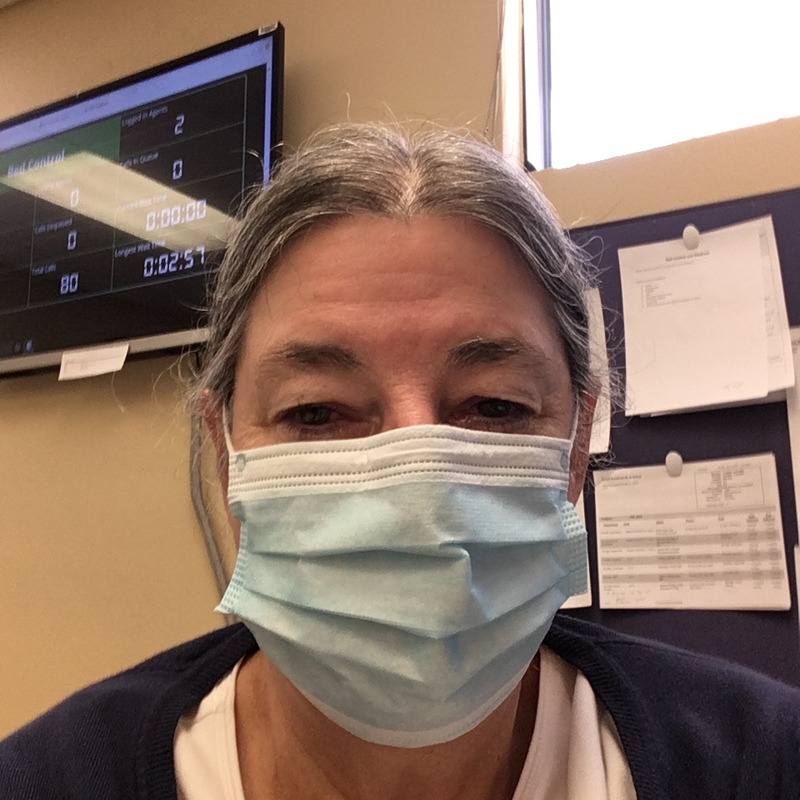
Tucson Medical Center went from no Covid patients in January 2020 to approx 160 at the peak (actually our third) in January 2021. It was amazing to see how quickly beds were repurposed, negative flow rooms were engineered, elective surgeries were cancelled and all the staff rallied around the ever changing patient case loads. Paula Marshall, RN July 12, 2020 at TMC Bed Control Department I work at Bed Control. We accepted patients from mostly southern Arizona from our ER and from the surrounding rural hospital. The Covid Surg line would call distributing covid patients needing admission throughout the area. When I graduated from nursing school in 1974, I never guessed that our world would experience a pandemic in my lifetime. I never knew that my job would change the way my family viewed my job. I don’t work at the bedside but work in an office and contribute to bed utilization. My son’s family lives 6 miles from me but I was invited to visit 4 times during 2020. My granddaughter said, “you work in a hospital. You could have Covid and not know it.” Gee whiz -
 2021-04-23
My Chaotic Covid
For me, the pandemic has been the exhaustingly consistent cherry on top of everything that’s gone sideways in my life over the past year. Now, this isn’t meant to be a pessimistic rant about the past 12 months, but just a sequence of events that kept things spiraling out of control while I tried my best to stay on top of the chaos and maintain an energetic passion for life and hope for the future. These traits used to come super naturally, as I had been following my ten year plan pretty successfully as of last March, until the rest of the year, which I thought to be set in stone, was pulled out from under my feet. I was having the time of my life in Rocky Point over spring break when Covid started hitting the fan. ASU announced a ‘temporary’ switch to online classes while I was on the road coming back home, and I drove straight into midst of a sudden global pandemic. Luckily, I had gotten out of Mexico in time before the borders were closed down. I was working at Harkins Theaters at the time, and my last shift was one with a whole bunch of disposable gloves and excessive new sanitization rules in concessions. I left that night not realizing that that would be my last shift there. I was at least planning on being there for another few months, before I would start a summer job I was recently contracted for. I was going to go on tour as a videographer with the Cavaliers drum and bugle corps, filming professional marching band videos and cutting together rad highlight reels all while traveling the country and getting paid for it. That was canceled soon after I was furloughed from Harkins. I went back home to visit my dad and brother in the midst of it all, but I don’t think my brother was ready for that kind of personal contact. He wound up giving me a black eye after I ended up getting too close to him and intentions were misconstrued. Shortly after, while already recovering from a destroyed face, I came down with a long, rough sickness that was aligned with the known symptoms and assumed by everyone to be Coronavirus. Unfortunately Covid tests were far from accessible at that point, and I was never able to confirm if that was the case. Trying to get away from the bleak outlook of everything, I took a few of my friends up to my grandparent’s empty house in Sedona. My roommate proceeded to secretly bring alcohol, drank too much and fall off a ladder, leaving a large-man-sized hole in the wall of my grandparents’ expensive house. While staying in Sedona the following week on one of my trips to head up and fix the wall, I got a call from my dad that my mom had passed away. She had been suffering for the past twelve years from a stroke and aneurism she had when I was eight, and on April 6th she finally let go. So that was a lot of emotion to throw on top of everything. After spreading my mom’s ashes with my dad and brother, I came back to find a baby monitor camera had been hidden on a shelf in my bedroom. I didn’t know who put this camera there, hidden in a sock, but it had been filming my girlfriend and I for the past three days and had gotten some pretty personal stuff on camera. It wasn’t hard to put together that that was the whole point of the monitor. My roommate felt violated as well, as he said he thought it was one of his friends who had put it there, and was on board with the whole police investigation we launched after the fact. I trusted my roommate, and while he had gone through a bit of an alcoholic phase the month before, I thought he was doing better. He had been one of my best friends for over five years at this point, and I didn’t want the worst case to be possible. But a few weeks later, my girlfriend’s phone mysteriously went missing in my apartment for a night. The next day she found a monitoring app downloaded onto it. My roommate had taken her phone, copied off all of all her private, ‘personal’ images of herself, and installed a program to track her and check in on her camera and microphone without her knowledge. Luckily we found this evidence soon enough, but it wasn’t an enjoyable experience kicking my best friend out of our apartment. The police found evidence that he put up the camera soon after and he was arrested. Two counts of voyeurism, one count of lying to the police, and everything he had taken off my girlfriend’s phone. I haven’t talked to him since last May, I can’t legally, it’s currently April of ’21 and his trial has yet to reach sentencing. After all that had happened, Summer was not what I had initially thought it would be. But it wasn’t all that bad. People started wearing masks, I got a temporary job making dough at Little Caesars, I was able to hang with my actual friends and the worst of it looked to be over. And while that much was true, the pandemic itself was far from over and slowly the months of lost experiences and thoughts of unfulfillment and wasted potential began to sit in. I got a different apartment in August, but it was an older and more run-down first floor unit with unexplainably loud upstairs neighbors. I’ve spent the entire lease of that unit trapped inside and longing for a normal college experience. These were supposed to be the craziest years of my life, and I felt like I had missed out on countless memories. I was working as a video editor from home on top of online school, and the days blended together into hopeless rituals of helpless procrastination. The motivation to thrive while held up in the new apartment was hard to find. But I still made it. I didn’t give up on pushing forwards. I’d put things off and the passing of time ultimately became an illusion, but I kept making sure I stayed productive. I edited together a vlog series through the beginnings of the pandemic, worked on other personal projects, and was able to get a pretty sweet internship doing remote editing work for a television studio in LA that I ordinarily wouldn’t have been eligible for as in person work. I made it through the 2020-2021 school year, my junior year, with good grades and came out on the other side more hopeful than ever. I got fully vaccinated a few weeks ago, I’m beginning to live again, and the bright outlook of a fresh start in a soon to be newly reintegrated world gives me an unparalleled excitement. I am looking insanely forward to all the new people I’ll meet, memories I’ll make, and experience I’ll gain through my senior year being back in person. Everything’s coming back together, and as long as everyone can make an effort to get vaccinated and keep each other safe, calm, and hopeful, I’m more than prepared to cram 13 months of missed experiences into the best, jam-packed, fulfilling, productive and exciting year of my life. …Yet. -
 2020-08-09
COVID Relations
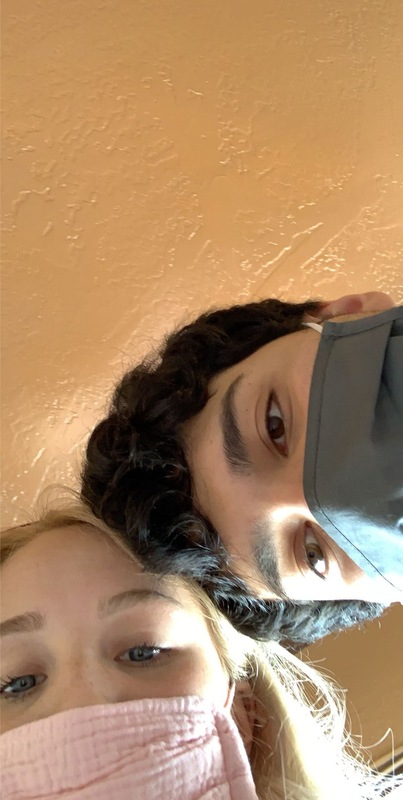
This picture was taken in my hometown of Elko, Nevada. My girlfriend and I decided to take some days off and go visit as her parents live in this small mining town. This small town had some pretty lenient restrictions, or they were being poorly enforced. One specific place or I guess monument when looking at the context of the town, the catholic church, was keen on maintaining social distancing protocols and doing what they could to protect those who decided to attend mass. I myself am not much of a religious individual and to be fair my girlfriend isn’t either, but her parents are. Due to this we decided to attend a bright and early 8 am mass. This is a selfie that she took as we are walking into the sermon, masks on of course as we were both wanting to follow the recommendations for our safety as well as the safety of others. This picture only shows half of the changes that were made to the normal sermons, every other pew was closed off and they made sure that people kept the masks on and made sure that each family was at the appropriate distance. This picture means a lot to me because it is the last time, I saw her family and it is mostly due to COVID reasons. Travel is harder and more expensive it seems, and this makes it all the more difficult to plan a trip. The past year has been difficult on every individual and everyone has gone through their own battles and experiences with COVID. This is a memory that brings a little bit of light to an otherwise very dark situation. Personally, speaking this may be one of my favorite memories of the past year and although I am not a religious person I would relive this moment again because of how much it meant to me. -
 2021-04-22
Uncertainty, Spirituality, and the Inevitability of Change #REL101
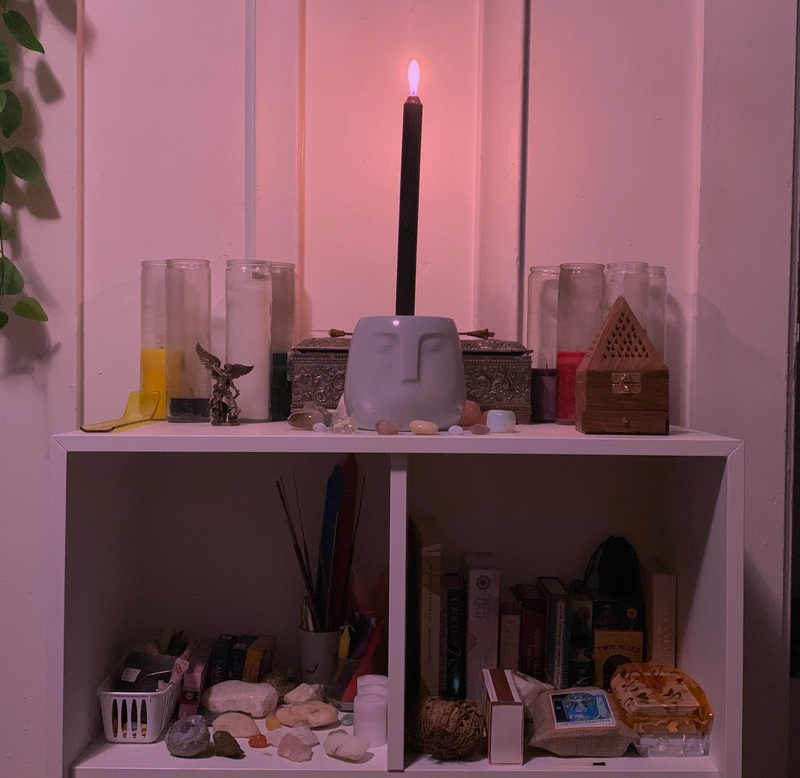
I foolishly thought that it would be easy to write this post. I didn’t anticipate struggling so much with finding the right words to explain the impact the last year of pandemic life has had on me, but I’ve deleted about a hundred paragraphs of rambling, existential stream of consciousness nonsense about cherishing the small moments and growing in the face of adversity because it is surprisingly hard to be concise about your feelings on an event you’re still living through. I’m starting to think that maybe doing so is impossible, so instead of falling into cliche and flowery prose, I want to just be blunt. I haven’t seen my family in two years. My grandmother has dementia and in that time it has worsened exponentially. On a weekly basis, I have a call with my mom that starts with a debrief on whatever the newest updates in her condition are and ends with a plea to visit as soon as I feel comfortable traveling. Every day, I go into my retail job and tell them no, I don’t have symptoms or live with anyone with symptoms while waiting for the beep of a thermometer meant to ensure I don’t have a fever. I breathe through two layers of fabric, disinfect my work area between transactions, and field rants about restrictive mask mandates for six hours a day, then come home and begin the process of undressing, banishing my clothes to the washer, and trying to relax before I have to do it all again. Everything in that paragraph is, to put it nicely, so bleak it hurts. It’s easy to get caught in the feelings of overwhelm that came along with this pandemic and it would be a farce to say that there aren’t days where everything feels like way too much for one person to handle. Surprisingly, though, the thing that has blissfully not survived the most turbulent year of my life is the apathetic, empty cynicism I used to feel. Instead, I feel weirdly hopeful that this is the beginning of massive change both in myself and on a global level. Maybe it’s naive to think that way and maybe it’s just a coping mechanism to help me through the pandemic, but there’s a part of me that thinks that may not even matter because the changes are coming regardless. In the last year, I’ve moved out of Nevada and into a pink house in California with the love of my life. Despite a fraught, stressful prior experience in college, I’ve finally come back to higher education in a way that feels both healthy and exciting. The field of religious studies has reawakened my passion for learning and my ability to grow in academia. I’ve abandoned my skeptical, agnostic views and traded them out for a brand of religiosity that combines self-improvement, magic, and trust in something bigger than myself. I know how that all sounds and if the last sentence has you rolling your eyes reading this, I get it. The last year has been weird, don’t get me wrong. If I told a 20-year-old version of myself that one day we’d be living through the plague of a lifetime, studying religion with hopes of examining cultism, and practicing a version of witchcraft grounded in our ex-Catholic roots, I doubt she would believe me. It admittedly sounds pretty wacky all laid out in plain English like that. Part of what I’ve learned throughout the pandemic, though, is that suspending cynicism, skepticism, and disbelief can sometimes lead you to unexpectedly lovely places. Whether I saw it coming or not, Covid has changed my life in countless ways, just as I’m sure it’s changed the lives of everyone reading these entries. Some changes have been for the worse, certainly, but the things that have changed for the better are what I’m choosing to focus on. I’ve read articles about a reemergence of spirituality amongst young people that make me think others have been having similar ideas and something about that feels good. We’ve spent a lot of time isolated, lonely, and missing a sense of belonging we took for granted before, but there’s reassurance for me in knowing that my experiences aren’t all that different from anyone else’s. That type of community, however it manifests, is (and I hope you’ll forgive this admitted slip into flowery prose) something that the pandemic has taught us we must cherish above everything else because it’s what makes our little human lives worth living. More than anything, whenever this pandemic reaches the time where we split our lives into not just before, but after, I hope we don’t forget that. -
 2021-04-21T18
Dinner and Hearts
As of yesterday, my two weeks was up and I am now "fully vaccinated" per the CDC guidelines. My wife got there Friday, and my mother has been fully vaccinated since February. Per the CDC, since we are all fully vaccinated, we can visit each other and not have to wear masks. We had Mom over for dinner for the first time since before the pandemic. After dinner we played a few rounds of hearts. I had to reacquaint myself with something that used to be "normal" before COVID-19. I was a bit rusty at playing cards, but I soon got back into it. It does not seem like that big a deal, but it was good for Mom to get out of her house for a while. It was good for all of us, and I am looking forward to more such evenings. -
 2021-04-18
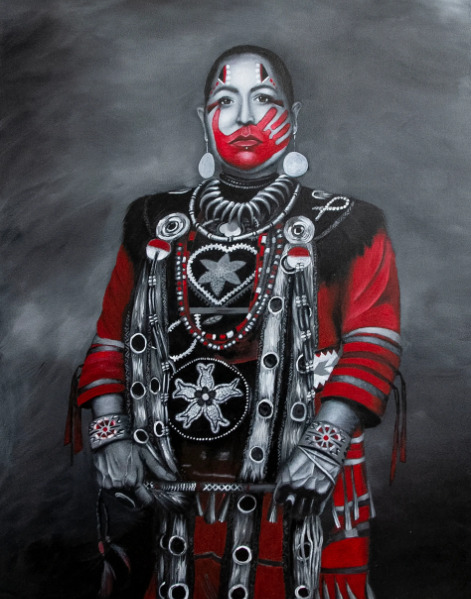
"Kimberly in Red" by Indigenous Artist Nayana Lafond
Indigenous artist, Nayana Lafond, painted this piece as part of the Missing & Murdered Indigenous Women & Girls (MMIWG) exhibition. The exhibit was designed to advocate for these missing women and to stop the violence against Indigenous women. On her website, Lafond features "Kimberly in Red" with the following description, "Kimberly LaRouge, Ojibwe from Lac Courte Oreilles Wisconsin. Mother, grand mother, motorcycle racer, traditional jingle dancer and badass." I would encourage everyone to visit Lafond's website and view her powerful and emotional art pieces. -
 2021-04-09
Prince Phillip just Died
Prince Phillip died after many jokes of him dying due to his last hospital visit at the drop of a hat. Well today, as of 4/9/2021, he has been pronounced dead, and my favorite thing about it all is how people are just now realizing that he and Queen Elizabeth were related, I thought it was more known but in hindsight, I guess that being more public would not be a very good image for the Royal Family. As someone who disagrees with the concept of the Royal Family probably knows too much about their transgressions and issues than the average person. -
 2021-04-04
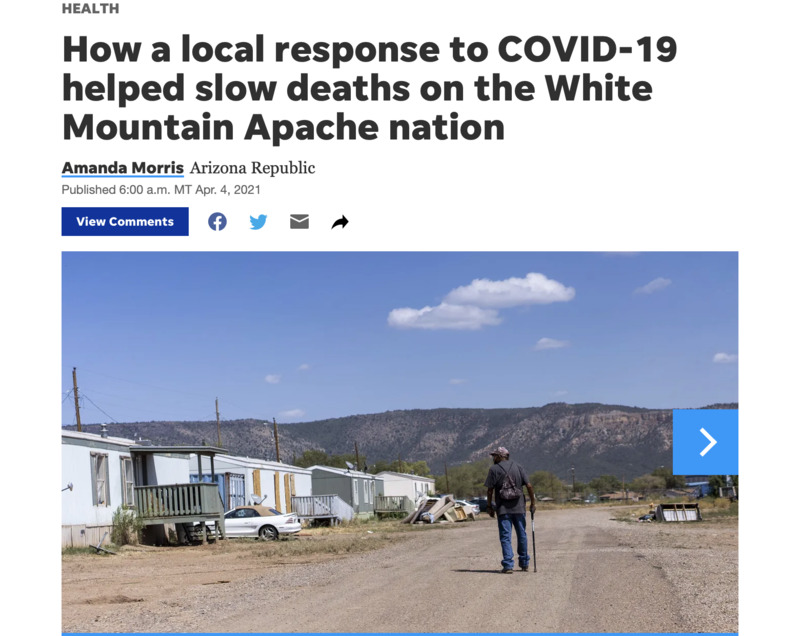
News Article: How a local response to COVID-19 helped slow deaths on the White Mountain Apache nation
By Amanda Morris of the Arizona Republic: When someone on the Fort Apache Indian Reservation receives a confirmed diagnosis of COVID-19, health care workers from the Whiteriver Indian Hospital jump into action. They personally visit the individual's home to test other household members, perform health evaluations on everyone there and trace any other potential contacts at risk for COVID-19 exposure. Health care workers in the community say that could be one reason why, even though the rate of confirmed COVID-19 cases among White Mountain Apache tribal members is nearly triple the state's rate, the death rate is much lower and continues to fall. Over 90% of COVID-19 cases in the White Mountain community are investigated within 24 hours of testing, according to Ryan Close, the director of the Department of Preventative Medicine at the Whiteriver hospital, which is the only hospital on the 1.67 million-acre reservation. "I feel like what we did made a huge difference," Close said. "We evaluated and admitted people aggressively and early. The tribe deserves an incredible amount of credit for mobilizing staff ... to make this response possible, because at some point it would have been very difficult to maintain without their considerable help." The quick response may have also helped the tribe turn the tide against rapid community spread of the virus, which scientists say could have been fueled by a single variant found only in the White Mountain tribal communities. The variant carried a mutation in the spike protein, which scientist theorize could have made it spread more rapidly than other strains of the virus. The number of confirmed COVID-19 cases among White Mountain Apache tribal members accounts for 24% to 28% of their population, according to Close, but the cumulative death rate among known cases is only 1.2%. By comparison, the statewide rate of infection was 11.5% with a 2% death rate among known cases. And over the winter, Close said the rate for the tribe dropped even lower, to about 0.5%. In a community with a high number of individuals with underlying health conditions, the low death rate and work of the tribe has been "remarkable," said David Engelthaler, director of the Translational Genomics Research Institute's infectious disease division in Flagstaff. The death rate also stands out as unusually low when compared with death rates in other Indigenous communities. Indigenous populations have been disproportionally affected by the pandemic. CDC data shows that Indigenous people are 3.5 more likely to be diagnosed with COVID-19 and almost twice as likely to die from COVID-19 than white people. Close credits a proactive strategy to combat COVID-19 that involved rapid contact tracing, in-person health evaluations and frequent outreach to high-risk COVID-19-positive individuals as well as early treatment with monoclonal antibodies and other antiviral therapies. Volunteers and health workers from the White Mountain Apache community were on the Whiteriver hospital's contact tracing team and high-risk COVID-19 outreach team, which Close said helped the team connect better with the people and work faster. One essential part of the team are the tribe's community health representatives, or CHRs, who are members of the community that serve as a cultural bridge between patients and medical establishments. JT Nashio, director of the Community Health Representatives for the tribe, said the "visceral connection" that CHRs have to the community helps them bring cultural awareness to the way questions are asked for contact tracing, which makes the process more effective and allows officials to better distribute information. "On top of that, quite simply, they know how to get around. It’s a big reservation and not all homes are easy to find," Nashio said. "But when you’ve lived here your whole life, you know where to find people. That became invaluable during the tracing and testing push during case surges." Virus mutation may have made it more transmissible When COVID-19 hit the White Mountain Apache nation, it spread rapidly. The community's first documented case was on April 1, 2020, from someone who had likely recently visited the Phoenix area, unknowingly caught COVID-19 and returned, according to Engelthaler. Within the first few weeks, Close said the community experienced a handful of deaths. "We soon had incidence rates that were skyrocketing. Case counts were going up very, very quickly," Close said. It's unclear why the disease spread so rapidly in the community, but the initial strain of COVID-19 that hit the community carried a mutation that Engelthaler believes could have made it more transmissible. "They were seeing the virus just rip through and have an 80 to 90 to 100 percent attack rate," he said. TGen partnered with the tribe and the U.S. Indian Health Services early on to provide tests to diagnose a case of COVID-19 and provide genetic analysis of the virus from each case. It showed one strain of the virus circulating in the tribal community that wasn't present anywhere else in the state. "This virus moved much faster than anything else we were seeing in Arizona at the time," Engelthaler said. "So we actually believe that we had one of these variant strains in Arizona that was causing very large numbers of cases, but it was secluded and maintained really only in that tribal population." The mutation, called the H245Y mutation, occurred in the spike of the virus, which Englethaler said is a "very sensitive" part of the virus where mutations can have a significant impact. Because of the low death rate, Engelthaler said TGen researchers would like to investigate the mutated strain of coronavirus seen among tribal members to see if it is also associated with a lower fatality rate. He acknowledged that other strains of the virus have since entered the community and that the actions of health care workers in the community and at the Whiteriver hospital is also responsible for the lower death rates. 'The earlier you treat an illness, the better' Close's biggest concern was that an outbreak would cause a "tsunami" of sick COVID-19 patients that would run the risk of overwhelming the Whiteriver hospital, which does not have an intensive care unit. Any patients that require intensive care need to be transported to other hospitals in the state. "We're a small hospital, we cannot take a wave of all very acute patients because there aren't enough ventilators in the hospital," Close said. "There aren't enough helicopters in the state to transport people out from our facility to a higher level of care." Within the first few weeks, Close said the community experienced a handful of deaths, and patients who had the poorest outcomes were the ones who self-presented at the hospital — often meaning they waited until they felt sick enough to go to the hospital. "People don't always bring themselves in early enough," Close said. "The earlier you treat an illness, the better." In response to this phenomenon, the hospital started a high-risk outreach program the third week of April. Health care workers regularly visited the homes of anyone who tested positive for COVID-19 and was at high risk for a poor outcome. Close recalls multiple days when he evaluated patients and found their oxygen levels dangerously low, even though they felt fine. It's a condition associated with COVID-19 known as "silent hypoxia," or "happy hypoxia." "They had no sense that they were even ill. They went on to get pretty sick in the hospital, but they survived and you can't help but think to yourself, 'Yeah, that's a life saved,'" Close said. "That person, if they had stayed home another day or another two days would not have done as well. They would have ended up on a ventilator or something." The Arizona Republic previously reported that the effects of the high-risk outreach program and contact tracing led to a fatality rate among tribal members of 1.6% last June, which was less than the state's rate of 2.5% and country's at 2.7% at the time. But the effect of the outreach program became even more pronounced over the winter, as the tribe and health workers gained access to monoclonal antibody treatments, according to Close. He said the high-risk outreach team started referring patients for antibody treatment in December as part of their protocol after the therapy received emergency use approval from the Food and Drug Administration. Hospital staff at the Whiteriver hospital then administered the antibody treatment. "We give that to people who are asymptomatic or mildly ill to prevent hospitalization," Close said. "The evidence currently suggests that reduces the risk that they're going to get sicker and get hospitalized and reduces the risk that they're going to die." Though there's no data proving the antibody treatments made a difference, Close said that after health care workers started using them, the community's COVID-19 death rate fell to 0.5%. Hospital workers also gave antiviral therapies, such as remdesivir, to patients early and often. "We probably overtreated some people," he said. "But the good news is it definitely led to significant reductions in mortality." Lessons for the future Close believes the different programs were so successful because health care workers were often able to test, trace, diagnose and treat individuals all in the same day — a feat he said was only possible because of how closely integrated hospital workers and community health workers were. "There were no barriers in communication between the public health arm of our response and the clinical care arm of our response," Close said. "It's really a case for an integrated health care system." As the tribe emerges from the pandemic and tribal members get vaccinated against the virus, Close said the hospital may start exploring other health conditions where it can use the high-risk outreach team, which is already trained and experienced in clinical evaluations. "The goal is to take what we've learned from COVID and now apply it to things that are not COVID-related," Close said. Another valuable lesson Close hopes to carry forward is how much of a difference visiting residents in their homes can make and how important building trusting relationships with the community is. Nashio said going door to door to trace and monitor COVID-19 cases was a natural step for CHRs, who had already gone door to door in the past for other community health campaigns. "We know firsthand how difficult it can be to not only connect with patients over the phone but communicate effectively over the phone," Nashio said. "When the community sees their CHRs coming to their door, it helps decrease the stigma of the disease." In addition to performing checkup evaluations and providing information, Nashio said CHRs can also provide food, medical supplies, cleaning supplies or services like grocery shopping and running basic errands. Not every tribal member has reliable internet or phone service, nor access to transportation, so Close said going door to door can be a good way to reach, and help, everyone. "Meeting patients where they are is invaluable," Close said. Amanda Morris covers all things bioscience, which includes health care, technology, new research and the environment. Send her tips, story ideas, or dog memes at amorris@gannett.com and follow her on Twitter @amandamomorris for the latest bioscience updates. Independent coverage of bioscience in Arizona is supported by a grant from the Flinn Foundation. -
 2021-01-15
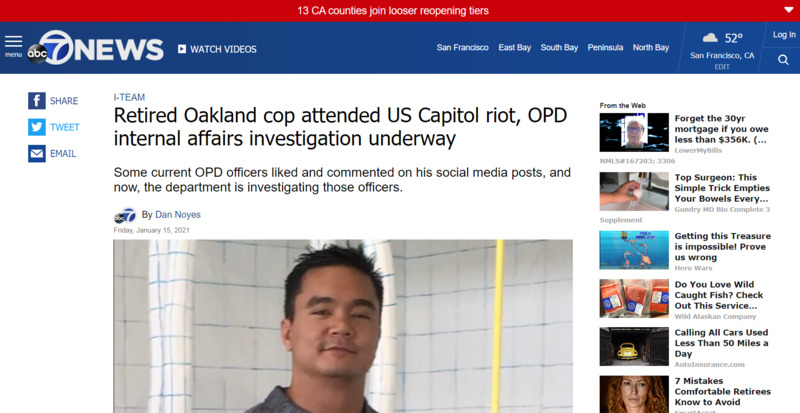
Retired Oakland cop attended US Capitol riot, OPD internal affairs investigation underway
A former Oakland police officer has received a visit from the FBI. Jurell Snyder tells the ABC7 I-Team, agents interviewed him about attending last week's Trump rally that led to the assault on the Capitol, and about his social media posts promoting conspiracy theories. Some current Oakland police officers liked and commented on Snyder's posts, and now, the department is investigating those officers. -
 2021-01-17
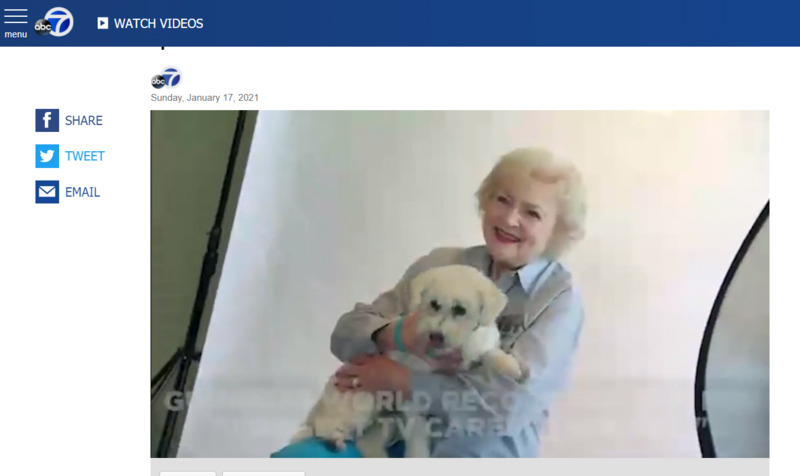
Betty White says she's celebrating 99th birthday in quarantine
LOS ANGELES -- The legendary Betty White turns 99 today, and like many others this year, she is planning a birthday in quarantine. White recently spoke with "Entertainment Tonight" about how she will spend the start of her last year as a nonagenarian. "What am I doing for my birthday?" she said. "Running a mile each morning has been curtailed by COVID, so I am working on getting The Pet Set re-released, and feeding the two ducks who come to visit me every day." -
 2021-03-28
COVID story
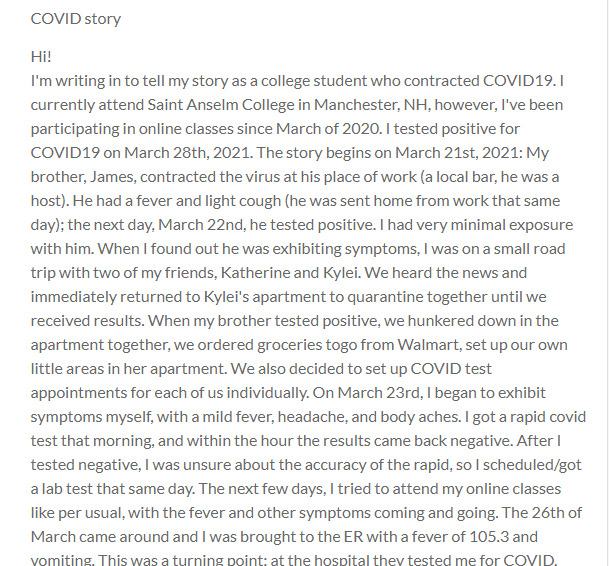
Hi! I'm writing in to tell my story as a college student who contracted COVID19. I currently attend Saint Anselm College in Manchester, NH, however, I've been participating in online classes since March of 2020. I tested positive for COVID19 on March 28th, 2021. The story begins on March 21st, 2021: My brother, James, contracted the virus at his place of work (a local bar, he was a host). He had a fever and light cough (he was sent home from work that same day); the next day, March 22nd, he tested positive. I had very minimal exposure with him. When I found out he was exhibiting symptoms, I was on a small road trip with two of my friends, Katherine and Kylei. We heard the news and immediately returned to Kylei's apartment to quarantine together until we received results. When my brother tested positive, we hunkered down in the apartment together, we ordered groceries togo from Walmart, set up our own little areas in her apartment. We also decided to set up COVID test appointments for each of us individually. On March 23rd, I began to exhibit symptoms myself, with a mild fever, headache, and body aches. I got a rapid covid test that morning, and within the hour the results came back negative. After I tested negative, I was unsure about the accuracy of the rapid, so I scheduled/got a lab test that same day. The next few days, I tried to attend my online classes like per usual, with the fever and other symptoms coming and going. The 26th of March came around and I was brought to the ER with a fever of 105.3 and vomiting. This was a turning point; at the hospital they tested me for COVID, which came back positive Sunday, the 28th. After I received my diagnosis, I still felt exceptionally terrible, so my mother had us call an ambulance for me to the ER. They, again, weren't able to do much. I returned to my home after this visit, as I wanted to be in my own bed for the duration of COVID. I had bad symptoms: vomiting, constant nausea and chills, drenched with sweat, trouble catching my breath, and all around feeling like trash and unable to keep anything down. My mom was scared for me; I became almost unresponsive at one point. My mom took me back to the ER (Wednesday, March 31), demanding they give me an IV for hydration; they did so, along with pain relief and anti nausea. This was another turning point; the next day I was able to sit up by myself, to go to the bathroom, and to take a shower. I slept for hours, healing. Friday, April 2nd was the first day I was able to stand up and keep some food down, without it coming back up. Finally, today, April 4th, 2021 (Easter Sunday), I'm able to focus back on some schoolwork and eat a full meal with my family. Both of my parents contracted the virus, and they are still recovering, like myself. -
 2020-03-11
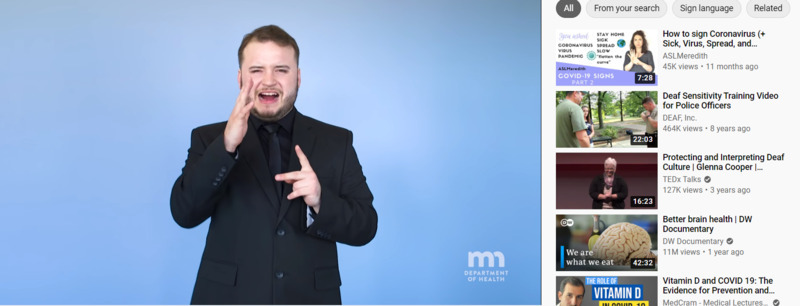
Minnesota Department of Health Travel, and Covid-19 Information in ASL
This video covers the basic information of the 2020 novel coronavirus (COVID-19) outbreak. For more information on COVID-19 visit: https://www.health.state.mn.us/diseas... ASL talent - James Paul Beldon III, Keystone Interpreting Solutions Video Transcript - Hello. This is a message from the Minnesota Department of Health. Lately we’re hearing a lot about an outbreak associated with novel coronavirus. This outbreak started in China, and now has spread to other countries including the United States. The novel coronavirus causes respiratory illness in people and can spread from person to person. Symptoms of infection include fever, cough, and shortness of breath. While most people recover, it has led to serious illnesses and death in some cases. Minnesota’s public health community is working hard to protect you, and we’re asking for your help by following the same precautions we all use to prevent colds and flu: ▪ Wash your hands often and well with soap and water. ▪ Cover your cough every time. ▪ Stay home when you are sick. Also, if you’ve recently traveled where novel coronavirus is spreading and have symptoms, be sure to call your doctor or health care provider to let them know of your symptoms and your travel history. They will work with you to assess your condition and take appropriate steps to get any needed treatment while limiting the risk of passing along an infection to others. We are learning more about this outbreak and will share key information as it continues. You can stay up to date by visiting the Minnesota Department of Health’s website at health.state.mn.us. -
 2021-03-25
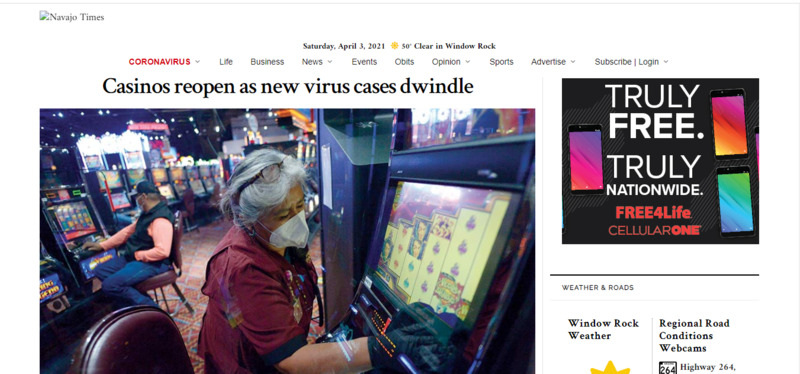
Navajo Nation casinos reopen as new virus cases dwindle
By Donovan Quintero | Mar 25, 2021 | Business, CORONAVIRUS | CHURCH ROCK, N.M. Peterson Zah has a concern. On Tuesday, while hundreds of Fire Rock Casino patrons tried to win some money, the former Navajo Nation president wanted to hear what the COVID-19 public service announcement sounded like in Navajo. “I didn’t hear any of the PSA while inside because it’s so noisy,” he said. After taking a step outside the casino, the former Navajo Nation president said he was able to hear it. But that raised a concern for him. “And it’s pretty good,” Zah said, explaining the PSA in Navajo was clear and concise. “But you can only hear that clear outside and inside you can’t really understand it.” Zah said he was concerned no one would hear the COVID-19 safety guidelines everyone needed to follow. His other concern was that since many Navajo people have gotten both doses of the vaccines, many of them might become emboldened. “The reason why I was concerned is people have this attitude that because of the shots … they say, ‘Hey, I’m immune, I don’t have to worry about the virus.’ So when I go places I’m gonna take mine (mask) off,”’ Zah said Tuesday. According to the president’s office, more than 76,000 people have been fully vaccinated as of March 23 and more than 191,000 total doses have been administered. Zah didn’t think people should take any chances by easing up on protecting themselves from the contagious respiratory virus because some people were not wearing masks. After being closed for more than a year, Fire Rock Casino and Northern Edge Casino were on the fifth day of a two-week “soft reopening.” Just the gambling portion of the casinos were open at 25% capacity, and only Navajo Nation residents were allowed into the casinos, according to Navajo Gaming interim CEO Brian D. Parrish. Parrish clarified Navajo Nation residents meant everyone, including non-Natives, living on the reservation would have access to the casinos during the reopening phase. “We’re doing it with a two-phase reopening plan that started with Fire Rock and Northern Edge first,” he said. “We’re going to reevaluate with the Navajo Nation. They’re going to do audits and monitor our implementation of our workplace safety plan.” Of the 1,180 casino employees, 650 have returned to work since last Friday, said Parrish. Employees like Fire Rock Casino housekeeper Mildred Russell, who said she’s been out of work for over a year, were happy to be working again. “It’s been a struggle,” Russell said while cleaning a slot machine last Friday. “Hopefully this pandemic will be gone and everybody can go back to their normal lives.” Other employees, like casino security officer Vernon Keeswood from Hogback, New Mexico, shared Russell’s gratitude for getting the call to go back to work. “It’s good,” he said on Tuesday during a telephone interview that was arranged by Michele J. Crank, executive director of communications and public relations for Navajo Nation Gaming Enterprise. Instead of the usual hugs and shaking hands, Keeswood said, now it was “fist bumps” and “elbow bumps.” As for the reopening, he said many Northern Edge Casino customers “are pleased and happy” the Navajo casinos have begun reopening. He added a few customers were not sure if the casinos should reopen. “I hope everyone washes their hands and practices social distancing so we open to 100 percent capacity,” Keeswood said. “I hope it opens more.” After all, the threat of another COVID-19 outbreak looms on everyone’s mind, including that of Robert Peterson from Thoreau. “People are still afraid to come here but a lot of them want to enjoy being out instead of being stuck at home,” said Peterson, who said he lives alone, last Friday. Peterson said being alone and dealing with the pandemic has been hard for him. Despite his fears, he decided to head to Fire Rock to get his mind off COVID-19. Mary E. Silversmith, 79, from Lupton, Arizona, ensured no one came to visit her with a “no visitors allowed” sign posted on her hogan. She was happy to support the casino employees who returned to work. “The casinos were opened for the casino employees,” she said on Tuesday at Fire Rock. “Many of have children and they have bills to pay. “Because of that, I am OK with the reopening,” she said. “Some people have been criticizing the reopening. Not me, I don’t think that way or talk that way.” Before the pandemic, Silversmith said she frequently ate at Fire Rock, as well as at Twin Arrows Casino and Resort, when she had extra money to spend. Silversmith was wearing a surgical mask. To gain entry into both casinos during the soft reopening, a state ID, like a driver’s license, is required and a working number at which customers can be contacted. Temperature checks were also part of the requirements for anyone wanting to enter. After their temperature was checked, security asked customers to momentarily remove their masks and look at the front entrance security camera. The purpose of collecting all of the information is for contact tracing, said Parrish. “We have an excellent plan that’s in place,” he said. “We’ve had it reviewed and modified and enhanced by public health experts, not only on Navajo, but outside the Navajo Nation.” He added that Navajo Gaming invested close to $2 million in “equipment, supplies, signage, training,” to keep everybody safe. U.S. Indian Health Service officials toured both of the casinos’ kitchens on March 12, Parrish added, to review their safety procedures. “And in terms of reopening of the other properties, especially at a higher capacity percentage, that’s going to be based not only on how well the enterprise does, but what’s happening with the public health metrics, the rate of vaccinations on Navajo and other key indicators like that,” the interim CEO said. The Navajo Gaming enterprise’s careful planning even got praise from Jordan Schermerhorn, a senior research associate at Georgetown Center for Global Health Science and Security. Schermerhorn stated in an email to NNGE their plan showed the tribe was leading “the entire country in a smart, careful return to normalcy.” “Combined with the Navajo Nation’s outstanding vaccine rollout, this soft reopening shows what is possible with a data-driven pandemic response in a community dedicated to public safety,” Schermerhorn‘s email said. Even the ventilation, air conditioning and heating systems, which completely re-circulate the air inside the casinos 15 times a day, were reviewed, said Parrish. “We’re ready to go to fifty percent, we’re ready to offer food and we’re ready to bring the rest of our team back,” Parrish said. Zah watched casino patrons trying to win money as sounds from the Tuesday afternoon hustle and bustle all but drowned out the COVID-19 PSA. “So basically, the attitude shouldn’t be such now that because they got their shot they don’t have to worry about it,” he said. “It’s still around. Even though ninety percent of the people may be wearing their mask, or all of them, if one of them comes in that has it, then we’re in trouble.” Zah explained a new COVID-19 variant is much smaller than the original strain, which to him was why everyone needed to double mask. “If you can see light through your mask that means it’s gonna go through,” Zah said. “We gotta start wearing two masks.” He said he intends to go on KTNN and remind everyone not to run off to Phoenix or Albuquerque just because they’ve been vaccinated. “At the same time, they still have to follow those protocols,” he said. “I want to say, ‘You gotta start wearing double masks.’” As of Tuesday night, the Navajo Nation Department of Health reported a cumulative 30,010 cases of the virus and 1,233 deaths. -
 2020-10-09
Quote from the Streets
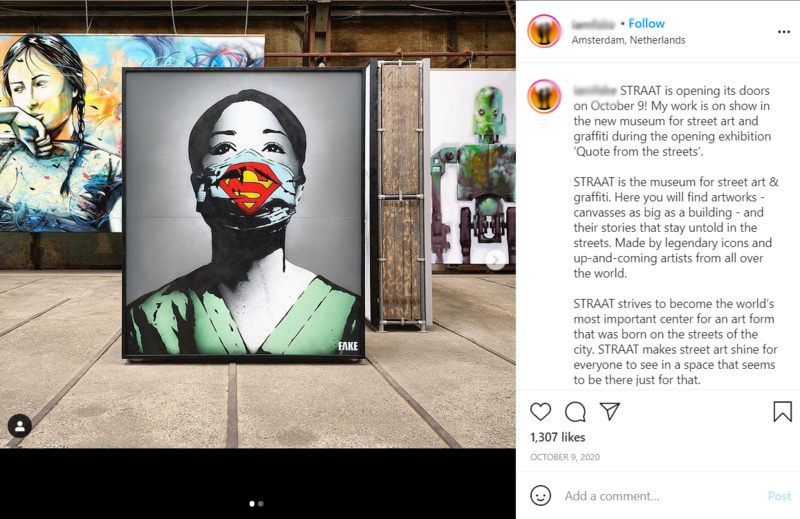
STRAAT is opening its doors on October 9! My work is on show in the new museum for street art and graffiti during the opening exhibition ‘Quote from the streets’. STRAAT is the museum for street art & graffiti. Here you will find artworks - canvasses as big as a building - and their stories that stay untold in the streets. Made by legendary icons and up-and-coming artists from all over the world. STRAAT strives to become the world’s most important center for an art form that was born on the streets of the city. STRAAT makes street art shine for everyone to see in a space that seems to be there just for that. You can visit the website for more information: www.straatmuseum.com. #STRAAT #fake #fakestencils #supernurse #straatmuseum @straatmuseum #stencilart #streetartmuseum -
 03/17/2021
Heather Martens Oral History, 2021/03/17
This is an oral history of Heather Martens by Monica Ruth, about her experiences of the pandemic. Heather shares her experiences as an administrator and facilitator of staff in her work role, her thoughts on pandemic life at home, and as a mother and partner. Heather also speaks a bit about conflicts over mask wearing, and what she hopes the future holds. -
 2020-08-03
Food Service Workers Rally For Justice
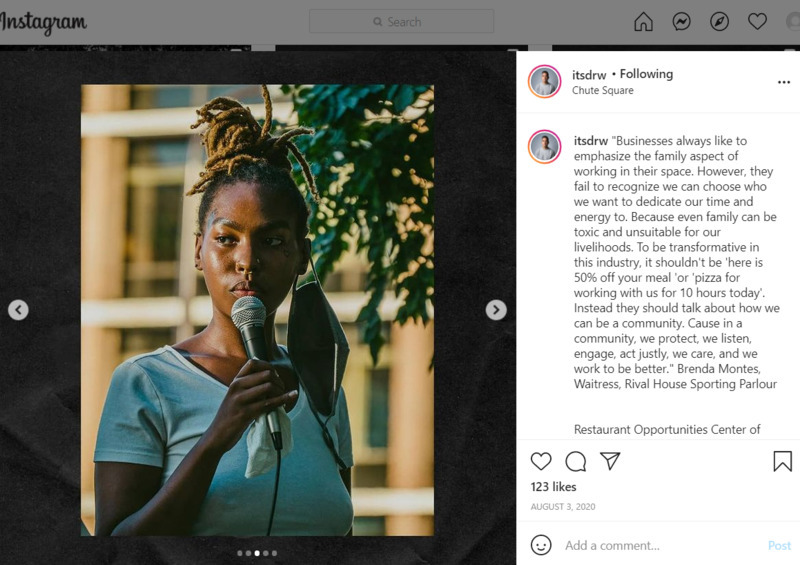
"Businesses always like to emphasize the family aspect of working in their space. However, they fail to recognize we can choose who we want to dedicate our time and energy to. Because even family can be toxic and unsuitable for our livelihoods. To be transformative in this industry, it shouldn't be 'here is 50% off your meal 'or 'pizza for working with us for 10 hours today'. Instead they should talk about how we can be a community. Cause in a community, we protect, we listen, engage, act justly, we care, and we work to be better." Brenda Montes, Waitress, Rival House Sporting Parlour Restaurant Opportunities Center of Minnesota is demanding these collective protections for restaurant workers: Worker health and safety to come before profitability and customer expectations Livable and equitable wages for all staff across the industry: no more wage theft Cultural & structural change in the industry that fosters equity, inclusion, dignity for all workers Visit @rocmn612 for more information or to get involved. Photos from Food Service Workers Rally For Justice, July 28, 2020 -
 2020-08-05
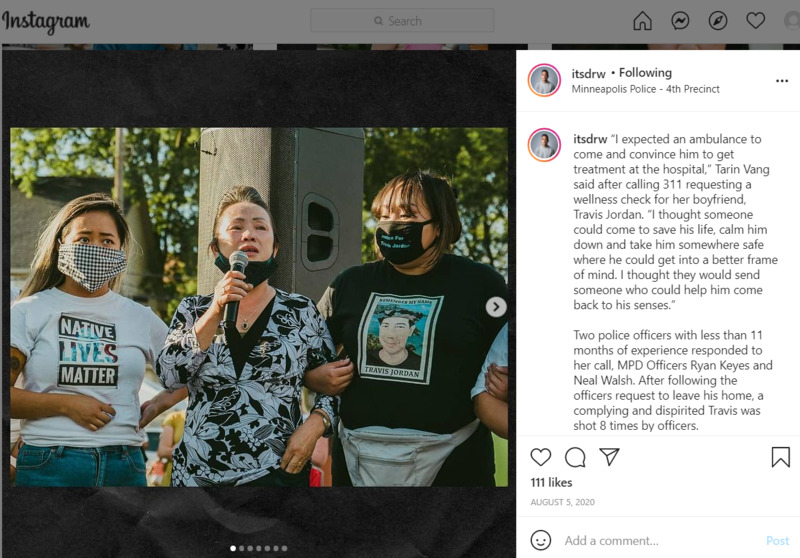
Justice for Travis Jordan
“I expected an ambulance to come and convince him to get treatment at the hospital,” Tarin Vang said after calling 311 requesting a wellness check for her boyfriend, Travis Jordan. “I thought someone could come to save his life, calm him down and take him somewhere safe where he could get into a better frame of mind. I thought they would send someone who could help him come back to his senses.” Two police officers with less than 11 months of experience responded to her call, MPD Officers Ryan Keyes and Neal Walsh. After following the officers request to leave his home, a complying and dispirited Travis was shot 8 times by officers. Travis Jordan should still be alive today. Travis' family is demanding: Travis’ case be REOPENED along with all other cases related to police violence. Officers Neal Walsh and Ryan Keyes to be charged and prosecuted for the murder of Travis Jordan. For his belongings to be given back to the family. Mike Freeman refuses to give back Travis’ notebook and black leather bracelet even though the case is closed. This is ILLEGAL. Mental health professionals to be first responders on scene during a mental health crisis, NOT the police. Visit 'Justice for Travis Jordan' on Facebook to support the family and learn more. Photos from Justice for Travis Jordan - 38th Birthday Protest - July 31, 2020 -
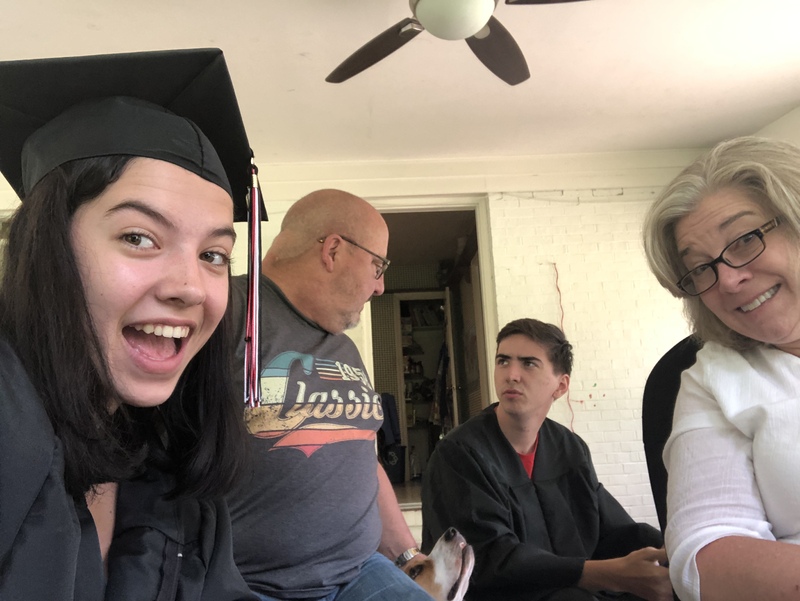 2020-06-21
A Class of 2020 Student's Covid Story
When I was in the second grade, I remember my math teacher telling my whole class that we would be graduating high school in the year 2020. It seemed so long ago, like this far away land that didn't exist. We all smiled and chatted amongst ourselves about how 2020 was such a cool-sounding year and we liked having that year to look forward to. Elementary school became middle school which became high school and then it was my senior year all the sudden. My high school has a tradition in which seniors paint some boulders behind our school with our class colors and have a barbecue. At senior barbecue, we complained about how we just couldn't wait 7 more months until prom and graduation, and how excited we were for them. If only we had known that none of those things would happen. I remember in March of 2020 going to Chicago away from my hometown of Baltimore to visit the college I'd decided on, and the news was a storm of talk about a virus called covid-19. My high school friends were blowing up my phone with texts telling me that we were off school for 2 weeks and how "awesome" this was. I remember having a gut feeling that this would not be "awesome." Though everything virtually shut down from March to May, my 4 best friends from high school and I were luckily still able to have a somewhat normal summer safely; we went swimming in the lake by my house and camped and it forced us to actually get some exercise. I also was fortunate enough to still make some money over the summer at the childcare center I worked at. I was fortunate in those ways, but I think anyone would agree it just wasn't the same. I remember being heartbroken about prom and graduation at first, until it hit me that this was a problem so much larger than Dulaney High School in Maryland. Bigger than the east coast, bigger than all of America. This was a virus affecting virtually everyone on the planet. That mindset is crucial to keeping everyone safe; your parties can wait. Your trip to Disney can wait. I knew my prom and graduation being sacrificed was for a greater good. I've heard that your true character isn't how you act in your finest hour, but in your worst. I'd say COVID has become a identifier for that. -
 2021-03-06
My favorite food! The Texas and Arizona connection
Traveling during the COVID-19 has become increasingly difficult due to restrictions, precautionary safety measures, and social isolation. I am a Texas native who is currently residing in Phoenix, Arizona. Sadly, It has been well over 2 years since I have been back home to visit, but my Aunt -who has been vaccinated- periodically decides to make a trip to Phoenix. Every time she visits she is kind enough to bring along frozen portions from my favorite restaurant- Chicos Tacos. Sharing a meal with my Aunt and relatives is a special memory I will treasure despite this incredibly difficult time. -
2021-02-18
When Covid is Over
When Covid is over I am going to see my grandkids in Washington State and paint my son’s house and then take my whole family out to dinner in a restaurant. When Covid is over I am going to dress like a rock star and play music in bars. When Covid is over I am going to keep the thrifty habits and good hygiene and good recipes that I learned during Covid. When Covid is over I am going to take my time browsing the hardware store and the supermarket. When Covid is over I am going to visit friends and have parties. When Covid is over I will be thankful that Covid is over. -
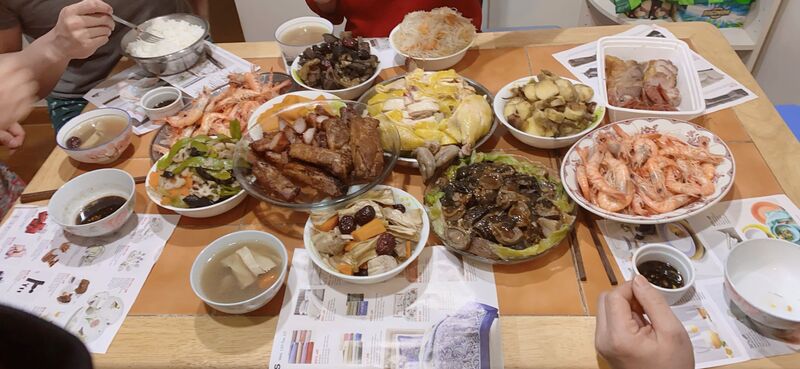 2021-02-12T12
The Celebration of Chinese New Year
I photographed this picture at the time of Chinese New Year. Even though we all live in Brooklyn, we reduce the time of visit because of the high infection rate. Finally, we got a moment to sit together and chat about the things that happened this past year (After making sure everyone is safe to attend this short and small dinner time). -
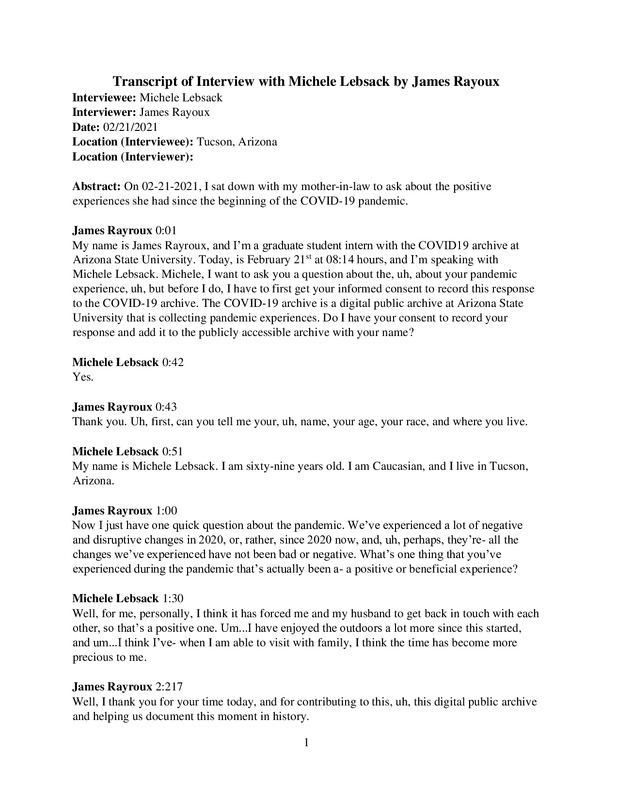 02/21/2021
Michele Lebsack Oral History, 2021/20/21
On 02-21-2021, I sat down with my mother-in-law to ask about the positive experiences she had since the beginning of the COVID-19 pandemic. -
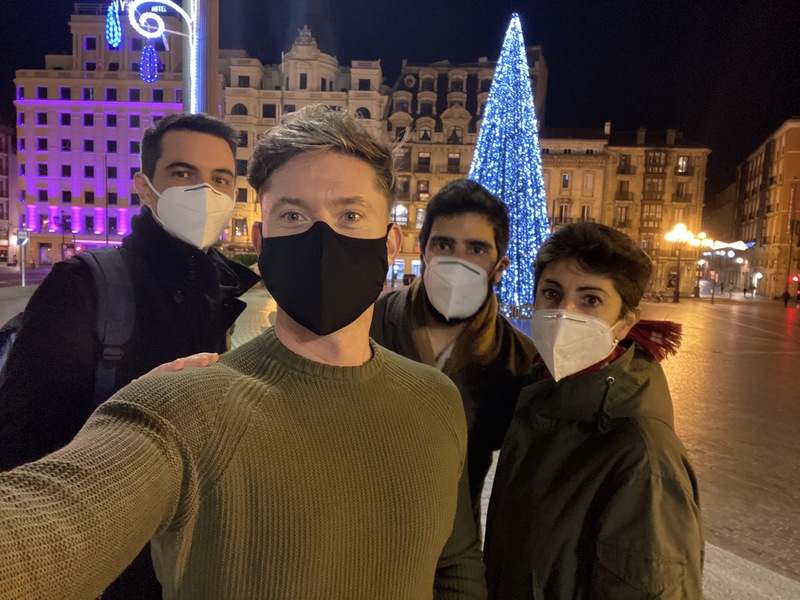 2020-11-15
New York, Bilbao, New York
In November 2020 I began reading Kirmen Uribe's novel Bilbao New York Bilbao while in Bilbao, Spain with my partner. We were there to care for his father who is suffering through the late stages of dementia and to spend time with his family who he had not seen in a year. Uribe's novel is important to my plague year for many reasons. He talks about the split mind being from Bilbao yet living in New York. My partner is from Bilbao, and the novel helps me understand his mindset. But Uribe also talks about the ways humans remember and carry pain and mark loss. Unlike trees who carry their growth in their rings or fish who mark time through their scales, humans mark time and pain through simply marking time. He notes that fish grow their entire lives, but humans start dying and shrinking from the moment we hit maturity. Growth, it seems is only for the fishes. My plague year was marked by my entire partner's family getting the virus, a story of gradual family loss, one of borders, and of course a presidential election. The pandemic closed not only schools and bars but also borders and our chances to move between Spain and the U.S. in any straightforward way. When we began planning the trip in the summer of 2020, we came up against all of the travel bans in place. My Spanish partner could get to Spain, but I could not. So, the research began, and I spent more time on Facebook groups than any person should be allowed to. We knew we weren't going to Spain just to have fun. We needed to take care of his father, but it felt like we were doing something wrong. Love, it turns out, knows no national borders, but border agencies certainly do. To get to Spain, he just hopped a plane to Madrid. I had to go through Lisbon, London, and Paris before arriving there. On the way back, I hopped on a plane flying directly to New York. He had to quarantine in Mexico for two weeks. Our stay there was marked by his father's continued decline but also moments of joy. The picture here captures one of those. As a U.S. citizen, his Spanish family and friends are always asking me about U.S. culture and practices. One of my tasks in Spain was to cook a big American Thanksgiving dinner, which I did with gusto. I made all the things: turkey, sweet potatoes, green bean casserole, mashed potatoes, cranberry sauce, and pecan pie. I tried to explain the significance of each dish while realizing how insignificant and somewhat gross Thanksgiving foods are. But we had fun and spent the night after the meal singing "American" songs and discussing art--his cousins are all artists. That night, one of his friends recommended I read Uribe's novel. So, I ordered it that night. It is a lonely book of loss and thinking about how art marks that loss. I think that is how we marked our time in Spain contemplating everything we had lost in 2020 and everything we were gradually losing. We spent time at the Guggenheim and Fine Arts museums in Bilbao. In fact, we waited for my partner's COVID test while browsing the Fine Arts Museum. It turned out positive, and we separated at the point for two weeks. But the picture here represents a moment of joy as we said goodnight to my partner's cousins after the Thanksgiving weekend. I hope for all the clichés of going back to normalcy. And we probably will get back to the "before times" given humans' inability to learn from any of their experiences. But I am one of those humans and just want to sit at a bar and talk to strangers again. When that normalcy returns, I will look back at this picture and remember Uribe's words: "As with the growth rings of fishes, terrible events stay on in our memory, mark our life, until they become a measure of time. Happy days go fast, on the other hand--too fast--and we forget them quickly." Maybe Uribe is wrong, though. I will not be forgetting this day anytime soon. -
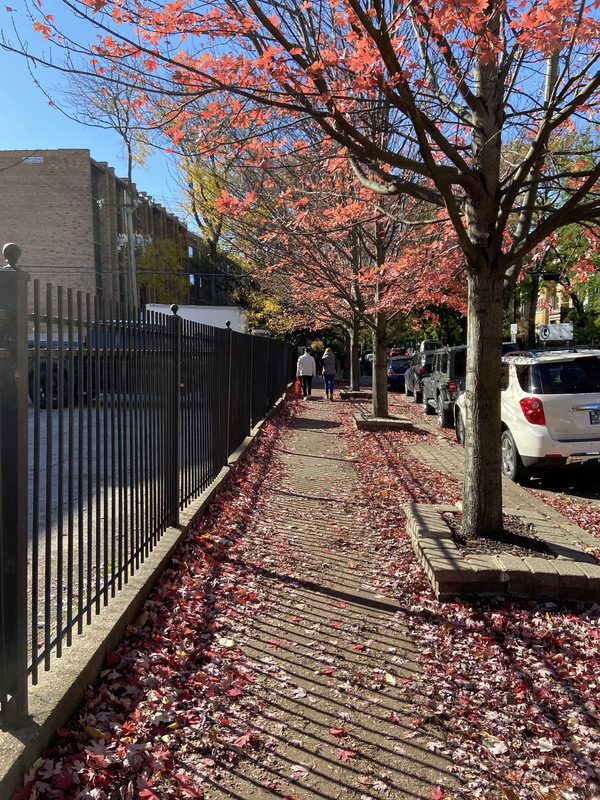 2020-09-25
A City Once Busy
I once used to walk this street on my way to work at a restaurant. I always loved how busy it was, seeing the streets overcrowded with people who had places to be. When I lost my job because of the pandemic in March I had to go home for 7 months. At the beginning I think we all thought that things would have turned around by the time the leaves started to fall. When I came back, I went downtown to visit the restaurant I had once worked at. The restaurant was boarded up still and the streets were mostly empty, and I felt kind of empty too. -
 2021-02-18
The Immorality of Being Happy in a Pandemic
As a student who goes to a very tight knit Catholic College, nothing has split the community on campus quite like this. The issue comes with balancing the benefits of an in person education with maintaining a healthy social life compounded by inconsistent rule enforcement. From my perspective, there is a scale for how seriously people follow the COVID protocols, on one end there are people who religiously follow every rule, and on the other, people who go at great lengths to break them and think nothing of going to a packed club. The student body sits everywhere in between these two poles. The difference in opinion causes the people who follow the rules to resent the people who break the rules. They see it as reckless and selfish that some students hold their interests in a higher regard than the well being of their classmates. The people who break the school’s quarantine were tired of never leaving their dorm and argue that college is meant to be fun and if you have to bend the rules to see friends that's acceptable. I’ve seen these disagreements split dorm rooms, best friends, sports teams and classmates. Without a common area to communicate our differences we are only left to passive aggressively hate through social media. Very often people's views on following the “Community Care Covenant” depends on how convenient it is to them. It is very easy to condemn off campus partiers when it is a Thursday night with no plans to go out and a lot of homework to do. It becomes just as easy to mock the frivolity of the rules when your friends are going out and leave you with the option of being lonely or finding enjoyment. I have been both amused and exasperated to see some of my acquaintances with strong liberal views condemn Trump and anti-maskers on all platforms for refusing to accept the sound science of social distancing and covering one's mouth. Then not even an hour later they will post from the same account a picture of them at a two-hundred person house party, drink in hand, and not a mask in sight. As if them claiming their intentions are pure makes their actions irrelevant. I have seen this every weekend and am dumbfounded with the lack of self awareness some people show. In the name of honesty I will admit that I feel this contradiction personally. I scroll through my phone and get jealous and annoyed by posts of my college peers in large groups, without masks, clustered together. Unfortunately, even though I agree with all the social distancing precautions things change when I have the opportunity for fun. One year into having almost every single conversation being with the same eight people, I long for the college experience. As much as I dislike going against rules that I personally agree with there is no end in sight to this pandemic. Besides, I rationalize, my friends and I are all healthy and would not purposefully endanger elders. So despite people like me self-righteously shaking our fists and quarantine breakers, I do feel strong temptations to do so. For example, I had not seen my girlfriend in weeks and the new relationship we had started was dying due to long distance. Do I break protocol by taking her on a date and spending time with her? Yes, I did. When friends I had not seen since first semester freshman year asked me my second semester sophomore year to join them for drinks. Do I follow the rules and stay in my dorm watching television, or do I go into junior year with more than two friends? There is a huge culture of hypocrisy at all levels, whether it be the students or the school itself. The school, sadly, is not innocent of responsibility for some of these divisions. The school refuses to allow men and women to visit each other in their dorms, but as the saying goes “out of sight out of mind” as the athletic teams and others have off-campus parties just a mile away the school would have to be fools not to notice. My friends and I are not allowed to play basketball in the gym. But if we are out of the public eye in a secluded part of campus, fifty people can play pick up sports. Sure the campus police will not break up bonfires in the woods and won’t bat an eye when several packed cars leave campus at the same time but four people can not eat lunch together. Most people seem to be concerned about covering their own behinds rather than any sort of actual safety. To conclude, this is not an easy time for anybody. There have been plenty of tough decisions to make and things are not so black and white as campus rules would like to believe. Having fun is hard work in COVID America. The social pressures at this school continue to weigh heavily on those who do their best to do the ‘right thing’. Like I said earlier, there is a large scale of where people's beliefs over COVID policy lands, but I think I can speak for college students everywhere when I say, I cannot wait for this to return to normal. -
 02/16/2021
Jaz Kaur Oral History, 2021/02/16
I recorded a mini oral history with my mom's old friend about the positive aspects she experienced during the pandemic -
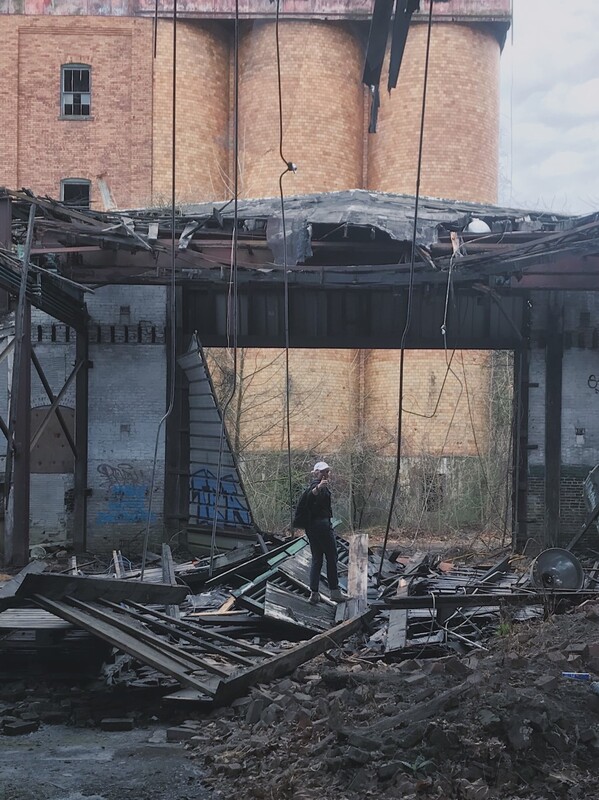 2020-03-15
Quarantine vs. A Budding College Student
When I first heard of the COVID-19 pandemic, I was entering my third quarter of my senior year at Berks Catholic High School. I initially took this as an extended Easter break, finding what opportunities I could find before my inevitable return to school. Except I didn't return to school, no student did. I actually visited Duquesne University to find out more information on March 13th as students were moving out; nothing could prepare us for what was to come of this pandemic. During the last two weeks of March I did as any teenager would do during an extending break off school- absolute shenanigans. I got extremely into urban exploration (essentially exploring abandoned buildings) and loved finding these forgotten pieces of history around Pennsylvania. My friends and I would often go to the local skatepark and make acquaintance with fourteen-year-old teenage boys, as we hardly knew how to skate. About a week after the beginning of this break, I decided the best course of action would be to visit my friend Parker who lives on the other side of Pennsylvania. After driving four hours across the state, we began our beautiful adventure. From hiking, exploring abandoned places, and almost getting arrested, I thoroughly enjoyed my time in Western Pennsylvania. Following this, I had the opportunity to pick up my now-girlfriend and take her across state lines to Maryland. She had never tried Wawa, which I deemed an indescribable experience and finding out the closest one was in Maryland, of course I decided that going there past midnight was the best decision. It was probably the best decision I had made all year as I am still with her, even through this pandemic. Returning home I had received the news that we were not to return to school. This sent me into a very confused mindset as I was unsure of what was to come. Then came spirals of misinformation and political divide of what this virus truly was. This was no help to the nation, let alone those of us at home who had no control over what was going on. It was April now, online school had begun for my high school- I did not attend a singular zoom class. A little over a month had passed and the nation came under racial turmoil after the killing of George Floyd. I was a supporter of the Black Lives Matter movement and had attending multiple protests. The most notable of these protests came to be the "D.C. Blackout". The night of May 31st, 2020 was that like none-other. I contacted my friend from Harrisburg earlier that day and asked her if she would travel to D.C. with me to participate in the protest; we had no idea what we were going into. We arrived in the D.C. area around 9:30 that evening, what turned to a night of complete anarchy. I have never seen or felt anything like I did that night and do not have the necessary words to describe what truly happened that night, or how some of the protesters that were arrested are still missing to this day. Three days following the blackout, I graduated high school. This was not your typical high school graduation with a huge ceremony filled with friends and relatives; this was a drive through by homeroom. Quite anticlimactic if you ask me. My life continued on after this and I now find myself in the midst of my spring semester at Duquesne University (pandemic still occurring of course). Mere words can not describe the true feelings and experiences I have gone through in the past year, I just ask that eventually this country ties up its loose ends. -
2020-02-05
Pandemic Brand Reviews: Sprouts Farmer's Market Grocery
There is a Sprout's less than 2 miles away from my house. My parents would often go to buy fresh produce and snacks from the bulk section. Due to the pandemic, Sprout's no longer offers their self serve bulk section. Instead, there are prefilled bags. My parents no longer frequent Sprout's, I think because of this new policy, or perhaps better prices elsewhere. Because my close friend works at Sprout's, I visit her at work. With the exception of the bulk section, everything is still the same. However, I do see the curbside pickup and grocery delivery options being used more. My local Sprouts has designated some parking spots for curbside pickup. One time when I was visiting my friend, she was on Instacart (grocery delivery) shopping duty that day. I walked around with her around the store as she picked up the items that the customer requested. She had to be very quick and find the items immediately. Not only that, but if the phone beeped, she had to drop everything she was doing to deliver a curbside order. Being an essential worker in customer service is very hard work. I hope that people can acknowledge and appreciate their hustle. -
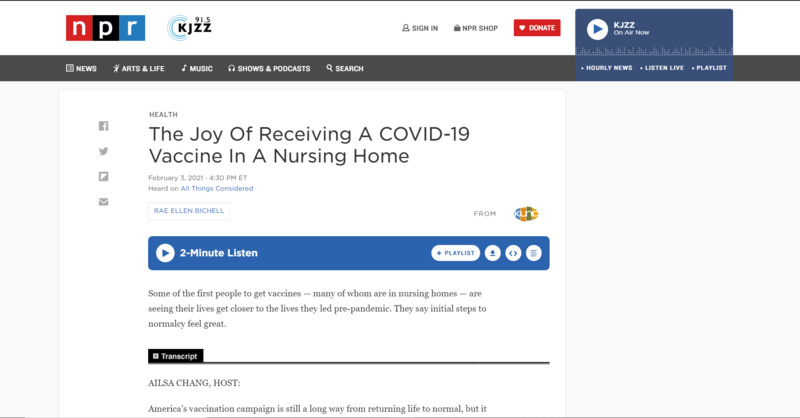 2021-02-03
The Joy Of Receiving A COVID-19 Vaccine In A Nursing Home
Residents at a Colorado assisted living faclity got their second dose of the COVID-19 vaccine. They are now allowed to have gatherings as long as they continue social distance and wear a mask. Their family can also visit them once again as long as certain safety measures are followed. -
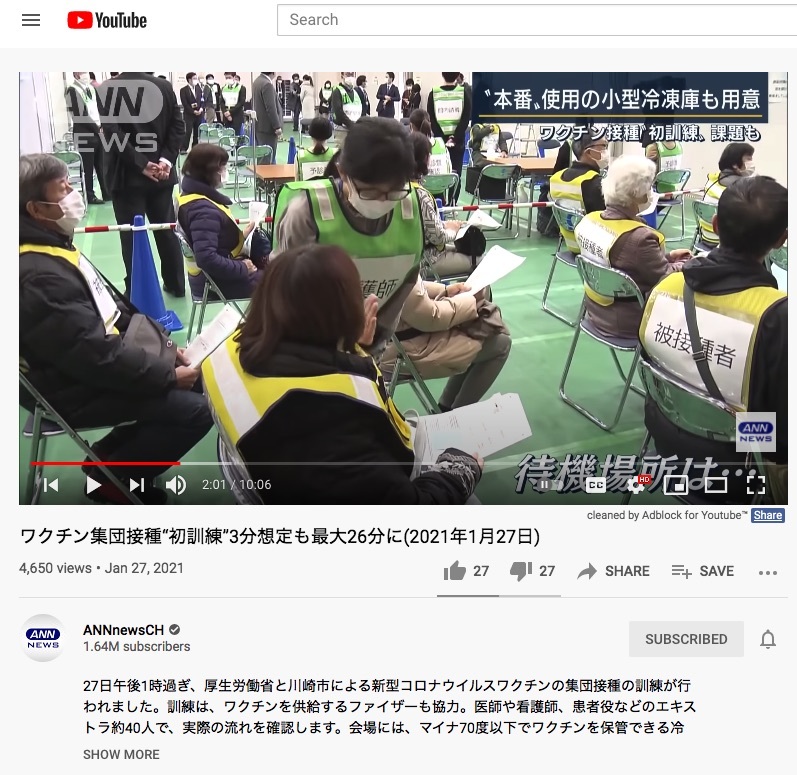 2021-01-27
ワクチン集団接種“初訓練”3分想定も最大26分に(2021年1月27日) – Vaccine mass vaccination "first training" assumed 3 minutes and up to 26 minutes (January 27, 2021)
This was a news video where Kawasaki city in Japan conducted a practice round of vaccination process. Personally, I do get the reason why the practice is happening; however, Japan still doesn't have a set date of when vaccinations will actually happen. This news and event itself could lead to people having high hopes of getting vaccinations soon when in reality, it could take much longer. Unlike U.S., Japan does not have a culture of drive through, meaning people physically have to go to locations for the vaccines. Also, having large gatherings like this I personally think should be avoided and maybe they should have videotaped it and posted on YouTube on how to get vaccinated, instead of many people physically going to the place and learning how to be vaccinated. I have translated the video. After 1:00 pm on the 7th, the Ministry of Health, Labor and Welfare and Kawasaki City conducted a training for mass distribution of the new coronavirus vaccine. The training also cooperated with Pfizer, which supplies vaccines. About 40 vounteers of doctors, nurses, and patients checked the actual flow. At the venue, there was also a freezer where vaccines could be stored at a minus temperature 70 degrees or less. The Ministry of Health, Labor and Welfare has already conveyed the message of mass distribution to each local government. First, at the reception, complete the temperature measurement and identity verification, and fill in the questionnaire about your health condition and chronic illness. Next, a pre-examination will be conducted to see if the doctor can actually vaccinate, and if there are no problems, vaccination will be given. You will then need to wait 15-30 minutes to receive a vaccinated certificate and follow up for any side effects. According to the Ministry of Health, Labor and Welfare, it takes 3 minutes per person from pre-examination to vaccination, and if it takes 7 hours, 280 people can get the vaccine a day. However, it is said that some people took up to 26 minutes from the pre-examination to the vaccination in the training. Kawasaki City College of Nursing, President Noboru Sakamoto: "I was a simulation patient today, but I feel like I would continue asking questions like ‘I am really scared of allergies from this vaccination’. People who are receiving the vaccination are most likely afraid so we would need to consider and adjust the fact that people will ask questions, for future vaccination sessions” the issue of selecting a venue was also pointed out. Kawasaki City College of Nursing, President Noboru Sakamoto: "I think it's okay if it's a gymnasium, but when it comes to elementary, junior high and high schools, we use it in regular class for students. Once vaccination starts, we have to use it for at least half a year or a long period of time. Given that it is unbearable, we will not be able to use gymnasiums that are used for education every day.” Some local governments cannot prepare large venues. In Izu Oshima, which has a population of about 7,500, we plan to vaccinate at the Oshima Medical Center, the only medical institution on the island. Oshima Town Welfare Health Division, Tetsuya Yoshizawa, Chief: "We plan to have Saturdays and Sundays, which are holiday medical treatment days, considering the system of medical staff. If that is not enough, we are considering about one day from the weekday. However, the trouble is that we have to vaccination twice. This is just new for us.” The vaccine will be shipped by ship, but the schedule may be affected depending on the weather. Tetsuya Yoshizawa, Chief of the Oshima Town Welfare Health Division: "Of course, depending on the weather conditions, it may be canceled. If we can't see when the vaccine will arrive, it's hard to prepare.” Vaccines are first transported from warehouses that can be stored at ultra-low temperatures to hospitals equipped with freezing facilities. However, since the number of facilities equipped with freezing facilities is limited, we plan to refrigerate the facilities and transport them to each vaccination site and facilities for the elderly. The government plans to secure 10,000 ultra-low temperature freezers and aims to complete the installation by the end of May. At a facility for the elderly in Chiba City, we have begun to consider whether vaccination can be done at the facility. This is because elderly people with dementia are admitted and it is difficult to take them to the vaccination site. Chiba Workers Welfare Association, Megumi Kadowaki, Director of Nursing Care: "If possible, it is safest to ask a" family doctor "and inject the vaccine." However, whether the family doctor is given permission to inject the new corona vaccine is still unknown. In addition, Ms. Kadowaki wants the procedure for vaccination to be as simple as possible. Chiba Workers Welfare Association, Megumi Kadowaki, Long-term Care Manager: "Employees are doing their best to prevent infection and protect users of the center, so I would like you to reduce the new office work as much as possible" because there are still those who cannot visit the vaccination. Dr. Tomitsuka is visiting the clinic in Ota-ku, Tokyo. There are currently 60 patients on-site. In the middle of this month, Ota-ku recruited doctors to register as vaccination doctors for patients, including me. He says he intends to join, but he is worried about carrying the vaccine. Director of Seseragi Clinic Tamagawa Taro Tomitsuka: "The biggest fear is that the vaccine's effect is lost after transportation because the environment of minus several ten degrees cannot be maintained. At the end, I have to vaccinate it. I am accustomed to storing and transporting the vaccine. I really want people who are used in transporting and maintaining the temperature to do it.” It is said that cooperation with doctors will become more important in the future toward the first vaccination. Director of Seseragi Clinic Tamagawa / Taro Tomitsuka: "I think it's safer and more secure if you leave it to your family doctor, but on the other hand, it's a vaccination that requires speed, so you can involve local doctors well.” Minister Kono met with the presidents of the National Mayors' Association. Minister Kono, in charge of vaccination: "I told you that vaccination of the elderly will be after April 1st at the earliest. 7日午後1時過ぎ、厚生労働省と川崎市による新型コロナウイルスワクチンの集団接種の訓練が行われました。訓練は、ワクチンを供給するファイザーも協力。医師や看護師、患者役などのエキストラ約40人で、実際の流れを確認します。会場には、マイナ70度以下でワクチンを保管できる冷凍庫も用意されました。 厚労省は、すでに、集団接種のイメージを各自治体に伝えています。まず受付で、検温や本人確認などを済ませ、健康状態や持病などを問診票に記入。次に、実際に医師が接種できるかどうかを診る予診を行い、問題がなければワクチン接種を行います。その後、接種済みの証明書を受け取り、副反応が出ないかの経過観察のため、15~30分、待機する必要があります。 厚労省は、予診から接種まで1人3分で、7時間行えば、一日280人が、ワクチンを打つことができるとしています。ただ、訓練では予診から接種まで、最大で26分かかった人もいたといいます。 川崎市立看護短期大学・坂元昇学長:「きょうは模擬患者だったが、つい本音で『これってアレルギーが怖いんですね』とか、お医者さんを目の前にすると、そういう話が延々と続いてしまう。受けられる方は不安だろうから、たくさん質問するというものを今後、どうやって調整するか」 会場選びの課題も指摘されました。 川崎市立看護短期大学・坂元昇学長:「体育館だったらなんでもいいやと思われるが、小中高校になると、通常の授業で使う。いったん予防接種が始まれば、少なくとも半年とか、長い期間、使わざる負えないということを考えると、日々、教育で使うような体育館等は使えないだろう」 大きな会場が用意できない自治体もあります。人口約7500人の伊豆大島では、島内唯一の医療機関・大島医療センターで接種を行う予定です。 大島町福祉けんこう課・吉澤哲也課長:「医療従事者の体制等も考えて、休日の診療日にあたる土曜、日曜を予定。それで対応しきれない場合は、平日いずれかの曜日1日くらいを考えている。ただ、厄介なのが2回、接種しなければいけないというところで。いかんせん何もかも初めてなので」 ワクチンは船で運ばれる予定ですが、天候次第でスケジュールに影響が出る可能性もあります。 大島町福祉けんこう課・吉澤哲也課長:「当然、天候状況によっては“欠航”ということもある。我々もワクチンが、いつごろ手元に届くのか、その辺が見えてこないと、準備のほうもなかなか進めるに進められない」 ワクチンは、超低温保存ができる倉庫から、まずは、冷凍設備が整った病院などに運ばれます。ただ、冷凍設備が整った施設は限られているため、その後は、冷蔵で、各接種会場や高齢者施設などに運ばれていく予定です。政府は、超低温冷凍庫を1万台確保する方針で、5月中の設置完了を目指しています。 千葉市にある高齢者施設では、施設で接種ができないかと検討を始めました。入所しているのが認知症の高齢者で、接種会場へ連れていくことが難しいためです。 千葉勤労者福祉会・門脇めぐみ介護部長:「できれば“かかりつけ医”が問診をして、ワクチンを接種してしただくのが一番、安心」 ただ、かかりつけ医に新型コロナのワクチンの接種許可が下りるかは、まだ、わからないといいいます。さらに、門脇さんは、接種までの手続きなどを、なるべく簡潔にしてほしいと訴えます。 千葉勤労者福祉会・門脇めぐみ介護部長:「職員は、感染対策と利用者さんを守ることで精いっぱいなので、新たに生じる事務作業は極力減らしていただきたい」 接種会場に足を運べない人は、まだいます。東京都大田区で訪問診療を行っている富塚医師。訪問診療している患者は現在60人います。今月中旬には、大田区から患者にワクチン接種をする医師として登録するよう呼び掛けられました。応じるつもりだといいますが、ワクチンを運ぶことに不安があるといいます。 せせらぎクリニック多摩川・富塚太郎院長:「マイナス数十度の環境が保てなくて、ワクチンの効果が運搬後になくなっているというのが最大の恐怖。最後は私が打つ。ワクチンの保存と運搬は慣れた人にしていただきたいのが本音」 初めてのワクチン接種に向け、今後は、医師の連携が、より大切になってくるといいます。 せせらぎクリニック多摩川・富塚太郎院長:「かかりつけ医に任せていただければ、より安全・安心で、対処できると思うけど、一方で、速さを求められているワクチン接種なので、うまく地域の医者を巻き込んでいただければなと」 河野大臣は、全国市長会会長らと会談しました。 “ワクチン接種”担当・河野大臣:「高齢者のワクチン接種が、早くても4月1日以降になるとお伝えした。