Items
Search full-text
free fc 26 coins ps4 Visit Buyfc26coins.com Zniżki na duże ilości..C10x
-
 2020-10-14
Jewish Melbourne: UJEB Hebrew Immersion Program online
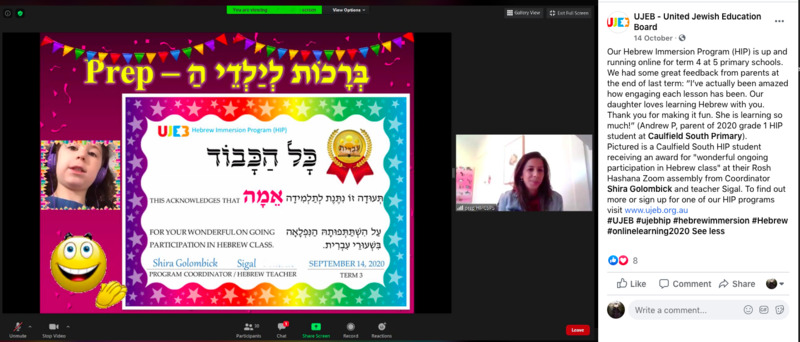
"Our Hebrew Immersion Program (HIP) is up and running online for term 4 at 5 primary schools. We had some great feedback from parents at the end of last term: “I’ve actually been amazed how engaging each lesson has been. Our daughter loves learning Hebrew with you. Thank you for making it fun. She is learning so much!” (Andrew P, parent of 2020 grade 1 HIP student at Caulfield South Primary). Pictured is a Caulfield South HIP student receiving an award for "wonderful ongoing participation in Hebrew class" at their Rosh Hashana Zoom assembly from Coordinator Shira Golombick and teacher Sigal. To find out more or sign up for one of our HIP programs visit www.ujeb.org.au" -
 2020-10-06
Jewish Melbourne: Visiting TBI's Sukkah
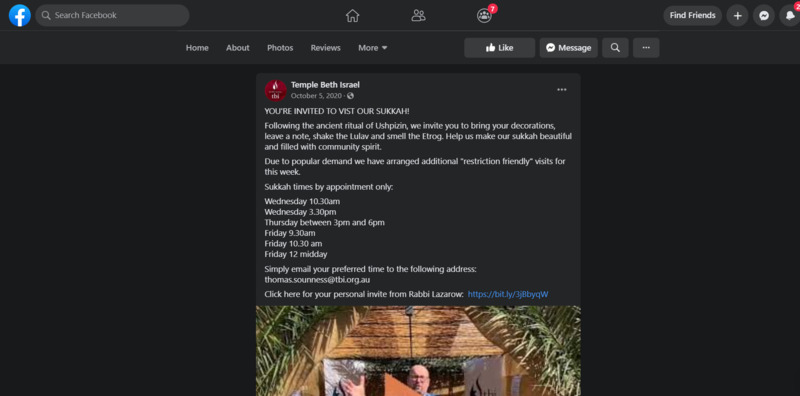
Sukkot took place during lockdown in 2020, and so Temple Beth Israel organised a booking system to visit their Sukkah: "Following the ancient ritual of Ushpizin, we invite you to bring your decorations, leave a note, shake the Lulav and smell the Etrog. Help us make our sukkah beautiful and filled with community spirit." -
 2020-11-19
Anonymous Oral History, 2020/11/19
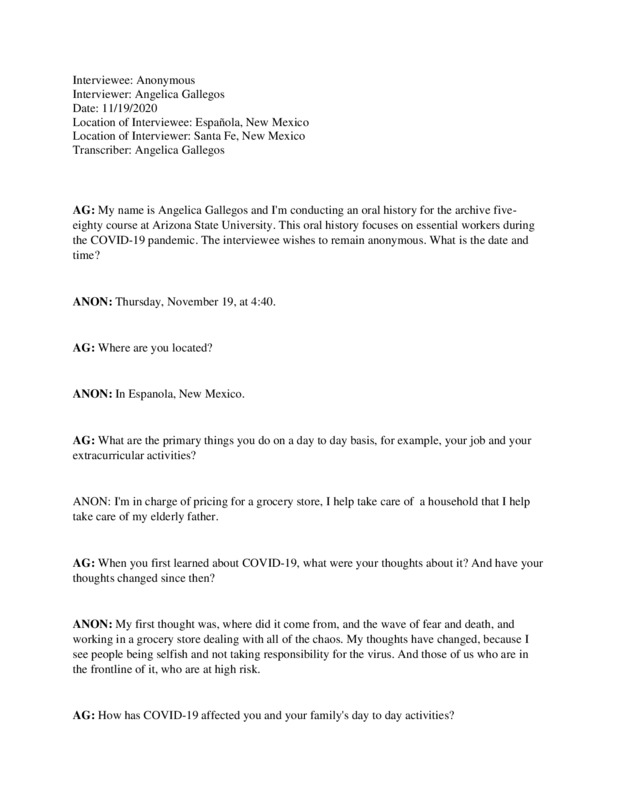
The interviewee discusses her life and daily activities during the COVID-19 pandemic. She addresses her role as an essential employee while caring for her family. -
 2020-11-09
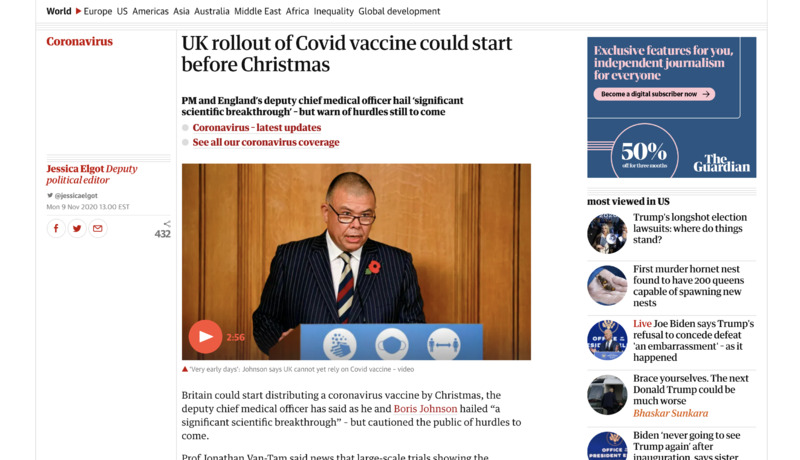
UK rollout of Covid vaccine could start before Christmas
As someone who is patiently waiting for this dismal lockdown to end so I can get on with my life this is good news. Hopefully, things will clear up so I can actually go and visit my fiance. I wonder who all will take the vaccine though, or if visitors will be forced to take it. -
 2020-11-10
Life in a Digital World
For millions of people, the blue and white logo of the digital video meeting service, Zoom, has become a familiar sight. I am sure that many of us, like myself, had to abruptly learn about Zoom in March 2020 when our lives entered a digital phase due to the pandemic. I’m sure that I am also similar to many others when I can now say that (in November 2020) I am more than proficient in my Zoom skills. Everything from school to work to social meetings are now conducted by sending Zoom invitation links. Zoom has become the classroom, the office, and the cafe…..possibly without even changing the room you are sitting in. This year has not been easy but, as I look back over these past months, I have realized that the technological world has become a surprising lifesaver. Technology has allowed people to stay connected to the world without even stepping outside their homes. Phone calls, emails, texts, Zoom meetings….they have all played a part in keeping us close to our family and friends. Even my college graduation in May was conducted over Zoom. We moved our tassels as one graduating department, even as we sat in front of our separate computers in different locations! I have started my first semester at graduate school this fall at a Pittsburgh university. My classes are conducted through Zoom, so I am not actually on campus or living in the city! While I miss in-person social interactions, I am also incredibly grateful that, thanks to digital tools and dedicated professors, I have been able to continue my education despite this year’s difficult circumstances. Interestingly, despite global lockdowns, I have been able to “visit” parts of the world I would not normally be able to, due to institutions’ and organizations’ commitment to providing virtual experiences. From our home, my family and I have watched theatrical performances, concerts, and other events occurring in different geographical areas because of the ability to livestream. We have also been exploring various museums by taking virtual tours and looking through virtual collections. Through technology, I have been able to learn about and experience events and places that I would not have been able to otherwise! Eventually, this pandemic will be over. I hope, however, that institutions and organizations continue to reach out digitally even when it is safe to resume in-person group activities. Digital programs and projects allow people to participate in events and experiences that might have been too costly in travel expenses or time commitments had they only been offered in traditional, in-person formats. Regardless, I am grateful for what digital programming and technology have already given me. This year has been incredibly stressful and filled with anxiety. Sometimes, it has made all the difference to be able to connect with a few people over a Zoom meeting. In the end, the Zoom logo has come to signify many things to me: pandemic, prevalence of digital technology, and, when it comes down to it, the importance of human connectivity and relationships. -
 2020-05-12T17:30+10:00
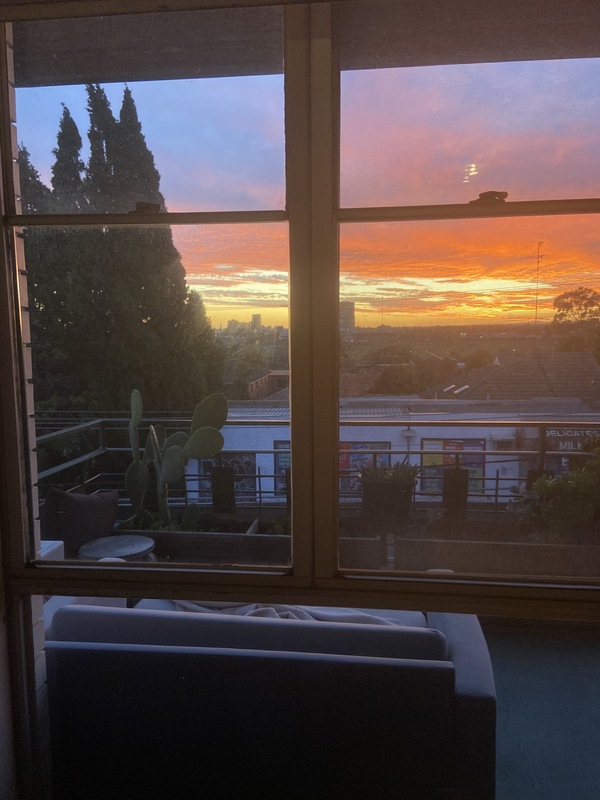
Finding Light in the Darkness: Sunset from a Melbourne Apartment in Lockdown
This photograph depicts a sunset from my apartment in Brunswick West, Melbourne on May 12, just before lockdown restrictions begin to ease in Victoria for the first time since March. I had spent that time completely alone in that apartment, as my room mate left for Queensland before lockdown began, my family mainly lived in Queensland, and my friends lived outside my suburb so I could not visit them. This was isolating in multiple ways and led to boredom, sadness, depression, agoraphobia and loneliness. I captured many sunsets like this over the months in my apartment, which brought a small bit of light amidst the dark monotony of lockdown. From this view I could imagine what lied beyond the walls of my small living space, and look forward to a day where I could feel safe moving beyond home and my nearby grocery store. HIST30060. -
 2020-11-09
2020: The Year of The Ring of Steel and Shaggy Dogs
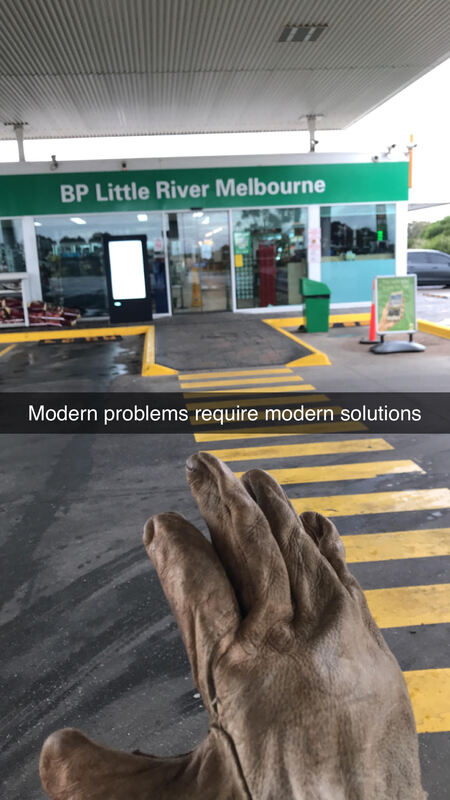
In the series of images depicted above, I portray the imminent changes to both my life and the lives of those I love. The stage three lockdown which dawned on the 8th of July 2020 somewhat replicated a tale of two cities. A ‘Ring of Steel’ enforced between metro and regional Victoria separated a state in the grip of a deadly second wave. For me personally, 2020 changed my life in two notable ways; my two worlds were separated, and as droll as it sounds, I couldn’t get my dog a haircut. The ring of steel meant that I was separated from both my family property and my boyfriend who lives in Regional Victoria, although we could still visit one another it just didn’t feel the same. Like going through customs at an airport you are grilled on your reasons for travelling into a regional zone, and the answer of visiting a partner seemed to also evoke a multitude of other questions confirming the validity of the aforementioned statement. This however was all very necessary as there are regions of Victoria that haven’t even seen one single case of COVID since it reached Australia in January 2020. My first image was taken one day upon my return to Melbourne from seeing my boyfriend in regional Victoria and epitomises how even back in April, COVID-related precautions were widespread. Whilst my second photograph pinpoints the outage which the Vic Roads change of address function encountered a day prior to the announcement of the ‘Ring of Steel’ on July 9, 2020. The third photo is a government document and summary of those restrictions that were also outlined from this date onwards. Stage 4 restrictions also meant that all non-essential services were shut to combat the unnecessary spread of the virus, and this included dog groomers. Our West Highland White Terrier Angus was certainly thankful for this as sitting still is not his strong point, but it also meant that he could hardly see with his hair growing over his eyes like a veranda. There were calls from the RSPCA to re-open these services to the public earlier as they had treated a number of grisly injuries from owners attempting at home cuts on their pooches. Whilst a number of petitions were also got up by dog groomers who were more concerned about the welfare of the animals rather than the business aspect. With continuous lobbying, the efforts of the animal welfare community paid off and on the 28th of September they were able to resume services, a far cry from October 26th the original date outlined. The fourth and fifth photo depicts Angus before and after his much-needed haircut in early October. -
 2020-06-19
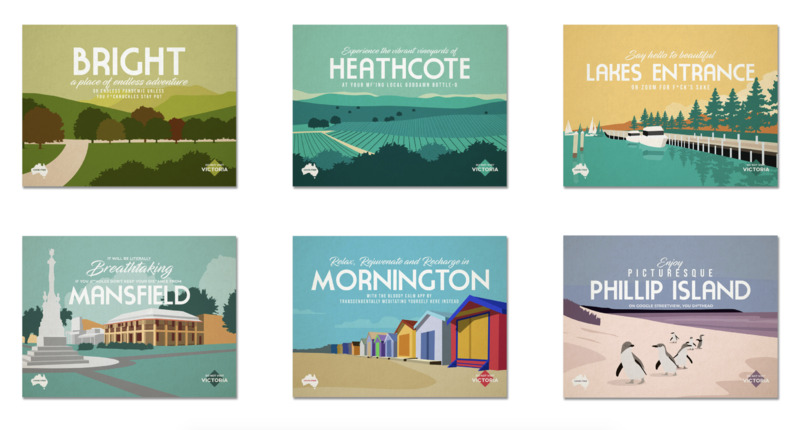
Division is no cure
HIST30060. This is a screenshot of anti-tourism postcards that were published when Melbourne went back into stage 3 lockdown. Their purpose was to deter Melbournians from travelling to regional Victoria. I selected this source as I believed this campaign was promoting the wrong behaviour of which we should all treat each other. During COVID, being caring, kind and empathetic to one another is needed in order to get through each day, and I felt these postcards were seeking to do the opposite of what we needed. -
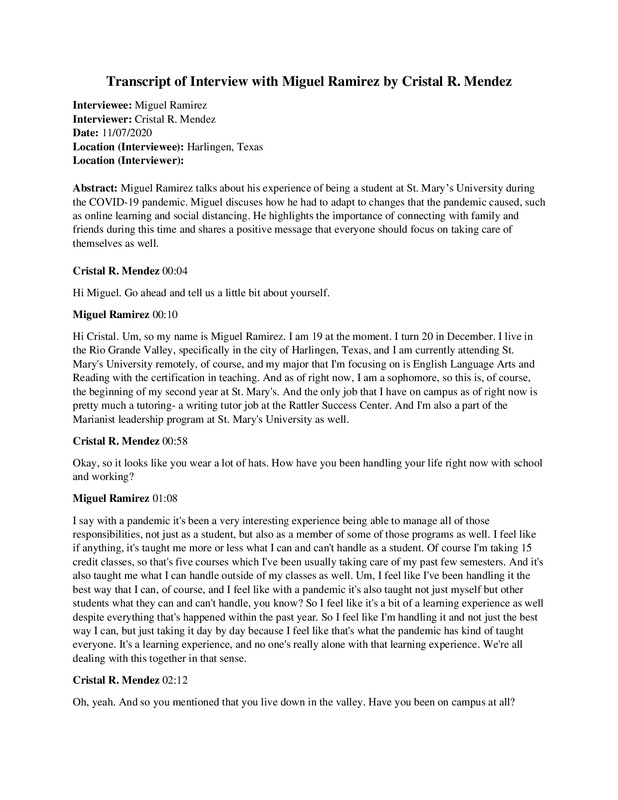 11/07/2020
Miguel Ramirez Oral History, 2020/11/07
Miguel Ramirez, a St. Mary's University student, shares his remote learning experiences. -
 2020-10
Small joys - HIST30060
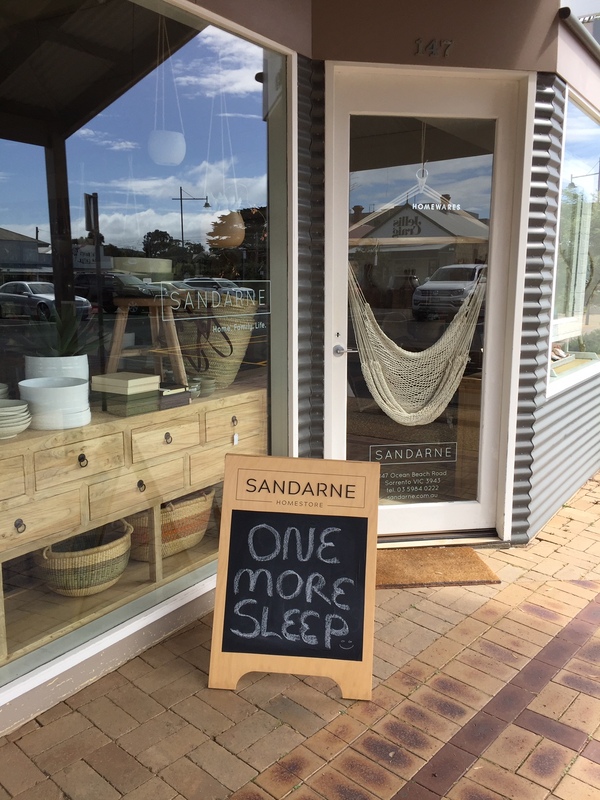
This collection of photographs were all taken during Melbourne's second-wave of Covid-19, towards or right at the end of our severe lockdown. After a fairly miserable winter and hundreds of cases each day, the light at the end of the tunnel was often pretty hard to see - but when the announcement finally came that it was safe to start opening up, it coincided with some of the most beautiful spring weather we'd seen. The local shops on the Mornington Peninsula started sharing a countdown until we could visit them again and it felt a bit like being a kid at Christmas. -
 2020-09-27
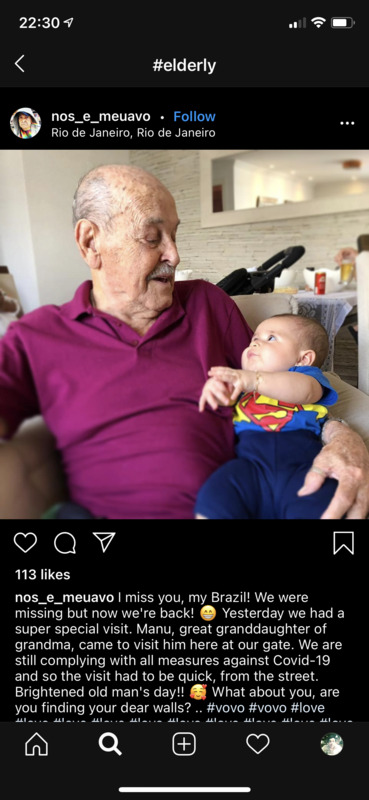
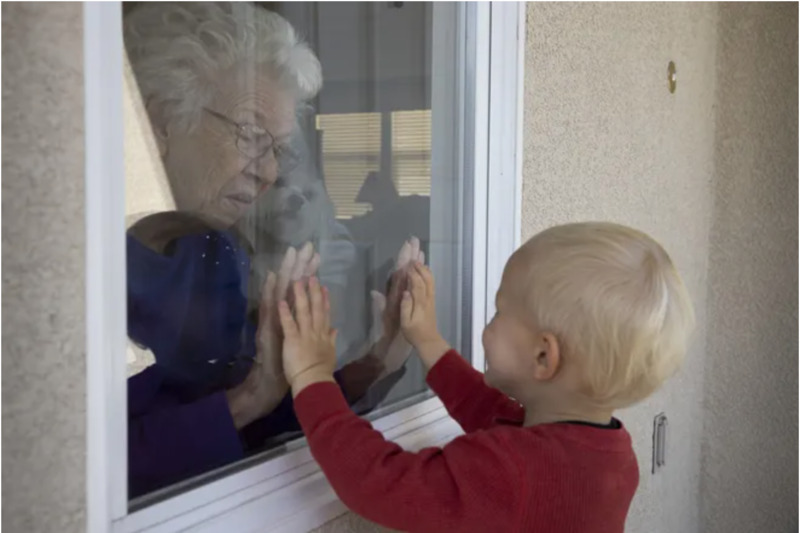
Grandfather visiting grandson during a pandemic
A social media post of a grandfather visiting his grandson during a pandemic. It’s a nice picture shared on instagram that reflects how seniors must cope when visiting family. -
 2020-11-06
Vacation Visits
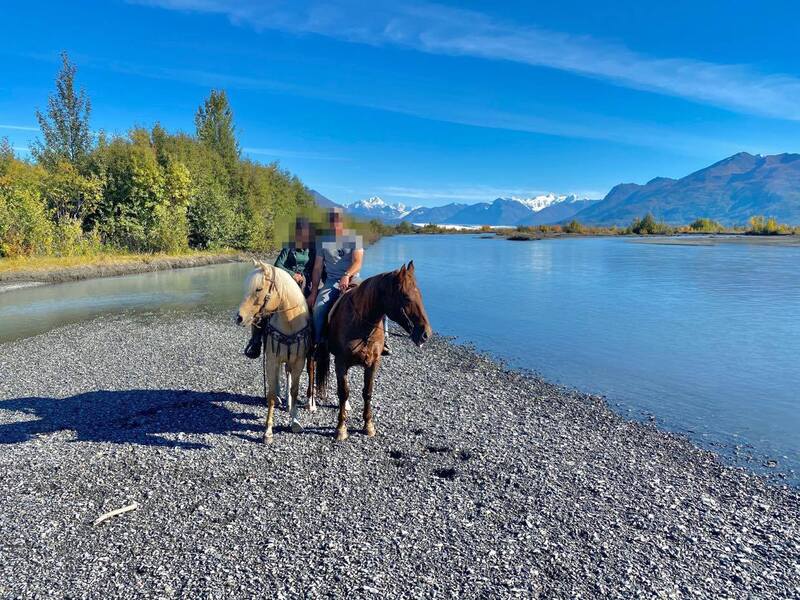
I had the most gracious and welcoming hosts on my trip to Alaska. I barely knew them aside from our communications over a horse I’d sold them and they invited me to visit, stay, and spend some time exploring the great outdoors of Alaska on horseback with them. After we finished one of our rides, we came across a group of people from the inlands of Alaska. None of this group had ever been on a horse, let alone seen one up close. The horse I sold proudly stood there while each kid took a turn sitting in the saddle and getting a taste of what being horseback was all about. It was one of my most proud moments of this great big mustang gelding that I tamed, broke, started, trained, and put out into the world to make it a better place. -
 2020-04-03
Ms. Jones COVID Experience
Ms. Jones had Alzheimer’s and was living with others like her prior to the pandemic. When she was isolated because of the pandemic she became anxious and confused thus causing her meds to be increased. She was found on the floor with serious injuries due to a decrease of nursing oversight. Her family did not want to cause her anymore stress so moved her to a hospice house so they could visit and she died a week later. -
 2020-11-04
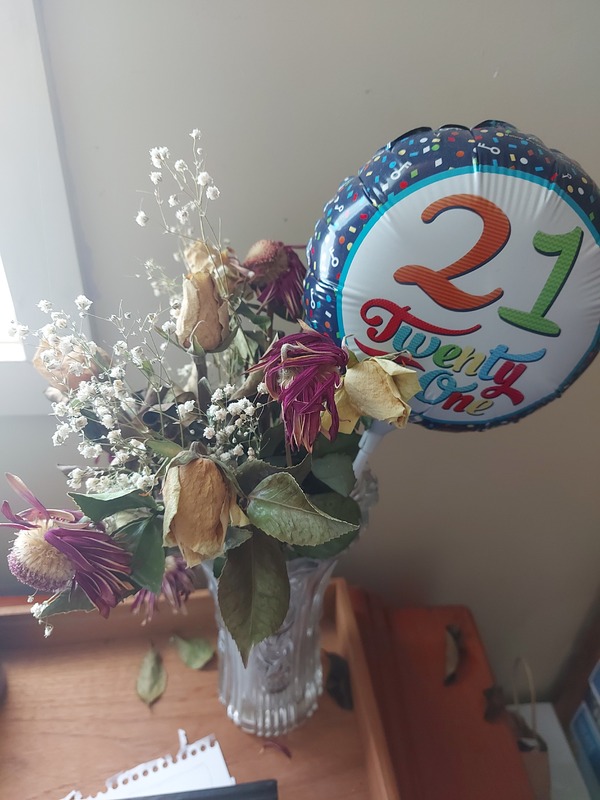
Happy 21st
HIST30060 A person’s 21st birthday (whilst not as big a deal in Australia as other countries) is still considered an important milestone. I, like many other people in Melbourne, had the pleasure of experiencing my 21st birthday in lockdown. Friends were not invited. Family could not visit. Instead, I spent the day at home with only myself, my sister and my dog. I feel like this picture accurately represents what the time was like. Dead. Not literally, of course, but life had grinded to a halt during this period. And yet, that day was one of my happiest. Maybe because it gave an excuse for people to contact me. A theme I think runs through a lot of the pandemic. Because we could not meet physically, social interaction through technology became a lot more prevalent. And who doesn’t love being sent cupcakes? -
 2020-10-31
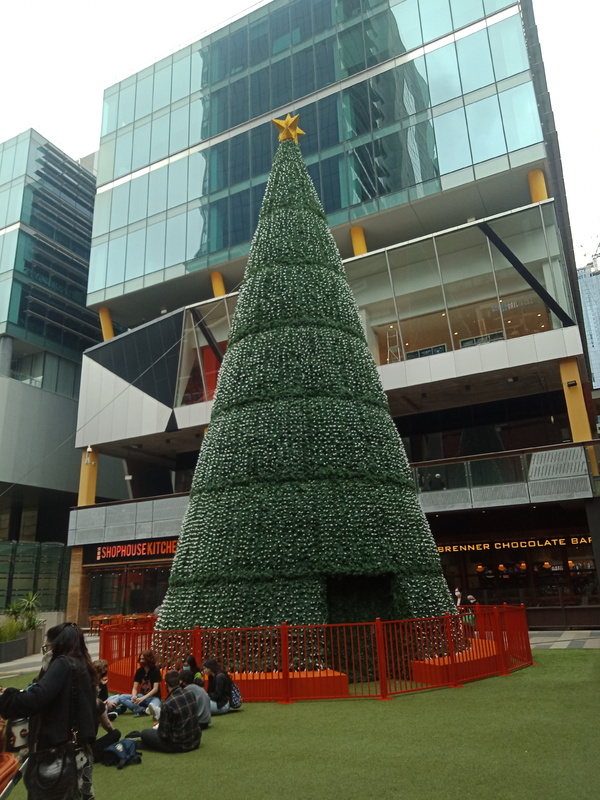
Eagerness to Celebrate
HIST30060. My first journey to the city after months of staying within 5km of my own home, you begin to take for granted the daily trips to university, the train and tram rides, and being around other people. I got to go to shops I haven't been to before and have discovered during lockdown as well as food that I have missed dearly and was a welcome change after so much monotony and repetition. These places were bouncing back after months of hardship and everyone seemed so keen to participate in society again. It's a first step towards normality, and I believe nothing speaks to that greater than seeing Christmas decorations on Halloween. It was October, and there was a giant Christmas tree in QV. Not many superficial things cause me to seethe, but it was over 50 days until Christmas. However, it's an annoying but nice way to demonstrate that there's a level of hope among everyone with the December holidays being a point in the future that everyone in Victoria holds dear. We hope that we will be able to travel interstate to visit friends and family for Christmas, that we can have gatherings at home around a BBQ celebrating Christmas and the holidays, but also the love we share for one another and the joy at being able to be together again. I believe this year will be the only one where I will not mind as much to see these decorations so early, as they demonstrate hope and a return to everything we know and love. -
 2020-10-27
How has COVID-19 challenged your VA 2020 school registration?
Reaching out to my school's student veterans, I was able to acquire one response. I emailed out a few questions about how the Covid-19 pandemic effected their registration process, and any other thoughts that may pertain to school and the pandemic. Even for myself, trying to find volunteers to participate in this project is difficult; not being able to visit the campus and collaborate with classmates proved I did not have an abundance of volunteers to work with at a moments notice. Before the pandemic we were able to ask for almost anyone's help with school projects, something that seems like a luxury at this time in the middle of Covid-19. I want to thank the individual for participating in my project, and wish them well with their classes throughout this difficult times that we are experiencing. -
 2020-10-28
How to Cope with COVID-19
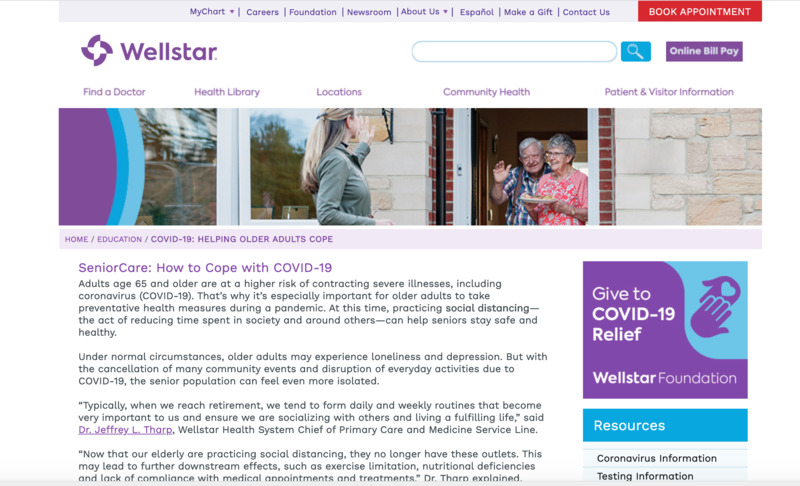
Prior to COVID-19 older adults or the elderly were prone to depression and isolation and now with community events cancelled those are rising. The CDC suggests not watching news coverage, care about your health, relax, ask for support if you need it, and take action if need be. If you know someone who is elderly make a virtual visit, send physical mail, encourage them to care about their health, and always be a helping hand if you can be. -
 2020-04-07
COVID-19 Infographic for the Elderly
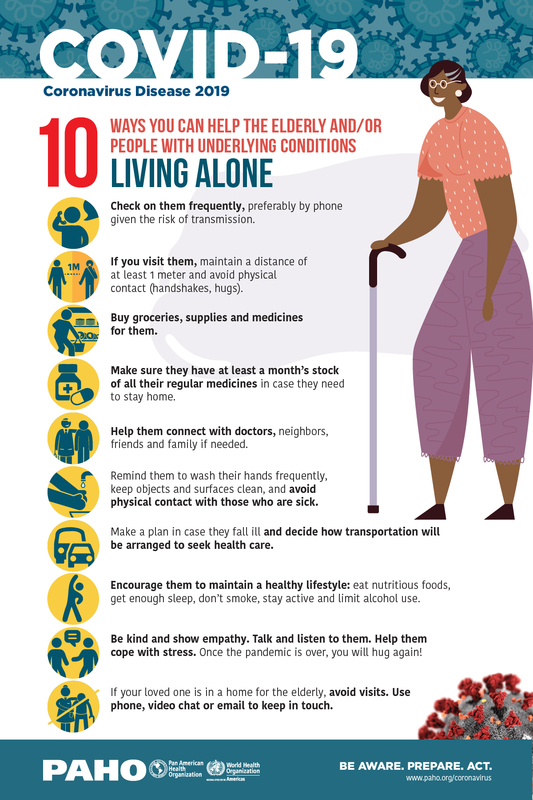
The image is an infographic that lists 10 ways for people to help the eldery during COVID-19. Such as checking on them frequently, visit them (social distanced of course), buy things they may need, and other ways you can easily show you care and can help. -
 2020-10-28
Pandemic Playlist: Reflections of Quarantine Life Through Music
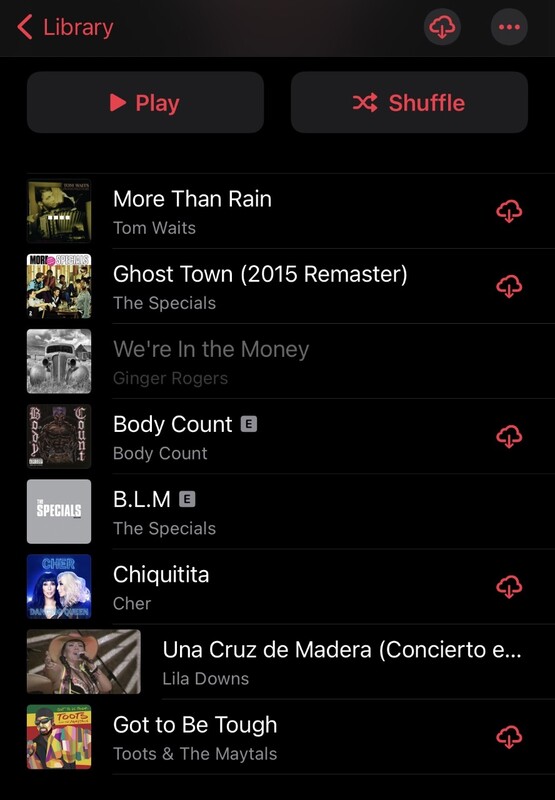
In March I was laid off from my full-time job of 6 years. Those first few weeks of unemployment found me struggling to stay productive and positive. With too much time on my hands I did what any well-adjusted person would do in that situation—listened to sad music to make myself feel worse. Tom Waits – More Than Rain Like many Americans, I live paycheck to paycheck. I knew that missing even one pay period would mean falling behind on several bills. I get paid weekly which means that even though I don’t make a lot of money, I at least always have enough to make it through to next Friday. Being broke made me feel like a failure. I resented my pre-pandemic life of always being so busy and going the extra mile at work. What did I have to show for it? “None of our pockets, are lined with gold Nobody's caught the bouquet There are no dead presidents we can fold Nothing is going our way” The “our” in this song made me think of all the other people who were in the same situation as me. I was sad not just for myself, but for everyone else who was out of a job. It reminded me to be grateful for the things I still had. Tom Waits is someone who I admire for his humor, but this particular song is void of any playfulness. The best way I can describe this song is to call it a cross between a lullaby for pirates and a circus ballad for depressed clowns. It features a melancholic vocal and a wearisome accordion sluggishly making its way through the song. “It's more than rain that falls on our parade tonight It's more than thunder It's more than thunder” The pandemic is much bigger than what we initially took it for. It’s poverty, depression, isolation, death… The Specials – Ghost Town The Specials are my favorite band, and this song which is perpetually on my playlist took on several new meanings for me. “Ghost Town” was originally written in response to unemployment and racial tensions in Thatcher era England. Now the song seems as though it was written against the backdrop of Trumpism. “This town, is coming like a ghost town All the clubs have been closed down This place, is coming like a ghost town Bands won't play no more” Driving around downtown San Antonio during the early days of quarantine was incredibly eerie. All the usual sights had vanished: tourists waiting at crosswalks, work trucks driving to their next job sites, bicyclists slowing down traffic, mariachis playing at restaurants, and people strolling the Riverwalk. San Antonio was dead. “This place, is coming like a ghost town No job to be found in this country Can't go on no more The people getting angry” The harmonized ghostly screeches in the chorus set the spooky tone for the song. How can we possibly live in a city that is dead? When everything was closed, I felt like a ghost--dead and unable to enjoy my favorite hobbies. I couldn’t visit friends, travel, or waste time browsing clothing stores. I had a difficult time figuring out how to enjoy life. Ginger Rogers – We’re in the Money Of course a depression era song would resonate with me. For the first time ever I had money in my savings account. This was only possible because I was temporarily laid off and able to receive unemployment benefits. I begrudgingly went back to work when my boss received a Paycheck Protection Program loan. Not only did I have to work in-person putting my health at risk, but I also had to do so at my regular pay rate which was much lower than my unemployment benefits. Body Count – Body Count I discovered this song while watching a video montage of BLM protests on Instagram. I was immediately drawn to Ice-T’s angry vocals complemented by an equally aggressive punk rock backing. The lyrics sound like they written this year, but they are from 1992—a year after the Los Angeles riots. “God damn, what a brother gotta do To get a message through To the red, white and blue What? I gotta die? Before you realize I was a brother with open eyes” The Specials – B.L.M. Just like Ice-T, The Specials have been singing about Black lives for decades. In 1980, Specials guitarist Lynval Golding wrote a song called “Why?” after he was violently attacked because of his race. In that song he seeks understanding and asks his attackers “Why did you try to hurt me?” Almost 40 years later, Golding wrote another song about his experiences with racism. Again, he takes a gentle approach by telling the listener: “I'm not here to teach you I'm not here to preach to you I just want to reach out and say Black lives matter” Cher – Chiquitita These days everything exhausts me, and I feel like I have no time to rest. As soon as Cher opens with “Chiquitita tell me what’s wrong?” I start crying. Thanks for checking up on me, Cher. As with most of her songs, I get happy when her music comes on because I know I’m about to do an ugly sing-along. Nowadays this song just hits different. “You were always sure of yourself / Now I see you’ve broken a feather” I have never felt so uneasy and uncertain in all my life. I used to be the shoulder to cry on when my friends needed comfort. I no longer have the energy to offer my strength. Lila Downs – Una Cruz de Madera Despite being a song about death, the Lila Downs version is a happy, upbeat tune. She turns it into a party song. The overall translation of the song captures how I want my loved ones to handle my passing. Instead of a fancy funeral, I’d prefer a big party in my honor. I don’t want my family and friends to shed tears, or feel any sadness. The only thing I want at my wake is a serenade in the early morning. Toots – Got to Be Tough Toots is one of those artists who radiates positivity. It’s hard to be in a bad mood when his upbeat tempos and powerful, soulful voice booms through the speakers. I saw him perform live a few years ago and watched him with awe. He would step away from the microphone and continue singing at an impressively loud volume—his voice filling up every corner of the auditorium. I was pressed up against the stage because he motioned for everyone to get closer. Toots came over to me several times and squeezed my hand and sang directly to me. In those moments I felt so happy and lucky to be alive. My best friend was right next to me and we both had tears in our eyes. How lucky we were that this Jamaican icon came all the way to perform for us in a stuffy San Antonio venue! We swore that we would see Toots again. I was excited when Toots dropped his new single “Got to Be Tough” earlier in the year. It meant that a tour would follow. The song itself was also a great comfort. “Got to be tough when things get rough You got to be tough and this is a warning You got to be smart, living in this time It's not so easy to carry on” Sadly, Toots passed away from Covid-19 two weeks after his “Got to Be Tough” album was released. Listening to the title single doesn’t bring me much comfort anymore. It makes me think of how excited I was that I was going to see him next year. Now it just makes me nostalgic for the days when we could go to shows and experience a more intimate connection with music. Nothing beats bonding with thousands of strangers who are singing, crying, and dancing to the same music as you. The song makes me miss being as happy as I was that day Toots held my hand and sang to me. -
2020-10-26
A change of lifestyle due to COVID-19
Back in March, when schools were initially shut down due to the virus, my friends and I thought it would be a short break and we would be back by the time spring break ended. Little did we know that the pandemic would last for many more months than that and we wouldn’t return to school that year. Normally, I would go visit my dad once a month but the pandemic made it impossible. He lives out of the state, in Utah, so for the first few months of quarantine I couldn’t get on a plane to see him. I ended up not going to see him for 5 months. Even now, In October, my mom isn’t very fond of the idea of me going to see him because of the way the virus has been handled in Utah. The infection rates are increasing rapidly in Utah at the moment so we ended up having to cancel my trip there in the beginning of November to be safe. Life has definitely shifted since the pandemic began and things have become different in some aspect for almost every single person. On the other hand, because of having so much time to myself this year, I’m more proud of the person I have become than I have ever been. -
2020-10-26
Store Shutdowns
March 13, 2020 started off a normal day. I went to school and listened to all the conversations about COVID and possible school shutdowns. After school my friends and I went to Target but little did I know that the next time I would visit a store would be completely different. A few days later I went to the grocery store with my family. It was a shocking sight when I walked in and seen everyone with a mask on and shelves completely empty. It was like an apocalypse was among us. Everyone was running rampid, pushing their carts as fast as possible and had a mask on all in the process. I had to feel everything through my rubber gloves and had a hard time smelling anything through my mask. Our new normal is wearing mask, social distancing and putting on hand sanitizer every second possible. This is important to share because it shows how COVID has shaped the way we live today. -
 2020-04-15
My Grandmother and I’s Final Touch
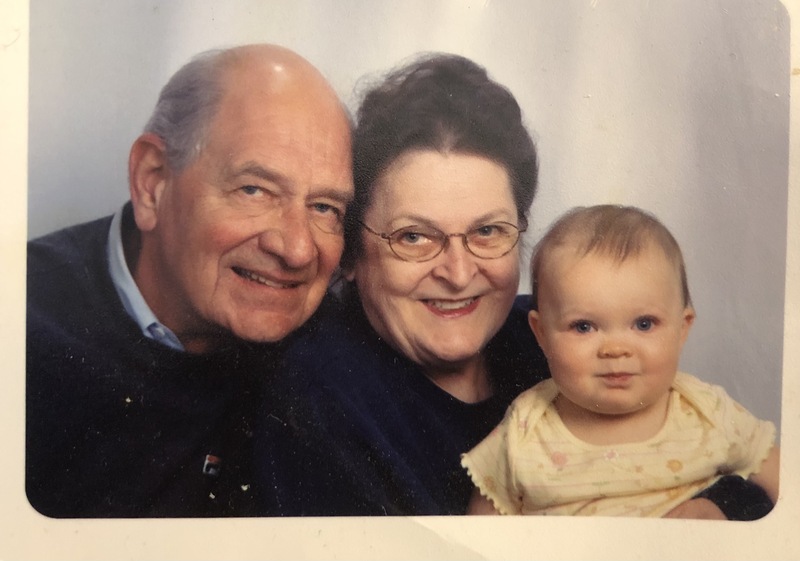
About a week before my grandmother passed, I went down to visit her for the day and help my grandfather with work around the house. When I arrived at their house, my aunt handed me a pair of nail clippers and asked if I could cut my grandmother’s nails for her. I kneeled at her bedside and began my work. I do not recall how it smelled in my grandmother’s room, as I was wearing my mask the entire time. I imagine it smelled like a hospital room though. I felt the cold metal of the nail clippers and the soft skin from my grandma’s hand, as the hum of her ventilator filled the room. I could hear her voice as well, she was hallucinating due to cerebral hypoxia, whispering to me about the train tracks in her closet. In those moments I could taste nothing but my own saliva. She died several days later on April 21, 2020, with my aunt, uncle, and grandfather in her company. I harbor great hatred for this virus, as it limited my time with my dying grandmother, and I harbor great disgust for everyone around me who refuses to take it seriously. You, however, don’t need to know about this. History does not care, it just happens. -
2020-10-26
Sensory Memory Changes During COVID-19
The COVID-19 pandemic has greatly affected our sensory memory. All of the 5 senses have experienced a lot of change during this pandemic. Personally, I found the streets and stores to not be as packed as they used to be. When I go outside, I see most people are wearing masks and staying 6 feet apart from each other. During the pandemic, it has been a lot quieter as well. There is barely any traffic on the freeways or even the sound of cheering from football games and gatherings. The sense of taste also experienced a lot of change. Due to social distancing regulation, restaurants and cafes have been closed or only allowed takeout. Personally, it's been almost 8 months since the last time I went out to eat at a restaurant or get coffee pastries at a local cafe. For smell, California was struggling with fires so for a few weeks and all I was able to smell was smoke. Finally, the sense of touch has been experiencing change. I'm not able to see my relatives and friends. Since I can’t really go outside or visit people during these times, I haven't experienced a hug, high-five, or shaking someone’s hands in a while. -
 10/10/2020
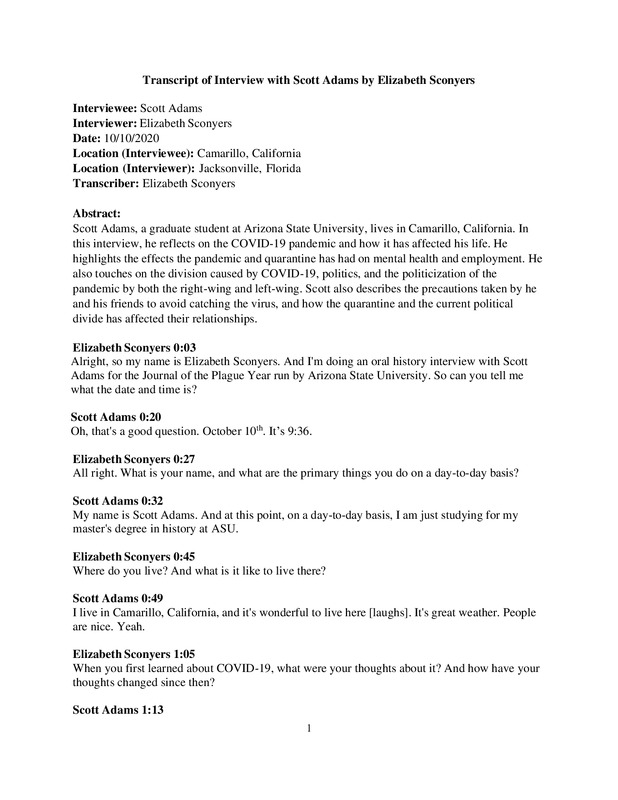
Scott Adams Oral History, 2020/10/10
Scott Adams, a graduate student at Arizona State University, lives in Camarillo, California. In this interview, he reflects on the COVID-19 pandemic and how it has affected his life. He highlights the effects the pandemic and quarantine has had on mental health and employment. He also touches on the division caused by COVID-19, politics, and the politicization of the pandemic by both the right-wing and left-wing. Scott also describes the precautions taken by he and his friends to avoid catching the virus, and how the quarantine and the current political divide has affected their relationships. -
 10/04/2020
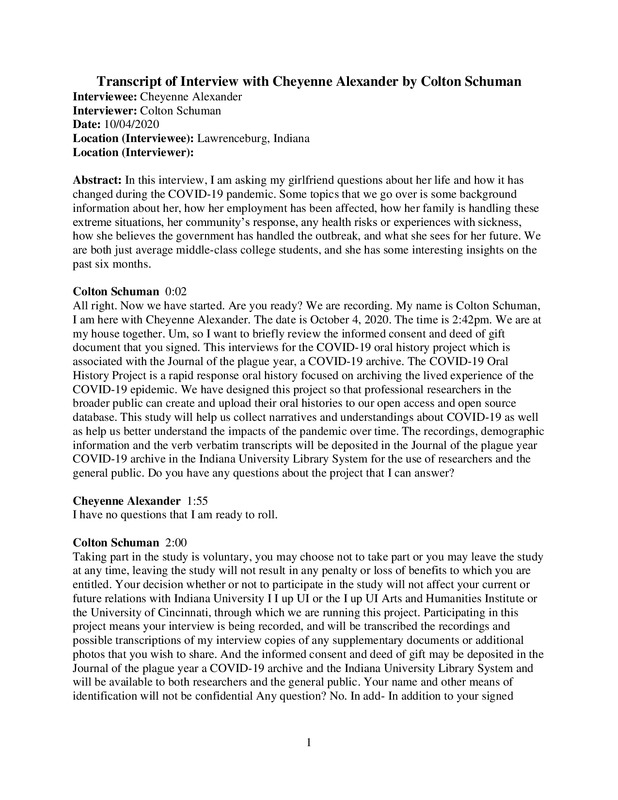
Cheyenne Alexander Oral History, 2020/10/04
Transcript Only. In this interview, I am asking my girlfriend questions about her life and how it has changed during the COVID-19 pandemic. Some topics that we go over is some background information about her, how her employment has been affected, how her family is handling these extreme situations, her community’s response, any health risks or experiences with sickness, how she believes the government has handled the outbreak, and what she sees for her future. We are both just average middle-class college students, and she has some interesting insights on the past six months. -
2020-10-16
Pre-Pandemic, what did we know? Teachers knew nothing.
March 12th, 2020 seemed to be a perfect spring day in Southeast Georgia, it was a beautiful morning. I am a teachers assistant in a self-contained classroom in Liberty Co., GA. We had a long weekend ahead of us, March 12th was a Thursday and we had Friday off, 5 day weekend, and all of the kids knew it! So as any teacher would do we had a relaxed day. We taught normal morning lessons, talked to the kids about why they will not see us on Friday, Monday, Tuesday, or St. Patricks day that was coming up. So, we painted pictures of rainbows - nothing out of the ordinary, at least not in our little self-contained bubble. The teachers for some time had been hearing about this virus, and that it was far worse than the severe flu we saw in 2018, or anything else we have seen from overseas. This illness was something that we all were closely monitoring in the news because schools are the perfect breeding grounds for germs of any illnesses; however, we knew one thing - that there were some measures being put in place for travel. Then we get an all-call on the intercom in our classroom, "Hey 201, we just want to inform yall the main water line is broken up the road. We suggest you call your parents to get ready to receive their children, its a half-day." STUNNED we all took a moment, took a breath. Our 7 kids had no idea what was happening so we all took to our phones and called the parents of the most vulnerable first, then the ones we knew may take some time to get a hold of. Next we informed our parents of the children who ride buses that they will be on their way home within the next hour as the school had no water. We rallied up our kids, went through our daily clean up (4 hours earlier than usual) and gave them all tight hugs. Some of them didn't want to leave, some really didn't understand why they were going home so early, and some just wanted to get out of the crowd. In the end, I hugged every last one of my kids I took up to the front office because I had a sick feeling about this weekend. I told them to be good and listen to their adults and I waved goodbye. For most, that was the last time I saw that set of kids again because last year's class was older. Those children went onto middle school. Friday, March 13th, 2020 came and rumors started that we may not be going back to school on Wednesday because of some virus called Coronavirus. What was this? Why? No one understood. My teacher friends were all communicating online what was happening, a lot of uncertainty. The weekend came and went, nothing. Monday, the 16th of March, we got the news we weren't to enter ANY school building, this virus is highly contagious. I'd seen the news and by then China, Japan, Korea, and Italy were on total lockdown, Spain was following suit; along with the rest of the world, the US was the only nation in the world not really doing anything. However, in Liberty co. we were on lockdown, schools shutdown. At some point we were told only lead teachers and 2 assistants per grade level may go into the school to help get the children's personal belongings, this did not happen. Everything was shutdown, it was too dangerous. Personally, I didn't hear from the majority of my students after March 12th. Many factors are at play here: little to no technology in low-income homes, parents decided that since school was out they weren't obligated to stay in the area so they went to visit family in different Counties/States (so no communication was made) or parents didn't pick up the phones when we would call, those that we did see online wasn't for long because our teaching method is very hands on for Special Education our parents had no idea how to help at home and some gave in a put YouTube videos on all day. This wasnt easy for ANYONE I know. Pandemics, changes in general, and a sudden life change is ALWAYS hard. School as we know it will never be the same. As of today, this new school year we are doing hybrid teaching, which is giving parents the option to send their child to school face-to-face learning (with a mask on at all times) or they can have virtual learning. Our county provided everyone child and staff with ipads, so there's really no excuse at this point. I'm optimistic for the future, I feel a change in teaching. It's hard to change a system that is so engrained in our systems but we can figure it out. -
2020-03-16
Silence at School, March 2020
This is a true anecdote about my experience as teacher during the pandemic, and the sensory experience by which I recall these events. I am a teacher at a middle school in Winston-Salem, North Carolina. In winter of 2019, I was aware of the coronavirus, which was something my students often joked about. For instance, if a child was out sick one day, the students would say the he or she had coronavirus, and everyone would laugh about it. It was funny to them at this time, because the virus was something that was mostly contained to places outside of the United States, and everyone thought it was preposterous that there was so much speculation about it on the news. My students engaged in speculation as well, and many of them concluded that it was actually a big cover-up for a zombie plague, and they would try to determine if I or their peers were also zombies in disguise. I recall hearing them laugh about it in the class, and I especially recall the return of one of our students to class after she had been out from the flu. I remember them asking her if she was a zombie, or if she had eaten bats before she got sick (remember, these are middle-school kids). Winter passed pretty much as usual, and cases began to occur in the US early in 2020. It was still seen as no big deal, generally. In March, we started to hear news stories about the virus in Winston-Salem. Some people claimed to know people who knew people who were related to someone with the disease in Greensboro. More and more cases began to appear, but it still seemed like something distant to us. Gradually, the sickness moved from Greensboro to Winston-Salem. I caught a cold in March, and by the end of the day on a Wednesday, I was feeling pretty bad. I told my many bosses that I would be out of work on Thursday, and on Thursday evening, I called out again. The first day that I was out sick, the school district had decided to close down the schools until further notice, starting the next day. I never got the chance to tell my kids goodbye, which was very painful, as we were all close and we had such a good experience in my class. Today, in October of 2020, I still haven’t seen any of them, as my school district is currently closed for in-person school. I wish very badly that I had the opportunity to say goodbye to them. Those are the events as they occurred chronologically. I will now recall the sounds that constitute my memory of the time. To begin with, my school is loud—our students are beyond unruly. I can recall the sounds of the end of a regular school day: raucous laughter, shouting, cursing, threats, insults, loud rap music, and the sound of me flipping the switch to cut off the overhead lights as we prepared to exit the classroom and make our way to the school buses. Then comes the sound of the announcements overhead, which no one can hear over the students, then the prolonged loud and dull tone of the "bell" which signals the beginning of the stampede to the buses. A chorus of shouts raises immediately—a proclamation of victory and freedom. It is exuberant. What follows is hundreds of footsteps on linoleum tiles, backpacks shuffling as kids adjust them on their backs, more yelling, screaming, and swearing, the sounds of an occasional "runner," who knocks the other students down to get to the buses, a teacher shrilly, piercingly yelling at him to go back and "try again", and reminding him that "you will not go up these stairs unless you can walk up them!," a muttered "f---you, b----," from a male voice that is just about to begin deepening as he turns around to try again, and so on until we get to the buses, load those kids up, and ship them out. Going to my car every day after work is over, my ears ring as I sit in the silence of my car with the doors shut before starting the engine and making my way home. I often sit for just a minute or two and enjoy the silence before departing, but the ringing in my ears gets uncomfortably loud, and I finally turn the car on and leave. When I go back to school on the Monday following my sick leave, the difference is remarkable. The school district has instructed us to come in safely, get whatever we need from our classroom that we require to work at home, and leave as soon as possible. Teachers are strictly instructed to only walk directly to and from their classrooms to their vehicles, not to visit with their friends, etc. Everyone is in their classroom, working quietly. The only sounds I hear as I walk down the halls to my room are the hum of overhead fluorescent lighting and my heels striking the linoleum tiles, echoing off the walls and rows of lockers. I hear my key turn in the lock of my classroom door, the flick of the switch to on, more humming fluorescent lights. Shuffling papers and sliding metal desk drawers and file cabinets come next. With a handful of papers in my arms (I travel light), I cut off the lights—the humming stops—and my heels strike the linoleum tiles until I open the exit door, walk across the parking lot, and leave. This time, the silence of my car is nothing extraordinary. Gone are the shouts, the yelled jokes, the subsequent laughter, the retaliatory swearing. Also gone are the kids coming up to me to just say "hey," do one of the complex handshake rituals we have worked out, and to ask me if they can have a dollar for a cookie in the cafeteria, which is a request that I have obliged so often that I will count it as a charitable donation on this year's tax return. On that last day in the school building, there was no sound of a kid coming up to me to tell me how well he did in last night's basketball game, and how poorly his best friend did by comparison, or a girl walking up to tell me that an unpopular teacher has once again worn ugly clothes to work, and that her shoes don't match either—middle school students pay a lot of attention to these things. Put simply, those are all happy sounds. They are the sounds of kids doing what kids do in 2020, saying the things that they say, and teachers managing the best they can. The sound of kids coming up to me to talk are the sounds of acceptance—acceptance of a teacher into their lives, who is usually the categorical enemy of the student. I'm glad to be an exception. These are the pre-Covid sounds. What follows conveys emptiness. The sound of echoing footsteps rebounding from the walls demonstrates how vacant the hallways are. The fact that I can hear the overhead lights hum is amazing in its novelty. The chatter of students is all gone, the desks, empty. For a teacher who loves his students, the sounds that follow the March arrival of the pandemic are the sounds of loneliness. -
 2020-03
Time to Complete a Decade-Old Project
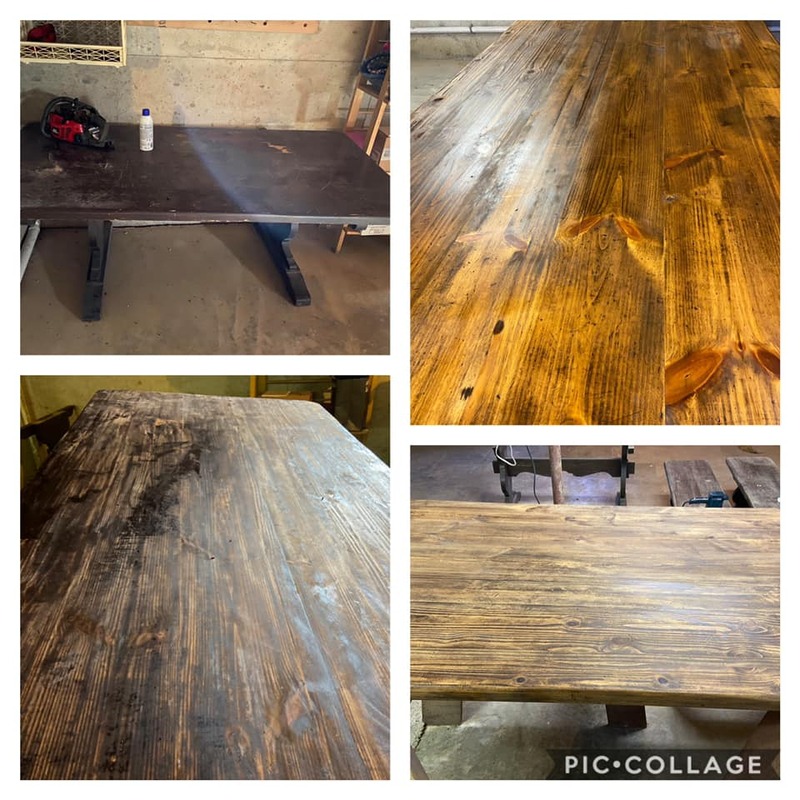
We had just moved from Fort Bragg (Fayetteville), North Carolina, to Eglin Air Force Base (Destin), Florida, when my husband learned he was deploying to Afghanistan this past January. Usually, when my husband deploys, I have work to occupy my time, but I did not find a teaching job when we moved. I decided to return to my hometown of Kane, Pennsylvania during my husband’s deployment. When the pandemic started, I decided to fix up a one-hundred-year-old table left in my sister’s house by the previous owner. I made my sister keep this table in her basement for ten years, with the promise that one day I would take it with me. It only took a deployment and a pandemic to get me started on this project. I figured working on the table would be an excellent way to pass the time since I could no longer visit old friends due to the pandemic. I started working on the table in my sister’s basement armed with paint scrapers, wire brushes, CitriStrip, Mineral Spirits, and an acrid-smelling varnish remover. CitriStrip smells like oranges, and that is not a bad smell to have to permeate your sister’s house for days; however, the other varnish remover was not as nose-friendly. It smelt so bad that one could say that I was using biological terrorism on my family. Imagine ten thousand girls removing their nail polish at the same time with acetone, and you have some idea of the smell. It did not take long for my sister to kick me out of my (almost warm) basement work area, and I began to work on the table in the frigid temperatures of my parent’s garage where the smell of chemicals would not reach inside. Pennsylvania is not very warm in March, and I could never get warm, especially when I was using acetone. Acetone evaporates quickly, and as a result, it kept my hands cold. Also, I found that the acetone melted my latex gloves, and that made matters worse. My hands were always dry. Removing the old varnish was laborious, and I am still not sure if it was varnish that coated the table. Research led me to believe that it might be shellac or a type of wax, and when I scraped the layers off, everything turned into a goopy mess. As I scraped each layer of the varnish off the table, I could begin to see more of the table’s features. I began to see the scorch marks from the saw, a mark where the previous owner left a paint can, and I could see the beautiful wood hiding underneath. Finally, it was time to sand. When you are sanding wood, you start with large grain sandpaper, and you work your way to finer sandpaper. I used both an electric sander and a hand sander. The electric sander made my hands numb, but the hand sander was time-consuming. As I wiped the sawdust away from the table, I felt accomplished. Now the table is a treasured part of our new home in Monterey CA; in fact, I am writing this paper on it right now. *This is the story of someone finally getting around to refurbishing an old table. -
 2020-04
The Silence of Moab
Moab Utah is a lively tourist town normally filled with visitors from around the world. However, the COVID-19 pandemic has made it a ghost town. -
 2020-10-10
Quarantine Doesn't Apply To The Rich and Famous
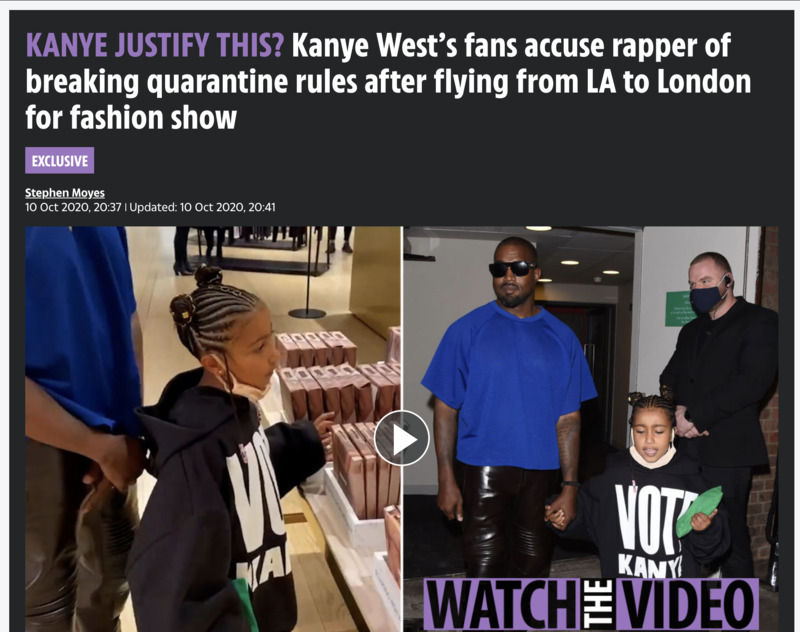
Kanye west visits the UK and doesnt even qurantine at all. Your supposed to undergo a 14 day quarantine but Mr. West immediately went out for a day trip with his daughter. I'm over here unable to visit my finace because of the difficulties of navigating the quarantine, but apparently all I had to do was be a famous rapper. -
 2020-08-11
Video Chat Birthday Celebration
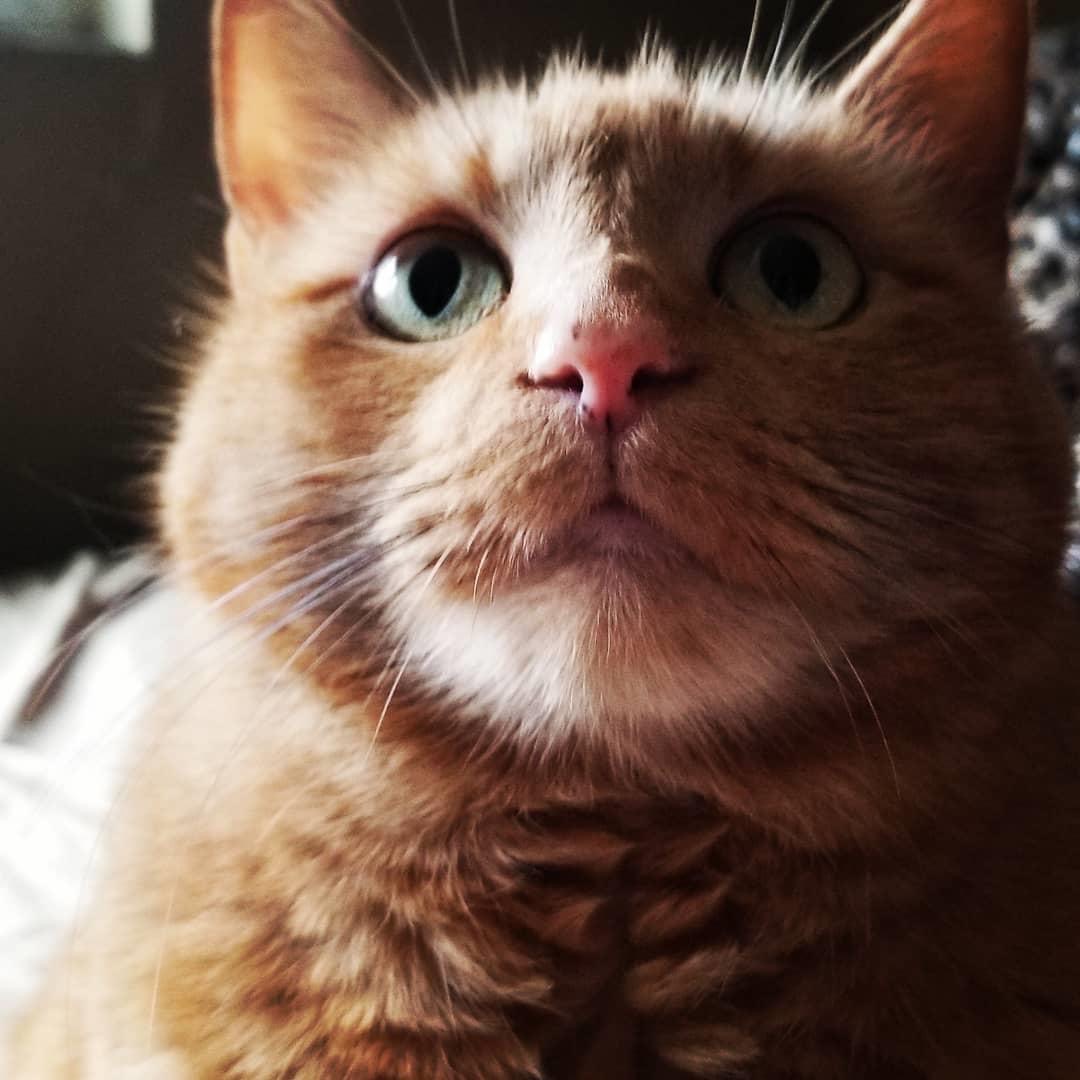
The pandemic disrupted the frequent trips I take to visit my friend Chrissie in California. We planned on celebrating her birthday together in person, but since we both lived in hot spots we decided it was best to postpone our festivities. I used some of the money I would have spent on traveling to buy her some very personalized gifts. When she received her presents I asked her to meet me on the Houseparty app so that I could see her reactions. They were priceless. I commissioned an artist friend to draw her beloved cat Dulce which I then printed on a poster. To add a Texas touch, I also got her a James Avery charm bracelet with an inside joke engraved on it. Even though I would have much rather hung out with Chrissie in person, this celebration was still special. Being away from made me think about how much I love and appreciate her. Quarantine allowed me the time to reflect on what makes her unique and what gifts would put a smile on her face. -
 2020-10-04
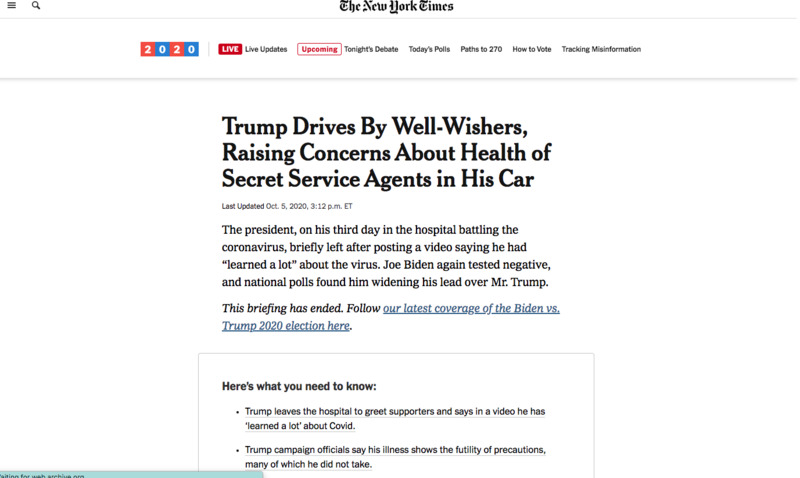
Trump leaves the hospital to greet supporters and says in a video he has ‘learned a lot’ about Covid.
The main point of this article is that Donald Trump, who was hospitalized for the coronavirus, visited his supporters outside the hospital through a drive-by in a SUV with two Secret Service agents. I chose this article because it’s a controversial topic and people have a lot of different views on Trump’s visit. It’s also been in the news a lot. This news article reveals the perspectives on the severity of the coronavirus during the pandemic, from both doctors and citizens. It also shows how life is still divided from a political and scientific standpoint even during a pandemic. This news article is important because our leader of our nation is potentially breaking medical protocols. In our society, it would be expected for our president to follow the rules to protect himself and others, so potentially breaking rules is a big deal for Trump. The bias that exists in this article puts a negative spin on Trump. For example, the article stated that “The president[‘s] mishandling of the pandemic has become a political liability”, making it clear that the writers of the article don’t believe that Trump has done a good job protecting citizens from the pandemic and that it’s hurting his political side. The article also included a statement made by a doctor at the hospital Trump stayed at. The quotes that the article included from the doctor were that Trump was putting the lives of the Secret Service agents in the car with him at risk. The doctor also stated that “the irresponsibility [was] astounding”, that the agents were “commanded by Trump to put their lives at risk for political theater”, and that it was “insanity”. By choosing to include these many quotes from the doctor, New York Times is siding with the doctor, implicitly agreeing that what Trump did was irresponsible. The article also stated that the N95 masks that the agents were wearing were “not an absolute guarantee of stopping transmission, especially in a small enclosed space occupied by a person known to be infected”; even though this statement doesn’t explicitly state it, the authors of this article don’t believe that the agents were protected well enough and that it wasn’t a smart choice. The article seems to contain Liberal views and biases. The responsibility of the media during the COVID-19 is to keep the media informed with all the updates with the coronavirus. This includes precautions, vaccine advancements, and what the government is doing to help protect the American people. The media should provide citizens with all the necessary information to keep us safe. It should also keep us updated with the presidential election and how the coronavirus will affect the process. The media’s primary goal is to keep the public well-informed. -
 2020-09-02
Keeping in Touch With Angie
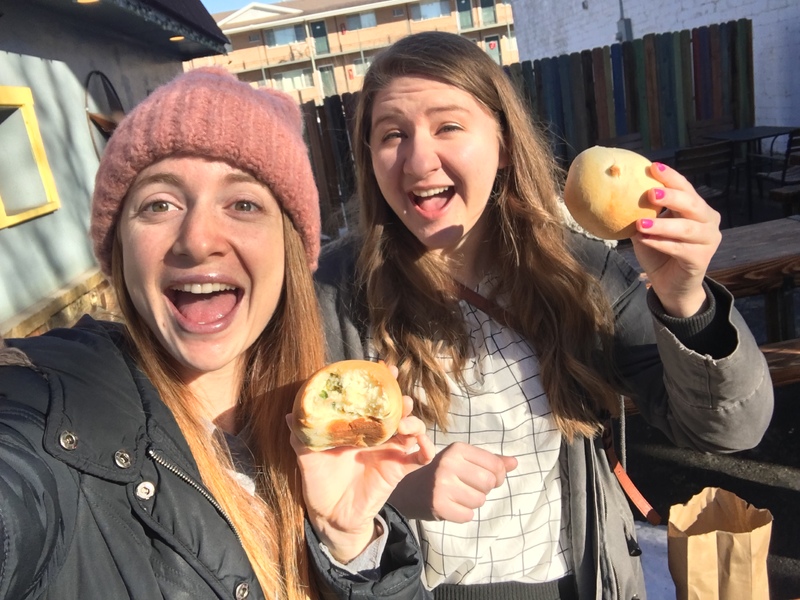
COVID-19 has affected several of my relationships and how I have stayed in contact with friends. I wanted to talk about how COVID-19 has changed my interactions with one of my friends, Angie. I have known Angie for several years but we became really close friends when we attended the same church congregation in Provo, Utah from 2015-2016. When I graduated from school in Spring 2018, I moved away from Provo for an internship and I haven’t lived in Provo since. Angie also graduated around the same time and she continued to work in the same area. Normally, Angie and I will visit one another every other month and get lunch or I would spend the weekend with her at her apartment. The last time I was with Angie before COVID-19 lockdown began was in February. I was staying with her for a weekend in Provo, Utah for a wedding. On February 7, we got Korean BBQ bowls and went to an art museum. The next morning we woke up early and got kolaches. And I was thinking we’d get together soon in another month or so. For Angie’s birthday that same month, I sent her a sun hat because we made plans with our other two friends to go to Myrtle Beach, South Carolina in June. But with the news of the onset of COVID-19 a few weeks later, we ended up canceling those plans. After a FaceTime call in April, we both figured out that we needed ways to stay connected while social-distancing safely. However, we didn’t have any new things to report because we were social-distancing. So we started our audiobook club to give ourselves something to chat about. So far we have listened and discussed The Only Plane in the Sky: An Oral History of 9/11, I Am Malala: The Story of the Girl Who Stood Up for Education and Was Shot by the Taliban, and White Fragility: Why It’s So Hard for White People to Talk About Racism. We are currently listening to Born a Crime: Stories From a South African Childhood. Neither of us remembered who suggested our book club, but I’m glad we have stayed connected through it. Both Angie and I have enjoyed each of these books. They have made us much more knowledgeable about the world around us and I like discussing them with Angie. My favorite book we read together was White Fragility. We read it in response to the death of George Floyd and Breonna Taylor. As white women, we realized we needed to better educate ourselves. We had a tough conversation, but I’m glad I had it with Angie who is incredibly compassionate and thoughtful. Besides our book club, we have had video chats with some other friends and we’ve texted one another. I finally saw Angie in person while she was passing through where I lived. We cautiously sat outside 6 feet apart and ate popsicles on my grass lawn. And I met her boyfriend for the first time! The pandemic has changed how I connect with my friends. I rely much more on technology and scheduled calls. I have learned to cut myself and others some slack for this situation because there is so much more social friction than before. Weirdly enough,in some ways it has helped with my social anxiety because I don’t feel FOMO (a.k.a. The “fear of missing out”). We’re all in the same crappy boat. The pandemic has also helped me think about why certain people are my friends. Now it’s less about proximity or someone’s availability but more so about someone’s loyalty, kind heart, or strong values. -
2020-10-03
Eating in Front of a Mirror
Pre-Covid I already lived an isolated life, both physically and due to pervasive anxiety. I would spend weeks pushing myself, go inside the store, talk to three people at yoga, text four people, a million little social tasks that I did to keep my human animal happy. I live in a rural area, work part time at a library, and survive in a sort of genteel poverty. About every three months I'd drive to visit an old friend. Beyond customers at the library and polite friendships with coworkers, that was the only social interaction I really had. Stage one of the pandemic and my workplace closed, we were furloughed. Still paid. And after a single massive shopping trip at the end of March I just stayed home. Really stayed home. I was lucky, I'm already an introvert, have a home on acreage, pets. It wasn't great, but I was comforted knowing so many people were quietly going through the same thing. Then George Floyd was killed and I was called back to work a week later. This was the worst time so far. The building was closed and yet staffed, so we sat surrounded by clorox while people banged on the windows and cursed us. The pointlessness of it, we were only there so our employer could qualify for the PPP money. The anxiety of each coworker potentially being ill. And then, in the lull of work, the many many political opinions of all my white coworkers. I stayed silent, the lone POC, but I can assure you, I now detest them all. This phase ended when my boss got covid an ill-advised vacation to the Gulf. Coming back from our isolation I entered phase 3 of my pandemic. I now hate all my coworkers and view them as existential threats. Due both to their extremely foolish behaviors and their racism. They attend 200 guest count weddings, take discounted flights, and attend funerals. I try to work around them, taking vacation days to avoid them directly after they return. I have moved my desk out of the shared office and directly into the main room of the building. We are fully open again. Masks are not required. It is possible to drive around my small town and see not a single sign of the pandemic. The local diner which has flouted all the mild restrictions since April still has their sign out front, "Our Fried Chicken is to Die For!" I've started to feel mildly insane for still isolating, for still wearing a mask. But I'm also used to having the sole dissenting opinion in the room. For now my plan is to just not get sick, there's no plan if I do get it. I just go home and spend another weekend eating in front of a mirror, and sleeping with a hot water bottle to try and quiet my lonely human animal. -
2020-10-01
The COVID Pandemic and economic greed
I wanted to share a bit about my life during COVID. My brother is currently incarcerated, and I would travel at least once a month to visit him. Once COVID hit, visitations were canceled, and my family was forced to rely on phone calls or snail mail. My brother would call us about once a week for his own sanity and ours as well. Several things have happened these past few months, which made our situation as a family more complicated. A phone call to my brother used to cost him (or us) 40 cents a minute. When COVID hit the private company used by the prison to facilitate calls, decided to take advantage of our reliance on phone calls and upcharge their prices. Phone calls now cost over a dollar a minute. Thankfully my family does ok and phone calls are not something we are willing to let go of, but I feel for families who have to choose between food, bills or funding their calling account. I know it sounds like an extreme situation, but there are families that have lost all contact with their loved ones who are incarcerated because of COVID, and these companies are taking advantage of the pandemic. Were now paying almost twenty dollars for every ten minute conversation, trust me it adds up real quick. The worst part is that these companies have contracts with the prisons, and we (the families on the outside) have no choice or say as far as what company we are able to go through to talk to those incarcerated. As if COVID and social distancing weren't enough, I'm now missing and worrying about my brother more than usual. -
 2020-09-29
Using Humor to Deal with the Pandemic
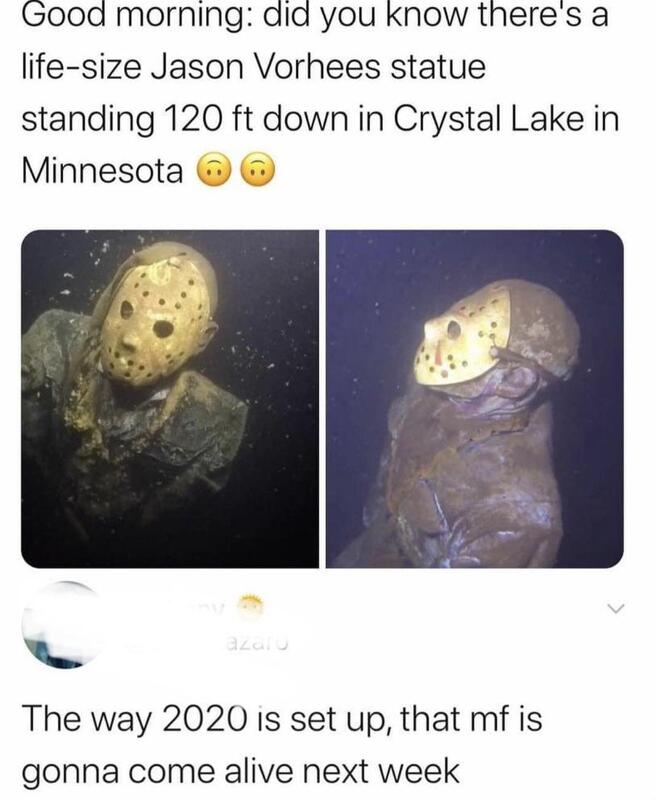
These memes that I have taken from various social media sites that I visit. They help to show how some people are processing the global pandemic through the use of humor and memes to deal with their feelings of anxiety and fear for the future. I have taken part in this and often search the various hashtags for pandemic memes when I am feeling anxious about the pandemic. Many of my friends too share these kinds of memes with each other in our group chats or on their own blogs. -
 2020-08-23
A Unlucky, Lucky Case
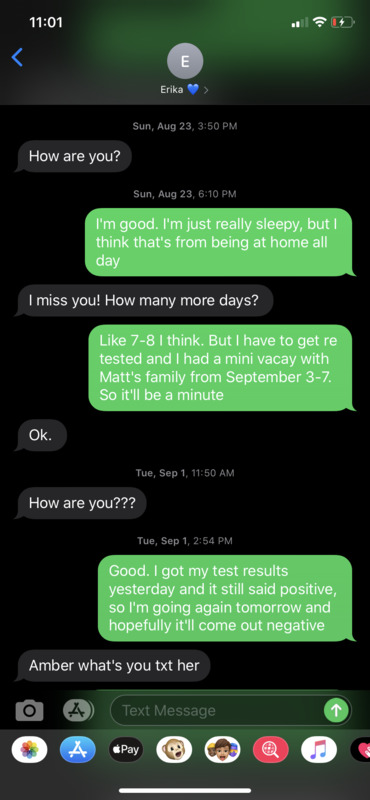
This screenshot is a routine "how are you?" text I got from one of my coworkers. She is a mother figure at work, and always made sure to check on me and keep me updated on work drama, updates, and just positive thoughts. She knew I was bored and made it a point to have a conversation with me almost every day. I was so bored because I was a lucky case and barely had any symptoms. I'm a healthy, twenty-two year old who caught it after taking a trip to Iowa to visit some friends. The whole group had it and it varied on the severity, but no one was affected too badly; although, one girl did lose her sense of taste for three weeks. My boyfriend and I were holed up for nearly two and a half weeks, due to waiting for negative test results for job-return purposes. While my boyfriend had symptoms that kept him in bed for a week, I simply lost my taste, had a stuffy nose, and minor body aches. I was very lucky because I could barley tell I was sick, and after 3-4 days everything cleared up except my sense of taste, which lasted a week. I will always be thankful that I didn't experience a bad case and that all my friend were okay after. -
2020-03-26
Reduced level of police services
Early on during the pandemic; I had a need to visit my old police department, Santa Barbara Police Department, in order to conduct my annual weapon qualification for my concealed weapon permit as a retiree. I was dismayed to find the police station shut to the walk in public. In addition, I learned that police officers were only responding to crimes in progress and emergencies of different kinds. All other contact had to be conducted over the phone. Such a reduced level of service has to have ramifications currently and down the road. Loss of personal contact between the citizen and officers will result in loss of information where as personal contacts often lead to obtaining unexpected criminal information. It’s a loss of opportunity to build trusting relationships. When little issues are not addressed by the presence of an officer; those little issues can grow to become significant problems. When officers are not dispatched to calls for service; citizens may decide not to call in the future. It’s well know that consensual contacts regarding minor issues often lead to felony crimes and arrests. So to some extent COVID-19 not only has a medical consequence it also has a public safety consequence. -
 2019
2019Far Away
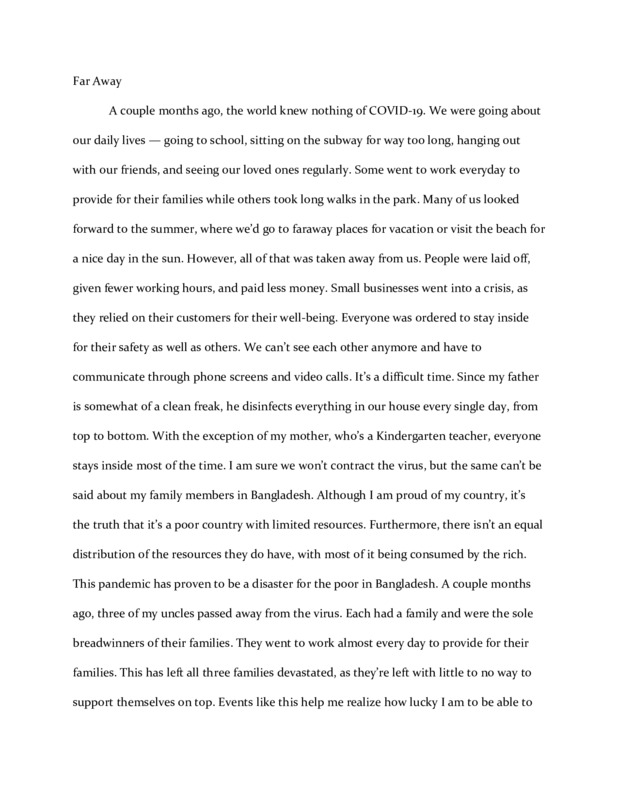
A couple months ago, the world knew nothing of COVID-19. We were going about our daily lives — going to school, sitting on the subway for way too long, hanging out with our friends, and seeing our loved ones regularly. Some went to work everyday to provide for their families while others took long walks in the park. Many of us looked forward to the summer, where we’d go to faraway places for vacation or visit the beach for a nice day in the sun. However, all of that was taken away from us. People were laid off, given fewer working hours, and paid less money. Small businesses went into a crisis, as they relied on their customers for their well-being. Everyone was ordered to stay inside for their safety as well as others. We can’t see each other anymore and have to communicate through phone screens and video calls. It’s a difficult time. Since my father is somewhat of a clean freak, he disinfects everything in our house every single day, from top to bottom. With the exception of my mother, who’s a Kindergarten teacher, everyone stays inside most of the time. I am sure we won’t contract the virus, but the same can’t be said about my family members in Bangladesh. Although I am proud of my country, it’s the truth that it’s a poor country with limited resources. Furthermore, there isn’t an equal distribution of the resources they do have, with most of it being consumed by the rich. This pandemic has proven to be a disaster for the poor in Bangladesh. A couple months ago, three of my uncles passed away from the virus. Each had a family and were the sole breadwinners of their families. They went to work almost every day to provide for their families. This has left all three families devastated, as they’re left with little to no way to support themselves on top. Events like this help me realize how lucky I am to be able to afford necessities such as disinfecting wipes, hand sanitizer, gloves, and masks. My family and I constantly worry about my relatives living in Bangladesh who can’t afford these things. We’re far away from each other, so we can neither deliver what they need to them or be with them when they’re sick. This is one of the hardest things I’ve experienced during this pandemic. Only my immediate family immigrated to the U.S., so everyone of my relatives are still in Bangladesh. It’s not safe to travel, so we won’t be able to fly over there in the case of an emergency. It’s a very bad situation, and we don’t really know what to do. I hope a vaccine will come out soon, not only in the U.S. but all around the globe. -
2020-03-23
Mystery Virus
In late March of 2020, I came down with a terrible migraine. Now, I get migraines a lot, at least once a week, but they usually go away with some naproxen or a nap conveniently timed around when it would be a more responsible decision for me to be doing my homework instead of sleeping. This migraine lasted for a full week. Standing up made my vision go blurry, and any light or noise would cause intense throbbing behind my eyes. It felt like my brain was swelling up and knocking on my skull walls begging to be released from my head. I spent most of my time splayed out on the living room floor covered in blankets with ice packs propped up around my head and neck to try to soothe the pain. I scheduled a tele-health visit with my doctor and she told me since migraines aren’t uncommon for me that I should just wait it out and drink lots of fluids, so I waited, but then I caught some mysterious virus which seemed to have a personal vendetta against my tonsils. My tonsils got so huge. They swelled up so much that even drinking became difficult, and very quickly a thick film of white gunk started to grow all over the back of my throat. I had a fever, chills, and a sore throat. Usually at that point I would go into the doctor’s office and get a strep swab, but this was during the second week of full lockdown in the US and doctors were not seeing patients in person. After multiple attempts to send my doctor precariously-angled photos of the back of my throat, they decided that if after a few more days of drinking fluids I still felt sick, I needed to go to the ER simply because it was the only place that was open in town and they could give me some tests. Going to the ER during the first wave of COVID-19 was absolutely terrifying. The first thing I saw when I pulled into the parking lot was the abundance of signs listing the symptoms of COVID-19. There were multiple entrances, one for people who had no symptoms, and a literal shipping container full of testing materials and staff in extensive PPE for those who did. I was just there for a strep test and someone to make sure I didn’t have mono or meningitis, so I went through the normal entrance. After triage, two nurses fully dressed in hazmat suits came up to me. They told me that since I had had a fever within the past few days, I had to be brought to the COVID-19 wing of the hospital. They took me outside to a golf cart where another hazmat suit-wearing driver drove me down to the basement level of the hospital that had not been part of the hospital in years but reopened for the sake of coronavirus. It honestly seemed like the doctors and nurses were bored and had nothing else to do because over the next few hours I had about ten random medical staff come poke and prod at me in my room. They took blood samples, shone lights into my eyes, and stuck probably the longest swab I have ever seen up my nose to tickle my brain for any COVID-19 particles. Hospitals are scary places to me and being surrounded by nurses and doctors decked out in layers of wearable plastic made me feel even more uneasy. I knew they were being safe, but it was difficult to stay calm when I couldn’t see the faces of the people I while being treated by. Eventually, they decided I had an intractable migraine along with something else and gave me shots of sumatriptan which made me drowsy. All of the tests came back negative and I was told to go home and, once more, drink lots of fluids. After another week on the couch and endless cups of tea, my mysteriously giant tonsils finally calmed down and my migraine decided it was bored of torturing me. I am extremely grateful that I did not have COVID-19, but it was an incredibly strange experience to have to receive relatively serious healthcare unrelated to COVID-19 during the pandemic. Even more than that though, I am so grateful for the healthcare workers that put their lives at risk for people in need every single day. -
 2020-09-03T12:24+10:00
Billie's House
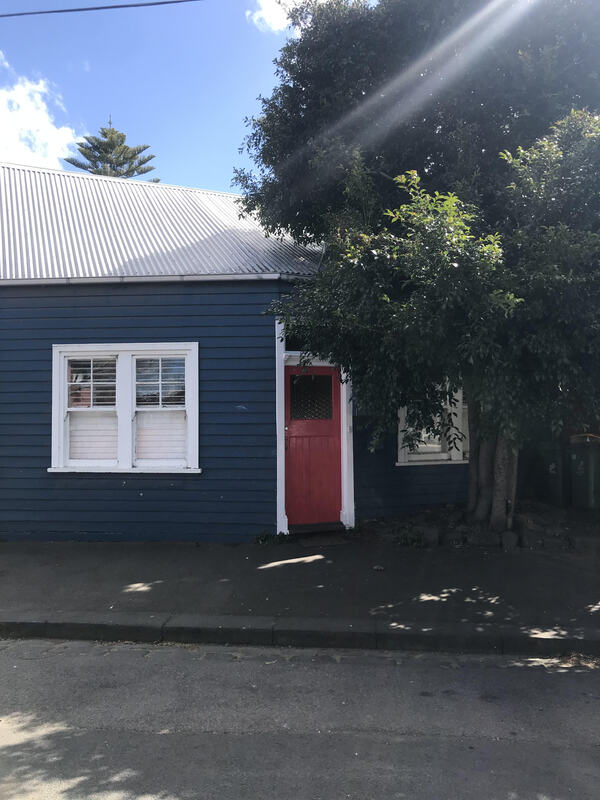
Over the past few weeks, my girlfriend and I have been watching the Australian TV Drama 'Offspring.' When I say watching, I probably mean obsessing. With nothing to do we would watch a few episodes a day and finished all seven seasons in around a month. We like the show particularly because it is shot in and around Fitzroy, a place where we would often catch up with out mates over a beer or in the park at Edinburgh Gardens, I think seeing the characters in Offspring be able to go for a pint at the Union Club Hotel gave us some sort of comfort, and the pub is top of our first visit list when they open again. As we tried to create entertaining walks we would look for some of the houses they shoot in and this photo shows one I stumbled upon on a run, Billie's house in later seasons. Like any show you like to be where they were, becoming part of the story yourself, and particularly when there was not really much of a story in our lives in lockdown, it was good to be part of theirs. Now that we've finished all seasons and are adrift in endless Netflix menus, seeing the houses returns me to that place of belonging I had. -
 2020-03-06
The Peruvian Experience
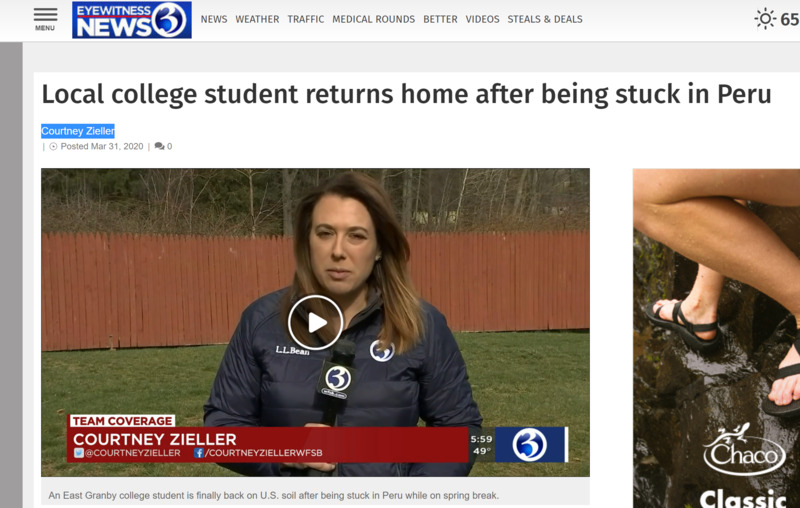
So I am down in Peru with three fellow students from Wesleyan University. We are just beginning our spring break, and had recently united in Lima before flying together to Cusco the next morning. Our plan was ambitious, chaotic, and irresponsible in hindsight; we had decided to hike the Salkantay Trek from Soraypampa to Aguas Calientes. The evening of our arrival, we were out to dinner when at 9 pm, my friend receives an alarming text from his mother stating that the Salkantay Trek was closed because of a historic mudslide that had decimated the entire trail below the highest pass. This slide sent at least 12 to their death (many remain missing today) while simultaneously displacing 430 families living in the valley. At the time, we were unaware of these disturbing statistics and decided to find a tourist agency that would perhaps guide us part of the way. At 10 pm that evening, we located a random tourist shop that was lightly populated by two employees in the backroom of a jumbled building of interior storefronts. They assured us that not only is the trek impassible at multiple points, but that the Peruvian government was preventing travelers from setting out on the trail. We offered to pay a guide to take us even part of the way, but they turned our proposal down. They did, however, secure us seats on a bus leaving at 5 am the next morning to Soraypampa where tourists engrossed themselves in a heavily assisted day-hike to Lake Humantay. We waiting in the darkness of the Plaza de Armas while bus after bus went to various other locations around Cusco. We dizzily wavered around due to the 11,000 feet of altitude gain that we had assumed less than 24 hours ago until a bus finally came to pick us up. From there, we dangerously (or so we thought at the time) drove through one-lane mountain roads in a loaded bus for nearly five hours. At last, we unloaded and grabbed our packs. We were the only backpackers in sight, and we planned on doing this trek without guidance both geographically and physically. As the rest of the hikers walked packless with sticks to the lake, we lagged behind, destroyed by the sudden difficulty of what was supposed to be an easy first day of trekking. Even with mouths full of coca leaves, two of us required sips of the small oxygen canister we picked up the day before. Our bodies pulsed with symptoms of altitude sickness, but we pressed on. No other view could have made me smile as widely as that of glacial Lake Humantay as we crested the final ascent. At 14,500 feet of altitude, we laughed at the fantastic beauty before us. We had arrived in the early afternoon, and found ourselves almost totally alone beside this pool in the Andes Mountains. Our descent was horrible. Pulsing again were headaches, fatigue, shortness of breath, and swelled joints. In our divergence from the path most traveled, we entered a trail of horse, cow, and llama (domesticated guanaco as we kept on) crap; an uncomfortable rain began to fall, and we found ourselves walking through a mountain feed mist. Within all of our heads was the terrible thought of setting up camp in the rain. Our level of exhaustion was overly evident to any onlooker (there was no one), but as the rain let up and our camp became established, moods lifted and excitement spiked. We were observing the most beautiful sunset display any of us had ever seen. The sun, setting at around 4:00 pm because of the extreme prominence of the surrounding mountains, swirled its orange and pink on the snow-covered top of Mount Salkantay almost as a kind of sorbet is presented at an ice-cream shop. Our wide smiles disappeared as a frigid wind whipped through the valley that we were so exposedly staying in. Dinner in the dark was followed by an unmatched view of eye-contracting stars as we retreated to the chilled interior of our tents. Altitude sickness plagued any chance of a good night's sleep, and we awoke frozen and in a misty cloud. It was this day that we would trek through the Salkantay Pass at 15,220 feet of altitude. Endless switchbacks defined the first half of the day. We toiled over each step, our packs dragging each attempt to press on. After a few hours of extreme exertion and chill, we passed through the highest point of the trek. Once the clouds parted, an incredible view of the mudslide's decimation shocked us into the reality of our unguided trek. The slide refigured the landscape with a melting expanse of boulders climbing both sides of the valley and completely filling in the previous location of the Salkantay Lake. Armed with a compass and an enthusiastic "we can't turn back now" mindset, our trek took us through a few miles of trailless movement into the valley ahead. The rest of this day wasn't by any means forgiving. Passing through a newly abandoned town, over a sea of boudlers and deep, wet sand, and into the jungle valley brought set after set of challenges. Towards hour 11 of the day's hiking, a thunderstorm burdened the final steps we had to take. The valley was steep, and beneath us crept a barren section of forest where the river washed away all vegetation in existence (it rose over 130 feet in some sections). Once we had almost made it to the supposed location of the next town, we hopped another small waterfall and rounded another unpromising corner to see only a gap. For about the length of a track, a secondary mudslide caused by the huge forest laceration made by the river's rise opened up to an impassible section of an unstable dirt cliff-face. We spent the next hour cautiously pressing up and around the empty gap in the forest in the ongoing rain. From there, we very quickly arrived in the next town, populated but in a state of emergency. Their supply of food had been entirely cut off, and reserves were running dangerously low. The following day, we were shown to a couple of provisional bridges that the locals had erected just two days before with some fallen logs and sticks. More treacherous than anything any of us had done, we inched along the sloped, wet logs that stretched over the intersection of two overflowing rivers. Later that day, a mile long mudslide had taken out another part of the trail, but this one was dry and had experienced some local foot traffic (there were no roads for the first four days of trekking). We got ahead that evening, and camped on a man's land high in the valley steeps who informed us that we had been the only group to travel the Salkantay Trek route for the entirety of the year 2020 (this was in March mind you). The next day of trekking was far longer than we had expected, but traveling alone through an ancient village to a phenomenal viewpoint of Machu Picchu made it worth it. We ended in with a beat arrival in Aguas Calientes, but that evening was full of celebration and restaurant food. Two of us woke up with food poisoning, and we decided to travel back to Cusco midday rather than in the evening. Upon arriving at our hostel, President Vizcarra came on the television to announce that Peru would close its airports in 24 hours. At the time of our departure in Soraypampa, the coronavirus had only spread widely in China and Italy, but when we got out, the internet flooded our phones with the reality of online classes, the spread of the virus into a pandemic, and the global closing of boarders. Panic-ridden, we awoke at 5 am to escape the claim that hostels and hotels would be locked from the outside by the police to force a 15-day quarantine period set by the Peruvian Government. We waited outside in the rain until the last flight to Lima departed with us onboard (our ticket had coincided with the last day of open airports by sheer luck). In Lima, we were locked in our friend's house, prevented from going outside by the fear of getting arrested by the endless number of police and military stationed on the streets of the city. Day after day passed, we played chess, meditated, and hoped for an email from the U.S. Embassy of Peru. Weeks passed, and the panic of my family was calmed by my less-bothered conscience. After daily reminders pointing towards the extension of our visit to Peru to months, the housing situation ended for two of us, and we ventured to a nearby hotel to wait out the rest of our stay in Lima. By some miracle, we were then put in touch with a DEA agent helping at the embassy (the DEA helped out because the chair of the embassy and many of his employees all fled back to the U.S. leaving thousands of citizens stranded for much longer). The person who aided us brought us to the embassy to get on a departing repatriation flight as standby passengers. In a rare moment of animation, my friend and I flew on an unfilled flight directly to Washington, D.C. Our trip had ended, but our quarantine in a very strange new world had just begun. I want to note that I skipped large swaths of experience to fit this shortened story into a mildly digestable piece. I also did not read through it yet so forgive any mistakes or sections lacking flow. -
 2029-09-21
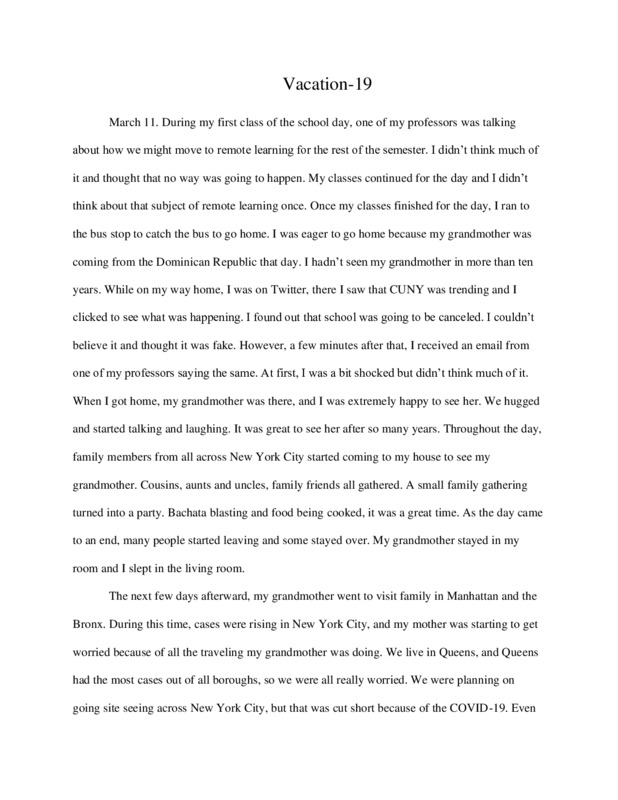
Vacation-19
I wrote a story about my grandmother's visit at the start of the pandemic and how it affected her stay. -
 09/20/2020
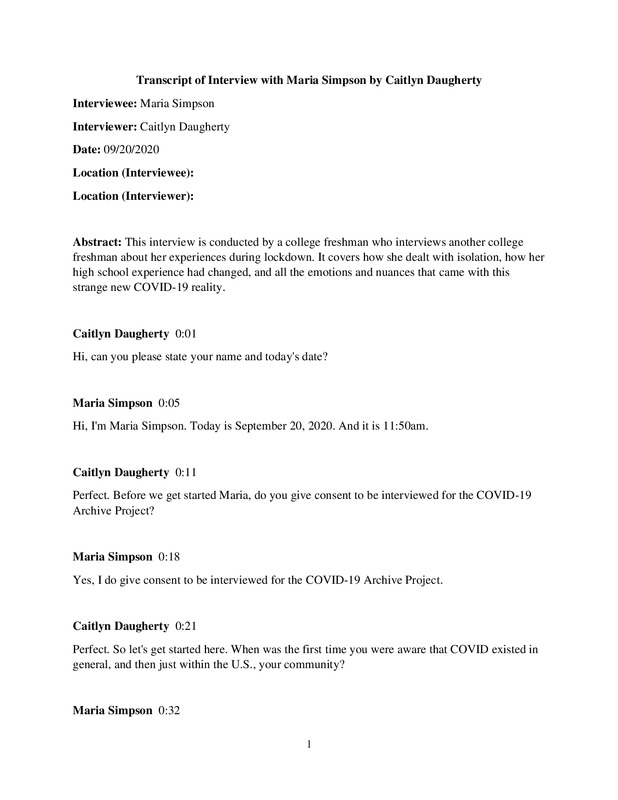
Maria Simpson Oral History, 2020/09/20
This interview is conducted by a college freshman who interviews another college freshman about her experiences during lockdown. It covers how she dealt with isolation, how her high school experience had changed, and all the emotions and nuances that came with this strange new COVID-19 reality. -
2020-09-20
‘We help with loneliness’: With cultural center temporarily shuttered, Iranian American Society of Arizona works to maintain ‘sense of community’ online
by Jessica Myers for the Luce Foundation: Southwest Stories Fellowship -
 2020-09-16
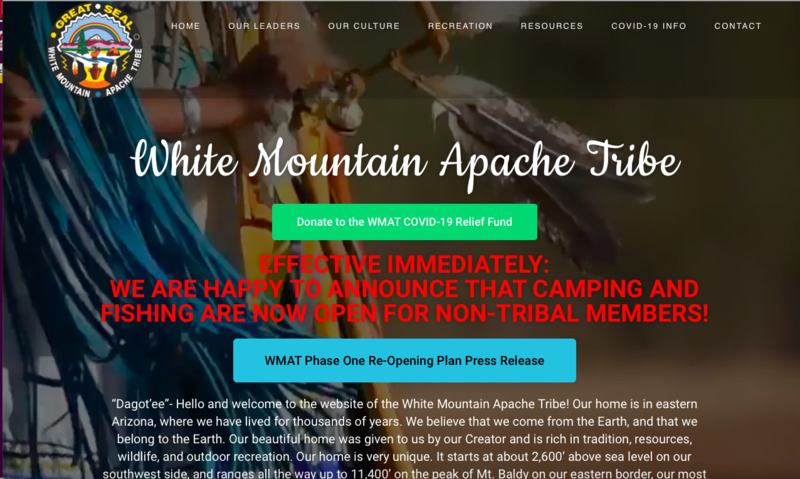
White Mountain Apache Tribe
"Welcome to the homelands of the White Mountain Apache Tribe! Apaches have been known since time immemorial for being resilient and having the will to survive in tough circumstances. Despite any challenge we may face, the ancestors of before gave us these bloodlines that still remain today. Located in the heart of the Great State of Arizona, the White Mountain Apache Tribe is blessed with over 400 miles of clean running rivers, streams, and over 26 lakes that are home to the Apache Trout. Be our guest and experience Trophy Bull Elk hunting, prize fishing and camping, or one of the finest ski destinations at Sunrise Ski Park! Visit us year-round within the four seasons. The White Mountain Apache Tribe continues to celebrate its culture, language, and songs and dances. The mountains, rivers, and pristine rivers offer an ideal vacation for anyone looking to relax and get away from it all.” Gwendena Lee-Gatewood, Tribal Chairwoman -
 2020-06-02
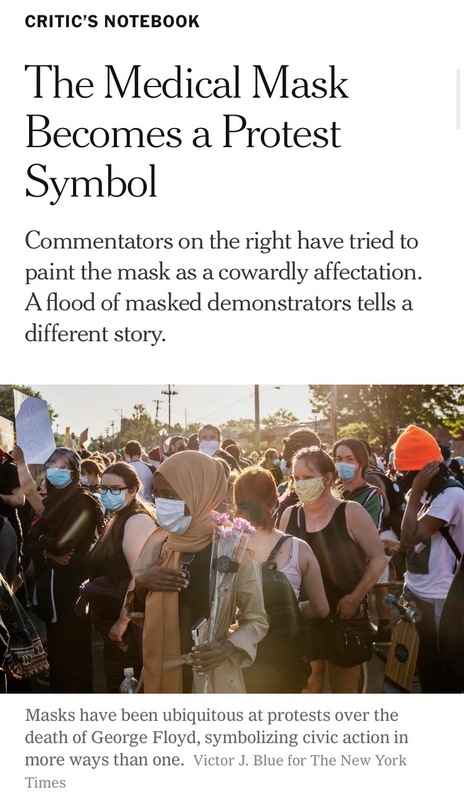
The Mask Wars
This article discusses the mixed ideas surrounding the wearing of masks. Some people see it as a show of “scientific authority” and respect for the safety of others, but another portion of the public thinks it is a sign of weakness, submission, and cowardice. Masks in America are an extremely political point of conflict. And although the majority of people protesting against the killing of George Floyd wore masks to protect their community from transmission of the virus, the rest of the nation is still in turmoil over the issue. I have experienced my own difficulty with this as well; we have had to avoid unmasked neighbors several times, and when relatives come, we have to be the enforcers of distancing when they visit and remain outside. Mask wearing should not be politicized; it should just be something everyone wears with the safety and health of themselves and others in mind. -
 2020-04-13
A Very Covid Birthday
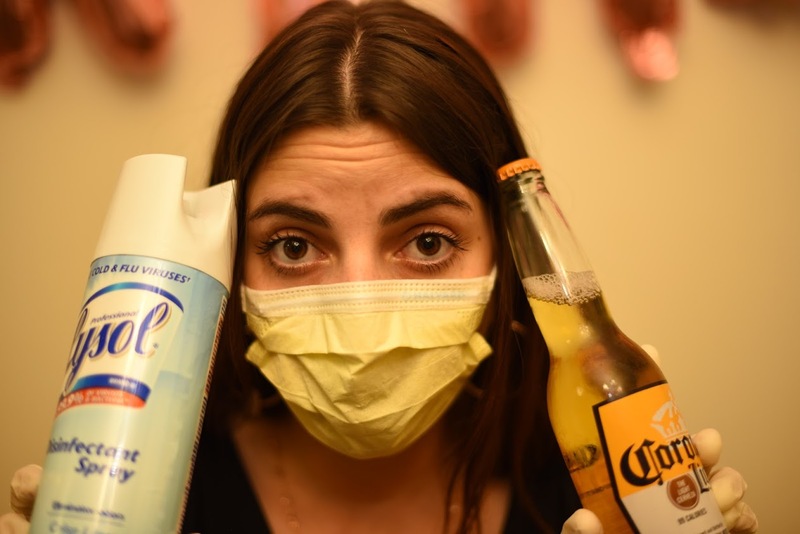
This year I turned 25, a quarter of a century. I definietly did not expect to celebrate as I did, but nonetheless this birthday in 2020 was one to remember. I through myself a party and luckily my mom and brother came to town to visit. We made dinner, I made my own cake, and we took pictures to celebrate, including some covid satire. I also got news on my 25th birthday that I landed my dream job and would have to move across the country during a pandemic, without many proper goodbyes. Bittersweet, but a birthday I will always cherish. -
2020-07-24
Be skeptical
My older brother has a friend named Rory. Now this happened sometime in late July 2020. Rory's wife Kayla went into labor with their first child. When Rory alerted his parents told his parents to come visit the kid they decided they should get tested for Covid-19 just to be sure they signed in and registered for the test, then they waited inline to get tested, and after about an hour of waiting they decided to leave and just go see the baby. After visiting them they went home and life continued. About 4 days later they received a letter from the hospital that said "Unfortunately your tests came back positive for Covid-19" which was odd since they didnt get tested. -
2020-08-20
Helping my little brother move in
Starting college can be hard at any time, and it's even harder for kids starting school during the pandemic. Since only so many people are allowed to help people move in, my brother had to pick between my mom and myself to be the last person to see him the night he moved in. He picked me, and my mom told me over the phone that she cried. Not being able to visit him has been hard because I don't even know how he's feeling during all of this. Being seperated from him because of coronoa for the first time this summer is horrible, and I know there are so many others out there separated from their loved ones because of Covid-19, as well. My brother and I hung out in each other's rooms all day over the summer, and now we can only see each other by appointment. I just hope my brother's first day of college was alright.