
Items
Search full-text
free fc 26 coins ps4 Visit Buyfc26coins.com Zniżki na duże ilości..C10x
-
 2022-05-15
The Nature of the Covid Skeptic
This is an interesting article I have found detailing 20 "facts" about the Covid-19 pandemic. This article largely attempts to refute the "overreaction" of the world when it came to the covid-19 pandemic. While criticism of conduct and policy is valuable and necessary for an open and clear discussion, attitudes of pandemic skeptics largely negate the vulnerable populations of the world and feed on the ignorance of the global population. This is one such article. 1. This article claims the lethality of covid is generally less than 1% of the population. While I seriously question that number, it still does not negate the extreme death seen by the world. The United States of America has roughly 331 million people living within their boarders. 1% of 331 million is still 3.31 million deaths. Is this a number in which it is appropriate to have an "it is what it is" attitude? Particularly when the people most impacted by the pandemic are those with health issues and the elderly? This attitude, which is shared by many skeptics borders on ageism and ableism. 2. This article claims that those most adversely impacted by covid are those over the age of 80 (78 in the US). But I ask again: is this a valid reason to not take the pandemic seriously? Are we supposed to let the elderly population simply waste away under the boot of covid? 3. This article claims that the covid-19 vaccine is ultimately ineffective in protecting against infection or transmission. The plain truth is that nothing is 100% effective. Seatbelts are not 100% effective in preventing deaths in the event of car accidents, so should we stop wearing them? Additionally, once the vaccines began rolling out, we have seen a decline in covid cases. Indeed, that is not to say vaccinated people don't get covid, I myself being one of them, but it has certainly made covid much more manageable, particularly on the already strapped healthcare industry. 4. This article claims that the vaccine can cause fatal reactions. As can the flu vaccine, or the polio vaccine, or any vaccine. It varies from person to person. 5. This article lays blame for increased mortality on the feet of covid lockdown procedure. I would simply say that correlation does not equal causation and I am certain the increased mortality rate can more accurately be attributed to the millions who have died from covid-19 across the globe. 6. This article mentions that in most cases, individuals were asymptomatic or only had mild to moderate symptoms and that obesity played a major part in whether or not symptoms were severe. While I doubt the validity of this, even so it does not negate the precautions the world took. Should asymptomatic people not take precautions and isolate? Should they be free to wander and infect those who could be vulnerable and perpetuate death? I feel this attitude, again, negates the vulnerable population. 7. This article claims that early treatment of the disease prevented hospitalizations. I feel this point negates the rapidity of covid's effect on people. Indeed, it also assumes that everyone has equal access to early-stage treatment. 8. This article claims that 10% of symptomatic people may experience long-term health related issues following covid. This appears to be about the only accurate point of this article, the only thing i question is the percentage of the population. 9. This article claims that the ability of transmission is very limited. This is very inaccurate, particularly when one looks at the extensive number of the population who received a positive test. 10. This article claims that masks had zero impact on limiting transmission. There are countless studies disproving this point. Often times this attitude is held by individuals who care only about their own comfort rather than the people around them. 11. This article claims that lockdown's were ineffective and only perpetuated economic issues across the globe. I think New Zealand is a prime example of why this is a moot point. New Zealand locked down early in the pandemic and did not have a single case of covid for nearly a year. It was only when their borders reopened that new Zealand began to experience covid. 12. This article claims that the impact of the virus on children is miniscule and that school lockdowns did nothing to help stop the spread. It is idiotic to think that children cannot contract covid. Indeed it is further selfish to not factor in teachers and staff and their health. 13. The article claims that PCR tests often returned false positives which artificially increased the number of cases. This is deeply inaccurate as there are numerous studies highlighting the effectiveness of PCR tests. 14. This article claims that contact tracing is ineffective and cites a WHO 2019 paper on influenza tracing. Contract tracing is valuable in informing the population that they have been exposed so that they may get tested and limit their contact with others to limit the spread, it is most certainly effective. As for the 2019 WHO paper on the ineffectiveness of contact tracing for the influenza: different disease, different way of managing it. 15. The article claims that vaccine passports are ineffective as the vaccine is ineffective and are used for tracking the population. Again, the vaccine has proven to be effective. And if the government wanted to track the population, it can be far more easily be done via phones and computers than via vaccinations. 16. This article claims that mutations of covid occur frequently and that new variants decline in lethality. While I agree that the virus mutates, I seriously doubt the decline in lethality. Indeed, I think because the virus can mutate so effectively, it is another justification in taking the pandemic seriously. 17. This article cites Sweden as a case where a full lockdown did not occur, a small number of deaths, and deaths being largely attributed to the elderly population. I think the primary effectiveness of Sweden this article cites is due to the Swedish taking the pandemic seriously, wearing masks, rapid vaccinations, social distancing, and not perpetuating misinformation. 18. This article claims that seasonal influenza largely disappeared during the pandemic and that covid has displaced it as the seasonal virus. Seasonal viruses aren't displaced. Indeed, the reason for the decline in flu cases is due to the population wearing masks and social distancing. Seasonal flu returned to pre-pandemic numbers in fall and winter 2021 when many of the covid protocols had been removed. 19. This article claims the media blew the pandemic out of proportion, spread fear, and distorted information. I disagree. It is the job of the media to make the population aware of global issues such as this. Indeed, the only distortion of facts that I found during the pandemic were from pandemic skeptics who were too selfish and uncomfortable to consider their fellow humans. 20. This article claims that the virus was lab-created. Whether or not the virus was lab-created is irrelevant. The point is: it exists, it is here, and it is vital that it be taken seriously. -
2022-05-04
Covid-19 Experience (school)
The impact on covid-19 brought upon an experience, an experience of both good and bad. I shall talk about my experience on Covid-19 more specifically on how it has affected me in terms of school. I was half way through my junior year when I got the news of how we would all be quarantined and won’t have school for three weeks. I was relieved, 3 weeks off from school who wouldn’t like that. The school district during that time (and all schools around the country) decided that we must continue with school, but online. Thus we stayed online for school for over a year. Through zoom, it was very beneficial because I had more free time, but sometimes being online distracted me and so it was very difficult to pay attention. During zoom I also did not like being in my house all day as it would be very tiresome and boring. There would be days or sometimes weeks where I wouldn’t leave the house at all. However, school during the pandemic allowed for such things as having hybrid classes which can present as a new school system, especially in college it could make managing students time more easier and efficient. Overall, my experience through online school during covid-19 brought upon a new change and experience that altered my perspective of school. -
2020-03-16
March 16th, 2020
On the morning of March 16th, myself along with millions of other people around the world woke up to go to school and work like any other day. There had been talks in the news recently of some new disease in Asia, but us Americans weren't too worried. As the day progressed, whispers and talks around campus began to swirl, with the rumor that we would be getting a free week off of school to see what affects COVID-19 will have as a few cases began to spurt up around the country. Me and my friends were just excited to be getting a 2 week spring break, but what we didn't know was that this would be the last time at school for awhile, and this would change our lives forever. After that first week had passed, it was announced we would not be returning to campus in person for the remainder of the school year. Fear of the unknown began to sink in. What had life become? How will I live my every day life now? Will I survive? People always learn about history in the classroom and on the internet, and now I was living through a part of history that will be talked about and remembered forever. -
 2022-04-26
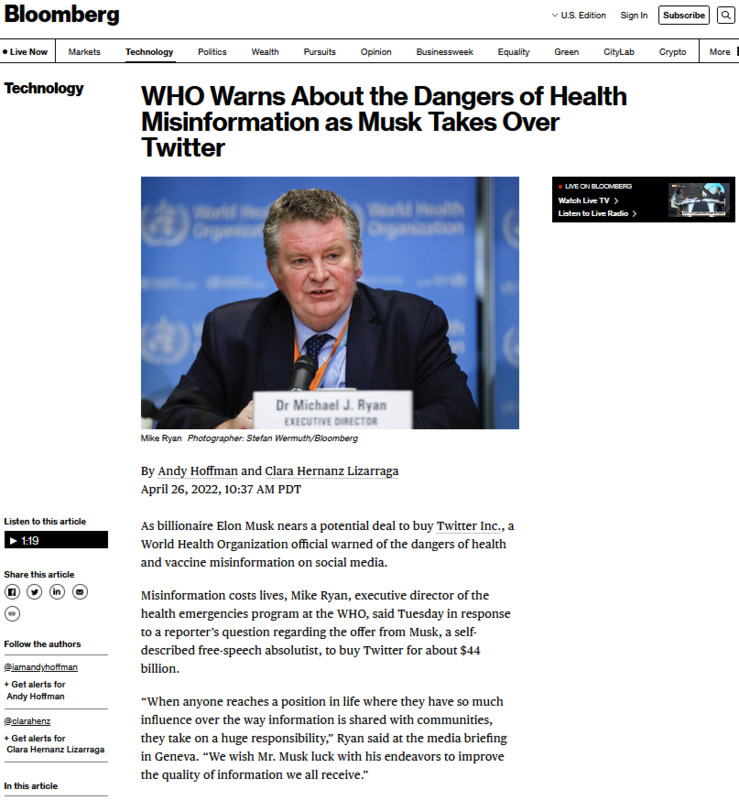
WHO Warns About the Dangers of Health Misinformation as Musk Takes Over Twitter
This is a news story from Bloomberg News by Andy Hoffman and Clara Hernanz Lizarraga. Since Elon Musk has officially acquired Twitter, it has prompted groups like the World Health Organization to give warnings on COVID misinformation. Mike Ryan, the executive director of the health emergencies program at the WHO issued a statement on Musk buying Twitter for $44 billion dollars. “When anyone reaches a position in life where they have so much influence over the way information is shared with communities, they take on a huge responsibility,” Ryan said at the media briefing in Geneva. “We wish Mr. Musk luck with his endeavors to improve the quality of information we all receive.” Throughout the pandemic, the WHO has worked to make sure correct information about the pandemic and vaccines are being spread. The WHO has an overall fear now that bad information could be spread more easily about COVID and possibly cause more death. -
 2020-08-08
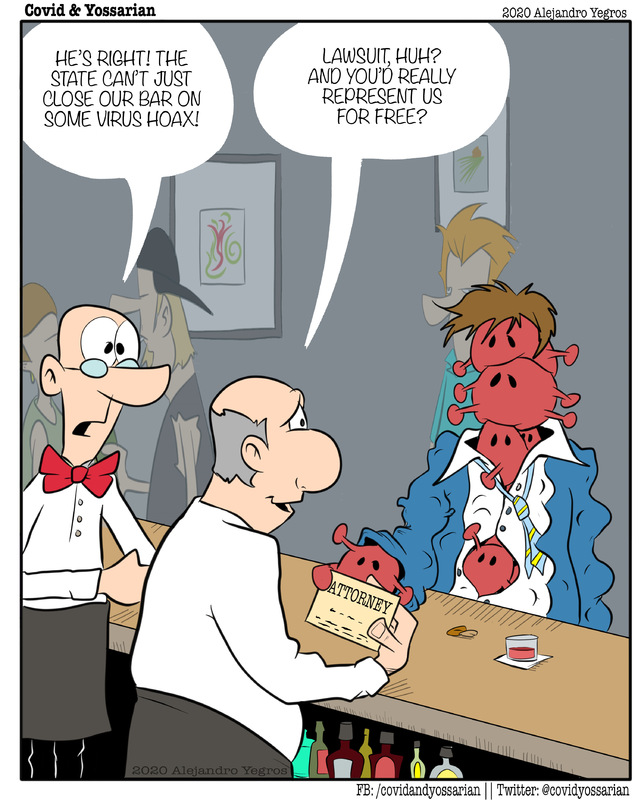
Time to sue
A comic strip about Covid-19. -
 2022-04-20
Travel and masks in Lima
we just arrived to Peru This morning. Before we got on the plane we were told that we would have to show two masks because in lima we would need to double mask while walking around no one seems to be checking if you have one mask or two masks but everyone is wearing a mask. This is a photo of the free breakfast the airport hotel provided this morning after waking up. You’ll notice the sign that says Masks are obligatory. We’re staying at the Wyndham Costa Del sol hotel. -
 2020-12-28
First Time Swimming Shirtless During The Pandemic
This is a picture of me swimming for the first time after top surgery! I can't even begin to explain how free I felt. One of the things I was worried about was the fact that my fiancé and I not being able to swim because there was people there, but it was completely empty! It was almost like it was meant to be. After being confined about something for so long and being able to take off my shirt in public was so weird! Before this picture, the last time I went swimming was in 2015. And now, I'm able to enjoy the water and the beach with my fiancé. -
 2022-04-04
Vaccination Celebration
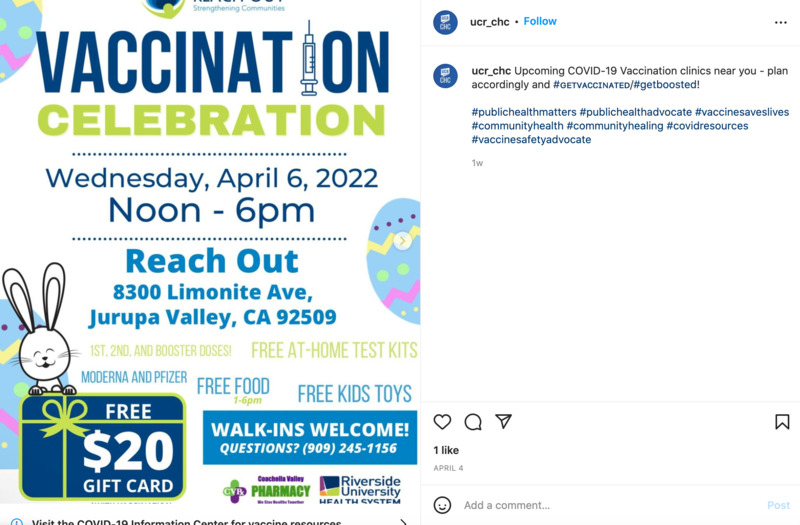
This is an Instagram post by ucr_chc. This is of a celebration where kids are encouraged to go and get vaccinated. The celebration flyer says that there will be food and kids toys available. The event is also giving away free testing kits, and will do booster shots as well. This event was held in Jurupa Valley, California. -
 2021-04-11
#FactCheck Vaccines in Peru
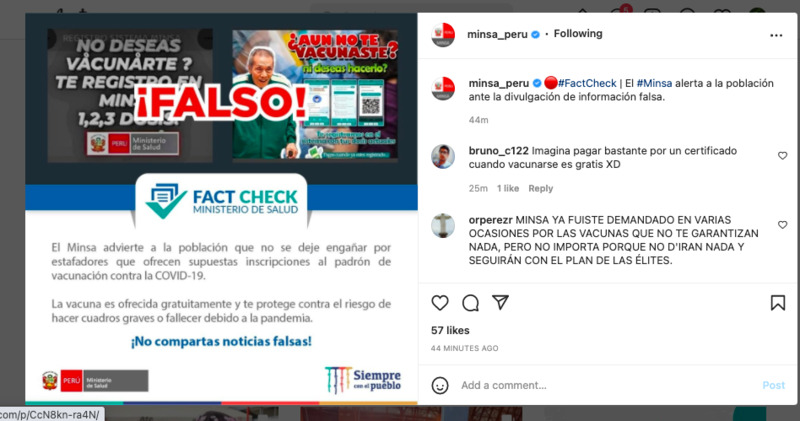
🔴 #FactCheck | El #Minsa alerta a la población ante la divulgación de información falsa. Instagram post targeting misinformation about the vaccines - including that all COVID-19 vaccines should be free. The commentators on this post are a bit more skeptical. -
 2022-04-06
Pfizer Loyalty Card
This is an Instagram post by 4kron2. This user posted few tags, but the picture does give a lot of information. There has been a controversy on if booster shots are even needed, with some believing that this is a ploy by Big Pharma to get more money from the pandemic. This picture is a parody of loyalty cards some places have where if you buy a certain product or service enough times, you will get a reward. -
 2022-04-05
Big Changes to a Small Island
At the "heart" of Polynesia, (referring to its geographic location in the Polynesian triangle) American Samoa appears as another tiny dot on the map. Nevertheless, it means the WORLD to its 55,000+ people, and to some, it is all they have ever known as their home. It is also the southernmost territory of the United States (below the Equator) and the second to the last place on earth to always welcome the New Year LAST. Perhaps it coincidently depicts the slow-paced nature of the island to which many visitors claim that "it feels like time slows down", here at a piece of heaven on earth that is deeply rooted in the Christian faith and the "Fa'aSamoa", a.k.a the Samoan culture or literally, the "Samoan way of life". The people of our island are like a big tight-knitted family--we are all related anyway--when something good or bad happens on the west side of the island, news travels to the east faster or about the same as the speed of light! It has its disadvantages, but for the most part, it is a beautiful thing to see the collective reaction of our people when it is of happiness, support, and sympathy. When the coronavirus started spreading rapidly in the United States in early 2020, our territory continued its commercial flights until mid-March when Hawaii's cases started to rise. Since March 2020, our borders were closed to commercial travel for the next 11 months, not including cargo flights and ships. Residents were stuck in the States for nearly a year. The first of many repatriation flights finally began in February 2021. The repatriation flights took place once a month, during which passengers would undergo a strict process of testing and reporting, a quarantined stay in Hawaii for 12 days, and another 2-weeks quarantine upon arrival in American Samoa. Throughout all repatriation and medical flights, the quarantine process was still a requirement, which was how positive cases were caught and taken care of to prevent community spread. Fast forward to February 2022, exactly a year later, news of a COVID outbreak quickly spread when it was leaked on social media that the family of a Department of Health worker tested positive for COVID at the main hospital. The general public was seeking answers and taking their concerns on social media until later on that same evening the said family tested positive, the local news channel held a Livestream in which the Governor, Lieutenant Governor, and the COVID-19 Task Force officially announced the community outbreak of the virus. People rushed to the stores to buy necessities and food before the lockdown was set to begin at midnight. The lockdown was marked as Code Red, with curfews from 9pm to 4:30 am, and business hours to be from 8am to 4pm, while all government workers and non-essential employees are to stay home, except essential workers and first-responders. Students transitioned to virtual learning and now interact in class with options such as "raise hand" and/or "mute/unmute". Our people had to adjust very quickly to the new reality we now face. A small island once free with family gatherings, church services, and close human interaction as we are known for...now all of that sounds like a distant memory that will take some time to experience again. Beaches and parks used to be crowded with people and all the happiness they offer their surroundings, now empty and eerily quiet with a "CLOSED" sign nearby. We are masking up everywhere--with little to no physical interaction--so far with 4,700+ cumulative positive cases and a total loss of 7 souls, which has hit our dearest island with extreme sorrow. While the world has moved forward and learned to live with COVID, even opening back up and unmasking, our island is once again a little behind with the experience. It is only the beginning for us! Fortunately, our unwavering faith in God continues to be our ultimate Hope, along with the support of our loving families, beloved people, the United States, and our fellow Pacific islands. One thing we are sure of is that WE ARE RESILIENT PEOPLE, having overcome many challenges for centuries! This too shall pass...on the bright side, in order for it to pass, our journey with COVID had to begin. Now we must go through it, endure it, and overcome together AS one like we always do! God be with us...God IS with us. -
 2020-10-03
Tsushima Island, my escape
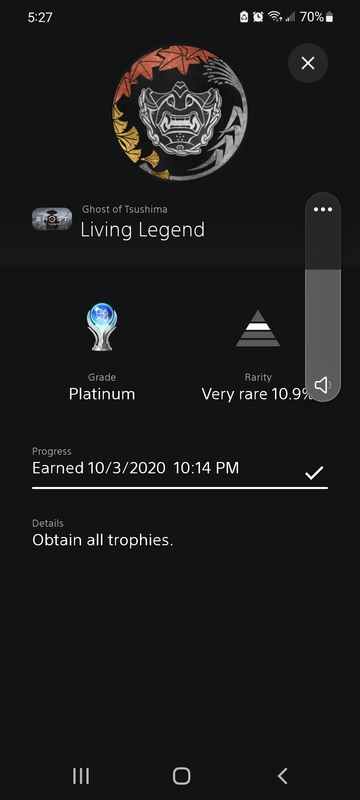
This is a picture of the platinum I received for beating the game Ghost of Tsushima on October 3rd, 2020. This game came out on July 17th, 2020 and it became my Game of the Year. This was also the year of COVID-19, so I had a lot more free time to play the game and beat it in several months. The pandemic was a difficult time and I just wanted something fun to play. I wanted to forget everything happening in the real world with the pandemic and other problems by jumping back to 13th Century Japan. The game is set on Tsushima Island as the Mongol Empire took its first step toward invading Japan. Ghost of Tsushima is a beautiful, but a brutal game that I had so much fun with. The soundtrack is beautiful and there were foxes to pet! My main character shifted from a samurai who followed the strict Bushido code into a brutal assassin in desperate times. I can relate to this idea of shifting between jobs because I had to shift my job around to adjust to the desperate times I was experiencing. I had to shift from working in person to working online. I wanted to add this to the collection because I want to show how I could escape the reality of COVID-19 and have some fun. -
 2020-05-08
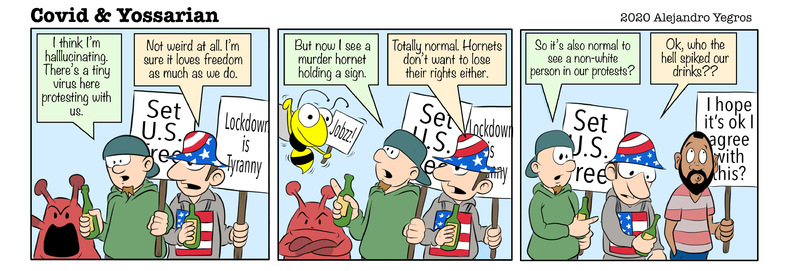
Something funny about the protest
A comic strip about Covid-19 -
 04/16/2020
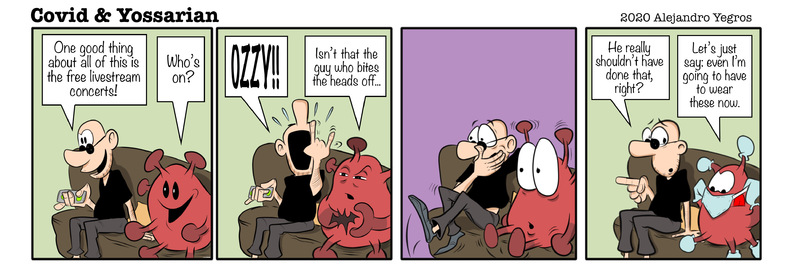
Ozzy!
A comic strip about Covid-19 -
 2022-03-27
Were masks and pandemic anxiety a useful distraction towards ideas that should not matter, but did (to many)?
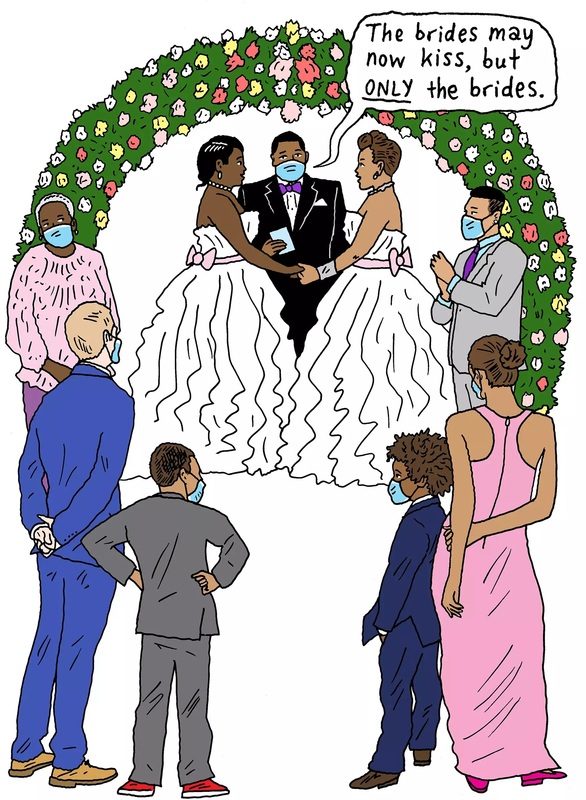
Like everything having to do with public interactions during the COVID-19 pandemic, social distancing and lockdowns significantly impacted "traditional weddings." Gone were the days of large weddings, dancing around mask free and hugging the happy couple. If you search the internet, you will find a large amount of information on happy couples who had to cancel or alter their plans. Many of the #COVID BRIDES stories on this archive illustrate the extreme panic of changing plans and constant change, such as wearing masks in their pictures. The pandemic altering, delaying, or even preventing weddings has impacted society's mental health and perhaps future cultural traditions in weddings. This archive has a collection on mental health, https://covid-19archive.org/s/archive/page/mental-health, which demonstrates how hard this pandemic has been on many people. The effects on mental health shows how weddings are a popular and important tradition in American society. The ceremony is a way to share your love before others, blend families and friends, and move from a "single person" to a team. When I say wedding, I mean the customs and celebration within the ceremony, not the genders of the couple. Gay marriage has not been legal throughout America long, only since 2013. The anxiety and stress of two years of delayed/cancelled weddings during a pandemic pale in comparison to the longstanding social pressure for LGBTQ people not to marry, on top of previous legality issues. There is still a large group of Americans that have the opinion that it is "evil" or a sin. I have seen and heard in person, movies, or television disparaging remarks on the idea of two men or two women getting married and/or kissing. I wanted to highlight this picture from TIME magazine as I hope it demonstrates that masks made people freak out. The idea that the officiant and the people were so distracted and concerned about the two brides either not wearing masks or being the only two kissing while not wearing masks----rather than not being male/female made me smile. I hope some of the pain, anxiety, and discomfort of the pandemic was turned into positivity by distracting people from the meaningless idea of couple's gender and that some LGBTQ opponents realized there are bigger problems in the world. -
 2022-03-20
A Day in the Life of a Delivery Driver in the South
I deliver copier toner to various clients across Northwest Arkansas, so I am able to see the various ways COVID-19 has impacted businesses, both large and small. Particularly, I am able to see the various protocols of businesses relating to admission into their facilities. From the time I began delivering in March of 2021 to today, it is interesting to see the adjustments made by the community as cases would fluctuate. It is further interesting to see a southern perspective, as the south has been notorious for having a lackluster approach to the pandemic. I will detail six varying instances of businesses across NWA and how they have changed or not changed from a year ago. 1. Banks were an interesting study. My company supplies three major banks across NWA, and all three had very stringent protocol in March 2021, and as cases have declined, they have removed these protocols entirely. In early 2021, bank lobbies were closed to outside visitors with zero exceptions. In order to make my deliveries, I was required to call the bank and meet a staff member at the front door, and both myself and the staff member were required to wear facemasks and social distance. Now, in 2022, these protocols have vanished entirely. Bank lobbies are now open entirely, and masks and social distancing are a thing of the past. This directly correlates with a dramatic fall in COVID cases and deaths, as well as a rise in vaccinations across Arkansas. 2. Chicken plants and food processing plants are an essential part of the economy of Northwest Arkansas, being the home of Tyson, George's, and Cobb-Vantress foods, as well as many others. The protocol for processing plants were stringent in 2021, and they continue to be so in 2022. It is standard practice to not only wear masks and social distance, but also to take temperatures and answer a health questionnaire by security guards. The only change I have seen is a vaccination requirement. Nobody is allowed on the premises of many of these chicken plants without having had both dosses of the COVID-19 vaccine, and vaccination proof must be available whenever requested. Food safety is essential in preserving the health of workers and the community at large, so it is no surprise that these stricter protocols have remained in place. 3. Schools are similar to banks in that COVID protocols greatly shifted from 2021 to 2022. Many schools in 2021 had masks mandates for both students and staff and encouraged social distancing. Now, in 2022, masks and social distancing are no longer required, and school is entirely like it was pre-pandemic. Student's are free to wear masks if they so choose, but any protocol has vanished. This is particularly prevalent in smaller school districts. Depending on the district, many smaller ones had zero protocols to begin with, so things haven't changed in that sense. 4. Manufacturing plants are common in NWA, and many of them have maintained pandemic protocols in 2022. Temperature checks, masks, and social distancing are the norm. There are even a few plants that require appointments to enter their facilities in order to maintain security and prevent the spread of COVID. This is largely attributed to maintaining the health of the workers and preventing outbreaks in facilities that would limit production capabilities in a time when goods are so scarce. 5. Transportation is another major business in NWA, and interestingly, protocols have been minimal. Many transport companies had no original mask requirement, social distancing requirement, or a temperature check. This attitude has continued in 2022, despite the extensive traveling many truck drivers engage in. There were many concerns in the COVID conscious sectors of the community about the possibility of interstate infection, but no changes to trucking protocol were made. It is further interesting the extensive COVID regulations placed on truckers from other states, compared to states like Arkansas. 6. Hospitals and medical clinics, like many across the nation, have made minimal changes to COVID protocol. Washington Regional Medical Center, Northwest Medical Center, and Mercy Hospital all have bared the brunt of COVID in NWA, and masks, temperature checks, social distancing, and exposure questionnaires are the new norm, and medical administration has been unmoving in their insistence on these protocols. Indeed, medical facilities are the locations in which there is the greatest risk of exposure and many medical clinics are still closed to walk-in visitors. The only change really seen from 2021 to 2022 is the allowance of visitors. Previously, no outside visitors were permitted in the hospitals without special permission. As cases declined and vaccine rates grew, the hospitals lifted this restriction and now visitors are common place. It will be interesting to see when and if some of these protocols will change as the pandemic advances. Indeed, it is also interesting to see how and if protocols become a new essential part to admission to various facilities across NWA beyond the pandemic. -
 2022-03-07
Rose Oral History, 2022/03/08
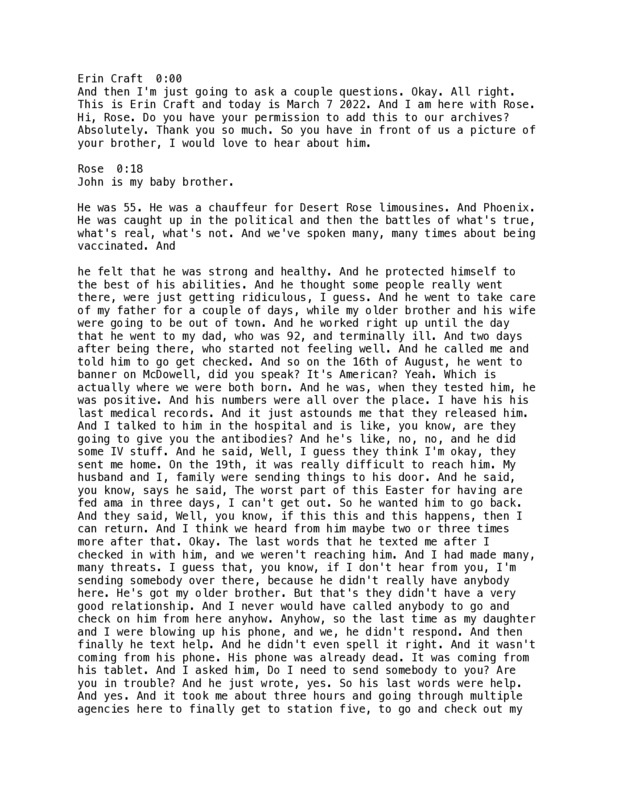
At the Arizona Historical Society's 2nd annual Covid Memorial event, I spoke with Rose and recorded her story about losing her brother, John, to Covid. Rose describes the challenges she faced being far away from her brother as he was diagnosed and then ill. She currently has her brother's dog, Emma, and is trying to re-home her according to her brother's wishes. Rose describes how her last communication with her brother was a text for help. After the recording was turned off and we were walking out, she described how she felt when she was parked and walking to the hospital to say goodbye to her brother she saw anti-mask protestors at Central and Thomas Road. She was so sad and angry that these people were arguing against something that might save lives. She said that she couldn't argue with them and just wished them good health and walked away. -
 2020-03-20
Eddie Case Oral History, 2022/03/07
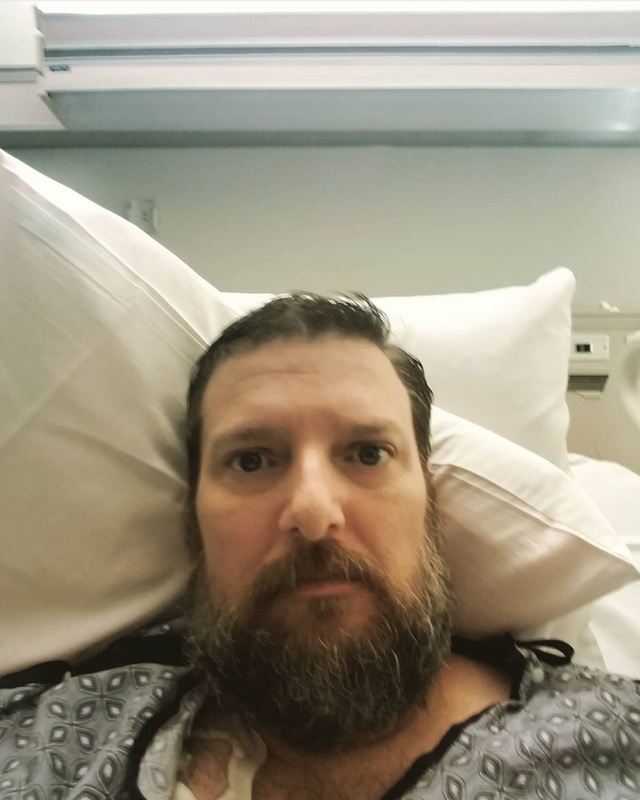
[curator's note] I recorded this interview at the Arizona Historical Society's 2nd Annual Covid Memorial Event at the Arizona Heritage Center. Eddie spoke about his experience as one of the first cases of Covid in Arizona, and his illness and long recovery. He views his story as a blessing. -
 2020-03-27
A Reunion with Childhood
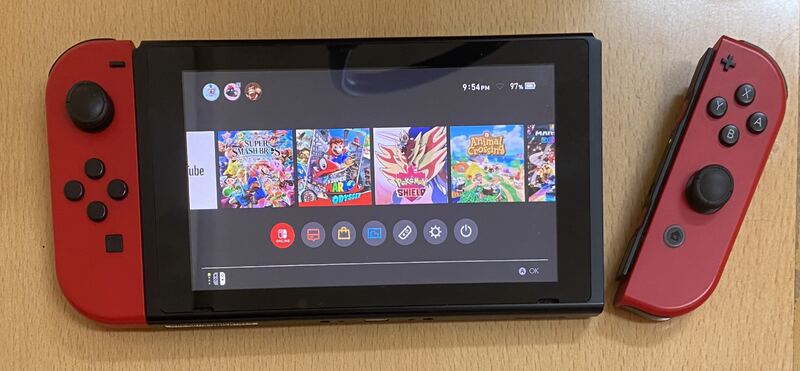
This is mine and my brother’s Nintendo Switch, although I use it the most since I have more free time. It has two joy-cons that slip lock into the main screen or can be slipped out to play one-handed or play with multiple people as multiple controllers. On the top left of the screen is each of our accounts, listed from left to right it would be my account, my middle brother’s, then my eldest brother. A lot of the games we play together are considered “party games” such as Super Smash Bros Ultimate (the first game on the left), some are single or two-player games that we end up taking turns playing in one sitting like Mario Odessey (the second from the left), Others would be a single-player game that each of us would play in each other account such as a social simulator like Animal Crossing (Furthest on the right). The weeks were slow and exhausting. Covid-19 caused whispers of fear throughout the neighborhood, from worry to frustration. One problem shared a lot with these households was the exhaustion of seeing the same people 24/7. Some had it harder than others, from parent to child and between siblings, irritation just burned between them as patience grew thin. As an introvert, I was one of the people that was excited about the lockdown! However, reality hit hard quickly. As more and more news about the virus spread and talks about other people experiencing the terrible aftermath grew. My family would convene every evening to turn on the news and witness how the world dealt with the virus. Similar to Kaashif Hajee in his The Pandemic Radically Altered My Relationship with India. I Don’t Know If I Can Ever Go Back writing, I felt like the world was on its head and things that I was blind to were revealed, such as the concealment of cases. Among actions that I was uneasy in facing were the required actions that the Saudi Government took but felt wrong, such as the banning of gathering for religious gatherings. While it is of course understandable, I could not deny the uncomfortable grip on my heart when, during the first day of Ramadan (April 1st), I witnessed the once full-of-life crowd become practically empty around the Kaaba. It hit really hard for me and my family, especially since it is kind of tradition to watch a Livestream when breaking our fast. Another issue due to the lockdown was the disconnect I felt with my two older brothers. We weren’t “disconnected” to the degree that we hated or were annoyed at each other (not always anyway). It was a “disconnect” that felt like we were there for the sake of being there, we talked for the sake of having a normal conversation, not because there was any meaning or purpose. I presume this comes partly due to the fact that we are all in different stages of our lives. We were all busy in our hectic lives but due to lockdown, we were kind of forced to interact to fulfill our societal needs. “You needed something to connect with!” our mother would tell all of us privately, but when you all have your own things to deal with it turns more difficult and stretched out. That is until my eldest brother bought something very nostalgic home. A brand new Nintendo Switch. At this point, this console made by Nintendo has been already released for a while, but with life being exhausting and taxing as it is, brothers and I were unable to get our hands on it, let alone any time to do so… until late march. My eldest brother took my mother’s words to heart and scoured the internet for something fun for us to do. One of the most fun things we used to do together was to play on Nintendo consoles like the Wii and play games like Mario Kart and Super Smash Bros. These games were competitive to a fun degree, it never got too heated but with time and age, the family-friendly Wii console was forgotten. When the Nintendo Switch was released it took the world by storm. It’s fun and the joy-cons mechanisms were easy to use and split between multiple people, so we were ecstatic! We are lovers of anything nostalgic and now we were able to relive the fun competitiveness we shared in our childhood. What was even more nostalgic was Nintendo’s new Super Smash Bros Ultimate, a game that is connected to another game in the Wii during 2008 that we bonded closely with. It held the same premise, It was a beat ‘em up platformer-style game that had hundreds of story features as well as major customizable levels. Nintendo made the new Super Smash Bros Ultimate like its predecessor, but better with more features including fighting others online! With this, me and my brothers were able to talk like we used to, with no awkward pauses and long meaningless conversations. After receiving a Nintendo switch, my cousins, who I am very close with and missed greatly over lockdown, grabbed a hold of their own consoles and played with us through the internet. Although they were not as emotionally connected to the games, it was fun for them nevertheless, especially since they were the same age as me and my brothers when we first started playing on the Wii. I felt a sense of warmth that the Nintendo Switch did not only make me remember the warm feelings of childhood, where we had no worries and fears, but I was also able to see these same warm feelings occurring in my younger cousins. It gives me happiness and comfort knowing that even if Covid-19 was terrorizing the world, at least there are objects that are able to help shift your mind from hard matters into a more calm and safe place. -
 2022-02-03
Zero attendance sports games
As a lifelong hockey fan, specifically for the New York Rangers, it was highly disappointing to find out that the rest of the 2019-2020 season would continue without the attendance of fans at Madison Square Garden due to lockdown restrictions during the COVID-19 pandemic. Watching every hockey game at home simply did not compare to being able to witness the firsthand action of rocket slapshots, massive hits, and gruesome fights seen up close in person. Although, I am fortunate that the rest of the season continued, and I was able to see the Rangers compete in the playoffs despite them being eliminated in the first round. Yet, the beginning of lockdown was indeed a scary time for most people. There was no anticipated end to quarantine restrictions nor an end in sight to the highly contagious virus itself. Writing this excerpt two years later, thankfully, the vaccine and the use of masks has allowed for regular attendance to return to most sports arenas and stadiums nationwide. Hopefully, we will find a permanent solution to the virus itself in the future and continue normal sports activities restriction-free! -
 2022-02-01
Patio Sounds
I never heard the sounds of my backyard and cared – now, it is my favorite sound, and my patio is my favorite place to work. I work in education, in March of 2020 our campus went virtual, and we began to work from home. My two kids, age 3 and 6 were home with me as well. Fast forward to today February 2022, our campus is still working virtually, however my kids now age 5 and 8 are away at school for 6 hours a day; this is the first time in my work history I have been able to work from home, and the first time I have been able to work kid free in two years. Prior to the pandemic, I was a busy person, work, school, kids, home, husband, dog – I did it all – what I didn’t do, was stop and listen to the peace I literally had in my backyard. Now, I sit on my patio from 9:00am to 3:00pm, rain or shine, and even though I am working, I listen and take it all in, I feel recharged to take on all my daily tasks. The calm and quiet time on the patio is much welcomed in the hustle and bustle life can become. Listening to the bird’s chirp, leaves rustle, dogs bark, sometimes the hum of a hummingbird, or the light drops of rain – it is therapeutic. The pandemic has been many things, but for me it has given me time to discover the peace the sounds around me can bring. This recording was taken on my patio, listening to the sound of my backyard as I wrote this description, appreciating the time I have. -
 04/29/2021
Kristina Jordan Oral History, 2021/04/08
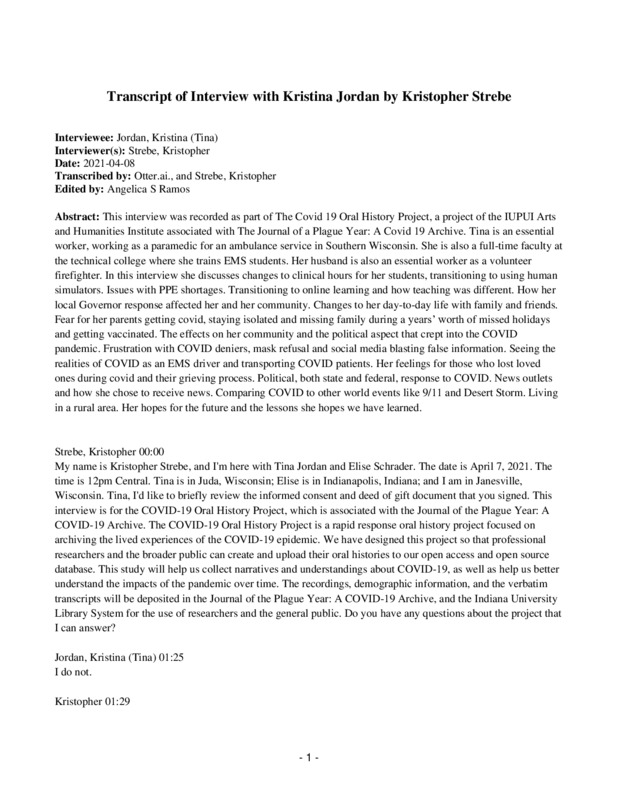
This interview was recorded as part of The Covid 19 Oral History Project, a project of the IUPUI Arts and Humanities Institute associated with The Journal of a Plague Year: A Covid 19 Archive. Tina is an essential worker, working as a paramedic for an ambulance service in Southern Wisconsin. She is also a full-time faculty at the technical college where she trains EMS students. Her husband is also an essential worker as a volunteer firefighter. In this interview she discusses changes to clinical hours for her students, transitioning to using human simulators. Issues with PPE shortages. Transitioning to online learning and how teaching was different. How her local Governor response affected her and her community. Changes to her day-to-day life with family and friends. Fear for her parents getting covid, staying isolated and missing family during a years’ worth of missed holidays and getting vaccinated. The effects on her community and the political aspect that crept into the COVID pandemic. Frustration with COVID deniers, mask refusal and social media blasting false information. Seeing the realities of COVID as an EMS driver and transporting COVID patients. Her feelings for those who lost loved ones during covid and their grieving process. Political, both state and federal, response to COVID. News outlets and how she chose to receive news. Comparing COVID to other world events like 9/11 and Desert Storm. Living in a rural area. Her hopes for the future and the lessons she hopes we have learned. -
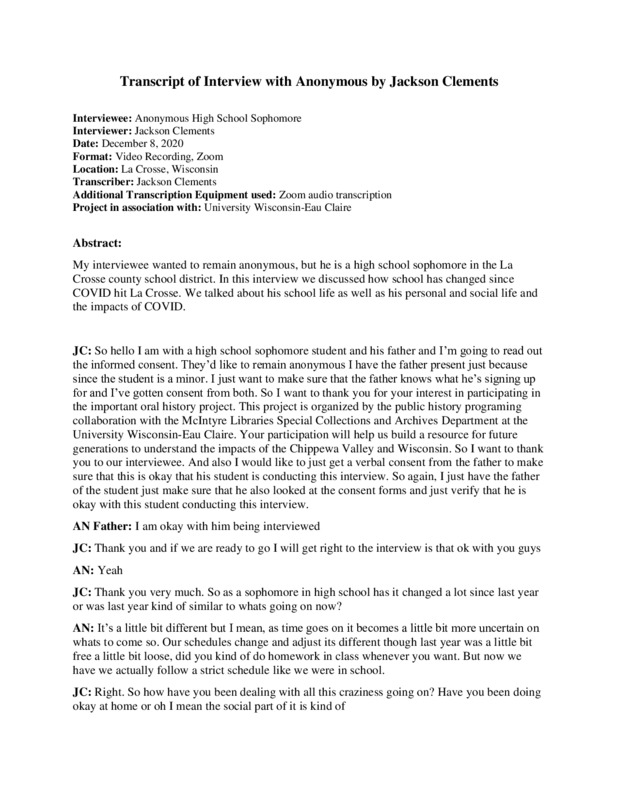 12/08/2020
Anonymous Oral History, 2020/12/08
C19OH -
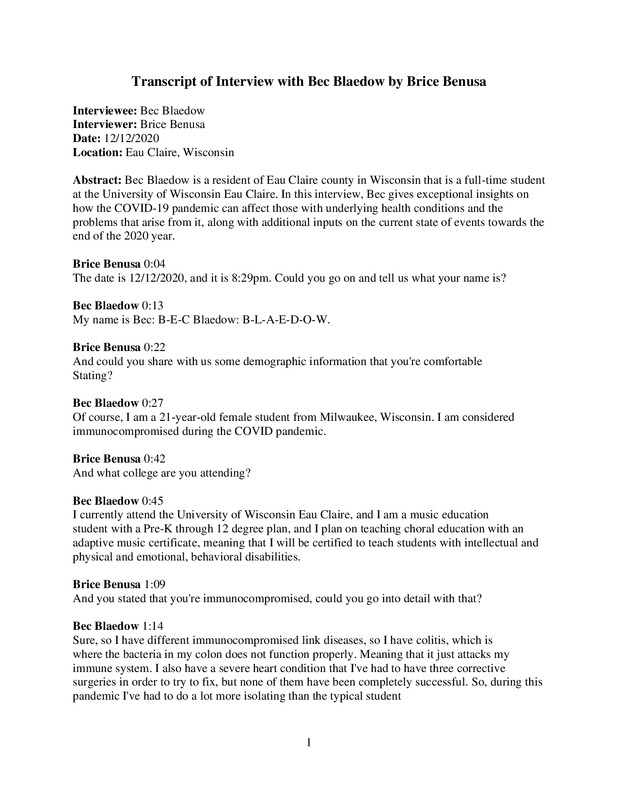 12/17/2020
Bec Blaedow Oral History, 2020/12/07
Bec Blaedow is a resident of Eau Claire county in Wisconsin that is a full-time student at the University of Wisconsin Eau Claire. In this interview, Bec gives exceptional insights on how the COVID-19 pandemic can affect those with underlying health conditions and the problems that arise from it, along with additional inputs on the current state of events towards the end of the 2020 year. -
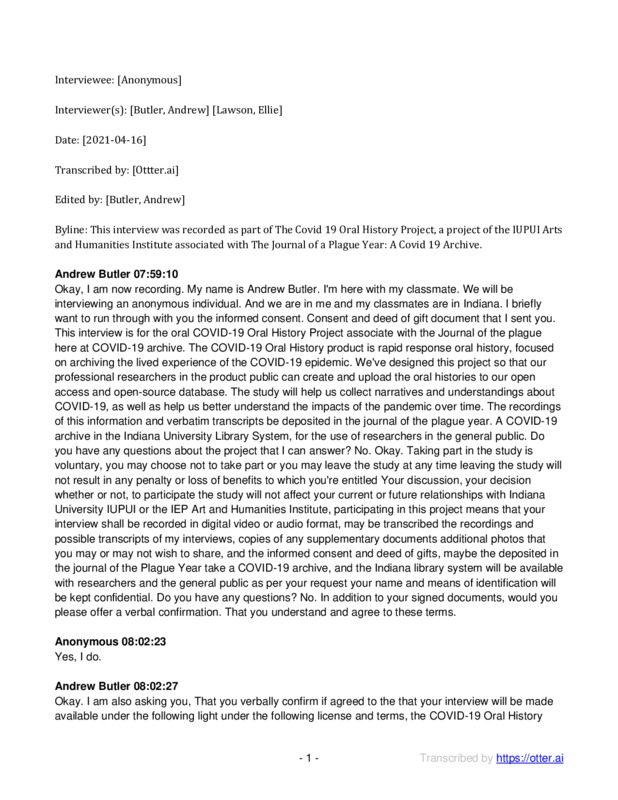 04/30/2021
Anonymous Oral History, 2021/04/16
C19OH -
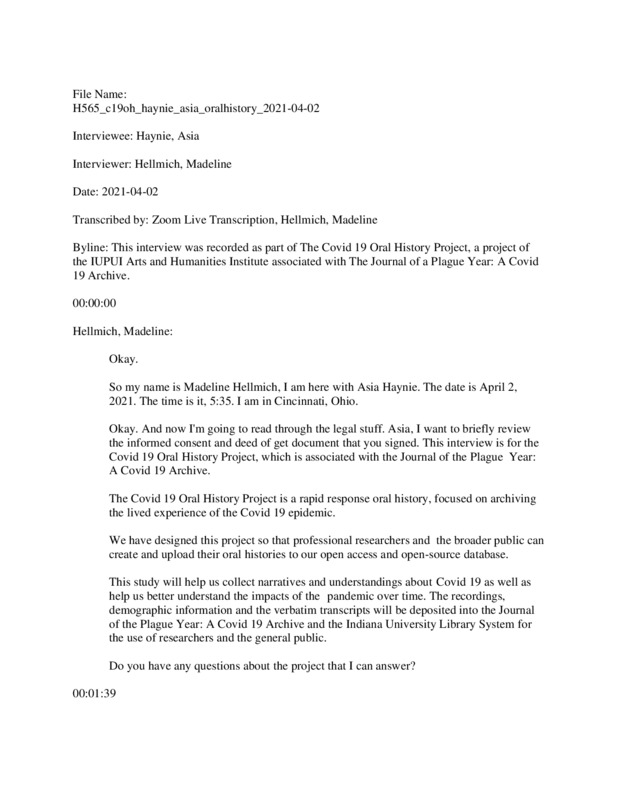 04/06/2021
Asia Haynie Oral History, 2021/04/06
Personal narrative towards understandings about Covid-19 to further the understanding of the impacts of the pandemic over time. -
 12/09/2020
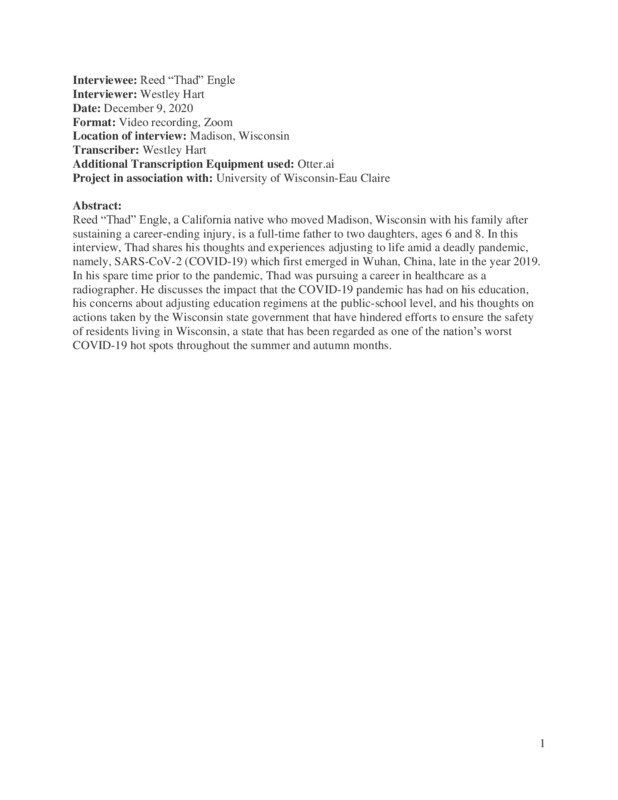
Reed Engle Oral History, 2020/12/09
C19OH -
 04/01/2020
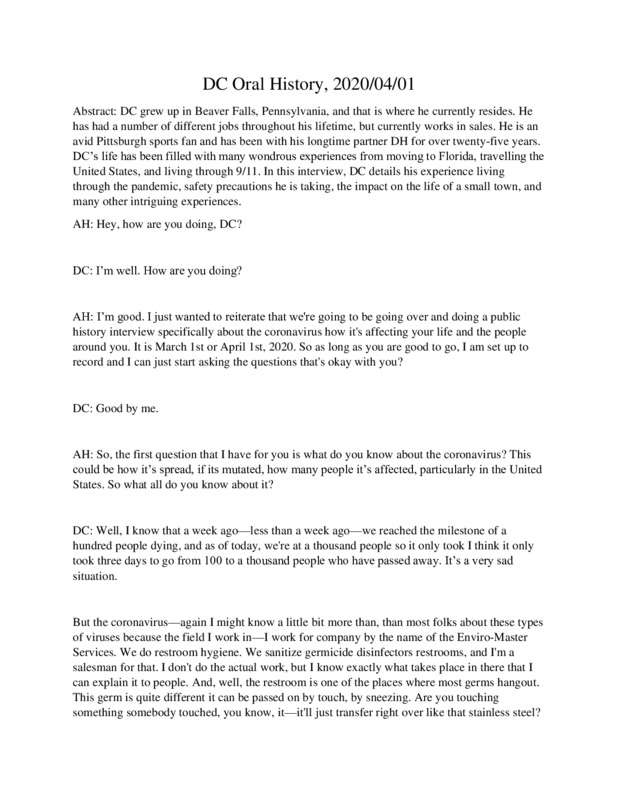
DC Oral History, 2020/04/01
C19OH -
 08/17/2020
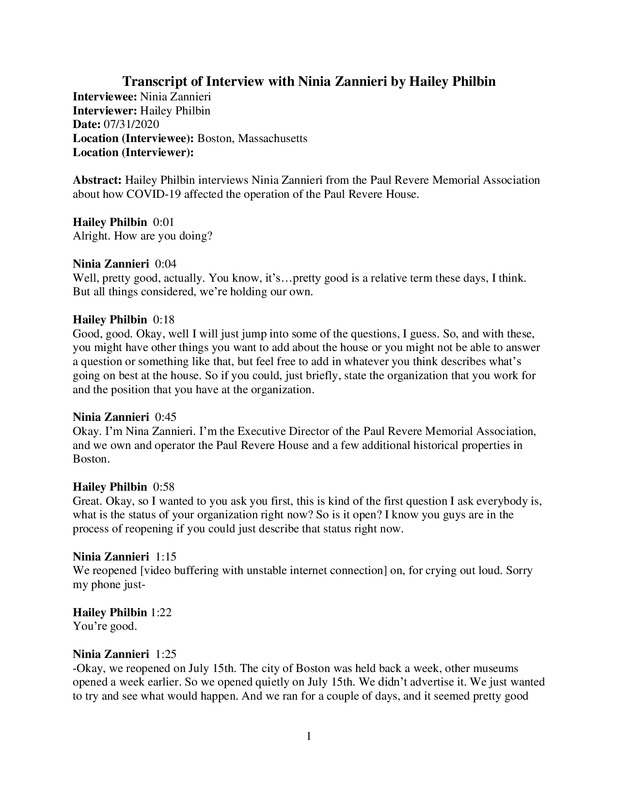
Ninia Zannieri Oral History, 2020/07/31
C19OH -
 05/11/2021
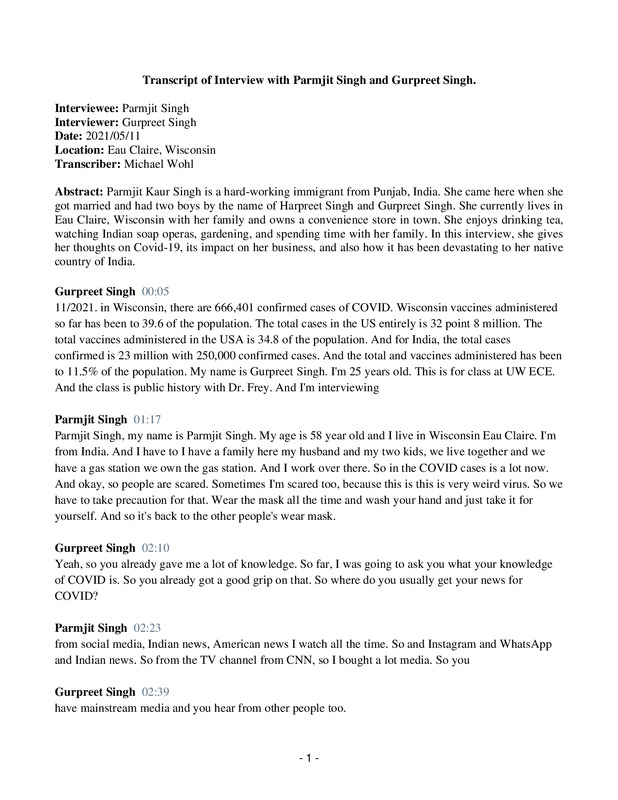
Parmjit Singh Oral History, 2021/05/11
Parmjit Kaur Singh is a hard-working immigrant from Punjab, India. She came here when she got married and had two boys by the name of Harpreet Singh and Gurpreet Singh. She currently lives in Eau Claire, Wisconsin with her family and owns a convenience store in town. She enjoys drinking tea, watching Indian soap operas, gardening, and spending time with her family. In this interview, she gives her thoughts on Covid-19, its impact on her business, and also how it has been devastating to her native country of India. -
 04/24/2021
Zakrzewski Nic, Oral History, 2021/04/24
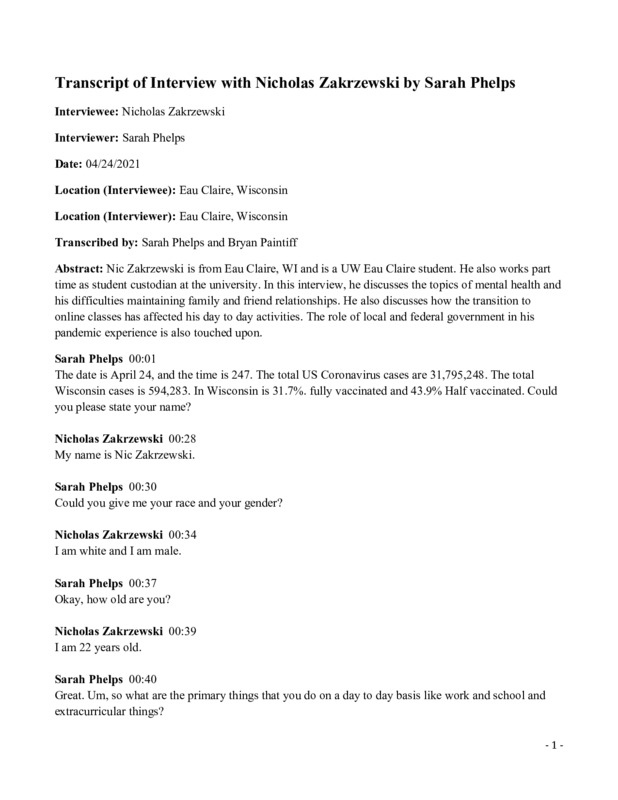
Nic Zakrzewski is from Eau Claire, WI and is a UW Eau Claire student. He also works part time as student custodian at the university. In this interview, he discusses the topics of mental health and his difficulties maintaining family and friend relationships. He also discusses how the transition to online classes has affected his day to day activities. The role of local and federal government in his pandemic experience is also touched upon. -
 04/22/2021
Barbara Hartwick Oral History, 2021/04/22
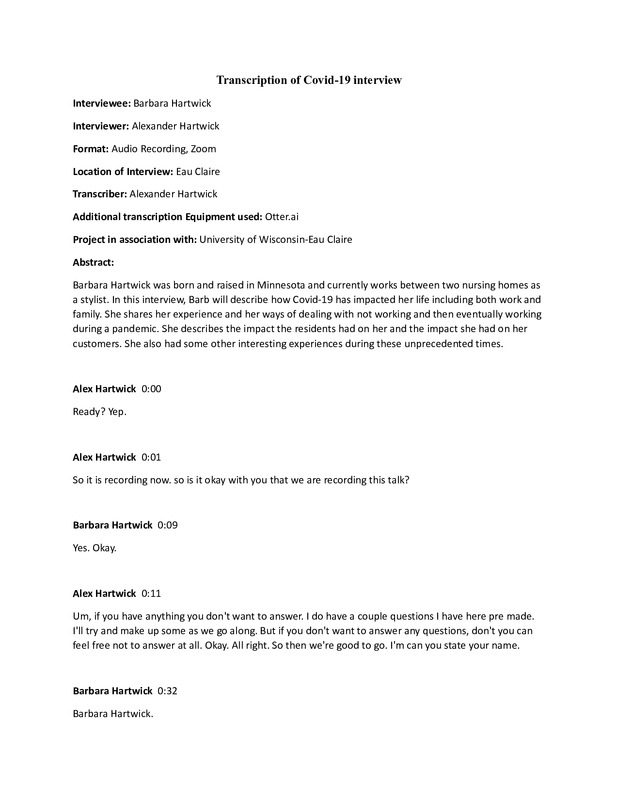
Barbara Hartwick was born and raised in Minnesota and currently works between two nursing homes as a stylist. In this interview, Barb will describe how Covid-19 has impacted her life including both work and family. She shares her experience and her ways of dealing with not working and then eventually working during a pandemic. She describes the impact the residents had on her and the impact she had on her customers. She also had some other interesting experiences during these unprecedented times. -
 04/21/2021
Pa Cha Vang Oral History, 2021/04/21
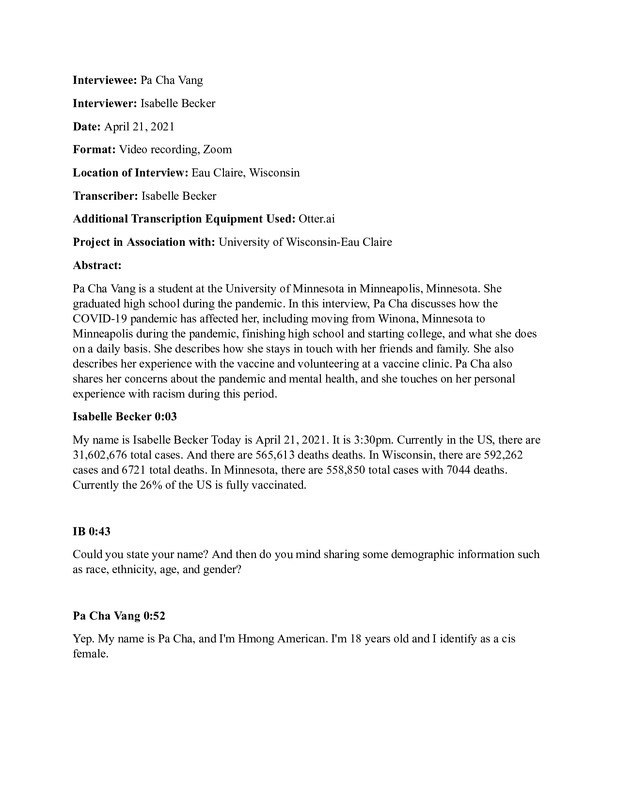
Pa Cha Vang is a student at the University of Minnesota in Minneapolis, Minnesota. She graduated high school during the pandemic. In this interview, Pa Cha discusses how the COVID-19 pandemic has affected her, including moving from Winona, Minnesota to Minneapolis during the pandemic, finishing high school and starting college, and what she does on a daily basis. She describes how she stays in touch with her friends and family. She also describes her experience with the vaccine and volunteering at a vaccine clinic. Pa Cha also shares her concerns about the pandemic and mental health, and she touches on her personal experience with racism during this period. -
 12/08/2020
Jackie Weber Oral History, 2020/12/08
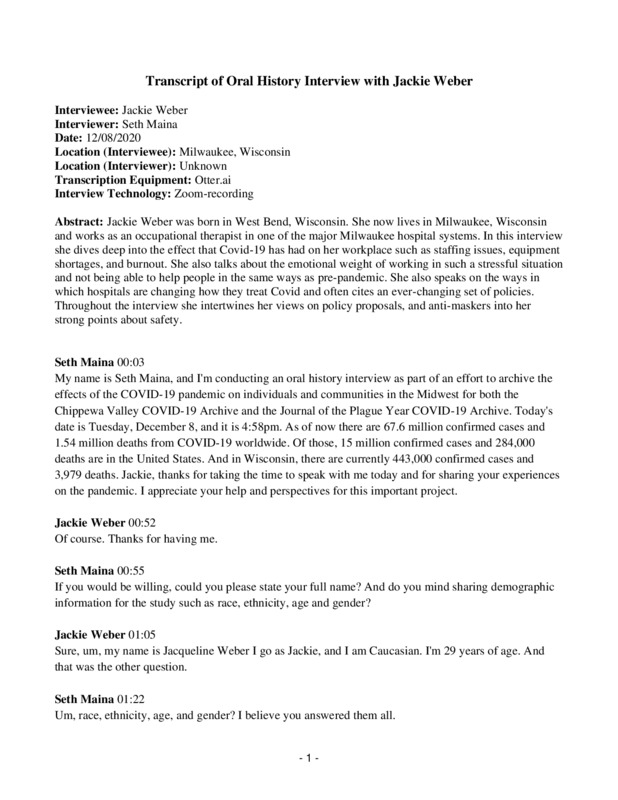
Jackie Weber was born in West Bend, Wisconsin. She now lives in Milwaukee, Wisconsin and works as an occupational therapist in one of the major Milwaukee hospital systems. In this interview she dives deep into the affect that Covid-19 has had on her workplace such as staffing issues, equipment shortages, and burnout. She also talks about the emotional weight of working in such a stressful situation and not being able to help people in the same ways as pre-pandemic. She also speaks on the ways in which hospitals are changing how they treat Covid and often cites an ever-changing set of policies. Throughout the interview she intertwines her views on policy proposals, and anti-maskers into her strong points about safety. -
 2020
2020Cooking During Quarantine
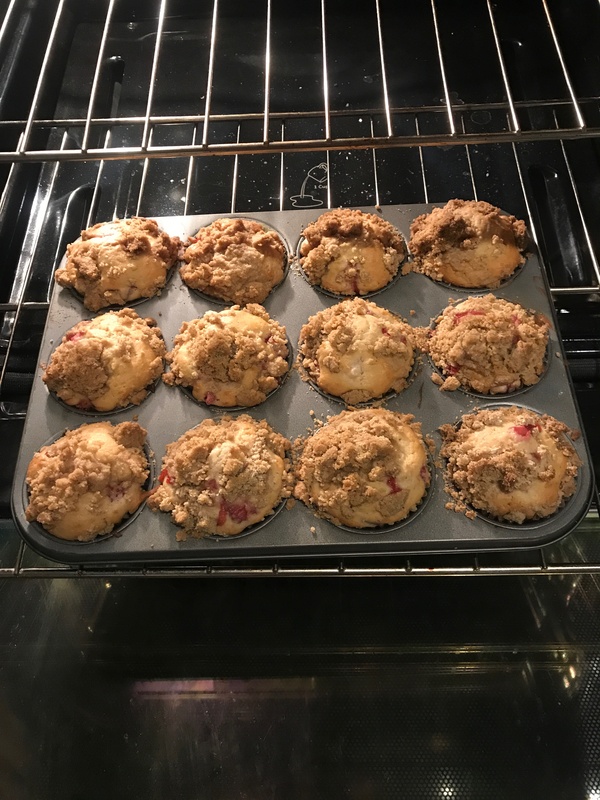
As a 14 year old kid during quarantine, I had not much to do. I was separated from my friends and longing for ways to feel free. At times, I even found myself begging to go into school, wanting to go back to the old world. Now, everyday would be the same routine. I would wake up and get on my zoom class, eat, and repeat. Yet soon, I began cooking. I found a way to connect and find myself through the foods I baked with my family. Now, I cook whenever I can. -
 03/29/2021
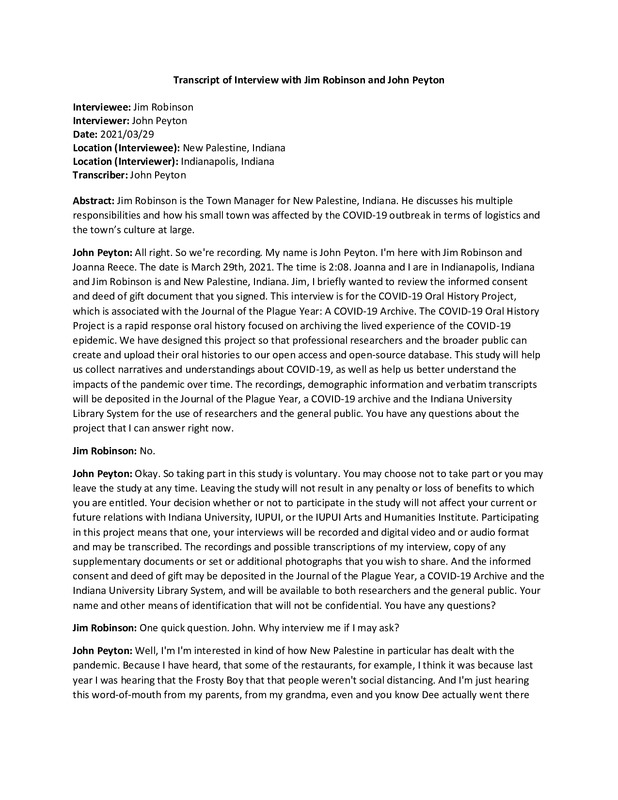
Jim Robinson Oral History, 2021/03/29
-
 09/23/2020
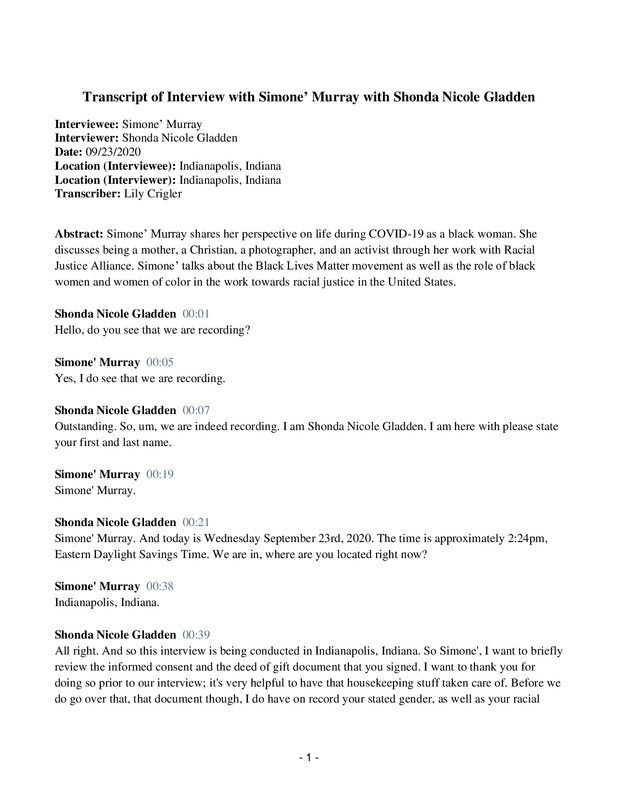
Simone' Murray Oral History, 2020/09/23
-
 04/22/2021
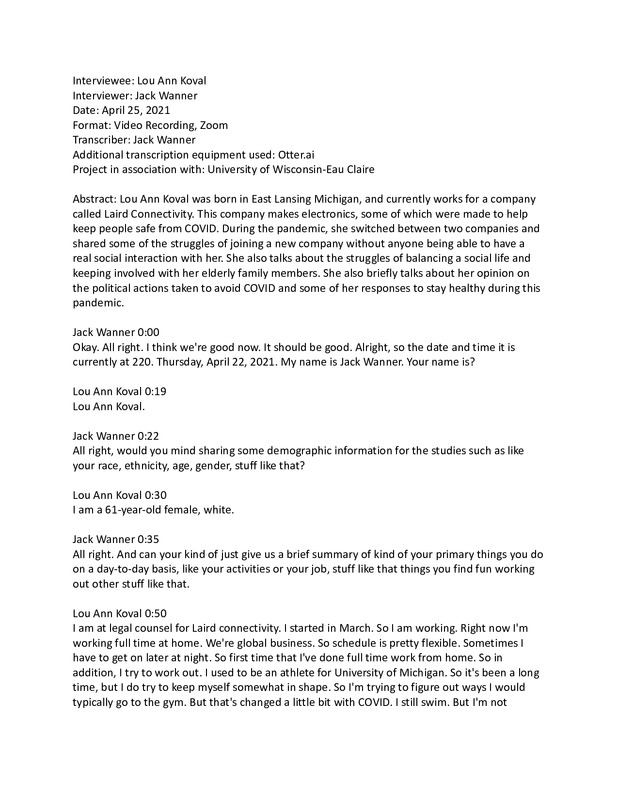
Lou Ann Koval Oral History, 2021/04/22
Lou Ann Koval was born in East Lansing Michigan, and currently works for a company called Laird Connectivity. This company makes electronics, some of which were made to help keep people safe from COVID. During the pandemic, she switched between two companies and shared some of the struggles of joining a new company without anyone being able to have a real social interaction with her. She also talks about the struggles of balancing a social life and keeping involved with her elderly family members. She also briefly talks about her opinion on the political actions taken to avoid COVID and some of her responses to stay healthy during this pandemic. -
 10/14/2020
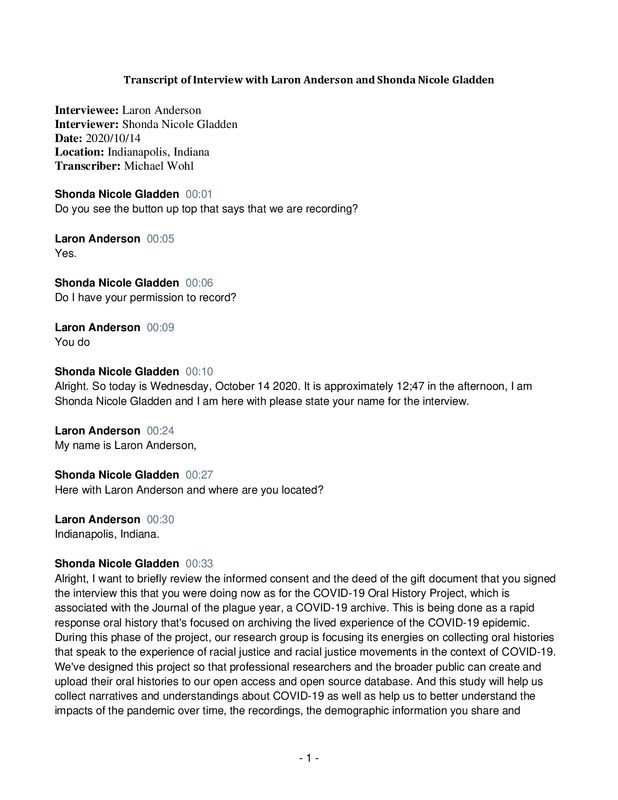
Laron Anderson Oral History, 2020/10/14
-
 10/28/2020
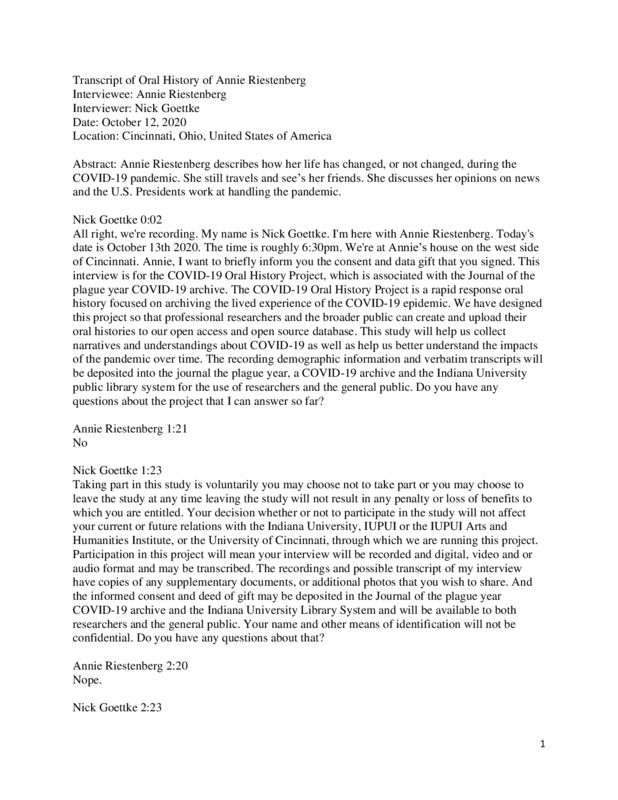
Annie Riestenberg Oral History, 2020/10/28
C19OH -
 10/27/2020
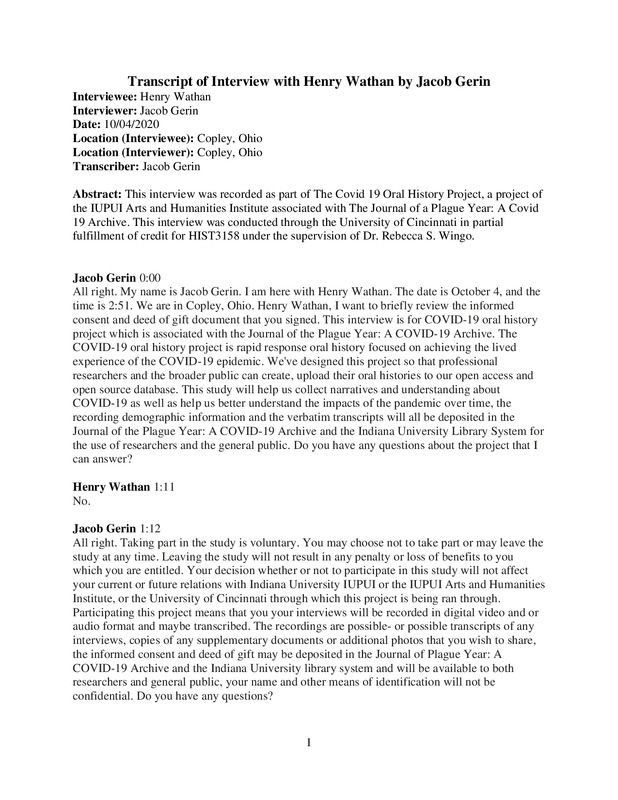
Henry Wathan Oral History, 2020/10/27
This interview was recorded as part of The Covid 19 Oral History Project, a project of the IUPUI Arts and Humanities Institute associated with The Journal of a Plague Year: A Covid 19 Archive. This interview was conducted through the University of Cincinnati in partial fulfillment of credit for HIST3158 under the supervision of Dr. Rebecca S. Wingo. -
2021-12-10
An Instructional Aid's Unusual Everyday Life at an Elementary School in 2021
12/10/21 Once I enter the school, I must be wearing a mask and have cleaned/sanitized my hands. Once I reach my classroom, I see a clean and disinfected classroom. It is part of my job to make sure the students stay in a safe, risk-free environment where they can learn without the fear of transmitting diseases such as COVID. I use special wipes that were given to eveery classroom that is specifically designed to kill germs found in COVID-19 strains when I wipe desks, chairs, toys, books, ect. Pencils have always been kept in the classroom and now, so are lysol spray bottles! When the kids get to class, they must keep their masks on, or they atleast try to. I work with SPED, so it's hard for them to follow this rule consistently for various reasons, i.e., the feeling of the mask might be too much stimulation for them at times. They sanitize their hands before and after each recess, as well as lunch, and when they need to use the restrooms, only two students are permitted in the bathroom at a time. This is to reduce traffic, therefore keeping the children safer from germs and contamination. Lastly, before the students go home, I clean and disinfect everything all over again, for their safety, as well as mine. Being an instructional aid also means being a cleaning nanny! -
 2021-12-10T14:00:00
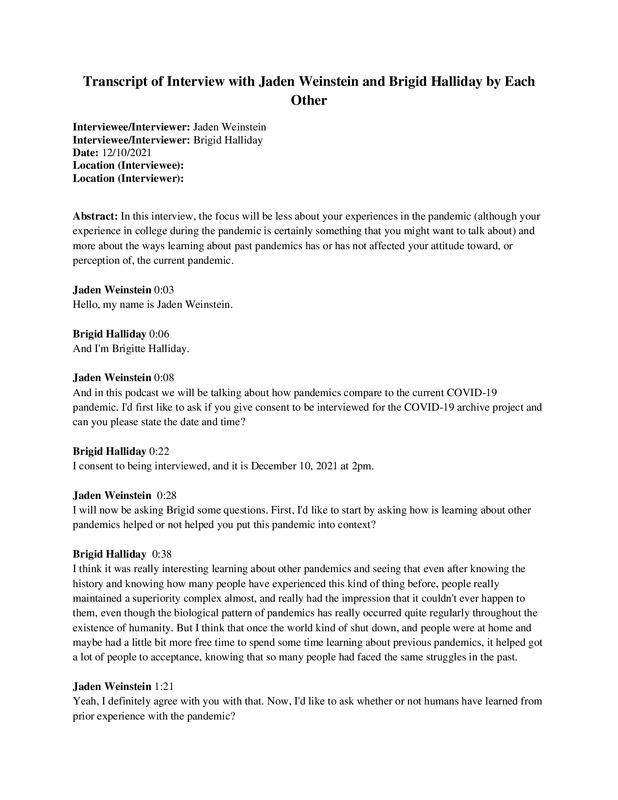
Brigid Halliday And Jaden Weinstein Oral History, 2021/12/10
In this interview, the focus will be less about your experiences in the pandemic (although your experience in college during the pandemic is certainly something that you might want to talk about) and more about the ways learning about past pandemics has or has not affected your attitude toward, or perception of, the current pandemic. -
 03/19/2021
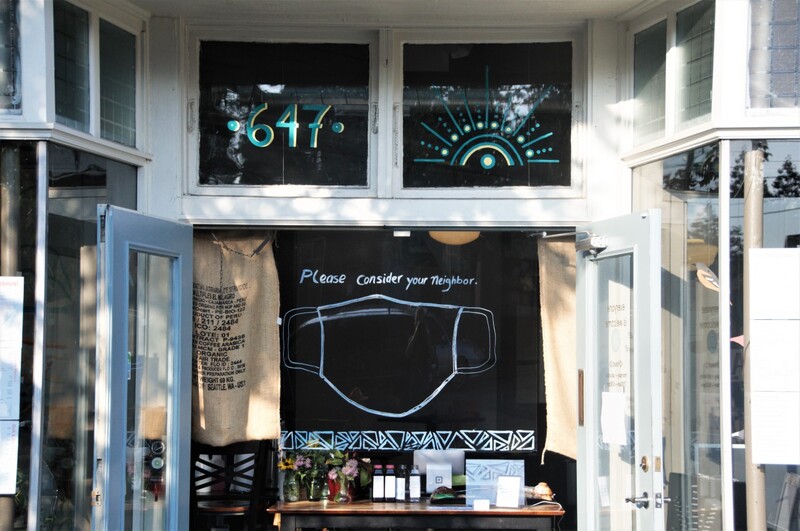
Jeff Litsey Oral History, 2021/03/19
Jeff Litsey is a resident of the Fountain Square Neighborhood in Indianapolis with his wife and two children. Jeff discusses how the pandemic has affected his family life and schedule while also discussing how the neighborhood dynamics have evolved during the pandemic. Jeff talks about the challenges of running a small, locally owned, coffee shop during the pandemic in the Fletcher Place neighborhood of Indianapolis. This includes revenue, business plan evolution, government assistance, adjusting employee’s hours and pay, and helping employees and customers feel safe during the pandemic. He also illustrates how the neighborhood community helped his employees through tips that rolled into a community employee assistance plan. Additionally, Jeff discusses his anxiety that increased during the pandemic from running a business and worrying about how his shop could affect others and himself. This extended to worrying about his family. He discusses how the hobbies of art, hiking, and birdwatching helped him feel better. The interview ends with his hopes for all people to have healthcare and a home. -
 11/30/2020
Brent Lameyer Oral History, 2020/11/30
C19OH -
 2021-12-03
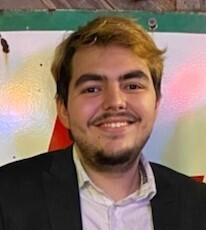
Jorge Martinez Oral History, 2021/12/03
Student Jorge Martinez relates how his experience as a St. Mary's University student living on campus for the first time in Fall 2020 amid the pandemic. Jorge was able to contact the office of student retention and Student Life to support the challenges he was facing during the pandemic. -
 12/09/2020
Chase Auguston Oral History, 2020/12/09
C19OH -
 05/21/2020
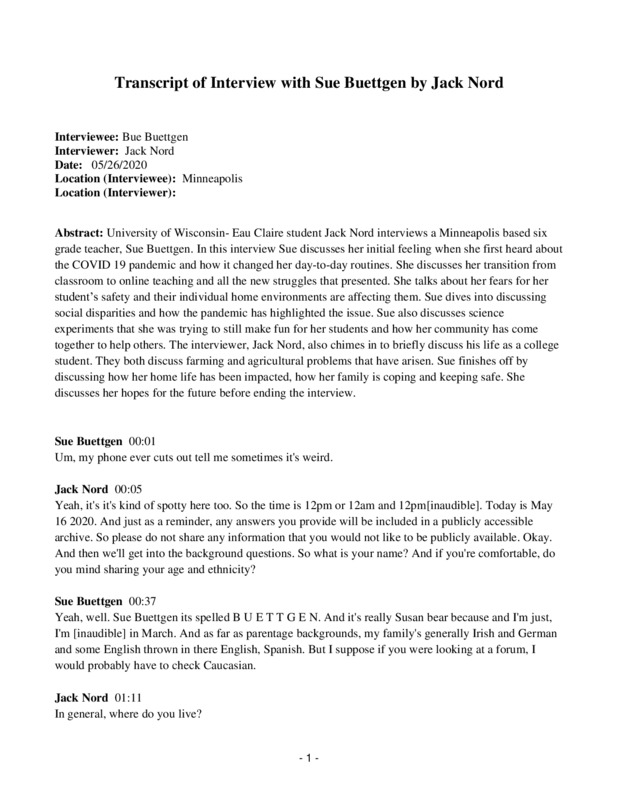
Sue Buettgen Oral History, 2020/05/16
University of Wisconsin- Eau Claire student Jack Nord interviews a Minneapolis-based six-grade teacher, Sue Buettgen. In this interview, Sue discusses her initial feeling when she first heard about the COVID 19 pandemic and how it changed her day-to-day routines. She discusses her transition from classroom to online teaching and all the new struggles that presented. She talks about her fears for her student’s safety and their individual home environments are affecting them. Sue dives into discussing social disparities and how the pandemic has highlighted the issue. Sue also discusses science experiments that she was trying to still make fun for her students and how her community has come together to help others. The interviewer, Jack Nord, also chimes in to briefly discuss his life as a college student. They both discuss farming and agricultural problems that have arisen. Sue finishes off by discussing how her home life has been impacted, how her family is coping and keeping safe. She discusses her hopes for the future before ending the interview. -
 2021-11-29
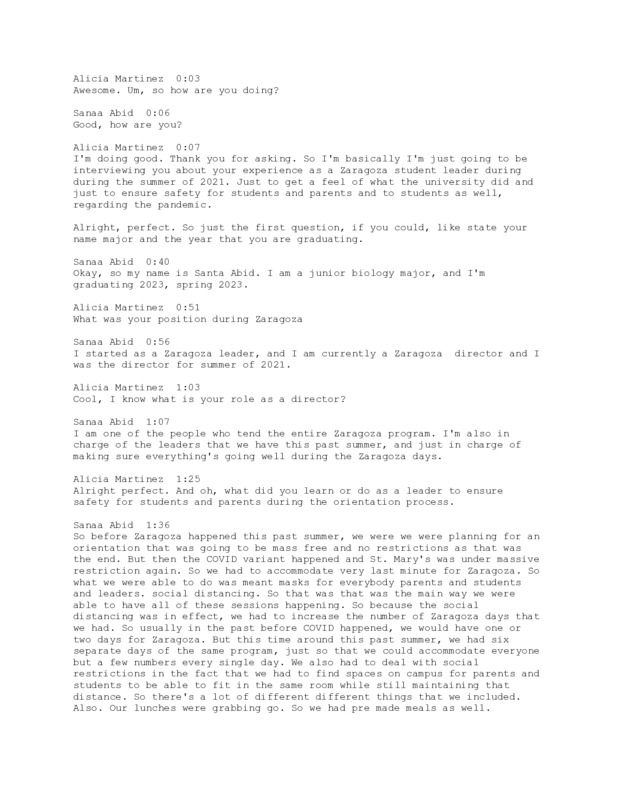
Sanaa Abid Oral History, 2021/11/29
This is an audio interview of Zaragoza director Sanaa Abid. She gave a behind the scenes looks into how the student orientation was organized working with other campus facilities to ensure a safe program for students and parents. She offered insight as her roles from a new student, a student leader, and a student director. From this interview, we are able to gain a better understanding of what the directors did during Zaragoza and how they accommodated to Covid-19. Students were able to still have an experience that allowed them to connect with other students and their families while still having a safe experience. From this interview, we can tell that the St. Mary’s Community came together to understand the different actions that were taken to ensure the program ran smoothly. Furthermore, Sanaa offered her unique experience from attending Zaragoza as a new student prior to Covid, a first time Zaragoza leader during 2020, and finally as Zaragoza Director during the summer of 2021. -
 2021-09-22
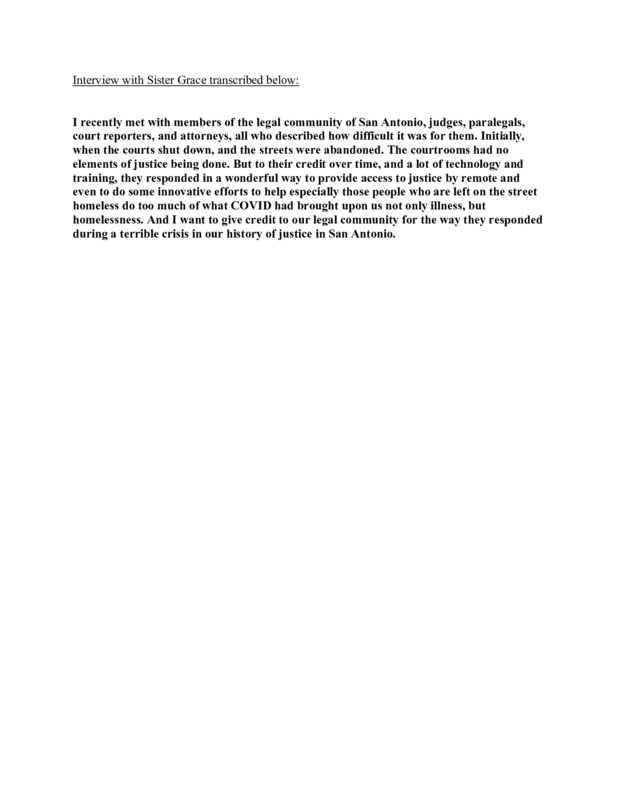
Helping Others during Covid-19 Pandemic
This is an excerpt from a video interview with Sister Grace that I and another student in my class did for a work project. Sister Grace is the Chaplin of the Law School at St. Mary’s University. Sister Grace graduated from St. Mary’s 1978 and worked in the undergrad Ministry and by 1993-94 in Law Ministry. Sister Grace has enjoyed watching students grow and succeed to becoming great people for the community. I used this excerpt because Sister Grace is someone who helps out the students and community and during the pandemic, she met a lot of people that ere going through hard times. Her and the church got together to help distribute food and clothing to the homeless, or whoever needed aid during the pandemic. She wanted to make sure everyone in the community was taken care of. Also, she even talks about how she got plenty of time to do more things during quarantine.