Items
Search full-text
free fc 26 coins ps4 Visit Buyfc26coins.com Zniżki na duże ilości..C10x
-
 2020-05-16
Penguins Visit Kansas City Art Museum During Pandemic
This is an adorable story of 3 penguins named Bubbles, Maggie, and Berkley who were taken on a field trip to the Nelson-Atkins Museum of Art. Since the museum was closed due to the Coronavirus, the penguins had the place to themselves. They walked through the galleries admiring the paintings on the wall. I thought this was so cute and also shows another way that animals are "able" to inhabit environments they normally can't due to the presence of humans. -
 2020-05-30
Summer Time
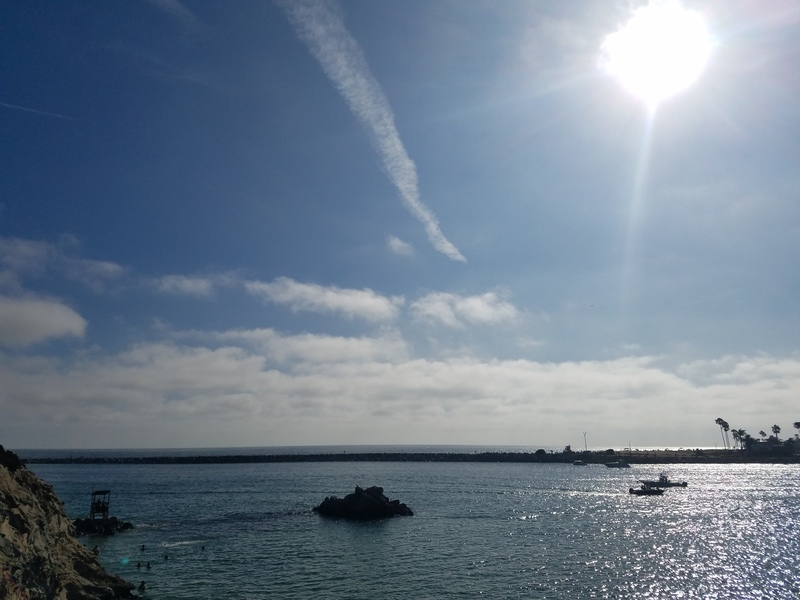
Relatives from Mexico were supposed to visit during the summer since they were finally granted access to visit the United States. Unfortunately, those plans have been canceled and it is truly upsetting. They've never experienced a fun day at the beach due to how they live in the very center of Mexico, the city, and we wanted to make the most out of this opportunity they were given. -
 2020-05-25
A Gift From the Past
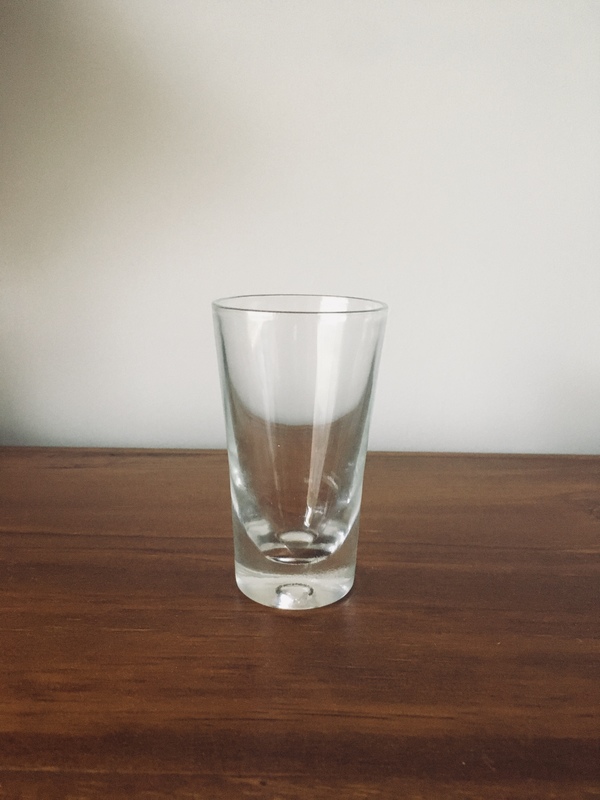
The first person I visited when restrictions in Tasmania were eased the first time was a ninety-year old lady, a family friend and distant relation who knows all the stories everyone else has forgotten. I sat in her house for two and a half hours and listened to her talk about our family and all the people they knew, and I learned about a past that is rapidly disappearing as the people who remember it age. After my visit, she gave this glass to my mother. It was my great-grandfather's preferred glass at the local pub, and was gifted to this woman's husband after he died, as he was a great friend to my great-grandfather. She chose to give it to us thinking it would mean more for us than it does her. I had intended to visit Mrs Howlett for months, but life kept getting in the way. The pandemic afforded me the opportunity to explore my own past and the history of many other people in a way that I usually can't in everyday life, and this glass is a physical, tangible example of that experience. -
2020-04-07
At Least Wear Facemasks
A J-Cast News article on a campaign by Taketomi Island, a small island in southern Japan, to encourage tourists/visitors to at least wear facemasks if they're going to visit the island. This article highlights the difficult position so many places and businesses are in - they need tourists for their economic well-being, but they also need to block the spread of the virus. A dilemma. While many islands are discouraging tourism altogether, Taketomi has apparently decided it's too vital for the economy of the tiny community. -
 2020-04-25
Okinawa: Sorry We Are Closed
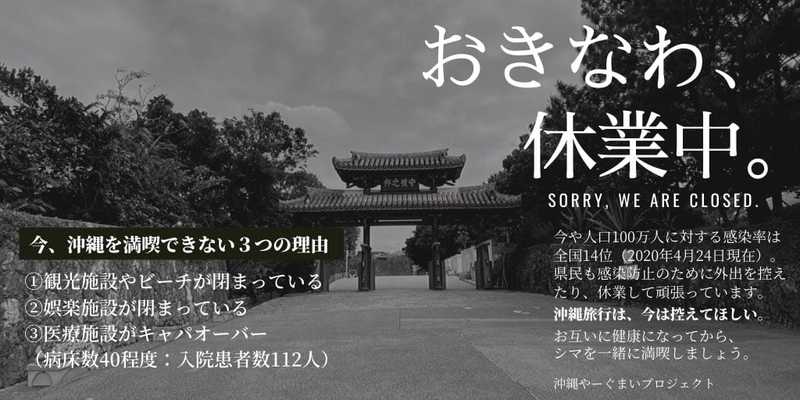
One of a series of digital posters produced by the Save Okinawa Project, depicting sites in Okinawa and encouraging people to not visit the islands right now. It reads: おきなわ、休業中 Sorry, We Are Closed 今や人口100万人に対する感染率は全国14位(2020年4月24日現在)。県民も感染防止のために外出を控えたり、休業して頑張っています。沖縄旅行は、今は控えてほしい。お互いに健康になってから、シマを一緒に満喫しましょう。 今、沖縄を満喫できない3つの理由 1)観光施設やビーチが閉まっている 2)娯楽施設が閉まっている 3)医療施設がキャパオーバー(病床数40程度:入院患者数112人) Okinawa, closed for business right now. Right now, our infection rate per 1 million people is 14th in the country (as of 2020/4/24). Residents of the prefecture are also refraining from going out, shutting down operations, trying hard to prevent the spread of infection. Right now, we want you to refrain from Okinawa travel. Once we both are well, let's fully enjoy the islands. Three reasons you cannot fully enjoy Okinawa right now: 1) tourist sites and beaches are closed 2) entertainment venues are closed 3) medical facilities are over-capacity (112 hospitalized patients for each 40 hospital beds) -
 2020-04-01
“To be honest, it has not affected my faith or belief at all..."
“To be honest, it has not affected my faith or belief at all because I wasn't religious prior to this pandemic so I'm still not. The only time that I did feel the need to pray or have any religious art in my life was when I thought I was sick and I was scared that I might die so I prayed or anytime I start to feel sick and think that I'm getting sick I pray.” -
2020-05-12
UNLV News Story: As COVID-19 Disrupts High School Graduates, Colleges are Ready to Meet Them
Article discussing the struggles of current high school seniors as they plan to enter college. -
 2020-05-01
The Danger of Being Essential
Everyone in the entire world has been affected in one way or another by the pandemic of COVID-19. The rapid spread and contagiousness of the virus has made the spread of the virus virtually impossible to contain, because of this, the virus has gone worldwide in a matter of months and has caused many casualties. My mother is a nurse working on the frontlines, and every day I am afraid for her. My family faces the constant fear of exposure. To protect the rest of the family, my mother has been quarantining herself on one side of the house and has been very careful about keeping clean and using disinfectants. I know that the work my mom does has taken a toll on her mental health lately. She seems more discouraged and less motivated than usual. Part of this is likely her isolation from her family, however, I think that working on the frontlines right now can be very stressful and I know that is it typical to lose faith in modern medicine at a time like this. My mother has mentioned how sad it is to see people on their deathbed, when there is nothing you can do to save them. She told me one of her patients was an elderly man who had no family except for his wife, and he could not contact her, and she could not visit him during his last hours of life. This made me realize how terrifying it can be to have the coronavirus. While I was discussing the virus with my mother, she told me about the supply shortages that many hospitals are experiencing at the moment. The main issue is with ventilators. Many coronavirus patients need to be put on a ventilator to facilitate their recovery, but without these machines, there are many more casualties. There is also a shortage in Tylenol and medical masks. Tylenol is used as a pyretic to reduce fever in patients and reduce pain from the symptoms. Medical masks are needed most in hospital settings because the healthcare providers need to be protected the most. Everyday Healthcare workers put their lives on the line by going to work and treating coronavirus patients, and every day they are helping to improve the statistics of the coronavirus pandemic. I worry for my mother every time she goes to work and pray that she stays safe and healthy despite the factors not in her favor. -
 2020-04-22
A Letter from 4-year-old Hattie to her Great Aunt, New Orleans, LA
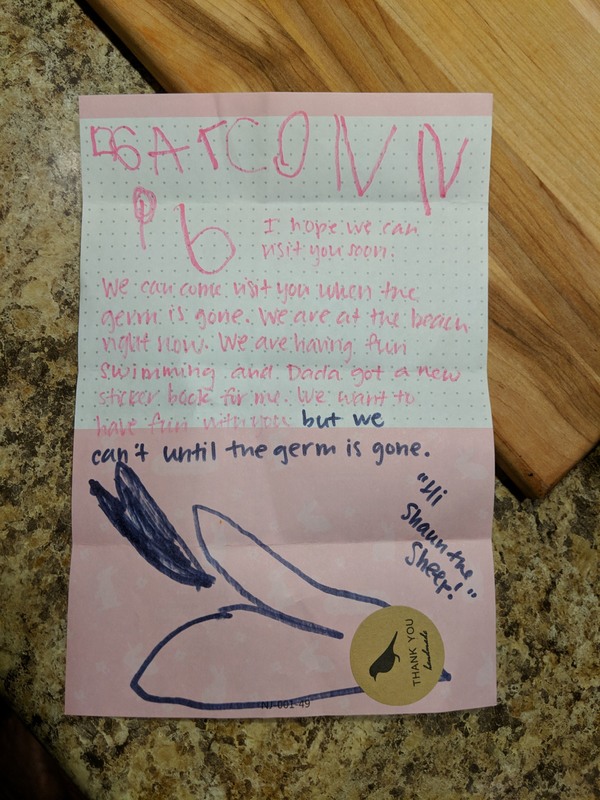
A letter from 4-year-old Hattie Jane Parker of Josephine, Alabama, dictated to her mother, to her 73-year-old great aunt in New Orleans, LA. The letter reads: "I hope we can visit you soon. We can come visit you when the germ is gone. We are at the beach right now. We are having fun swimming and Dada got a new sticker book for me, We want to have fun with you but we can't until the germ is gone. 'Hi Shaun the Sheep!'" -
 2020-04-17
Can't Be There
Reflection about not being able to visit relatives during the COVID-19 pandemic. -
 2020-04-11
I Just Want A Hug
I just want a hug. Nothing means more to me right now in the time of crisis than a hug. I am not much of a hugger. By me saying that I want a hug, that must mean something. It is strange to go visit your family and having to stay more than 6 feet away from them. Overnight we went from being able to hang out with our elderly family members to now not being able to hug them. I miss hearing my great-aunt say, “Give me some sugar” when she wants a hug. I miss being able to see my extended family. I miss being able to go over and hear stories about their life. I feel that the coronavirus has taken time away from that! I just want to shop. I want to be able to go to the store without just going to get groceries. It happened overnight. I miss being able to shop. I don't even want to buy anything. I just want to go look. I have only been able to shop online. I will not buy anything online, but it’s nice to know that if I ever wanted to buy a $100 blanket, I know where to find one. I want to go to Ross and Goodwill. I mis being able to just walk in the malls. It has been a month! It may not sound like a long time, or like I have an addiction, but trust me, it is hard when your life comes to a halting stop. Not shopping with friends is hard. We would go at least once a month. We just shopped to shop. Sometimes we went shopping for my apartment or for clothes, but now we can't do that. Before the quarantine, I would hang out with my friends at least once a week. Now we have not physically hung out for a month, which has been very hard. -
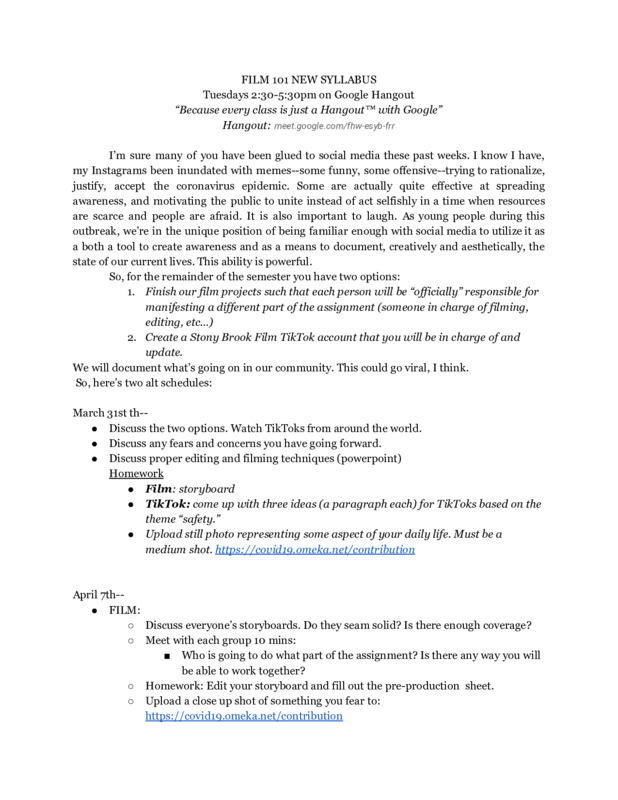 Class starts Tuesday March 31st at 2:30 pm
Stony Brook Film Post Corona Film 101 Syllabus
A syllabus created for the second half of the semester after class has become digital. -
 2020-03-26
UCLA Health announces increase in COVID-19 tests to more than 500 per day
More than 3 weeks after the first confirmed case of coronavirus in Los Angeles County, health care systems are still struggling to provide testing in sufficient numbers . -
2002-06-22
The Most Magical Place on Earth to get COVID
Disney has always been a big deal for my family. When I was a kid, we lived near Disneyland and my grandmother on my dad's side was a huge Disney fan. We would go about once a year, or so, when we lived in Southern California, and my grandmother always had a huge collection of Disney movies for the grandkids to watch. She would also give everyone in the family a Hallmark ornament at Christmastime that was Disney branded. When my wife and I got married in 2010, my parents gave us a 5 day Disneyland trip for our honeymoon. Since that time, my wife and I (and our kids), have made Disneyland a priority and we visit at least once or twice a year since 2013. We even had an annual pass one year, and made a monthly trip to Disneyland that year. When the COVID-19 pandemic hit and the world shut down in March of 2020, that hit us hard. I'm severely immunocompromised, and the idea of being out in public scared me to the point of developing agoraphobia during the lockdown. During Quarantine, from February 2020 to August 2021, I did not leave my house - even to go to the grocery store. I was lucky enough to be able to work from home during that time, but I became a recluse and a shut-in. My social anxiety climbed through the roof, and the thought of being among people was so frightening to me, because I'm prone to getting sick, and I was terrified that if I caught COVID I would be one of the unlucky ones. During that time, in December of 2020, my wife's grandfather caught the virus during a family get-together for Thanksgiving (which I had politely but firmly declined to attend) and ended up passing away because of it, so my fears were not unreasonable. In the summer of 2021, COVID travel restricitions were lifted, and our work from home season ended. I returned back to teaching on campus, (everyone was in masks), and I slowly but surely reacclimated to society. Disney reopened their gates (with masks and restricitions) and our family was itching to return. My parents had recently sold their house in Southern California and moved back to Stockton to be closer to us, and now that travel restrictions were easing back they wanted to take us on a summer trip in 2022 to Disney World in Orlando, Florida. I was put in charge of doing all the booking and the planning, and so I decided that it was time to face my fears and plan a trip worth remembering. I set up a 2 week stay in the Disney World hotels, 10 days at Disney World, and 1 day at Universal Studios with a VIP tour of that park. I wanted to really give my family a trip they would never forget, while also keeping in mind that I was largely uncomfortable with being in public. June of 2022, our trip to Disney World - The Most Magical Place on Earth - began. We stayed at the Art of Animation hotel in Disney World, at the Cars themed wing of the hotel. The trip started out with my dad getting a bug on the flight that had him drained for the first couple of days. We spent our first 4 days at the different Disney World theme parks, getting to see and do and ride as much as we wanted. Because travel restrictions and masks had only recently been lifted, the parks were not at full capacity and it was easy to get to experience everything the parks had to offer without being overly crowded and sparking off my social anxieties. On day 6 we visited Universal Studios. My dad was feeling better, and the VIP tour was incredible. We got to see and experience so many cool things during that tour, and it was great to be taken to the front of the line for all the rides we wanted to go on. All in all, it was a great time. Two days later, day 8 of 14 in Florida, I came down with COVID (for the third time). I spent the whole second week quarantined in the hotel room, while my family (who was not sick or showing any symptoms) enjoyed the rest of the trip. Funnily enough, my catching COVID did not negatively impact the trip at all. On day 6 the hotel informed us that the Cars wing was being remodeled and we were given the option of remaining in that part of the hotel or relocating to a different wing with the rest of their guests. We chose to remain in the Cars wing, because we enjoyed the theme, and it ended up being that we were the only family left in that part of the hotel while I was sick with COVID. No risk of contaminating or infecting anyone else. My family was all fine, and got to enjoy the rest of the trip. I ended up being symptom free on the last day we had in the parks, and got to enjoy EPCOT one last time (masked and medicated). The trip was overall a success, and my family got to enjoy something we'd never been able to experience before and likely never will again. We're Disneyland people, through and through, and Disney World was great but there's no park like home. Since that trip, we've made several more trips to Disneyland, taking advantage of every school break we could. But that first trip after COVID restrictions were lifted was an incredible time, even though I spent nearly half of it by myself. -
 2021-10-30
Traveling Behind the Mask: Post-COVID Trip to the Louvre
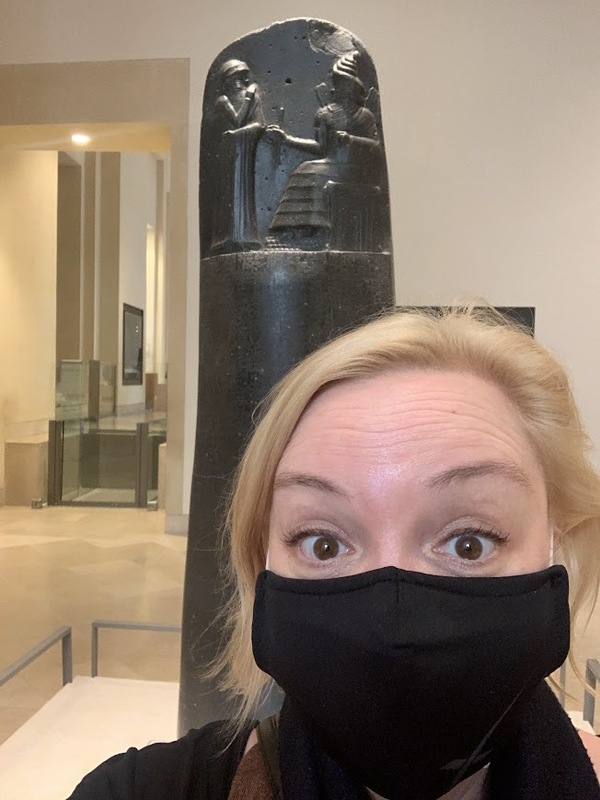
During the COVID-19 pandemic, I found myself working from home for over a year. Our area and friends were extremely cautious about public health (Southern California), so we didn't explore international travel until after we were fully vaccinated in summer of 2021. In the fall of that year, we visited Paris for the first time and went to the Louvre. During the 1+ year on self-imposed house arrest, I needed something to keep my mind busy. I took a number of online classes about Ancient Egypt, Greece, and Mesopotamia, historical subjects that I've always returned to whenever I had time in life. But given the frankly unimaginable amount of free time I had in 2020, I delved in further than ever, and even managed to teach myself hieroglyphics. By the time we could travel, a first visit to the Louvre seemed like the ideal place to experience some of this new knowledge first-hand. In these photos, I'm in front of the Law Code of Hammurabi and a bust of Akhenaten, one of Egypt's more fascinating pharoahs. We had to show proof of vaccination to travel as well as enter the museum, and masks were required at all times. One of my favorite things about these photos is someone trying to express a lifetime's worth of excitement using one's eyes only. I look insane. But the experience truly was important to me and now serves as a snapshot of post-pandemic travel and life. -
0012-03-20
The Day the World Changed
On March 12th, 2020, I found out the fate of the remainder of my first spring semester as a college student. I don’t remember much about days during quarantine, but I do remember specific details of this day. It was the week before Spring Break for UAB, and all students were preparing for a week off from school. That weekend, my family was planning a trip to New Orleans for the weekend as my mother’s employer offered her a free two-night stay at any hotel of her choosing. My dad and I were planning to finally visit the National World War Two Museum. As my friend and I were walking to dinner at a local poke place in Five Points South, I received my first email that my English class would remain virtual for the remainder of the semester. My professor had Type 1 Diabetes and did not want to risk his health. Shortly after, the entire student body of UAB received an email that students would not return to campus until April 1st, 2020, at the earliest. While some students decided to pack up all of their belongings and take them home with them, others truly believed we would be coming back on April 1st. I decided not to take my belongings with me and traveled four hours to my hometown for the extended break. I went home that Friday, March 13th, 2020, after taking my midterm for Biological Anthropology. Once I arrived home, my parents made the decision to cancel our trip as the spread of COVID-19 was unknown at this time, and they did not want to risk going to a public and crowded place like New Orleans. Instead, my father and I traveled four hours back to Birmingham to pack up my dorm room and bring my belongings home. At this time UAB had completely shut down and was limiting access to campus and the dorms. They only allowed me 15 minutes to get any belongings needed. After that trip, UAB officially closed for the remainder of the term and students belongings were moved out of the dorms by moving companies to make room for healthcare workers. We did not get the chance to go on our New Orleans trip until over two years later, in 2022. I planned a big trip for my 21st birthday with my friends and family. While most restrictions have been lifted, people were still wearing masks, and businesses were still enforcing the three- to six-foot social distancing. I wasn’t surprised, as just earlier in the year, my employer required face masks for the spike in COVID cases in Birmingham. I remember going to restaurants and we were required to wait outside for our table. In the National World War Two museum, there were stickers on the floor that represented how far we should stand from each other. While many of the restrictions, including the social distancing and wearing a mask, had been lifted, it was nice to see that people were still making it a point to follow them for the safety of themselves and others. -
2021-03-11
Missouri Travels A Year After COVID
In 2020, the COVID-19 pandemic shut everything down, and the world went into a global lock down. A year later, restrictions started being lifted and my mother and I traveled to Osage Beach Missouri, as well as the surrounding areas. Because Osage Beach was a tourist town on a lake most of the local attractions were closed due to it being the off season. It was March of 2021. Previously, my family had loved going to Missouri, but always had gone to Branson. We chose Osage Beach, however, because we could get free accommodations through my parents timeshare points. The day I remember most of the trip was traveling to St. Louis, Missouri to visit the St. Louis Zoo. The day before going we had to book a time slot in order to reduce our chances of being exposed to COVID and in order for the zoo to know approximately how many people were there. We did not have to wear medical masks outdoors, since we were fully vaccinated, but when in areas like the gift shop or some dining facilities we had to wear masks. If a zoo worker asked to see our COVID vaccine cards we had to show them or put on masks. After visiting the zoo, my mom and I went to a local pizza pub in Osage Beach that had St. Louis style pizzas. They were not as concerned about the COVID regulations and did not enforce any mask or social distancing policies that the St. Louis Zoo had. This was a theme of Missouri restrictions as I saw when I toured the Missouri State Penitentiary in Jefferson City. There I was not required to wear a mask or social distance, but group numbers were limited and reservations had to be made. Luckily my mother and I did not get COVID during the trip, but after a year of lock down and restrictions, the few restrictions still in place felt like a culture shock, even though I still lived in Texas at the time. -
 04/17/2020
Judy Byron Oral History, 2020/04/17
-
 12/29/2021
Scott Koran Oral History, 2021/12/29
Scott Koran was born and raised in Marshfield, Wisconsin, and works at Rogers Cinema as its CEO. Over the course of this interview, Scott Koran details the difficulties of running his family business during the pandemic including its effect on his life, his family, and on the overall local community. He discusses the difficulties of closing down his theaters and moving perishable food items from all his locals to a central location. Scott explains his attempt to pay the bills by running the popular curbside popcorn sales at his Marshfield theater location. He shares what the situation in his local community is like and allows people are reacting to Covid-19 safety measures created by local businesses. At the end of this interview, he discusses the uncertainty of the future and how the media and health organizations have been sending out conflicting and confusing messages regarding the disease. -
 11/27/2021
Terry Ehle Oral History, 2021/11/27
Terry Ehle lives in Two Rivers, Wisconsin with her husband, three daughters, and two foster boys. She works as a librarian at the local public library. In this interview, Terry discusses the struggles she faces during the COVID pandemic trying to juggle such a large family and their many extra-curricular activities. Her daughters are involved in musical theater, sports, and international travel- all of which have been impacted by COVID. She struggles to manage all of these different activities together, all while trying to be a good mother and a good employee. Because of her situation, she has had to take a lot of time off of work and has found herself working many nights and weekends to make up for the lost time. -
 2021-04-12
21st Birthday Trip, Post-Pandemic
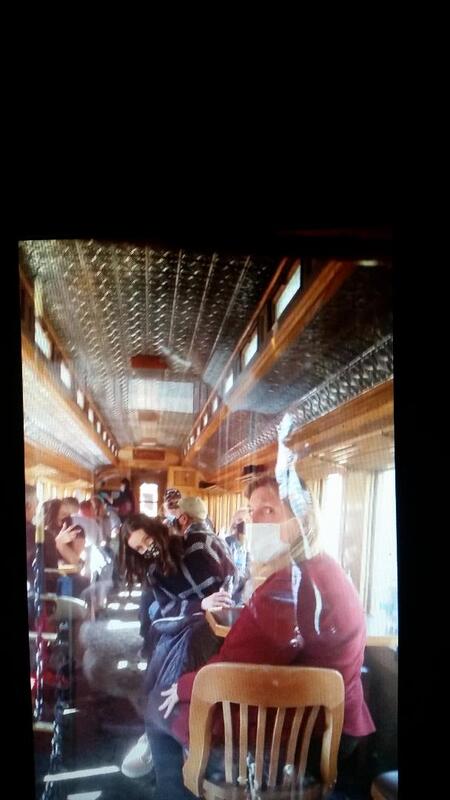
My twin sister and I turned 20 right after the beginning of the pandemic in April 2020. That birthday was a gigantic bummer, because all my friends had left my college campus and I was still there but couldn't visit home either due to Covid concerns (my parents are in their 60's and my sister has asthma). So, after a year of not traveling or doing very much else, my first post-covid trip was for my 21st birthday. Not yet ready to get back on airplanes but wanting to do something exciting, my mom, dad, sister, and I packed into the van for an 8-hour drive across Colorado to an Airbnb in Durango, near the southwest corner of the state. Durango is a cute little tourist town that's still sleepy from winter in April, and definitely non-traditional for a 21st birthday bash. We had two objectives for the trip: Mom and Dad were going to buy us our first (legal) alcoholic beverages, and we were going to take a ride on the narrow-gauge railroad that ran from Durango to the nearby tourist/old mining town of Silverton. The first goal was accomplished quickly upon our arrival; we located the old Strater hotel, built in 1887, complete with a bar where we immediately situated ourselves. The servers were dressed like flappers, all wearing masks, many matching the colorful fringes of their dresses. I ordered an old fashioned, was tipsy after half, and handed it off to my mom to finish. My dad had a great time shepherding us back to the van. The train ride the next day was the highlight of the trip. We bought tickets in advance, since only a limited number of seats could be filled in each car due to lingering covid precautions. Masks were also still required, except when eating and drinking (a full bar was available, as well as coffee and pastries). The train crept up into the mountains alongside a river, sometimes crossing over very tall trestle bridges, prompting my mom, who's afraid of heights, to pull her mask up over her eyes. Lunch, which was previously served on the train, was instead provided to us in pre-packaged boxes, to be eaten outside at picnic tables along the river where we were free to spread out and remove our masks. On the ride back to Durango, the full bar on the train was open, and most masks came off. My parents bought my sister and I our second drinks of being 21 (mimosas at 3:30pm, woo!) and we headed back to the Airbnb, stopping to pick up some Serious Texas Barbecue. While Covid ruined my plans for the 21st birthday party I thought I would have, it gave me a few years to slow down and to appreciate my family and small, meaningful, gatherings together, which I wouldn't trade for the wildest party in the world. -
 2022-10-30
Silenced voices of the commoner
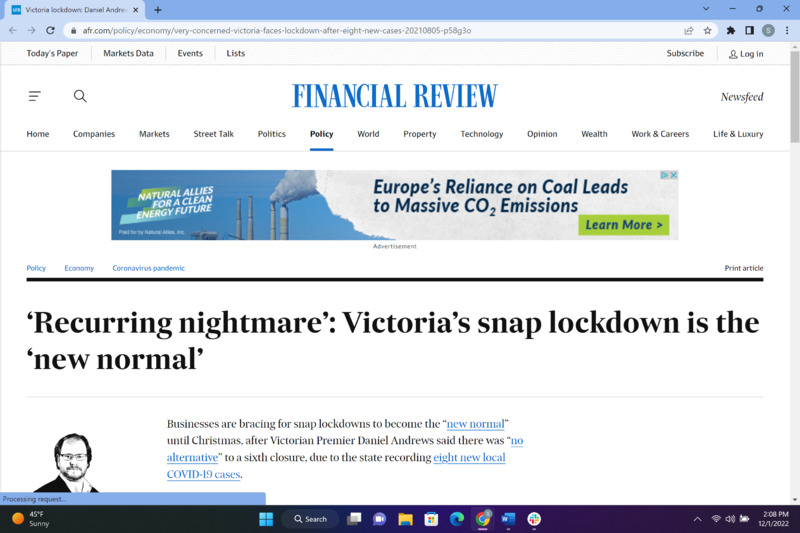
The recent Covid-19 pandemic has had immense local and global ramifications, especially for us Victorians who have experienced the world’s longest lockdowns. It was a significant worldwide event which will certainly be looked back upon by future generations, just as we have analysed previous historical diseases, such as the bubonic plague. But how should archivists determine which sources, and likewise which voices should be permanently preserved within the historical record? Traditionally, an archive is a collection of documents that archivists have selected to be permanently preserved as sources for future historical or other forms of research. Initially, only scholars with an ambition to conduct historical research had access to archives, but their digitisation and free nature have ensured that anyone is able to access the documents they contain online. However, the process of creating both physical and digital archives is inherently flawed. Archivists have a formidable power to evaluate which sources are “worthy of inclusion”, and simultaneously which ones are not; essentially what compromises the historical record. Therefore, although archivists are characterised as unbiased and impartial individuals, they are inextricably influenced by “societal biases” in their decision-making, as they simply have to select what they personally believe will have value to future researchers. It has culminated in them privileging and prioritising the voices of individuals within positions power, which has indefinitely created “gaps within the historical record” through inhibiting the voices of those without it. Rodney G.S. Carter echoes the problem in asserting that the existence of archival “silences” is the “manifestation of the actions of the powerful”, which has a substantial impact on how marginalised groups produce and likewise form both social history and memory. Ariella Aïsha Azoulay has cautioned readers that “digital archives are no exception”. With this in mind, if we consider the 19-month impact of the pandemic upon Victoria, I am certain that archivists will acknowledge the voices of those within positions of power when determining what sources should be preserved. Of particular importance would be those of primary actors that shaped Victoria’s lockdown experience, most importantly the protagonist of the lockdowns, Premier Daniel Andrews (fig.1). Figure 1. Video of Premier announcing sixth lockdown, cited in Patrick Durkin, “’Recuring nightmare’: Victoria’s snap lockdown is the ‘new normal,’” Financial Review, August 5, 2021, URL: https://www.afr.com/policy/economy/very-concerned-victoria-faces-lockdown-after-eight-new-cases-20210805-p58g3o. I am aware of the threat of “information overload” both real and digital archives currently face with an abundance of available sources, but I would argue that the preservation of major political statements alongside previously supressed voices would be beneficial to any archive created surrounding the Victorian Covid-19 experience. A consideration of the experiences of marginalised voices would be imperative to a future historian, as it would enrich historiography by offering insight into the social-political dynamics of the event, and its psychological impact beyond official government and political documents. I will now consider the value of this “bottom-up approach” in capturing the Victorian pandemic experience from the viewpoint of the common man, me, a historically marginalised group within the realm of archives. I personally wasn’t too concerned about the first lockdown and its stage three and four restrictions as they would “flatten the curve” of infectious cases, providing our health system with the best opportunity to tackle the fast-spreading virus. Life as we know it changed though with only four reasons to leave home; shopping, exercise, caregiving, and work. The café I worked at had to shift to “take away only”, as many others (fig.2). Figure 2. The Food Republic Café, “covid update for customers,” Blackburn, March 23, 2020, URL: https://www.facebook.com/thefoodrepubliccafe. I was still able to work alongside my barista colleague and friend Max which was pretty good, and I was able to perfect my coffee artwork (fig.3). Figure 3. The Food Republic Café, “promotional post during lockdown 1” Blackburn, April 8, 2020, URL: https://www.facebook.com/thefoodrepubliccafe. I was also able to continue exercising and riding my bike, but I wasn’t able to see or visit any friends or family, which initially seemed like a fair sacrifice to make for the health and wellbeing of all Victorians (fig.4). Figure 4. George Vesnaver, Selfie on bike ride, April 10, 2020, photograph, Main Yarra Trail, Melbourne. However, after being continuously plunged in and out of lockdowns by the time the sixth one came about, I was very angry to say the least as representative within my covid journal entry (fig. 5). Figure 5. George Vesnaver, Covid Journal Entry, October 27, 2022, photograph, Kew East, Melbourne. Laura A. Millar’s observation that “the concept of evidence” must be broadened as opposed to its current restrictive and rigid format adopted by archivists has reaffirmed my belief that my experience and that of other regular people should not be forgotten. My sources may just seem like information to an archivist because of their form, but they are filled with evidence of this historic moment. Their eternal preservation within an archive would serve anyone wanting to write about the Victorian Covid-19 experience in the foreseeable future. For example, figure 2. would enable one to see how government information was disseminated via social media; the confirming and likewise conforming of political decisions. Figure 3. would reveal the way in which people adapted to Victoria’s first initial lockdown via humour, helping us remember attitudes towards the past event. Figure 4. would showcase a sense of normality during unprecedented times, through an ability to continue exercising. But most importantly the response depicted in figure 5. towards figure 1., a first-hand account of the psychological impact of the endless lockdowns instigated by those with political powers. Winston Churchill once said that “history is written by the victors”, so considering those with and without power survived the pandemic it seems only fair that all our voices should be recognised in the historical record. -
 2022-05-09
I can't even make this up anymore
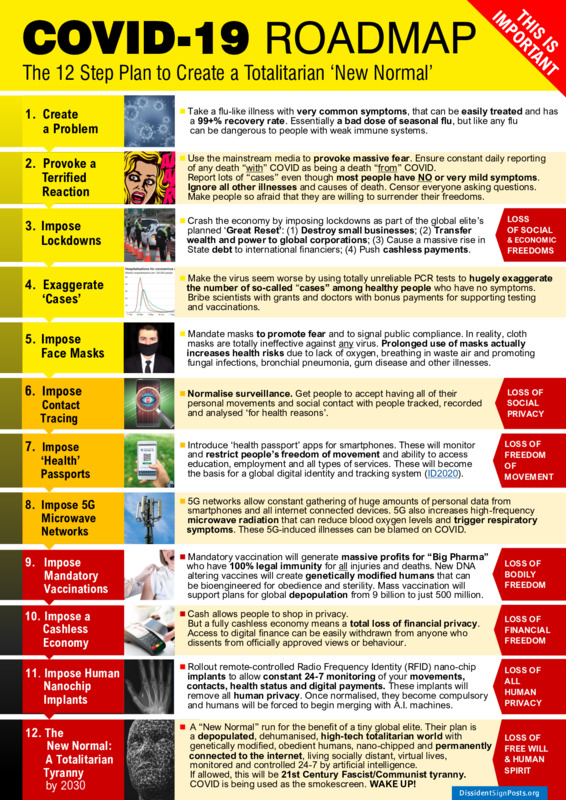
First off, I do not agree with the attached pdf to this story. When I first looked at this awful website, and saw that they had FREE DOWNLOADABLE PRINTS, I immediately sighed because this is the type of stuff that's turning people AWAY from getting a vaccine. These people are the reason why people can't trust "media". It is also very obvious that these people have never taken a history or any type of political science class in their lives. Let's analyze a little bit of what they say. First off, in their step 1 of "create a problem" they compare COVID-19 to something like the flu. Given, I'm sure people have died from the flu. I mean, the influenza pandemic was a thing in 1918. Also important that they even wore masks then! Their step 2 is "provoke a terrified reaction". What I'm getting from this is, we shouldn't be worried. But we should. Any pandemic should be worrying. I can also guarantee you as well that these people didn't give a shit when the AIDS/HIV Epidemic was literally killing so many queer people at an alarming rate, and wasn't addressed until 6 years later after it started. Anyways, the steps that talk about "contact tracing" and "health passports" things are interesting. They talk about surveillance, but surveillance has been happening since the dawn of time. I'm sure muslim's everywhere in the United States could talk more about surveillance than I could as a white person. Health passports? You have to have certain vaccines to attend public school or even a public university. Also, actual passports are a thing. You know, the thing you need to tell other people who you are and where you're from when you visit their country. I'm going to jump to step 10's "Impose a Cashless Economy," anyone that has ever handled cash during a job knows how gross cash is. This pamphlet must've been when the pandemic first happened, because that's when my last job couldn't take cash because we were too afraid to touch anything. Now knowing the information I know now, a lot of places take cash now. But also, people are gross. Half of the time, people are sneezing into their hands or not washing their hands and come out of the bathroom and go to pay and give you cash. Don't even get me started on people pulling money out of their bras. Throughout this entire pdf, they talk about the elite. Which is probably the only thing I agree with them because the rich got richer during the lockdown and even made prices higher. This type of propaganda could be harmful to someone that was already on the fence about vaccines, but the fact that this information is out there instead of the actual science based truth is harmful. It uses familiar words from history to persuade people to not get the vaccine. -
 04/29/2021
Jacob Wrasse Oral History, 2021/04/29
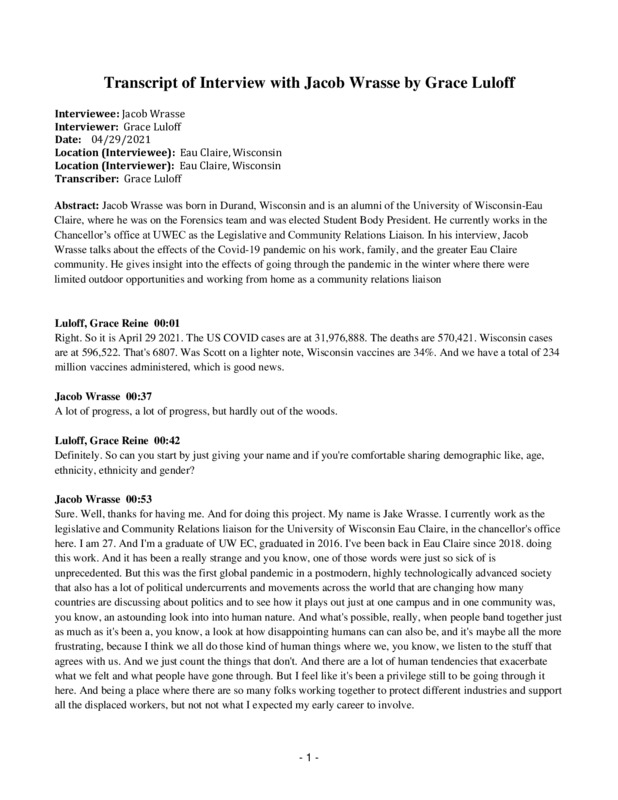
Jacob Wrasse was born in Durand, Wisconsin and is an alumni of the University of Wisconsin-Eau Claire, where he was on the Forensics team and was elected Student Body President. He currently works in the Chancellor’s office at UWEC as the Legislative and Community Relations Liaison. In his interview, Jacob Wrasse talks about the effects of the Covid-19 pandemic on his work, family, and the greater Eau Claire community. He gives insight into the effects of going through the pandemic in the winter where there were limited outdoor opportunities and working from home as a community relations liaison -
 08/21/2020
Caroline Birks Brown Oral History, 2020/05/31
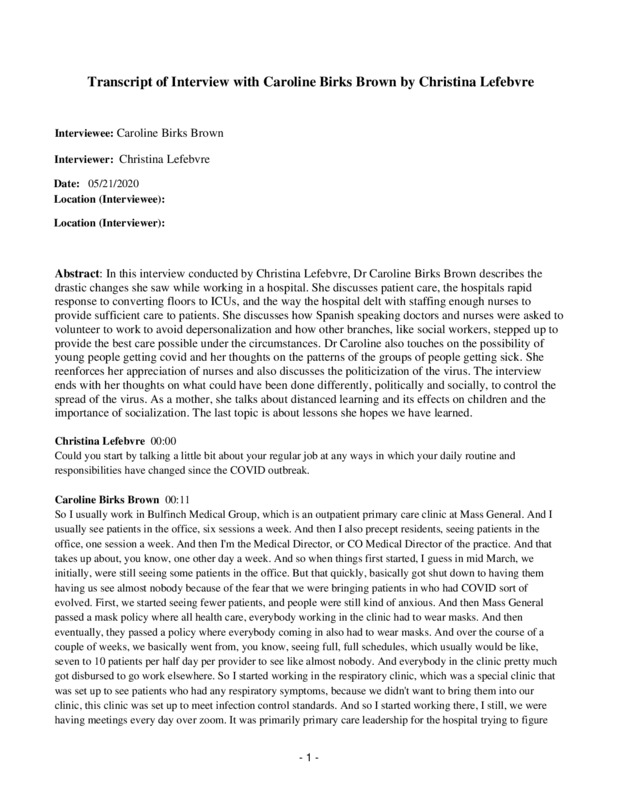
In this interview conducted by Christina Lefebvre, Dr Caroline Birks Brown describes the drastic changes she saw while working in a hospital. She discusses patient care, the hospitals rapid response to converting floors to ICUs, and the way the hospital delt with staffing enough nurses to provide sufficient care to patients. She discusses how Spanish speaking doctors and nurses were asked to volunteer to work to avoid depersonalization and how other branches, like social workers, stepped up to provide the best care possible under the circumstances. Dr Caroline also touches on the possibility of young people getting covid and her thoughts on the patterns of the groups of people getting sick. She reenforces her appreciation of nurses and also discusses the politicization of the virus. The interview ends with her thoughts on what could have been done differently, politically and socially, to control the spread of the virus. As a mother, she talks about distanced learning and its effects on children and the importance of socialization. The last topic is about lessons she hopes we have learned. -
 05/06/2021
Linda White Oral History, 2021/05/04
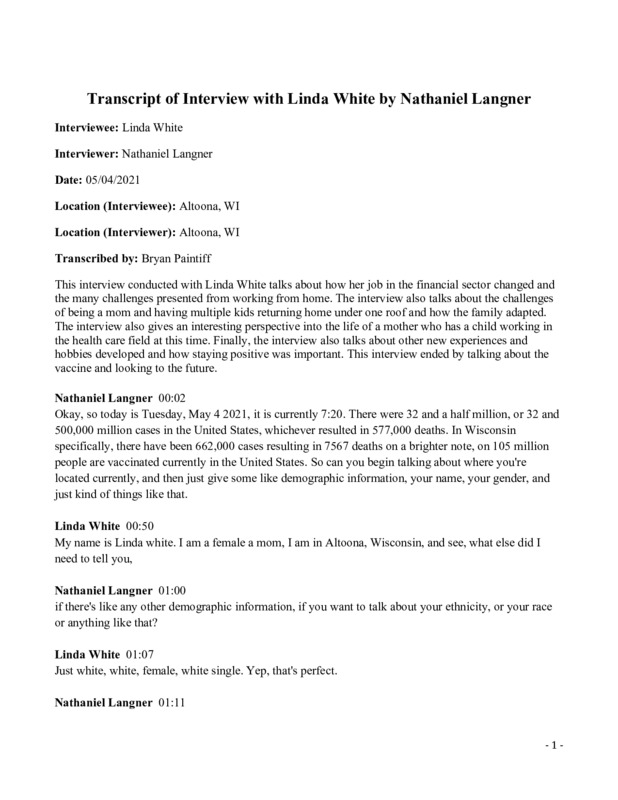
This interview conducted with Linda White talks about how her job in the financial sector changed and the many challenges presented from working from home. The interview also talks about the challenges of being a mom and having multiple kids returning home under one roof and how the family adapted. The interview also gives an interesting perspective into the life of a mother who has a child working in the health care field at this time. Finally, the interview also talks about other new experiences and hobbies developed and how staying positive was important. This interview ended by talking about the vaccine and looking to the future. -
 11/13/2020
Craig Zehms Oral History, 2020/11/13
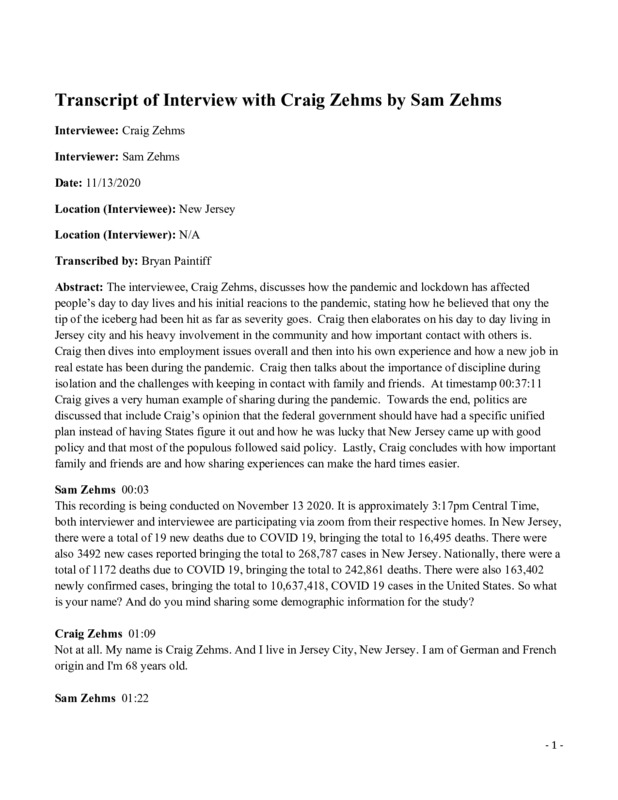
The interviewee, Craig Zehms, discusses how the pandemic and lockdown has affected people’s day to day lives and his initial reacions to the pandemic, stating how he believed that ony the tip of the iceberg had been hit as far as severity goes. Craig then elaborates on his day to day living in Jersey city and his heavy involvement in the community and how important contact with others is. Craig then dives into employment issues overall and then into his own experience and how a new job in real estate has been during the pandemic. Craig then talks about the importance of discipline during isolation and the challenges with keeping in contact with family and friends. At timestamp 00:37:11 Craig gives a very human example of sharing during the pandemic. Towards the end, politics are discussed that include Craig’s opinion that the federal government should have had a specific unified plan instead of having States figure it out and how he was lucky that New Jersey came up with good policy and that most of the populous followed said policy. Lastly, Craig concludes with how important family and friends are and how sharing experiences can make the hard times easier. -
 04/28/2021
Jill Polglaze Oral History, 2021/04/28
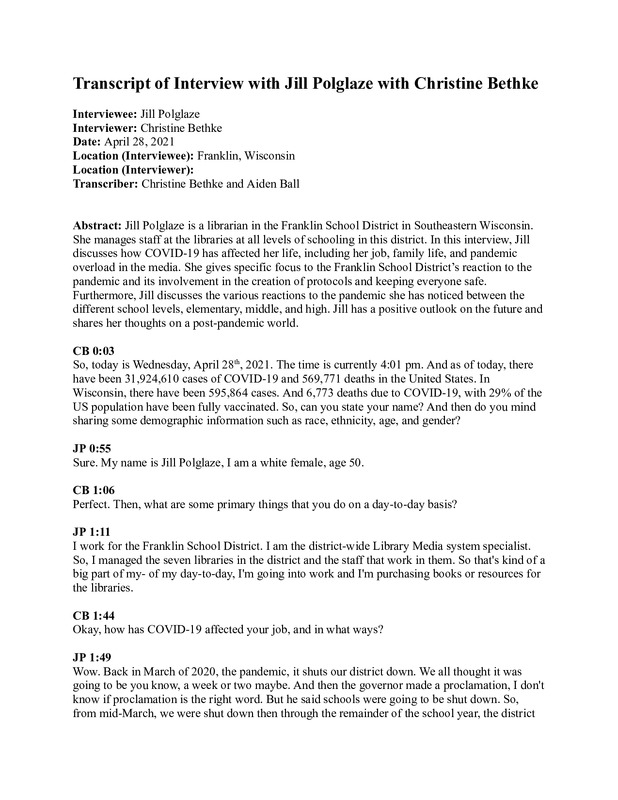
Jill Polglaze is a librarian in the Franklin School District in Southeastern Wisconsin. She manages staff at the libraries at all levels of schooling in this district. In this interview, Jill discusses how COVID-19 has affected her life, including her job, family life, and pandemic overload in the media. She gives specific focus to the Franklin School District’s reaction to the pandemic and its involvement in the creation of protocols and keeping everyone safe. Furthermore, Jill discusses the various reactions to the pandemic she has noticed between the different school levels, elementary, middle, and high. Jill has a positive outlook on the future and shares her thoughts on a post-pandemic world. -
 05/27/2020
Celia White Oral History, 2020/05/27
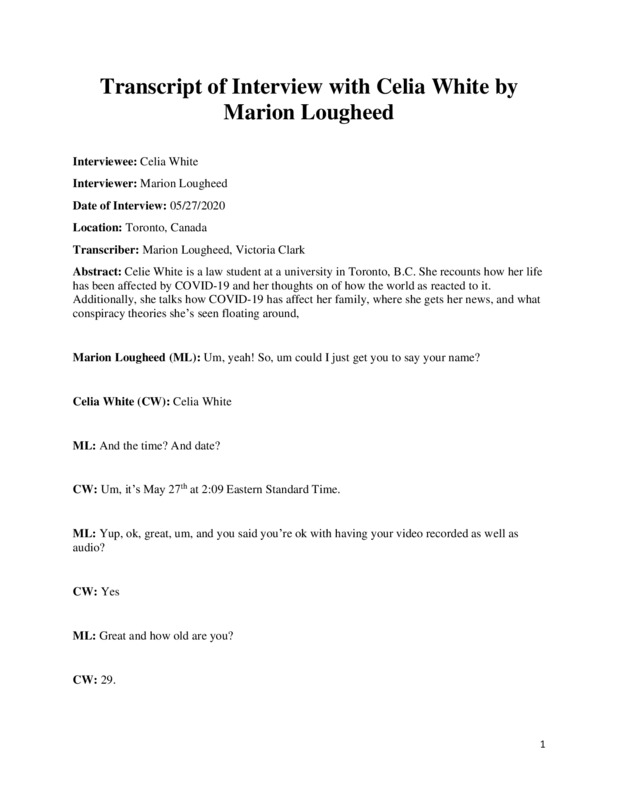
Celia White is a law student at a university in Toronto, B.C. She recounts how her life has been affected by COVID-19 and her thoughts on of how the world as reacted to it. Additionally, she talks how COVID-19 has affect her family, where she gets her news, and what conspiracy theories she’s seen floating around. -
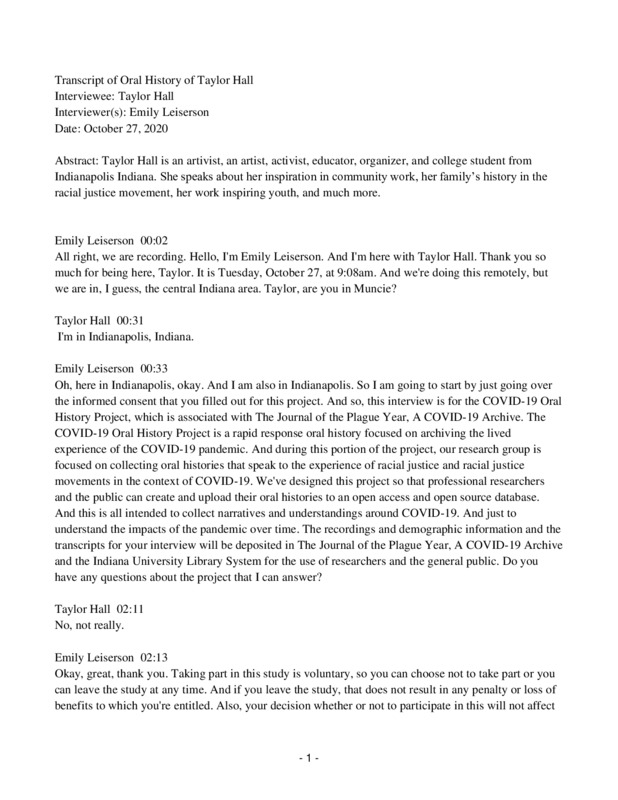 10/27/2020
Taylor Hall Oral History, 2020/10/17
C19OH -
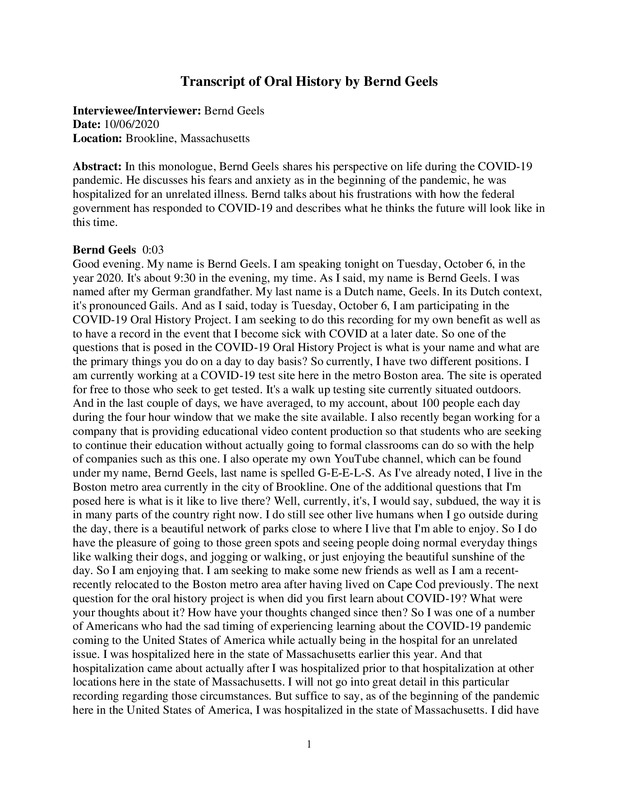 2020-10-06
Bernd Geels Oral History 2020/10/06
C19OH -
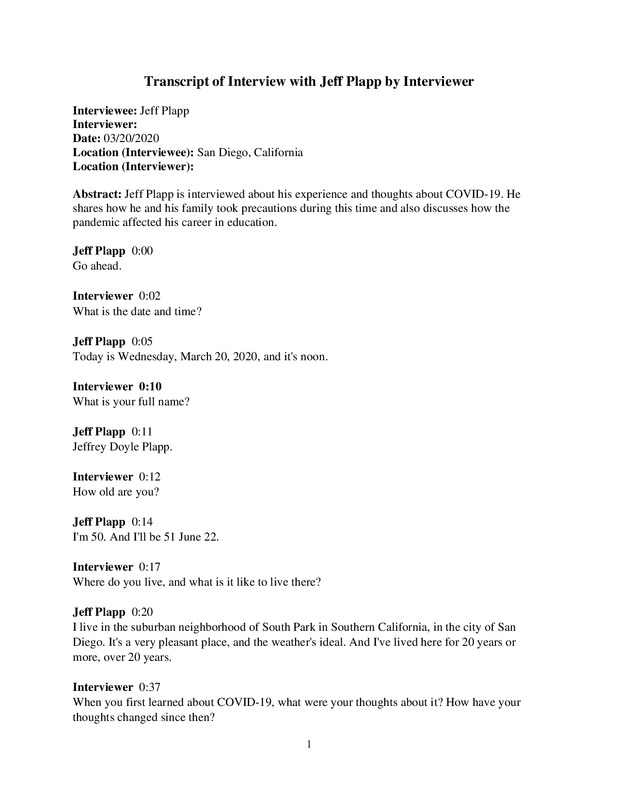 2020-05-20
Jeff Plapp Oral History, 2020/03/20
C19OH -
2021-10-15
The Love of Candles
Before 2020, I hardly ever burned a candle. My parents had forbid it, convinced me or my siblings were going to forget about it and burn the house down. My dorm room had extremely strict (and understandable) rules about open flames and heat sources. It wasn’t until I had graduated college and moved back into and then out of my parents’ house that I was free of these regulations. Even then, though, it never occurred to me to buy candles. My favorite scents were often nature-based and could easily be experienced by visiting the ocean, or the forest, or the occasional bakery. It wasn’t until the pandemic, when I was living in Ohio without being comfortable traveling to the ocean, or to the forest, or in public at all, that I turned to candles. Soon one impulse purchase of a sea salt and balsam scented candle turned into a constant hunt for all of my favorite scents, to bring me to places I didn’t feel safe or responsible traveling to. My collection grew rapidly, and for the past year or so I’ve had a candle lit in my home almost every day. I never thought something a simple as a $7 candle I found at TJ Maxx or Bath & Body Works could bring me so much peace, calming my need to return to my favorite far-off places until it is once again safe to do so. Don’t get me wrong, candles still can’t compare to the real smells I adore, but even a weak imitation is better than a scent-less longing. Even though I’m currently residing in Ohio, I can use candles to feel connected to my home state of California, or my favorite places to visit, bringing comfort and familiarity in a time that is anything but comfort and familiar. My bank account may not be happy with me given this new habit, but it’s a price I am willing to pay. -
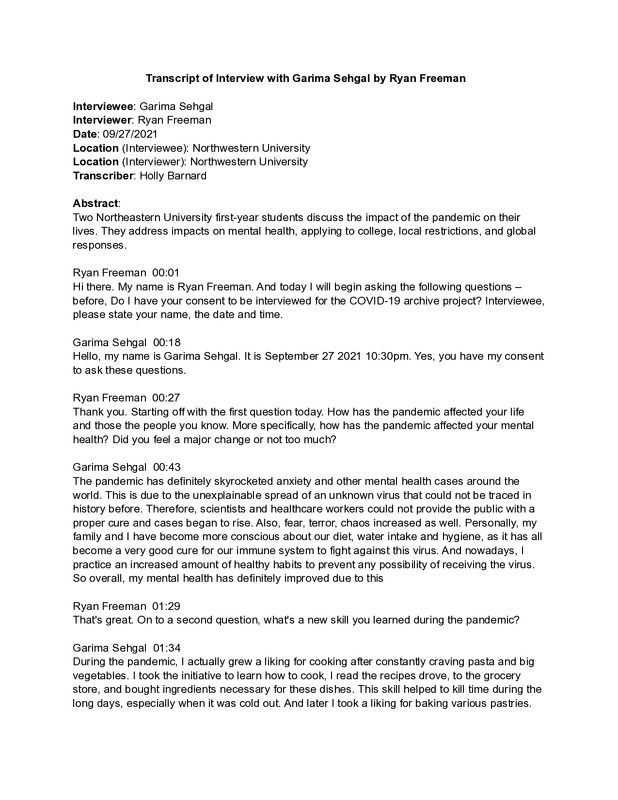 2021-09-27
Garima Sehgal Oral History, 2021/09/27
Two Northeastern students discuss how the pandemic affected their lives, including the impacts of the pandemic on their communities -
 2020-06-29
The Unpredictable Horrors of Pandemic
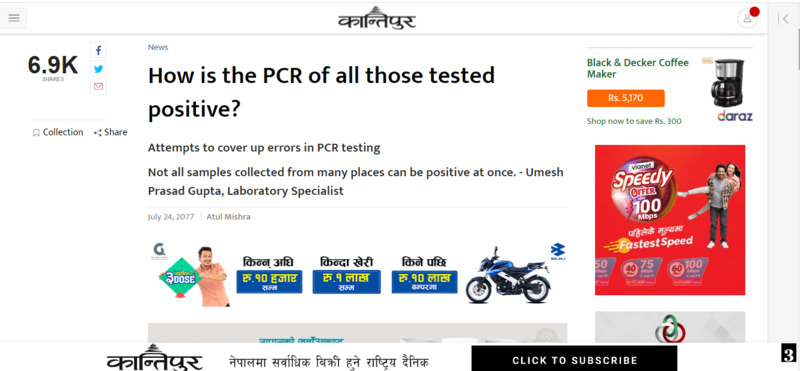
The unpredictable horrors of pandemic “Corona Virus” the most lethal being on the earth that swept a mass population since its spread in December 2019. The Corona Virus had already started its attack and only a few cases had been reported in Wuhan, China until 2020, where it spread like a wildfire taking down millions of people. I belong to Nepal which is a neighboring country to China, so it surely was at higher risk which led to a countrywide lockdown in March 2020. It was then, people started to realize the seriousness of the situation. I would like to share my part of the pandemic experience in the first person “We” because I believe in this time I was with my family and we went through this experience- some bitter and some sweet but we were always together as a single unit. When the lockdown was imposed in Nepal, people were not aware of why it was being done. Why a mere viral disease was threatening nations? People took it as an excuse to vacation from work and school. We were told to stay inside the house, wear a mask and avoid gatherings by the national authorities. We could only go out for buying essentials (food, medicine) in the evening between 6-7 PM. Other times we were enjoying with our family because it is very rare to have this much free time in this busy life. We would cook new dishes, we also started gardening, growing vegetables in our backyard, and sometimes there was even “Movie Time” with the family. So, for the first few weeks, this lockdown was a perfect family time. Then the economy slowly started to tremble. People were left jobless, savings started to dry out. We were getting conscious and calculative on the grocery shopping. We own a garment factory (textiles and embroidery) so with no shops open during the time, we were also struggling with the money. My sister was currently stuck in Bangladesh because she had gone there for her educational studies and was stuck since both the countries were on lockdown. She finally arrived back home in June 2020 in an evacuation flight. She was then on self-isolation for 14 days. In these days of self-isolation, she showed no signs of COVID. Finally, on her last day of isolation, she went for a test and the horrors began. The reports came POSITIVE. This came as a shock to all of us because she had followed all the health protocols both in Bangladesh, during the flight, and after arriving in Nepal. We all were in disbelief and were taken aback. Unfortunately, the same day when the reports came out, there a news report regarding the lab where the reports were tested had cross-contamination, leading to inaccurate results in the hospital that day (the same day as my sister was tested). All of the samples were tested positive. Health authorities had to investigate that matter. But since she had no symptoms whatsoever, we wanted to re-check. Before we could even go to the other hospital, the members from the localities hurdled outside our house. They had been informed that an infected person was there in the area. My mom and dad went out to calm the crowd, trying to convince us that the results were doubtful and we were going for a re-check. The crowd was more like an angry mob and was dismissing all our claims, maybe also because this was the first case in our locality. They didn’t want to hear what we had to say. They forcefully started sealing the gates and the areas of our house, ordering all our neighbors to stay away from the area. They were told not to cross the gate and come in contact with us. Since the coronavirus is truly a big deal, though we had some doubts, we accepted that all our family members should go into isolation. But this was easier said than done. For those 14 days, we had no one around us to help. We couldn’t go out to get groceries or even other essentials. Our neighbors were threatened by the local authorities to not help us. They couldn’t send us the groceries or anything else. We were cast away from the whole society around that time. Luckily, we had an aunt living nearby. She used to leave us grocery items in our backdoors before the sunrise…. before anyone could even see. And we would run outside abiding by proper protocols, get those items and be back inside, panting, hoping no one saw us. At that time we had no money, limited food supply, and many mouths to feed. It was like we were living in an apocalyptic world. Baseless rumors had started to spread around the society stating we were seen partying and having gatherings a few days back. People would ring us up just to blame us as if we were the rotten ones. The most heartbreaking incident was when we were called by the local authority asking us to not come out on the balcony because according to them, somehow, we were exposing the virus in our area. Those 2 weeks became hell for our family. Finally, on the 14th day, all the members of our family members took a PCR test, and luckily, we were all tested negative. So in simple terms, we had recovered BUT society still didn’t accept us. Whenever we used to go to the shop, we were stared at and could hear whispers behind our back. People used to stay away from us and we were regarded (sort of) untouchables even after we had medical reports to prove them otherwise. Then a month later, even my maternal grandmother was infected with the virus. We could not go visit her as the hospital didn’t permit and she was under strict surveillance. She soon developed pneumonia as a complication of the COVID attack. Almost half of her lungs had been severely damaged and on 29th November 2020 she passed away. This pandemic left a great impact on us. We suffered great loss both emotionally and financially. From sneaking in groceries like smugglers to bidding goodbye to someone who loved us the most, it will always be an inerasable memory for us. Even as I write my experience, my words are not enough to emphasize the pain this pandemic has caused. But all I can say is we fought this as a FAMILY. One for All and All for One. -
 2020-11-12
A snarky mask reminder
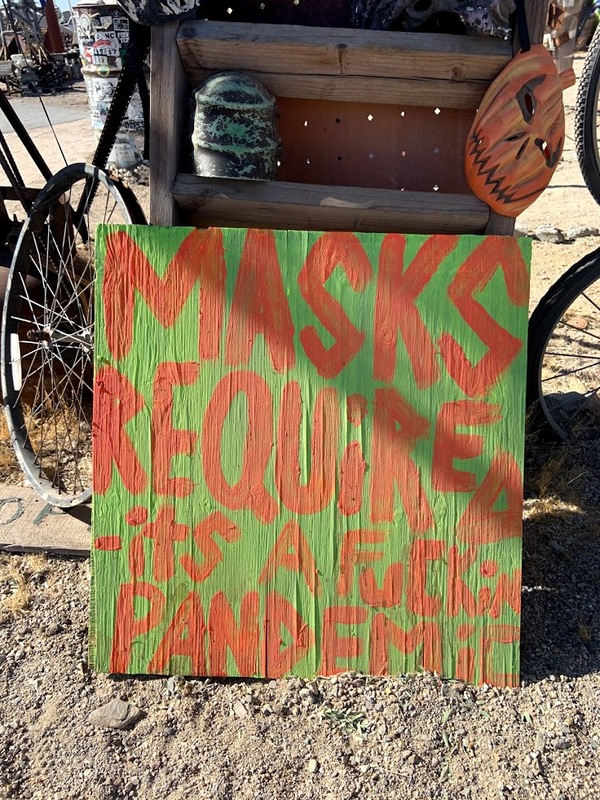
Slab City California is a very unique place. I would describe it loosely as being part squatter and snowbird encampment, part artists’ colony, part homesteading community. The one description that is agreed upon, at least by its residents, is that it is the “last free place on earth”. Given this fact, I was a bit nervous to visit, but I was also really excited to check it out and figured that if nobody was wearing masks or social distancing and I wasn’t comfortable, I could just leave. I was very pleasantly surprised therefore when I arrived and found that residents were all taking the pandemic seriously. I stayed away from people as much as possible, as I did everywhere I went and was able to safely enjoy the art. I snapped this picture in East Jesus, an outdoor art museum/sculpture garden, and felt it was a good representation of the general attitude in the area. I think this item illustrates an interesting part of people’s response to covid which is that while there are many people who refuse to take the pandemic seriously, there are also a lot of people who are doing the right thing because they genuinely care about others. Slab City is an unincorporated community with no government and nobody to enforce state mandates. People might get fined if they threw a big party and word got out to someone who could do something about it, but it’s unlikely that there would be consequences. And yet, people were being responsible, Which to me says something significant about the fact that I would say that most people who are wearing masks and social distancing it are doing it not because they are required to, but because it is the right thing to do. -
 11/21/2020
Monserrat Garcia Oral History, 2020/11/21
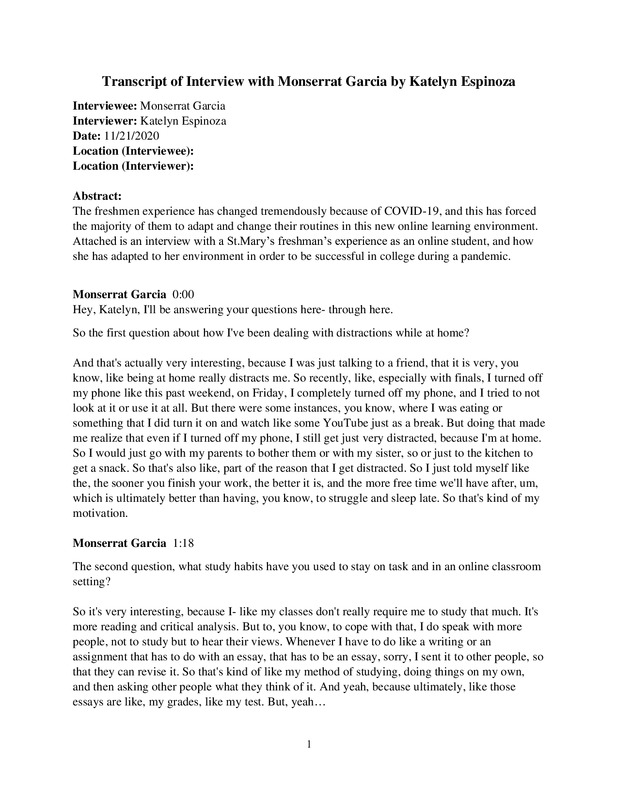
The freshmen experience has changed tremendously because of COVID-19, and this has forced the majority of them to adapt and change their routines in this new online learning environment. Attached is an interview with a St.Mary’s freshman’s experience as an online student, and how she has adapted to her environment in order to be successful in college during a pandemic. -
 10/17/2020
Emily Tyler Oral History, 2020/10/17
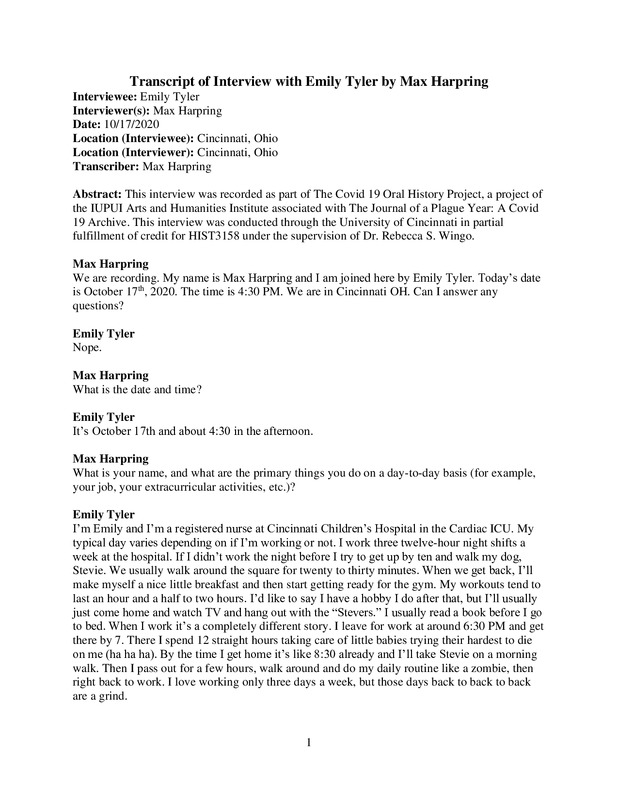
Transcription only: In this oral history interview, I sat down and interviewed Emily with a range of topics including: her background, employment, family, household, community, health, information sources, government, and the future. This interview was conducted at Emily’s apartment in Cincinnati, Ohio. Informed Consent was obtained previously before the interview. -
 2020-09-24
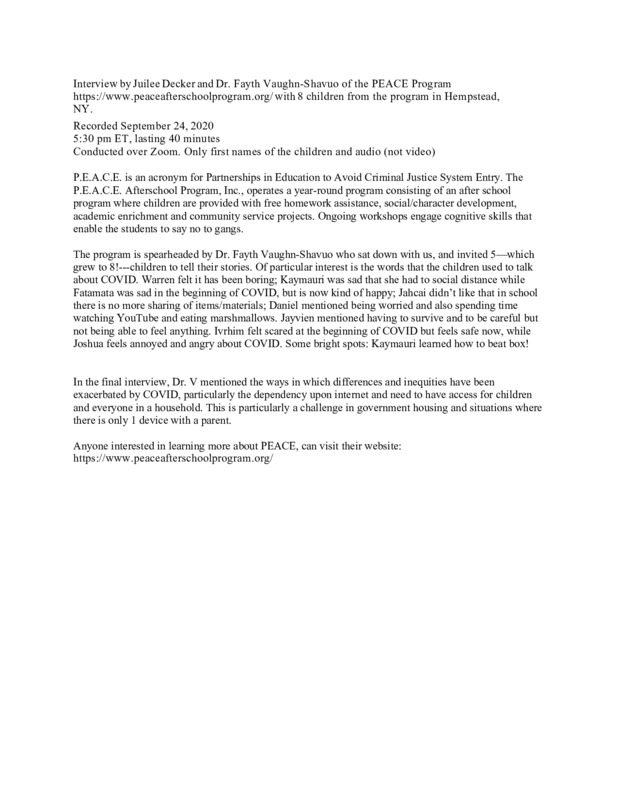
Interview by Juilee Decker and Dr. Fayth Vaughn-Shavuo of the PEACE Program
P.E.A.C.E. is an acronym for Partnerships in Education to Avoid Criminal Justice System Entry. The P.E.A.C.E. Afterschool Program, Inc., operates a year-round program consisting of an after school program where children are provided with free homework assistance, social/character development, academic enrichment and community service projects. Ongoing workshops engage cognitive skills that enable the students to say no to gangs. The program is spearheaded by Dr. Fayth Vaughn-Shavuo who sat down with us, and invited 5—which grew to 8!---children to tell their stories. Of particular interest is the words that the children used to talk about COVID. Warren felt it has been boring; Kaymauri was sad that she had to social distance while Fatamata was sad in the beginning of COVID, but is now kind of happy; Jahcai didn’t like that in school there is no more sharing of items/materials; Daniel mentioned being worried and also spending time watching YouTube and eating marshmallows. Jayvien mentioned having to survive and to be careful but not being able to feel anything. Ivrhim felt scared at the beginning of COVID but feels safe now, while Joshua feels annoyed and angry about COVID. Some bright spots: Kaymauri learned how to beat box! In the final interview, Dr. V mentioned the ways in which differences and inequities have been exacerbated by COVID, particularly the dependency upon internet and need to have access for children and everyone in a household. This is particularly a challenge in government housing and situations where there is only 1 device with a parent. Anyone interested in learning more about PEACE, can visit their website: https://www.peaceafterschoolprogram.org/ -
 10/11/2020
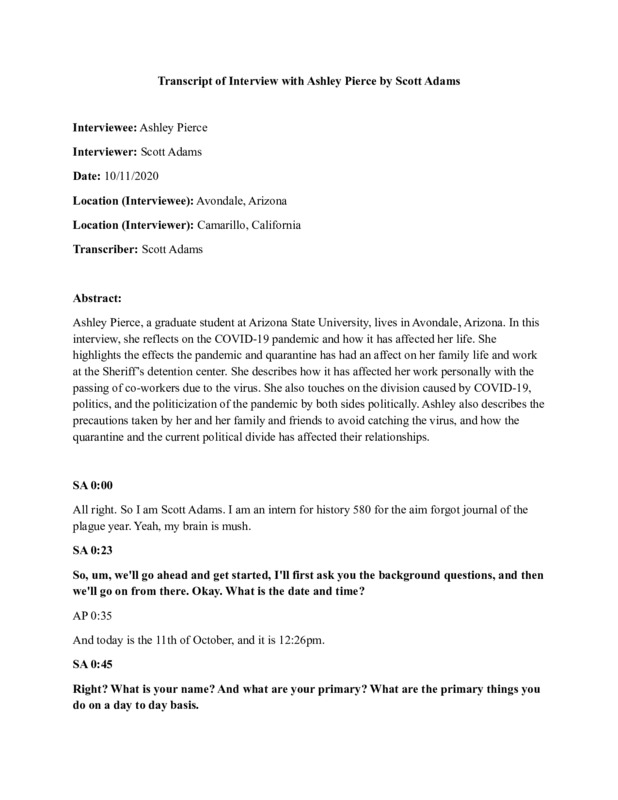
Ashley Pierce Oral History, 2020/10/11
Ashley Pierce, a graduate student at Arizona State University, lives in Avondale, Arizona. In this interview, she reflects on the COVID-19 pandemic and how it has affected her life. She highlights the effects the pandemic and quarantine has had an affect on her family life and work at the Sheriff’s detention center. She describes how it has affected her work personally . She also touches on the division caused by COVID-19, politics, and the politicization of the pandemic by both sides politically. Ashley also describes the precautions taken by her and her family and friends to avoid catching the virus, and how the quarantine and the current political divide has affected their relationships. -
 10/09/2020
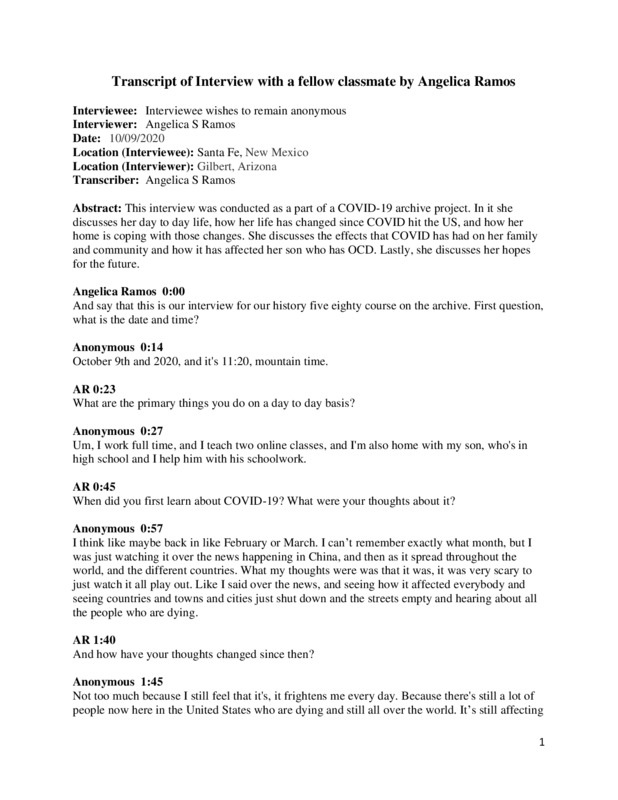
Anonymous Oral History, 2020/10/09
This interview was conducted as a part of a COVID-19 archive project. In it she discusses her day to day life, how her life has changed since COVID hit the US, and how her home is coping with those changes. She discusses the effects that COVID has had on her family and community and how it has affected her son who has OCD. Lastly, she discusses her hopes for the future. -
 09/29/2020
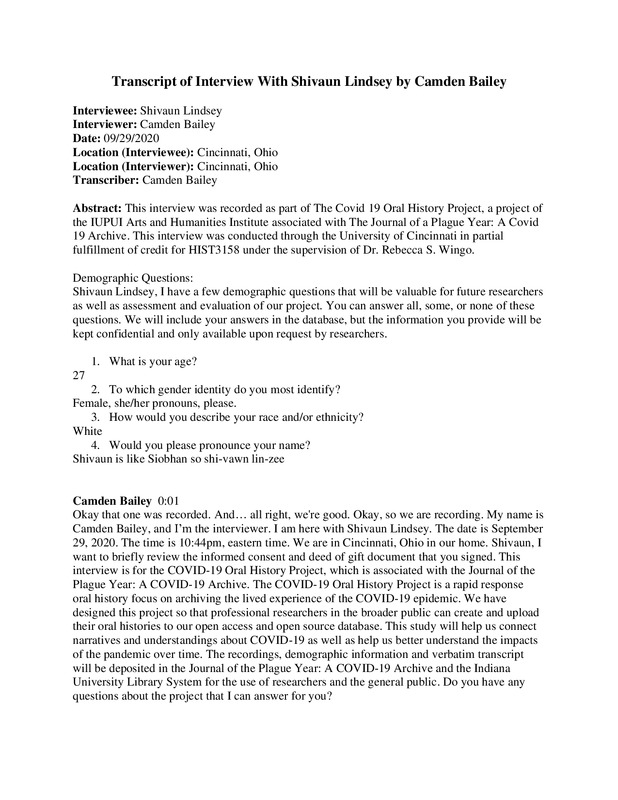
Shivaun Lindsey Oral History, 2020/09/29
An interview given with Shivaun by her wife, Camden regarding COVID-19. -
 2020-10-08
Isolation & Madness
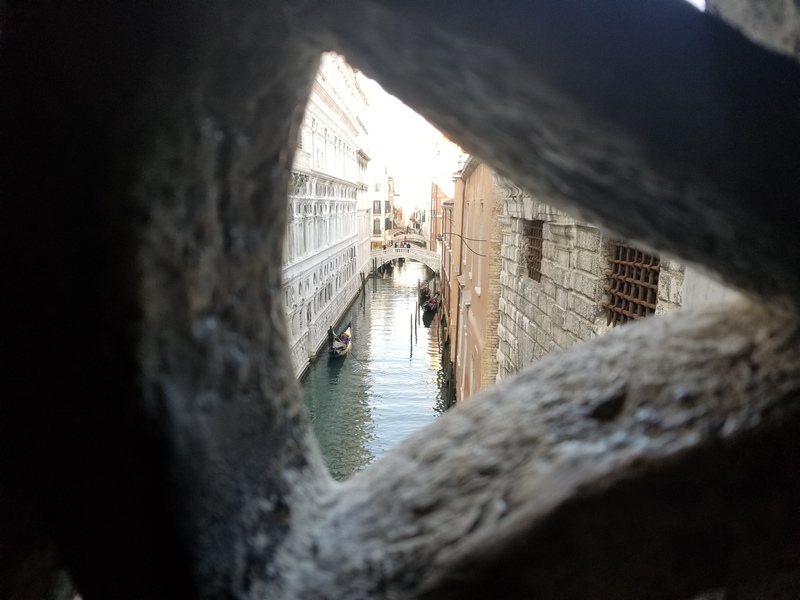
The last time I traveled before the Pandemic shut down the world was November of 2019. I spent 11 days, quite literally wandering around Italy. I went with no plan - other than to visit the Vatican. I spent time in cafes and walking around the city. I made random conversation with locals and tourists alike. I allowed myself to listen to other's experiences to see if it was a venture I would like to experience. It was such an exciting experience. I actually made friends with a photographer who was travelling to Sicily for a nature shoot. She allowed me to tag along. We took a bus and once we got there we explored the small village. We had fresh fudge and freshly ground coffee. While she was at her photo shoot, I walked along the water and explored the remainder of the village which would easily have fit within 3 city blocks in New York City. As I describe that adventure, it has nothing to do with the pandemic and it's completely unlike what we are experiencing now. I was free to wander; something about being out in the open with no general plan is exciting and calming all at the same time. As I reflect on that time, I remember what happened right after. As people got sick, businesses shut down, people were restricted to their homes, I could think of nothing else except for this view from Doge's Palace. Casanova was the most infamous prisoner, especially since he was the only one known to escape. Just imagine what it must have been like. Making this walk over this bridge and this little sliver of light is the last you saw of the outside world. After that walk, it was just stone and candle light. I took this picture on my cell phone and as the course continued this term, I kept thinking about this picture. In a place like Italy, where religion is part of the culture, they were hit so hard by the pandemic. What must it be like there to be restricted to your home and all you can do is look out your window? The idea of only being able to see a small piece of reality while the world around you changes in extreme ways, not knowing what comes next or when it was going to happen. Imagine what went through prisoners minds in the early 1600s as this small image is the last thing they say. Do you think they found solace in a deity or faith? Those who were confined to their homes and were getting sick, what must have gone through their minds? The reason I wanted to submit this picture is because this pandemic really showed us, we are all human. By nature there are things we cannot escape and things that we come to appreciate. When we become restricted and slow down, we begin to appreciate what's around us no matter how big or small. The pandemic restricted me from travelling abroad and I lost a number of friends and family members but I had no restriction on my view of the world. I could still experience nature and explore and appreciate. The pandemic was a humbling experience. This picture is a visual representation of that experience. There's so much out there but only when we cannot explore at our leisure, do we stop to notice and take it in. It's only through isolation that we miss the world around us. Is it the isolation that caused madness or fear? Only being able to see such a small part of such a big world, it could drive anyone mad. -
 09/20/2020
Mary Grace Arents Oral History, 2020/09/20
This is an interview of my friend Grace who lives in Sarasota Florida, and her experience during the Covid-19 Pandemic -
2020-03-15
Staying Strong
A couple of months leading to the COVID-19 pandemic, my wife and I were paying off all of our consumer debt and saving for a down payment on a house to purchase in late 2020. 2019 was very stressful on us, working all the time, did not take any time off, or any vacations; we did not go out like we used to; we just worked and paid off the debt. We started 2020 debt-free, and we kept on working and saving, in March 2020, I went to Turkey for a week to visit the family that I had not seen in 4 years. Two days before my return to the United States, the president decided to ban travel from all European countries due to COVID-19. I was terrified to be stuck in Turkey away from my wife and kids for months. Thankfully, Turkey was not included, I came back to the US, and life was not as healthy as it was. The following months were some of the toughest we have been through. When the Stay at Home restrictions began in our state, my wife lost her job while I stayed employed as an essential worker. My wife stayed with the kids teaching them as schools were shut down for the rest of the school year. COVID-19 impacted us not just financially, but emotionally as well. I believe we are in a better financial situation, considering what the pandemic has done to so many people worldwide. We are in an unprecedented time, and we are all in this together, and we will get through it sooner or later. I am looking forward to what the future holds for us. -
 2020-07-12
Lawson Miller Oral History, 2020/07/12
Lawson Miller grew up in Utah. He has studied Political Science and North American History at Arizona State University. He currently works as a classroom instructor at Excelsior Academy. Lawson has a partner and they enjoy extracurricular activities such as reading, school work together, and watching TV shows and other documentaries. Lawson shares that he is a part of implementing a unified LGBTQ+ community for Arizona State University students. Lawson touches on the impacts of Covid-19 specifically the LGBTQ+ community and other minority communities. He also highlights the political and social implications of the coronavirus on all social sects as of prime importance. Lawson’s reflection on past significant global events includes the many school and civil shootings that have devasted United States populations, the George Floyd protests, and the many fights for civil and social rights. In this interview, Lawson reflects on COVID-19 from a perspective of civil and social rights while emphasizing the utmost regard for health and safety priorities for all. -
 2020-07-01
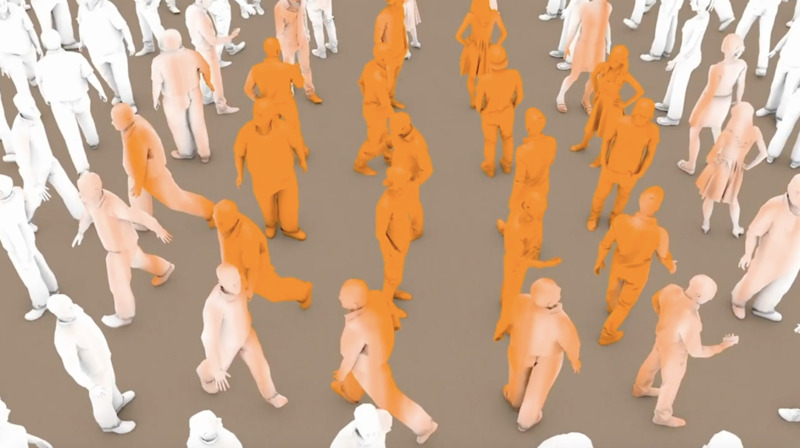
‘They’re scared’: A look inside the COVID-19 crisis in Arizona prisons.
By Katelyn Keenehan | Luce Foundation: Southwest Stories Fellowship -
 05/25/2020
Sandra Smith Oral History, 2020/05/25
Interview with Sandra Smith. This interview is the fifth in a collection compiled by Glennda McGann, a volunteer researcher for the IUPUI Arts and Humanities Institute COVID-19 Oral History Project -
 2020-04-22
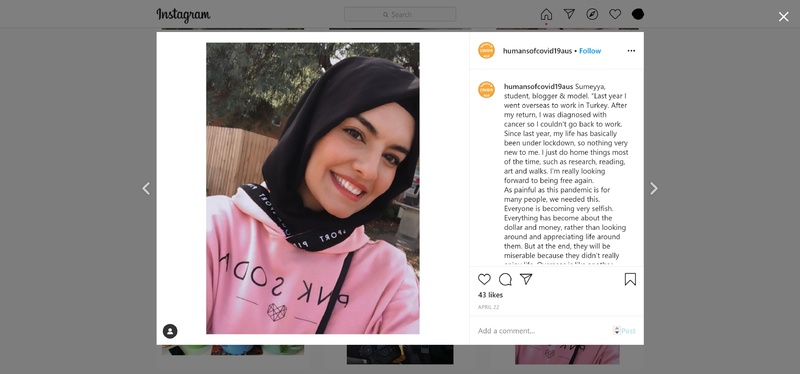
Humans of Covid-19 AU: Sumeyya
“Last year I went overseas to work in Turkey. After my return, I was diagnosed with cancer so I couldn't go back to work. Since last year, my life has basically been under lockdown, so nothing very new to me. I just do home things most of the time, such as research, reading, art and walks. I’m really looking forward to being free again. As painful as this pandemic is for many people, we needed this. Everyone is becoming very selfish. Everything has become about the dollar and money, rather than looking around and appreciating life around them. But at the end, they will be miserable because they didn’t really enjoy life. Overseas is like another world, especially in poor countries. But no one stops to think about how these people are surviving. Ramaddan is in a few days' time. There is a mixture of excitement and nervousness. It will be hard because we can’t visit friends and family, or have meals together with lots of people. But a lot of people are working on keeping it positive. This year we can pray just with our family, and it is still rewarding. As hard as this time is, we are going to be part of history!” Instagram post on Sumeyya, student, blogger & model, and her experience during the pandemic, which was created by a psychology student living in Melbourne who was interested to hear about how COVID-19 was impacting on different peoples’ lives. -
2020-05-07
French Quarter Festival and Satchmo SummerFest 2020 Cancelled, New Orleans, LA
French Quarter Festivals, Inc. (FQFI) announces that plans to host French Quarter Festival in October are no longer moving forward. At the City’s direction and out of caution for the safety of fans, musicians, staff and partners, French Quarter Festival and Satchmo SummerFest 2020 have been canceled due to COVID-19. These events had previously been postponed to the fall of 2020.