
Items
Search full-text
futcoins 26 Besuche die Website Buyfc26coins.com. Beste Qualität..N7Ft
-
 04/03/2020
Can't go home
India decides to extend the travel ban for incoming international flights until April 14th, 2020. Currently, all of my classes are online and there is not much to do staying here in the US, but going home isn’t an option either. -
 2020-03-16
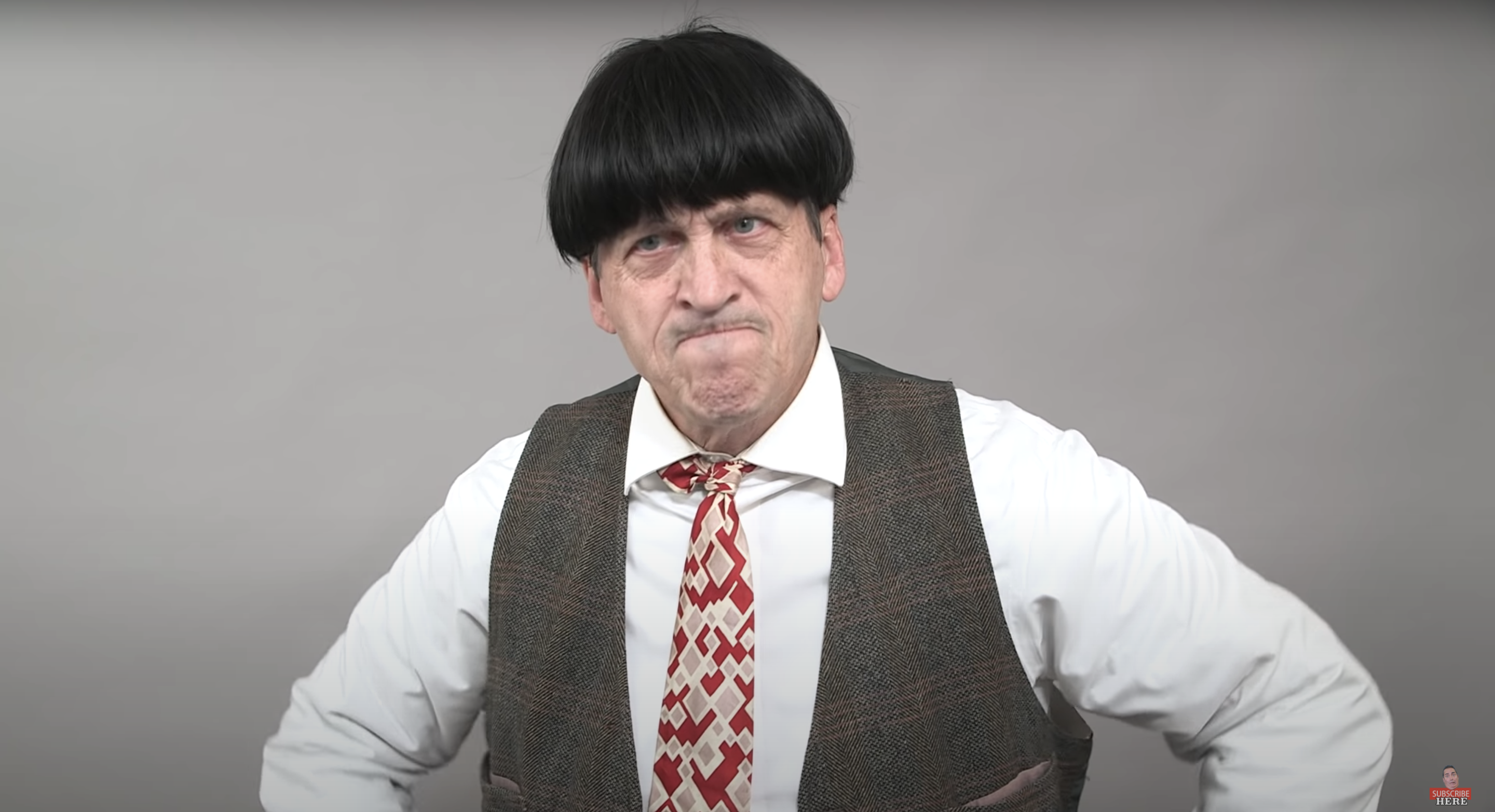
Corona Virus PSA by MOE Howard- THREE STOOGES - Covid - 19 CDC
The video is a public service announcement with comedic overtones by the grandson of comedian Curly Howard, one of the original Three Stooges. It features him and companions dressed up like the Stooges to provide viewers with useful information as well as a link to find more. The link they recommend is the CDC website. -
 2020-04-02
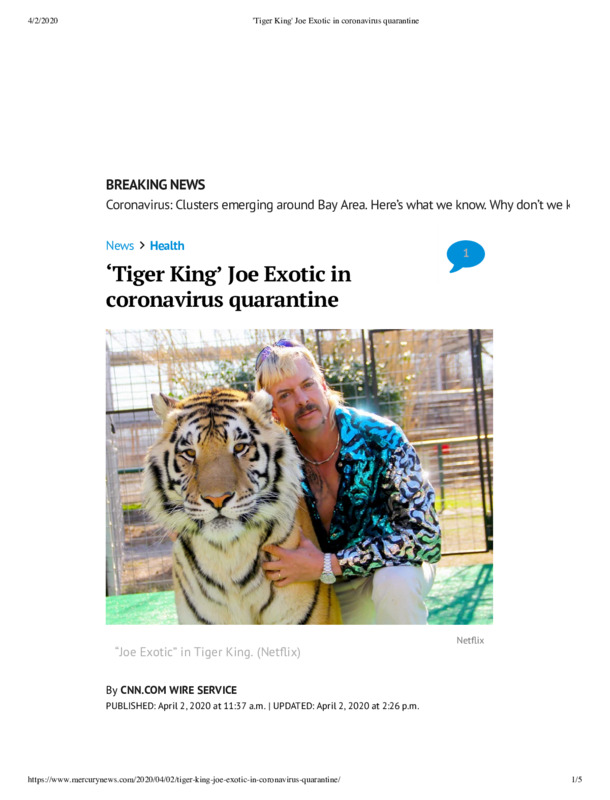
Joe Exotic in Quarantine for Coronavirus
The man made famous as "Joe Exotic" in the Netflix documentary series "Tiger King" is reportedly in quarantine in a Fort Worth prison. -
 2020-03-15
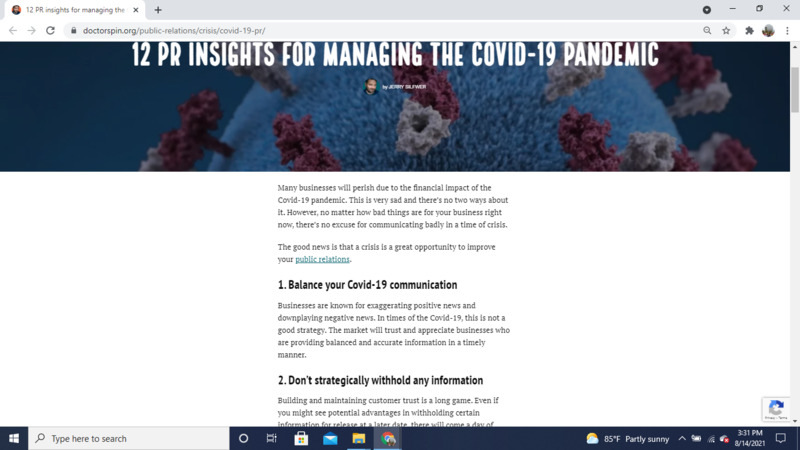
Public Relations — Coronavirus Advice for Businesses
A descriptive website for how businesses should communicate to the public about COVID-19. -
 03/16/2020
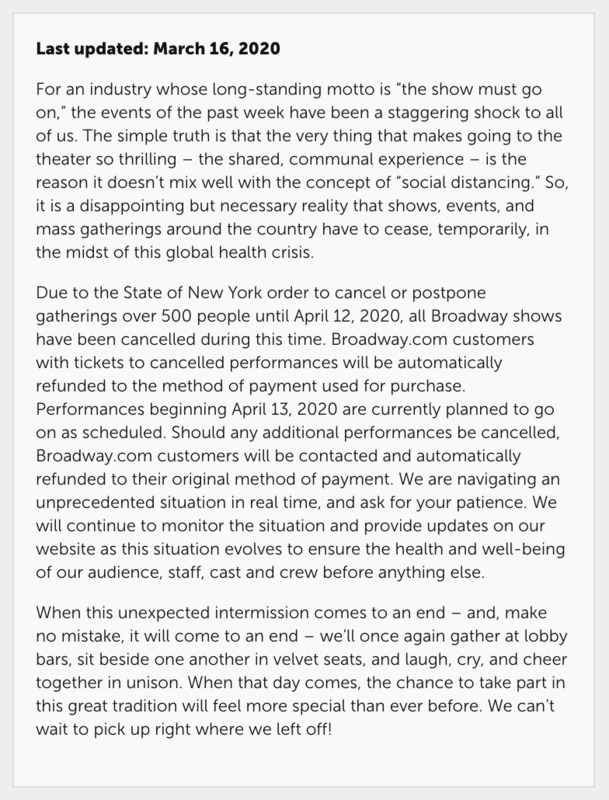
Covid-19 Update: Broadway Cancels Shows
This explains Broadway's decision to cancel or postpone shows throughout April 12 due to the Covid-19 global crisis. -
 2020-03-29
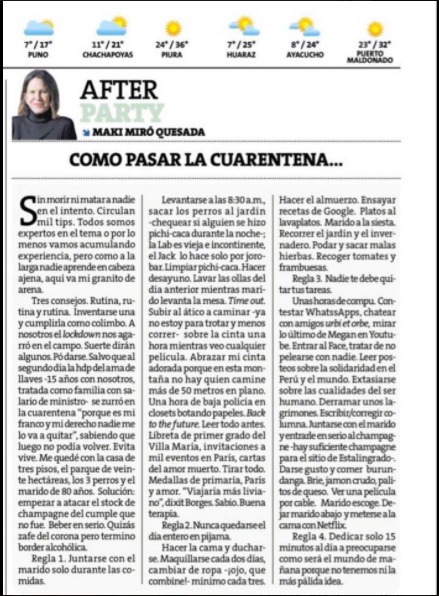
Como pasar la cuarentena
Columnist Maki Miró Quesda published an article on 3/29/2020 calling the family employee an "hdp" for passing the cuarentena with his/her family instead of returning to work in Quesada's home. The article was later deleted from the Peru21 website and an apology issued. -
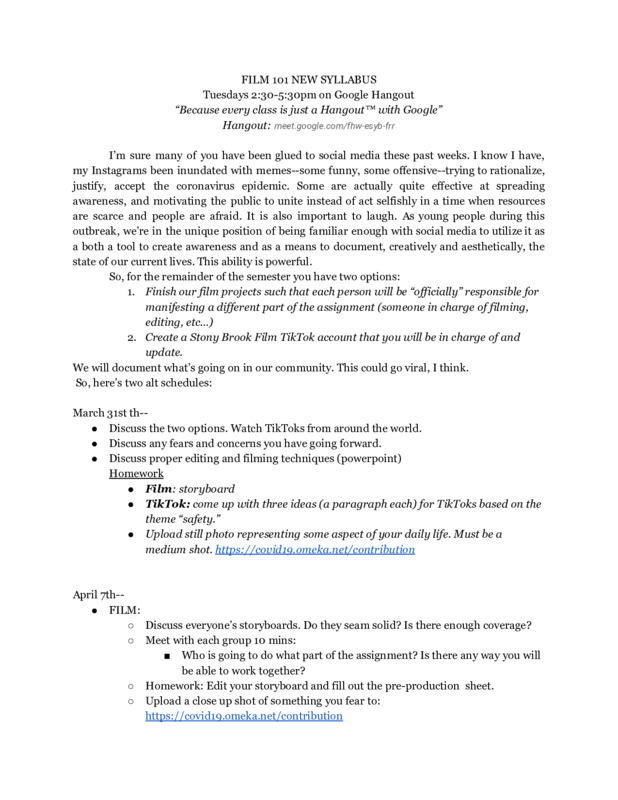 Class starts Tuesday March 31st at 2:30 pm
Stony Brook Film Post Corona Film 101 Syllabus
A syllabus created for the second half of the semester after class has become digital. -
 2020-03-20
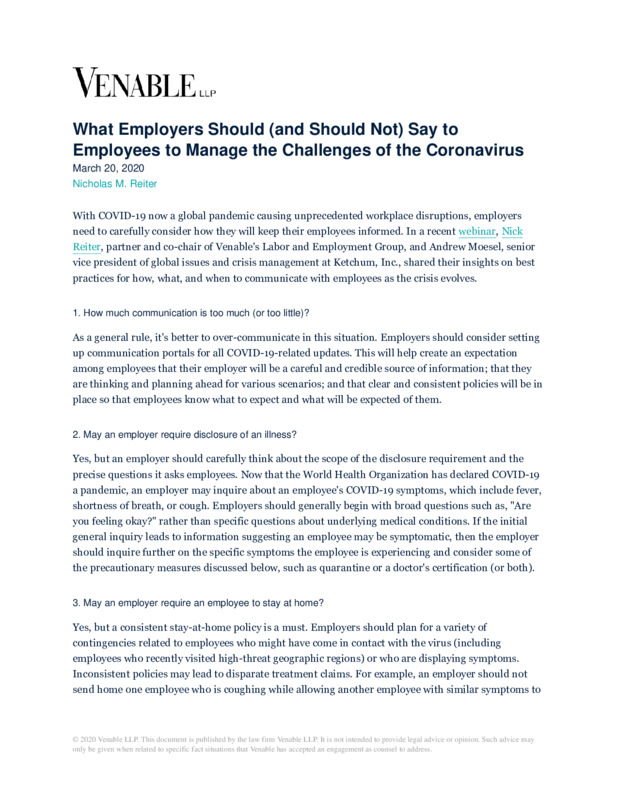
What Employers Should (and Should Not) Say to Employees to Manage the Challenges of the Coronavirus
Memorandum from the law firm Venable LLP on managing risk for employers during the COVID-19 crisis. #HIST5241 -
 2020-03-27
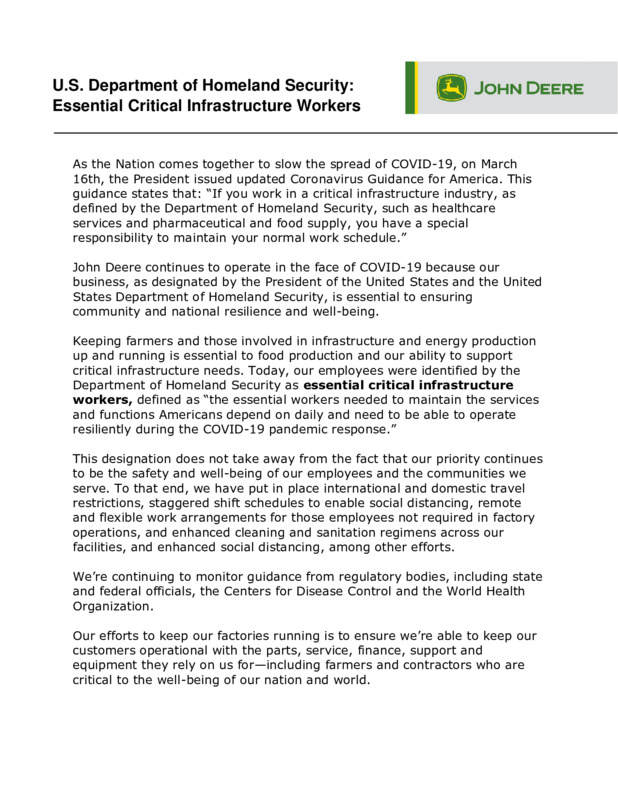
John Deere U.S. Department of Homeland Security: Essential Critical Infrastructure Workers
Statement from John Deere about being recognized an essential critical infrastructure worker available via their website. #HIST5241 -
 2020-03-23
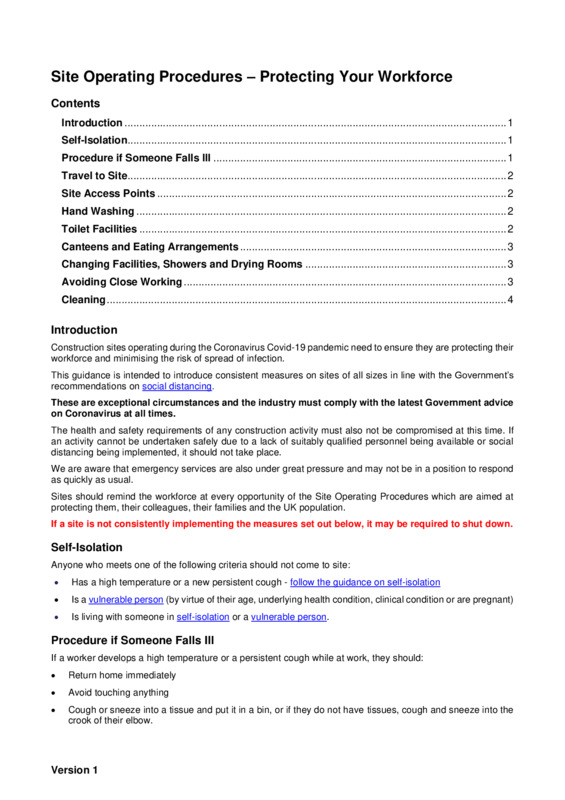
Site Operating Procedures - Protecting Your Workforce
Publication from the UK Construction Leadership Council on construction site safety precautions during the COVID-19 crisis. PDF available from Build UK website. #HIST5241 -
 2020-03-24
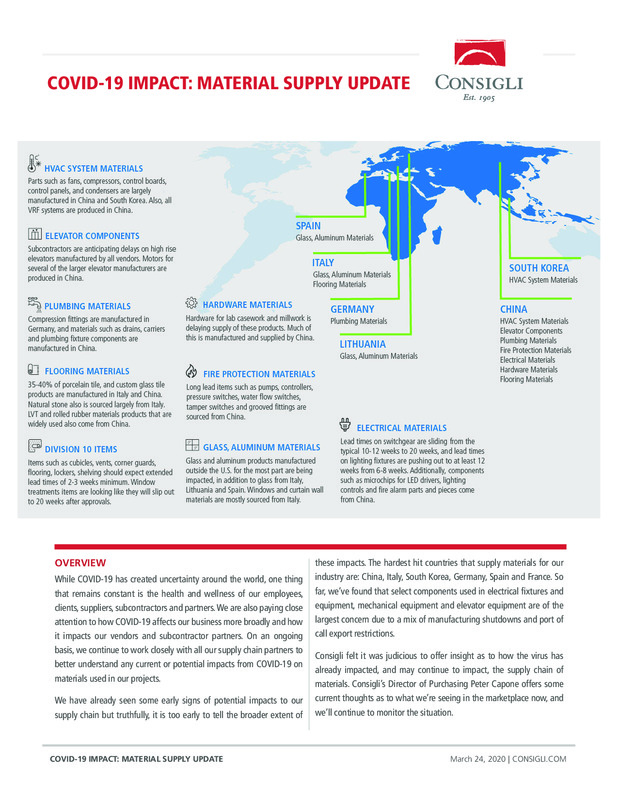
COVID-19 Impact: Material Supply Update
Discussion of the impact of COVID-19 on the U.S. construction supply chain. #HIST5241 -
 03/24/2020
"Amid uncertainty around COVID-19, architects adjust to a new normal"
Article on American Institute of Architects website discussing effects of COVID-19 on work. -
 2020-03-29
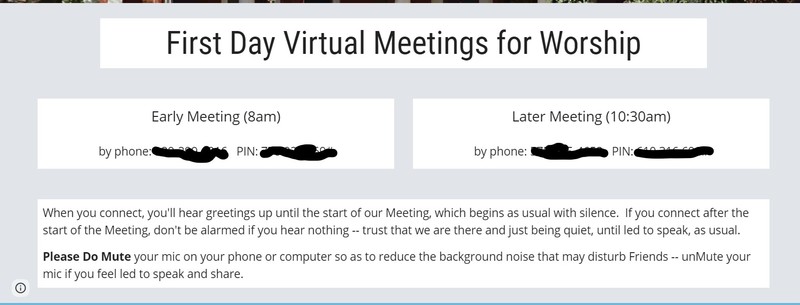
Quaker Virtual Silent Meeting
Traditional Quaker meetings include a period of silent meditation followed by community contribution. The Pima Friends of Arizona organized a virtual meeting during the outbreak. -
 2020-03-15
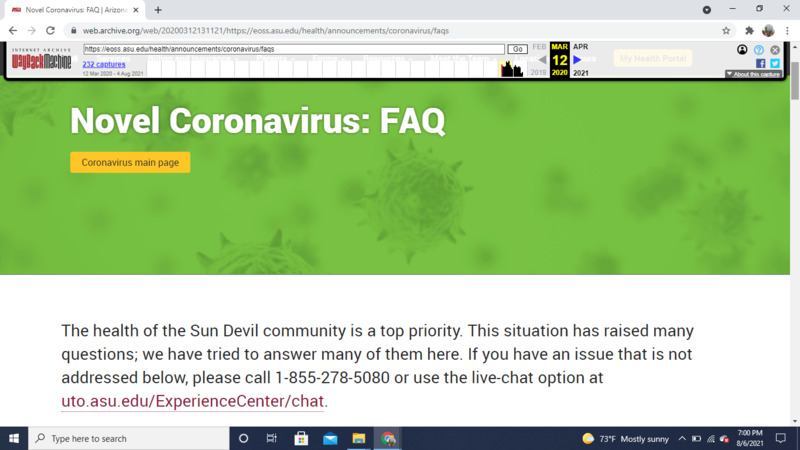
ASU Coronavirus FAQ
An evolution of ASU's Coronavirus FAQ page, as archived through the Wayback Machine. -
 2020-03-26
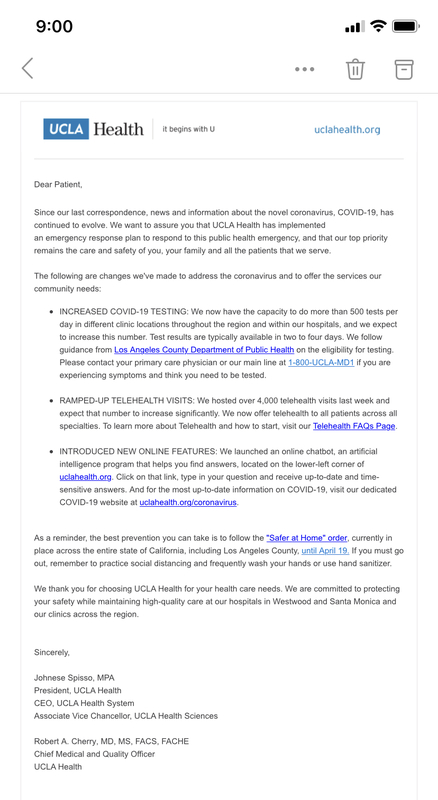
UCLA Health announces increase in COVID-19 tests to more than 500 per day
More than 3 weeks after the first confirmed case of coronavirus in Los Angeles County, health care systems are still struggling to provide testing in sufficient numbers . -
 2020-03-16
Governmental Coronavirus Postcard Mailer
I received this mailer on March 24, 2020. It outlines "President Trump's Coronoavirus Guidelines for America,' dated March 16, 2020. Includes various tips such as "Avoid eating or drinking at bars and restaurants--USE PICKUP OR DELIVERY OPTIONS," and "DO NOT VISIT nursing homes or retirement or long-term care facilities unless to provide critical assistance." Also recommends following state and local authorities' directions and visiting the coronavirus.gov website. "It is critical that you do your part to slow the spread of the coronavirus." -
 2020-03-22
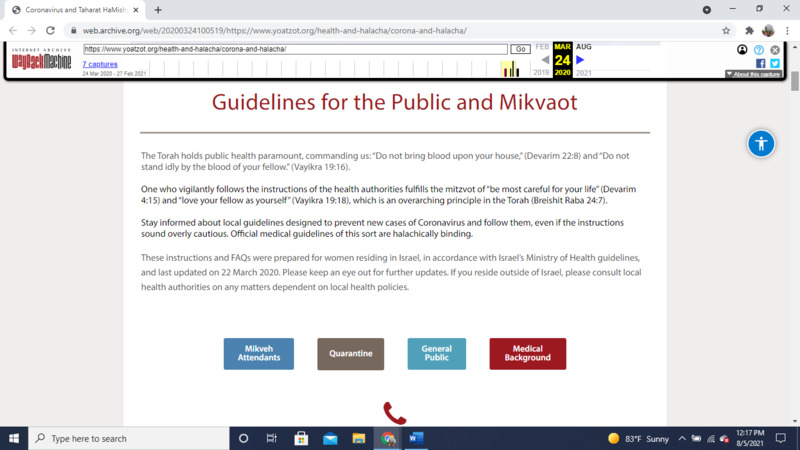
Coronavirus, Mikveh, and Taharat Hamishpacha
My partner shared an email with me from the Rabbi of a synagogue we're affiliated with, which addressed questions he'd received from congregants about how to deal with family purity laws under the current physical distancing restrictions. The email recommended reviewing the advice on this website, which provides guidelines for Jewish women performing ritual immersion at a mikveh (ritual bath) for the purposes of family purity, and for mikveh attendants, during the coronavirus outbreak. The advice was developed by Jewish women who are revered as experts in this aspect of religious law. -
 2020-03-23
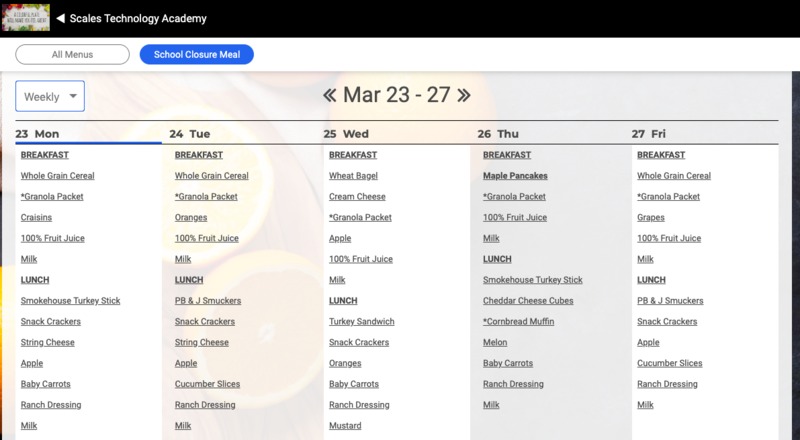
Menu for grab and go breakfast & lunch at Scales Technology Academy, March 23-March 27, 2020.
When public schools closed across Arizona, some worried that low-income students who normally receive breakfast and lunch at school for free, might face food insecurity. 9 Schools across Tempe, AZ offer a grab and go breakfast and lunch. -
 2020-03-04
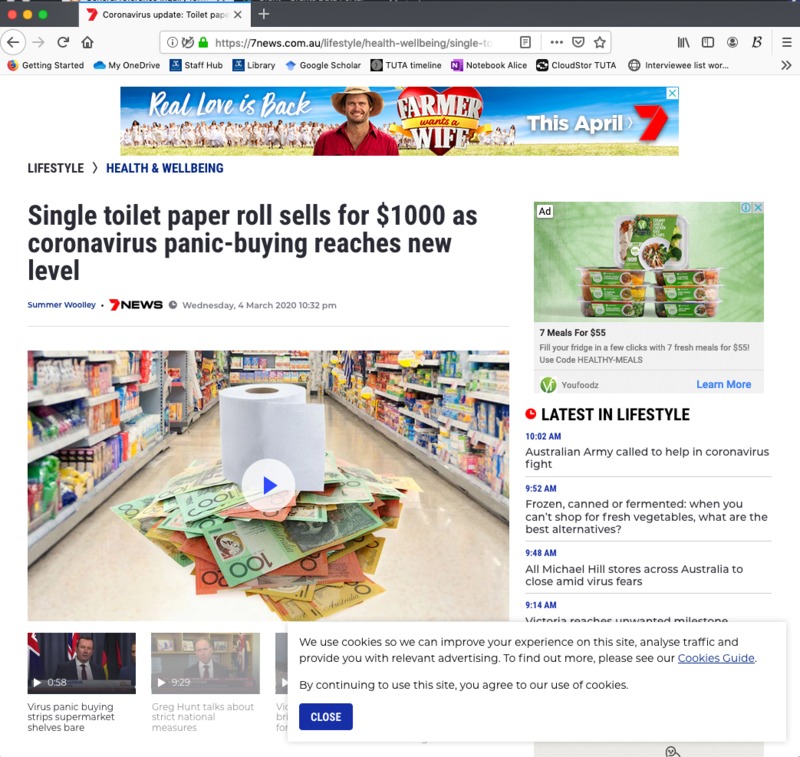
Single toilet paper roll sells for $1000 as coronavirus panic-buying reaches new level
A commercial news website reports on the panic buying of toilet paper. URL for full article here: https://7news.com.au/lifestyle/health-wellbeing/single-toilet-paper-roll-sells-for-1000-as-coronavirus-panic-buying-reaches-new-level-c-729542 In Australia, supermarket shelves were stripped of many essential items once people understood how serious the pandemic was, but the one that became a national obsession was toilet paper. People were filling trolleys with packs of toilet paper as soon as they realised lockdowns might be ordered. Major supermarkets eventually instituted 2 packs per person limits. A black market emerged online. There were many many memes, videos, articles, as well as serious analysis of this phenomenon. The irony is that toilet paper is in fact produced in Australia, so it was never going to run out. So this was an opportunity for us to think about human irrationality and panic; local and global manufacturing (and ignorance of this); enjoy humour as a response... and so much more. Also an opportunity to think about what people used before toilet paper was the norm - squares of newspaper, leaves etc! Suddenly ads for bidets appeared in our newsfeeds as well! -
 2020-03-20
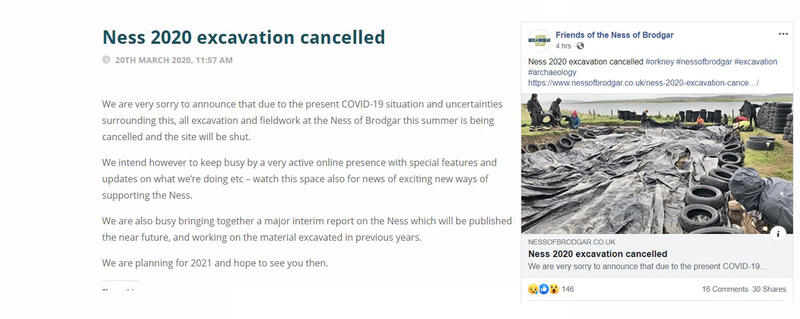
Dig season canceled - Ness of Brodgar
The Ness of Brodgar dig season has been canceled in Orkney, Scotland, United Kingdom. Text of the announcement as follows: Ness 2020 excavation cancelled 20TH MARCH 2020, 11:57 AM We are very sorry to announce that due to the present COVID-19 situation and uncertainties surrounding this, all excavation and fieldwork at the Ness of Brodgar this summer is being cancelled and the site will be shut. We intend however to keep busy by a very active online presence with special features and updates on what we’re doing etc – watch this space also for news of exciting new ways of supporting the Ness. We are also busy bringing together a major interim report on the Ness which will be published in the near future, and working on the material excavated in previous years. We are planning for 2021 and hope to see you then. -
 March 19, 2020
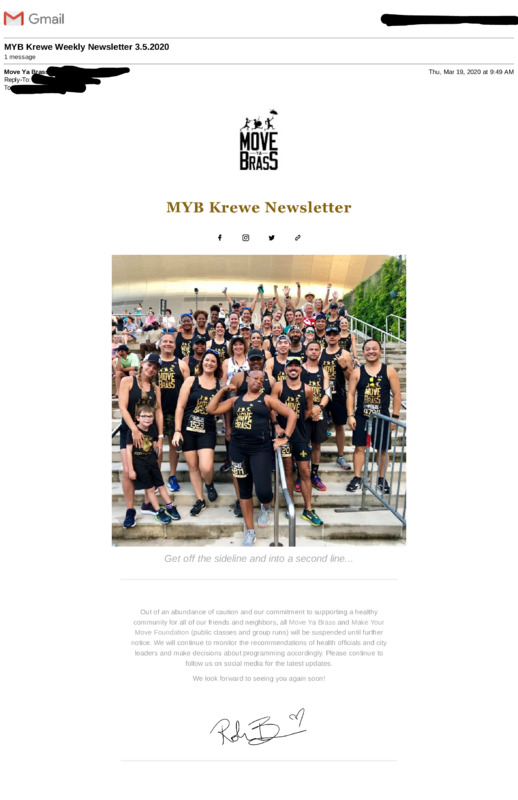
Move Ya Brass Krewe Weekly Newsletter
Email from Move Ya Brass, a New Orleans non-profit offering guided community workouts, canceling future community dance classes and offering virtual dance classes via Instagram to encourage social distancing in light of the Covid19 pandemic. -
 2020-03-18
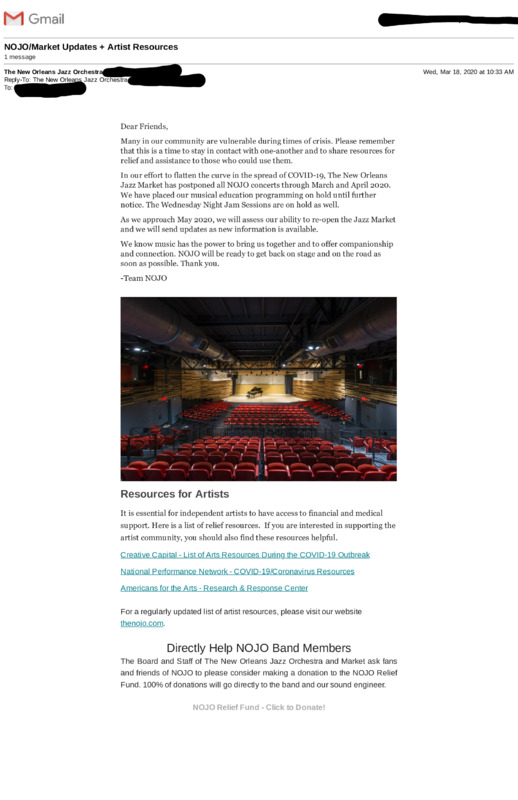
The New Orleans Jazz Orchestra Updates + Artist Resources Email
The New Orleans Jazz Orchestra (NOJO) email announcing all NOJO concerts, jam sessions, and educational programs are postponed through April 2020. -
 2020-03-18
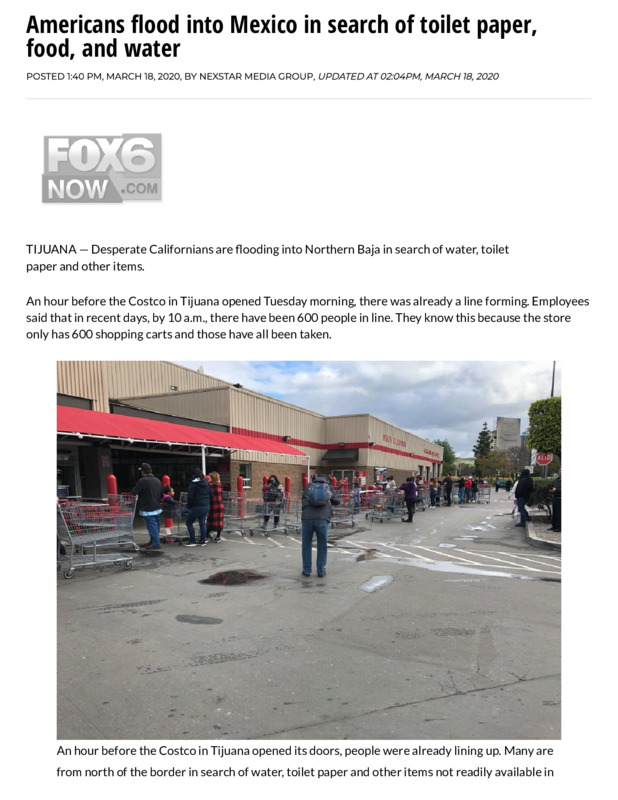
Americans flood into Mexico in search of toilet paper, food, and water
An online news article about people from the USA (California) crossing the US-Mexico border in order to purchase high-demand products such as toilet paper, bottled water, and food. -
 2020-03-11
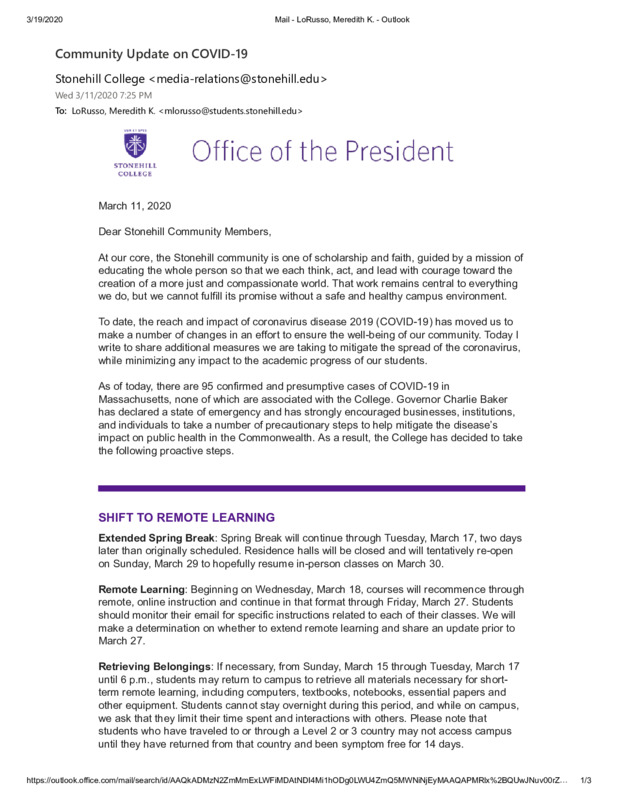
Stonehill College shifts to temporary remote learning (email)
On March 11, 2020, the Office of the President at Stonehill College sent out an email notifying students that the school would be making a temporary shift to remote learning. -
 2020-03-11
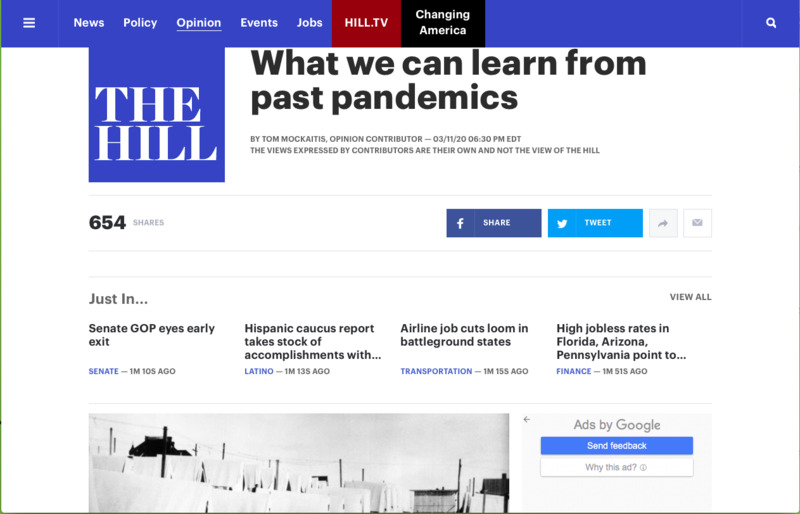
What we can learn from past pandemics
The article provides a good overview of the history of pandemics, from the 6th through 20th centuries. -
 2020-03-17
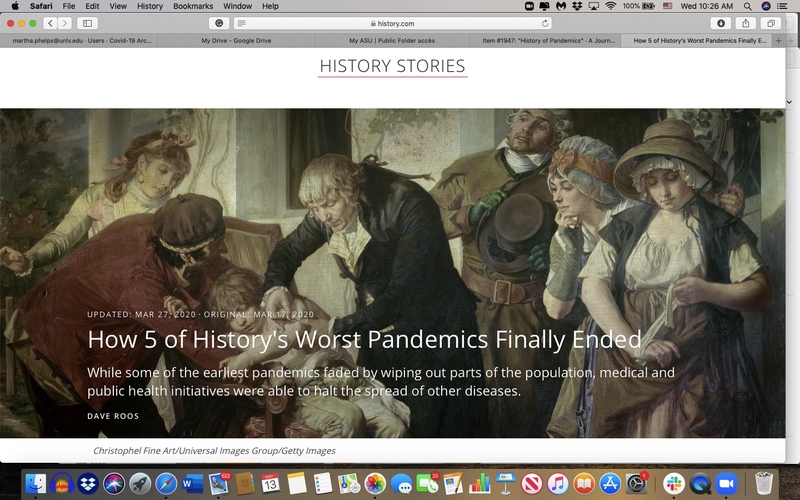
Historical Pandemics
An overview of history's greatest pandemics and how they ended. -
 2020-03-18
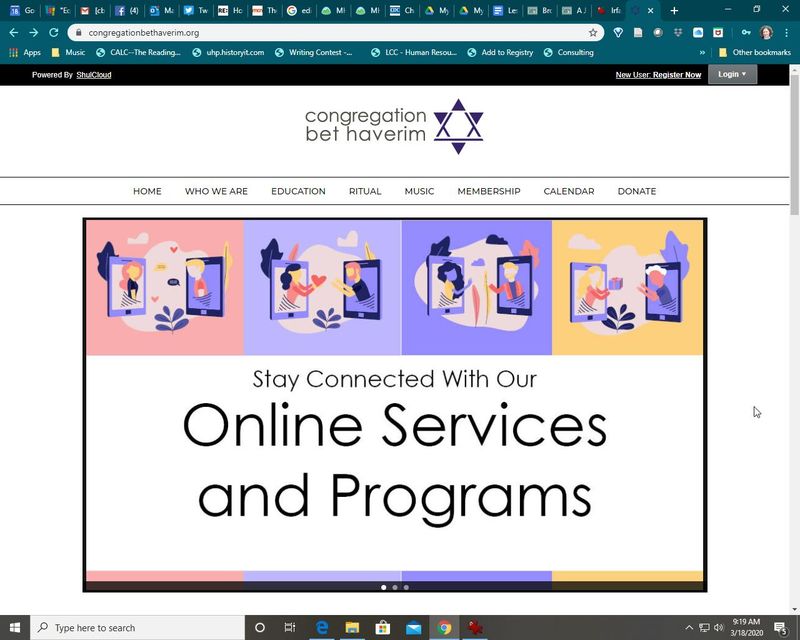
Stay Connected with our Online Services and Programs
Congregation Bet Haverim in Atlanta, Georgia, started holding services and programs remotely on March 16, 2020. The move was made for general public health reasons, and in particular to protect the many vulnerable individuals who are part of the synagogue community. -
 2020-03-18
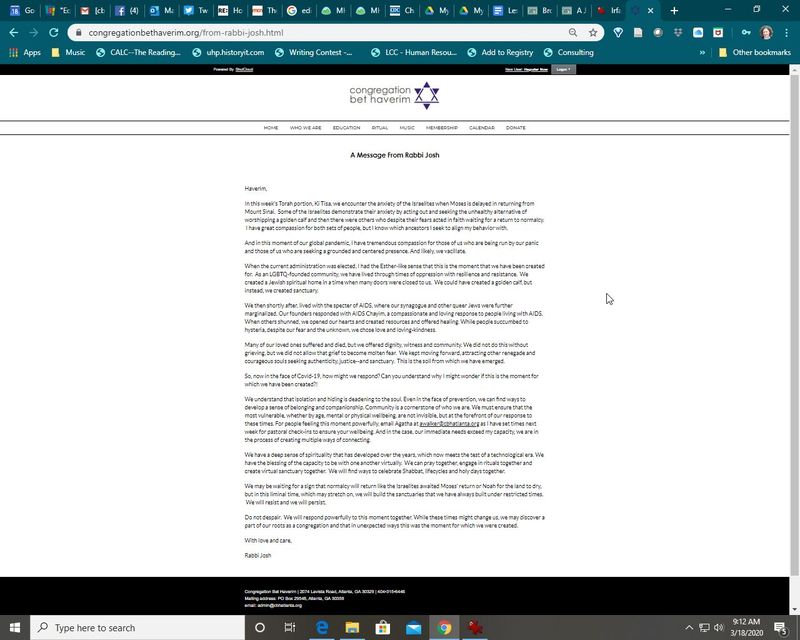
Message from Rabbi Josh at Congregation Bet Haverim in Atlanta, Georgia
This message was posted by Rabbi Joshua Lesser of Congregation Bet Haverim in Atlanta, Georgia, a Reconstructionist synagogue founded by LGBTQ+ Jews in the 1980s, during the AIDS epidemic. The message offers spiritual guidance and grounding in the synagogue's history of compassion toward people who were marginalized during the HIV epidemic that ravaged and stigmatized the Gay community at the time of the synagogue's founding. -
 March 16, 2020
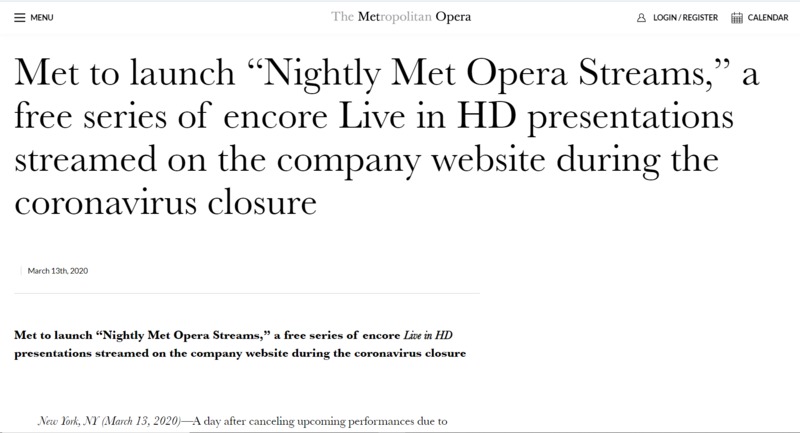
The Metropolitan Opera Offers Free Nightly Streams of Past Performances During Coronavirus Closure
An article from the Metropolitan Opera's official website announcing free nightly streams of archived past performances after cancelling their live performances due to the coronavirus. In the article, the Opera states that their aim is to provide comfort to people during the difficult time. -
 2020-03-17
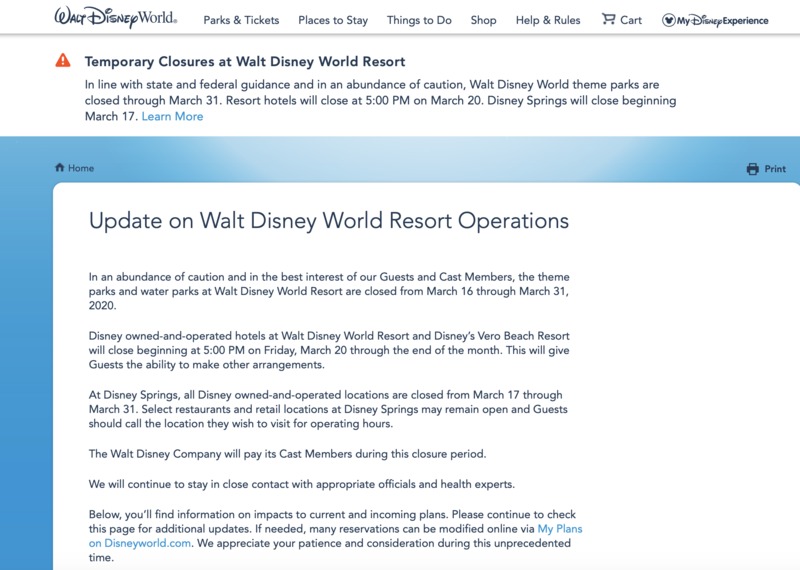
Public Entertainment (such as Walt Disney World & sporting event stadiums) closed due to COVID 19
Public entertainment sites such as Walt Disney World (see picture) have closed due to COVID 19. Additionally, college and professional sports have cancelled or postponed games. At the beginning of the virus teams continued to play but without fans in the stadium. Now sporting events have either been cancelled or postponed including professional teams such as the National Basketball Association (NBA) and Major League Baseball (MLB). College sports have also been cancelled such as the Big East Tournament and March Madness for college basketball. -
 2021-01-16
TOMMY CHURCH! I ONLY MISS U WHEN IM BREATHING DADDY!
I used to tell my dad if I had to choose between loving you and my last breath daddy, I would use my last breath to tell u I loved you! Then he got covid and I tried to give him one of my lungs. I would of given him both of them. I never got to touch him.ir comfort him only look at him thru glass. He had to be all alone to die. If I could if touched him I felt as thou I could of healed him as touch is more powerful then one will ever know. My dad was the most kindest helpful and giving man I have ever known. He will never be forgotten. Rising him the way covid took him has left a hole forever in my heart. -
2022-11-08
The Sunset of covid-19
My experience with Covid 19 was all over the place. If I were to describe it in one word it would be chaos. I remember going to Kingsborough Community College at the time and just everything shutting down and not knowing what to do. I remember all my classes turning into online classes. During this time, my mother fell ill with covid before any vaccines came out. I remember seeing how ill and bedridden she was. I was scared My mother was going to pass away and started bawling my eyes out to brother. Covid hit alot of my family and I started to become depressed. I ended up dropping all my classes because mentally I was not there. Eventually, my mother and other family members recovered, but some were not so lucky. An old friend from down the block lost their mother to covid. We used to practice karate together as kids with my brothers and her brother. Her mother was Sandra Santos-Vizcaino the first NYC public teacher to die of covid 19. I used to know their mother from the karate tournament and block parties we went to so finding out she passed away made me realize how lucky I was with my family. After all of this I got motivation again to start doing something with my life because at this point i was just rotting in my room for a few months. I ended up finding a job at a covid hotel in queens where I had to always wear a mask, gloves, vizor, etc. I was working alongside some doctors and nurses. It was such a different experience from anything I worked at before. Covid 19 had such a significant impact on everyone's lives and will forever leave a scar in many family's hearts. -
2024-05-09
COVID 19 zero contact
The pandemic was the worst for me to be honest because I couldn't take a class that was designed for on campus. Because of that, I had to drop the class and wait for campus classes to be available so I could learn better in the classroom settings. I was depressed because it was my first time dropping a class since I started college in spring 2018. I had to wait for the next semester to retake the class which held me back a semester . I'm happy I got out of that stage which took me a while to get out of. I had to go to work regardless of what was happening in the pandemic because I was working in a retail store at the time and wasn't allowed to stay home like other people. Until you have COVID and you submit your doctor's note to get two weeks off. The new rules that were made for the retail stores cause people to fight because of a cough or a sneeze was just overall depressing. The news was very depressing because older people in the nursing home could see their loved ones before they die or hug them for the last time. Nurses couldn't go home to their family because they had to work long hours and they did not want to carry any disease home to their loved ones. 2020 was No bonding time at this moment. -
2020-08-18
life in camera
When COVID-19 first started I was in 8th grade. I didn't really understand what Covid really was or how serious it was. I went in feeling kind of okay about it all and staying at home. Once high school started things went downhill for me mentally. I did pretty well in school. I did all my work and turned it in on time and got good grades, but I struggled a lot mentally with myself and socializing with others. During that time being at home did help me to get closer to my mom, we would go walking throughout the day and that helped me a lot to start losing weight a lot more. However, I started to become depressed and struggled with my outward appearance a lot. Once we started going back to school in person, I didnt know ow how to act, I just felt ugly and quiet. I used to be such an outgoing person and I would talk to almost everyone. Now I don't like being in public and around others. I have very bad social anxiety and overthink a lot about what people think of me. I personally never got Covid-19 so I don't know how that can affect someone physically and I hope I never do. I watched those around me get it and the way that they struggled and even saw a few of them die. It was a really depressing time, to watch your loved ones around you hurt and struggle and eventually give up, and you're never able to see them again. Going back to school in person did help me a lot. Socializing with people and seeing my friends that I hadn't seen in so long was what really helped me to get out of my shell and help me love myself more. -
 2020-04-17
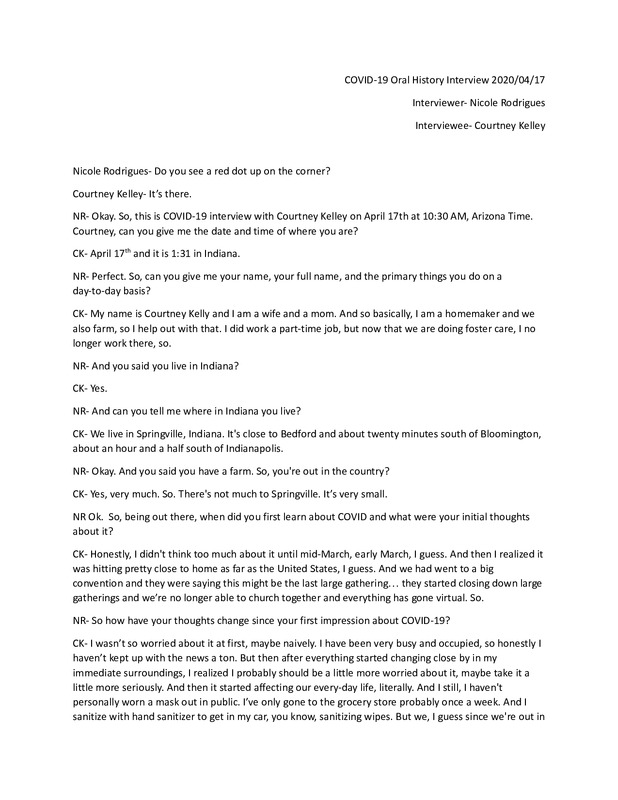
Courtney Kelley Oral History, 2020/04/17
-
 04/17/2020
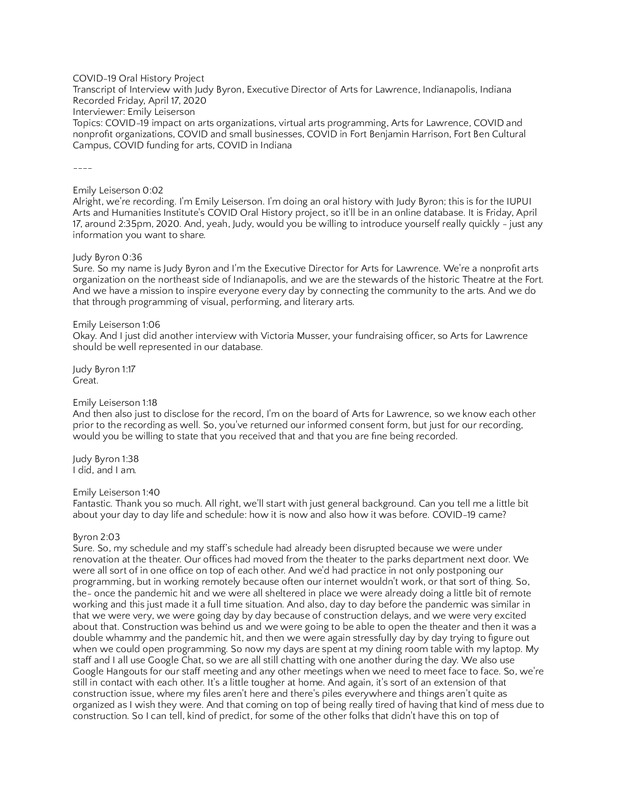
Judy Byron Oral History, 2020/04/17
-
 04/16/2020
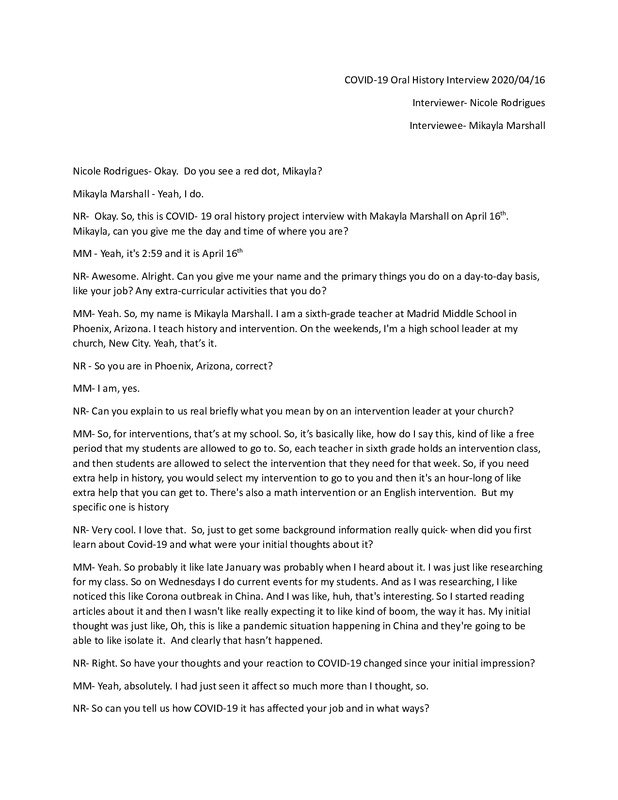
Mikayla Marshall Oral History, 2020/04/16
-
 2023-05-14
Pandemics are Not "Great Equalizers" - Comparing COVID-19 to the Bubonic Plague Outbreak of 1870-1905
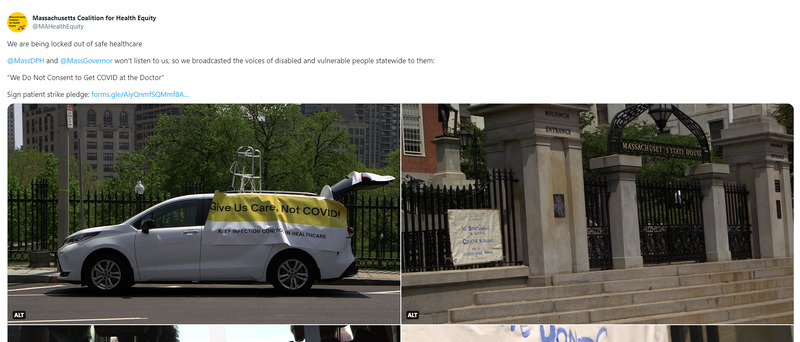
With the designation of COVID-19 as a "public health emergency" by the Centers for Disease Control and Prevention (CDC) ending as of May 11, 2023, public healthcare facilities throughout the US are rolling back protections they once employed to try to keep people safer during this ongoing pandemic. So, as this unit asks of us students, are pandemics the “great equalizers” in terms of social inequalities, and is there more equality now that the "emergency" has been deemed to be over? I argue that this is not the case, as immune compromised and disabled people have been more or less left for dead. A huge swath of healthcare facilities have removed mask mandates for care providers and hospital visitors, which leaves vulnerable and immune compromised people at a much higher risk of getting COVID-19 while receiving the medical care that is necessary for them to manage their conditions. In response, people and organizations, such as the Massachusetts Coalition for Health Equity in the tweet above, have begun to mobilize in favor of maintaining COVID-19 protections in healthcare settings by organizing strikes, protests, petitions, and phone banks to public officials. The reasons for maintaining COVID precuations such as mask mandates, access to COVID tests, and enhanced filtration in healthcare settings are clear. As the Massachusetts Coalition for Health Equity describes in their petition titled "Patient Strike Authorization Vote," the CDC "advises immunocompromised people to avoid crowded indoor settings, which now includes all healthcare institutions without universal masking," essentially maintaining that COVID is dangerous to immune compromised people while giving them no option but to risk exposure if they want to receive their necessary healthcare (Patient Strike Authorization Vote). The petition text explains that "[n]ational leaders in hospital epidemiology argue that universal masking should become the new standard of care, as gloves became with HIV" in order to keep people with compromised immune systems such as young children and elders safe (Patient Strike Authorization Vote). Currently, disabled and immune compromised people "are being locked out of safe healthcare" and are facing discrimination that makes them unwelcome and unsafe in healthcare settings (Massachusetts Coalition for Health Equity). In order to relate this modern COVID-19 pandemic to our course materials and demonstrate that discriminatory treatment during times of disease is not new, I will compare the above post to points from the text "The Chinese as Medical Scapegoats In San Francisco, 1870-1905" by Joan B. Trauner. This text discusses the discrimination against Chinese and other East Asian people living in San Francisco's Chinatown during a bubonic plague outbreak in the late nineteenth century. Sinophobic and anti-Asian sentiments, similar to those that arose during the epidemic Trauner details, have also been evident throughout the COVID-19 pandemic, so much so that even US President Donald Trump referred to COVID-19 as the "China virus." Ableism has also been prevalent throughout the COVID pandemic, as many people no longer care about the effects of the virus, because it harms disabled and immune compromised people most, especially people who also face racial discrimination in healthcare. Trauner explains that, because white people in the US believed the plague primarily affected Chinese and other Asian people, and because plagues were bad for business,"[t]he governor of California, Henry T. Gage, and executives of big business and of the large railroads, in conjunction with the San Francisco Board of Trade, the San Francisco Chamber of Commerce, and the Merchants Association, were all determined to prove that the plague did not exist in San Francisco" (78). The author of the Patient Strike Authorization Vote argues that today, we see a similar pro-business sentiment that comes at the expense of immune compromised people who are more likely to get sick with and die from COVID-19, writing: "Hospitals that remove masks and surveillance testing are making a value judgement about our lives, because they want to preserve their profit margins" (Patient Strike Authorization Vote). The CDC's ending of the COVID-19 public health emergency designation and the resulting halt of COVID mitigation procedures indicate that people are ignoring the needs of immune compromised people so that everyone can feel more comfortable going "back to normal" and maintaining consumption habits that are desired by businesses. Additionally, in both the past plague outbreak and the current pandemic, public health officials have shown hesitancy to give people vital information, which has led to harm. As Trauner explains, during the bubonic plague epidemic, "San Francisco Mayor Eugene Schmitz refused to approve the printing of health reports and vital statistics and even attempted to remove from office four members of the Board of Health who persisted in stating that plague existed in San Francisco" (79). Today, because the public health emergency designation ended on May 11th, 2023, the CDC is "no longer reporting aggregate cases and deaths, COVID-19 Community Levels, COVID-19 Community Transmission Levels, or COVID-19 Electronic Laboratory Reporting (CELR) data," all of which have been used to determine the severity of the situation throughout the pandemic (COVID Data Tracker). Meanwhile, over one thousand people are dying of COVID every single week, but COVID transmission levels are not being tracked, so people cannot know how many COVID positive cases there are in their county and how likely they are to contract the virus by going out in public (COVID Data Tracker). Another similarity between the COVID-19 pandemic and the bubonic plague outbreak of the late nineteenth century lies in the responses of the people facing discriminatory treatment in public health settings during these respective disease outbreaks. Trauner writes that before, during, and after the bubonic plague outbreak, Chinese businesses and health practitioners constructed and operated their own hospitals that would treat the people of Chinatown, because they were not welcome at other hospitals due to racial discrimination (81). Trauner explains that "[e]arly Chinese immigrants realized the necessity of banding together and providing for their own health care needs," in light of the government abandoning their health needs (81). Activists and organizations like the Massachusetts Coalition for Health Equity are currently banding together and fighting to get better and safer care for immune compromised people during the COVID-19 outbreak, as they are also facing discrimination at hospitals rolling back COVID precautions, because these spaces are not safe for them. The organizing they are doing to try to make healthcare settings safer for immune compromised people looks different, as no one is proposing the creation of immunocompromised-specific hospitals. They are fighting for better treatment, still, using slogans like "We Do Not Consent to Get COVID at the Doctor," and urging people that "[w]e must take collective action to prevent this mass violation of our human rights and federal rights to safe care," as stipulated under the Americans with Disabilities Act (Massachusetts Coalition for Health Equity). In both disease outbreaks, it has been the duty of those being discriminated against to take care of and advocate for themselves. So, in fact, pandemics are not "great equalizers"; in reality, they not only make pre-existing inequities even more visible, but exacerbate them even further. As Trauner argues, "Health policy [...] manifests not only the state of the medical sciences, but the expectations and the value system of society-at-large," and as such, if society-at-large is racist and ableist, then the health policies put into place will reflect these discriminatory values (70). These governmental measures come at a cost to everyone, and especially those facing racist and ableist discrimination. Had the nineteenth-century bubonic plague outbreak been determined an emergency and treated as a serious threat in spite of sinophobic and anti-Asian sentiments, perhaps more research could have been carried out sooner, and more lives could have been saved. If people in the US continue to take the COVID-19 pandemic seriously and not dismiss the pleas of immune compromised and disabled people to continue precautions, perhaps loss of life and further disablement from COVID infection can be mitigated. -
 2021-08-06
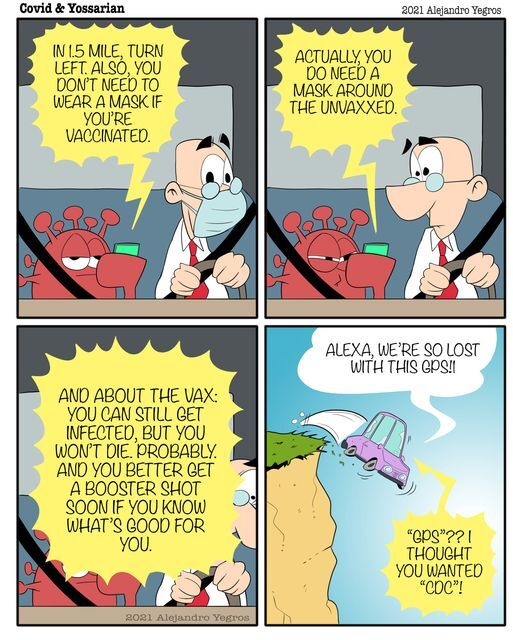
Alexis We're Lost
A comic strip about Covid-19 -
 05/26/2021
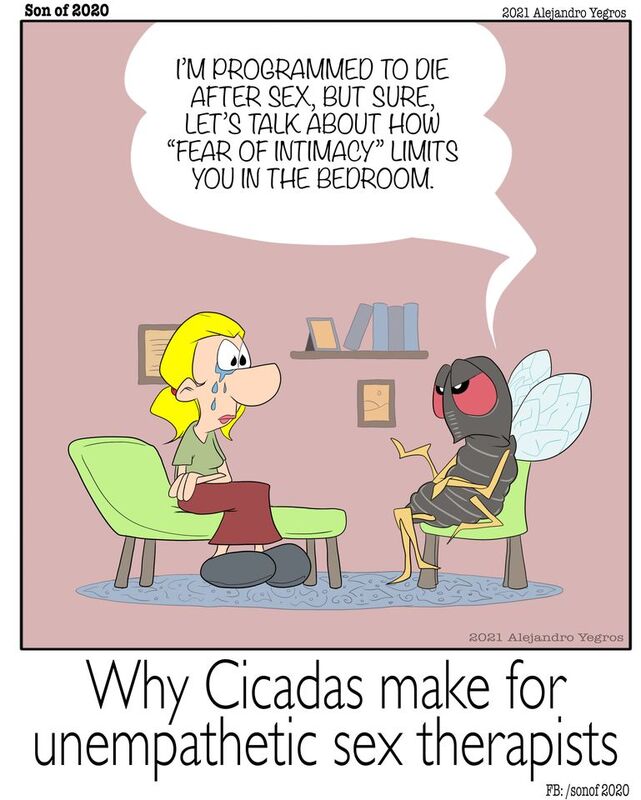
Cicada Sex Therapists
A comic strip about Covid-19 -
 2021-05-13
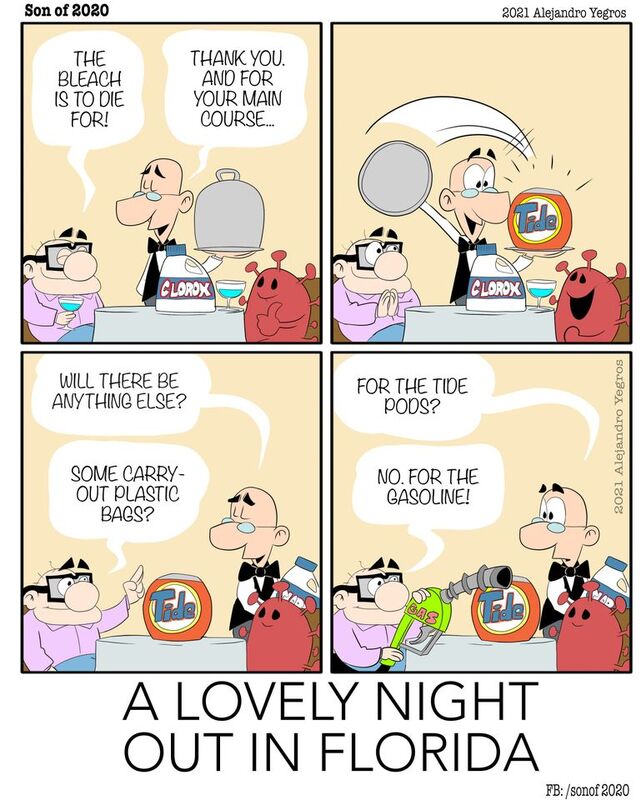
A Lovely Night
A comic strip about Covid-19 -
 11/29/2021
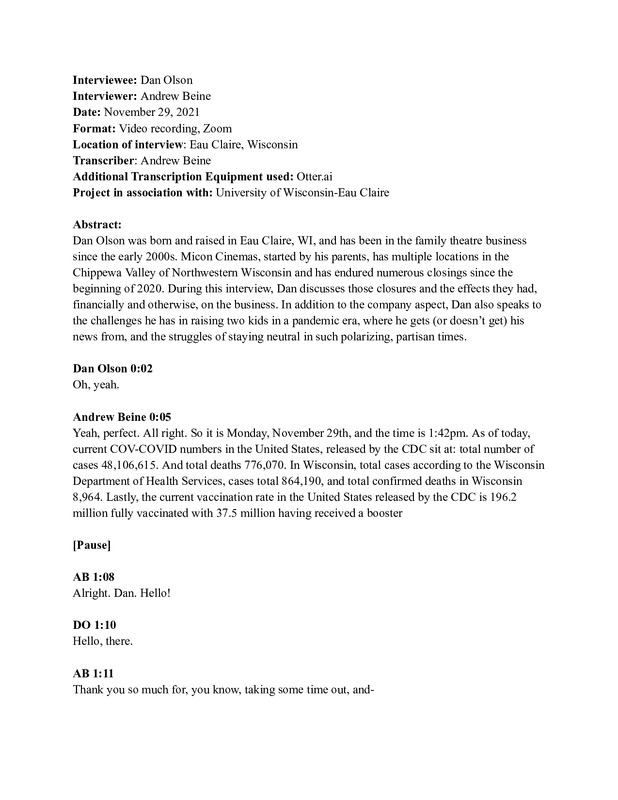
Dan Olson Oral History, 2021/11/29
Dan Olson was born and raised in Eau Claire, WI, and has been in the family theatre business since the early 2000s. Micon Cinemas, started by his parents, has multiple locations in the Chippewa Valley of Northwestern Wisconsin and has endured numerous closings since the beginning of 2020. During this interview, Dan discusses those closures and the effects they had, financially and otherwise, on the business. In addition to the company aspect, Dan also speaks to the challenges he has in raising two kids in a pandemic era, where he gets (or doesn’t get) his news from, and the struggles of staying neutral in such polarizing, partisan times. -
 12/01/2021
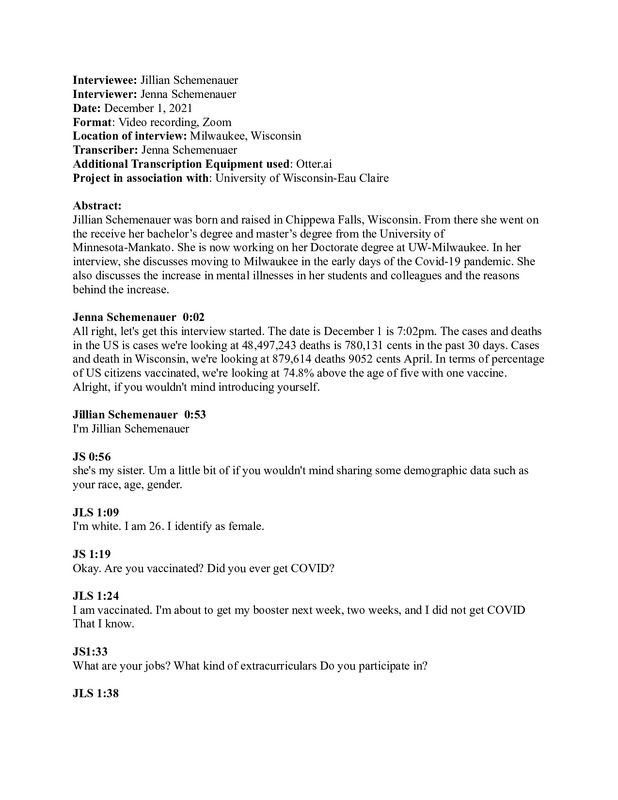
Jillian Schemenauer Oral History, 2021/12/01
Jillian Schemenauer was born and raised in Chippewa Falls, Wisconsin. From there she went on the receive her bachelor’s degree and master’s degree from the University of Minnesota-Mankato. She is now working on her Doctorate degree at UW-Milwaukee. In her interview, she discusses moving to Milwaukee in the early days of the Covid-19 pandemic. She also discusses the increase in mental illnesses in her students and colleagues and the reasons behind the increase. -
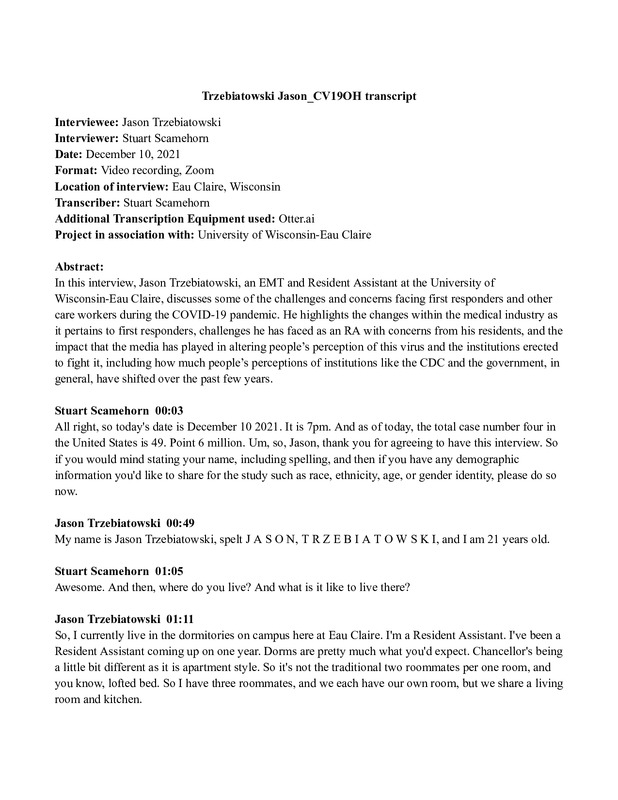 12/10/2021
Jason Trzebiatowski Oral History, 2021/12/10
In this interview, Jason Trzebiatowski, an EMT and Resident Assistant at the University of Wisconsin-Eau Claire, discusses some of the challenges and concerns facing first responders and other care workers during the COVID-19 pandemic. He highlights the changes within the medical industry as it pertains to first responders, challenges he has faced as an RA with concerns from his residents, and the impact that the media has played in altering people’s perception of this virus and the institutions erected to fight it, including how much people’s perceptions of institutions like the CDC and the government, in general, have shifted over the past few years. -
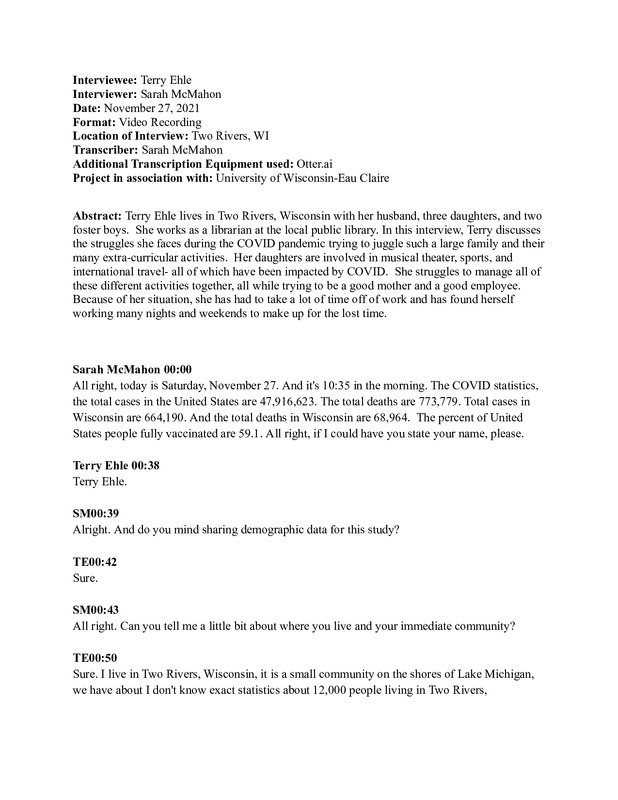 11/27/2021
Terry Ehle Oral History, 2021/11/27
Terry Ehle lives in Two Rivers, Wisconsin with her husband, three daughters, and two foster boys. She works as a librarian at the local public library. In this interview, Terry discusses the struggles she faces during the COVID pandemic trying to juggle such a large family and their many extra-curricular activities. Her daughters are involved in musical theater, sports, and international travel- all of which have been impacted by COVID. She struggles to manage all of these different activities together, all while trying to be a good mother and a good employee. Because of her situation, she has had to take a lot of time off of work and has found herself working many nights and weekends to make up for the lost time. -
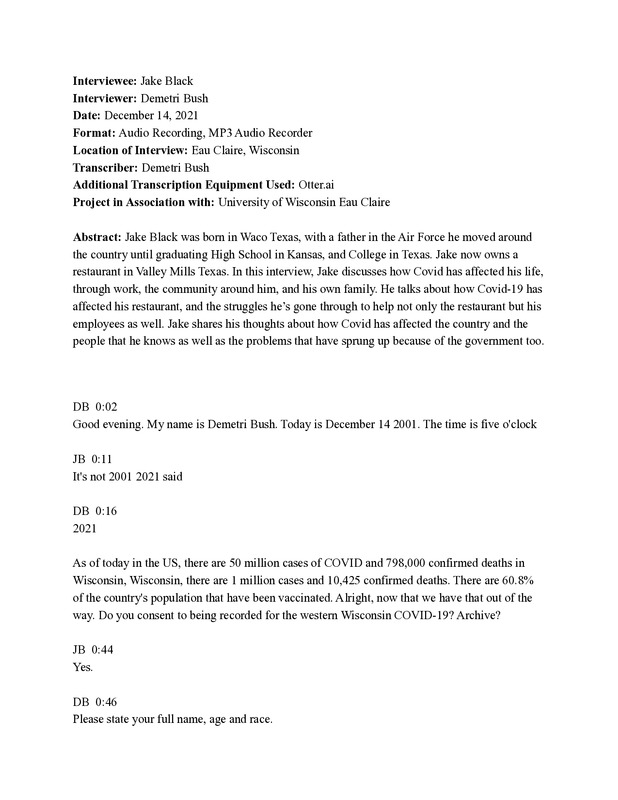 12/14/2021
Jake Black Oral History, 2021/12/14
Jake Black was born in Waco Texas, with a father in the Air Force he moved around the country until graduating High School in Kansas, and College in Texas. Jake now owns a restaurant in Valley Mills, Texas. In this interview, Jake discusses how Covid has affected his life, through work, the community around him, and his own family. He talks about how Covid-19 has affected his restaurant and the struggles he’s gone through to help not only the restaurant but his employees as well. Jake shares his thoughts about how Covid has affected the country and the people that he knows as well as the problems that have sprung up because of the government too. -
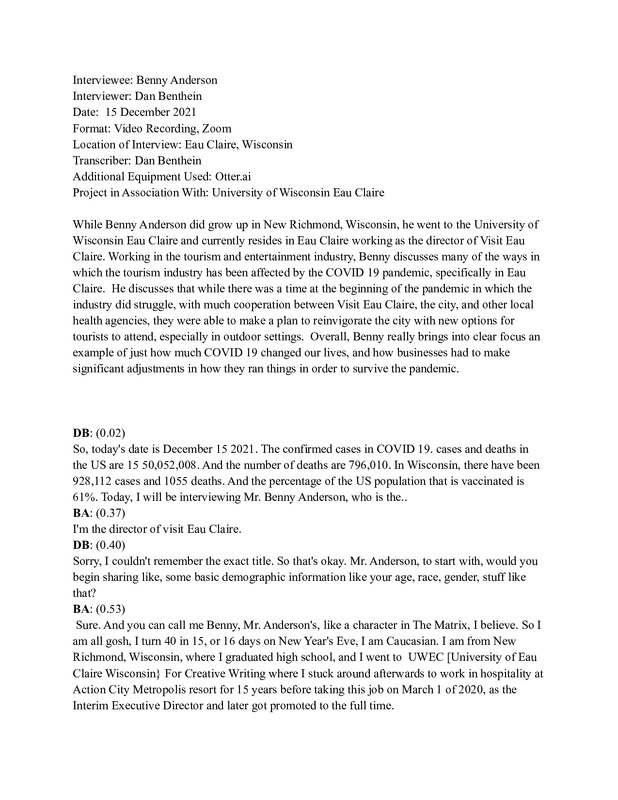 12/15/2021
Benny Anderson Oral History, 2021/12/15
While Benny Anderson did grow up in New Richmond, Wisconsin, he went to the University of Wisconsin Eau Claire and currently resides in Eau Claire working as the director of Visit Eau Claire. Working in the tourism and entertainment industry, Benny discusses many of the ways in which the tourism industry has been affected by the COVID-19 pandemic, specifically in Eau Claire. He discusses that while there was a time at the beginning of the pandemic in which the industry did struggle, with much cooperation between Visit Eau Claire, the city, and other local health agencies, they were able to make a plan to reinvigorate the city with new options for tourists to attend, especially in outdoor settings. Overall, Benny really brings into clear focus an example of just how much COVID-19 changed our lives, and how businesses had to make significant adjustments in how they ran things in order to survive the pandemic. -
 2020-05-24
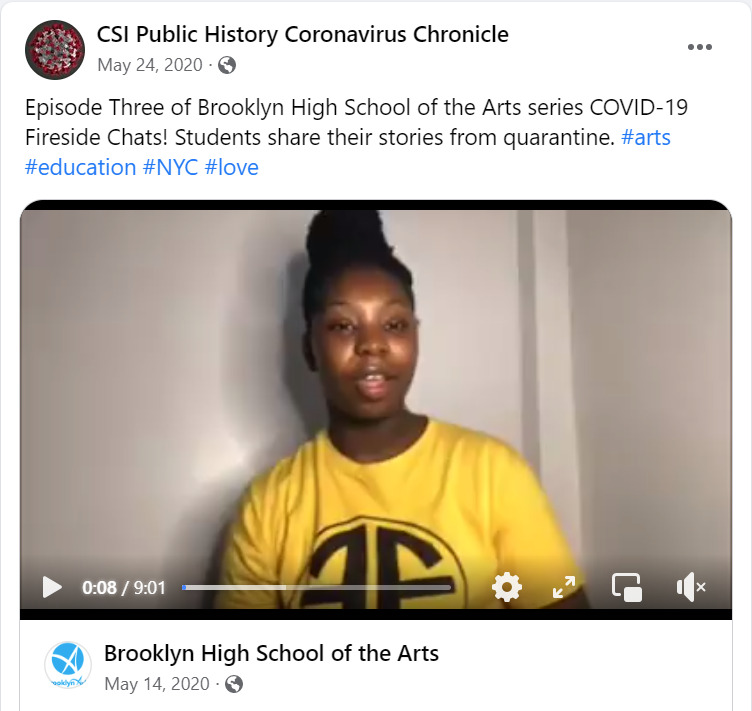
Fireside Chat Episode 3
Episode Three of Brooklyn High School of the Arts series COVID-19 Fireside Chats! Students share their stories from quarantine. -
 2020-03-05
Germs and Touch: Contact OCD during the pandemic
The pandemic, rather the first 5 months, was debilitating for my mental health. I suffer from a type of Obsessive Compulsive Disorder (OCD) called "Contamination OCD". This could also be known as germaphobia. When the pandemic began, I began to be cautious. I would slide my sleeves over my hands to open doors at the college I was attending. I stopped touching things directly. For years I already practiced this in the bathroom, such as not touching stall locks before using the toilet or always washing my hands before and after I went. Due to medical issues, my doctors advised me to truly quarantine for 30 days or more. This sent my anxiety into a severe shock. I truly, genuinely did not leave my home for 30 days. There may have been a few trash outings but I did not go to the stores or see friends; nothing. It is hard to describe how my touch was affected, especially if the reader does not understand contamination OCD. An example that truly became a problem for me is Amazon packages. For everyone else, Amazon was still running and this allowed everyone to still have fun; to still live. For me, any package I took in, I used gloves. I would not touch the box. In my mind, the carrier could have had COVID, which would be outside the box. Inside, the handler could have coughed on the item as well. Even the manufacturer could have contaminated it. I cut trash bags in half and laid my items on them as I carefully dissected each one. Anything that came into my home, groceries too, was wiped down with bleach or Clorox wipes (if I had them). Amazon packages were quarantined for 10-14 days in a cupboard so the alleged virus would die and then I could use it. I remember how dry my hands were from washing 20 times a day, at least. The way the bleach would hurt my hands if I forgot gloves. Clorox wipes were familiar and on ration as I cut each one in half to make them last. The gloves I had were the last box in my city after searching for a whole day. I had tickets booked to Seoul, South Korea the first week of March 2020...which was obviously cancelled. For me, everything was dirty until I got to it. Even then, I barely trusted it. My couches, handles, walls, phone, laptop, window, groceries, bags, clothing, and more all went through cleaning as they came into my home. I would never sit on any furniture in "dirty" clothes from the outside. I had to shower and throw them in the wash. My mind was obviously anxious and ill. While I have severely recovered and pushed those limits, I still find myself holding onto those habits, knowing the risk is still out there. My hands still dry out from washing and I use hand sanitizer too much. I haven't had COVID yet, so I am holding out. -
 2022-05-26
From COVID-19 to shootings: Is mass death now tolerated in America?
This is a news story from The Associated Press. Just recently, there have been over one million COVID deaths recorded in the United States. The author of this piece asks if Americans have just begun to tolerate mass death. Racial and social inequalities are also cited, where the author claims that those of certain backgrounds are more likely to die sooner or more violently. The COVID deaths are then related to the recent shooting deaths, such as in Buffalo and in Texas. While the gun violence deaths are lower than the COVID deaths, the author uses this to show that little is being done for either to help lessen the amount of deaths. I don't agree with the author completely on this due to dying from COVID being very different from dying from a mass shooter. With COVID, people could pass it along unknowingly and get someone infected, as it is an asymptomatic spread. With a mass shooter, it is much less predictable and far more sudden. From what I have seen on my social media, I did not see anyone I follow really mark the 1,000,000 COVID death milestone, but many have expressed outrage over both the Buffalo and Texas shootings. I don't think the question should be whether Americans accept mass death or not, but of methods of prevention. Obviously, gun ownership won't solve all problems. The police that had guns were waiting outside the school as the shooter was slaughtering kids and adults. Though, one man with a gun, a border patrol agent, is who finally shot the mass shooter and killed him. This is more of a question of character, as well as how competent police forces are in these scenarios. I do not think the author made a fair comparison because protecting yourself from COVID to prevent death would be an entirely different process than protecting yourself from a mass shooter. While the goal of preserving life is the same, the methods differ. Outrage isn't an issue because I have seen people upset over death from COVID and mass shootings. The main problem I see is that people have trouble coming together on a solution.