Items
Search full-text
futcoins 26 Besuche die Website Buyfc26coins.com. Beste Qualität..N7Ft
-
 2022-05-03
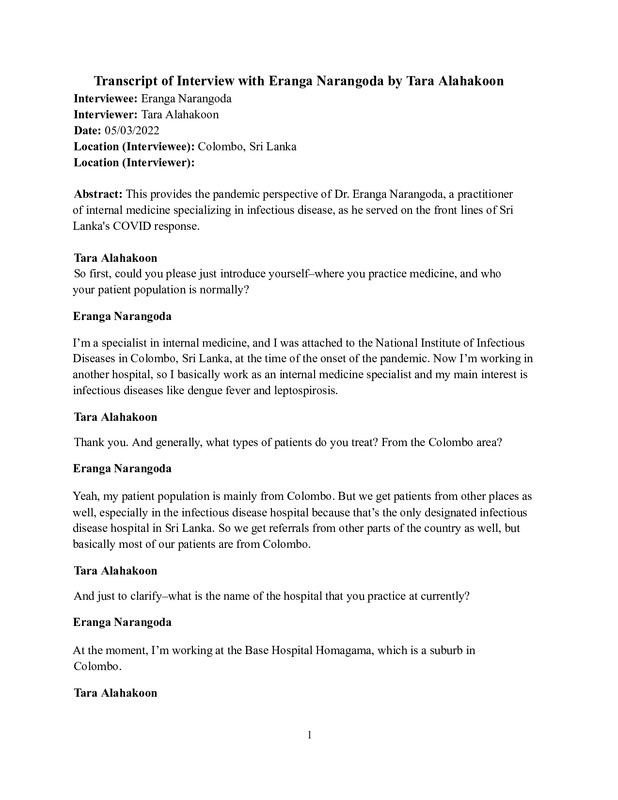
Eranga Narangoda Oral History, 2022/05/03
It provides the pandemic perspective of Dr. Eranga Narangoda, a practitioner of internal medicine specializing in infectious disease, as he served on the front lines of Sri Lanka's COVID response. -
 2020-06-01
A privilaged white latina women.
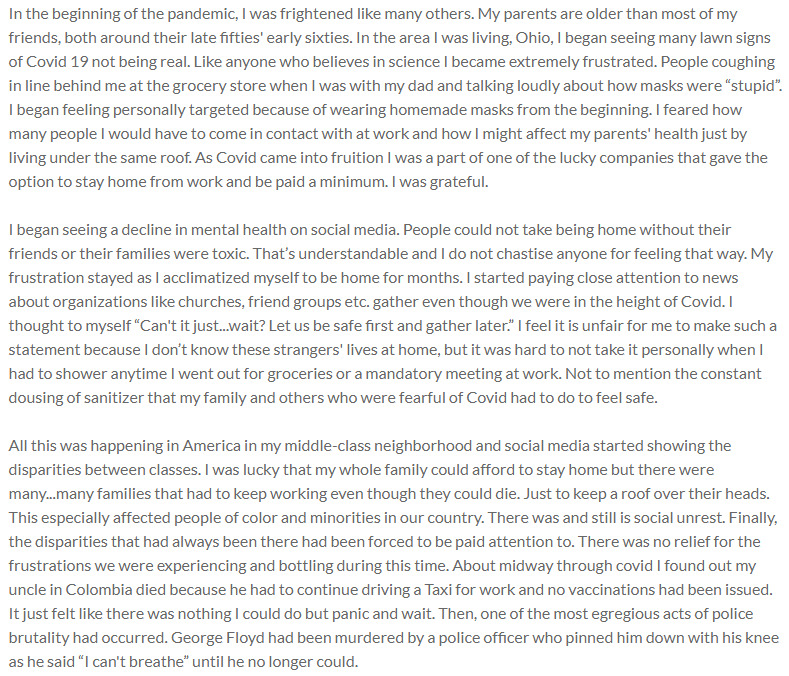
In the beginning of the pandemic, I was frightened like many others. My parents are older than most of my friends, both around their late fifties' early sixties. In the area I was living, Ohio, I began seeing many lawn signs of Covid 19 not being real. Like anyone who believes in science I became extremely frustrated. People coughing in line behind me at the grocery store when I was with my dad and talking loudly about how masks were “stupid”. I began feeling personally targeted because of wearing homemade masks from the beginning. I feared how many people I would have to come in contact with at work and how I might affect my parents' health just by living under the same roof. As Covid came into fruition I was a part of one of the lucky companies that gave the option to stay home from work and be paid a minimum. I was grateful. I began seeing a decline in mental health on social media. People could not take being home without their friends or their families were toxic. That’s understandable and I do not chastise anyone for feeling that way. My frustration stayed as I acclimatized myself to be home for months. I started paying close attention to news about organizations like churches, friend groups etc. gather even though we were in the height of Covid. I thought to myself “Can't it just...wait? Let us be safe first and gather later.” I feel it is unfair for me to make such a statement because I don’t know these strangers' lives at home, but it was hard to not take it personally when I had to shower anytime I went out for groceries or a mandatory meeting at work. Not to mention the constant dousing of sanitizer that my family and others who were fearful of Covid had to do to feel safe. All this was happening in America in my middle-class neighborhood and social media started showing the disparities between classes. I was lucky that my whole family could afford to stay home but there were many...many families that had to keep working even though they could die. Just to keep a roof over their heads. This especially affected people of color and minorities in our country. There was and still is social unrest. Finally, the disparities that had always been there had been forced to be paid attention to. There was no relief for the frustrations we were experiencing and bottling during this time. About midway through covid I found out my uncle in Colombia died because he had to continue driving a Taxi for work and no vaccinations had been issued. It just felt like there was nothing I could do but panic and wait. Then, one of the most egregious acts of police brutality had occurred. George Floyd had been murdered by a police officer who pinned him down with his knee as he said “I can't breathe” until he no longer could. America turned upside down. We saw videos of buildings being destroyed, fires, mass protests, shootings, the worst you could imagen. As a collective we had reached our boiling point and the last straw was this murder. My family was against my brother and I protesting because Covid still being at its height. I have protested at the Womens March in D.C and several pro-choice marches in Ohio but the Black Lives Matter movement was something I needed to educate myself on and stand up for. It was a calling for someone in my position of privilege to show up in numbers for people of color that deserve rights just as the rest of us. I often reflect on how my life could have been so different. My father is Colombian, and my mother is Polish. I look white and have always been raised in a middle-class neighborhood. I have not had to face the same injustices as my father, my family and minority groups in America just based off the color of my skin. Police brutality has always been in existence but when we were all home during Covid with modern day technology and video evidence, we felt that video to the core. We felt the pure rage and frustrations as a society of how we were not being cared for in the way we thought we would have been during this pandemic. I have never witnessed in my lifetime such united support for one another. Such a strong fight against people in power who are coming after the people we call friends, workers, lovers, and family no matter the color of their skin. In such destruction, pain and chaos I had never felt such beauty in our society. I will never forget the feeling of unity around me I had felt as hundreds of people laid down on the hard pavement during the Black lives Matter protest yelling “I cant breathe.” Finally, we could help the unheard be heard and take a deep breath together. -
 2020-08-19
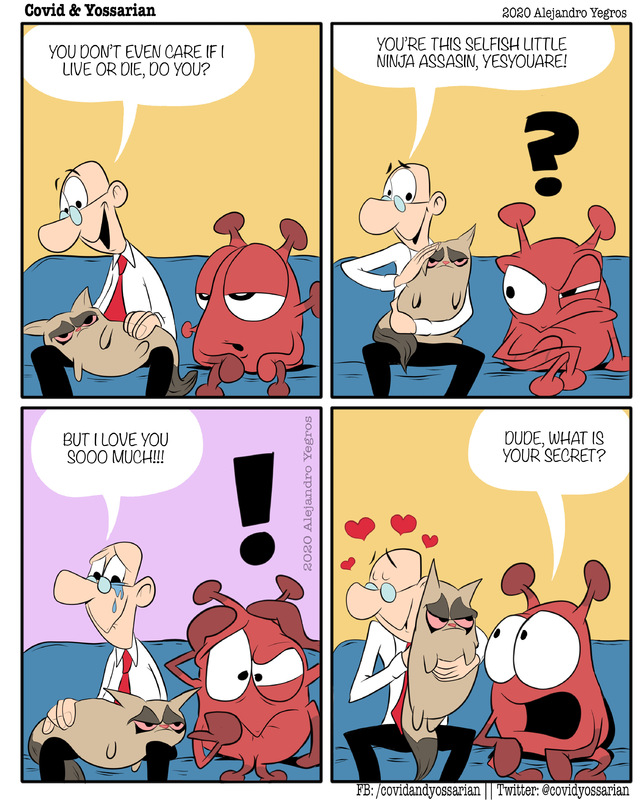
Cats vs Covid
A comic strip about Covid-19 -
 2022-04-08
The Herman Cain Award: the prize no one wants to get and creators want to destroy
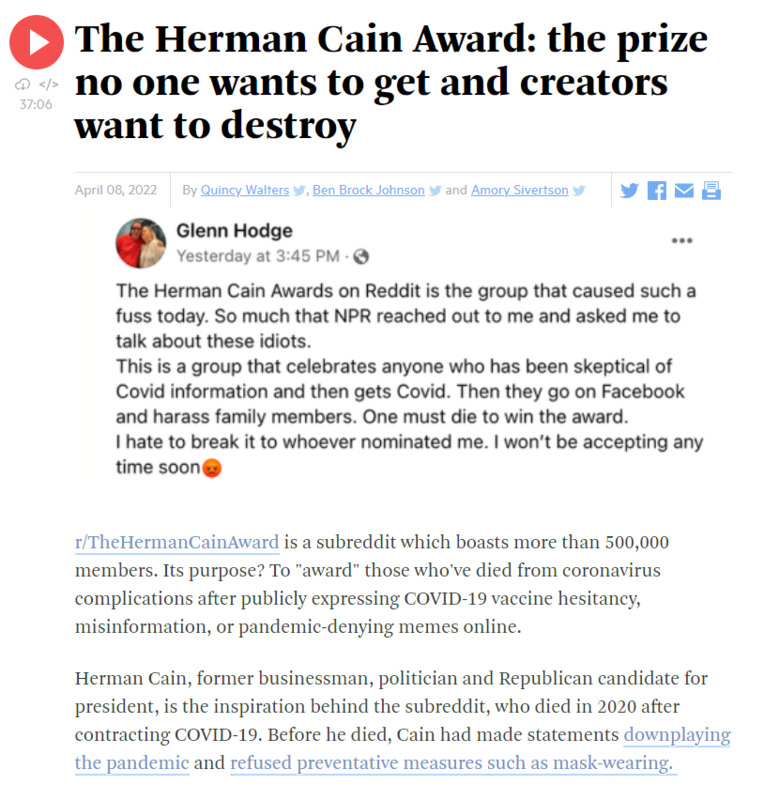
This is a news story from WBUR by Amory Sivertson, Ben Brock Johnson, and Quincy Walters. This is an interview that has been transcribed about the subreddit r/TheHermanCainAward. This subreddit has over 500,000 members. It is named after Herman Cain, a former businessman and Republican presidential candidate, who died in 2020 after getting the Coronavirus. One of the moderators, "Hammy", says that specific anti-mask and anti-vaccine people are featured on the subreddit in an attempt to influence, and in turn, take what is posted publicly, and throw it back in their faces. In order to get an "award" on the subreddit, one has to die. Nominations are for those that go to the hospital. The subreddit makes sure that all information is verified so people cannot call it "fake." They also go to lengths to black-out names, faces, and places in order to protect privacy. Though, even with attempts to make things anonymous, people are still found out. The moderator "Hammy" also does not wish to include their real name in this interview for fear of harassment. Glenn, someone that got featured in the subreddit, was also in this interview to explain his reasoning. Many of his doubts stem from the way the government has been handling it, in addition to the producers of the vaccine themselves asking for more boosters after the initial vaccine, which to him, doesn't seem normal for a vaccine. Glenn also recounts getting lots of harassment on his own Facebook page after getting featured in the subreddit, saying it isn't treatment their own kids should have to see, like people cheering on his death. Despite being vaccinated, "Hammy" contracted "long COVID." Glenn ended up with COVID pneumonia. -
 2022-04-09
Covid sped up my great grandmothers death
My great grandmother was diagnosed with dementia and was living in a nursing home for a few years, she started to get worse when the pandemic started so but we weren't able to visit her due to covid-19. She began to become very depressed due to the lack of visits and her son (my grandfather) had been diagnosed with stage 4 lung cancer in June and was given up to 6 months to live. My grand father died on October 19th of 2020, my great grandmother caught covid while in her nursing home and on November 20th 2020 my great grandmother died from covid-19. Even though she was dying of dementia, covid sped up the process and caused her to die alone in a nursing home. I couldn't even burry her like she would have wanted because the nursing home had her cremated for contamination purposes. I would give anything to be able to hold her hand as she passed and give her a proper funeral that she would have wanted but covid compromised this. -
 2022-04-04
The Hypocrisy of Communists
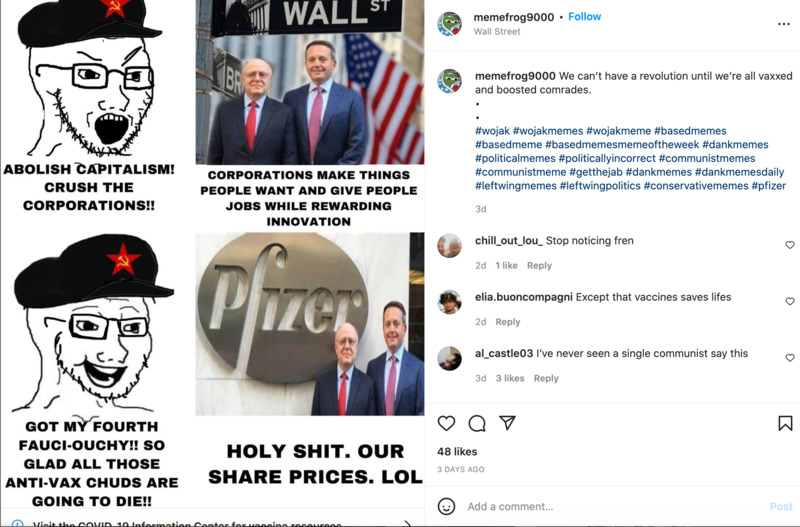
This is an Instagram post by memefrog9000. This shows a meme of a communist getting mad at Wall Street for stealing money, but is okay with Pfizer making profits off of the vaccine, with the communist in the comic saying "Got my fourth Fauci-ouchy!! So glad all those anti-vax chuds are going to die!!" This meme is in the standard wojak format, and the wojak from the late 2010s to the current 2020s has been a popular meme format for certain groups. The wojak of the communist is meant to be depicted negatively because he has double standards on which corporations are allowed to profit. -
 2022-03-31
COVID-19 and pregnancy: More new mothers dying, increasing women's fears during tense time
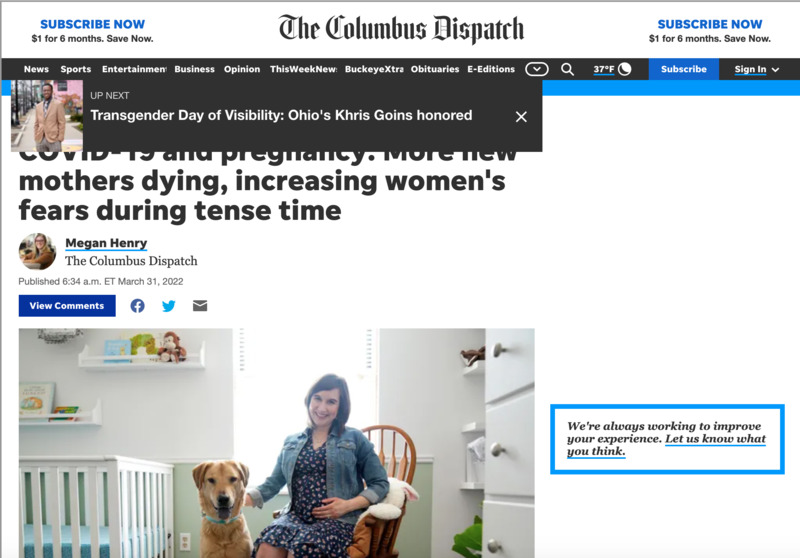
This is a news story from The Columbus Dispatch by Megan Henry. This story is about the rising fears of new mothers as COVID has increased their chances of dying. In 2020, motherhood mortality rate increased by 20% in the United States. There were also large disparities in who died, with Black women dying three times the rate of White women during pregnancy. Dr. Jason Melillo, an OB-GYN for OhioHealth claims that COVID is the main culprit for the rise in pregnancy related deaths. Pregnant women are more prone to complications from COVID, with things such as blood clots, stillbirth, and preeclampsia happening more often. This concern has made some couples only deciding on pregnancy until they have both been vaccinated. Dr. Melillo hopes that over time, mortality rates associated with pregnant women will go down. -
 2022-01-19
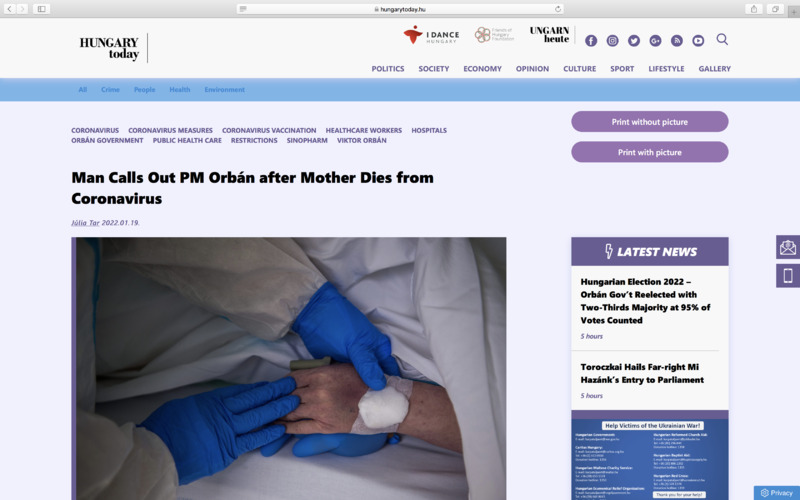
Man Calls Out PM Orbán after Mother Dies from Coronavirus
This is a news story from Hungary Today by Júlia Tar. A man's mother and sister from Nagykanizsa both died from the Coronavirus. Later, this man calls out Prime Minister Viktor Orbán because he believes PM Orbán did not properly protect his family. His mother was vaccinated with Sinopharm, a Chinese vaccine. The PM himself received Sinopharm as his first two doses, with Moderna as his third dose. The man describes feeling hurt seeing his mother die in the hospital after she contracted the Coronavirus. -
 03/27/2020
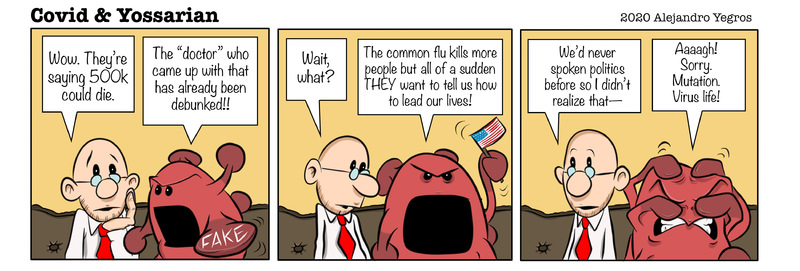
Oh, no. Not Politics.
A comic strip about Covid-19 -
 2022-02-05
The Bittersweet Impact of the Pandemic
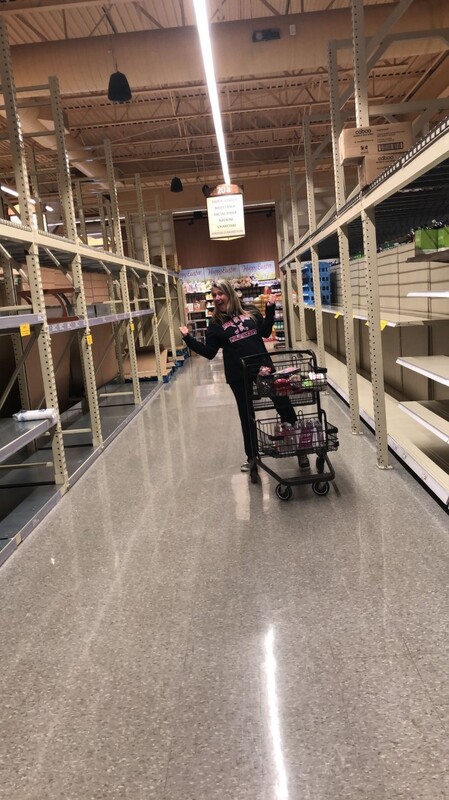
March 13, 2020 was my last day as a student at Fairport High School in Rochester, NY, although I didn’t know it yet. I remember that day at school being filled with joking remarks, especially “Happy last day of school!” We discussed whether or not we thought school would close in economics class, and if it did, we came to the conclusion that it would only be a couple of weeks. The next day, I was in the car with my mom when I heard that school was to be closed indefinitely and that my dance studio, which I had been dancing at since I was three, also canceled classes. I started crying and got mad at myself that I took all those moments in the halls and with my teachers and friends for granted, as well as dance competitions and practice. But, I calmed myself down by reassuring myself that it would only be a couple weeks. My mom and I then went to Wegmans to see how empty the aisles were, and I was surprised to find that the cheese aisle was basically empty, and that there was no more toilet paper nor paper towels available. It’s weird looking back on how we weren’t wearing masks yet. The two weeks turned into months and on May 1st, school and dance stated that they were closed for the remainder of the year. I missed out on ball, my last dance competitions, my last dance recital, senior bash, and my graduation. We graduated by watching a poorly put-together slideshow of everyone’s pictures and pre-recorded speeches. Teachers came by and handed us our diplomas. We all drove by the dance studio the day that recital was supposed to be. However, despite these setbacks, I was able to learn more about myself and become closer to my family. My life that was previously extremely busy was put on pause, and sometimes I miss that. I started to paint, I watched a ton of movies that I had always wanted to see, I had time to spend with my dogs and cat, I got closer with my siblings, and I started to become an activist after the death of George Floyd and educate myself on racial inequalities and police brutality. The scariest part of quarantine was when my mother was redeployed to the COVID unit at RGH. She was only there for a couple weeks, but she saw how hectic and scary COVID truly was. She saw people die and not be able to say goodbye to their loved ones. Whenever she returned from work, I would have the front door propped open and the shower running so she could just jump right in the shower, and then I would spray everything with Lysol. Although I became majorly depressed in September of 2020 and I still dwell on the moments that I have missed, the pandemic was able to put my priorities into perspective. The pandemic was able to teach me not to take things for granted, to pay attention to the world around me, to try to make a difference in the world, and to make more time for the things and people that I love. May all those who have passed from COVID rest in peace and my heart goes out to all those impacted. -
 2020-10-25
My Life with Covid 19
In 2020, The week of my 22th birthday I tested positive for covid-19. I had no signs that I had even feel sick or had covid. I tested three times before that due to my family friend having covid but I was not really in direct contact but wanted to test anyway. Negative all three time that day. I don't know why they tested me three times but whatever. When I was at home resting and trying to "do my time" I felt totally normal. It was like any other day to me. However, when I got my shots I when I had all the side effects and was out for a good two days at school. I felt like I was gonna die. I had to wait the two days out and nothing felt good to me,I could not get comfortable, and I was sore all over. It even felt like that when I got my booster. Overall, covid sucks! -
 11/15/2020
Retail Worker Oral History, 2020/11/15
C19OH -
 11/12/2020
Kristine Benusa Oral History, 2020/11/12
-
 03/30/2021
Landon Bridges Oral History, 2021/03/30
An oral history between three students from Indiana University–Purdue University Indianapolis concerning the Covid 19 pandemic -
 04/25/2021
Lou Fraise Oral History, 2021/04/25
Dr. Lewis Fraise details his service as a geriatric doctor during the Korean War and Vietnam War. He mentions his service in both Washington D.C. and Korea and continues to break down how the Coronavirus actually infects one's body and the response of the government as the pandemic ensued. Dr. Fraise criticizes the actions of Donald Trump and states that the spread of more medically-accurate information would have led to a better outcome in terms of the early stages of the pandemic. -
 11/24/2020
Kirsten Dutzle Oral History, 2020/11/24
C19OH -
 12/13/2020
Kevin Dombrowski Oral History
C19OH -
 08/14/2020
Robert Shimp Oral History, 2020/08/04
In this interview, Robert Shimp discusses how the pandemic has affected the Paul Revere Memorial Association -
 12/01/2020
Brooke Dusk Oral History, 2020/12/01
Brooke Dusk is a Senior Business Loan Officer at WESTconsin Credit Union. Her job is to help businesses in their time of need. That being said, her whole world has gotten flipped upside-down. She worked first hand with helping businesses apply for the Federal Grant known as the Paycheck Protection Plan, as well as other state grants and loans that businesses could take out. Brooke also has a science background and gives some amazing insight into the pandemic and what she foresees for the future. -
 12/08/2020
Lindsey Jo Boehm Oral History, 2020/12/08
Lindsey Jo Boehm is a full-time student that attends the University of Wisconsin-Eau Claire where she studies Nursing. Lindsey is a very busy student who balances work and school, and still finds time for spending time with her friends and family. In addition to a heavy school load, Lindsey works as a nurse’s aide in a critical care unit at Mayo Clinic Hospital in Eau Claire, Wisconsin, as well as being a research assistant for a nursing professor at the University. In this interview, Lindsey illustrates how the COVID-19 pandemic has affected her employment, her relationship with her friends and family, her health, and her community. She provides meaningful insight as somebody who interacts with the healthcare field, and explains how the world can better prepare for a future viral outbreak. -
 04/15/2021
Kurt Kurman Oral History, 2021/04/15
-
 11/10/2020
Kenneth and Wendy Moran Oral History, 2020/11/10
C19OH -
 04/24/2021
Zakrzewski Nic, Oral History, 2021/04/24
Nic Zakrzewski is from Eau Claire, WI and is a UW Eau Claire student. He also works part time as student custodian at the university. In this interview, he discusses the topics of mental health and his difficulties maintaining family and friend relationships. He also discusses how the transition to online classes has affected his day to day activities. The role of local and federal government in his pandemic experience is also touched upon. -
 11/20/2020
John Verdon Oral History, 2020/11/20
John Verdon was born and raised in Lansing, Iowa. After attending college, John had a long and successful teaching career at Waverly Shell-Rock High School in Waverly, Iowa. John Verdon is currently retired and resides in the town where he was born and raised. In this interview, John Verdon illustrates how COVID-19 affected his life, his family, his friends, and the small midwestern community he lives in. He discusses the rising number of COVID cases raging across the United States, leadership response to the pandemic, how individuals that he knows responded to the virus, and what impact COVID-19 has on our future. -
 05/07/2021
Kathy Volkmann Oral History, 2021/05/07
Kathy Volkmann works at a credit union in the center of Wisconsin. She also volunteers at a museum through the Marathon County Historical Society. In the interview, she discusses the ways that Covid has changed the way she works and communicates with people around her. She also considers how museums in the present and future could be shaped by the virus. Additionally, she contemplates the ways that Covid has changed the way she looks at her community based on people who have not been cooperating with mask mandates and CDC guidelines. -
 12/11/2020
Anthony Wallace Oral History, 2020/12/11
C19OH -
 05/26/2020
Judy Cherniak Oral History, 2020/05/26
Judy Cherniak discusses how the COVID pandemic changed life for her during the opening months of the pandemic in Toronto, Canada in 2020. She touches on family life, her job loss, the local economy, news media, fake news, isolation, mental health, homelessness, and how she filled her time at home in isolation. -
 05/19/2020
Trent Jansen Oral History, 2020/05/19
An oral history interview with Trent Jansen. Trent discusses how family and friends have been impacted by the COVID pandemic. He also talks about how his day-to-day work life has evolved during the pandemic. Trent additionally discusses his views that it is time to reopen businesses and get people back to work. He theorizes that mental health issues caused by shutdowns will result in worse long-term issues than the virus itself. -
 03/29/2021
Jim Robinson Oral History, 2021/03/29
-
 04/22/2021
Lou Ann Koval Oral History, 2021/04/22
Lou Ann Koval was born in East Lansing Michigan, and currently works for a company called Laird Connectivity. This company makes electronics, some of which were made to help keep people safe from COVID. During the pandemic, she switched between two companies and shared some of the struggles of joining a new company without anyone being able to have a real social interaction with her. She also talks about the struggles of balancing a social life and keeping involved with her elderly family members. She also briefly talks about her opinion on the political actions taken to avoid COVID and some of her responses to stay healthy during this pandemic. -
 05/05/2021
Jocelyn Penagos Oral History, 2021/05/05
Jocelyn Penagos was born and raised in Columbia until the age of eight when she finally followed her older brother's footsteps and moved with her family to Florida. Leaving Colombia was a callous but necessary thing that she felt she had to do. Upon arrival in America, she began watching a movie and listening to music to better learn English. After being fluent in both languages and graduating High School, Jocelyn joined the armed services and enlisted in the United States Marine Corps. She is still currently enrolled in the Marine Corps and is going on her ninth consecutive year. Jocelyn shares her experiences with covid from a military point of view. She offers great insight into what had changed or been created because of the lockdown and the virus. Jocelyn also shares with us her struggles to see her mother in Columbia because of fears that she could be the reason for her death. -
 10/12/2020
Alexis Tardy Oral History, 2020/10/12
-
 10/14/2020
Laron Anderson Oral History, 2020/10/14
-
 12/15/2020
David Huber Oral History, 2020/12/15
C19OH -
 12/01/2020
Wade Pitrucha Oral History, 2020/12/01
Wade Pitrucha, Marine Corps veteran and butcher, was raised in Texas and lived in California for several years, and currently works as a butcher and lives in Barron, Wisconsin. In this interview, Wade discusses the political and economic developments he has observed since the beginning of the COVID-19 pandemic. Wade gives an inside look at the COVID-19 meat shortage, and explains some of the causes, as well as the impacts on farmers and families. Wade also shares some of his personal experiences and frustrations with the local handling of the pandemic, and how he feels the federal government and the Trump administration has contributed to the massive spread of COVID-19 in the United States. In an entertaining and sometimes darkly humorous interview, Wade’s military experience and personal beliefs provide a unique and well-balanced view of the COVID-19 pandemic and modern American society. -
 12/11/2020
Janet Pope Oral History, 2020/12/11
C19OH -
 2021-12-08
End of Semester Covid-19 Interview Oral History 2021/12/08
This interview is about our thoughts and understandings of the Covid-19 pandemic after having taken a semester-long course about the history of pandemics spanning from the black plague until the Spanish flu. We've discussed how we think the world could have handled this pandemic differently, the similarities and differences between this pandemic and previous pandemics, and how this pandemic affected our personal lives. -
 04/23/2021
Gary Lato Oral History, 2021/04/23
This interview is done with Gary Lato who is 69 years old and has lived in Stanley, Wisconsin his whole life he is a retired mailman of 34 years. Here I discuss with him how COVID has affected those around him in his community as well as how it has affected him. Primarily I am getting his thoughts on the entire issue since he says he lives a mostly hermit lifestyle. During the interview, he spoke as an observer of all these things going on in the community and what he is noticing from his perspective. From Garys’s point of view as an older member of the community, he sees all this as something that is going to pass and just run its course. He also touches on how most in his area in the country are mainly just staying out of it and going about their lives as normal and not worrying about it in general. He also goes on to note how this is affecting people in a big way, due to there being restrictions on many aspects of life. He ends the interview with his own spiritual view, that if you have spiritual views may agree or disagree with them. -
 2020-02-21
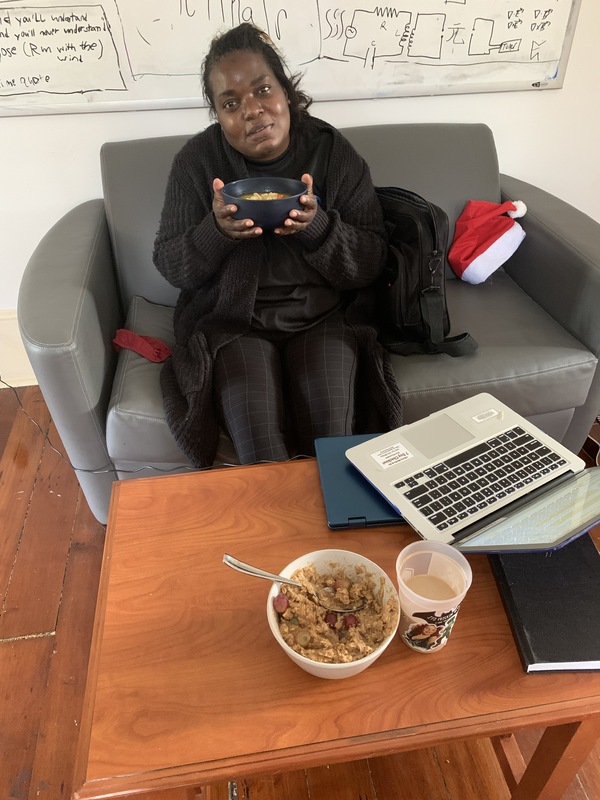
Journey into Georgetta's Covid Experience
My name is Georgetta Jones, and I am a cashier at the College of Charleston City Bistro. Also, I work at a Daycare; Devine Daycare. As soon as Covid-19 started, I contracted it (February 2020) due to my being an 'essential worker' at my job. I was horribly laid up for fourteen days, and, as this was before the vaccines were released, I was afraid & certain I was going to die from this terrible disease. Fortunately, due to my rare blood type (O+), I had natural immunity to the virus, and was able to recover quickly after the fourteenth day; I went back to work on the 15th day. COVID-19 is a horrible virus, & it is shameful not to see people take it seriously. Due to my vitamins & water, I was able to get better quickly; it is important to take the natural precautions to protect oneself against the disease. If we as a country (and the world) are to overcome this deadly disease, we must trust in medicine, trust the doctors, trust science, and, most importantly, trust each other. -
 12/11/2020
Damir Kovacevic Oral History, 2020/11/16
Professor Damir Kovacevic was born in Bosnia before coming to the United States. He has lived across the midwest but currently lives in Eau Claire, Wisconsin. Damir works as an assistant professor of political science at the University of Wisconsin-Eau Claire with a focus on international relations. In this interview, Damir Kovacevic discusses how the pandemic has affected his life, profession, and emotions. Damir provides insight into how the University of Wisconsin-Eau Claire has handled the pandemic with testing and closing the college for the remainder of the Fall 2020 semester. Damir also touches on how Eau Claire, the state of Wisconsin, the United States, and foreign countries on the international scale handled the pandemic. He discusses how teaching as a career has changed and adapted to the pandemic. He discusses topics such as the media and misinformation when it comes to healthcare and the virus, but also the general decay in trust. -
 2020-05-28
Gomez_Elizabeth
C19OH -
 2020-05-26
Lo_Emerson_
C19OH -
 2020-05-20
Jeff Plapp Oral History, 2020/03/20
C19OH -
 2021-11-10
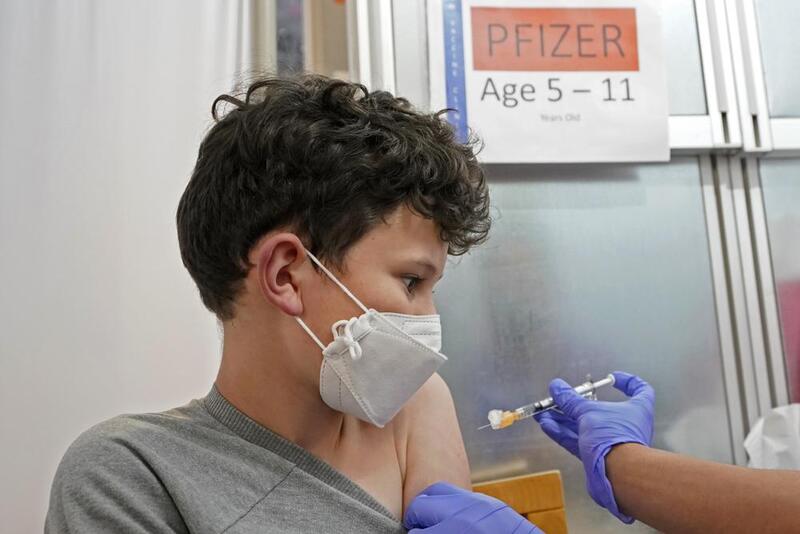
Children Ages 5-11 Now Eligible for Vaccine
The campaign to vaccinate elementary school age children in the U.S. is off to a strong start, health officials said Wednesday, but experts say there are signs that it will be difficult to sustain the initial momentum. About 900,000 kids aged 5 to 11 will have received their first dose of the COVID-19 vaccine in their first week of eligibility, the White House said, providing the first glimpse at the pace of the school-aged vaccination campaign. “We’re off to a very strong start,” said White House COVID-19 coordinator Jeff Zients, during a briefing with reporters. Final clearance for the shots was granted by federal regulators on Nov. 2, with the first doses to kids beginning in some locations the following day. The estimated increase in vaccinations in elementary school age children appears similar to a jump seen in May, when adolescents ages 12 to 15 became eligible for shots. Now nearly 20,000 pharmacies, clinics and physicians’ offices are offering the doses to younger kids, and the Biden administration estimates that by the end of Wednesday more than 900,000 of the kid doses will have been given. On top of that, about 700,000 first-shot appointments are scheduled for the coming days. About 28 million 5 to 11 year-olds are now eligible for the low-dose Pfizer vaccine. Kids who get their first of two shots by the end of next week will be fully vaccinated by Christmas. The administration is encouraging schools to host vaccine clinics on site to make it even easier for kids to get shots. The White House is also asking schools to share information from “trusted messengers” like doctors and public health officials to combat misinformation around the vaccines. A initial surge in demand for vaccinations was expected from parents who have been waiting for the chance to protect their younger kids, especially before the holidays. About 3% of newly eligible children in the U.S. got first shots in the first week, but the rate of vaccinations in varied widely around the country, as it has for adult vaccines. California Health and Human Services Secretary Dr. Mark Ghaly said Wednesday that more than 110,000 Californians ages 5 to 11 have received their first coronavirus shot — 9% of kids that age in the state. “We are starting to see this pick up and I’m really encouraged about what this means for our state,” Ghaly said. On the other ends of the spectrum, Idaho reported just 2,257 first shots, or 1.3% of the newly eligible kids there. In West Virginia’s Cabell County, high demand led local health officials to start setting up vaccination clinics in all the county’s public middle schools. A spokeswoman for the county health department said there were some lines for vaccines in the first few days after the doses were approved for kids ages 5 to 11, but that things have slowed since then. Some experts say that nationally, demand could also begin to recede soon. They note polling data suggests only a fraction of parents have planned to get their kids shots immediately, and they suspect the trend will play out like it did earlier this year when kids ages 12 to 15 were first able to get shots. In the first week after vaccines for that age group were authorized in May, the number of adolescents getting a first shot jumped by roughly 900,000, according to an American Academy of Pediatrics review of federal data. The next week, it rose even further, to 1.6 million. “There was an initial burst,” said Shannon Stokley of the Centers for Disease Control and Prevention. But then the number dropped steadily for months, interrupted only briefly in early August as the delta variant surged and parents prepared to send children back to school. Adolescent vaccinations have since flagged considerably, to just 32,000 getting their first shots last week. Only about half of adolescents ages 12 to 17 are fully vaccinated, compared to 70% of adults. It’s unlikely that vaccination rates in young kids will be as high as what’s seen in adults — or even in adolescents, some experts said, unless they are required for school. Part of the reason is that adults are far more likely than children to suffer serious illness or die from COVID-19, they noted. “Parents may have the perception it may not be as serious in young children or they don’t transmit it,” said Stokley, the acting deputy director of the CDC’s Immunization Services Division. But more than 2 million COVID cases have been reported in U.S. children ages 5 to 11 since the pandemic started, including 66 deaths over the past year, according to CDC data. “We’re going to have a lot of work to do to communicate to parents about why it’s important to get children vaccinated,” she said. Zients said the effort to vaccinate younger kids is still ramping up, with new clinics coming on line. Government officials expect the number of children who are vaccinated to keep rising in the days and weeks ahead, he said. “We are just getting started,” he said. Earlier this year the White House set — and missed — a July 4 goal to have at least certain percentage of U.S. adults vaccinated. Officials have not announced a similar target for kids. Dr. Lee Savio Beers, president of the American Academy of Pediatrics, called the new numbers reassuring and said the rollout appears to be going smoothly for the most part. She noted however that with a lower dose and different vials than for older kids, the rollout requires more steps and that some states have been slower in getting vaccine to providers. Initial data from some areas show Black children lagging behind whites in getting their first doses, which Beers said raises concerns. “It’s really important to make sure the vaccine is easily accessible in a wide variety of places,” Beers said. -
2020-03-21
Gardening During the Apocalypse
I can't think of the beginning of the COVID-19 pandemic, the shut downs and lock-ins, the stay-at-home orders without thinking of my brief foray into gardening. My husband and I bought our house in northwest Baltimore in April 2019. Our little duplex sits near the end of an unbelievably picturesque street in a fairly affluent neighborhood known for its garden communities and HOA-hosted wine and cheese parties you have to pay to attend. The neighborhood is surrounded by much poorer neighborhoods and heavily-trafficked streets, the direct product of red-lining in Old Baltimore. While the Original Northwood neighborhood is much more diverse - demographically and economically - than it was when it was first established in the 1930s and 1940s, my husband and I, as some of the only residents under 40, still felt like we didn't necessarily fit in with our older, more well-to-do neighbors, despite absolutely adoring our little home, which had been lovingly renovated and reimagined by its previous tenants. Come March 2020, however, the noise from the crowded streets, the surrounding neighborhoods, and from our own neighborhood, died down substantially. Our streets and its surrounds have always been a great place to go for a walk, but now every day people were strolling by in ones and twos, sometimes in small family units. Everyone needed to get out of the houses they were now cooped up in, and I was no exception. Much to my mother's chagrin - and likely to my neighbors' embarrassment - I did not inherent my mother's green thumb. Because I am a millennial I found an app that identifies plants and set about rooting out weeds, pruning the flowers the previous tenants had not intended for me to neglect, picking up the endless stream of leaves from our several 100+ year old trees, digging up more weeds and debating with my husband about whether we should start an herb and vegetable garden or put in a patio in the little garden area that connects our front and back yards. I did not become proficient at gardening. I am much better than I was, however, at identifying the truly astonishing diversity of plants in my own garden and in my neighborhood by scent and even touch. I learned that the dried and withered allium stalks pull effortlessly out of the ground after they die, that African violets also give way to a gentle scooping from the earth, and that thistle, of course, will still try to prick you as it attempts to cling to the soil. I learned that those thin but tough shoots of elm and oak born from the seeds and acorns the squirrels missed not only grow rapidly, but are extraordinarily difficult to rip from the earth. And no matter how much seemingly-delicate clover one claws at, its roots will always remain beneath the surface, as virulent in a day or two as when one earlier tore at it in complete dismay of its sheer stubbornness. I did not become proficient at gardening. But I did relish the feeling of cool, damp earth underneath my hands, even in my fingernails, the crunch of dry leaves, the slick sliding of wet leaves, the red, angry weals left on my hands from those stubborn oaks. I felt accomplished as I pulled lovely, but ultimately threatening African violets and wild raspberry from underneath the spreading cover of the hostas, and as I pulled wild mint, lemon, and rosemary for tea and cooking. I told myself I'd use the ramps (a species of wild onion that smells and tastes sort of of like a combination between garlic and scallions) in a soup, as a college roommate of mine had done, but I forgot to harvest them in time. From what I recall, summertime is best, particularly late summertime. The other thing I remember about this time spent in my garden, hands in the dirt, sweat on my brow, bug bites inflaming every available inch of skin, is the new sense of connection I felt with my neighbors who stopped to wave hello, nod and smile at my gardening efforts. Neighbors who I hadn't gotten to know before the pandemic which now prevented us, due to fear of contamination from contact with other people, from truly getting to know each other still. But somehow, the simple act of being out in my garden, doing this simple, repetitive toil, made me feel like I was participating in a ritual, an activity that linked me to the less unsavory past of the community, and to neighbors who otherwise might have remained alien in a plague environment that seemed to bring a new apocalypse with every week. -
 2021-10-08
my Quarantined life
My Name is Alex Clayton and I go to lone star Middle School, and I am a basketball player for the Idaho Stags. It started as a news report saying a cruise ship arrived in the U.S with diseased passengers and I did not think anything big about it, so I let It go. A few months later everything shut down out m of nowhere and school, restaurants, movie theatres, just anything public that is a company shut down or was close to that. Eventually things started to die down and things opened back up, but you would get your temperature checked and be wearing a mask everywhere. Life was never the same for like two years. (This was all my perspective) -Alex Clayton -
 2021-10-03T14:23
Brianna Biagini Oral History, 2021/10/03
-
 2021-03-08T12:38
Danny Denial Oral History, 2021/03/08
Self-description: “Audio visual artist that lives in Seattle, Washington, specifically in the realm of music and film, and also the intersection of the two. A lot of my work involves amplifying experiences and voices that are often underrepresented, primarily in the Black and LBGTQ+ community. And that’s something that overtime my work has been diving deeper and deeper into over the years, which is something that I think as an artist, I’ve only really come to terms with in the last few years. But it’s been definitely both empowering for me and illuminating to see it reflected back in the ways that people have responded to the work.” Other biographical details: late 20s, from Los Angeles. Some of the things we discussed include: The dysphoric experience of Black artists filtered through white talking points. Unstable work and income as an artist--audio and visual--pre- and mid-pandemic. 2019 was the first year that work as an artist and in performance communities was stable. Releasing the album Fuck Danny Denial in 2020 (https://dannydenial.bandcamp.com/album/fuck-danny-denial). Pandemic specific economic penalties of musicians in the case of live streams for Seattle Pride and Folsom Street Fair. The burden on artists to make ethical calls about canceling performances in the early stages of the pandemic, and needing to wear “new hats”, like health safety inspector. The pandemic as a shared experience of stoppage, and the need for adaptation. Aging and changing awareness about one’s needs for health care. Working to build equitable opportunities for artists. Since 2015-2019 doing gigs and video projects on contracts. Media outlets’ poor representations of the summer protests, acts of civil disobedience, and the autonomous zone in Seattle. Funding the serial project Bazooka (http://web.archive.org/web/20210622155802/https://ca.gofundme.com/f/dannydenialbazzooka) The ethical decisions associated with wanting to participate in amplifying and uplifting the BLM movement without exploitation for personal gain, engaging as a citizen. Witnessing a friend’s experience of hospitalization due to COVID-19. The value in studying patterns of human friendships and how the pandemic disrupted the conditioning of existence and the importance of local histories of resistance in Seattle. Cultural references: Pan’s Labyrinth, Smash Mouth’s super spreader event, Portland International Film Festival, The Tape Deck Podcast, Punk Black, Darksmith, Taco Cat, Alice and Chains, Duff McKagan, Pearl Jam, MoPOP, Shaina Shepherd, and TheBlackTones. -
 2021-08-26T14:54
The not so boring every day life
I used to work at a store called Bed Bath & Beyond. It was a mediocre job at best. Getting up at 9am and working until 5pm. The occasional customer who’d come in every now and then and brighten my day was nice, but there has to be a balance. The occasional customer who would come in with the sole purpose to ruin your day. Pre December 31st, 2019. After work I would come home and play some video games, do homework, and if I had time go to the skatepark late at night. When I wasn’t at work, I was at school. I went to Palmetto Ridge High School, and it was my junior year. I was looking forwards to just graduating already. It was fun, I met a lot of friends, but it was just getting tedious, going to the same classes over and over again, just to meet the state requirements. I couldn’t wait to go to college, to pursue only the classes I needed for my future career. Life was pretty much mundane, no action, repetitive. December 31st, 2019. I had just awoken from my sleep and was getting ready to go into school, since it was a Tuesday. I turned on my TV and switched to the news channel to see if anything interesting was happening on the news, and to my surprise, this “virus” was said to have started in Wuhan China. Our “wonderful” president said it was nothing more than the common flu, so I shrugged it off and got ready for school. A couple of days had passed since the announcement of COVID-19 and things only escalated. I still thought it was nothing more than a virus, because at the time I followed Trump, (still don’t know why I ever did). That was until a customer came in, coughing their lungs out. I made sure not to check her out because she looked really, really ill. I stayed in the back most of the day, claiming that “Today was just not my day, I am tired, and I do not feel well”. I asked to leave work early that day and left. January 21st, 2020. By now I was seriously worried. I heard over the news that COVID-19 was spreading fast, and that it had just infected its first citizen in the U.S. I did not know what to do to counter it, so I treated it like a plague. I wore a medical mask everywhere I went, and double layered my hands with two latex gloves. My coworkers teased me, saying I was too worried and that it would pass. I almost wanted to listen to them, but I stuck to my guns and wore my protective gear in work. March 14th, 2020. Schools were now closed until April 14th. Things were starting to get serious, now my friends weren’t doubting my use of masks and gloves and they followed in my footsteps. There was no school now, which meant I had to work more hours. It was really weird not going to class, but I was kind of glad we weren’t. I was just happy to still be earning money. March 15th, 2020. I was supposed to work today, it was a Sunday, but seeing as my job was overstaffed that day, I called off saying that I was sick. (I really wasn’t). I wanted to go to the skatepark today with my friends and did not want to work overnight today. I am glad now that I skipped because a customer that had COVID-19 was not wearing a mask and had infected two co-workers. This had forced the building to shut down, and had the CDC close the building down to quarantine it. I really dodged a bullet. August 26th, 2021. (Present Day) A lot has changed over these past few years. Mainly lockdowns and mask mandates. I have been fully vaccinated with Moderna and am going to take my booster shot when the time comes. Oddly enough after the first major lockdown, nature started to come back. A lot of deer in the roads, alligators in swimming pools, and a ton of insects and amphibians. It is present day now, and we have a new variant of COVID-19, named the Delta Variant. Mask wearing was mandated, and then unmandated, and since Trump left office cases dropped with real facts on COVID-19 daily, none of this “fake news” as Trump used to say. COVID-19 is starting to die down a lot more now, but it still is not over. Hopefully people will use their brains and get vaccinated, and if they don’t, hopefully they use masks. -
 2021-08-03
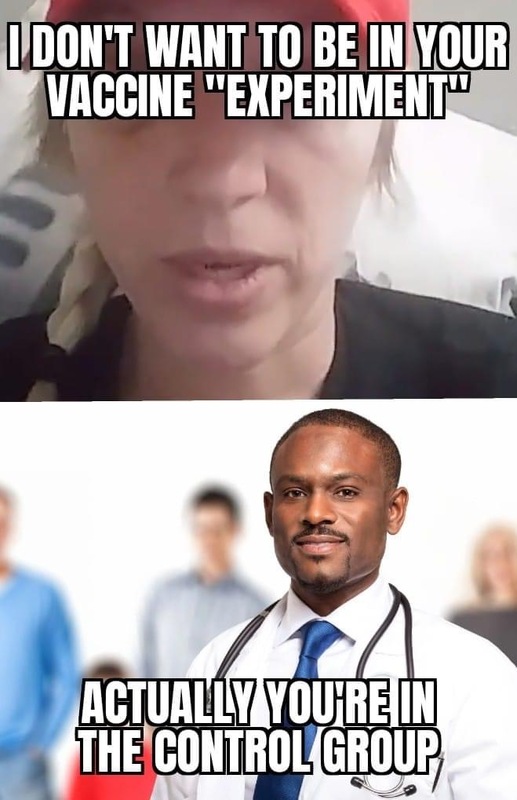
Control Group
It's sadly interesting how many people are clinging onto this thought of their rights being infringed on. I have a lot of acquaintances on social media that have excuses like liberty and rights. Some people still believe there is a government conspiracy, that we have been implanted with a mind-controlling chip, or that were being willfully expereimented on. I have come to a point where, as frustrating as it is, I don't care if people won't get vaccinated. It's a sad thought but I hope they done die of the virus. Like with many things in life I think humor does a really good job cooling heated situations down. I laughed louder than I thought I would when I came across this meme on my feed.