
Items
Search full-text
futcoins 26 Besuche die Website Buyfc26coins.com. Beste Qualität..N7Ft
-
 2020-04-09
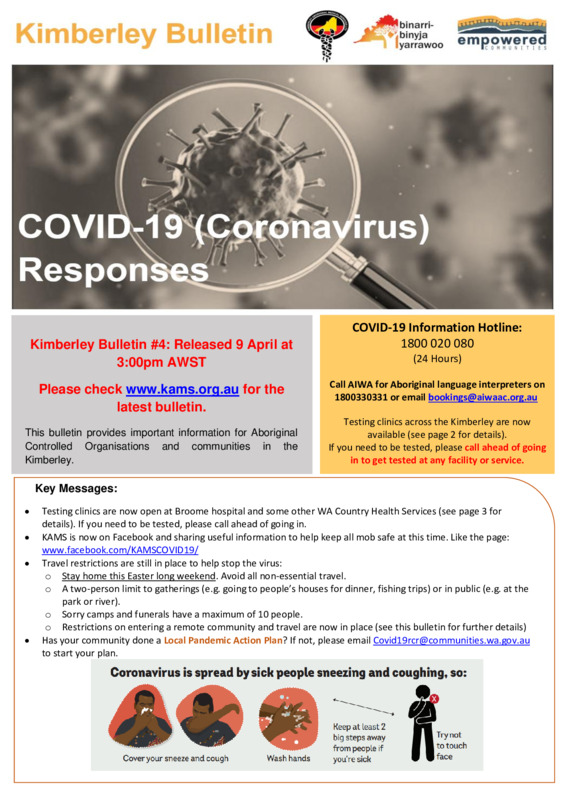
Kimberley Bulletin: Covid-19 (Coronavirus) Responses
A regular Covid-19 bulletin issued to local indigenous community members and health providers describing hygiene practices, local travel and safe distancing restrictions, background information on covid-19 and available social support using terminology and cultural examples specific to the region. For example, a 'sorry camp' is special area where visiting relatives would stay when attending a funeral in a community, as communities can be extremely far apart. These are subject to the country-wide limit of a maximum 10 people at funerals current at the time of publication. Remote Aboriginal and Torres Strait islander communities are considered to be at higher risk of severe impacts from Covid-19 than the wider population due to their higher level of chronic health issues, frequently crowded households, and long distance from healthcare. The Kimberley region of Western Australia has unique travel restrictions in place to limit movement between the four Shires, in addition to restrictions on movement across different regions of Western Australia and lockdowns of individual indigenous communities. -
 2020-04-12
How things have changed so far
This is just a summary of how me and my family have adjusted to the new conditions created around Covid-19. -
 03/29/2020
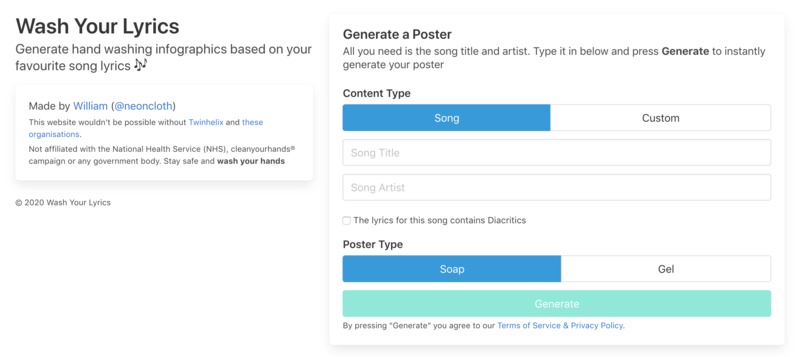
Wash Your Lyrics
This website allows users to pair the National Health Service (NHS), cleanyourhands® campaign posters with their favorite song lyrics. Users choose a song and generate a poster for the website. The format became a popular meme format. As it became more popular, the meme went beyond song lyrics to include Shakespeare, famous movie dialogue, etc. #HIST5241 -
 2020-03-21
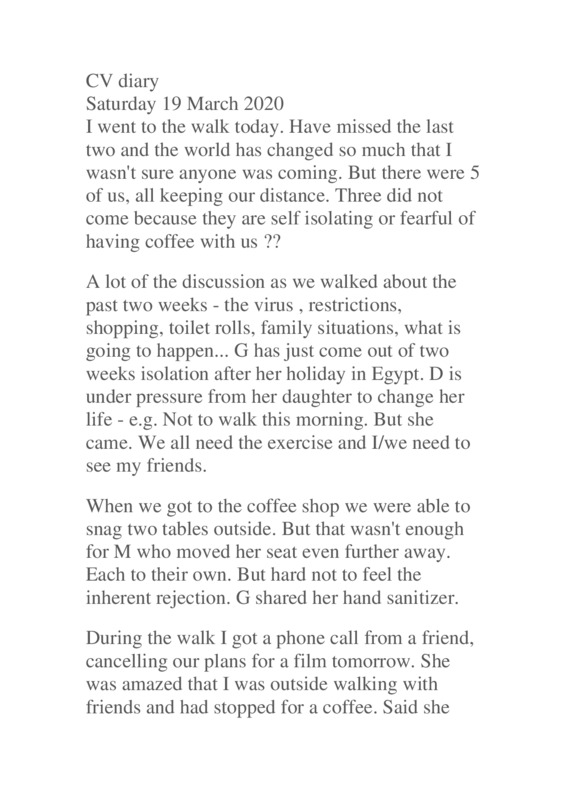
Diary LM
CV diary Saturday 19 March 2020 I went to the walk today. Have missed the last two and the world has changed so much that I wasn't sure anyone was coming. But there were 5 of us, all keeping our distance. Three did not come because they are self isolating or fearful of having coffee with us ?? A lot of the discussion as we walked about the past two weeks - the virus , restrictions, shopping, toilet rolls, family situations, what is going to happen... G has just come out of two weeks isolation after her holiday in Egypt. D is under pressure from her daughter to change her life - e.g. Not to walk this morning. But she came. We all need the exercise and I/we need to see my friends. When we got to the coffee shop we were able to snag two tables outside. But that wasn't enough for M who moved her seat even further away. Each to their own. But hard not to feel the inherent rejection. G shared her hand sanitizer. During the walk I got a phone call from a friend, cancelling our plans for a film tomorrow. She was amazed that I was outside walking with friends and had stopped for a coffee. Said she and her husband have been in isolation since last Sunday. Cautioned me to do the same. When I got home I thought about my plans. I will go to church tomorrow (it was confirmed late today that the Diocese has belatedly decided to ban all services from Monday). Should I go to the gym on Monday? They seemed well organised last week. Should I cancel my lunch with Susan on Tuesday? Have not seen her since her mother died, I could not go to the funeral or the wake. And she seems quite distressed and needs support. On Wednesday I am expected to present at an important Board presentation to Club members. It is being taped and uploaded to our website for those who cannot get to the meeting. Should I cancel everything after that? LM -
 04/05/2020
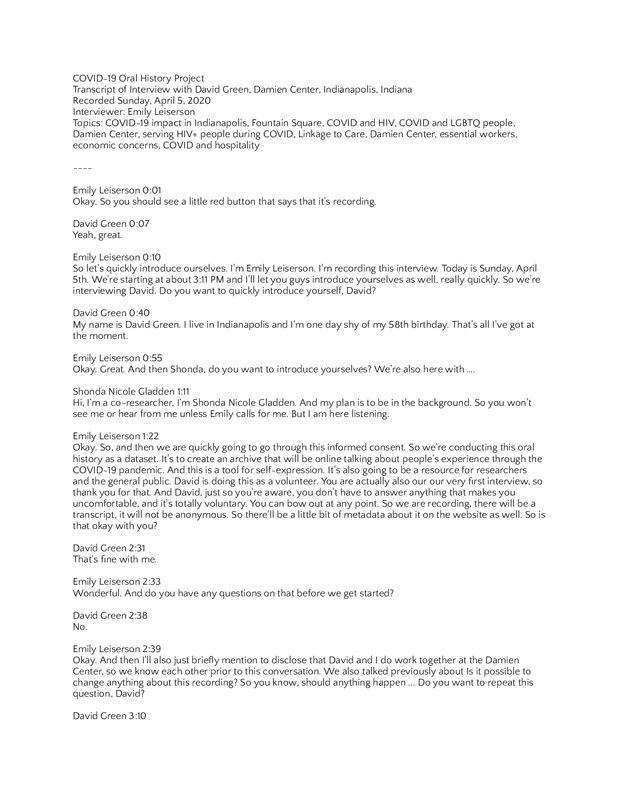
David Green Oral History, 2020/04/05
-
 12/08/2021
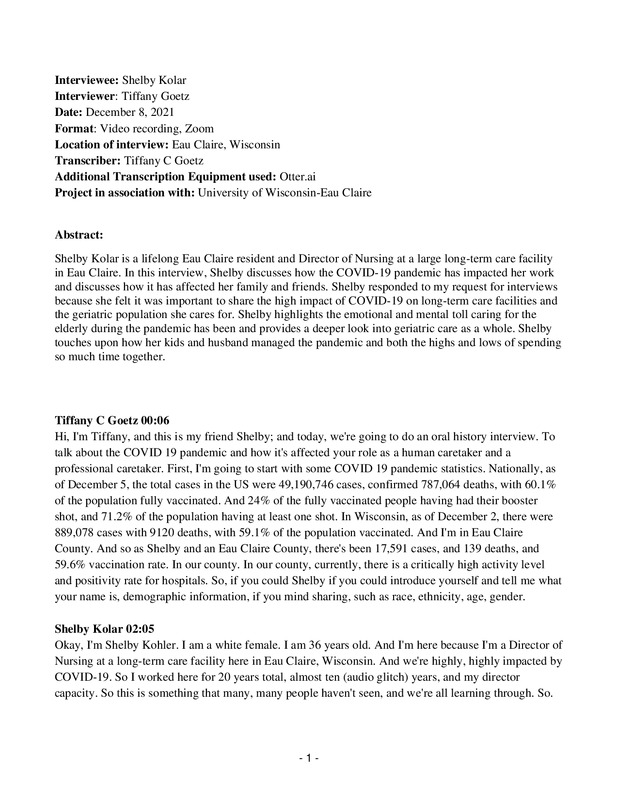
Shelby Kolar Oral History, 2021/12/08
Shelby Kolar is a lifelong Eau Claire resident and Director of Nursing at a large long-term care facility in Eau Claire. In this interview, Shelby discusses how the COVID-19 pandemic has impacted her work and discusses how it has affected her family and friends. Shelby responded to my interview request because she felt it was important to share the high impact of COVID-19 on long-term care facilities and the geriatric population she cares for. Shelby highlights the emotional and mental toll of caring for the elderly during the pandemic and provides a deeper look into senior care as a whole. Shelby touches upon how her kids and husband managed the pandemic and the highs and lows of spending so much time together. -
 2022-07-01
Delay to The Bay
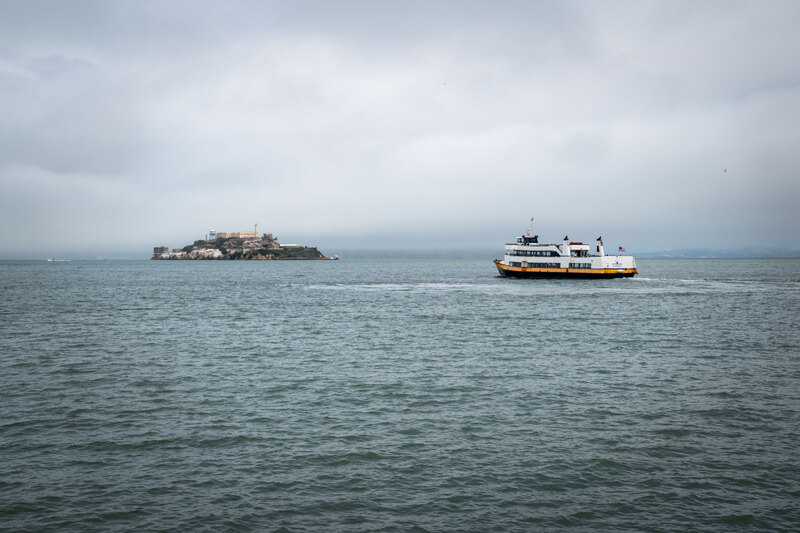
My plans to visit San Francisco in 2020 came to a halt with the outbreak of the Coronavirus. As a high school teacher, I was looking forward to my long awaited-spring break. It had been quite some years since my last visit to the San Francisco, and I knew a trip to ‘The Bay’ was long overdue. I booked a flight, hotel, and waited patiently as the weeks went by. Spring was coming up and there were heavy concerns about COVID 19 spreading into North America. I was slightly concerned but figured I would be safe to make this trip. As news broke out about cases emerging in San Francisco, the nation went into hysteria. I was not skeptic about the hazard of Coronavirus, but selfishly planned to proceed with the trip. Then my father called me. My parents, both in their seventies were definitely at risk, especially my mother who struggled with health since my childhood. My father asked me kindly not to go to San Francisco. Without hesitation, I canceled my flight and hotel. I had booked everything online through a third party and was unable to receive any refund. Bummed out, I knew it was the right thing to do. Coronavirus spread, schools shut down and my spring break prolonged. At first I was spending time kayaking, but the weather in Phoenix got so hot I had to stay inside. The Phoenix summer of 2020 had record breaking heat with 55 consecutive days of 115 degrees plus Fahrenheit temperatures. I was miserable. With concerns of my mom’s health, social distancing, living alone and bored, I was very unhappy. The unjustifiable killing of George Floyd caused anger, and rightfully so, across the nation which contributed to more hysteria. The only positive that came from that hot summer were my experiments in the kitchen. I would then deliver tasty meals for my parents. This was the one thing that made me happy. Unfortunately, my mother did not survive past the summer of 2020. She passed away in her sleep peacefully due to an unrelated COVID cause. I was on an all time low. Sad, empty, missing my students, and missing normal daily life. We had no idea how many people would die and when things would normalize. It was truly scary. Fast forward to 2022 and things were much better. I figured surviving 2020 made me stronger and much happier. Vaccinated and boosted, I decided to pursue my trip to San Francisco. I made the best of this short trip. I went to a party outside the Chase Center for the NBA Finals, in which the Golden State Warriors played against the Boston Celtics. For the first time, I took a ferry to Alcatraz. In China Town, I saw locals dance with dragons, in which one bopped me in the face while I was taking photos! Caught by surprise, I did not take offense to this. Observing how the dragons behaved with mischief, I knew it was all for fun. This made me laugh. This was a much-needed trip indeed. 2020 affected everyone around the world. With global hysteria, people getting sick, people dying, racial injustice, everyone except pandemic deniers and those oblivious to political issues resonated with fear. Passing through time, my 2022 trip to San Francisco was a rebirth. A rebirth to normalization. A rebirth to my passion of exploring culture. A rebirth of sanity, and a rebirth of controlling fear. A rebirth to laughter. With dragons, noodles, basketball, and Ghirardelli, the delay to ‘The Bay’ will forever be a golden memory. -
 11/04/2020
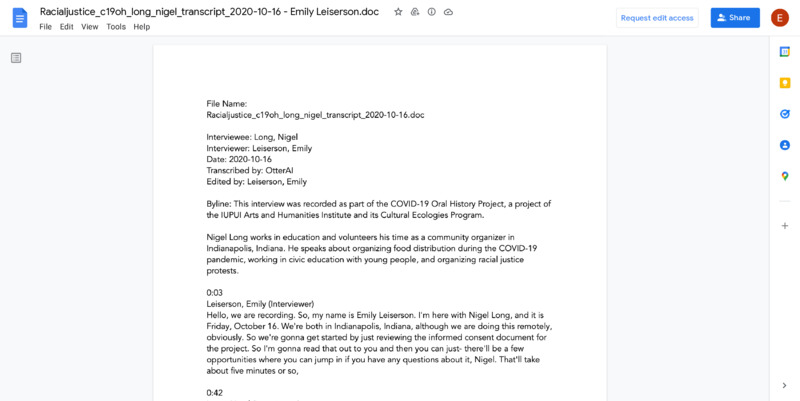
Nigel Long, Oral History, 2020/11/04
Oral History is an interview with and educator to discuss taking up initiatives to combat social justice and police injustice that has occurred during the pandemic. -
 05/23/2020
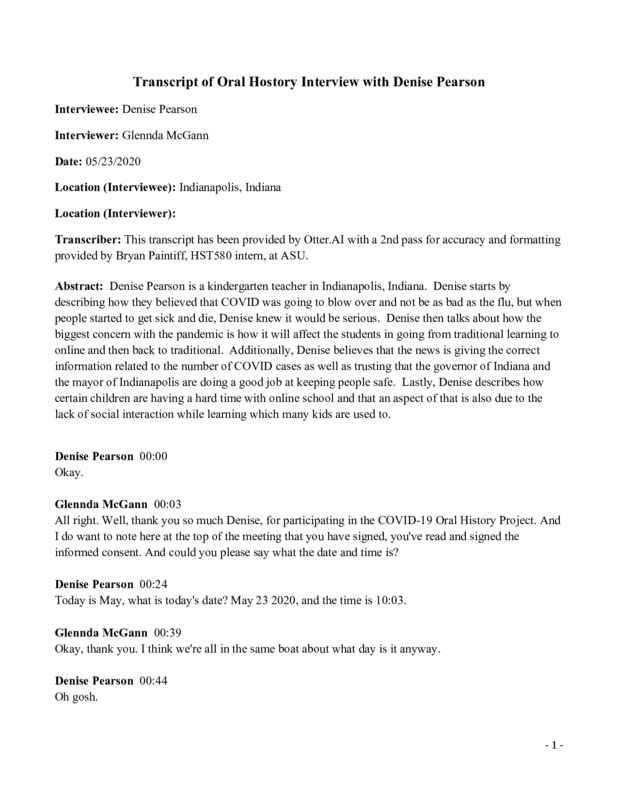
Denise Pearson Oral History, 2020/05/23
This interview is the fourth in a collection compiled by Glennda McGann for the COVID-19 Oral History Project -
 05/15/2020
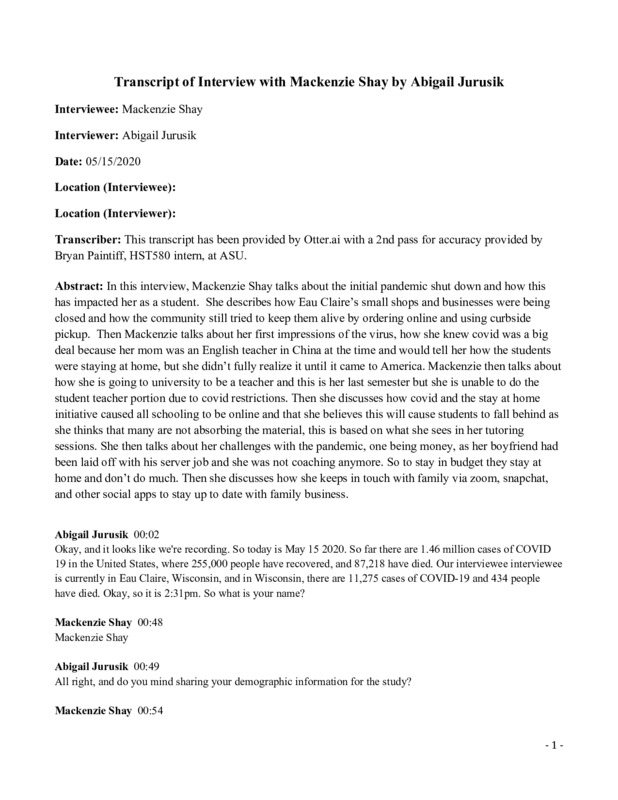
Mackenzie Shay Oral History, 2020/05/15
In this interview, Mackenzie Shay talks about the initial pandemic shut down and how this has impacted her as a student. She describes how Eau Claire’s small shops and businesses were being closed and how the community still tried to keep them alive by ordering online and using curbside pickup. Then Mackenzie talks about her first impressions of the virus, how she knew covid was a big deal because her mom was an English teacher in China at the time and would tell her how the students were staying at home, but she didn’t fully realize it until it came to America. Mackenzie then talks about how she is going to university to be a teacher and this is her last semester but she is unable to do the student teacher portion due to covid restrictions. Then she discusses how covid and the stay at home initiative caused all schooling to be online and that she believes this will cause students to fall behind as she thinks that many are not absorbing the material, this is based on what she sees in her tutoring sessions. She then talks about her challenges with the pandemic, one being money, as her boyfriend had been laid off with his server job and she was not coaching anymore. So to stay in budget they stay at home and don’t do much. Then she discusses how she keeps in touch with family via zoom, snapchat, and other social apps to stay up to date with family business. -
2025-03-31
5 Year Reflection
Five years since COVID, and so much has changed. Since COVID, I have: - Obtained my driver’s license (July 2022) - Obtained my MA in global history (May 2022) - Started working as a behavioral therapist (May 2023) - Became an aunt (July 2022) - Had my grandma on my dad’s side die (January 2022) - Had my grandpa on my mom’s side die (October 2023) - Been married five years to my husband (we married in May 2019) These are all just some personal events that have happened. That said, some things have stayed since COVID. One thing I really notice are people being more willing to call off work and school more often if they feel sick. I myself have had to call off work a few times due to illness myself, and because I work with such young populations, I want to make sure they don’t catch whatever I have. I’m glad my job is pretty okay with calling out sick when needed, because some employers will still pressure people to come to work sick. Speaking of illness and sickness, my dad (who is a doctor) has been glad he doesn’t have to wear full PPE anymore for work. I remember him telling me he got sweaty so easily. COVID has still affected the medical industry a lot, as there is still a doctor shortage for the amount of care needed. My mom, who has a history of working in special needs education, has said that she has noticed kids being behind socially and academically due to lockdowns, and this being especially detrimental to their development. The kids would sometimes lack access to computers to do work, especially if the parents had to work from home and there was no computer available. Sometimes, I believe schools provided laptops for COVID (happened with my youngest sister), but I’m unsure of how well funded other schools were for that. When it came to social skills, my mom described lots of regression in those areas (such as difficulty interacting with peers). One thing that has really come back to normal since COVID are people dining in large groups again, in close proximity. I remember my first anniversary that was during COVID, and the dinner experience then was so much different than today. I remember having to make a reservation (they were mandatory), all the staff were masked, the capacity was limited, and tables were spaced far apart from each other. One perk is that it felt a bit like private dining, but I’m also glad I can now just walk into any restaurant without having to go through all those steps. At the time, I felt like lockdowns would last forever, but looking back, it wasn’t as long as I thought it would be. Eventually, businesses had to open up again in order to make enough money. Speaking of business, the economy still hasn’t recovered well since COVID. The record federal spending in 2020-2022 (some of it COVID related), has made economic recovery slow down. Industry needs to be brought back in order to keep things functioning. There have been political changes too since COVID. When COVID started in November 2019 (lockdowns didn’t happen until March 2020), Trump was president. Then from 2021-2025, Biden was president. Honestly, I think being president during COVID would have been tough on anyone, and the response to it both affected Trump’s and Biden’s presidencies. Trump’s approach was to keep lockdowns for 1-2 months at its highest, then open up businesses again to prevent economic disruption. Biden, on the other hand, had a policy that expressed more caution, and encouraged lockdowns to last longer (in addition to masking). Ultimately, it was up to the governors of each state to decide when lockdowns ended. Doug Ducey, the then governor of Arizona, kept lockdowns until around early 2022. Other states, like Florida, opened up as early as the summer of 2021. Ohio, a state I used to live in, also opened up in the summer of 2021. Overall, most states were fully opened by 2022, and 2022 was the year I could go to the Renaissance Festival again (the last time I went before that was in February of 2020 before lockdowns). The state of emergency had to be lifted for the fair to happen again. Culturally, there’s been a big shift since COVID. Celebrity worship being looked down upon is probably one of the biggest changes I’ve seen. At a time where people lost their jobs, were under lockdown in small apartments, and had tight finances, you had a bunch of celebrities in this viral video singing “Imagine” from their mansions in order to help people cope with lockdowns. It understandably was seen as tone deaf, and ti me was the real beginning of the end to celebrity worship that was present in the 2010s. Also, celebrities now have to compete with influencers to earn money, so you see a lot more celebrities launching brands to maintain their income. Some of the brand attempts have been more successful than others. Additionally, way more celebrities are on apps like TikTok competing for attention, and that loses some of the mystique celebrities maintained prior to ubiquitous social media. Overall, I would say that COVID has had a great impact on so many aspects of life. I’ve gained a lot more skills since COVID, and now can say that my work history looks better than before. It really helped that I was able to take care of elderly during COVID, because if I worked in most other industries, I may have been out of a job. For that I will always be grateful. I’ve also learned that I need more social interaction in my everyday life to stay mentally healthy. I don’t need a ton, but the lack of it during COVID really brought my mood down. Even today, I’m still happy when a cashier wants to talk to me. I now cherish my social interaction more since COVID. Learning to drive during COVID has probably been one of my biggest life changes though. It helped me get the job I have today, in addition to being able to do the grocery shopping myself, in addition to getting myself to appointments. What I want in the next five years is to be a mom, and hopefully that will happen. Parts of my life did stop, but since I kept persevering, I’m not as “behind” on life as I think I am. -
2020-05-10
TEN LITTLE TENANTS IN THE CORONAVIRUS CRISIS
TEN LITTLE TENANTS IN THE CORONAVIRUS CRISIS A little story from the lockdown By Berthold von Kamptz (2020, Hamburg, Germany) Before the corona period: Once upon a time there were ten little tenants. They lived in an apartment building near Charlesburg near Castle Newman Street in Atlanta, which was managed by the strict landlord Johann Hermann, a real estate agent and philistine, and his son Rudolf, an often rebellious son and sound engineer who owned a small music studio. The ten tenants lived in the red brick apartment building and not always harmoniously. But as long as they avoided each other and did not know each other well, it worked out reasonably well. Either they were too busy with their work, their relationship, family and other obligations, so that in this often stressful time before the corona pandemic there was hardly any time. Only Grandma Leni asked how Mr. Lemke, Mr. Schmitz, Mr. Weidmann or Mr. Ehlert were doing. Because she was a pensioner, was curious, interested in other people and had time. Otherwise - if you were honest - almost no one was interested in anyone else. Everyone had their own life, something to do with themselves. Most people left the apartment in the morning and then disappeared into the grey mass. And Grandma Leni thought: "My contacts in the building are only superficial. How I hate that." Tenant No. 1: The former humorous gallery owner Jochen Schmitz from Switzerland lived in the basement. He represented many young artists, had sales skills, good taste and often cracked jokes. And what artists he had! Neo-expressionists, conceptual artists, pop artists and cubists. What exhibitions he did. Nobody would have thought of that before! Tenant No. 2: And now we come to Grandma Leni. She lived on the left on the ground floor. Her name was exactly Grandma Leni Saubermann. She always read a lot, knitted and lovingly looked after her two grandchildren, who often visited her, as did her daughter Ruth. At 85, Grandma Leni was fit. And many thought: "What more can she do." But her son Hugo, with whom she had little contact, thought: "She's old, just wait a bit and then she'll leave us." Tenant No. 3: On the right on the ground floor lived the artist Fritz Weidmann. He came from Europe. He always wore trousers with holes in them. He was not successful as an artist. The gallery owner down in the basement didn't want him. Schmitz said: "At 40, he's too old. His work leaves me cold." So Fritz drank a lot and was often drunk. And when he raged, you could hear it throughout the house. And many said: When will the landlord finally throw him out! Tenant No. 4: Upstairs on the second floor on the left lived the singer Daniel Lechler. He often wrote and sang his songs - sometimes even late at night. And that really annoyed the neighbors below and next to him. But that's how he was. Vain and completely gay, that's just how this singer was. He had a friend somewhere that nobody knew.And the neighbor Herbert Lemke in particular got upset and hated guys like Daniel. He had to get up at 5 a.m. because he was a baker! Tenant No. 5: And now we come to the baker Holger Lemke. He lived on the second floor to the right, opposite Lechler's apartment. Lemke was always upset and the only reason they didn't argue was because Mr. Lechler rarely met him in the dark stairwell. And Lemke hated people who were different - people like Lechler, because he was also politically extremely right-wing. Tenant No. 6: To make matters worse, a tenant named Gustav Ehlert lived above him on the third floor to the right. And he wasn't politically right-wing, but politically extremely left-wing. He had lots of left-wing websites with multiple links. And sometimes he was inclined to violence. And he always felt miserable when he heard the tenant Lemke running around the apartment. And heard the people he hated ranting. And one day he came up with a nasty plan. Tenant no. 7: And on the third floor to the left lived Ali with his wife and child. The family came from somewhere in the Middle East Europe - presumably. After the arguments with Holger Lemke, which were caused by both of them, he was protected by Gustav Ehlert, who lived opposite his apartment on the right. Whenever there were problems, he simply went over to Ehlert. Tenant no. 8: Above Ali on the fourth floor to the left lived old Knut Rückner, who was suffering from cancer. He was alone, depressed and addicted to medication. He had an uncertain future. But he did not want to end it because he was a fighter. Reason prevailed here. Tenant no. 9: On the fourth floor to the right opposite Knut Rückner lived Tim Rösler, who often argued with his wife Anna since he had recently been unfaithful. At this point, Anna could not yet decide whether she should forgive her husband and stay with him, or not forgive him and leave him completely. She had already taken another room in Woodberry City in Atlanta and only lived with her husband from time to time. At first he begged her to stay with him. But gradually he had had enough of her swearing, accusations, frustration and jealousy. And he thought: "If it doesn't stop, I'll kill her or leave her, then finally stop shouting!" Tenant No. 10: And in the attic lived the graphic artist Albert Eisenblätter, a graphic artist who had been left by his girlfriend and who either cried now and then, watched TV or masturbated in his attic apartment. He had messed up several relationships. This was now the fourth! The landlord Johann Hermann and his son Rudolf: They lived in a single-family house in Greenwood City (Atlanta). And the father-son relationship was not always easy. Johann Hermann had a lot to do with managing the property. Since Rudolf often didn't help much in the past, this sometimes caused the relationship to cool down.Because Rudolf had a job and a lot to do. And therefore often had little time for property management. He was a sound engineer, was involved in various small music productions - also in advertising - and also had a small recording studio, but what he earned was not enough to live well from it. He had also gambled in the casino, had too many women who often stole money from his pocket. At some point he was in debt, it was no longer possible, and there were discussions with his father. And then everything came out. And then his previous life was over. And so he promised to pull himself together. And also to do property management and earn some extra money. His father told him: "You have to change, because if you don't, it will tear the whole family apart." And so they did property management together and Rudolf pulled himself together after these incidents. And soon father and son got along well again. And his father encouraged him. Then suddenly Corona came... Then suddenly Corona came and changed everything. Like a huge monster, Corona swept across the whole world. And turned everything upside down. In America. In Europe. In Afrika.... During the lockdown, all shops closed. Hotels, sports clubs, concert halls, opera houses, bars, restaurants, hotels, clubs, brothels, cafes,... Only supermarkets, doctor's offices and pharmacies were open. The landlord Johann Hermann and his son Rudolf: They panicked. Johann immediately bought masks from the pharmacy. And Johann immediately sent his son to panic buy. And soon the cans were piling up in the basement. But there was almost no toilet paper anywhere! It was a lot of running around to at least get kitchen paper as a toilet paper substitute. Fortunately, Johann earned well and had fortunately saved a lot of money during the Corona period. That was enough for the time being. Rudolf was not so lucky. He lost his job as a musician because concerts were not allowed and contact restrictions necessarily applied and could no longer keep his head above water financially. So Johann helped his son and then he managed to make ends meet. As the number of people infected with Corona kept increasing, Johann and Rudolf stocked up on food in the basement and then stayed at home. They were afraid. And they told themselves: If they stayed at home, nothing would happen. When they turned their attention to the property management, they noticed something frightening: There were more and more arguments among the tenants, some had not paid. Everyone against everyone, nothing had been normal since the Corona crisis. And if it continued like this, chaos would break out. That had a lot to do with Corona, Corona acted as a problem amplifier, nerves were frayed and this led to more arguments. Also due to tight budgets. Johann often said: "But often it is not just Corona, but also the people themselves, who have not learned to show solidarity and deal with problems. Many were doing too well before the crisis,could have everything they wanted and now there is a lockdown. A lot of things are different. You can't blame everything on Corona." Victim number 1 was tenant number 10: graphic artist Albert Eisenblätter was the first to freak out. He couldn't handle the lockdown and the loneliness at all, he kept thinking about his ex-girlfriend and masturbated constantly. And he often drank too much alcohol to the point of almost fainting. He couldn't handle losing all his graphic design jobs at all. He could no longer pay the rent and so Johann Hermann and his son Rudolf sent him several reminders by letter. They wanted to throw him out if he could no longer pay the rent. Then one day during the lockdown he stopped responding to their reminders. Finally, Johann and Rudolf drove to his apartment and knocked on his door. But he didn't open it! He seemed to have disappeared off the face of the earth. Then Johann called the police and they broke down the door. Then they saw Albert Eisenblätter and the rope around his neck. He had hanged himself! There were only 9 tenants left in the house. Victim No. 2 was tenant No. 8: Knut Rückner could not cope at all with the fact that tenant Eisenblaetter had hanged himself above him. He was still battling with his cancer. He only made it to his doctor's office in great pain and with the risk of contracting the coronavirus. And he couldn't even get all of his medication from the pharmacy. He only got one pack of antidepressants. Then he was taken to hospital and died. Then there were only 8 left. Victim No. 3 was tenant No. 2: Grandma Leni Saubermann fell into depression. Her grandchildren could no longer visit her during the coronavirus lockdown because of the risk of infection. She became increasingly lonely and depressed. Finally, her daughter Ruth made sure that she went to a nursing home. But before that, she caught the coronavirus when she secretly met an old friend. So she ended up in a nursing home and died a little later of Covid-19. Then there were only 7 left. Victim No. 4 was tenant No. 3: Tenant Tim Rösner did not die. But the lockdown frustration and certain circumstances caused him to become angrier and angrier. And his anger was directed at the gallery owner down in the converted basement, who did not appreciate his art. How humiliated he felt! He had already earned little from his art before and then Corona came along, so that he could not pay his rent. Finally, at some point he went crazy and beat up the gallery owner and devastated his gallery. He was then taken away by the police and had to go to a psychiatric hospital. Then there were only 6 left. Victim No. 5 was tenant No. 1: The Corona crisis also made the gallery owner Jochen Schmitz feel bad. After being attacked by the artist Fritz, he became depressed and suffered from post-traumatic stress disorder. He could no longer pay the rent,had to move and rent other premises. Nobody knew for sure whether he went bankrupt. When he moved out there were only 5 left. Soon after, the apartment was rented out again. Victim No. 6 was tenant No. 9: After a short period of peace in the apartment building, Tim and his wife argued more and more. The arguments were often so violent that everyone in the house heard everything. Then one day he almost beat her to death. Then he had to go to prison. She barely survived and then moved out too. There were only 4 left. Victim No. 7 was tenant No. 7: Ali got it in the fall. He attacked Mr. Lemke, Mr. Lemke attacked him. Nobody knew exactly who started it. Since Corona, it got worse and worse. Mr. Ehlert, who lived to his left, wanted to help him wherever he could. Even the singer Daniel Lecher! When Ali left the house one day, he was knocked down by an unknown man wearing a mask. The police could not prove anything against Mr. Lemke. Maybe it wasn't him. Only Ehlert suspected that Mr. Lemke was behind it. Ali was taken to the hospital. His family then moved out of the apartment. Ali did recover. But as we later learned, Ali became infected with Corona through unfortunate circumstances. So Ali eventually died of Corona. Then there were only 3 left. Victims No. 8 and 9 were tenants No. 5 and No. 6: After Ali's attack and his entire family moved out, Lemke and Ehlert got into increasingly serious arguments. When they met by chance outside, a fight broke out. Later there was a stabbing and both killed each other. So there was only one left. Victim No. 10 was tenant No. 4: One day during the Corona crisis, singer Daniel Lechner learned that his friend had contracted Corona in May 2020. According to stories, he visited him. The latter then died suddenly. Daniel became depressed and drank more and more. Then one day during the corona crisis he fell from the first floor. He later died in hospital. It was inexplicable and incomprehensible. Then everyone left the house and then there were only 0. The landlord Johann Hermann and his son Rudolf: The fact that so much was happening in the apartment building frightened Johann Hermann and his son Rudolf. It was pure madness! That wasn't the case before the corona crisis! First bills piled up. Then there was the first major trouble. The unpleasant tenant Lemke wanted a lot of repairs to be done in the house. All of the electrical systems in the basement, the doorbell panel, lights in the entrance, pipe inspections in the basement, a new refrigerator and the heating in his apartment, which was supposedly making noises. Some of it was certainly necessary, others not. A lot of it was lies or made up. He wanted to have the whole house done ideally and then live cheaply! And he acted as a caretaker, threatening to inform the building authorities.Who was going to pay for all of this? And all of this during the lockdown and the Corona crisis that followed! A little later, an unknown person caused a riot in the house and damaged doors in the basement, the railing, the steps, and rubbish was scattered around the basement. Nobody knew who it was. Johann suspected that it was a frustrated tenant or a tenant who had gone crazy during the lockdown and who hated Johann and Rudolf. Probably the evil Lemke! Or Ehlert - he was also a suspect! But nothing could be proven if there were no witnesses. Because suspicions were not enough for the police. Then, a little later, there were serious conflicts between the tenants. There were the first deaths. First the tenant Eisenblätter, then the tenant Rückner.... Every time Rudolf heard of a tenant's death in the apartment building, his hands shook. Johann was also worried. "During the Corona crisis and the lockdown, many people are going crazy. Unfortunately. Everyone against everyone. At first, during the Corona crisis in March and April, solidarity was the order of the day. But the longer the Corona crisis lasts, the more aggressive many people become. The good people seem to be dwindling. In the past, the bad people lived at the expense of the good. If everyone becomes bad, then even the bad people will eventually be afraid and no longer want to live in such a world. A philosopher once said something similar," said Johann. It was an attempt to explain these strange occurrences. Because of all the problems in the house, they eventually got into financial difficulties. Then their son Rudolf had an accident during the second lockdown. He drove drunk into a tree and then died. A little later, their father Johann died of a heart attack from grief. Uncle Jochen Hermann was Johann's brother. He inherited the apartment building from his brother. Renovations were carried out and new tenants moved in. Everyone thought that Jochen Hermann had solved all the problems with the apartment building. But then another disaster happened later: the house was set on fire by a leftist, a friend of Ehlert. Several new tenants died and the house burned down almost completely. Only rubble towered into the sky like individual memorials. They were images like from a war. The conclusion: And the undertaker Walter had a lot to do. And he shamelessly exploited the grief. For example, he made a mourner pay him 3000 euros for an expensive coffin and instead of the expensive coffin he only took a cheap coffin for 300 euros. That's how he made a profit. And how good the business was! Lots of people died - like mayflies - of Corona or perished or killed themselves or each other. "I love the Grim Reaper as long as he doesn't find me. And if he's looking for me, I'll hide somewhere in the cemetery behind the gravestones. But the money is there. And when the money is there, a good woman isn't far away for me. Because money is power. To be honest, I never let anything burn.I already have a steady wife. I'm a Corona denier anyway. For me, the hysteria about Corona is exaggerated, the people who died of Corona had pre-existing conditions and would have died anyway. I don't care. Life is too short, I don't care about rules. I have my wife. What does the Bible say? It says: The man should give to the woman what is due to her, and the woman to the man in the same way. Do not deprive one another of it, so that Satan does not tempt you... A pastor once said to me who was transferred because of a scandal. Walter, like many others, lived by the motto: "Let us eat and drink, tomorrow we die." How wrong he was! Even in the wrong interpretation of the Bible. He became careless with his contacts, later no longer paid attention to keeping his distance and wearing a mask. Shortly afterwards, he contracted Corona while giving a blowjob to a strange woman. He died a short time later. And finally, one more gravestone adorned Atlantas' Greenwood cemetery and on it sat a black crow with very black eyes. And it cawed horribly. It almost sounded like: "When is the next one's turn? In the meantime, I'll look at the graves." THE END -
 2020-05-08
Scaling Mountains - Overcoming Obstacles (and New Englands peaks) During the Covid-19 Pandemic
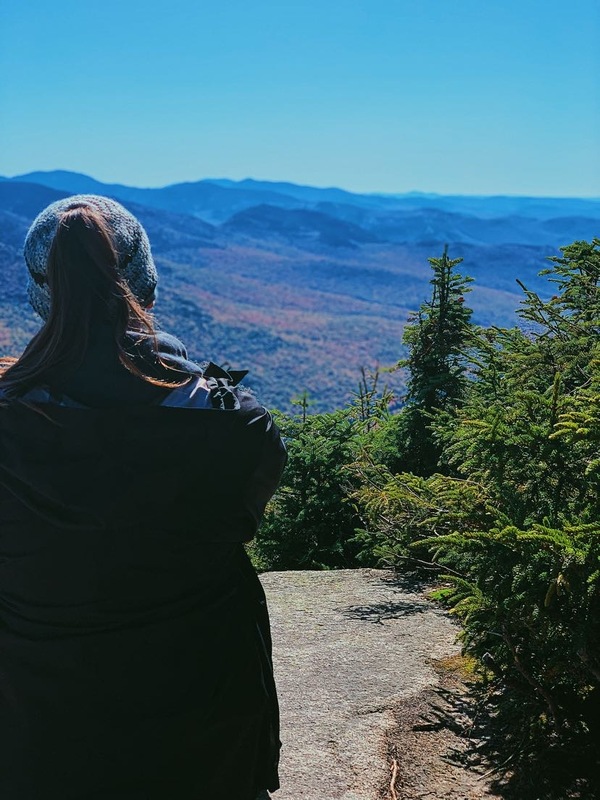
During the pandemic, I was lucky that I didn't lose anyone close to me. I know many people around me and in the world who watched their loved ones die from COVID-19. It has also had long-lasting health effects on many people as well. It is an ongoing conversation because people are still contracting the virus daily. Lockdown was a surreal moment for many in our ordinarily fast-paced world. The entire world stopped, and for once, we couldn't rely on our usual entertainment and schedules for distraction. This led to the development of new habits, which, unfortunately for me, were not just board games and binge-watching Netflix. Alcoholism had been at my doorstep since my senior year of high school, with my dependence on the substance worsening as the years passed. This is a genetic condition, and I have had countless family members struggle and die because of substance abuse, mainly alcohol. When the pandemic hit, I drank nearly every day, and this continued during lockdown with my roommate and a few friends. Not only was this dangerous because of the spreading pandemic, but it also worsened my mental health. Soon, my college shut down, and I had to move back home, where my substance abuse continued. My relationship had fallen apart when my ex moved back to India as he was on a student visa. The drinking and emotional isolation/strife led to a breakdown wherein intrusive suicidal thoughts plagued me. Something had to change; one night, I quit all substances and contacted my PCP about a mental health evaluation. I know my diagnosis was wrong, but it got me on the medication I needed to forget the intrusive thoughts and piece my life back together. My saving grace was my father and, eventually, my friends, who decided to pick me up and give me a distraction. This distraction became hiking mountains, a shared hobby of previous substance abusers. The chemicals released in the brain during these hikes and the physical exercise filled the void alcohol used to. It served it and began to heal the void left by years of mental health struggles and abuse. Like in this picture, the world's problems and my own seemed small when I was on top of a mountain. Not only that but also hiking is a very social-distance-friendly activity. The love for hiking fostered in my childhood was rekindled during the pandemic and remains one of my favorite things to do. My father and I are attempting to walk up all New England's notable peaks. -
 12/29/2021
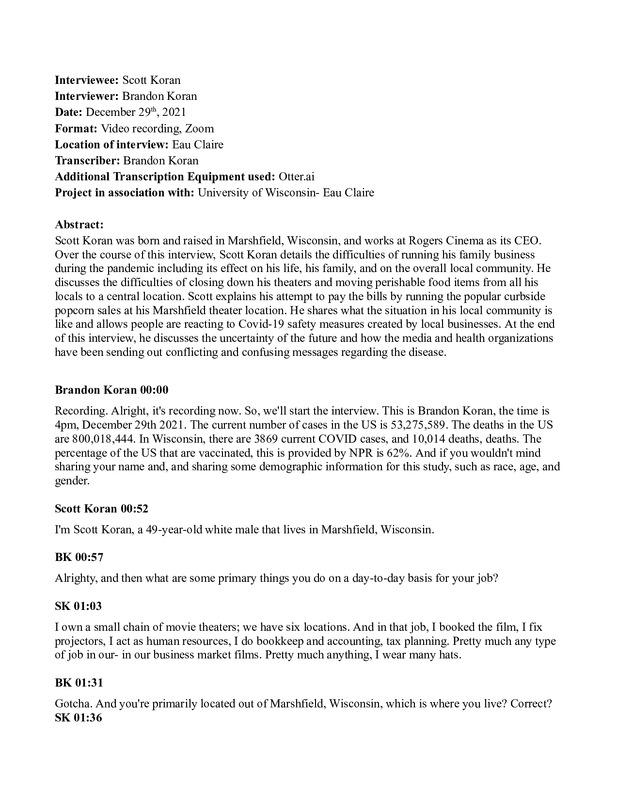
Scott Koran Oral History, 2021/12/29
Scott Koran was born and raised in Marshfield, Wisconsin, and works at Rogers Cinema as its CEO. Over the course of this interview, Scott Koran details the difficulties of running his family business during the pandemic including its effect on his life, his family, and on the overall local community. He discusses the difficulties of closing down his theaters and moving perishable food items from all his locals to a central location. Scott explains his attempt to pay the bills by running the popular curbside popcorn sales at his Marshfield theater location. He shares what the situation in his local community is like and allows people are reacting to Covid-19 safety measures created by local businesses. At the end of this interview, he discusses the uncertainty of the future and how the media and health organizations have been sending out conflicting and confusing messages regarding the disease. -
 12/01/2021
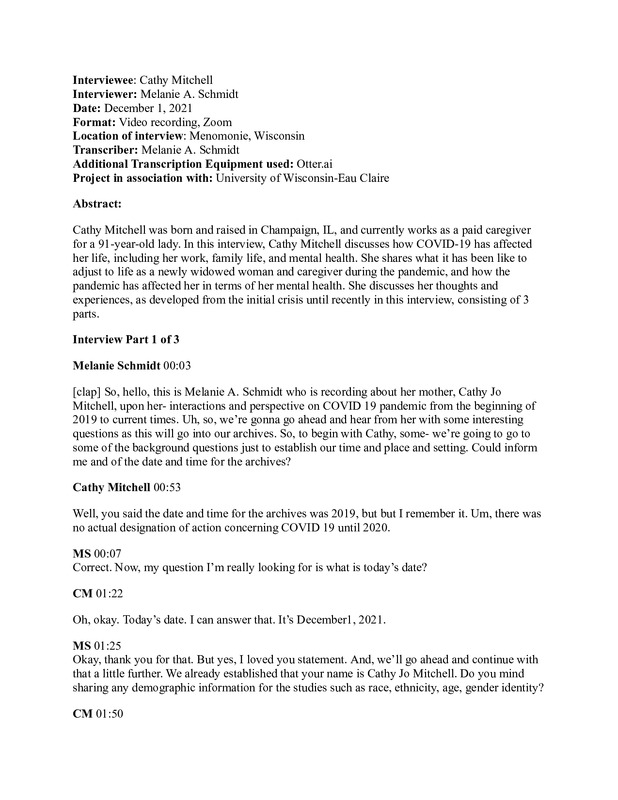
Cathy Mitchell Oral History, 2021/12/01
Cathy Mitchell was born and raised in Champaign, IL, and currently works as a paid caregiver for a 91-year-old lady. In this interview, Cathy Mitchell discusses how COVID-19 has affected her life, including her work, family life, and mental health. She shares what it has been like to adjust to life as a newly widowed woman and caregiver during the pandemic, and how the pandemic has affected her in terms of her mental health. She discusses her thoughts and experiences, as developed from the initial crisis until recently in this interview, consisting of 3 parts. -
 12/08/2021
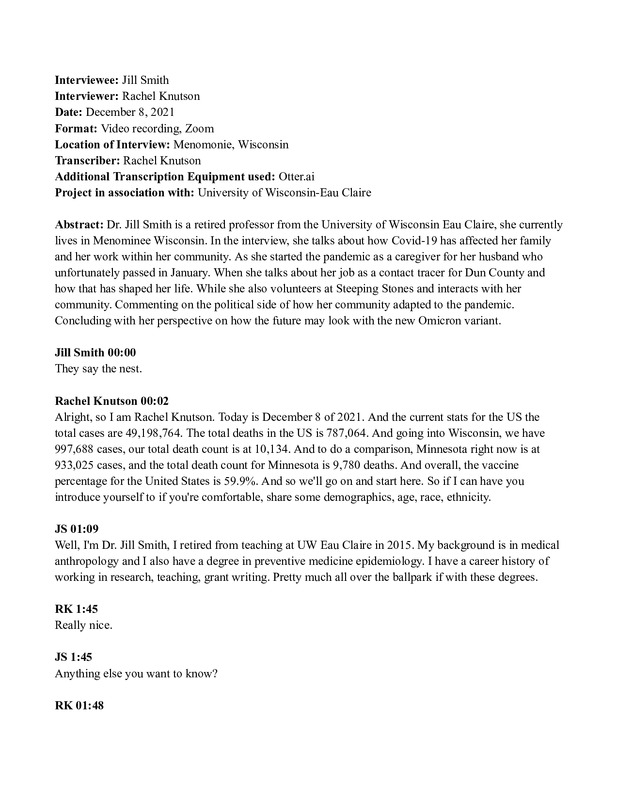
Jill Smith Oral History, 2021/12/08
Dr. Jill Smith is a retired professor from the University of Wisconsin Eau Claire, she currently lives in Menominee Wisconsin. In the interview, she talks about how Covid-19 has affected her family and her work within her community. As she started the pandemic as a caregiver for her husband who unfortunately passed in January. When she talks about her job as a contact tracer for Dun County and how that has shaped her life. While she also volunteers at Steeping Stones and interacts with her community. Commenting on the political side of how her community adapted to the pandemic. Concluding with her perspective on how the future may look with the new Omicron variant. -
 2022-05-22
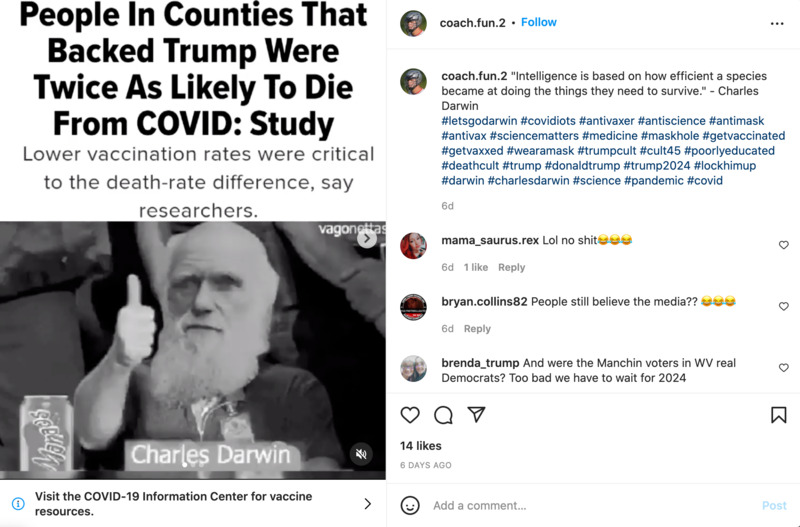
People in counties backed by Trump were twice as likely to die from COVID: Study
This is an Instagram post by coach.fun.2. The study is not linked in the description, but I did find the article the title is referencing. The story come from the Huffington Post. It says that political affiliation is linked to vaccination rates, which some claim are what is making the difference between living and dying from COVID. Wealth and access to certain care are also taken into account. The study was from Brown and the study claims that states that went heavily for Trump had more cases of COVID deaths. -
 2020-05-24
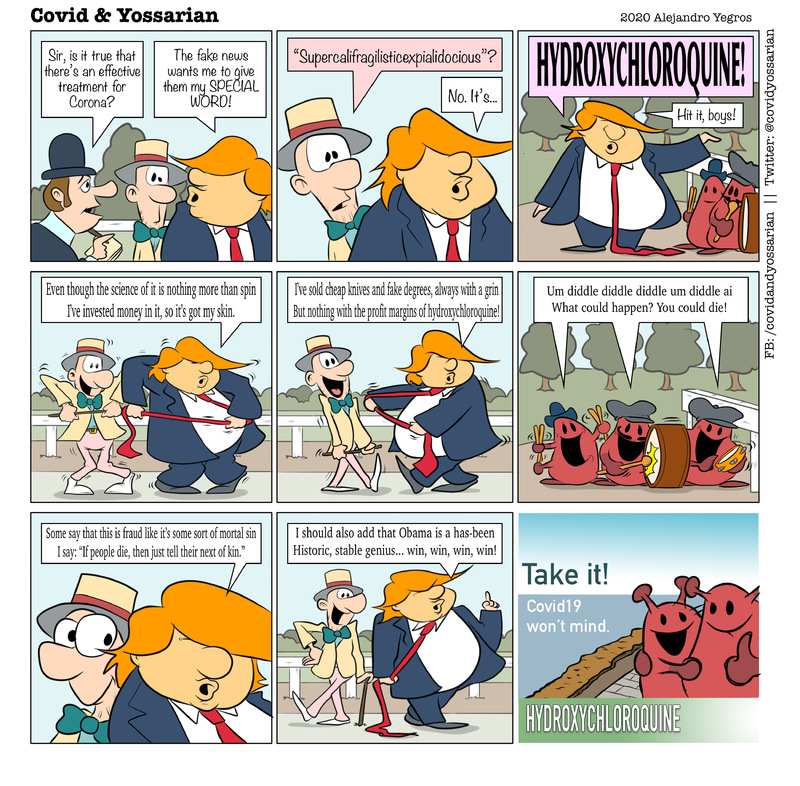
Hydroxychloroquine
A comic strip about Covid-19 -
 2020-04-14
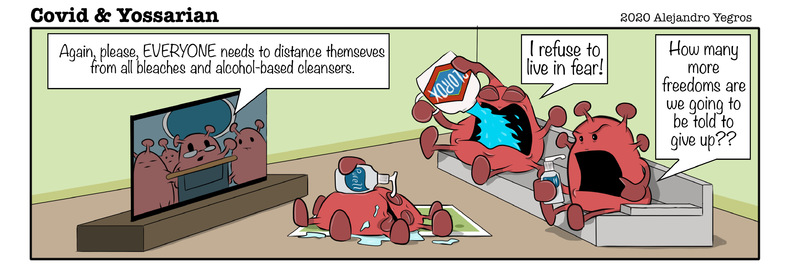
Live free or die
A comic strip about Covid-19 -
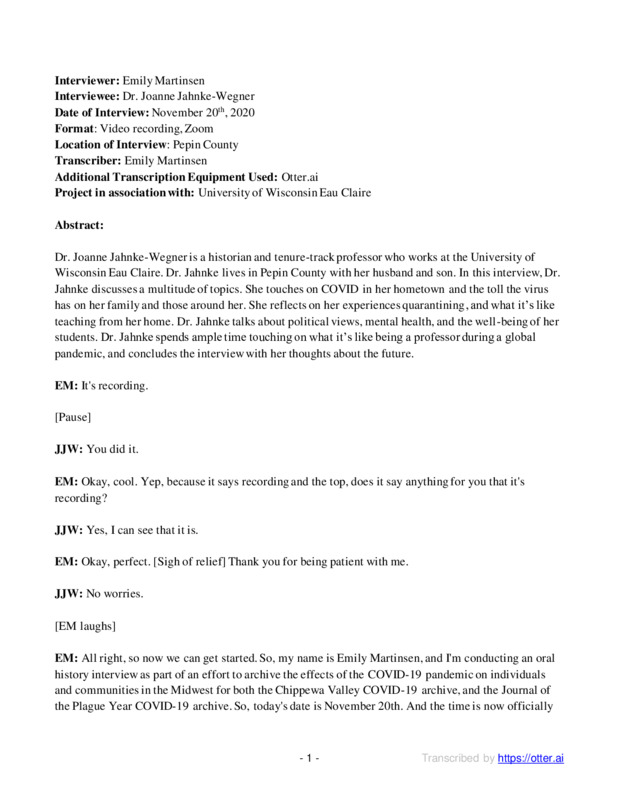 11/20/2020
Joanne Jahkne-Wegner Oral History, 2020/11/20
C19OH -
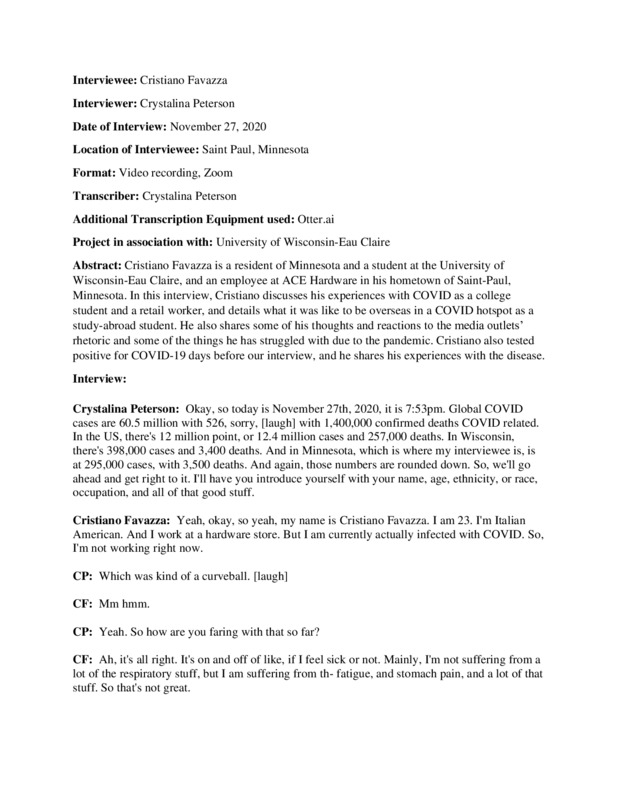 11/27/2020
Cristiano Favazza Oral History, 2020/11/27
C19OH -
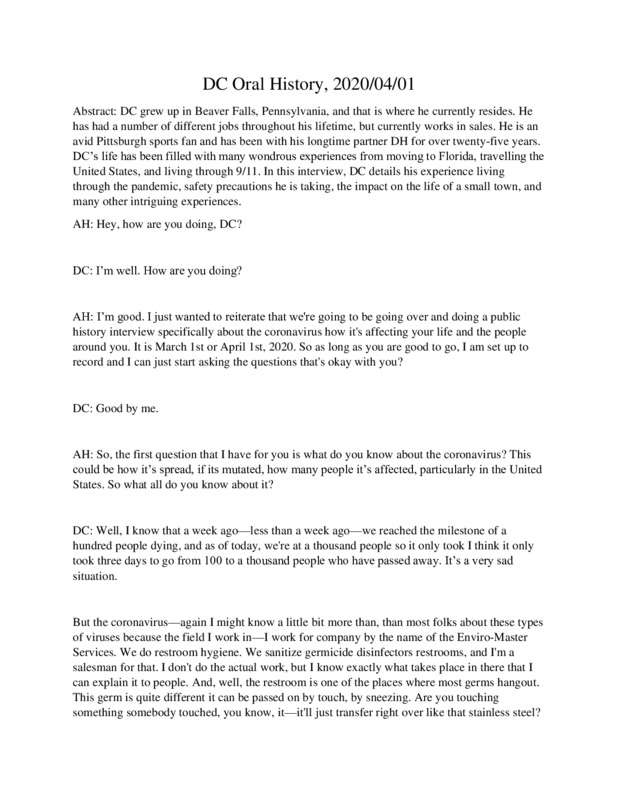 04/01/2020
DC Oral History, 2020/04/01
C19OH -
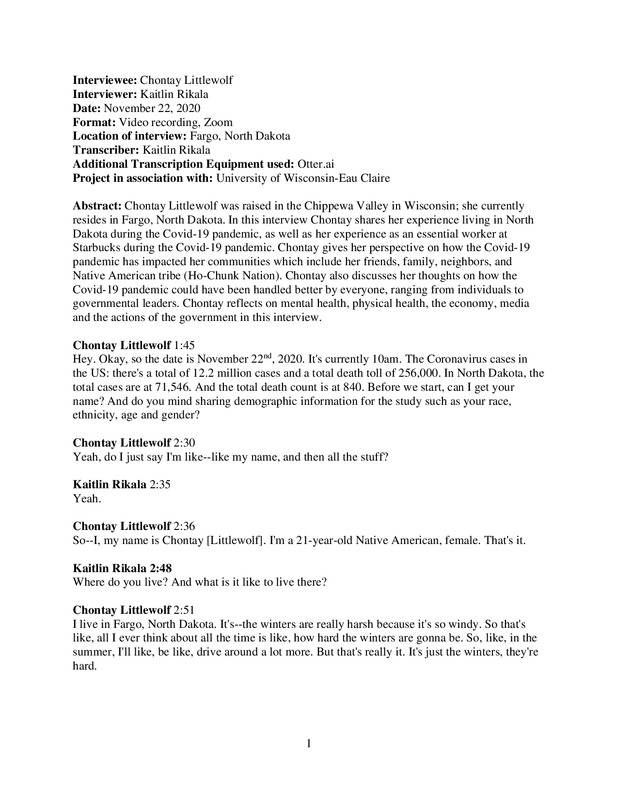 12/09/2020
Chontay Littlewolf Oral History, 2020/11/22
Chontay Littlewolf was raised in the Chippewa Valley in Wisconsin; she currently resides in Fargo, North Dakota. In this interview Chontay shares her experience living in North Dakota during the Covid-19 pandemic, as well as her experience as an essential worker at Starbucks during the Covid-19 pandemic. Chontay gives her perspective on how the Covid-19 pandemic has impacted her communities which include her friends, family, neighbors, and Native American tribe (Ho-Chunk Nation). Chontay also discusses her thoughts on how the Covid-19 pandemic could have been handled better by everyone, ranging from individuals to governmental leaders. Chontay reflects on mental health, physical health, the economy, media and the actions of the government in this interview. -
 04/14/2021
Liana Smith Oral History, 2021/04/14
-
 05/12/2021
Katherine Running Oral History, 2021/04/22
Katherine Running was raised in Eau Claire, Wisconsin. She currently resides in Fargo, North Dakota. She is currently occupied as a graduate student and a lab researcher at the USDA in Fargo. In this interview, Ms. Running talks about how the covid-19 pandemic has affected her professional and personal life. She also discusses how people have stopped trusting science and facts. -
 05/09/2021
Galina Pozharsky Oral History, 2021/04/21
Galina Pozharsky is a Russian immigrant who has been living in Eau Claire for the past 10 years. We discussed her views on why she believes Covid-19 is not that big of a deal and why she believes the pandemic is at least partially politically motivated. -
 10/06/2020
Sa'Ra Skipper Oral History, 2020/10/06
-
 2021-12-06
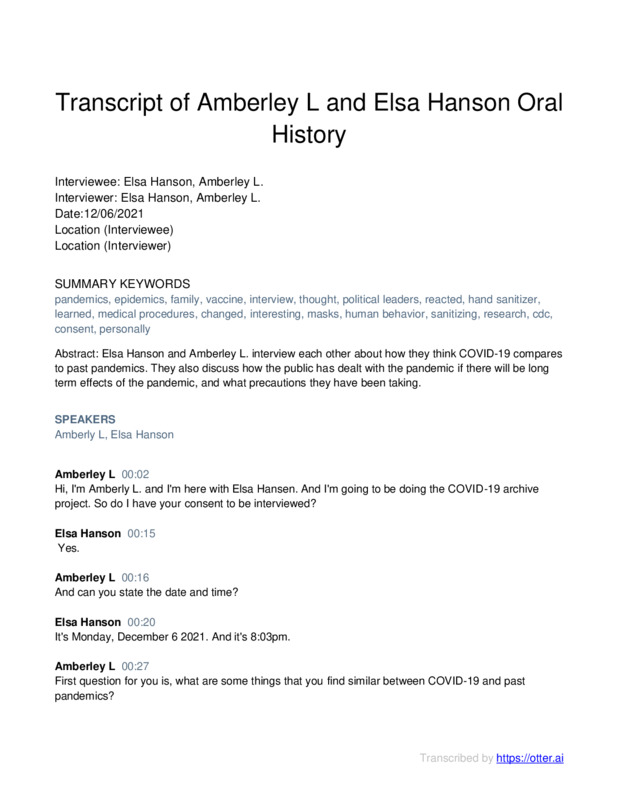
Amberley L. and Elsa Hanson Oral History, 2021/12/06
Elsa Hanson and Amberley L. interview each other about how they think COVID-19 compares to past pandemics. They also discuss how the public has dealt with the pandemic if there will be long term effects of the pandemic, and what precautions they have been taking. -
 05/06/2021
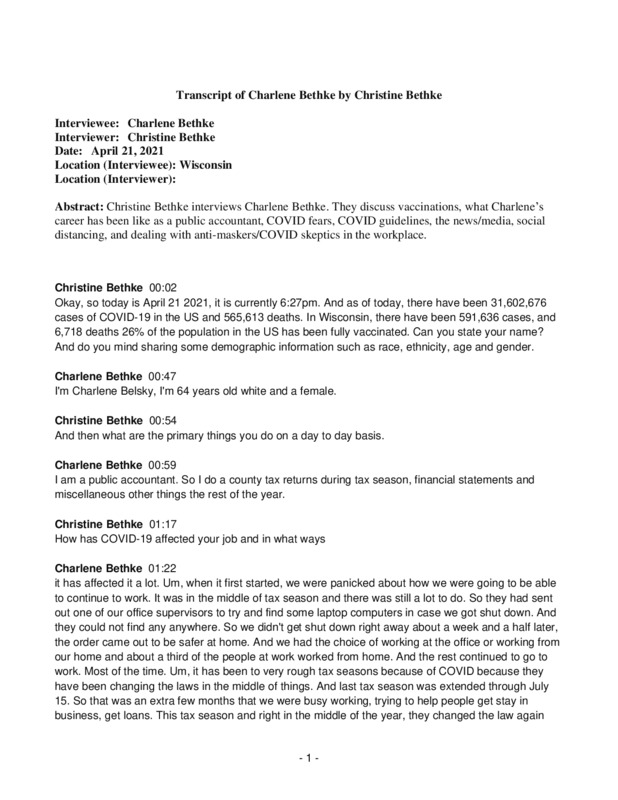
Charlene Bethke, Oral History, 2021/05/06
Christine Bethke interviews Charlene Bethke. They discuss vaccinations, what Charlene’s career has been like as a public accountant, COVID fears, COVID guidelines, the news/media, social distancing, and dealing with anti-maskers/COVID skeptics in the workplace. -
 11/30/2020
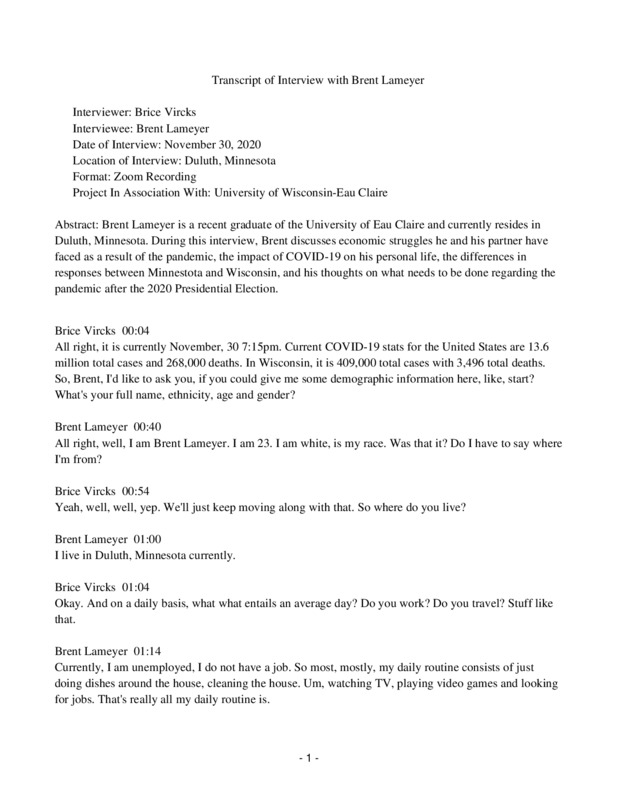
Brent Lameyer Oral History, 2020/11/30
C19OH -
 2020-08-21
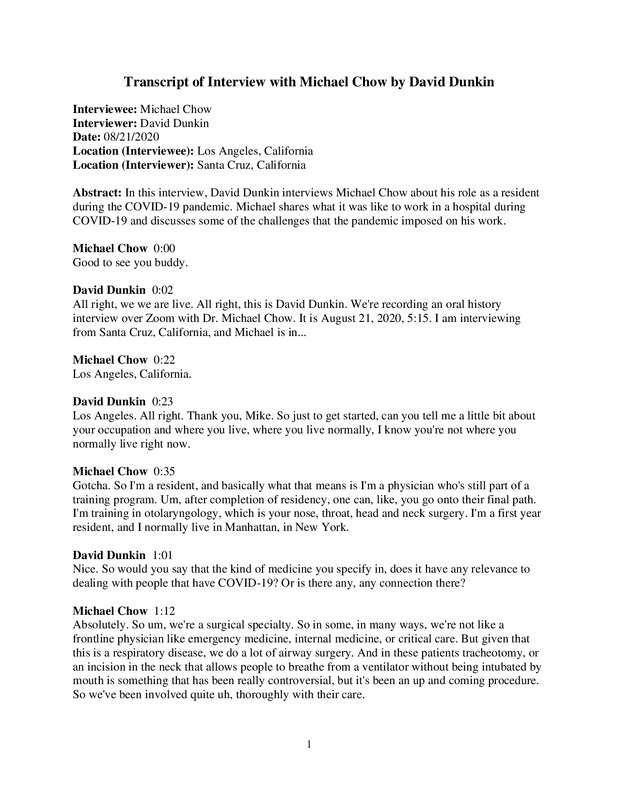
Michael Chow Oral History, 2020/08/21
C19OH -
 2021-11-13
Anti-Vaxxers in the Family
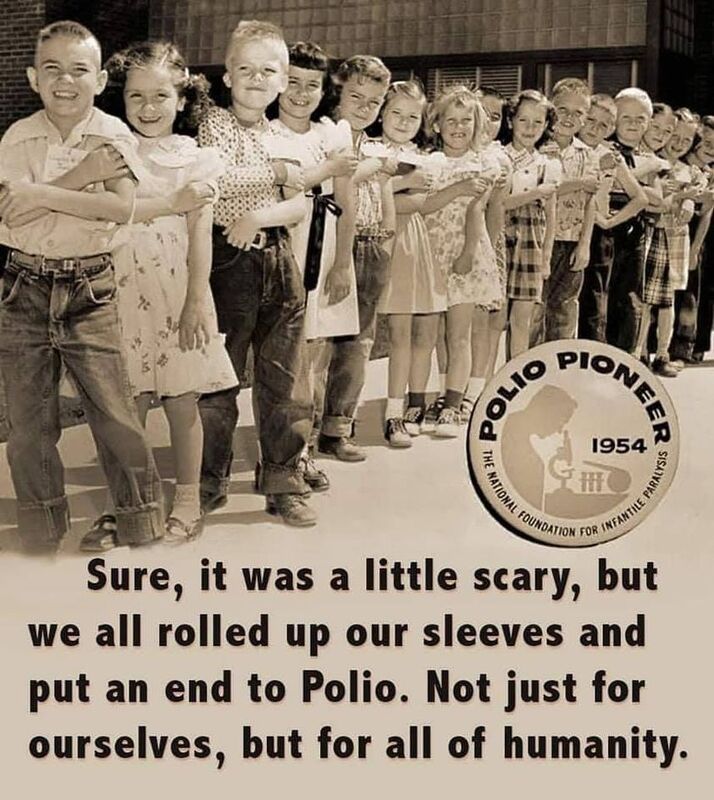
I have a minimum of 2 resolute anti-vaxxers in my extended family. We try to avoid conflict but sometimes their ignorance is just too much for me to bear and I feel like I have to set the record straight. Here's a summary of what's going on in these screenshots from a FB post. 1. Great aunt posts a meme using the experience of the Polio vaccine to promote the COVID vaccine. (meme included) 2. Anti-vax aunt (orange) posts snarkily that in the case of the polio vaccine, it was only rolled out after 60 years of research. 3. I step in (as a historian of public health) and comment that she's mistaken, the polio vaccine went from lab to roll out in 25 years. While mRNA (on which the COVID vax is based) was first discovered in a lab 35 years ago so it stands to reason that the amount of time between lab and roll out is similar. 4. Meanwhile... anti-vax second cousin (purple- daughter of great aunt who made the original post and also resolutely anti-vax) tags anti-vax aunt (orange) and says "amen." as in... she lends her support 5. Anti-vax aunt (orange) responds to my initial rebuff in #3 and says "wrong. it took 35 years to discover it was a virus" (as if that, added to the 25 years of development constitutes 60 years of "research" 6. I step back in and repeat... polio vaccine research began in 1930, and it rolled out in the US in 1954. Surely she doesn't want to go back to the "good old days" when it took 30 years to discover whether something was a virus, really...?? 7. I was wrong. Anti-vax aunt (orangs) DOES want that. She says, "Yes, really" 8. pro-vax cousin (light blue-an oncology NP) comments "Wow. That's sad to think about" 9. Anti-vax aunt (orange): ? 10. pro-vax cousin (light blue): is we were not able to identify viruses like we can today. It's sad to think about all of the people that would die unnecessarily. This exchange went on but I just don't have it in me to continue with screenshots. Great aunt (original poster) chimes in and says she doesn't care what people's beliefs are but both of her daughters (one of them the anti-vaxxer in purple) families have COVID right now and she's in her 70s and was exposed to both and never caught it. She firmly believes it's because the vaccine works. Anti-vax aunt claimed she "didn't post a belief, she posted a fact" I said "no. you posted an incorrect fact that was skewed to make it look like the polio vaccine underwent 35 more years of research than it actually did and I corrected you." It's amazing to me that technology that has been in development for 35 years (mRNA) is seen with such suspicion because the virus it's being used with COVID-19 is new. So the assumption is that the vaccine is "untested" even though the technology behind it has a robust research history. I'm even more amazed by people who are anti-covid vaccine even though they had their full slew of childhood vaccines on schedule. I have two very close family members who refused to get vaccinated (different family members than the two distant family featured above) and they had all of their childhood vaccines. One of them even told me she fully expected that everyone who was vaccinated with the COVID vaccine will die in a few years or even "sprout dicks" for all she knows.... yes... It's imperative that we, as a society, figure out how to address misinformation and disinformation. Certainly, facts/statistics/"Research" are open to interpretation to a degree but much anti-vax info out there is politically motivated. It's not coming from scientists who spend their whole lives studying this stuff.... it's coming from PACs and anti-establishment groups who have beef with the US government and/or "Big Pharma" or Western medicine. -
 2021-01-11
My Dad...The first EPPD officer to die from Covid-19
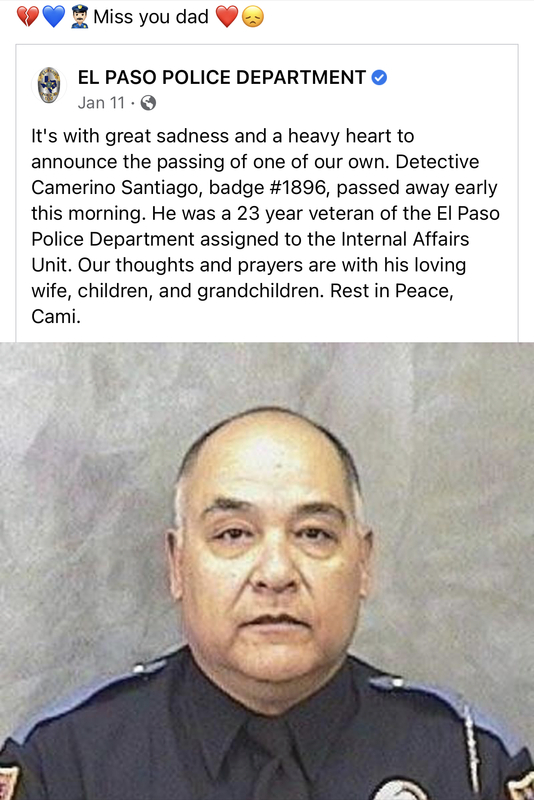
After a month of battling Covid-19, my father passed away due to complications caused by the virus. He was due to retire in January 2021. He worked for the El Paso Police Department for 23.5 years. His passing hit us all hard and it was unexpected as the doctors had told us several days before that he would make it. Then he took a turn for the worst. When his co-workers asked what did he look forward to in his retirement, he said spending time with his family and his granddaughter. We still miss him to this day, especially as the holidays approach. -
 2021-03-29
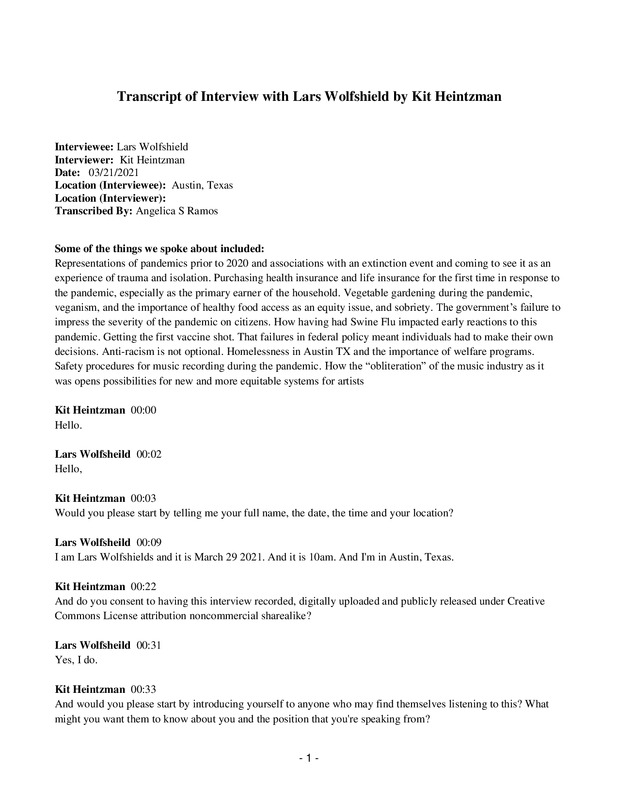
Lars Wolfshield Oral History, 2021/03/21
Self-Description: “I am a pansexual and gender fluid artist and artist manager and I work primarily with Black and queer musicians and bands.” Record label: https://www.instagram.com/wolfshieldrecords/ -
 2021-03-31
Gyre Oral History, 2021/03/31
Self-Description: “My name is Gyre. I am a multidisciplinary artist based in South Africa with global ambitions. I specialize in music, but I also work as a freelance writer as well as in dance. I’m a dancer learning to choreograph. Political commentator, particularity with regard to the LBGTQA+ community. I identify as queer. I am homoromatic and homosexual at this point in my life. You never know honey, it’s a spectrum. I had my first venture into artistic expression that is rooted in queer rights and queer understanding and queer theory, was my debut album, titled Queernomics, which was a documented audio-visual book about the contemporary experiences of a Black queer South African male, and that has gotten me into the positions that I express myself in, both out of passion and out of profession. Inkosi Yenkonkoni, which means “The Gay King”, in my native language which is Zulu.” Other details available here: Works produced during the pandemic: Kithi, International LGBTQ+ Rights Festival, writing on football. Some of the things we spoke about included: “What happens at the top is just politics, what happens at the bottom is real life.” Thinking about the term “pandemic” Listening to the body The pandemic exposing state corruption Having written a song called “Quarantine” in 2018 The inadequacies and privileges of Medical Aid in South Africa, having aged out of Medical Aid before COVID, the personal impact of worse-health insurance during pandemic, the importance of demonetizing health care Pre-COVID keeping busy: organizing, walking, collaborating Transit during COVID, sub/urban and outskirt disparities Canceling shows and taking dance classes and rethinking what it means to be productive Global Americanization and the impact of Trump’s pandemic denialism on South African health Moving out of disbelief about the severity of COVID after losing a loved one in the first wave Gratitude for the global influence of the Black Lives Matter movement, and sadness that tragedy in the diaspora brings neocolonialism to the fore The importance of social media for queer counter-violence and activist fractures among LGBTQA+ Feeling allyship with the #metoo movement How homophobia intersects with everyday altercations about social distancing The anxieties of hooking up during the pandemic The importance that scientists learn to speak in lay terms about climate change and vaccines Existence as resistance and creating art “Spread love not tolerance” Other cultural references include: Trans Day of Visibility, astrology, and the TV series Pose. -
 2021-04-04
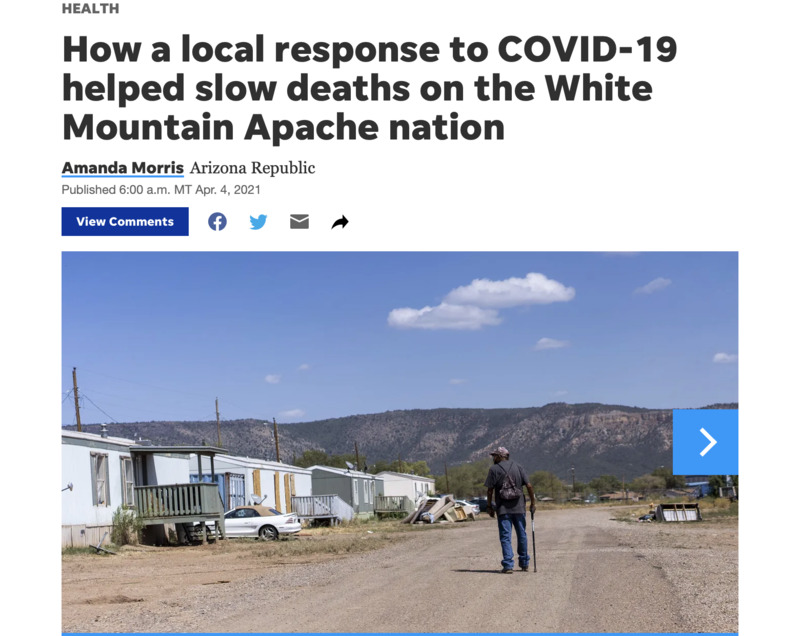
News Article: How a local response to COVID-19 helped slow deaths on the White Mountain Apache nation
By Amanda Morris of the Arizona Republic: When someone on the Fort Apache Indian Reservation receives a confirmed diagnosis of COVID-19, health care workers from the Whiteriver Indian Hospital jump into action. They personally visit the individual's home to test other household members, perform health evaluations on everyone there and trace any other potential contacts at risk for COVID-19 exposure. Health care workers in the community say that could be one reason why, even though the rate of confirmed COVID-19 cases among White Mountain Apache tribal members is nearly triple the state's rate, the death rate is much lower and continues to fall. Over 90% of COVID-19 cases in the White Mountain community are investigated within 24 hours of testing, according to Ryan Close, the director of the Department of Preventative Medicine at the Whiteriver hospital, which is the only hospital on the 1.67 million-acre reservation. "I feel like what we did made a huge difference," Close said. "We evaluated and admitted people aggressively and early. The tribe deserves an incredible amount of credit for mobilizing staff ... to make this response possible, because at some point it would have been very difficult to maintain without their considerable help." The quick response may have also helped the tribe turn the tide against rapid community spread of the virus, which scientists say could have been fueled by a single variant found only in the White Mountain tribal communities. The variant carried a mutation in the spike protein, which scientist theorize could have made it spread more rapidly than other strains of the virus. The number of confirmed COVID-19 cases among White Mountain Apache tribal members accounts for 24% to 28% of their population, according to Close, but the cumulative death rate among known cases is only 1.2%. By comparison, the statewide rate of infection was 11.5% with a 2% death rate among known cases. And over the winter, Close said the rate for the tribe dropped even lower, to about 0.5%. In a community with a high number of individuals with underlying health conditions, the low death rate and work of the tribe has been "remarkable," said David Engelthaler, director of the Translational Genomics Research Institute's infectious disease division in Flagstaff. The death rate also stands out as unusually low when compared with death rates in other Indigenous communities. Indigenous populations have been disproportionally affected by the pandemic. CDC data shows that Indigenous people are 3.5 more likely to be diagnosed with COVID-19 and almost twice as likely to die from COVID-19 than white people. Close credits a proactive strategy to combat COVID-19 that involved rapid contact tracing, in-person health evaluations and frequent outreach to high-risk COVID-19-positive individuals as well as early treatment with monoclonal antibodies and other antiviral therapies. Volunteers and health workers from the White Mountain Apache community were on the Whiteriver hospital's contact tracing team and high-risk COVID-19 outreach team, which Close said helped the team connect better with the people and work faster. One essential part of the team are the tribe's community health representatives, or CHRs, who are members of the community that serve as a cultural bridge between patients and medical establishments. JT Nashio, director of the Community Health Representatives for the tribe, said the "visceral connection" that CHRs have to the community helps them bring cultural awareness to the way questions are asked for contact tracing, which makes the process more effective and allows officials to better distribute information. "On top of that, quite simply, they know how to get around. It’s a big reservation and not all homes are easy to find," Nashio said. "But when you’ve lived here your whole life, you know where to find people. That became invaluable during the tracing and testing push during case surges." Virus mutation may have made it more transmissible When COVID-19 hit the White Mountain Apache nation, it spread rapidly. The community's first documented case was on April 1, 2020, from someone who had likely recently visited the Phoenix area, unknowingly caught COVID-19 and returned, according to Engelthaler. Within the first few weeks, Close said the community experienced a handful of deaths. "We soon had incidence rates that were skyrocketing. Case counts were going up very, very quickly," Close said. It's unclear why the disease spread so rapidly in the community, but the initial strain of COVID-19 that hit the community carried a mutation that Engelthaler believes could have made it more transmissible. "They were seeing the virus just rip through and have an 80 to 90 to 100 percent attack rate," he said. TGen partnered with the tribe and the U.S. Indian Health Services early on to provide tests to diagnose a case of COVID-19 and provide genetic analysis of the virus from each case. It showed one strain of the virus circulating in the tribal community that wasn't present anywhere else in the state. "This virus moved much faster than anything else we were seeing in Arizona at the time," Engelthaler said. "So we actually believe that we had one of these variant strains in Arizona that was causing very large numbers of cases, but it was secluded and maintained really only in that tribal population." The mutation, called the H245Y mutation, occurred in the spike of the virus, which Englethaler said is a "very sensitive" part of the virus where mutations can have a significant impact. Because of the low death rate, Engelthaler said TGen researchers would like to investigate the mutated strain of coronavirus seen among tribal members to see if it is also associated with a lower fatality rate. He acknowledged that other strains of the virus have since entered the community and that the actions of health care workers in the community and at the Whiteriver hospital is also responsible for the lower death rates. 'The earlier you treat an illness, the better' Close's biggest concern was that an outbreak would cause a "tsunami" of sick COVID-19 patients that would run the risk of overwhelming the Whiteriver hospital, which does not have an intensive care unit. Any patients that require intensive care need to be transported to other hospitals in the state. "We're a small hospital, we cannot take a wave of all very acute patients because there aren't enough ventilators in the hospital," Close said. "There aren't enough helicopters in the state to transport people out from our facility to a higher level of care." Within the first few weeks, Close said the community experienced a handful of deaths, and patients who had the poorest outcomes were the ones who self-presented at the hospital — often meaning they waited until they felt sick enough to go to the hospital. "People don't always bring themselves in early enough," Close said. "The earlier you treat an illness, the better." In response to this phenomenon, the hospital started a high-risk outreach program the third week of April. Health care workers regularly visited the homes of anyone who tested positive for COVID-19 and was at high risk for a poor outcome. Close recalls multiple days when he evaluated patients and found their oxygen levels dangerously low, even though they felt fine. It's a condition associated with COVID-19 known as "silent hypoxia," or "happy hypoxia." "They had no sense that they were even ill. They went on to get pretty sick in the hospital, but they survived and you can't help but think to yourself, 'Yeah, that's a life saved,'" Close said. "That person, if they had stayed home another day or another two days would not have done as well. They would have ended up on a ventilator or something." The Arizona Republic previously reported that the effects of the high-risk outreach program and contact tracing led to a fatality rate among tribal members of 1.6% last June, which was less than the state's rate of 2.5% and country's at 2.7% at the time. But the effect of the outreach program became even more pronounced over the winter, as the tribe and health workers gained access to monoclonal antibody treatments, according to Close. He said the high-risk outreach team started referring patients for antibody treatment in December as part of their protocol after the therapy received emergency use approval from the Food and Drug Administration. Hospital staff at the Whiteriver hospital then administered the antibody treatment. "We give that to people who are asymptomatic or mildly ill to prevent hospitalization," Close said. "The evidence currently suggests that reduces the risk that they're going to get sicker and get hospitalized and reduces the risk that they're going to die." Though there's no data proving the antibody treatments made a difference, Close said that after health care workers started using them, the community's COVID-19 death rate fell to 0.5%. Hospital workers also gave antiviral therapies, such as remdesivir, to patients early and often. "We probably overtreated some people," he said. "But the good news is it definitely led to significant reductions in mortality." Lessons for the future Close believes the different programs were so successful because health care workers were often able to test, trace, diagnose and treat individuals all in the same day — a feat he said was only possible because of how closely integrated hospital workers and community health workers were. "There were no barriers in communication between the public health arm of our response and the clinical care arm of our response," Close said. "It's really a case for an integrated health care system." As the tribe emerges from the pandemic and tribal members get vaccinated against the virus, Close said the hospital may start exploring other health conditions where it can use the high-risk outreach team, which is already trained and experienced in clinical evaluations. "The goal is to take what we've learned from COVID and now apply it to things that are not COVID-related," Close said. Another valuable lesson Close hopes to carry forward is how much of a difference visiting residents in their homes can make and how important building trusting relationships with the community is. Nashio said going door to door to trace and monitor COVID-19 cases was a natural step for CHRs, who had already gone door to door in the past for other community health campaigns. "We know firsthand how difficult it can be to not only connect with patients over the phone but communicate effectively over the phone," Nashio said. "When the community sees their CHRs coming to their door, it helps decrease the stigma of the disease." In addition to performing checkup evaluations and providing information, Nashio said CHRs can also provide food, medical supplies, cleaning supplies or services like grocery shopping and running basic errands. Not every tribal member has reliable internet or phone service, nor access to transportation, so Close said going door to door can be a good way to reach, and help, everyone. "Meeting patients where they are is invaluable," Close said. Amanda Morris covers all things bioscience, which includes health care, technology, new research and the environment. Send her tips, story ideas, or dog memes at amorris@gannett.com and follow her on Twitter @amandamomorris for the latest bioscience updates. Independent coverage of bioscience in Arizona is supported by a grant from the Flinn Foundation. -
 2021-01-21
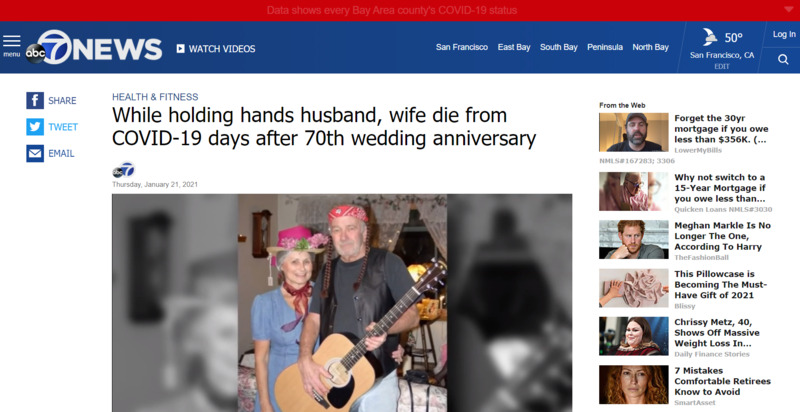
While holding hands husband, wife die from COVID-19 days after 70th wedding anniversary
The increasing death toll from COVID-19 has devastated many families on a personal level. One instance illustrates that like no other. An Ohio couple that had recently celebrated their 70th wedding anniversary both passed away minutes apart, leaving behind seven decades of memories, five children, 13 grandchildren and 28 great-grandchildren. Dick and Shirley Meek celebrated their anniversary on Dec. 22. It was then when they innocuously told their children they were feeling a little under the weather. "They said to all us kids, 'we think we're getting colds,'" said Kelly Meek. But suddenly, things got bad and it was evident this was no mere cold. On Jan. 8, they both tested positive for COVID-19. When things started to worsen for both of them, the family asked for them to be together for their final moments. Hospital staff found a room for two beds and the necessary equipment. Dick and Shirley died in each other's arms on Jan. 16. They were due to get the COVID-19 vaccine on Jan. 19. -
 2021-04-01
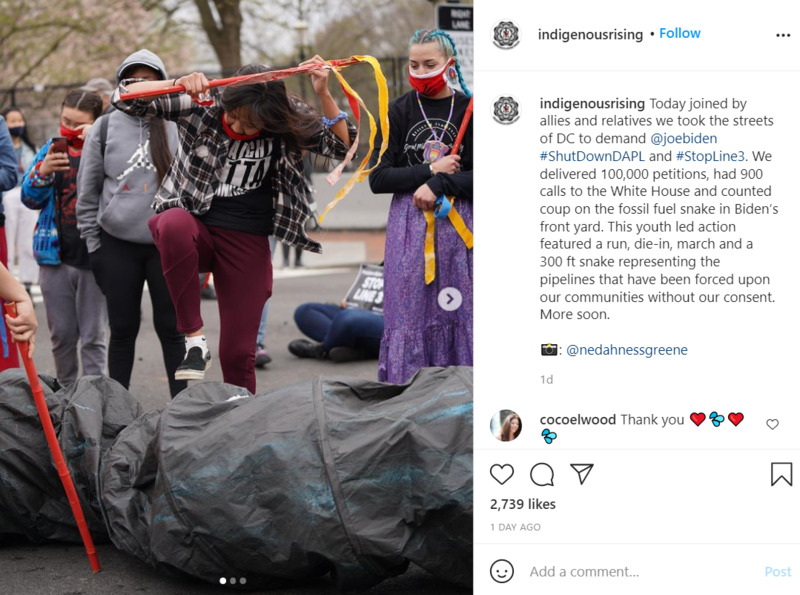
White House demonstration
Today joined by allies and relatives we took the streets of DC to demand @joebiden #ShutDownDAPL and #StopLine3. We delivered 100,000 petitions, had 900 calls to the White House and counted coup on the fossil fuel snake in Biden’s front yard. This youth led action featured a run, die-in, march and a 300 ft snake representing the pipelines that have been forced upon our communities without our consent. More soon. -
 2021-01-25
COVID-19 Stats and Story
Coronavirus happened so quickly. It is difficult to recall details from March 14 2020. The day my family and thousands of others went into quarantine. March 14 2021 is approaching quickly. Back then it seemed like nobody knew anybody who had the virus. It was all rumors and stories. Now it seems like everybody knows or has had Coronavirus. A prediction is that 1 in 3 people in LA county have had Coronavirus, which is totally insane. Los Angeles county has over 10,000,000 residents. Meaning that about 33,333,333+ people have been infected, many without knowing. Although it is an estimate, that shows how serious this virus is. 1000-3000 (about) people in America die due to Coronavirus each day. About 15,000 people die each day worldwide. There have been almost 100,000,000 Coronavirus cases and 2 Million deaths. 1/70 of the world has been diagnosed, not including those who are asymptomatic and those who were not or do not have access to tests. About 2 million people have died. That is 1/50 of those diagnosed. Seeing these numbers shocks me. It opens my eyes and makes me realize how truly important it is the wear a mask and to be safe. My grandpa, I call him Papa, is getting the first dose of his Coronavirus vaccine tomorrow. I am so excited that he will have immunity. There are 11 cases of Coronavirus in his 200 person retirement home. He is 84 years old. I am so glad that Papa will be safe. He was widowed when my grandma, Grammy about 11 years ago, so I believe she had been his guardian angel just as she has been mine. My final thought is that I cannot wait for Coronavirus to be cured and for the vaccine to have wider distribution. -
 2021-01-21
Lion in Hibernation
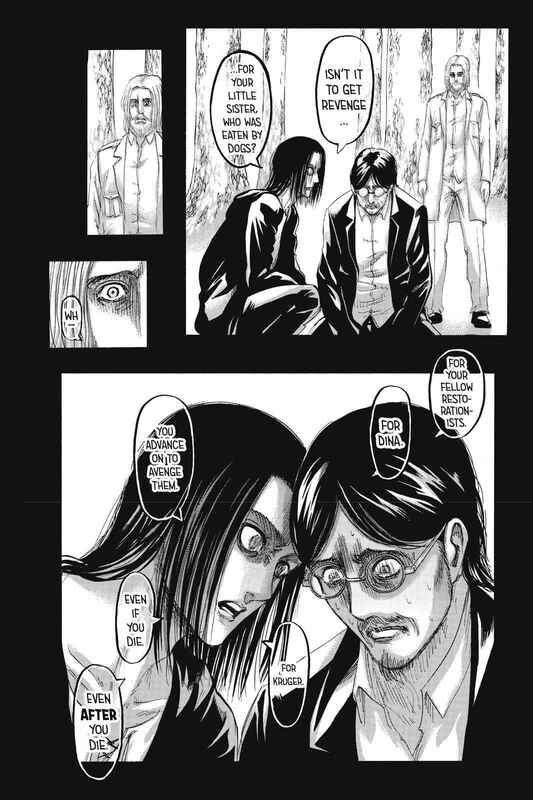
The beginning of 2020 was actually going really well for me. February was Lunar New Years, and it was one of the best years I’ve had lion dancing. Later that month it was Vietnamese culture night, and me and some school friends decided to form an impromptu team to perform for the event, and eventually it led me to starting an actual lion dance team for my school. A little context to this is that I’m a very young, but passionate lion dancer, and I’ve been lion dancing since I was in 7th grade. Growing up I always wanted to be a lion dancer, and never in a million years would I have imagined that I'd end up starting and running one. So when I did it was one of the most exciting things that happened to me, and life for me was starting to look good; I was doing well in school, I finally asked out this girl I had a crush on, and I somehow recruited members for this school lion dance team. I will always rember that day, March 13th, 2020. I remember it was a wet and rainy day, but the rain had stopped for a bit. So we decided to have practice. I remember in the middle of our practice, we had received an email from the school saying that we would shut down. (Ironically, I remember being in 5th period, joking about how I’d take one for the team and get COVID so school would get shut down) I remember everything was just quiet in that moment, then suddenly everyone started to freak out. They worried about their AP exams and their stuff from sports and yearbook, etc. On the inside I was freaking out too, but I tried to keep my composure and tried to get back to practice. But eventually we all decided to end practice early. I remember going with my brother after that to get sushi with our Vietnamese teacher and we just thought it was going to be a short term thing. In the beginning I thought it would be a fun and breezy 3 weeks. But 3 weeks became 3 months. And 3 months became 9 months. I remember just sitting at home and feelin devastated about the current situation. I didn’t think that it would ever be so bad and it’d be such a low point in my life. I remember waking up everyday during summer feeling more and more worthless, with no goal or idea of what to do next. And this thought basically continued into the new school year, but it suddenly got worse. It was the middle of November and I remember jogging and i felt like i was choking, I rember i got home and fell down and just started gasping for air. Later my family got tested and turns out I had COVID. And what I thought was isolation became even more isolated. I was all alone, both emotionally and physically. There comes a time where you become tired of everything and you just lay in bed and stare at the ceiling and wonder, “Why the hell is this happening? Is everything I do a failure? Why do I even have these hopes and aspirations when it seems like the world doesn’t approve of it anyways?” But there was one thing that really comforted me, and that was anime and manga. I remember re-reading one of my favorite series, and a certain line always stuck out to me, especially during my quarantine. It was a simple line said by the protagonist(?), Eren Yeager from Attack on Titan. “We need to keep moving forward, even if we die, even after we die.” I think this line really stuck out to me because it gave me a simple yet unclear solution to this unprecedented situation. I just need to keep moving forward; because there’s really nothing I can do except dwell on all that I've lost. But if I just sit and dwell then I would never know if there’s hope moving forward. Even now as I’m writing this, it is approaching Lunar New Years, but almost everything is cancelled. Sure it hurts to see lion dance teams around the globe take off while mine is stagnant, or see people finding new romance while I’m here getting rejected and ghosted, but what more can I do except continue walking. If I had to sum up my whole lockdown situation with one word, it would be hibernation. I don’t know if lions hibernate, but mine is, and so am I. We’re not resting per se, but waiting for this tough time to pass so that when we come out of hibernation, we come out better and stronger than before. -
0020-01-20
Covid Rules
Covid was not that scary for me because I knew that if I got it I wouldn't die due to my age. But what worried me was all the people that can die to it. So in order not to spread it I had to follow rules. I had trouble distancing from my friends. I was so use to to being close to them and talking with them. That was the only rule I had a lot of trouble with. The rest were not that bad. I did forget my mask a lot. But I now have gotten use to having it. Quarantine was easy until now because now I am so tired of it. We couldn't go to school or sports. It felt like I was lazy. But I had more time to learn new things. The rules were not bad just really boring and hard to get use too. -
 2020-10-01
Interview by Dr. Juilee Decker and Alicia Evans, educator and Fiber Artist
Alicia Evans describes her busy life before COVID. She was a professor at City University New York as well as a fiber artist and medical actor. She describes how her work changed due to COVID, and how virtual learning has changed the way things are taught. She shares her art and stories about how she is impacting lives through her work and art. -
2020-10-23
No New Friends during Covid
The saddest part about living my last year as a teenager during covid isn't the fact that I have to stay at home and live with my parents for the 8th month in a row while all of my friends go out and party, or the fact that I constantly feel like I'm wasting time and should be doing more with my life and my time, or the fact that I'm constantly at a crossroads about wanting to change my major but not wanting to do so remotely, and as a result making my curriculum harder than it needs to be. I would say that the saddest part of it all is all of the people I lost along the way. For starters, I guess being in the house 24/7 makes people reveal true colors. Not only did I lose friends, but I also lost love-interests and overall people I thought would be in my life forever. No these people did not die, but their relationships to me did. The first friendship lost was a guy I held very close to me during high-school, so close that our friend group continued to communicate with one-another post-graduation (which says a lot). The reason everything blew-up was his reaction to the BLM. Me, being an African-American girl would hope that I had chosen friends that would not support unnecessary police brutality, and instead stand-up for the killing of black lives... Sadly, this wasn't the case. Lost friend #1, remained quiet during this movement after George Floyd's murder, and instead only chose to speak about how the rioting and looting had inconvenienced his life as a caucasian male living in Naperville IL. You could say I was a little offended about where his concerns lie, but this didn't stop me from speaking on it and giving him the chance to save the friendship. The was a chance he neglected to take and let's just say that was the last time I have spoken to him. I do not believe that politics should be the "end-all-be-all for relationships, but not wanting someone to die because of the color of their skin is not politics... it's human rights. Moreover, friend #2 was lost during the period of COVID due to him developing a completely new personality and turning into someone who didn't respect the words of others, and instead get mad when things didn't go his way. Given that I had shared a lot of personal experiences with friend #2, I was very hurt to see this side of him. But this didn't stop me from cutting him off. I haven't spoken to him since April, may that friendship RIP. Moreover, countless people turned out to be the opposite of who I thought they were during this time, and I have cut many ties and burned many bridges amidst experiences COVID-19. Although on the bright side, those who are truly meant to be in my life have shown their loyalty and strengthened our bonds stronger than ever throughout the past few months, and for this, I will be forever grateful to have lived through something as life-altering as the pandemic. -
 07/10/2020
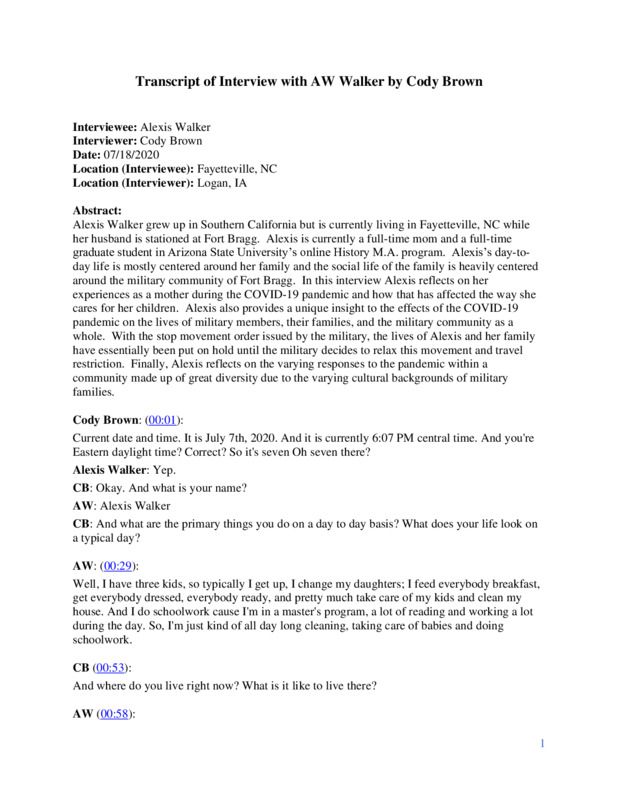
Alexis Walker Oral History, 2020/07/10
Alexis Walker grew up in Southern California but is currently living in Fayetteville, NC while her husband is stationed at Fort Bragg. Alexis is currently a full-time mom and a full-time graduate student in Arizona State University’s online History M.A. program. Alexis’s day-to-day life is mostly centered around her family and the social life of the family is heavily centered around the military community of Fort Bragg. In this interview Alexis reflects on her experiences as a mother during the COVID-19 pandemic and how that has affected the way she cares for her children. Alexis also provides a unique insight to the effects of the COVID-19 pandemic on the lives of military members, their families, and the military community as a whole. With the stop movement order issued by the military, the lives of Alexis and her family have essentially been put on hold until the military decides to relax this movement and travel restriction. Finally, Alexis reflects on the varying responses to the pandemic within a community made up of great diversity due to the varying cultural backgrounds of military families. -
 04/13/2020
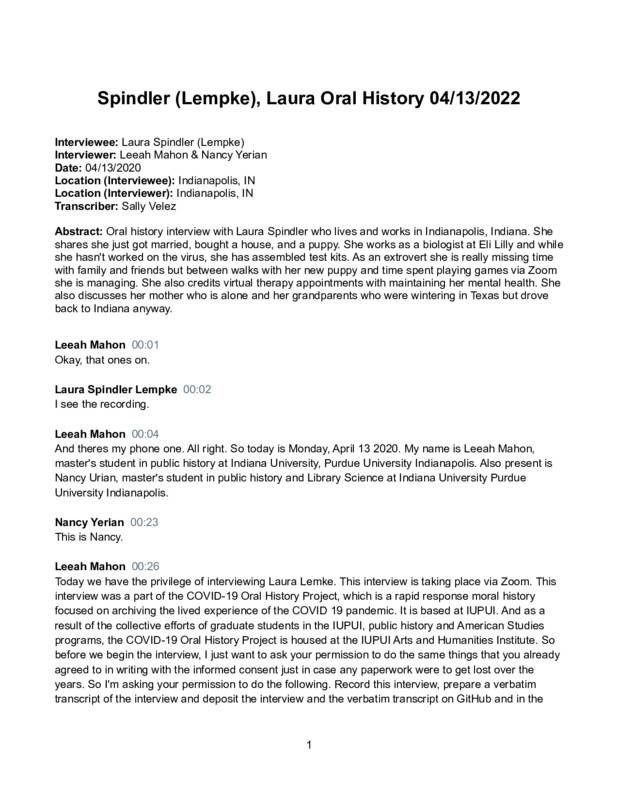
Laura Spindler Lempke Oral History, 2020/04/13
Oral history interview with Laura Spindler who lives and works in Indianapolis, Indiana. She shares she just got married, bought a house, and a puppy. She works as a biologist at Eli Lilly and while she hasn't worked on the virus, she has assembled test kits. As an extrovert she is really missing time with family and friends but between walks with her new puppy and time spent playing games via Zoom she is managing. She also credits virtual therapy appointments with maintaining her mental health. She also discusses her mother who is alone and her grandparents who were wintering in Texas but drove back to Indiana anyway. -
 2020-04-17
Life In Isolation: The Coronavirus... Romy Marisa Schwaiger
A virtual exhibition by the Evansville Museum of Art, History and Science -
 2020-07-04
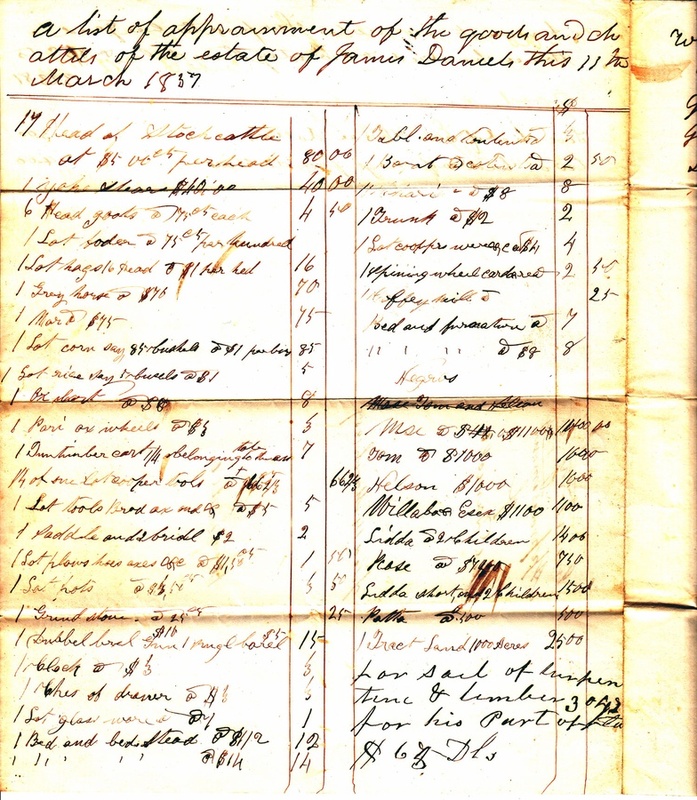
Queen Willoughby, my 5x Great Grandmother
COVID gave Janice Gilyard the opportunity to dig deeper into genealogy, one of her hobbies. On July 4, 2020, she uncovered details about the remarkable life of her 5x great grandmother, Willoughby McWhite. Here is Janice's story about finding Willoughby. (Other items in the archive include an interview where Janice tells the story of how she discovered how Willoughby went from being property in 1829 to being a wife who was independent and keeping house in 1870. The interview with Janice was recorded on July 21, 2020). I’m the President of the Afro-American Historical and Genealogical Society – New Jersey Chapter. Following is the link to the show that aired. It is at the very beginning. Thank you for reading. From a proud descendant of a STRONG woman who endured, overcame, and refused to die during the struggle!!! Her name was Willoughby and I honor and celebrate her today with my entire being! After finding and viewing a segment on the PBS Program, The History Detectives https://www.pbs.org/video/history-detectives-bill-sale/ regarding Willoughby, my 5th Great- grandmother, there are new questions that I must answer. I pray that the answers will be found and in my lifetime. They are: Were you born in Charleston, South Carolina, Africa, or the Caribbean? Who are your parents and where did you last see them? How and why were you separated from your parents? Did you cry? How were you treated by your enslavers? Ugh! Did you and Essex decide to be a couple or was the relationship/marriage forced? Were you ever reunited with your parents? Where is your final resting place? Other than me, who are your descendants? All of these questions caused tears to stream down my face. I can’t image my children being ripped away from me and not know what their fate would be? To have your child taken away and you don’t know anything is unfathomable. You were bought and sold three times. It is hard for me to even type these words. Willoughby McWhite, you were victorious to me. You survived, you were married, you had children, and you purchased land! Because of you, I am. I hope that when you purchased the land (160 acres), that you felt free, empowered, and strong! I hope you felt safe that you could breathe freely. When I found about you, I was stunned. Then I wondered why I didn’t find you sooner. Although I wish I had, I realize that I found you when God wanted me to find you, the 4th of July! This is a day that freedom is celebrated in this country. Yeah right! Settlers came to this country for religious freedom, yet they enslaved you and countless others. If one group is free and another is not, there is no real freedom! Thank you for refusing to die. Many would have died from grief but you didn’t. Many would have died from disappointment, but you didn’t. Many would have died from loneliness, but you didn’t. In the segment for The History Detectives, they stated that you were alone twice! Unbelievable! You were still a child. Did you cry yourself to sleep? I was left with my grandmother whom I loved when my mother moved to New Jersey without me and I cried for three days! I have so much more that I will share for your essay. It will include as much information as possible regarding what was going on in the Pee Dee Region of South Carolina as you were being transported/taken from Charleston, SC to Marion, SC. Who were your neighbors? Were there other enslaved people near you that might have been family members? After speaking with my Aunt Ruby and then finding you and a part of your history, I know that I was supposed to find you on the 4th of July! I will celebrate you, tell your story, and make sure that as many people as possible know who Willoughby McWhite was. Thank you for finding me! Thank you for the tugging at my heart to go to Charleston, to visit the slave cabins, to meet Maxey Foxworth, the chat with Joseph McGill via Facebook. Oh yes, I can see clearly now that it was meant to be. Thank you Queen Willoughby! You are forever etched in my heart and soul! For your DNA exist in me! Other entries in the archive relate to this one. To find them search by Willoughby McWhite. -
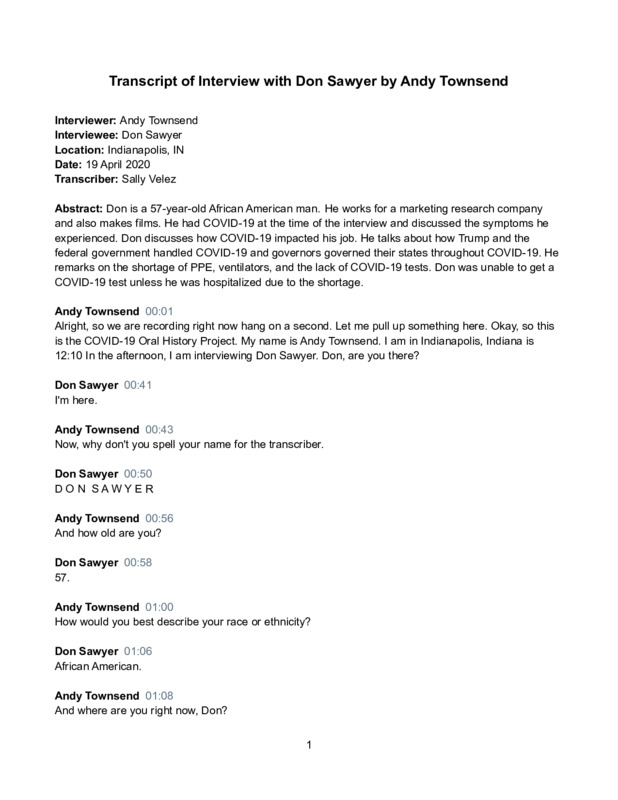 04/19/2020
Don Sawyer Oral History, 2020/04/19
Don is a 57-year-old African American man. He works for a marketing research company and also makes films. He had COVID-19 at the time of the interview and discussed the symptoms he experienced. Don discusses how COVID-19 impacted his job. He talks about how Trump and the federal government handled COVID-19 and governors governed their states throughout COVID-19. He remarks on the shortage of PPE, ventilators, and the lack of COVID-19 tests. Don was unable to get a COVID-19 test unless he was hospitalized due to the shortage. -
 2020-07-01
COVID-19 Cases Surge In ICE Detention article
"The number of immigrants with COVID-19 in Immigration Customs Enforcement custody has risen rapidly. More than 2,700 detainees nationwide have tested positive, according to ICE data, and the Eloy detention facility is among the hardest hit by the pandemic. More than 200 detainees there have tested positive — a tenfold increase in less than three weeks." NPR published an article highlighting the vast spread of COVID amongst immigrants in detention centers. As the pandemic has spread, ICE has continued to arrest and hold detainees in detention centers, while not providing safety measures to curb or prevent the spread of the virus. -
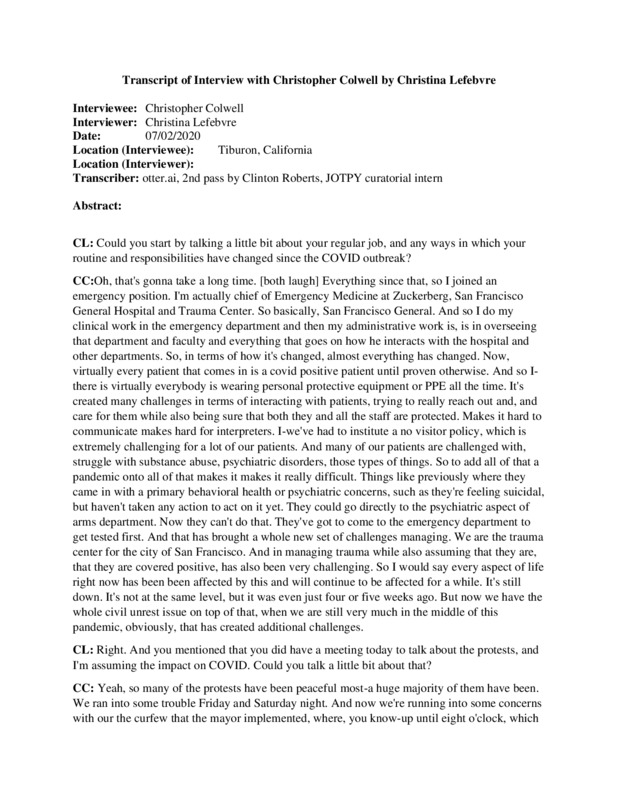 06/02/2020
Christopher Colwell Oral History, 2020/06/02
Interview with Dr Christopher Colwell, Chief of Emergency Medicine at Zuckerberg, San Francisco General Hospital and Trauma Center by interviewer Christina Lefebvre. Dr. Colwell speaks about the changes in his daily work activity and the obstacles of hospitals to respond to protests and a pandemic. He also shares his thoughts on how the pandemic has altered the practices and routines of medical facilities to maintain safety for patients and healthcare workers.