
Items
Search full-text
futcoins 26 Besuche die Website Buyfc26coins.com. Beste Qualität..N7Ft
-
 12/16/2020
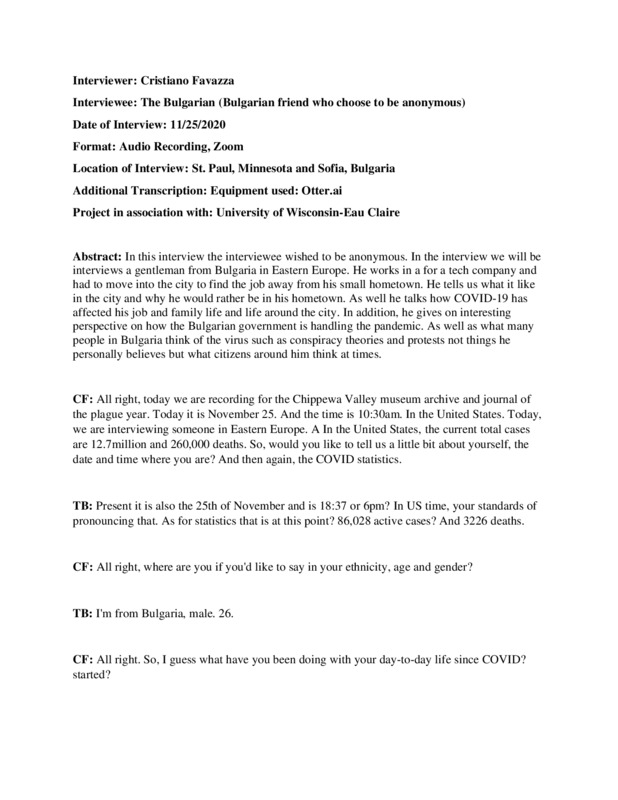
The Bulgarian Oral History, 2020/12/16
In this interview the interviewee wished to be anonymous. In the interview we will be interviews a gentleman from Bulgaria in Eastern Europe. He works in a for a tech company and had to move into the city to find the job away from his small hometown. He tells us what it like in the city and why he would rather be in his hometown. As well he talks how COVID-19 has affected his job and family life and life around the city. In addition, he gives on interesting perspective on how the Bulgarian government is handling the pandemic. As well as what many people in Bulgaria think of the virus such as conspiracy theories and protests not things he personally believes but what citizens around him think at times. -
 12/10/2020
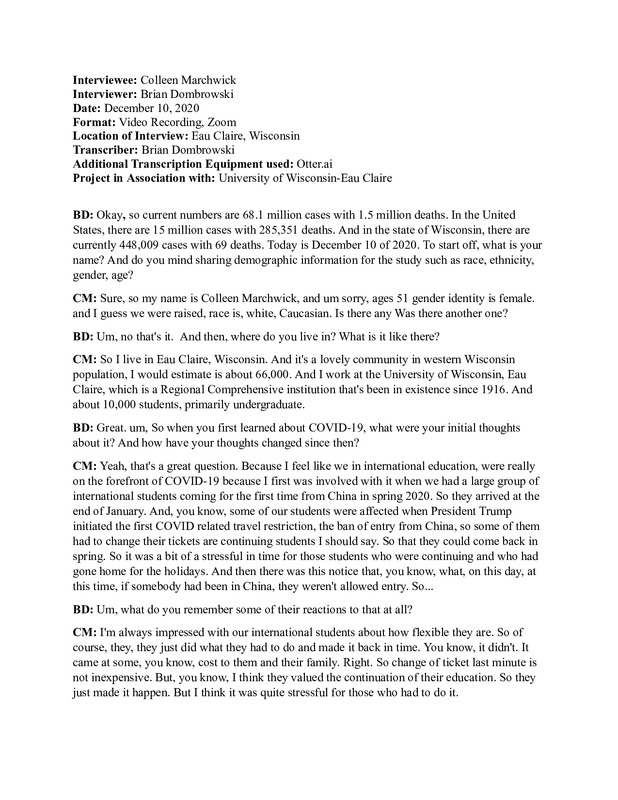
Colleen Marchwick Oral History, 2020/12/10
-
 05/16/2020
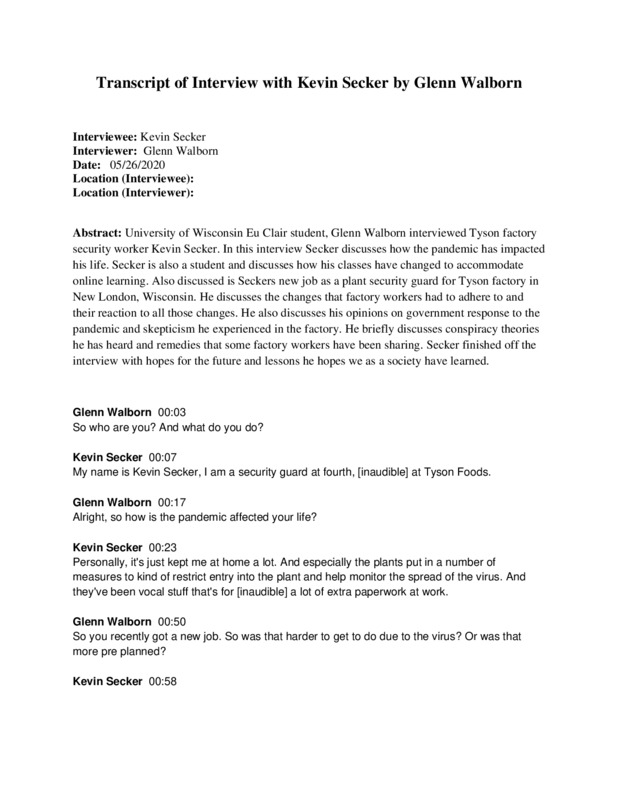
Kevin Secker Oral History, 2020/05/16
University of Wisconsin Eu Clair student, Glenn Walborn interviewed Tyson factory security worker Kevin Secker. In this interview Secker discusses how the pandemic has impacted his life. Secker is also a student and discusses how his classes have changed to accommodate online learning. Also discussed is Seckers new job as a plant security guard for Tyson factory in New London, Wisconsin. He discusses the changes that factory workers had to adhere to and their reaction to all those changes. He also discusses his opinions on government response to the pandemic and skepticism he experienced in the factory. He briefly discusses conspiracy theories he has heard and remedies that some factory workers have been sharing. Secker finished off the interview with hopes for the future and lessons he hopes we as a society have learned. -
 05/12/2021
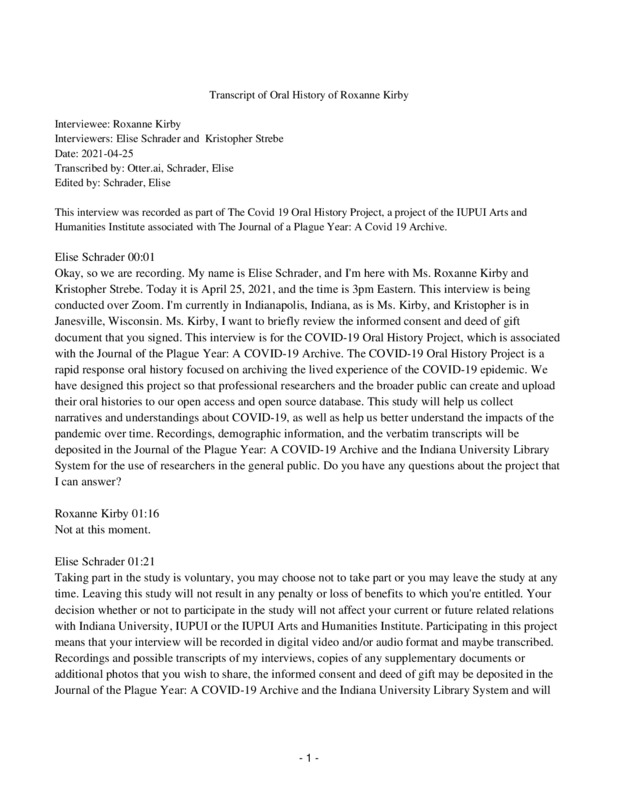
Roxanne Kirby Oral History, 2021/05/12
C19OH -
 2021-11-23
A new Director for a renewed office
Maria Del Mar Aponte Rodriguez is the new Director for the Center of International Programs at St. Mary’s University. After a semester of being in charge, Aponte tell us more about her experience as the new leader in the office and her future goals to make the CIP Office more open and warming for international students. As COVID has impacted several levels of the office, Aponte comments how she overcome these issues and how she is preparing a new plan of action for Fall 2022. -
 2020-10-06
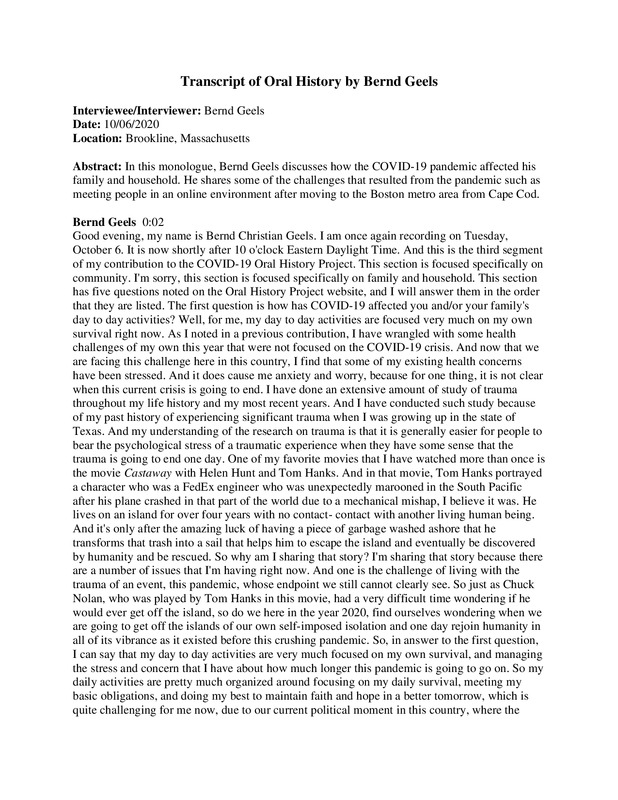
Bernd Geels Oral History, 2020/10/06
C19OH -
 2021-11-22
Stop the Spread
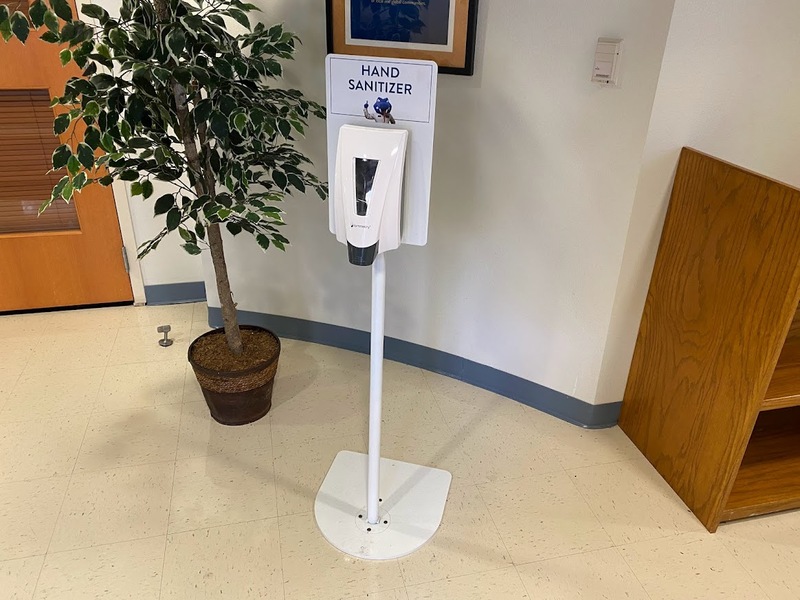
St. Mary's University made some major changes in preparations for the return of students and staff on campus for this Fall semester of 2021. Signs posted as a reminder to wear your masks and new hand sanitizing stations have eased the fear of Covid potentially outbreaking in the university. Updates on their website have helped students and staff keep updated on new rules to prevent the spread and habits that we can maintain to keep everyone healthy and safe. -
 2021-04-23
Shipping during COVID-19: Why container freight rates have surged
UNCTAD (United Nations Conference on Trade and Development) included an article on their website which examines the shipping container shortage. More broadly, it comments on the staggering domino effect of the pandemic on industry and consumers and offers future solutions for avoiding current problems. The article concludes with a section that provides insight into how to avoid shipping container shortages in the future. -
 2021-09-07
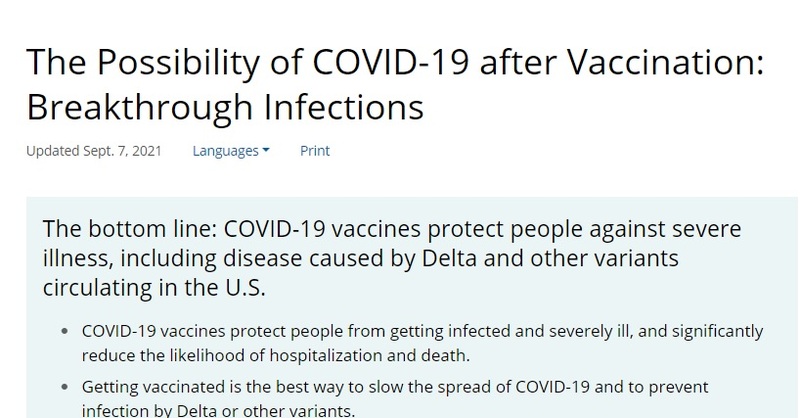
The Possibility of COVID-19 after Vaccination: Breakthrough Infections
COVID-19 vaccines are effective at preventing infection, serious illness, and death. Most people who get COVID-19 are unvaccinated. However, since vaccines are not 100% effective at preventing infection, some people who are fully vaccinated will still get COVID-19. An infection of a fully vaccinated person is referred to as a “vaccine breakthrough infection.” -
 2021-10-14
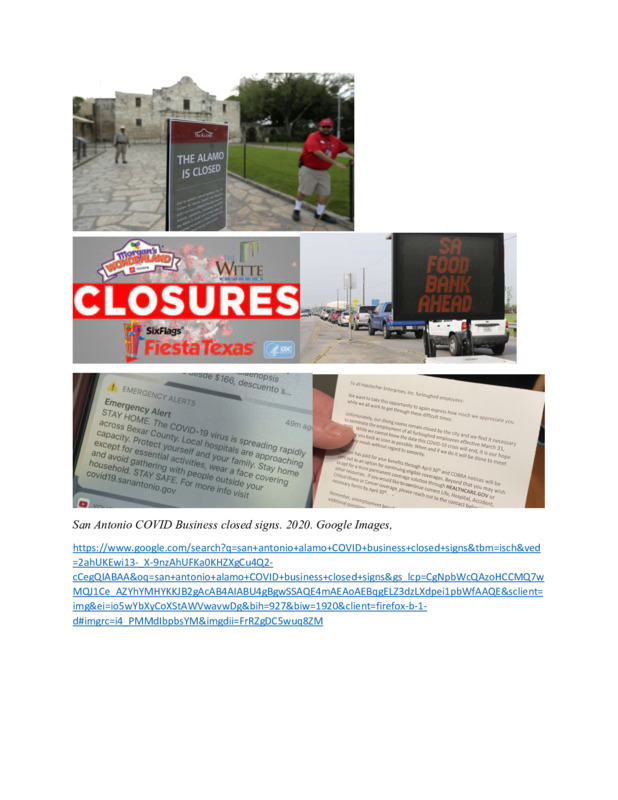
Jobs/Businesses Closed during Covid-19 Pandemic
I want to begin that looking through google website I found some interesting images that went well with what I believe are very important reminders of how and when the pandemic just hit San Antonio. This is important to me because it is a reminder of when businesses/schools were closing and people were losing their jobs and being furloughed had no clue where this pandemic was taking us and so many people lost their homes, no way to put food on tables, or pay bills, etc. Not knowing if we would ever come back to the job we once had and relied on for many years a change that no one knew how it would impact our lives dramatically. For me personally at my employment when I received an email that they will soon let people go from their jobs or furloughed I was worried out of my mind, and a constant thought, of “What will I do if I lose my job.” Something like this can never be forgotten and is a reminder of how our lives can change due to a pandemic that no one ever thought would ever happen and not even prepared for. -
 2021-10-18
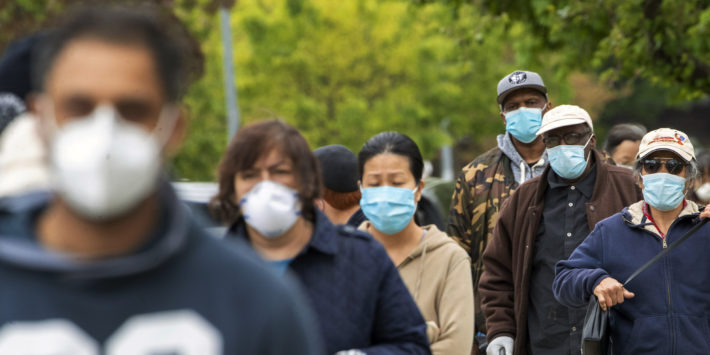
Don't Forget Your Mask!
The mask has had a huge impact on our sense of touch and smell. For one, breathing with a mask on was an adjustment. Tuna sandwiches became something to avoid at all costs because of the smell you could be stuck with all day by wearing a mask. There is also something to say about the feeling of a mask around your ears and over your nose. The constant practice of grabbing a mask and putting it around one's ears has become a ritual of protection or habit as we are now bound to this object like that of a cell phone which is now always on our person. The sense of touch also adapted to various kinds of masks that were promoted and the variety of masks that would be marketed for commercial value. The mask, one of the few things that forces us to run back inside the house because we forgot it. The mask, a true measuring stick for how quick we can adapt and change society for better and for worse. -
 2021-10-06
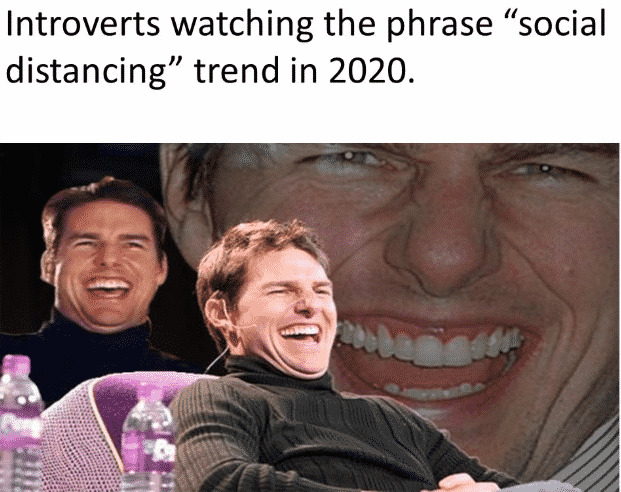
Introverts during social distancing
I was scrolling through memes and this one adequately describes my reaction to social distancing at the beginning of the pandemic. I felt like my time had finally come when we had to begin social distancing and staying at home. I'm not a very social person so I was happy being in my little bubble. -
 2021-10-06
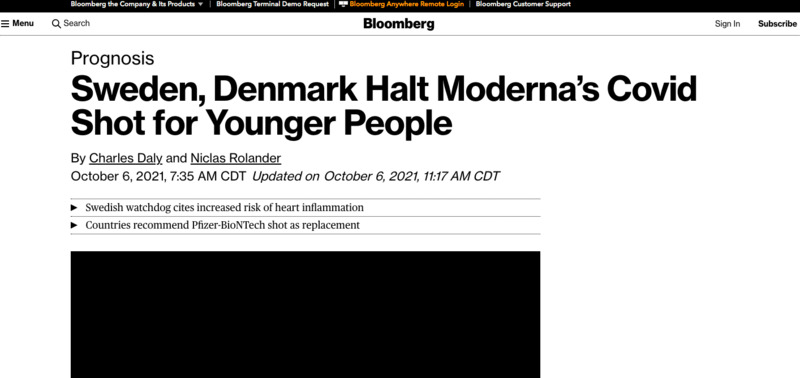
Sweden, Denmark Halt Moderna’s Covid Shot for Younger People
Sweden and Denmark decided to halt vaccinations with Moderna Inc.’s Covid-19 shot for younger people because of potential side effects. -
 2021-10-04
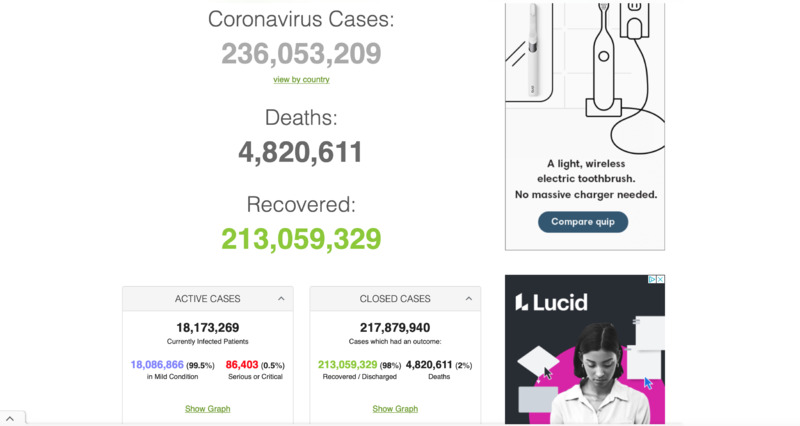
Worldwide Statistics
While researching pandemic memes, I came across this website that compiles statistics on the pandemic from all around the world. -
 2021-09-22
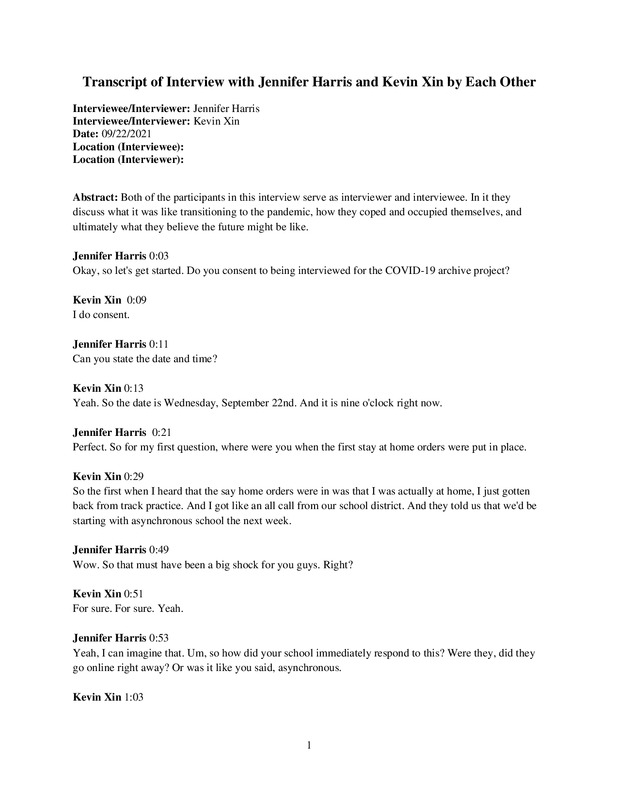
Jennifer Harris and Kevin Xin Oral History, 2021/09/22
The object of this story was for us to tell our unique experiences living through the COVID-19 pandemic. We think that our interview is a good representation of what life could be like during the pandemic for two average teenagers. -
 2020-05-30
The Dashathon
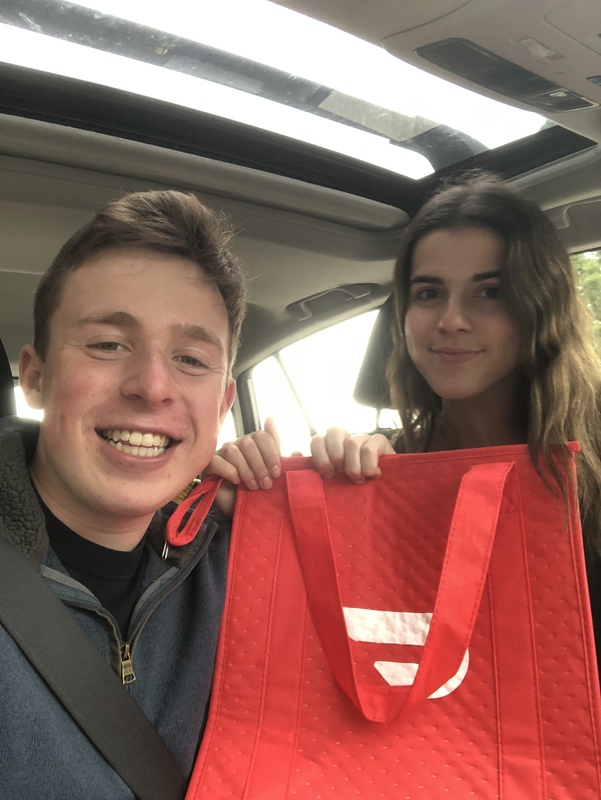
When the pandemic quarantine was initially imposed, I found myself with lots of free time on my hands. After weeks of low motivation and extreme boredom, I decided to sign up as a food delivery driver for Doordash, a job that was in high demand at the time. By this point in quarantine, all restaurants were closed for indoor dining, but many were still offering carryout and delivery services, largely through food delivery apps such as Doordash. Some of my friends and I started driving Doordash as frequently as 5-6 nights a week. We strategically prioritized the 4 to 8 PM time-slot in order to cover the majority of the dinner shift. Although it was quite mindless work, it was one of the few things that I had to look forward to as a daily break from the monotonous isolation of quarantine. Orders were frequent and because of the high demand for delivery drivers and very light traffic, tips were generous and reflective of the community’s appreciation for service provided by “frontline workers” like ourselves. After about a month of driving, my friends and I decided to put together a fundraiser called “Dashathon” to support some of our favorite local restaurants and small businesses that were struggling during the pandemic. Because many smaller restaurants did not have the financial resources to operate at a loss during periods of the pandemic, many were forced to shut their doors. Our idea was to reach out to all of our family and friends and designate one night where all of our income and tips from Doordash would be donated to these struggling restaurants and other local charities in need. With lots of outreach, we secured underwriting from 10 different sponsors as well as a dollar-for-dollar match pledge from Doordash itself. Our Dashathon was even highlighted in a television news segment broadcast on the local Denver NBC-affiliate newscast (linked above). We were successful in recruiting over 40 drivers to participate in our event. Through a competition-style format that rewarded the highest earners with gift cards from our sponsors, we were able to raise $15,000 dollars in just four hours. The proceeds were distributed in their entirety to designated local restaurants and charities. -
 2020-04-06
The City That Slept
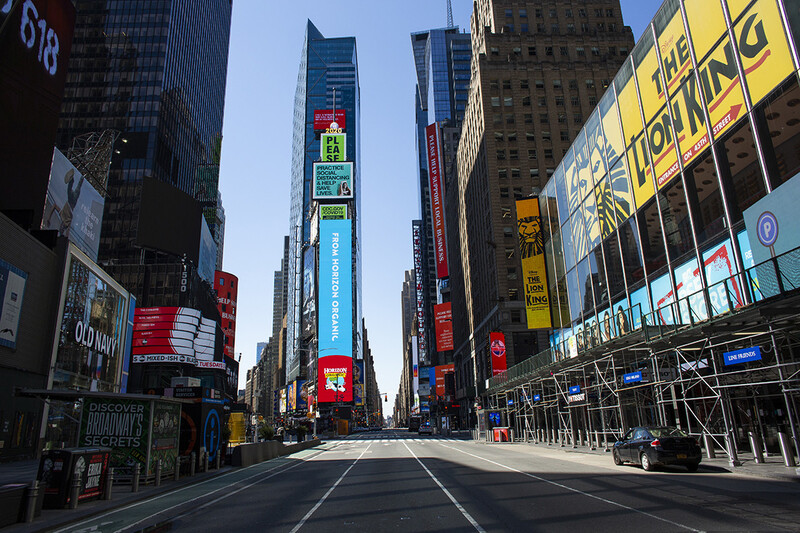
When you look at this picture, you notice something right off the bat. Most likely the fact that the streets of New York City are completely empty. On April 6th, 2020, New York City was as quiet as it’s ever been. The streets were empty and there was a ghostly feeling to it. If you were downtown that day, something had to feel wrong. I chose this picture to submit to the archive because these streets represent how the majority of people felt during lockdown; empty and alone. When people are cooped up and confined to the safety of their home, they start to realize the things that they took advantage of when things were normal. This picture also represents the odd nature in which the pandemic brought upon the world. We’ve never experienced anything like this before, and didn’t really have any idea how to prepare. It kind of just happened, and whether we liked it or not our way of life was going to have to change for the time being. While sitting in our homes, time was never an issue and, for me personally, I kind of just expected that one day this was just going to be all over. -
 2020
2020Exploration Camp Main Page
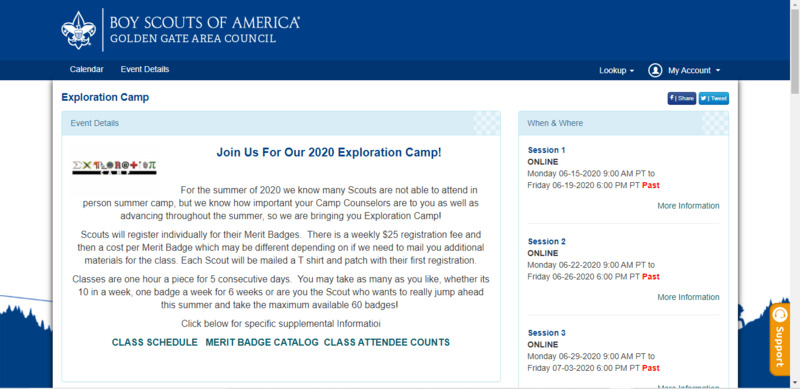
This is the main page on the Golden Gate Area Council website about Exploration Camp, which was a virtual merit badge camp offered in the summer of 2020. The session information on the side notes the camp ran from June 15 to August 7. -
 2021
2021Drought at Camp Wolfeboro
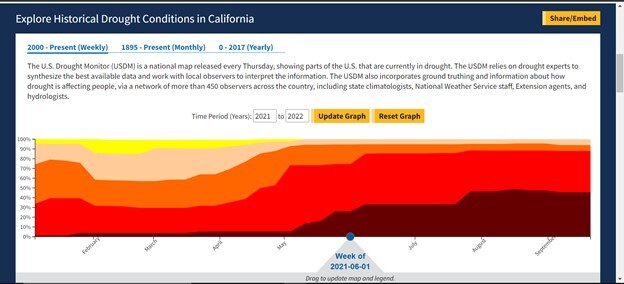
This National Integrated Drought Information System website shows a timeline map of drought conditions in the United States from 2000 to present by week. The map timeline shows that Camp Wolfeboro was located in the extreme drought category during the entire of the 2021 camp season. Extreme drought, according to NIDIS, means: "Livestock need expensive supplemental feed; cattle and horses are sold; little pasture remains; fruit trees bud early; producers begin irrigating in the winter Fire season lasts year-round; fires occur in typically wet parts of state; burn bans are implemented Water is inadequate for agriculture, wildlife, and urban needs; reservoirs are extremely low; hydropower is restricted". During the same time period most of the rest of California was also in drought conditions. -
 2021
2021Map of Camp Wolfeboro
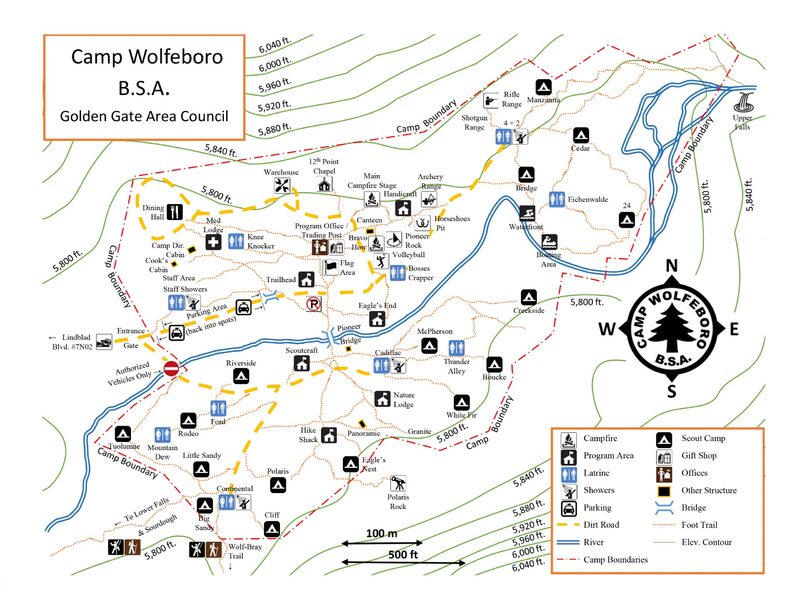
This is a map of Camp Wolfeboro that was on the Golden Gate Area Council website during the summer of 2021. The map includes the various paths and trails, as well as the program areas, buildings, and campfires. -
 2021-08-05
Recovery Justice Mail Art
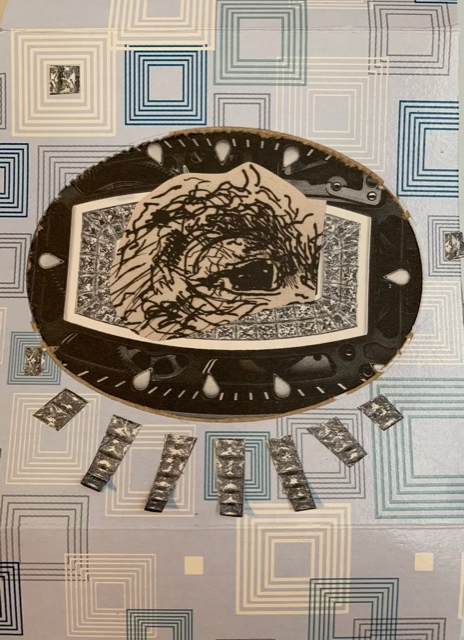
I See Dedication I See Hope I See Love We are all suffering illness, sadness, loss of the way we think life should be– Using the cool patterns on the panels of tissue boxes, I thought that material appropriate. Most of these collaged images appropriate an eye form, much like the Turkish Evil Eye, when given as a gift it offers protection. In this project many 18th St. artists participated and a single art piece was sent out with mental health support materials for anyone who signed-up on our website. This has been an artist-driven 18th St. Arts supported and produced project also supported by Recovery Justice, Santa Monica and We Rise LA. Special thanks to Sara Daleiden and Sue Bell Yank at 18th St. –Melinda Smith Altshuler P.S. Honestly it has been an honor and a blessing to produce work for this project and also support our friends and neighbors who are suffering more than us. -
 2021-03-21
A tale of the babka
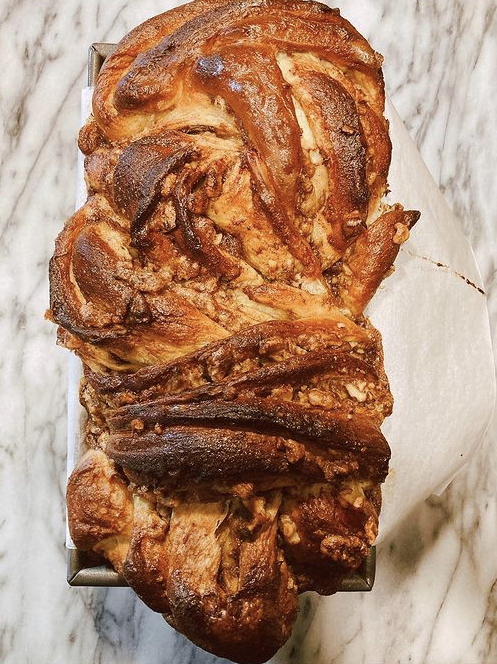
If you had asked me if I was a baker prior to the year 2020, I would have unequivocally said no. A cook? Yes. But a baker? Absolutely not. But that was before the global Covid-19 pandemic. I worked in the cruise industry prior to the pandemic and I travelled a lot for my job. I was not home enough to really jump into and try to master baking. Following mandatory quarantine in March 2020, I suddenly had extra time on my hands. Further, I was laid-off from my job in early June and ended-up with even more time on my hands. Like so many around the world during quarantine, I took up baking. But unlike the many who tried sourdough, I started with making standard wheat breads and then went straight to enriched breads like babkas or challahs. The photos I am attaching here show my progression as a baker. My first babka was fine and tasted great, but as you can see, I have improved in technique and in flavor over time. My favorite babka recipe comes from King Arthur Flour. As a new baker, I relied on the King Arthur Flour website for flour and yeast tips, baking tools, and recipes. I was too hesitant to add walnuts the first time and I accidently used a quick-rise east instead of standard yeast. As time went on, I felt more comfortable adding walnuts and raisins. I also felt more comfortable working with the dough to perfect the twisting technique of the babka. I relied on trial-and-error for most of my recipes, but I also watched all episodes of the Great British Baking Show and found some videos that gave me the basics of flour, yeast, and water. My family were very surprised by this newfound baking skill. But they enjoyed tasting the results. I have enjoyed bringing people together over food – and I have enjoyed giving loaves as gifts. I am still trying new bread recipes and plan on continuing to bake even as life slowly returns to our new normal. -
 2021-07-29
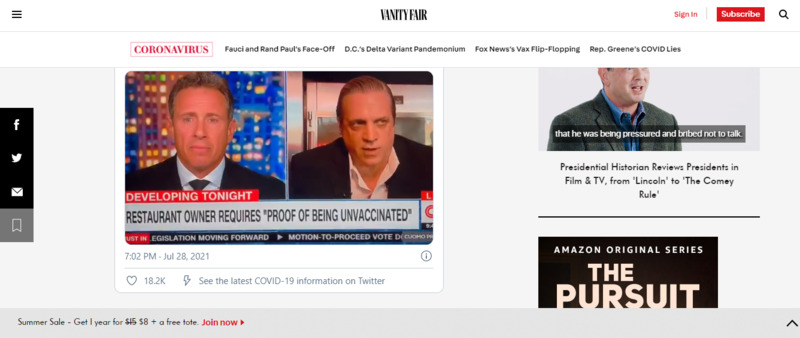
Restaurant That Probably Spits in People’s Food Says It’ll Only Serve Unvaccinated Customers
This colorful article by Vanity Fair explores the anti-vax, anti-government Huntington Beach restaurant Basilico’s Pasta e Vino. The writer urges its readers to avoid this restaurant and its "anti science" owner. -
 2021-07-29
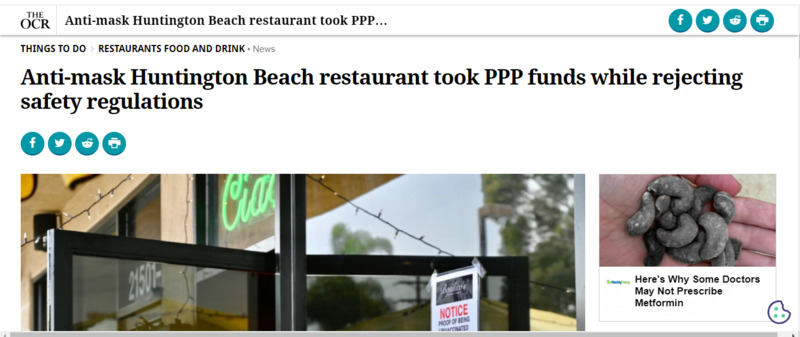
Basilico’s Pasta e Vino in Huntington Beach
After submitting a restaurant's sign promoting their anti-vax stance I was curious as to whether or not they were still in business. It turns out this restaurant has made quite a buzz in California. They unapologetically promote misinformation and publically prefer their customers to be unvaccinated but happily took thousands in PPP funds. They have spent money on controversial billboards and are not at risk of losing their liquor license. I'm so interested to see where else this story goes. The last sentence of this article sums up the ignorance of the restaurant owner - “Our stand is for all Americans,” wrote Roman. “They can thank us later.” -
 2021-07-20
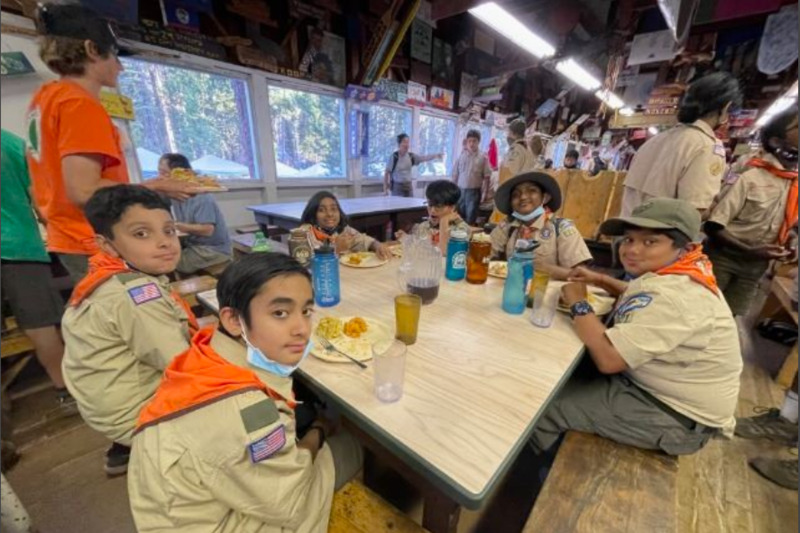
Troop 621 in the Mess Hall
This is a photo of some Scouts from Troop 621, in San Ramon, eating dinner at the Camp Wolfeboro mess hall. The Scouts have masks around their necks. The photo was found on the troop's public website. The photo is identifiable as being taken on July 20, 2021 between 6:15 and 7:00, because Troop 621 attended camp during the fifth session (July 18 to July 24) and ate B shift dinner from 6:15 to 7:00, and part of Tuesday night's dinner was stuffing and mashed yams, which are visible on the Scouts' plates. -
 07/25/2021
Lauren Pease Oral History, 2021/07/25
Ashley Tibollo interviewed stay-at-home mom, Lauren Pease about her experience with the Covid-19 pandemic. In this interview, they discuss her experience with the lockdown, her worries about the pandemic, and what life was like during lockdown with her foster child. This interview also touches on political protests, virtual learning and her husband's transition to working from home. -
 2021-04-19
Health Equity Considerations and Racial and Ethnic Minority Groups
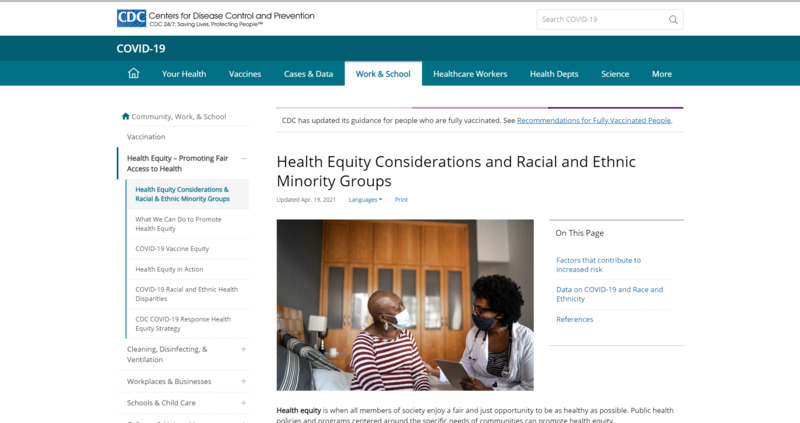
The pandemic has brought the issue of health inequity in the United States, based on factors such as race and ethnicity, to the forefront. Racial and ethnic minority populations make up a disproportionate essential workers. Poverty restricts access to health care for many individuals. The country must address these issues of health equity and social justice now and continue to address it t ensure the health and safety of all those living in the United States. The website provides references, information, and data on the link between ethnicity and race and COVID-19. -
 2021-06-30
COVAX initiative helps vaccinate the elderly in Peru
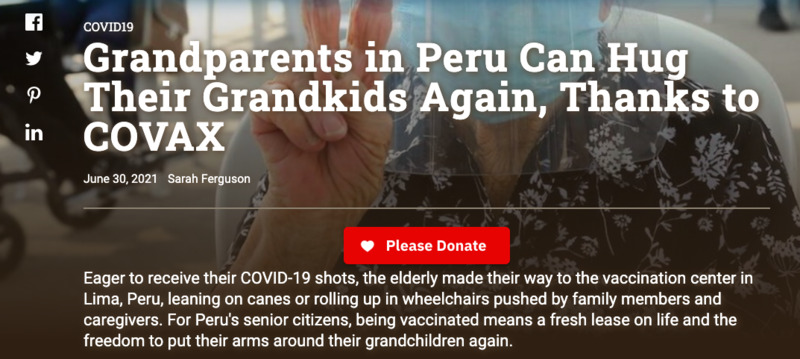
COVAX is one of the organizations helping get vaccines to Peruvians. This story focuses on older adults in Lima, Peru receiving their vaccines and the prospect of reunification with family. The video shows several people waiting or receiving their COVID-19 vaccine shot, and encouraging other people to get vaccinated as well. The location is a school called Libertor Jose de San Martin. In Peru over 2 million people have contracted COVID-19 and 200,000 people have died. The pandemic is still in many ways an epidemic in this region of the world, and until we can control the disease globally, there's no hope for a true "return to normal." -
 2021-06-19
Museum of the San Ramon Valley
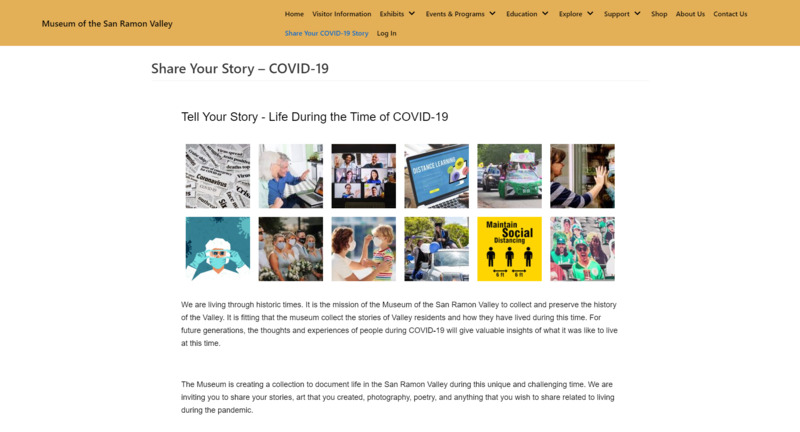
The Museum of the San Ramon Valley is well on its way to being back to normal. On June 15th, California officially reopened, which amongst other things meant there were no restrictions on how museums could operate. This means we can finally operate at full capacity. Even when we could only operate at 25 percent capacity we never hit our upper limit of guests, so capacity wasn't ever really a problem. That is something that concerns me as the museum reopens; that we will have low attendance. I was able to work at the museum a few times in the middle of the pandemic, and I never worked a day where we had more than thirty total guests (including people who were merely looking for a restroom or asking for directions to something, who did not pay to look at the exhibits - we had probably no more than 20 or so paying customers per day). We also don't need to impose mask mandates as of June 15, but the museum's board of directors decided to keep our mask mandate. However, if someone comes in without a mask and doesn't want to take a free one then we will still allow them into the museum. I am not concerned by this because I am vaccinated, and even if I wasn't there is a very low likelihood of getting sick. We have not done any exhibits related to COVID yet. Starting last year and continuing this year we have an exhibit on the 100th anniversary of the ratification of the 19th Amendment, with a focus on our local area. This is in addition to our regular exhibits. Starting today (June 19) we also have our train exhibit for a month, which is a model train display with models of local historical buildings (and other things, like a UFO and more non-history-related things). The model train exhibit always brings in little kids with their families, so hopefully that improves museum attendance. Most of our attendance comes from families with little kids, older Baby Boomers, and the elderly. The museum needs to improve on attracting people in their teens and twenties in order to earn more. Hopefully, a COVID exhibit can do that by making history more personal. On our website, we have a story collection form for people to share stories of COVID, much like JOTPY, but I do not know what we will be doing with those responses. When I physically work at the museum next I have a bunch of items from last year (inspirational painted rocks, city council and school board campaign materials, masks) that I will donate, and hopefully, those and other items find their way into an exhibit. -
 2021-03-16
Teacher Interview: Avilette de Castro
Middle school Spanish teacher, Avilette de Castro, answers student questions about changes to education in the coronavirus pandemic. Walls: What is your name, grade you teach and school you teach in? de Castro: Avilitte Castro, Sebastian Middle 7-8th grade Spanish Walls: How has the pandemic changed the way you teach? de Castro: So, the biggest thing is that I feel like I haven’t taught enough, like I'm putting stuff out there and it’s not sticking. Before the pandemic there was more engagement and now there isn’t. Especially with those that are DL’s (distance learners). Walls: What was the biggest challenge in the beginning? de Castro: We were not prepared as teachers at all for what we had to do. I had never taught online before and I had to try to adapt everything online. Not everyone showed up. It’s not high school, they don’t think that it counts. They don't realize that even though their grades won't neccessarily carry on to high school, everything else will. Walls: What is the biggest challenge now? de Castro: So now, it’s mostly back to normal in some senses. We haven’t had any kids go into quarantine in awhile and I’m down to only 3 DL’s and I don't know if the kids are fully into it. I always have the thought that we could go back into quarantine. We just adopted a new textbook and I have to tell that book as well. The EOC (End of Course Exam) for this year is being used from this new book. I am adapting everything, but not able to get a hold of everything. I am learning this new book as well as my students. Walls: How do you think students are doing? What are their biggest challenges? de Castro: I don’t think, for me, I really don’t think I’ve taught them as well as I normally do. I hate to say this because it’s not quite bad. Some of my students aren’t doing anything, because they don’t think it will count. The other thing for me, I do a language class. A big part of my class is conversation. I don’t let them work in groups and they aren’t able to get the conversation that they used to get. Right now we are doing a food unit. They don’t get the reaction in conversations. Walls: Do you see anything beneficial coming from the changes you have had to implement? de Castro: Oh yeah. For me, doing stuff with technology has always been supplemental instead of part of the curriculum. Like if I post this you can have it and now everything is online. The kids have access to it online, doesn’t mean the students use the extra resources. I’ve been having to use the textbook website and it’s something that they can do anywhere that they are at. It’s an added resource, so it's a benefit for them. Walls: How has parent involvement changed during the pandemic? de Castro: No, one of my DL’s has his guardian sister with him the whole time and it’s a little nerve racking to have her hear me the whole time. It’s pretty much the same overall. -
 2020-09-17
Environmental effects of COVID-19 pandemic and potential strategies of sustainability
The article discusses the positive and negative effects of the COVID-19 pandemic on the environment and climate and proposes possible strategies for global environmental sustainability going forward. The open-access article is posted on the U.S. National Institutes of Health website. -
 2021-05-25
Stephanie Oral History, 2021/05/25
I am a victim of online pedophilia. My experience discusses how that has effected the switch to online school. -
 2020-03-12
COVID 19
COVID 19 I decided to choose as a source an image related to the COVID 19 virus. The image belongs to https://www.pharmaceutical-technology.com/news/coronavirus-countries-cross-100-covid-19-world-update/. This website provides information about the virus and was last updated on March 12, 2020. The image shows the virus spread around the planet earth. This image helps me explain what the virus is and how it spread. I select this type of source because I consider that it expresses a simple but concise message. I consider that it is something that everyone can understand and from which they can learn. By looking at the image people can get an idea of what the spread of the virus really meant. They can observe that its spread was not in a specific area, but rather that it spread around the entire world. Since the virus made its first appearance in Wuhan China, everything has turned into a catastrophe. The virus began to spread rapidly around the world. People were really not prepared for the COVID 19 virus. Many people died from this virus and those who were infected and survived did not have a good time. The virus isolated everyone and everything stopped being what it always was. People could no longer visit their loved ones or spend time with them. Many businesses closed, and as a result many people lost their jobs. Now everyone had to wear masks, they had to keep their distance from each other, and they also had to constantly wash their hands. This was somewhat frustrating, as people searched for gloves, masks, and disinfectants in stores. However, because everyone was looking for the same items there was a shortage of them. Sometimes when people found such items they could only buy one per person, especially alcohol and disinfectants. People really felt desperate. Things had changed a lot. Now many people had to work from home. The same thing happened with the students. Students had to take classes from home through a computer. This was something that didn't seem right to everyone. Many students lost interest. I consider that both historians and everyone in the future should be aware of what the COVID 19 virus was. Although the COVID 19 virus is a new virus that arose suddenly, it is not the first time that humanity experiences something like this. Previously around a hundred years ago something similar had happened with the Spanish flu. The Spanish flu like COVID 19 had also become a pandemic. Because of this, millions of people died. However, this was something that remained in the past as no one spoke of this event. I consider that people could have learned something from the history of the Spanish flu and applied that knowledge during COVID. However, few people are aware of what the Spanish flu was. Therefore, it is necessary to take into account everything related to COVID 19. Although it is likely that the appearance of a new virus cannot be prevented, at least people will know how to protect themselves and thus prevent the spread. The virus spread around the world rapidly for various reasons. However, one of these reasons was that people had no idea how to react to the virus. If people had had an idea of how to protect themselves at that time, perhaps the virus would not have spread the way it did. I believe that acquiring the necessary knowledge about the virus will be of great help in the future. -
 2020-08-03
The Pandemic that Changed It All
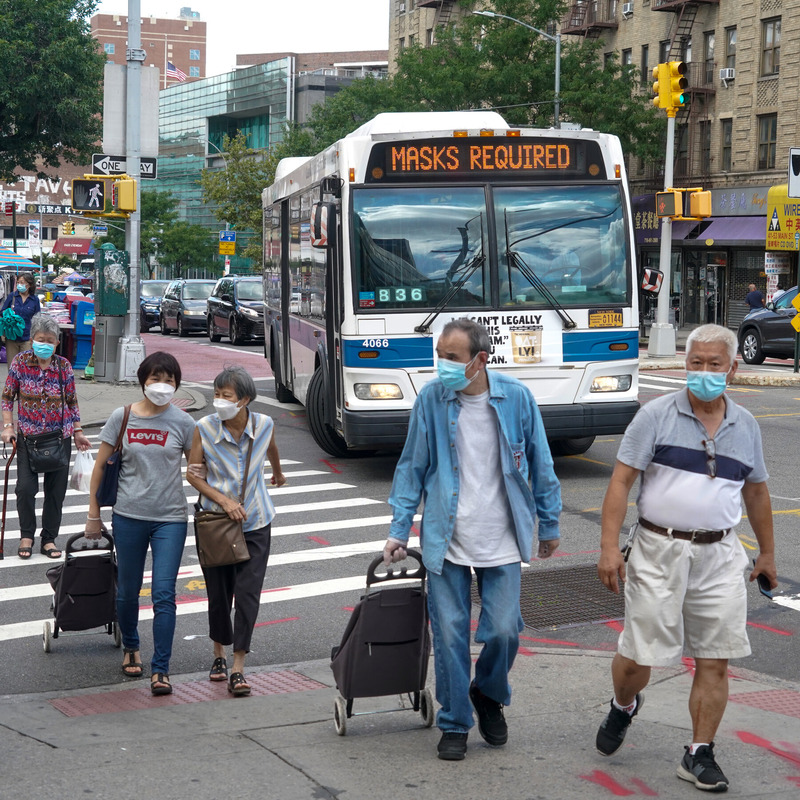
I think we all should take this as an experience to be prepare for the next major event. -
 2021-05-13
Farewell!
My work ends here on 5/15/2021, I have curated on this website for 2 semesters at ASU and have read sad stories, funny stories, stories that are strange, and people who seem so lost, It was a nice refresher to see how people reacted to pandemic a lot more than my old job which was captioning hard of hearing people's phone calls. I heard so much more death and depressing tales there than in this archive which I find interesting but I have seen many sides of the pandemic. I did have to caption, not once but twice, old people having phone sex from that job and here have read hundred of children ponder the origin of the COVID-19 virus. It is strange but I have seen and lived many lives this pandemic thanks to my jobs. -
 2020-05-19
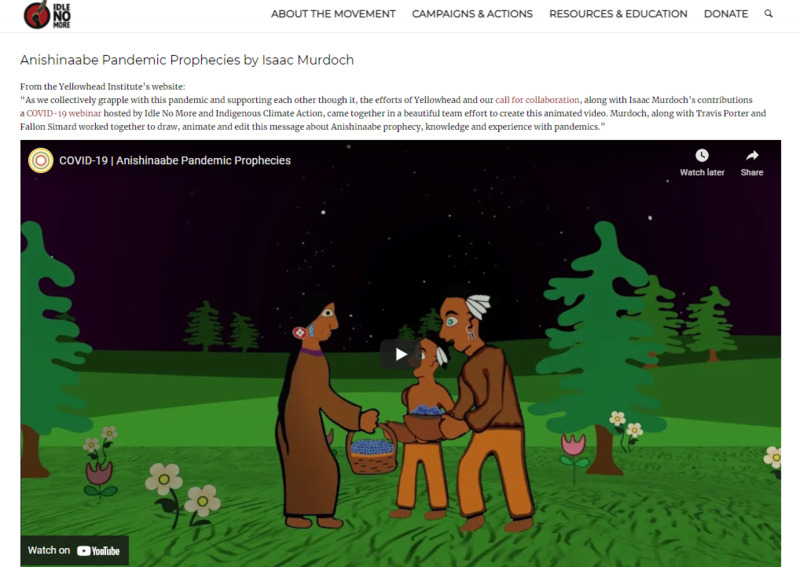
Anishinaabe Pandemic Prophecies by Isaac Murdoch
From the Yellowhead Institute’s website: “As we collectively grapple with this pandemic and supporting each other though it, the efforts of Yellowhead and our call for collaboration, along with Isaac Murdoch’s contributions a COVID-19 webinar hosted by Idle No More and Indigenous Climate Action, came together in a beautiful team effort to create this animated video. Murdoch, along with Travis Porter and Fallon Simard worked together to draw, animate and edit this message about Anishinaabe prophecy, knowledge and experience with pandemics.” -
 2021-04-20
JOTPY Exhibit: "Arizona's COVID-19 Pandemics" by James Rayroux
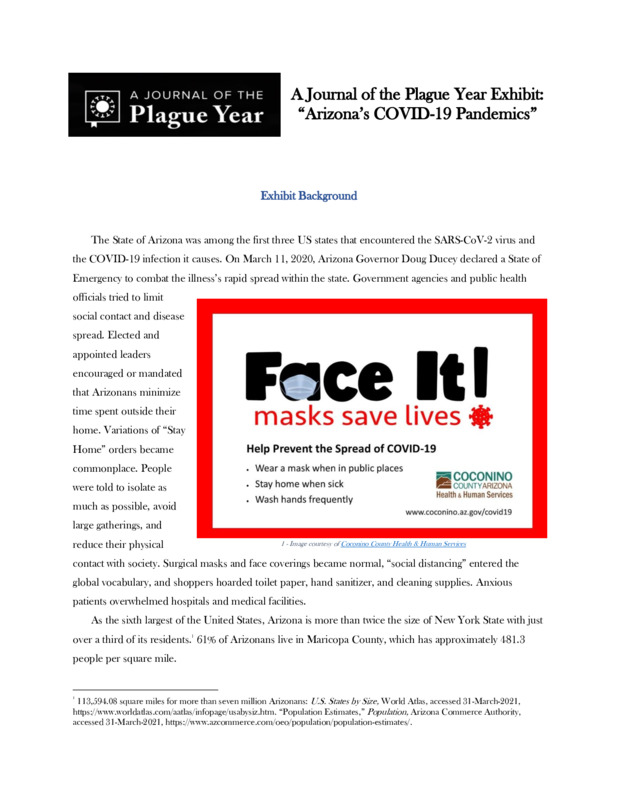
While working as a curatorial intern on ASU's 'A Journal of the Plague Year' COVID-19 archive, I created this exhibit on the pandemic experience within the state. In addition to obvious, overarching realities such as socioeconomic status and immediate access to healthcare systems, I initially believed one of the greatest deciding factors that determined one's experience in Arizona was an individual's residence in either predominantly urban or rural environments. The proposed exhibit had been originally titled "A Tale of Two Arizonas" to pay respect to Charles Dickens and the differing realities experienced here. To test my proposed hypothesis, I went about finding data, stories, and submissions that substantiated or disputed my premise. Within a short time, I had identified four distinct environmental drivers of personal pandemic experiences; to me, that indicated the existence of many more I hadn't yet found or had overlooked along the way. My evidence suggested a minimum of four pandemic locales: Urban, Rural, Border, and Tribal within the State of Arizona and its fifteen counties. The recorded health data and personal experiences demonstrated the naivete of my initial hypothesis, and I retitled the exhibit: "Arizona's COVID-19 Pandemics." The Exhibit Background section illustrates the vast dichotomies within Arizona in terms of population density and access to healthcare facilities. Given the virus's respiratory nature, these factors seemed especially relevant to driving diverse local experiences. I chose to include a flyer from the Coconino County Health and Human Services' "Face It! Masks Save Lives" campaign. The flyer included a specific line to "Stay Home When Sick" that seemed to illustrate a different public health paradigm than the broader "stay home" orders from Maricopa and Pima county. This section also features an image of Sedona's red rocks and a portion of The Wave to remind visitors of the wide-open rural areas accessible to all, as well as those with cultural significance to the Native American tribes and limited access to the general public. The next section asks a short, five-question survey in which visitors may participate. The Silver Linings piece features a short audio clip of a father and husband discussing some unexpected benefits of the pandemic. Visitors may explore additional Silver Linings stories and submit their own experience. The Tséhootsooí Medical Center piece seeks to illustrate the different pandemic experience on the state's tribal lands. I hoped to inspire some relevant emotional turmoil for the visitors through the piece's visual presentation. I wanted to create a series of waves with quotes from the medical center's healthcare workers. I hoped visitors' attention would be drawn to the large, bolded key words, and that they would first experience the segments out of sequence because of that. After potentially feeling a sense of chaos, they might settle themselves into a deliberate reading of the texts and find their own order within the experiences provided here. This piece allows further exploration of Native submissions and topics, a review of an additional related news article, and a submission prompt that invites visitors to offer guidance to hospital managers. The next piece illustrates the differences between mask mandates in communities across Arizona. In addition to hearing an audio clip of interviews with mayors and a public health official, visitors can explore additional submissions related to mask mandates and submit their thoughts on statewide mandates. The Arizona Department of Health Services provides zip-code specific infection data on its website, and the wide array of known case infections therein further illustrates potential dichotomies across the state. In working to include and represent this data in a consumable way, I encountered inconsistencies with tribal data. The nation's Indian tribes are overseen by Indian Health Services, a federal public health agency, and it does not collect or report data in the same manner as the State of Arizona or its counties. At first glance, the data would seem to suggest that tribal areas had less severe pandemic experiences than the rural and urban areas, which was not objectively true. I wanted to offer the unedited data to visitors, allow them to drawn their own conclusions, and invite them to offer their thoughts on what potential misunderstandings might emanate from these reporting differences. Visitors may also choose to review the foundational data from this piece, as well. I used the following two sections to offer submission prompts about the visitor's overall pandemic experience as a function of their location, as well as what they might have done if placed in charge of their city, county, or state during this pandemic. A diverse Search section allows visitors to explore additional topics of interest to them. 23 hyperlinks offer pre-defined search parameters. An Advanced Search link allows self-defined research, and a Join The Staff link connects visitors with opportunities to work within the JOTPY archive. A final section asks visitors to provide feedback on the exhibit, its content, and the pandemic in general. Both surveys within the exhibit will display overall results to visitors who participate in them. Through this process, I found incredible amounts and diversity of data outside the archive that spoke to these generally localized experiences, but not that much yet within the archive explained what Arizonans had experienced outside the state's urban environments. I created a call for submissions and delivered it to fifty rural entities that might help support the effort to collect and preserve more rural Arizona stories. Between all the local libraries, historical societies, museums, small-town mayors, and county health officials to whom I asked for help, I am optimistic the archive will better represent all Arizonans in the coming months and years. Despite the exhibit having been created, I ensured its internal search features would include future submissions and allow the exhibit to remain relevant long after its release. -
 2021-04-20
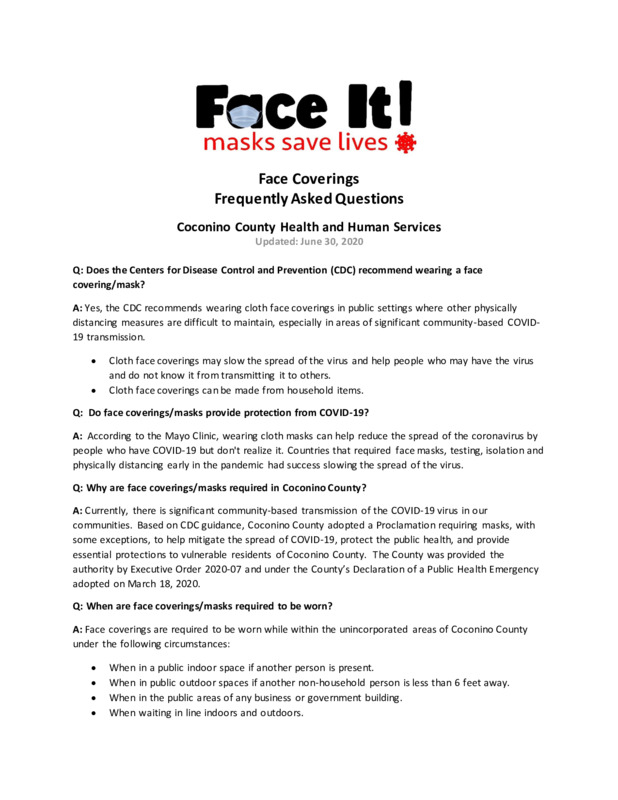
Northern Arizona's Coconino County "Face It" Mask Campaign and Online Toolbox
The Coconino County Health & Human Services department created its "Face It" campaign in 2020 to promote the use of masks and face coverings in their communities. The following webpage is for the campaign's digital "toolbox" to give the public access to official signage for display to customers, the public, and employees to address mask use issues. -
 04/07/2021
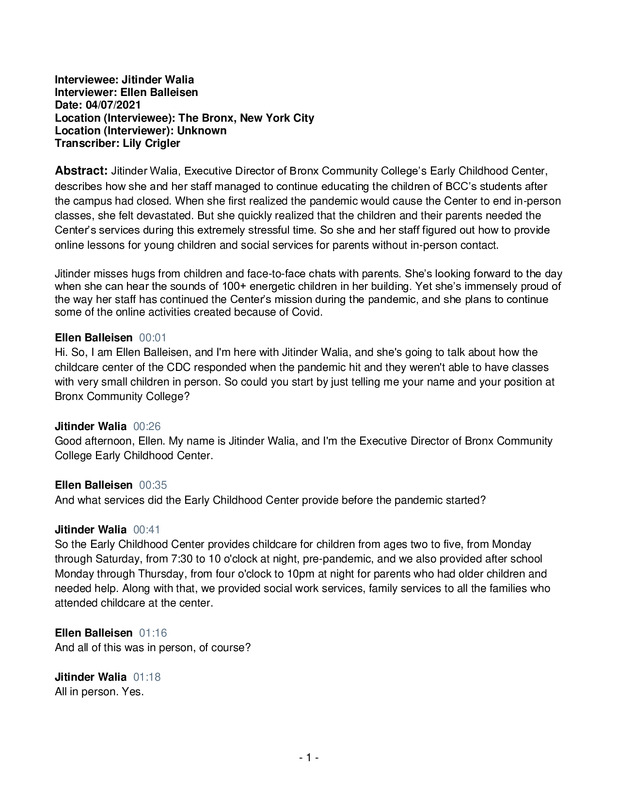
Jitinder Walia Oral History, 2021/04/07
Jitinder Walia, Executive Director of Bronx Community College’s Early Childhood Center, describes how she and her staff managed to continue educating the children of BCC’s students after the campus had closed. When she first realized the pandemic would cause the Center to end in-person classes, she felt devastated. But she quickly realized that the children and their parents needed the Center’s services during this extremely stressful time. So she and her staff figured out how to provide online lessons for young children and social services for parents without in-person contact. Jitinder misses hugs from children and face-to-face chats with parents. She’s looking forward to the day when she can hear the sounds of 100+ energetic children in her building. Yet she’s immensely proud of the way her staff has continued the Center’s mission during the pandemic, and she plans to continue some of the online activities created because of Covid. -
 2021-04-19
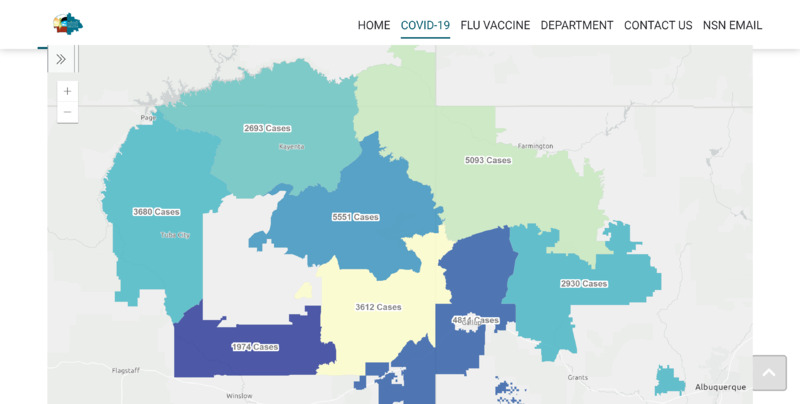
Navajo Department of Health COVID-19 Case Infection Data by Region through 19 April 2021
This image, taken as a screenshot from the Navajo Department of Health website on 19 April 2021, shows COVID-19 infection case data by region within the Navajo Nation. -
 2020-10-16
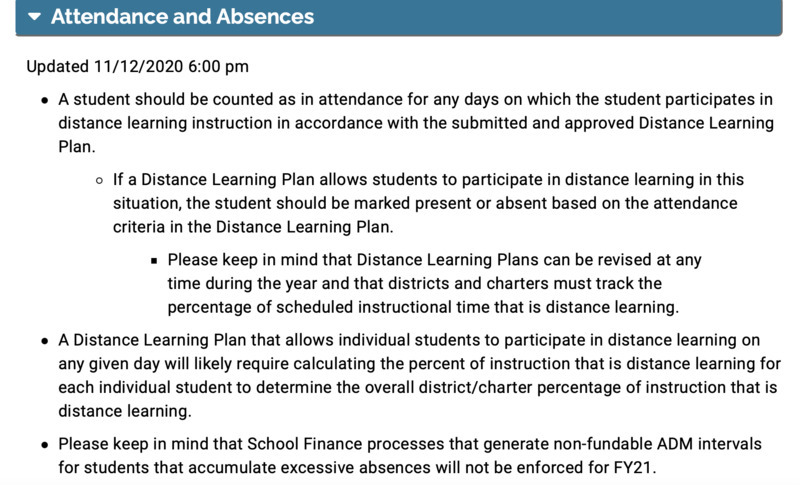
School Finance Guidance for COVID-19
Arizona Department of Education fiscal information and guidance pertaining to attendance and absences while students participate in distance learning. The guidance page also includes links to important forms, school finance reports, and other valuable external resources. According to the report, the due date for a financial plan (Budget/AFR) is November 13, 2020. The name of the file is, "Distance Learning Report -Actual". No recent updates appear to have been made. -
 2020-10-16
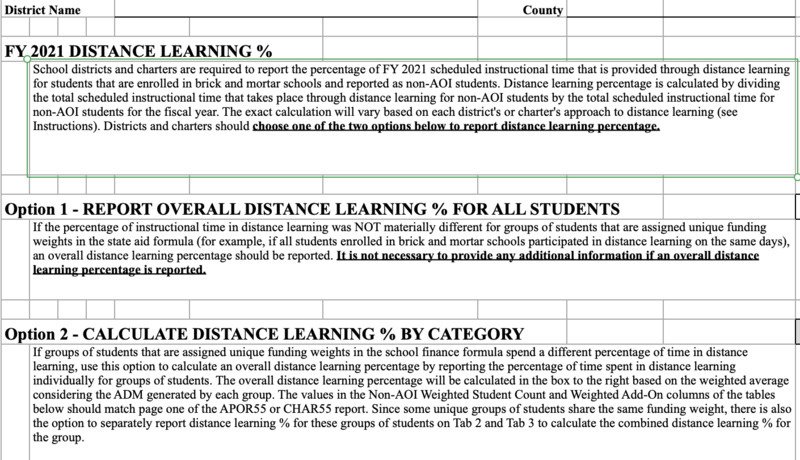
Distance Learning Submission- FY2021
Arizona Department of Education authorizes distance learning with the passage of Executive Orders 2020-41, 2020-44, 2020-51. Students that are participating in online instruction "...shall be treated as pupils participating in Arizona Online Instruction for funding purposes." In this context, COVID-19 has impacted, on an economic level, the fabric of everyday life- down to gathering statistical data and reporting student attendance for online education for the purpose of funding virtual education, not brick-and-mortar institutions. -
 2020
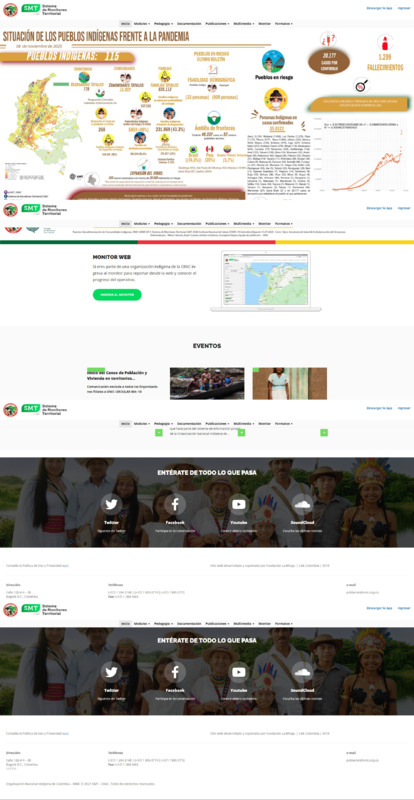
2020Sistema de monitoreo territorial
"El Sistema de Monitoreo Territorial es una plataforma de recolección y generación de información que hace parte del sistema de información propio de la Organización Nacional Indígena de Colombia." "The Territorial Monitoring System is a platform for collecting and generating information that is part of the information system of the National Indigenous Organization of Colombia" -
 2020
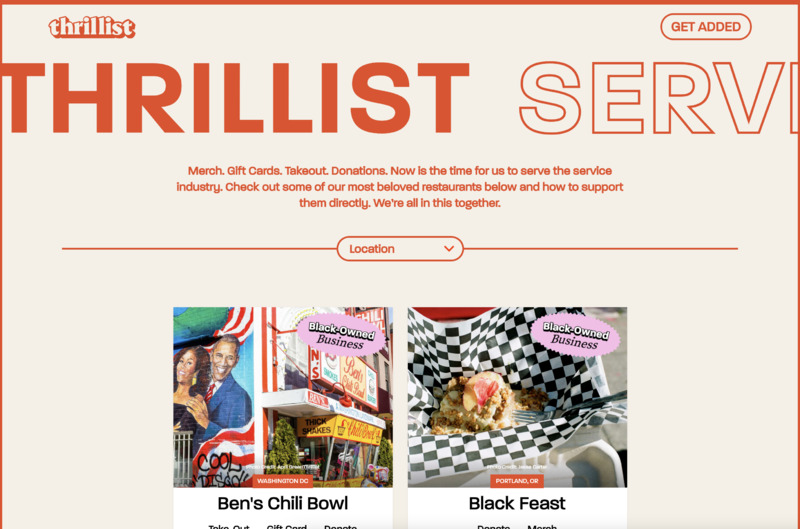
2020Thrillest Serves
Because of the struggle the pandemic has put on small businesses and restaurants, Thrillest has created a webpage that lists a variety of businesses with links to merchandise, donation pages, and places to buy gift cards. By providing this support, Thrillest is trying to prevent any small businesses from closing due to the pandemic, and are spreading the word about small businesses that need support to encourage people to support them rather than large companies that aren't necessarily struggling during this time. They hope to serve the service industry, providing direct support for businesses in many major cities across the U.S. -
 2020
2020International mobilization to save Indigenous Lives
"A Articulação dos Povos Indígenas do Brasil (APIB) apresenta um plano emergencial indígena de enfrentamento da Covid-19 no Brasil e conclama todos a apoiarem medidas que possam salvar vidas e exercitarem a solidariedade. Os povos indígenas estão entre os grupos mais vulneráveis ao avanço da pandemia e encontram-se desprovidos de condições para enfrentar a doença. Precisam do apoio de todos." "The Articulation of Indigenous Peoples of Brazil (APIB) presents an indigenous emergency plan to confront Covid-19 in Brazil and calls on everyone to support measures that can save lives and exercise solidarity. Indigenous peoples are among the groups most vulnerable to the advance of the pandemic and are devoid of conditions to cope with the disease. They need everyone's support." -
 2021-04-08
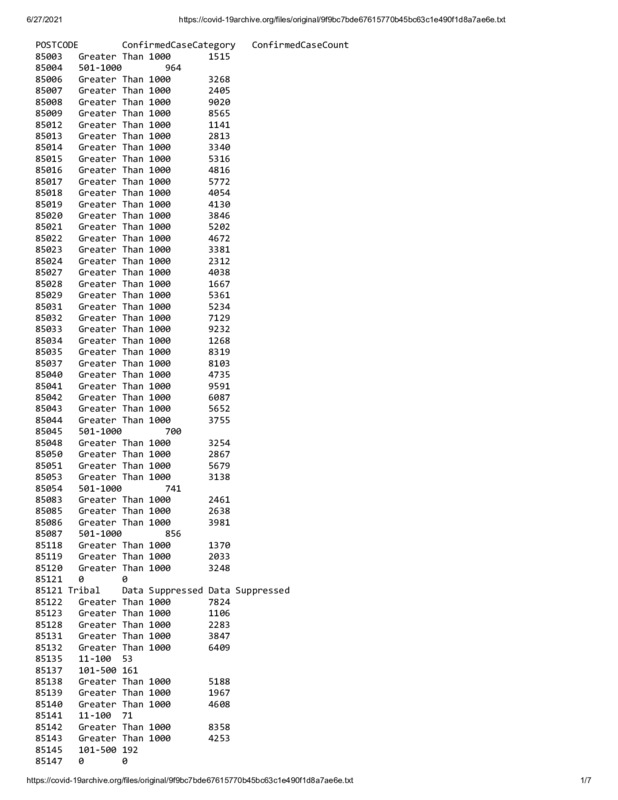
Arizona COVID-19 Infections by Zip Code through 04/08/2021
This text file shows data from the Arizona Department of Health Services for confirmed COVID-19 infections tied to the patient's residential zip code. The data runs through 04/08/2021 and can be searched by "Ctrl + F" and entering specific zip codes. AZDHS suppressed tribal data from this data file prior to its publication on the organization's website. -
 2020
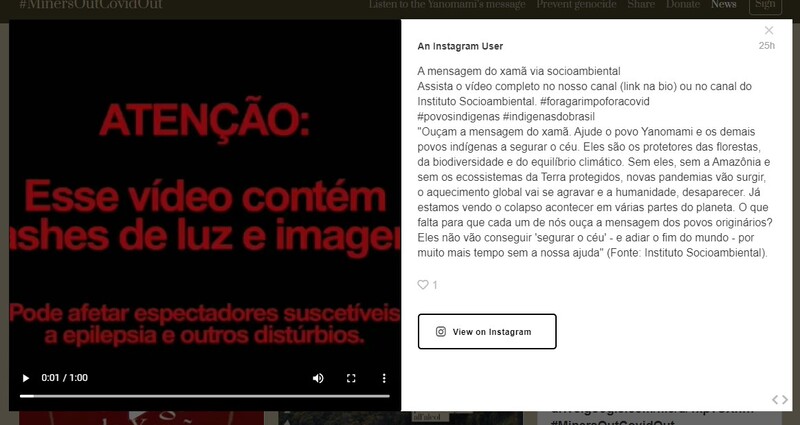
2020Yanomami want miners out of their lands to prevent spread of COVID-19
"The most well-known Yanomami shaman and leader, Davi Kopenawa, with French anthropologist Bruce Albert. Inspired by his words and teaching, Ye'kwana Leadership Forum produced the film "The Shaman’s Message", to bring the #MinersOutCovidOut campaign to the world. The campaign calls for the immediate removal of illegal miners who are active in the Yanomami Territory, destroying the forest and rivers, bringing violence and now COVID-19 with them into the communities." -
 2020-11-11
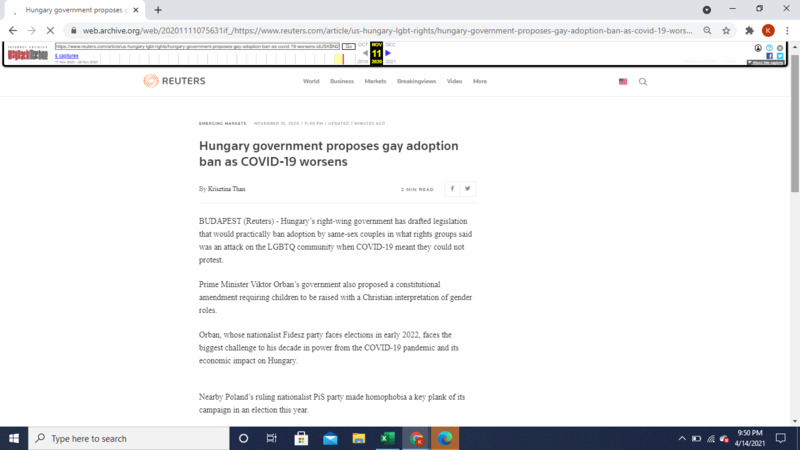
Hungary Government Proposes Gay Adoption Ban As COVID-19 Rages
The story from Reuters talks about how the country of Hungary has people who want to ban Gay adoption as COVID-19 is raging around the world. It is important to note that there are many people who are losing loved ones and who will need a home in the future. The proposed ban would not allow people who are both domestic and international to adopt from this country that currently has a COVID-19 rate that is going up. The Prime Minister is proposing that there be an Amendment stating that children be raised with Christian traditional gender roles. Hungary currently does not allow for same-sex marriage. -
 2021
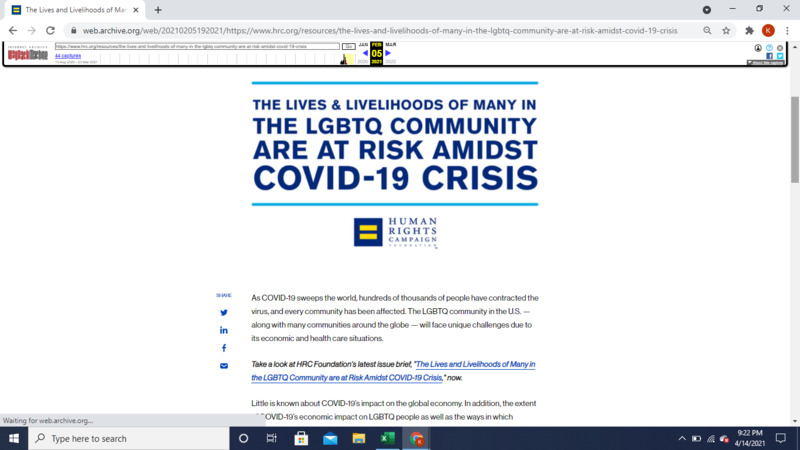
2021The Lives and Livelihoods of Many in the LGBTQ Community are at Risk Amidst COVID-19 Crisis
The story speaks about how many people in the LGBTQ community are at risk while the COVID-19 crisis is occurring. The study shows that people within the community have less access to healthcare, a greater risk of health complications due to COVID-19, and do not have paid leave. -
 2020-03-11
Minnesota Department of Health Travel, and Covid-19 Information in ASL
This video covers the basic information of the 2020 novel coronavirus (COVID-19) outbreak. For more information on COVID-19 visit: https://www.health.state.mn.us/diseas... ASL talent - James Paul Beldon III, Keystone Interpreting Solutions Video Transcript - Hello. This is a message from the Minnesota Department of Health. Lately we’re hearing a lot about an outbreak associated with novel coronavirus. This outbreak started in China, and now has spread to other countries including the United States. The novel coronavirus causes respiratory illness in people and can spread from person to person. Symptoms of infection include fever, cough, and shortness of breath. While most people recover, it has led to serious illnesses and death in some cases. Minnesota’s public health community is working hard to protect you, and we’re asking for your help by following the same precautions we all use to prevent colds and flu: ▪ Wash your hands often and well with soap and water. ▪ Cover your cough every time. ▪ Stay home when you are sick. Also, if you’ve recently traveled where novel coronavirus is spreading and have symptoms, be sure to call your doctor or health care provider to let them know of your symptoms and your travel history. They will work with you to assess your condition and take appropriate steps to get any needed treatment while limiting the risk of passing along an infection to others. We are learning more about this outbreak and will share key information as it continues. You can stay up to date by visiting the Minnesota Department of Health’s website at health.state.mn.us.