-
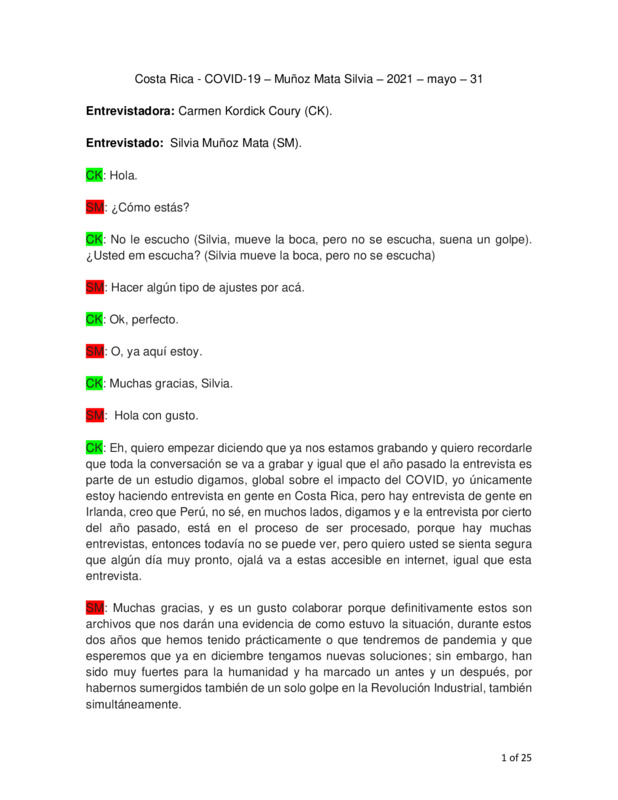
05/31/2021
En esta entrevista Silvia Muñoz Mata es entrevistada por Carmen Kordick Coury concerniente al covid-19 en Costa Rica. Empiezan hablando de los cambios que habían ocurrido desde el ano anterior. Hablan del trabajo y el trabajo virtual. De la violencia domestica y otros problemas que existen en la sociedad. De allí hablan del crimen, violencia y las divisiones económicas que existen alrededor de ella. Hablan de las vacunas, gente conocida que no se quiere vacunarse y las teorías conspiratorias que existen sobre las vacunas. De allí hablan del gobierno, familia y salud física y mental. Para terminar hablan de narcotraficantes y del futuro.
-
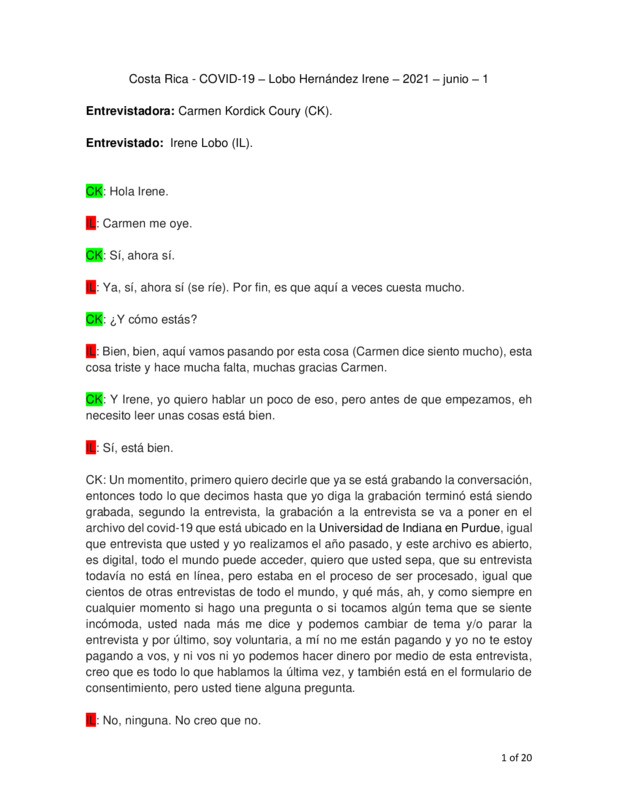
06/01/2021
En esta entrevista Irene Lobo Hernández es entrevistada por Carmen Kordick Coury concerniente al covid-19 en Costa Rica. Habla de los cambios desde el año anterior. También hablan del gobierno, de la vacuna y de la gente que no se quiere vacunar. Hablan de las aulas virtuales y del uso de mascarillas. De allí, Irene habla de su hermana Eugenia que falleció de complicaciones de covid. Irene también habla de la caja, del ministerio de salud, el presidente y la asamblea. Hablan de la frontera de Nicaragua y la economía. Para terminar, hablan de su familia y el futuro.
-
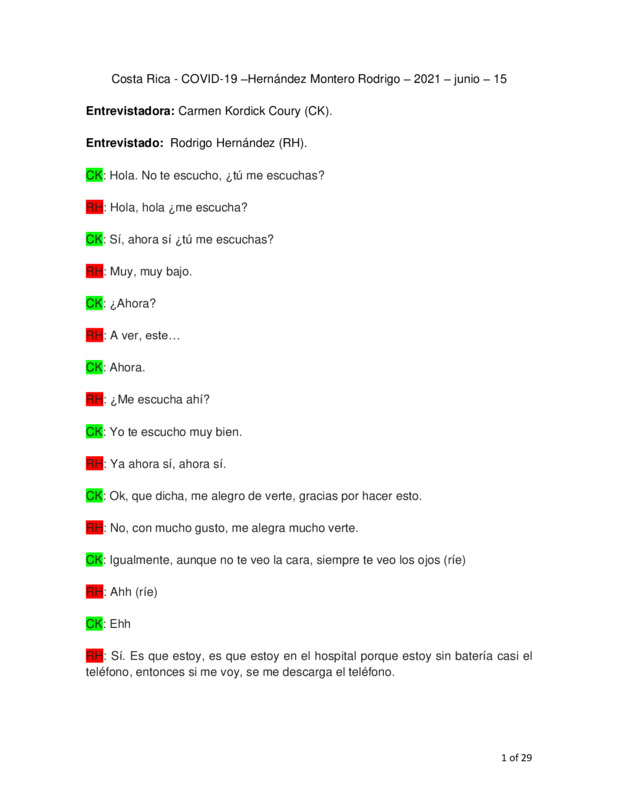
06/15/2021
En esta entrevista Rodrigo Hernández Montero es entrevistado por Carmen Kordick Coury concerniente al covid-19 en Costa Rica. Empiezan hablando de cosas que habían cambiado desde el ano interior. Hablan de los cambios que ha visto en el hospital donde trabaja y del equipo de protección. De allí, hablan de la economía, de la vacua, de su hogar y el uso de las mascarillas. Rodrigo cuenta del momento que el vio la situación de la pandemia empeorar, como ha cambiado la cultura de tocar y de su familia. Para terminar, habla de las fuentes de información y del futuro.
-
06/27/2021
En esta entrevista Rodrigo Hernández Cordero es entrevistado por Carmen Kordick Coury concerniente al covid-19 en Costa Rica. Para empezar, hablaron de los cambios que pasaron desde el ano anterior. Rodrigo es dueño de tienda, hablan de su negocio, de las vacunas y de su deseo de no vacunarse. Hablan del gobierno, del uso de mascarillas y su familia. De allí, hablan de La Caja, el sistema médico y hospitales privados. Rodrigo habla de cruzando fronteras y comparando para su tienda. También de la corrupción del gobierno, vida familiar, salud mental y de los funerales. Para terminar, hablan de la esperanza para el futuro, fuentes principales de noticias y noticias falsas.
-
06/10/2021
En esta entrevista Francisco Guzman Solano es entrevistado por Carmen Kordick Coury concerniente al covid-19 en Costa Rica. Empiezan hablar de los cambios que Francisco ha visto desde el ano anterior. Hablan de la economía y el gobierno, de su trabajo y la vacuna. También hablan del aumento del crimen, de las drogas, y de las noticias falsas. De la Caja y el ministro de Salud. Francisco también habla de su familia y su hogar, de las fuentes principales de información y la sociedad. Terminan hablando de las clases virtuales de su hija, de la educación y del Ministerio de Educación.
-
2020-04-10
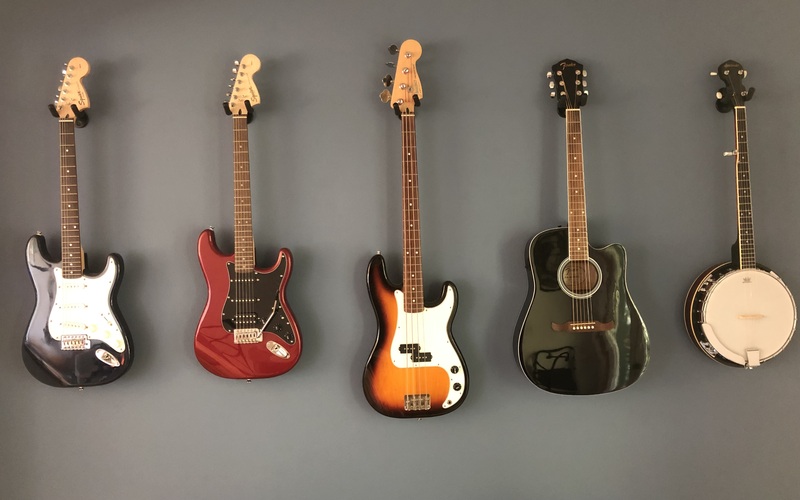
Bringing music into the home to ease the pandemic woes.
-
2021-02
It was several months since my last day in a classroom. March 13, 2020 to be exact. Friday the 13th. The previous school year we were told it was to be a possible 2 week break that ended up going until the end of the year. What was to become of the next school year of 2020-21? I tried to stay optimistic over the summer and enjoy the time spent with family. We were lucky to have each other and have a yard and house where we felt safe to be quarantined. I knew a lot of my students were not so lucky in that they lived in apartments with several family members. Still I wanted to be optimistic about the upcoming year.
As the start of school year date got closer, it was apparent we were to continue online teaching via zoom. I felt I was pretty tech savvy and could integrate technology enough to keep my students engaged, but it was still challenging. I taught incoming freshman 9th grade students. They did not get the “new students” experience of coming to my school and meeting and greeting all the faculty and each other. Initially the expectation was to have all students have cameras on, and for the most part in that Fall semester, my students did. But then towards the break students started getting sick, parents were losing their jobs, some even lost family members. People were sad. We barely made it into the winter break with students attending “online”. I was fortunate to have most of my students log in but in other classes students stopped showing up. And if they did log in, cameras were off and it felt like talking to a void. Were they still paying attention? Were some of them just logging in and doing other things like playing video games or sleeping? I was frustrated, but also empathetic knowing for a lot of these students survival, not academics, was their priority during the time.
After the winter break and a return to zoom teaching, it was a palpable sadness. There were people who had lost loved ones, and my students were depressed. I could feel the grief and sorrow through the screen and sometimes I would weep after my classes ended for the day. I had to maintain a persona of optimism for my students online and also keep encouraging their academic pursuits. I have never had such a challenging teaching year like the 2020-21 year.
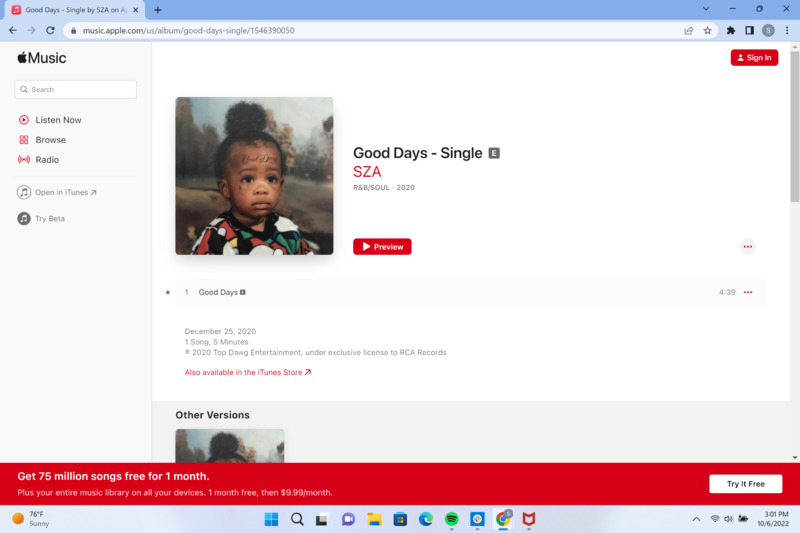
The sensory experience I am recalling is sometime in February of 2021. It was the second semester of school, back from the break and many people had a rough time of the holiday season with loneliness, fear, and loss. I don't know how I came up with the idea but I thought about students sharing playlists with the class. I would review them, and if we had a test together on zoom I would play songs on the background. One particular song I found was “Good Days” by SZA. It was not my style of music, but I knew it was what my students listened to. The day I played that song I started to get a lot of feedback from the zoom chat from all my classes about that song. By this time a majority of students had stopped showing themselves on camera and/or stopped talking, however Good Days sparked something in my students. The intro of the song is very melodic and serene. It is one of those songs that sounds very sweet, but is very sad at the same time. I could tell by the response of my students that it hit a nerve. A few of them began to speak up again in class, a few would turn their camera on again. And of course, I had several sending messages after class thanking me for the song. This happy/sad song connected me again to my students that I thought I had lost over winter break. It gave me a little hope again, and I think it gave some of them hope too. Now, whenever I hear Good Days by Sza it reminds me of those lonely online zoom classes in February and how we were all feeling a bit sad, but a simple song gave us all a bit of hope that the future was to have some Good Days ahead.
Lyrics to Good Days
All the while, I'll await my armored fate with a smile
Still wanna try, still believe in (good days)
Good days, always (good days)
Always inside (always in my mind, always in my mind, mind)
Good day living in my mind
-
06/23/2021
En esta entrevista Danitza Guzman Solano es entrevistada por Carmen Kordick Coury concerniente al covid-19 en Costa Rica. Hablan de los cambios que han ocurrido desde el ano anterior. De su trabajo como docente, los cambios que han ocurrido y sus estudiantes. Hablan del ministerio de educación, ministerio de salud y de las vacunas. También hablan de gente que no se quieren vacunar y cuenta de cuando se enfermo con el coronavirus. Danitza habla de gente conocida que se enfermaron y algunos que murieron de la enfermedad. Para terminar, hablan del gobierno, del futuro, de la salud mental y de las elecciones.
-
2020-06-01
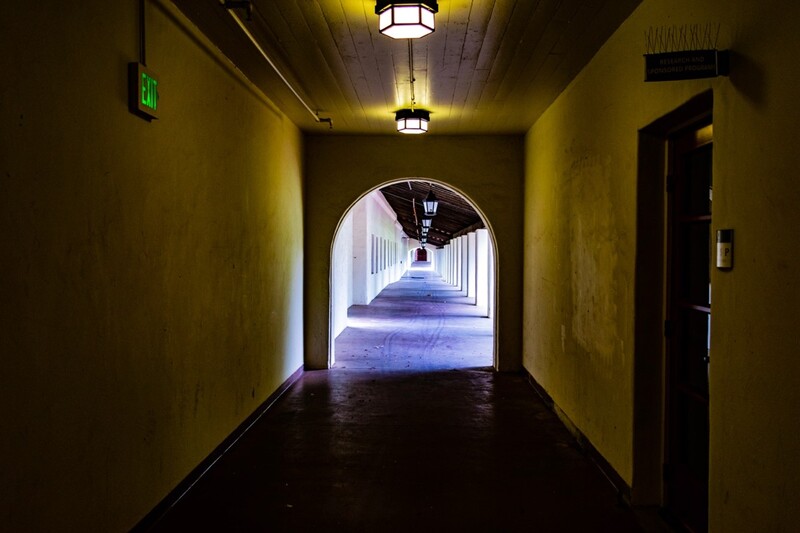
The property of California State University Channel Islands (CSUCI) was not always the site of the CSU’s twenty-third campus. From 1936-1997 the Spanish-colonial style buildings housed 7,000 of California’s mentally handicapped population at Camarillo State Hospital. The site sat vacant for 5 years from 1997 until CSUCI took over the old hospital buildings in 2002. The COVID-19 pandemic brought back an unnerving quietness, reminiscent of when the property was unoccupied.
My mom and I took advantage of how serene the campus was and made a point to walk our dogs there several times per week. We did it not just to get out of the house, but due to how enjoyable it was to take in the beauty of the campus. Recalling these memories strongly evokes all five senses and immediately brought me back to the lockdown times of the early pandemic.
The absence of college students rushing to their next class made the campus strangely quiet, but there was an enjoyable quality to it. You would occasionally hear ocean breezes whizzing around the vacant corridors and then immediately get greeted with the smell of salty beach air. It would be common for the air to be mixed with the smell of cilantro and strawberries being harvested at farms surrounding the campus. However, not all smells are made equal. When the winds would change, the on-site wastewater facility would waft heinous odors into the direction of the campus, momentarily ruining the blissful experience.
The open corridors of the former hospital buildings contain steady slopes, occasionally requiring one to hold the handrails that have stood for nearly one hundred years. It always made me dive back in history and think about the thousands of patients at the hospital that probably held onto that same rail. At times we would hear screeching from the sky near the old Receiving and Treatment hospital where the current university library stands. We both would look up and see large turkey vultures or hawks elegantly gliding over the thousand-acre property, creating a picturesque scene above us.
Now that we are in a post-pandemic world trying to return to normal, these experiences are not quite the same as they were in the height of the pandemic when the school was completely emptied. Students have returned to the dorms, and university-related events are once again a common occurrence throughout the campus.
-

2020-03
When the pandemic began, I was finishing up my last few months of student teaching. My mornings included talking to students about their day and weekend plans they had; however, once the pandemic started that changed drastically. The students were gone and the silence began. Highschools are customarily, a loud and busy environment; yet, overnight the students were gone and there was nothing at school but silence. The halls were empty, my classroom was empty, the whole school was empty apart from a small group of staff. For the rest of the year, I would go to school and sit in my classroom alone in almost complete silence. No face to face interaction with students or even other staff. As a teacher, this was taxing on my mental health. From one day to the next my entire occupation had been flipped upside down. I never saw my students again. I still wonder what became of them. The one thing that sticks in my mind from that period is the sound of dismissal bells at school. For some reason the bells continued to ring even though there were no students. Everyday when that first hour bell would ring I would remember that no students were coming. This was a reminder everyday that the world had changed.
I recorded the sound of dismissal bells at my highschool. Two years after the pandemic started, this sound still reminds me of teaching during the pandemic.
-
2021-01-15
In January of 2021 my husband and I traveled to Venice Italy for a quick weekend getaway to meet up with my brother & his family. My husband and I had visited Venice before, but not since COVID, let alone during a time when regulations in Italy were quite strict; vaccine documentation had to be shown everywhere we went, masks needed to be worn at all times, etc. Upon arrival to the city, there were several things that instantly struck both my husband and I in regard to the changes we were now witnessing. A far different Venice than the one we experienced a few years before. Not only FAR less crowds, all the masked faces, empty plazas once the sun set, the clear waters of the canals, but the SMELL of Venice was different. Even though I love Venice as a city, I vividly remember the unpleasant smell of the canals when we visited a few years prior, in the height of the summer. Remebering that as we took a gondola ride through the canals, I couldn't help but notice the unpleasant aroma coming from the canal waters. But now that we have found ourselves in a COVID world Venice, the smell was noticably gone, and you could actually see the bottom of the shallow canals as you walked over the bridges throughout the city. I was previously unable to notice how truly shallow the canals were until this COVID world allowed for less polluted waters of Venice, and therefore a better smelling Venice as well.
-

2020-04-07
I was a line cook and baker for many years professionally, but ended up with severe carpal tunnel syndrome and had to find a new profession. For a while I just stopped cooking all together because it was hard for me to give up something I loved so much. But during the COVID-19 pandemic I had a lot of time on my hands, so I started baking and cooking again. I was determined to find the best sugar cookie recipe I could find. This was one of the recipes I tried out during the long lockdowns. They ended up turning out really well.
-
05/21/2021
En esta entrevista Erika Franco Quirós es entrevistada por Carmen Kordick Coury concerniente al covid-19 en Costa Rica. Habla del regreso al trabajo presencial y los protocolos que tiene que seguir en el trabajo. Habla de las vacunas, del gobierno y de las personas que viajan para vacunarse. También habla de los cambios que ha visto en la sociedad, de la gente que son contra la vacuna, su familia y vida personal. Erika también habla del uso de la máscara y del ministro de salud. Para terminar, ella habla de las fuentes principales de noticias que usa, de las noticias falsas y de el futuro.
-
05/20/2021
En esta entrevista José Pablo Enríquez Arcia es entrevistado por Carmen Kordick Coury concerniente al covid-19 en Costa Rica. José Pablo vive en San José. Habla de los cambios que han sucedido desde el año anterior, de la salud mental y el suicidio. De las vacunas, el temor a las vacunas y el turismo para las vacunas. El también habla del estrés, el crimen y la gente que vive en la calle. José Pablo también habla del gobierno y el ministro de salud. Cuenta de las fuentes de noticias que ve y las falsas noticias. Para terminar el habla del futuro y todos los cambios que causo la pandemia en su vida personal.
-
2021-06-15
During the COVID-19 pandemic I worked at a preschool where I taught primarily 12-to-18-month-old children until they were ready to move onto the next class. The use of a face mask and rigorous cleaning methods were a constant part of my day for the entire time I worked there. Now, the memory of that time stands out to me the most through the feel of the mask on my face and the smell of the bleach that seemed to stay with me for days. The kids I taught were too young to wear masks (that was reserved for the two-year-old and up classes), but they did not seem bothered that the adults surrounding them wore pieces of fabric over their mouths and noses. For eight hours a day I felt the pull on my ears, the scratchy material against my nose, and the frustration of the mask muffling my voice when trying to get the attention of ten children in the classroom. Pointing out facial features like a nose or certain facial expressions like being happy or sad with a mask on became normal. More often than not, I would feel a small hand reach up and attempt (or succeed) at pulling my mask down which I proceeded to pull back on as quickly as possible while ignoring how good the fresh air on my face felt.
Aside from the masks, the administration required routinely cleaning all toys used everyday with a high concentration of bleach. During nap time, the smell of the bleach filled the room as we cleaned all toys used that day, regardless of the duration of the activity. Even with a mask on, the smell lingered in my nose, on my clothes, and in the classroom to the point that I always felt that I smelled of bleach. When COVID-19 infection numbers were up in the local area or we had case in our school, the bleach concentration, as expected, went up and so did the smell. While I supported all efforts made at the preschool to reduce possible COVID-19 infections, these sensory descriptions illustrate the mental and emotional draining portion of the pandemic history.
-
2020-08-11
The American response to the global COVID-19 Pandemic was multi-faceted. However, of specific importance to the nation were the changes made to public education. As the Pandemic resulted in the closure of businesses, teachers and students were required to continue their educational programs online from the privacy of their homes. Although the effects of distance learning will continue to be seen, virtual learning severely limited the ability of students and teachers to use sensory perception as a tool for learning and instruction.
First, distance learning no longer enabled American teachers to utilize the sensory perception of “proximity.” Throughout public education “proximity” is used to encourage student engagement with both instruction and content. Many teachers will walk their classrooms during student activities and use sensory perception to sensorially inform students that they are near to them and are assessing their engagement. Teachers use this strategy as a reinforcement tool to develop students’ ability to stay on task. Yet, during the COVID-19 Pandemic, social distancing policies made “proximity” not only impossible, but also illegal, limiting to what extent teachers could use sensory perception to foster engagement and learning.
Second, not only were educators no longer allowed to use the sensory perception tool of physical proximity, but also many educators were forced to rely solely on the sensory perception of sound. School districts throughout the state of California, for example, did not permit educators to require their students to verify their attendance in live video format. The result was educators and students were engaging predominantly through speaking and listening. Furthermore, being denied the sensory perception of sight, educators could not assess to what extent students were engaging with instruction and activities.
In conclusion, the COVID-19 Pandemic enacted emergency response strategies which directly affected the education of Generation Z. For both students and educators, sensory perception became more limited for every student. Yet, the sciences, including social science, are built upon the empirical information a human being receives through them. Perhaps this video will serve as evidence to answer the question, “Is the right to sensory perception and scientific information included within the natural rights of life, liberty, and property?”
-
2020-06-06
It had been a few months after that start of the pandemic. I left my home early in the morning and noticed something odd when I got outside there was no sound. At this time of the year, I would expect to hear kids outside playing in the Cul-de-sac. It was the weekend and early in the morning I expected to hear someone working on their yard, yet no one was around I heard nothing. I also lived close to the highway and if it was any other day I would hear a cars and trucks going by but, today there was nothing. It gave me an eerie feeling like time had stood still or that I was the last person on earth. Lucky a few seconds later I herd a car that pulled me out of this moment of dread. My wife had just returned from working the night shift as a nurse at the hospital. I will never forget the day it was so quiet that I felt the earth stand still.
-
2020-03-21
It emphasizes the suddenness of the pandemic through sensory history.
-
2020-03-16
Arizona State University employees, myself included, were sent home mid-March of 2020 due to the rising concerns of Covid-19. I recall driving home that initial day thinking that a sea change was upon us and that uncertainty lay ahead. How would I balance my concerns about this unknown virus yet help keep the peace in my house with my wife and our young boys as the country learned how to live with our new, unwelcome guest? Little did I know the biggest changes in our lives would be the small changes in our daily routines.
In looking back at those first days, one scene that was routinely repeated in particular plays out in my memory. We quickly shifted our grocery shopping from in-person purchases to ordering on-line and picking up food curbside outside of the store. Before bringing the food inside our house, my wife and I had agreed that we would wipe down our new food packages with paper towels soaked in isopropyl alcohol. At the time it was unclear if the virus survived on packaging for long periods so we thought it best to disinfect the food. Looking back on it now, it seems silly but the scene still plays out in my memory:
I can still smell the latex of the rubber gloves I would put on so as not to completely dry out or burn my hands. When pouring the alcohol onto the paper towels, the smell would sting my nose and a tingling sensation would pervade my nasal passages. When wiping the plastic packaging of say, frozen vegetables, I would hear the crinkling sound of the bag and it would resonate through my ears. To compound the smells and sounds of this process, I would be remiss to not include the fact that this was all taking place in our garage during one of the hottest Arizona springs and summers on record. The heat was oppressive that season, enough to identify with that 'oven blast' description we use in this region and I would be dripping with sweat by the time the task was complete. To say the least, it was a surreal experience; one where if you had told me two weeks earlier, I would be wiping down groceries in a stifling garage to prevent a possible infection of an unknown virus, I would have laughed at you but, alas, I was there and the senses surrounding the scenario were real.
-
2022-06-26
Flying home from a tournament, where my team suffered defeat after defeat, I was not aware of much outside of my muscle aches, my mental and emotional exhaustion, and the bitter taste of failure in my mouth. The first twenty minutes of the flight was uneventful, just the occasional cry of a child, the subtle rock of the plane in turbulence, the dim light by which I read my book.
Soon, as the turbulence died down, and the child fell asleep in the arms of its mother, every single person on the plane became distinctly aware of the continuous coughing of a lady wearing her mask. I had forgotten to grab one for the flight home, despite every intention of wearing one, and nobody else on the flight had one. Conversations noticeably died down as the coughing continued, and even seemed to get more frequent and intense. I put down my book, donned my headphones, and tried to watch a movie to drown out the noise. People shot furtive glances at the lady in question, all of us wondering from the sound of her cough, if she had Covid.
The more I heard it, the angrier I felt, and the more afraid I got. I am an athlete and young, so would likely be fine if I caught Covid. However, my girlfriend and little sister are both high risk, and I did not want to risk exposing them. I managed to calm myself as to not make a scene, worthless at this point tens of thousands of feet in the air. I could not know the situation of the lady, whether she had a choice to be on this flight, or had to return home, attend a funeral, or whatever other reasons she may have had to go on a flight, sick, while there was a global pandemic. All I can tell you is that from the sounds of uncomfortable shifting in seats, the murmurs pointed at the lady, and the otherwise silence of the formerly talkative plane, nobody felt entirely safe or comfortable.
I ended up catching Covid-19, and unknowingly giving it to my girlfriend who I live with. Despite having to take her to the hospital briefly, we both ended up fine. Whether our cases of Covid were from the lady on the plane or somebody else, I will never know. But the sound of incessant coughing during this pandemic still has the same effect wherever I go, creating a perceptible unease.
-

2020-03-21
If there's one thing you can count on in the Muslim world, it's the call to prayer (adhan) audibly marking the sun's path through the sky, and everyone's route to a mosque, five times a day. It might sound a little different in various regions, a little more musical in Egypt, a little less practiced sometimes in Kyrgyzstan, but it's always the call to prayer, and has been for over 1000 years. But across the Muslim world in March 2020, as mosques closed because of the coronavirus pandemic, the call to prayer was adapted. Instead of saying, "Come to prayer, come to salvation" it said in Egypt, "Pray in your homes, pray on your travels." The wording had been changed like this a few times in the past when mosques were closed because of war or plague or weather, but I honestly never thought I'd hear it myself. The call to prayer seems constant and unchanging, part of the highly sensory experience of Muslim prayer, so this adaptation made the pandemic more present for everyone in Egypt.
I'm not Muslim myself, but I talked with Muslim friends all over the world about the change in the adhan. One woman in Kuwait said, "It just sounds so... ominous.. especially at maghrib prayer, it's sunset and getting dark, and the voice over the loudspeakers is saying to stay home... also because I have never, ever heard them change it like this before. Ever. It's like I'm waiting for an eclipse, and the flocks of birds flying away, animals fleeing, etc."
I took this video during the last prayer of the day on 21 March 2020 at a mosque near our apartment in Cairo, Egypt. If you're not familiar with the adhan, you obviously won't notice anything different, but this rendition is beautiful even if you don't understand it. If you do, the new wording begins at 1:13. The beginning of the video is a little bumpy while we were getting to the right spot, but then it settles down a bit.
-
2020-03-15
I worked at a McDonald’s in March when the United States went into lockdown. Before the lockdown, the drive-thru line was long, the lobby was full of customers, and employee’s rushed around everywhere. The restaurant was always loud with fryers beeping, headsets beeping, customers ordering and complaining, and employee’s trying to have conversations with each other while taking orders all at the same time. People were constantly sneezing, coughing, or sounding like their voices were hoarse, and no one thought anything of it. Everyone went on about their business. After the pandemic, the restaurant was quieter. No more customers were in the lobby, fewer people came through the drive-thru, and fewer employees were at work, less food was being made, so the fryers beeped less often, as did the headsets that warned us when customers wanted to order. One new sound we could all rely on was the alarm that went off every hour, followed by a manager yelling out that everyone needed to wash their hands. The sound of a raspy voice from a customer, a sneeze, or a cough echoed from the speaker above side one in the kitchen, though the entire restaurant and employees would all look at each other in disgust, sure that this customer must have the Corona Virus. The employee in the first booth taking the payment would instantly remove their gloves and rush to scrub their hands before retrieving a new pair of gloves. The person in the second booth who handed the food out the window would be stretching their arm out the window as far as they could in an effort to stay as far away from the person as possible before repeating the same ritual as the last employee in disinfecting themselves. Sounds that usually just fell into the background noise and people assumed were allergies or just a simple cold suddenly elicited a significant amount of fear in my friends and co-workers. While things have mostly gone back to normal, the handwash alarm and manager yelling for a handwash is an hourly reminder that Covid-19 is still around.
-
2020-03-19
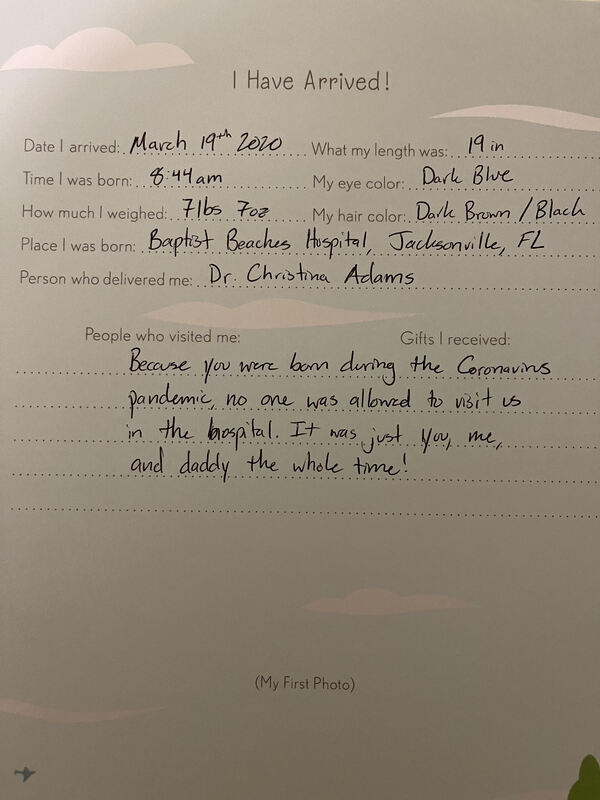
The Covid-19 quarantine started on March 16th, 2020. I gave birth to my daughter four days later. Thankfully my labor was very quick and there were no complications. By 8:44 a.m. on the 19th, my daughter was in my arms. After the commotion of the nurses and doctors coming to check on my daughter and myself, there was just silence. Newborns, as a quickly discovered, slept a lot. There were long stretches of silence for the two days we were in the hospital. I would look at my husband and say, “It is eerily quiet in here.” I was only one of three mothers giving birth in my area of the hospital, there were no visitors, and we were told to stay in our rooms unless we absolutely needed to walk around. My husband would order food and have to wait at the front of the hospital for them to drop it off. Every time he left and came back, he talked about how he had barely seen anyone, and that it was completely silent in the hospital. When it was time for us to finally leave, walking out of the hospital was also silent. There were no phones ringing, no nurse pagers, no talking between nurses, nothing. The only sounds were my flip flops squeaking off of the floors. When we finally made it outside, the birds were chirping and I remembering thinking, ‘thank goodness for some background noise!’
-
0022-08-18
In the audio-file I tried to manipulate the sounds to reflect some of the ways I interpret the world as a Hard of Hearing woman during the Covid-19 pandemic. I want the listener to be able to feel the frustration as they listen and try to understand the story. The pandemic has forced many of us to adapt. This is my story.
-
2020-03-05
The pandemic, rather the first 5 months, was debilitating for my mental health. I suffer from a type of Obsessive Compulsive Disorder (OCD) called "Contamination OCD". This could also be known as germaphobia. When the pandemic began, I began to be cautious. I would slide my sleeves over my hands to open doors at the college I was attending. I stopped touching things directly. For years I already practiced this in the bathroom, such as not touching stall locks before using the toilet or always washing my hands before and after I went. Due to medical issues, my doctors advised me to truly quarantine for 30 days or more. This sent my anxiety into a severe shock. I truly, genuinely did not leave my home for 30 days. There may have been a few trash outings but I did not go to the stores or see friends; nothing. It is hard to describe how my touch was affected, especially if the reader does not understand contamination OCD. An example that truly became a problem for me is Amazon packages. For everyone else, Amazon was still running and this allowed everyone to still have fun; to still live. For me, any package I took in, I used gloves. I would not touch the box. In my mind, the carrier could have had COVID, which would be outside the box. Inside, the handler could have coughed on the item as well. Even the manufacturer could have contaminated it. I cut trash bags in half and laid my items on them as I carefully dissected each one. Anything that came into my home, groceries too, was wiped down with bleach or Clorox wipes (if I had them). Amazon packages were quarantined for 10-14 days in a cupboard so the alleged virus would die and then I could use it. I remember how dry my hands were from washing 20 times a day, at least. The way the bleach would hurt my hands if I forgot gloves. Clorox wipes were familiar and on ration as I cut each one in half to make them last. The gloves I had were the last box in my city after searching for a whole day. I had tickets booked to Seoul, South Korea the first week of March 2020...which was obviously cancelled. For me, everything was dirty until I got to it. Even then, I barely trusted it. My couches, handles, walls, phone, laptop, window, groceries, bags, clothing, and more all went through cleaning as they came into my home. I would never sit on any furniture in "dirty" clothes from the outside. I had to shower and throw them in the wash. My mind was obviously anxious and ill. While I have severely recovered and pushed those limits, I still find myself holding onto those habits, knowing the risk is still out there. My hands still dry out from washing and I use hand sanitizer too much. I haven't had COVID yet, so I am holding out.
-
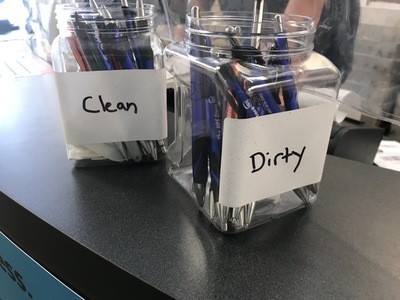
2020-03-11
How I personally remember the pandemic is mainly through the olfactory sense. The smell of bleach and Lysol filled just about every public area during the time of the pandemic, and many things spent more time than needed being disinfected with bleach water. The smell of Lysol makes me feel a bit in despair since it is so heavily linked to a very lonely and sad time in the world. The smell of bleach makes me feel a bit ill now, even three years later. I had only ever used bleach for cleaning while at work, disinfecting changing tables and toys, but now I remember it as a time of sadness and sickness. The idea of "clean" will likely never be what it was years ago, and the population will probably never be able to live well knowing the existence of germs.
-
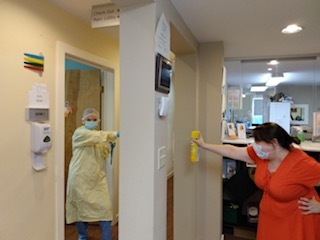
2020-06-21
The photo was taken at the beginning of the pandemic, probably a Friday in the summer because I was not wearing scrubs (casual Fridays). I was working in a pediatric office as a medical assistant in Litchfield County, Connecticut. If you know anything about that area, it was scary at the time because all of the families with any means in NYC were fleeing the city and coming to Litchfield and Fairfield Counties. We were quite nervous at the time that they would spread covid to our communities at the same rate as it was in NYC. Luckily it did not happen. It was a scary time, as every day we would get the ding in the morning and the end of the day of an email notification telling us how many deaths were in local hospitals, how many beds were left (spoiler- none), how much PPE was available (again, none) etc. We were so short on PPE we had to reuse our masks for a whole week (unless exposed of course). I can still remember the feeling of the little fabric “firs” that would start to itch my face after a few days, and the nice smelling essential oils we put in them to make wearing them tolerable- I used citrus smells, and my coworker used coconut. The worst was the lack of cleaning and disinfecting products. We tried to not see patients that were even remotely sick with covid symptoms because we did not have enough cleaner to disinfect the rooms after they left. When we were fortunate enough to get a new bottle of Lysol, we would take fun photos like this one of me threatening my coworker whom I suspected was covered in germs. Little moments like this helped to alleviate the stress of the moments when that email ding came in at the end of the day.
-
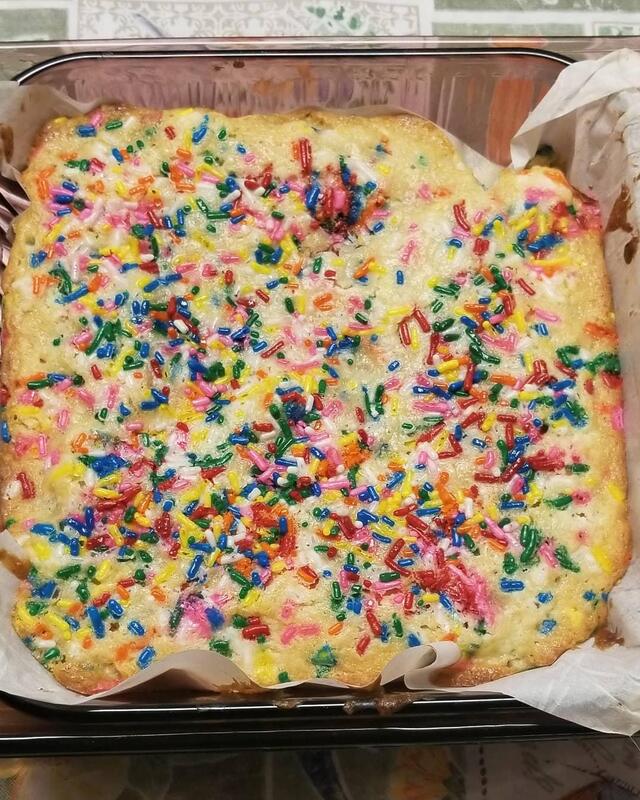
2020-03-29
I have a love for baking and cooking which takes up lots of my time when I'm not doing schoolwork. I love trying new and exciting recipes because food from different parts of the world is like a new historical experience. I was a sophomore in college when the pandemic caused us to go into lockdown. We had just come back from spring break, and I remember getting an email saying that we would be moved to online instruction for the remainder of the semester. I was scared because it really hit me that school would not be the same ever again. Luckily, I did not get COVID, but my dad almost died from it. Everyone in my house was separated which meant I had no social life due to not being able to talk to anyone. I turned to baking as a way for me to not think about my sick dad. I basically lived upstairs from my parents. Whatever I made, I would leave for them on the steps to take. Even though my food was delicious, I lost a sense of taste because I wasn't enjoying it with anyone. Food is about culture and people; they go hand in hand. When you don't have that sense it changes how you feel on a social level. When you cook, you want people to enjoy what you're making.
-
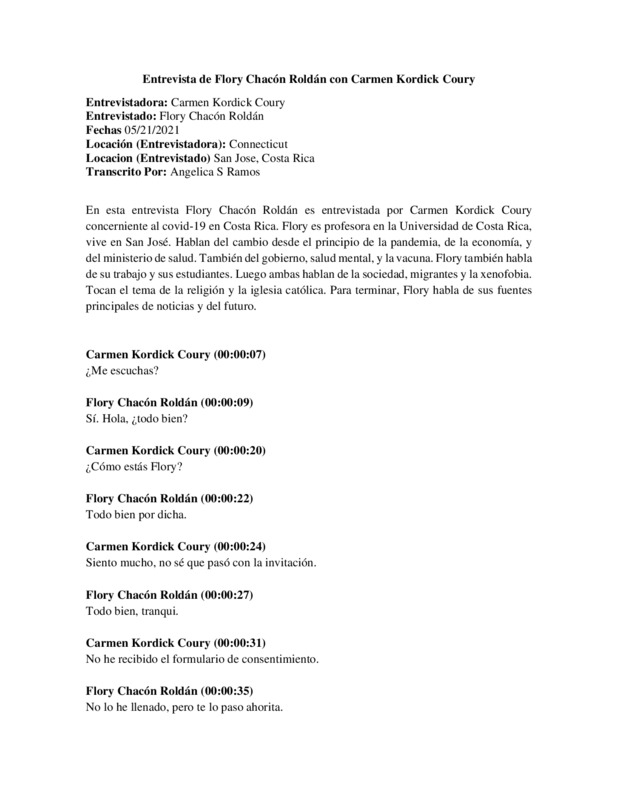
05/21/2021
En esta entrevista Flory Chacón Roldán es entrevistada por Carmen Kordick Coury concerniente al covid-19 en Costa Rica. Flory es profesora en la Universidad de Costa Rica, vive en San José. Hablan del cambio desde el principio de la pandemia, de la economía, y del ministerio de salud. También del gobierno, salud mental, y la vacuna. Flory también habla de su trabajo y sus estudiantes. Luego ambas hablan de la sociedad, migrantes y la xenofobia. Tocan el tema de la religión y la iglesia católica. Para terminar, Flory habla de sus fuentes principales de noticias y del futuro.
-
06/11/2021
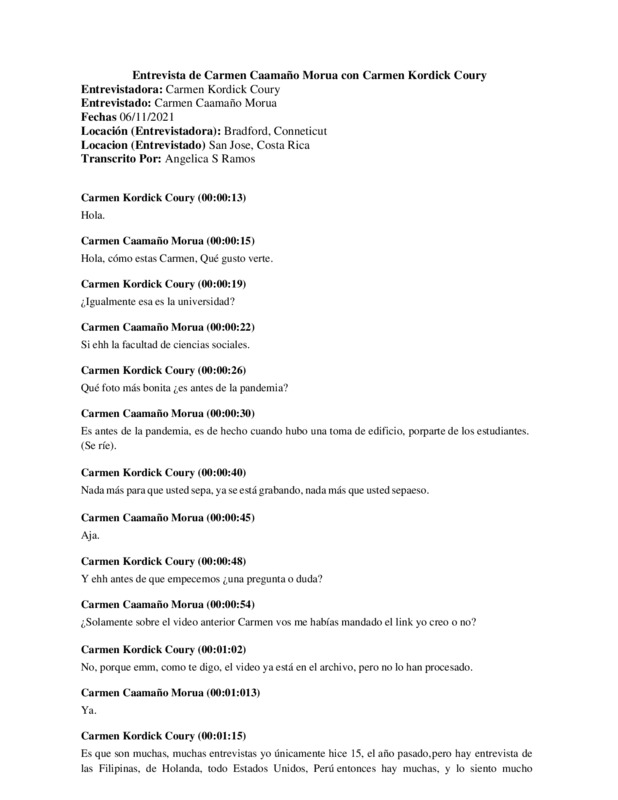
En esta entrevista Carmen Caamaño Morua es entrevistado por Carmen Kordick Coury concerniente al covid-19 en Costa Rica. Carmen es profesora en la Universidad de Costa Rica y vive en San José. Habla de su trabajo virtual en la universidad, del crisis de la salud mental y de la gente que cree en las teorías de la conspiración. Carmen habla de la relación entra las ciencias y la religión y como eso afecta los sentimientos hacia la vacuna. Habla de la xenofobia, el racismo y el clasismo. También habla de las vacunas y la respuesta del gobierno. Para terminar, Carmen habla del gobierno, la economía y las noticias.
-
05/19/2021
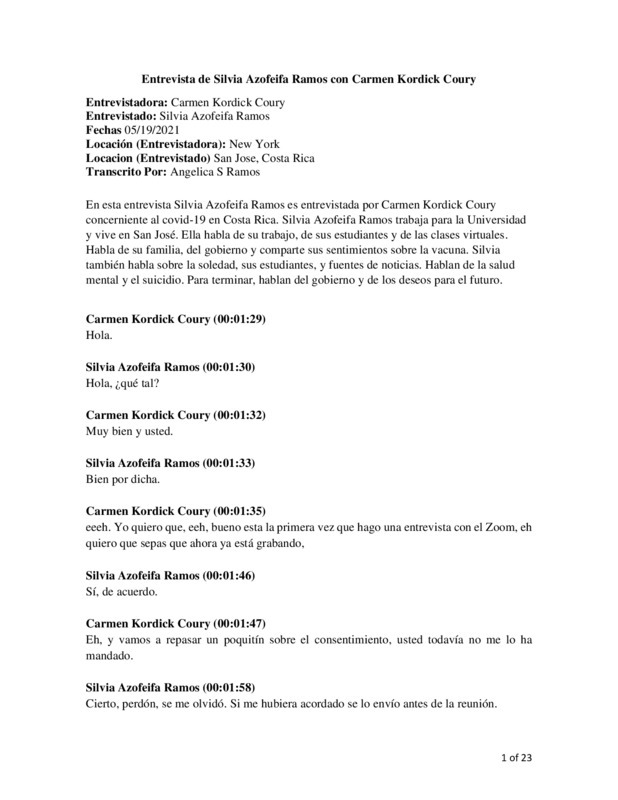
En esta entrevista Silvia Azofeifa Ramos es entrevistada por Carmen Kordick Coury concerniente al covid-19 en Costa Rica. Silvia Azofeifa Ramos trabaja para la Universidad y vive en San José. Ella habla de su trabajo, de sus estudiantes y de las clases virtuales. Habla de su familia, del gobierno y comparte sus sentimientos sobre la vacuna. Silvia también habla sobre la soledad, sus estudiantes, y fuentes de noticias. Hablan de la salud mental y el suicidio. Para terminar, hablan del gobierno y de los deseos para el futuro.
-
2022-08-02
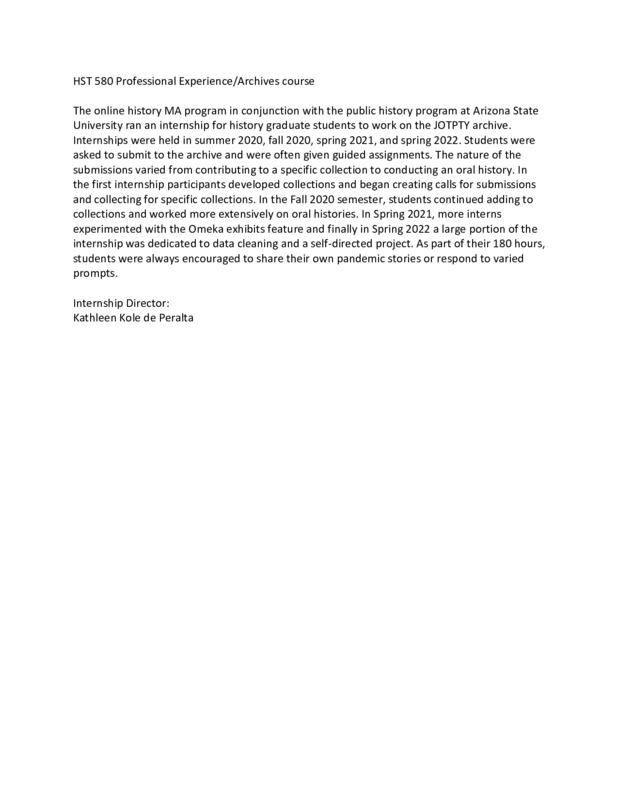
The online history MA program in conjunction with the public history program at Arizona State University ran an internship for history graduate students to work on the JOTPTY archive. Internships were held in summer 2020, fall 2020, spring 2021, and spring 2022. Students were asked to submit to the archive and were often given guided assignments. The nature of the submissions varied from contributing to a specific collection to conducting an oral history. In the first internship participants developed collections and began creating calls for submissions and collecting for specific collections. In the Fall 2020 semester, students continued adding to collections and worked more extensively on oral histories. In Spring 2021, more interns experimented with the Omeka exhibits feature and finally in Spring 2022 a large portion of the internship was dedicated to data cleaning and a self-directed project. As part of their 180 hours, students were always encouraged to share their own pandemic stories or respond to varied prompts.
Internship Director:
Kathleen Kole de Peralta
-
2022-07-12
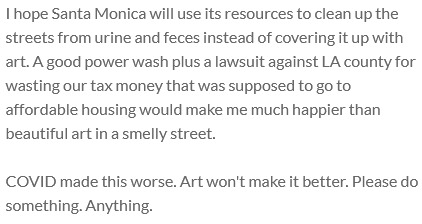
I hope Santa Monica will use its resources to clean up the streets from urine and feces instead of covering it up with art. A good power wash plus a lawsuit against LA county for wasting our tax money that was supposed to go to affordable housing would make me much happier than beautiful art in a smelly street.
COVID made this worse. Art won't make it better. Please do something. Anything.
-
2022-07-21
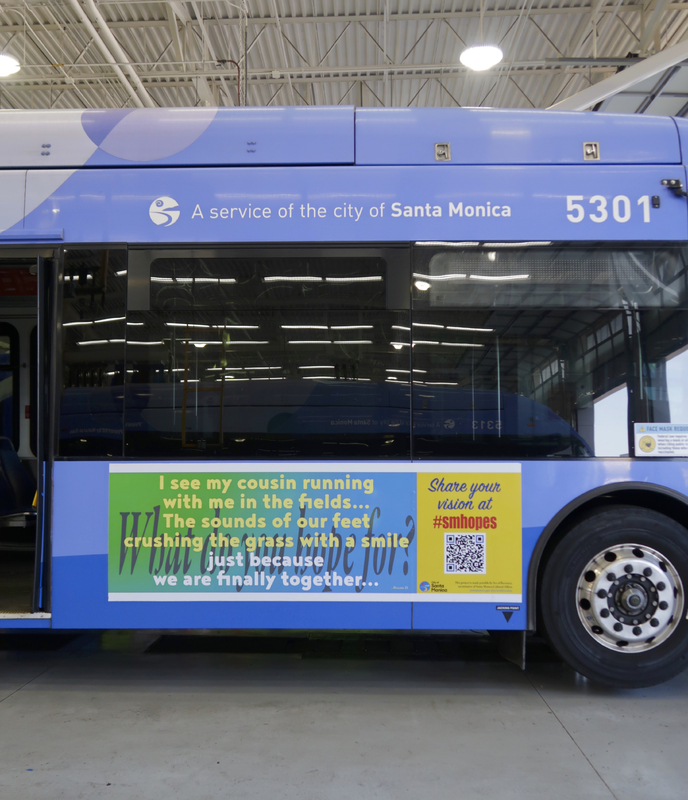
Through a grant from the City of Santa Monica Cultural Affairs Department program, Art of Recovery, artist Paula Goldman designed five banners based on uploads to the project call page on this website, SMhopes: an Archive of Hopes and Dreams. The banners will run on Santa Monica's Big Blue Bus transit system for the month of July, 2022.
-
2020-04
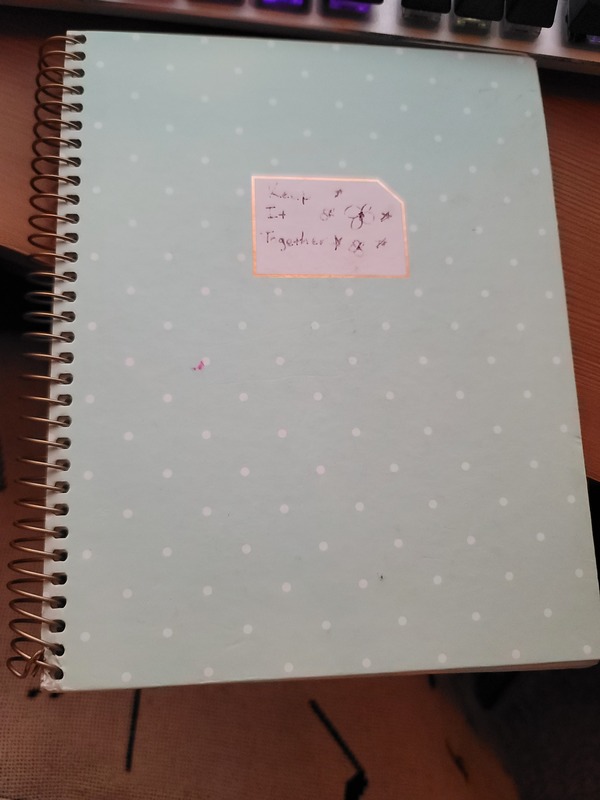
This bullet journal, titled "Keep It Together," was created fresh after moving states in January of 2020. January through February are well organized, with the planner I drew out having individual days, and places for grocery lists, to-do lists and monthly goals. Even March keeps the same energy, stretching into the beginning of the pandemic, but April comes with a great shift. What was once a detailed planner has lost any sense of time, becoming an amalgamation of grocery lists for vague weeks, stream-of-consciousness poetry, and abandoned bullet lists of brainstorming what to do with my life...only for the journal to snap back into focus at the end of July, continuing its main function as a planner, what with less frills than before. This mirrors my own experience in 2020, as April-July was the period of time I spent alone, living in a new city, working at a fast food job that did not stop when the rest of the world did. I felt very much like my journal, unmoored and adrift, until a change in job and living situation and deciding to go back to school helped bring me some sense of purpose again.
-
2020-06-11
I started college to attain my Bachelors degree in 2014, despite setbacks and working a number of part time jobs along the way I successfully graduated in 2020. Unfortunately 3 months into my final semester the world was put on pause In a way. Everyone across the world was asked to quarantine, to limit physical contact, and not gather in large crowds. Years of yearning for the recognition of graduating in front of my friends and family as I walked across the stage to get my diploma became a mere dream in my head. My graduation took place digitally and while I am grateful for the recognition and fully aware of the circumstance the world was under, it is still something I wish I had experienced in my life. The pandemic put many events on hold but I surely wish the events that transpired weren't so poorly timed and that I experienced the recognition of graduating in pre pandemic era.
-
2020
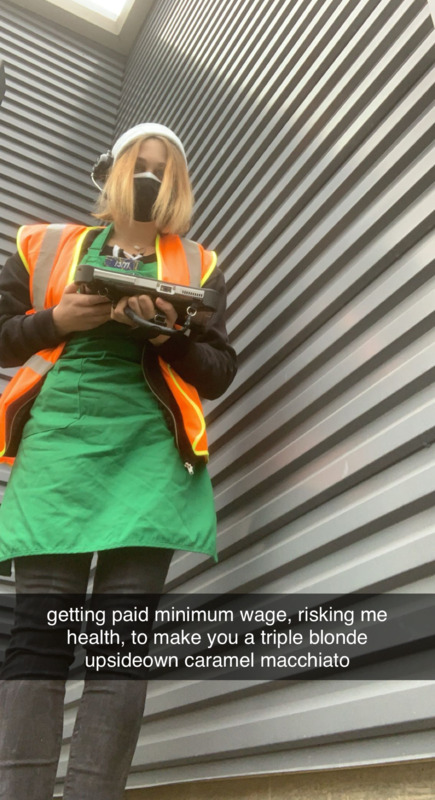
I worked at Starbucks Coffee Company from 2019-2021. The company begging their workers to continuously go to work under awful conditions, with little regard for their safety, took a huge mental toll, not only on me, but every barista. We were told providing coffee to our community was an "Essential" job, when in all reality is was essential for us to work to ensure that company's made a profit. We had to work to pay rent and buy food because the united states government offered little support, but were not justly compensated for our work. These pictures of myself remind me how tired I was working from 3 am to 2 pm, in the middle of a pandemic, in order to be able to afford living.
-
2022-07-24
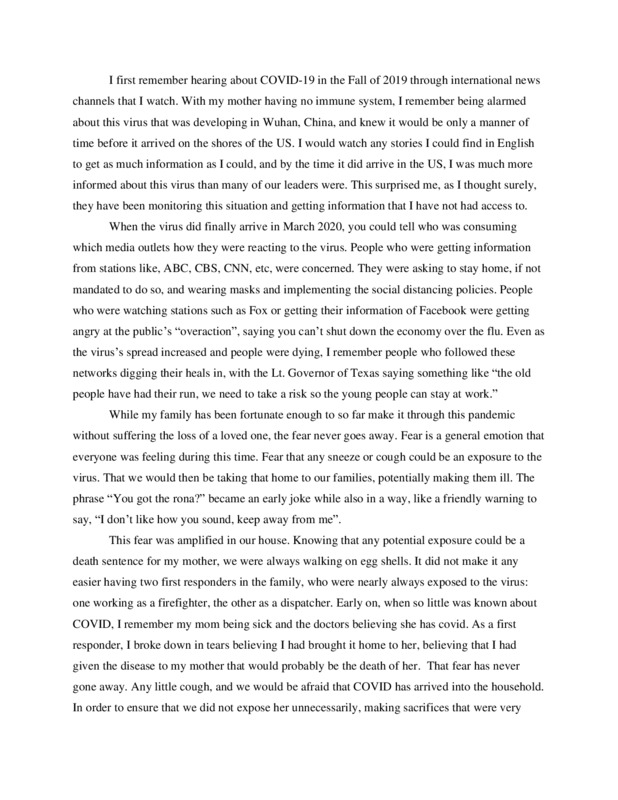
I've written a short story centered around my experience with fear of this virus, particularly focusing on how my fear is heighten with an immuno-compromised mother. I wrote about how the media the people around me consumed affected their behavior and played a role within my fear and the impact it had on my mother.
This story says two things about this pandemic I think: it shows the impact that information had/has on how people approach the virus and the emotional toll the pandemic had on people living their daily lives.
What I've submitted is important because it validates what Americans have experienced. Many Americans
-
2020
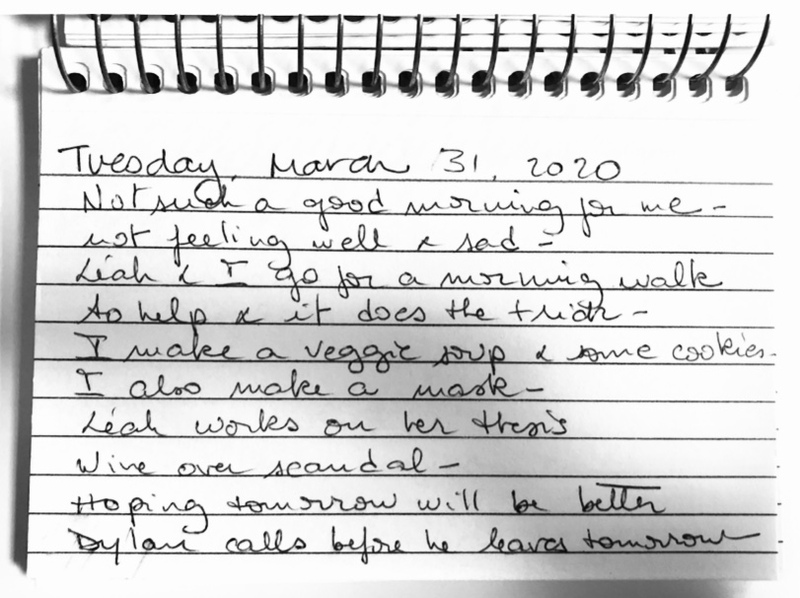
The three index card entries represent our emotions and actions at the start of the pandemic. I came back home from school to live with my mom so we relied on one another for emotional support. The shared journal helped us record our daily activities, take note of our current state of minds, and allowed us to 'take it one day at a time.' The act of writing down our movements (or lack thereof) and accomplishments (ranging from submitting my thesis to making sweet potato fries) helped us recognize that time was passing and that good days were approaching. We continued to write in our shared spiral journal for about 6 months. The entries are important to me because they reflect how my mom and I were feeling at a very uncertain and unique time in history. While I don't feel comfortable reading through them all just yet, I'm excited for the day when enough time has passed and I can reflect on the months in isolation in an objective manner.
-
2020-03
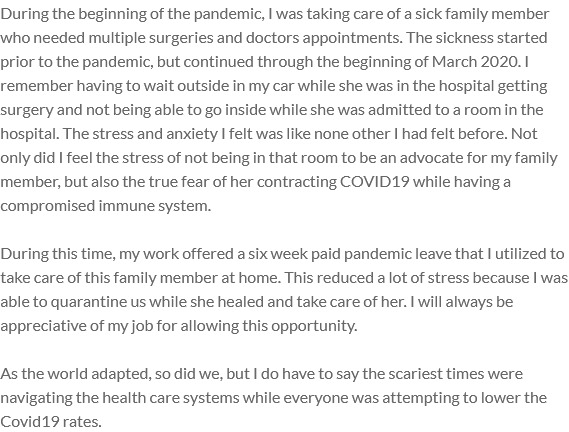
During the beginning of the pandemic, I was taking care of a sick family member who needed multiple surgeries and doctors appointments. The sickness started prior to the pandemic, but continued through the beginning of March 2020. I remember having to wait outside in my car while she was in the hospital getting surgery and not being able to go inside while she was admitted to a room in the hospital. The stress and anxiety I felt was like none other I had felt before. Not only did I feel the stress of not being in that room to be an advocate for my family member, but also the true fear of her contracting COVID19 while having a compromised immune system.
During this time, my work offered a six week paid pandemic leave that I utilized to take care of this family member at home. This reduced a lot of stress because I was able to quarantine us while she healed and take care of her. I will always be appreciative of my job for allowing this opportunity.
As the world adapted, so did we, but I do have to say the scariest times were navigating the health care systems while everyone was attempting to lower the Covid19 rates.
-
2021-12-20
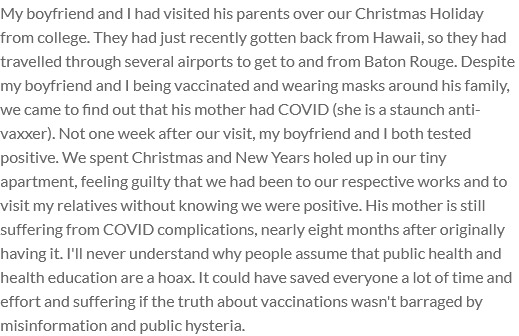
My boyfriend and I had visited his parents over our Christmas Holiday from college. They had just recently gotten back from Hawaii, so they had travelled through several airports to get to and from Baton Rouge. Despite my boyfriend and I being vaccinated and wearing masks around his family, we came to find out that his mother had COVID (she is a staunch anti-vaxxer). Not one week after our visit, my boyfriend and I both tested positive. We spent Christmas and New Years holed up in our tiny apartment, feeling guilty that we had been to our respective works and to visit my relatives without knowing we were positive. His mother is still suffering from COVID complications, nearly eight months after originally having it. I'll never understand why people assume that public health and health education are a hoax. It could have saved everyone a lot of time and effort and suffering if the truth about vaccinations wasn't barraged by misinformation and public hysteria.
-
2022-07-20
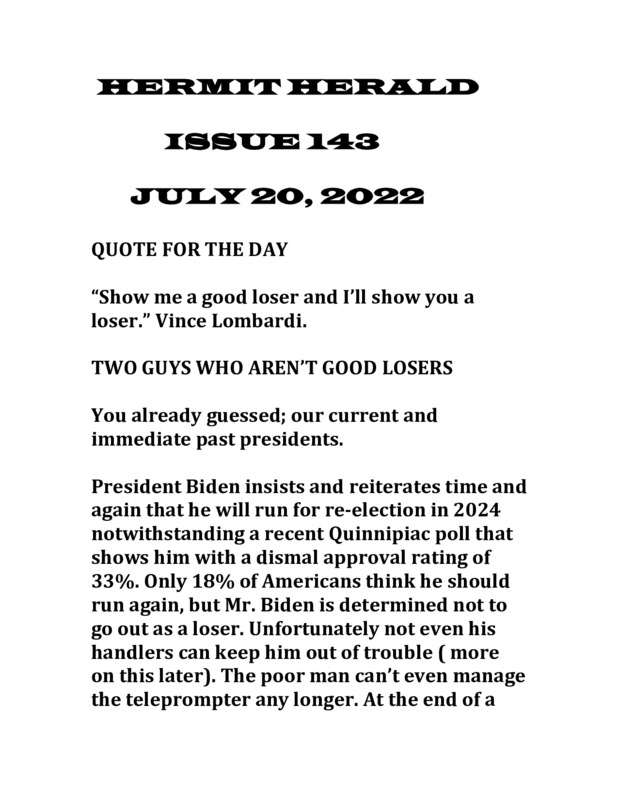
Biden/Trump 2024?
-
2022-07-20
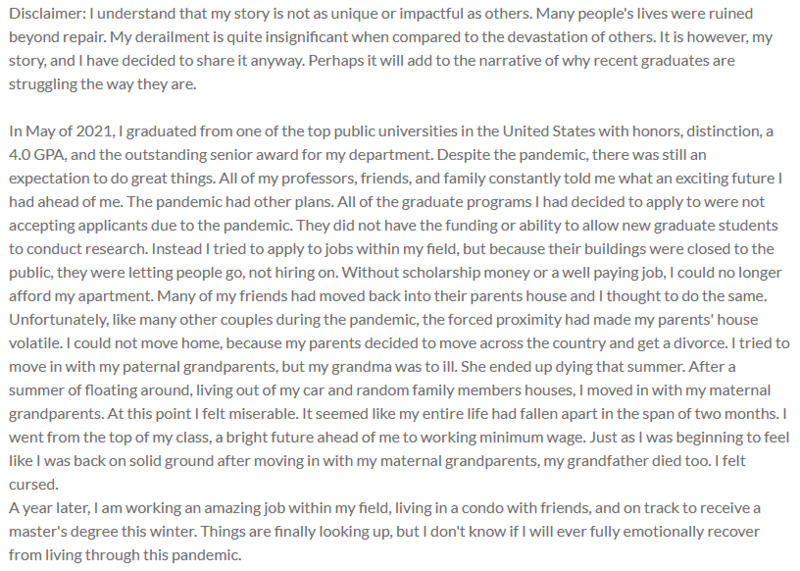
Disclaimer: I understand that my story is not as unique or impactful as others. Many people's lives were ruined beyond repair. My derailment is quite insignificant when compared to the devastation of others. It is however, my story, and I have decided to share it anyway. Perhaps it will add to the narrative of why recent graduates are struggling the way they are.
In May of 2021, I graduated from one of the top public universities in the United States with honors, distinction, a 4.0 GPA, and the outstanding senior award for my department. Despite the pandemic, there was still an expectation to do great things. All of my professors, friends, and family constantly told me what an exciting future I had ahead of me. The pandemic had other plans. All of the graduate programs I had decided to apply to were not accepting applicants due to the pandemic. They did not have the funding or ability to allow new graduate students to conduct research. Instead I tried to apply to jobs within my field, but because their buildings were closed to the public, they were letting people go, not hiring on. Without scholarship money or a well paying job, I could no longer afford my apartment. Many of my friends had moved back into their parents house and I thought to do the same. Unfortunately, like many other couples during the pandemic, the forced proximity had made my parents' house volatile. I could not move home, because my parents decided to move across the country and get a divorce. I tried to move in with my paternal grandparents, but my grandma was to ill. She ended up dying that summer. After a summer of floating around, living out of my car and random family members houses, I moved in with my maternal grandparents. At this point I felt miserable. It seemed like my entire life had fallen apart in the span of two months. I went from the top of my class, a bright future ahead of me to working minimum wage. Just as I was beginning to feel like I was back on solid ground after moving in with my maternal grandparents, my grandfather died too. I felt cursed.
A year later, I am working an amazing job within my field, living in a condo with friends, and on track to receive a master's degree this winter. Things are finally looking up, but I don't know if I will ever fully emotionally recover from living through this pandemic.
-
2022-07-15
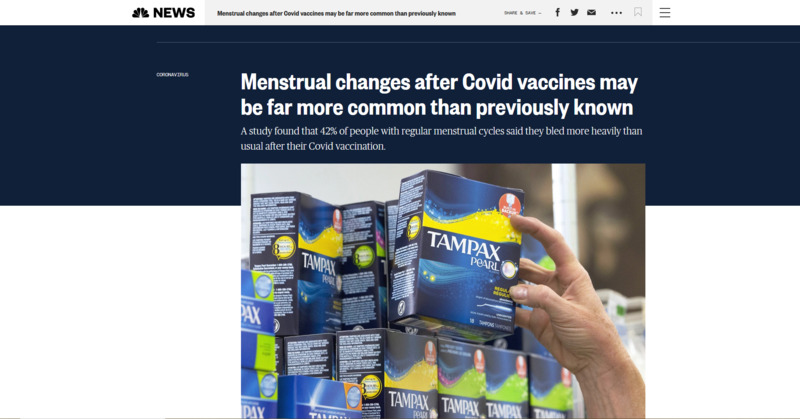
This is a news story from NBC News by Sarah Sloat. Since vaccines have been administered for the last year, new information has come out on how they effect the human body. The journal, Science Advances, found 42% of women with regular menstrual cycles bled more heavily after vaccination. 44% said no change occurred, while 14% reported lighter periods. There is no mention on if this side effect has any effect on fertility.
-
2022-07-11
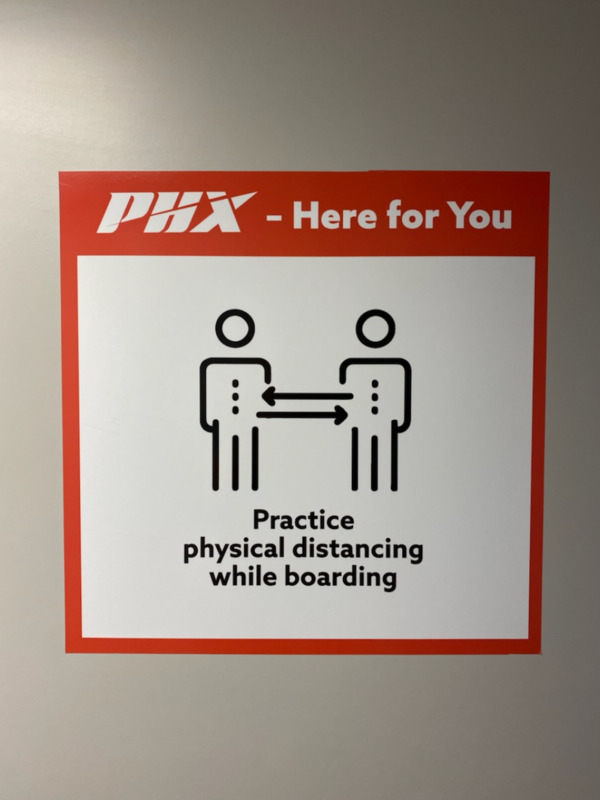
This was a sign at the Phoenix Sky Harbor International Airport. It is a sign reminding people to social distance.
-
2022-07-11
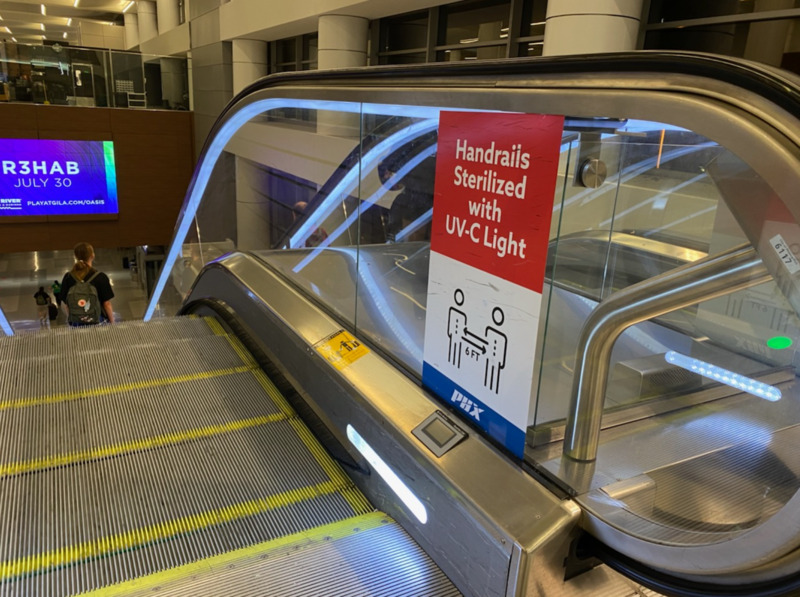
This is a picture of the UV light in action at the Phoenix International Airport. The UV light is said to help with sanitizing the handrails at the airport. Seeing as many people go through the airport every day, I can understand why things like this would want to be sanitized.
-
2022-07-11
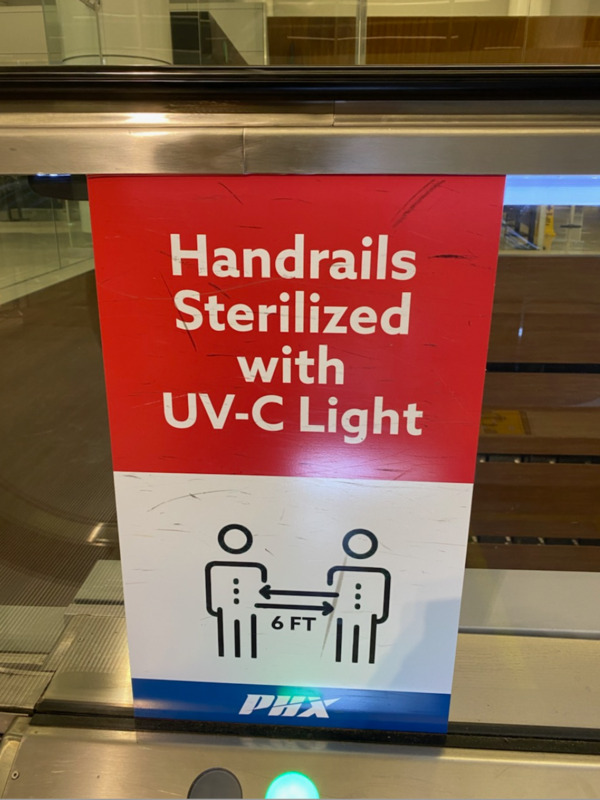
This was a picture taken by my mom while traveling out of town. Here, it is a sign telling people that the railings have been sanitized with UV light. My own prediction is that this will be one of the things that sticks since the pandemic. In my own life, I have noticed that sneeze guards are still being used in places like grocery stores. These precautions will possibly help improve public health at large, as higher sanitation levels could help lessen the spread of harmful bacteria and viruses.
-
2022-07-11
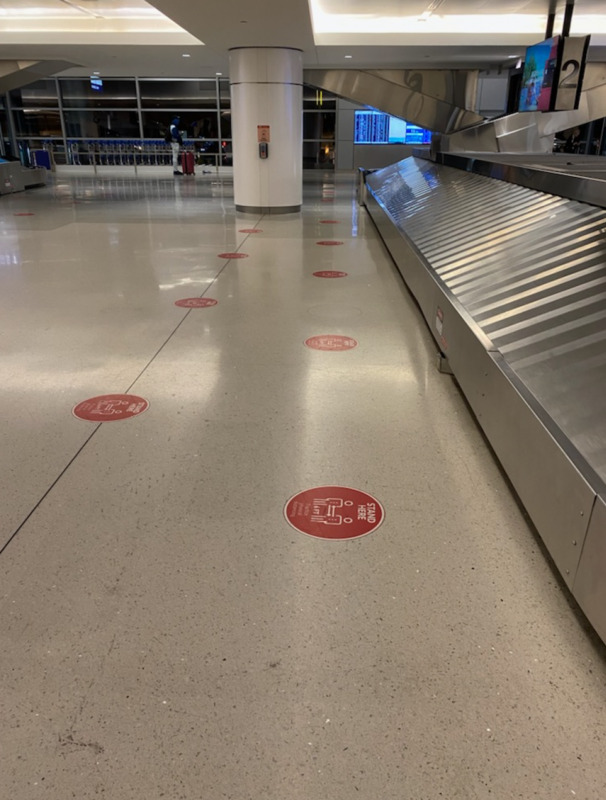
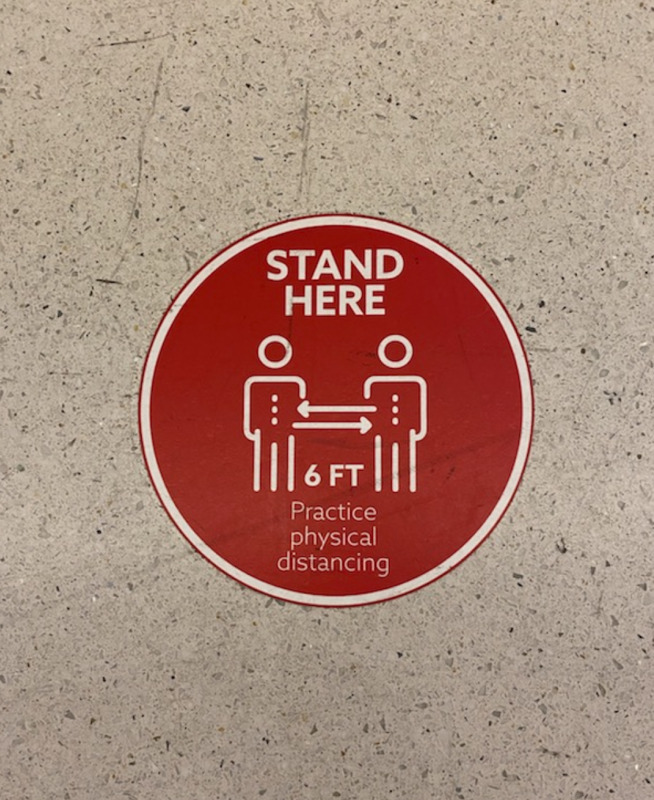
This are markings my mom saw while at the Phoenix Sky Harbor International Airport. Since the pandemic, things like this have become more commonplace in some areas, such as airports. I do not know if this was enforced or not.
-
2022-07-11
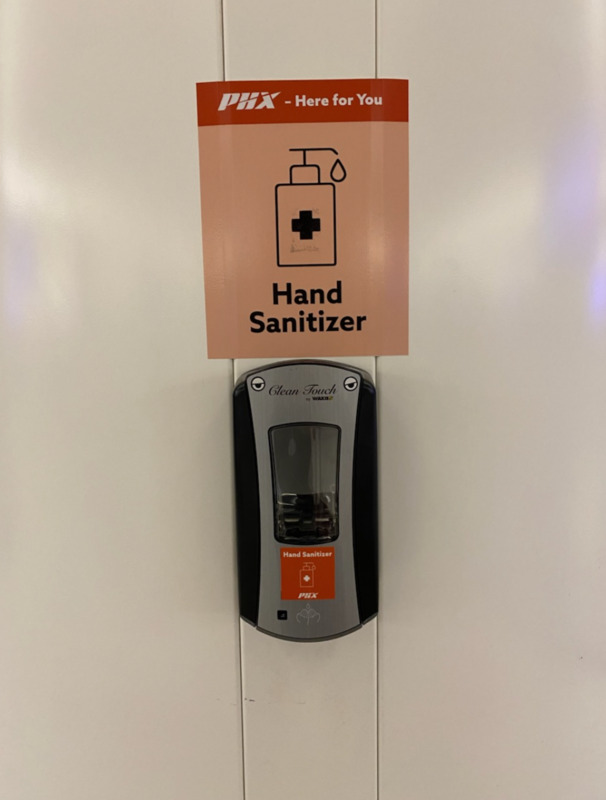
This is a picture my mom took while at the Phoenix Airport. Since the pandemic, hand sanitizer has become more available in public places.
-
2022-07-11
This is a picture my mom took while at the Phoenix Airport to visit my sister. I don't know if this was enforced since I was not present.