-
2020-05-08
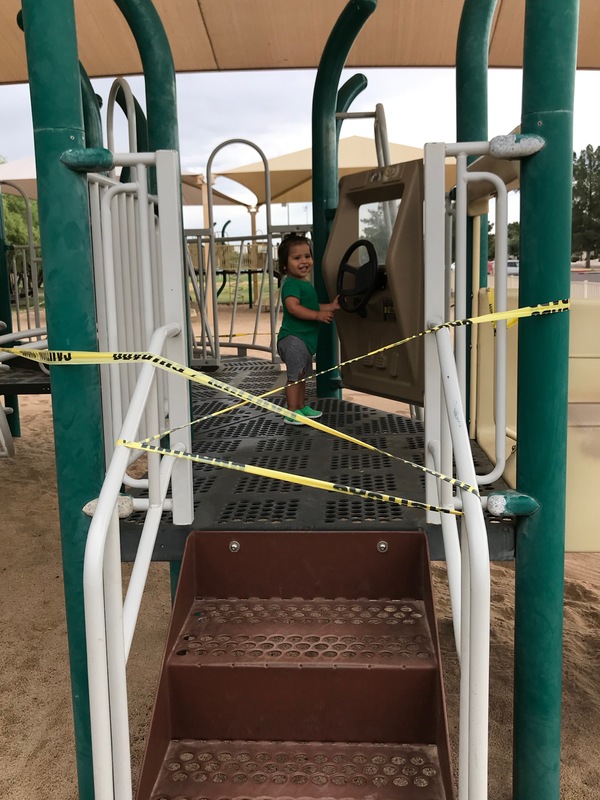
7.5 weeks into the official quarantine in AZ, and about 6 weeks after public parks closed, I let my 1yo visit a closed park in Scottsdale, AZ. (El Dorado Park in Scottsdale).
-
March-May 2020
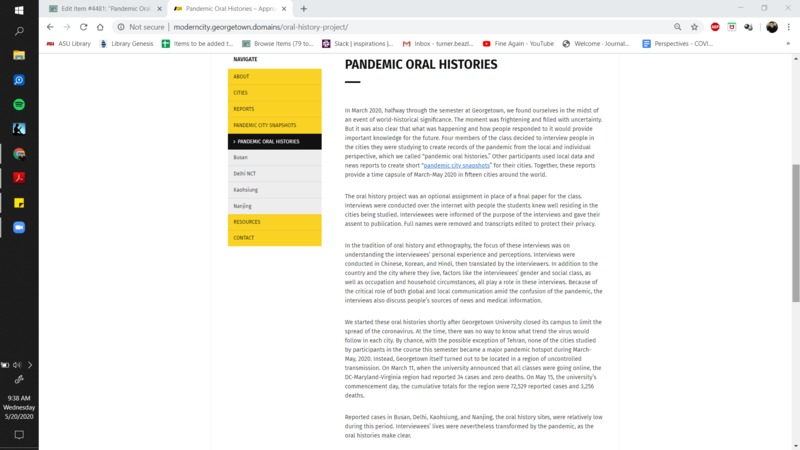
These are four extended interviews with residents in Asian cities about their experience of the pandemic.
*Students in the Georgetown University course, "Approaches to the Modern City," taught by Jordan Sand.
*Interviews with residents in four Asian cities.
-
2020-05-15
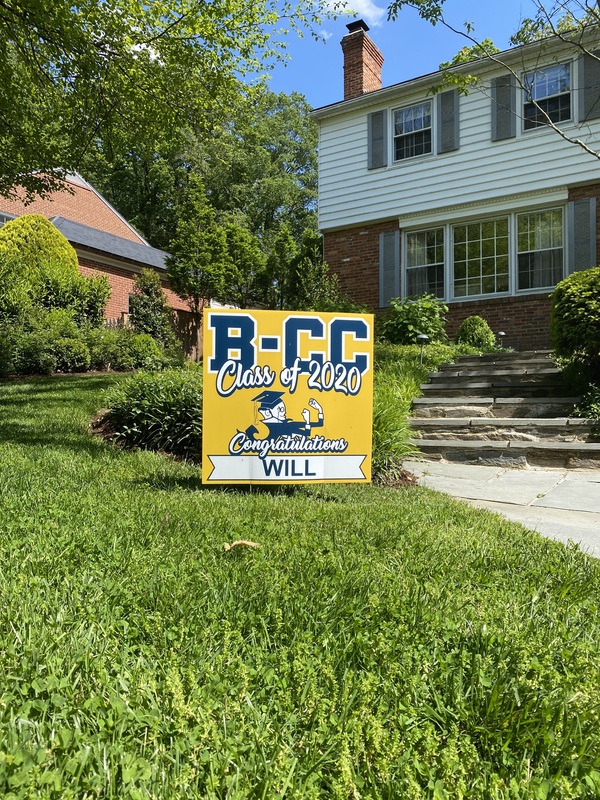
Congratulations Will! This personalized sign reminds us that we are a part of a community and should celebrate each other, even in uncertain times.
-
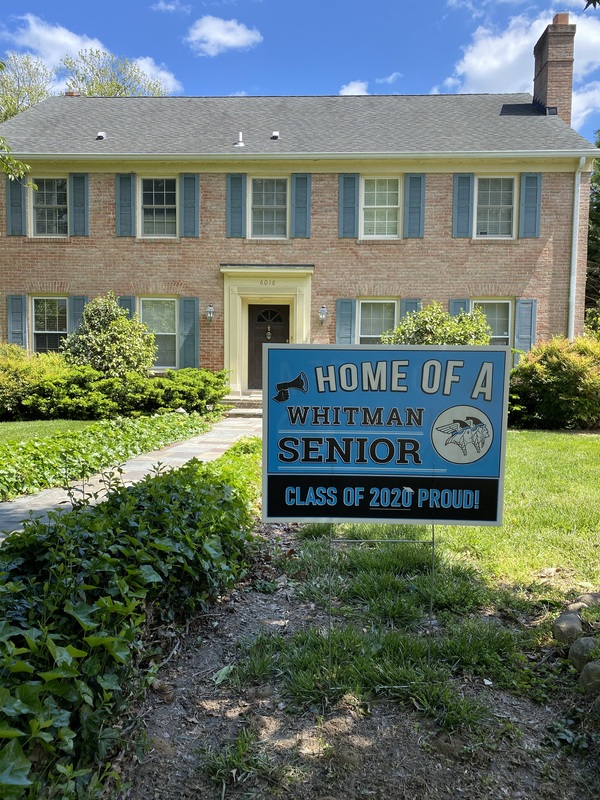
2020-05-12
The home of now a former cheerleader! I know she is happy to share her success with those who pass by!
-
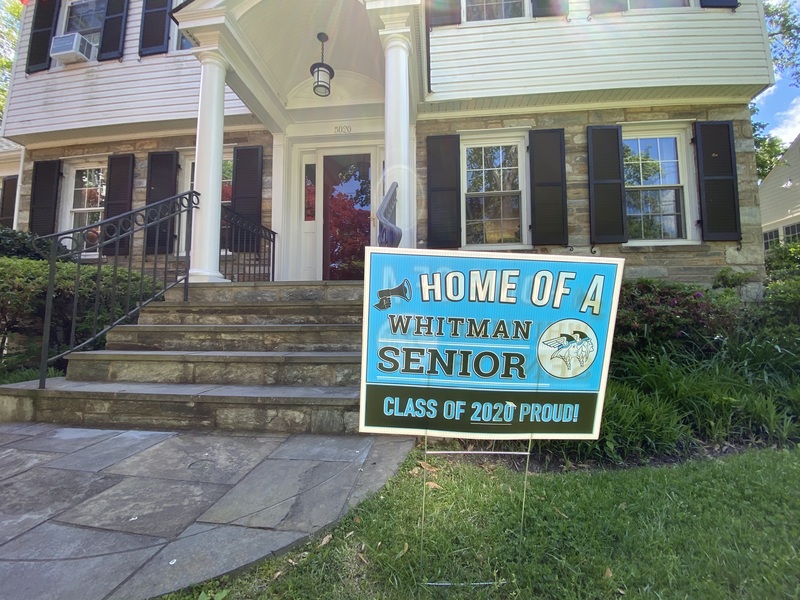
05/12/2020
Right by the front door, this sign shows how this senior's achievement is close to their heart and home.
-
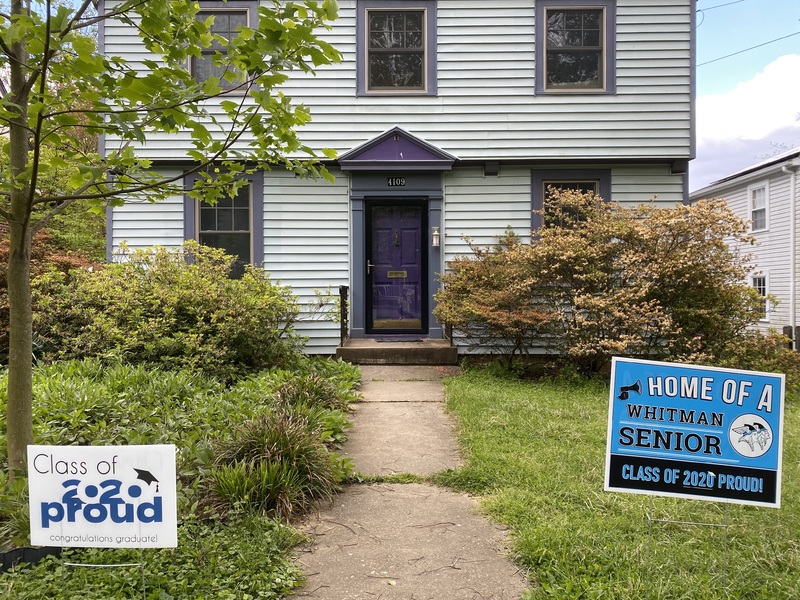
05/12/2020
Two signs stand in this yard, showing the strength and pride of this senior and their family.
-
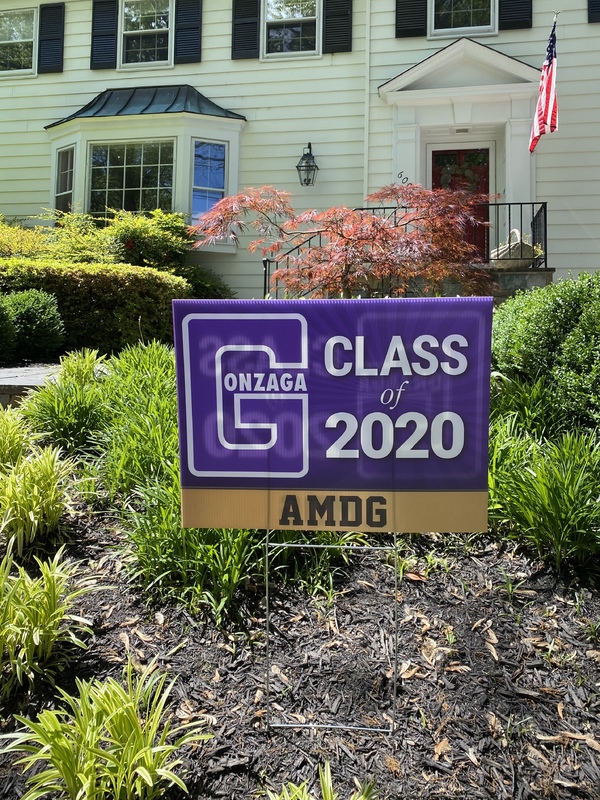
2020-05-12
A graduation sign of a private school in the District of Colombia, announcing the achievement of its seniors!
-

2020-03-19
t feels like the streets of Boston haven’t been this empty since the cows (apocryphally) laid out the paths centuries ago.
Aram Boghosian, a regular freelance photographer and videographer for the Boston Globe, shot aerial video with a drone over several Boston hotspots on Monday and Tuesday. On a normal weekday afternoon, the city bustles with workers and tourists and commuters alike.
But in the footage, the city sits nearly empty. It’s a ghost of what it was just a week ago, before Gov. Charlie Baker banned gatherings of over 25 people, established tight restrictions on stores and restaurants, and closed the schools in the wake of the coronavirus pandemic.
Newbury Street and Faneuil Hall Marketplace are nearly devoid of shoppers. The seagulls on Summer Street seem to outnumber the pedestrians. Traffic is breezy in and out of the city, and an empty Fenway Park won’t see a pitch anytime soon. Only a handful of people walk and bike across Boston Common, which hosted a rally of over 13,000 densely packed people less than three weeks ago.
It seems unimaginable now
*Drone footage of Boston during quarantine
-
2020-05-01
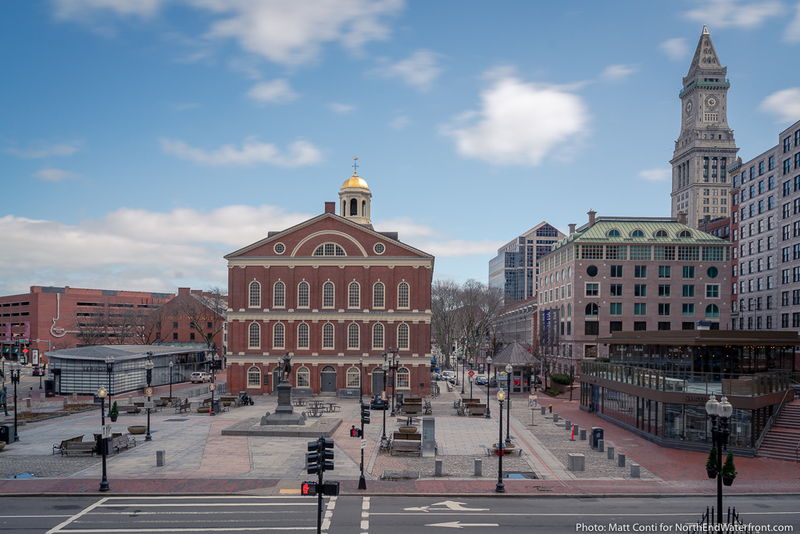
The beginning of Spring would normally have the North End and downtown Boston streets bustling with locals and visitors taking in the season after a long Winter. As the business shutdowns and stay-at-home advisories associated with the COVID-19 outbreak have gone into effect, the streets are very quiet with very few moving vehicles, and only a smattering of social distancing locals walking around. All the tourist and community sites are nearly abandoned as shown in this daytime photo.
-
2020-03-24
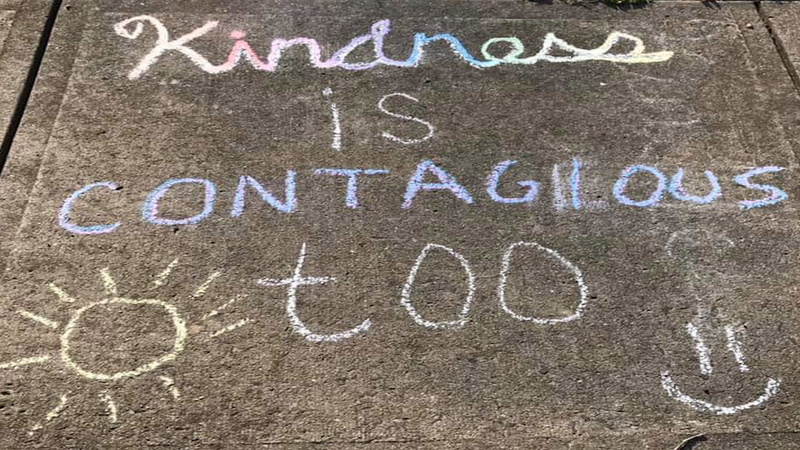
Kids around the country are using chalk to spread positive messages on the sidewalk. This image taken in the Jamaica Plain Neighborhood of Boston is just one example. The link below is to a video that shows more images like this from around the city. https://www.nbcboston.com/news/coronavirus/kids-spread-cheer-on-sidewalks-during-coronavirus-pandemic/2096368/
-
04/22/2020
This short video, created using the app One Second Everday (1SE), is a collection of photographs each day taken during the initial weeks of the stay at home order in Boston. The images demonstrate the ways that life shifted during this time. For example, many people spent more time than ever inside, took up baking bread or cooking more elaborate meals, and began to wear homemade masks anytime they would leave the house.
*A short video, created using the app One Second Everday (1SE), is a collection of photographs
-
04/15/2020
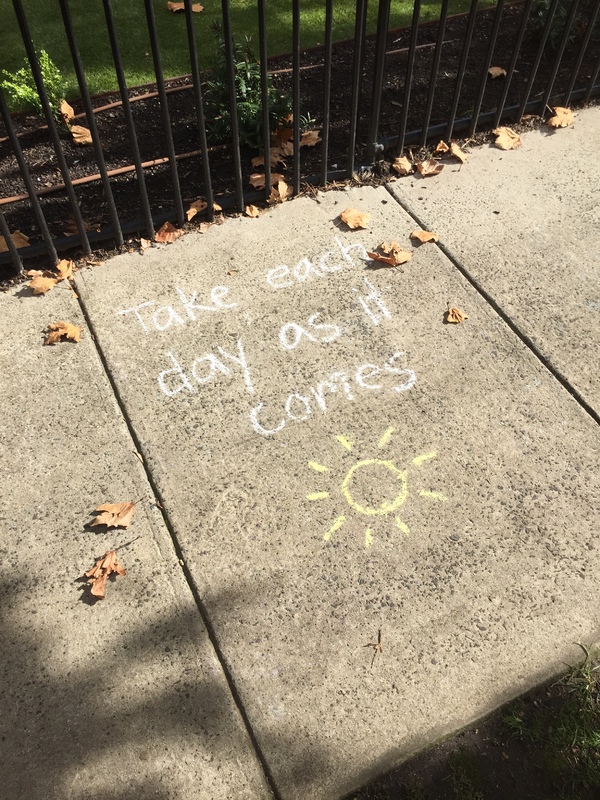
Messages of kindness from unknown neighbours; take each day as it comes.
-
04/15/2020
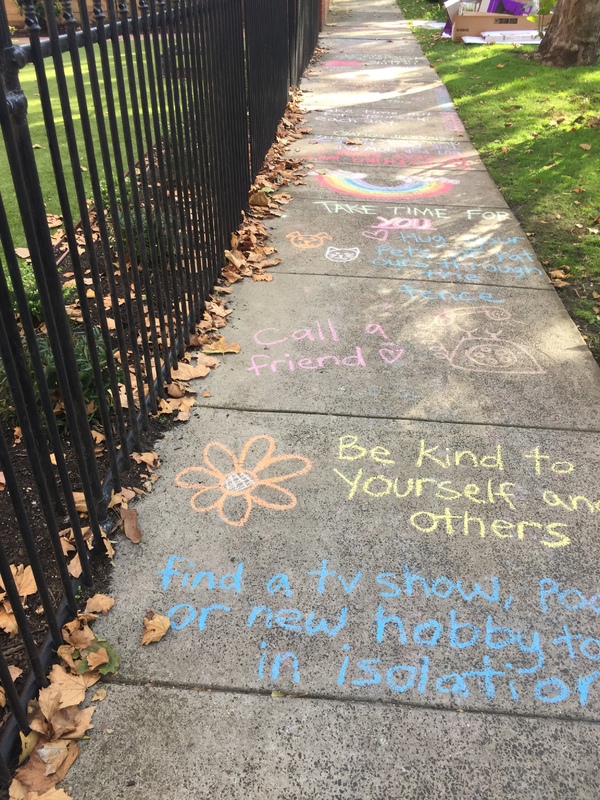
Messages of kindness between strangers.
-
2020-04-14
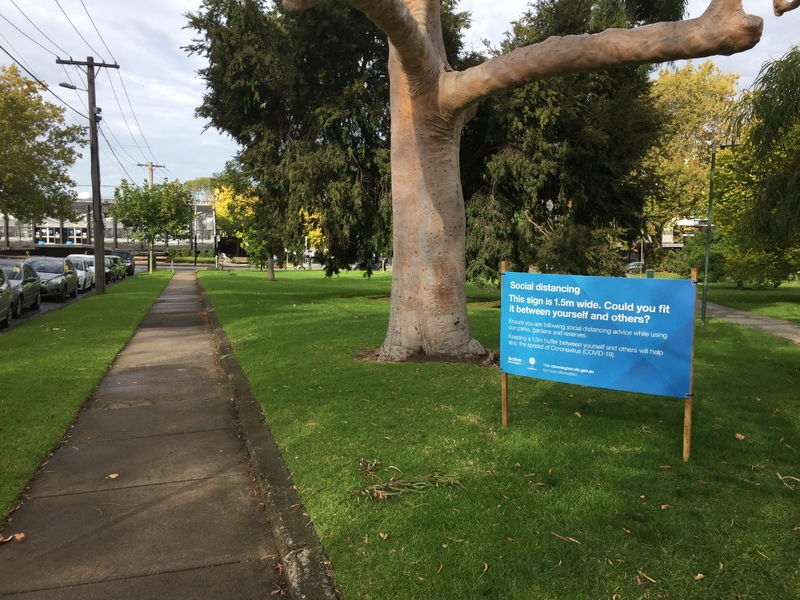
Example of a social distancing sign placed in all parks in the City of Stonnington.
*Signage by Stonnington Council
*Photograph by Alyssa Coombs
-
05/18/2020
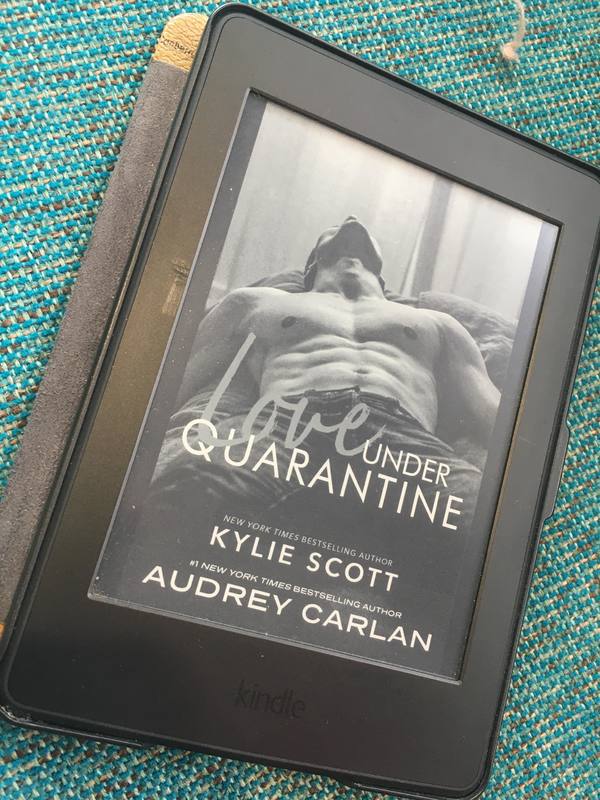
This is one of many examples of quarantine or lockdown themed romance and erotica currently for sale on Amazon Australia, reflecting trends in comfort reading, the response of entertainers and creators to the crisis, and the way COVID-19 has become inescapable in popular culture.
*HUM402
*Photo of a kindle screen, showing the bookcover
-
04/2020
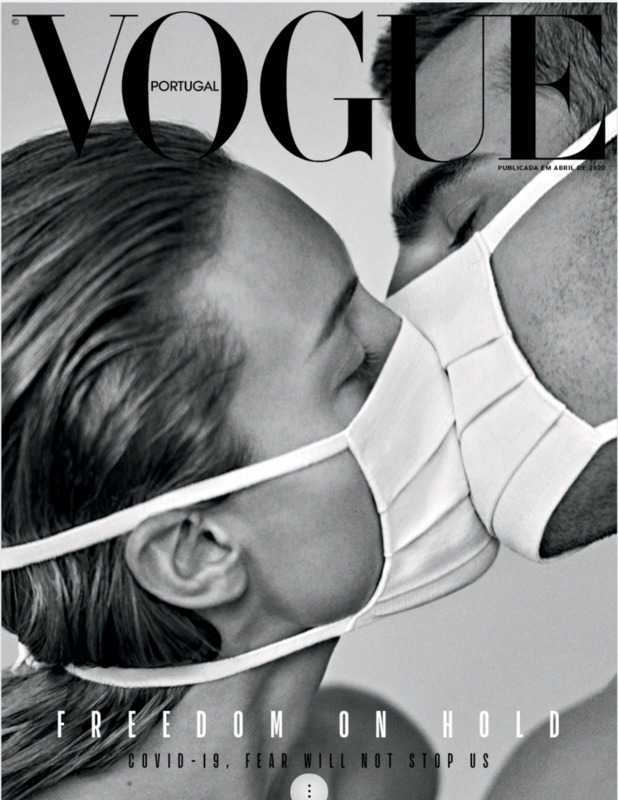
The cover for Vogue Portugal's April 2020 issue. Apparently, freedom is not on hold for Vogue magazine, as they are free enough to produce an entire issue and somehow shoot two people kissing through masks for their cover while trying to prevent a pandemic.
*Fordham University
*SOCI2800
-
2020-05-18
One of the most interesting things to watch during this pandemic for me is the rise of designer face masks. Ever since the CDC advised personal protective gear (PPE) to prevent the spread of the coronavirus, people have begun making DIY face masks or purchasing them from retailers ranging from small to large. There have been luxury face masks around before the COVID-19 pandemic—the most notable example in my mind is the all-Gucci outfit singer Billie Eilish wore to the 2020 Grammys that included a mask covered in the Gucci logo, which I think was simply for fashion despite the Grammys occurring in late January, around when people in the United States began to be on alert for the novel coronavirus. I had seen some designer face masks worn in photos compilations of “Instagram rich kids,” who are usually children of business moguls, celebrities, or royals, but had never seen them reach enough popularity to be worn by people in my social stratosphere (white & upper-middle class/upper-class) until now.
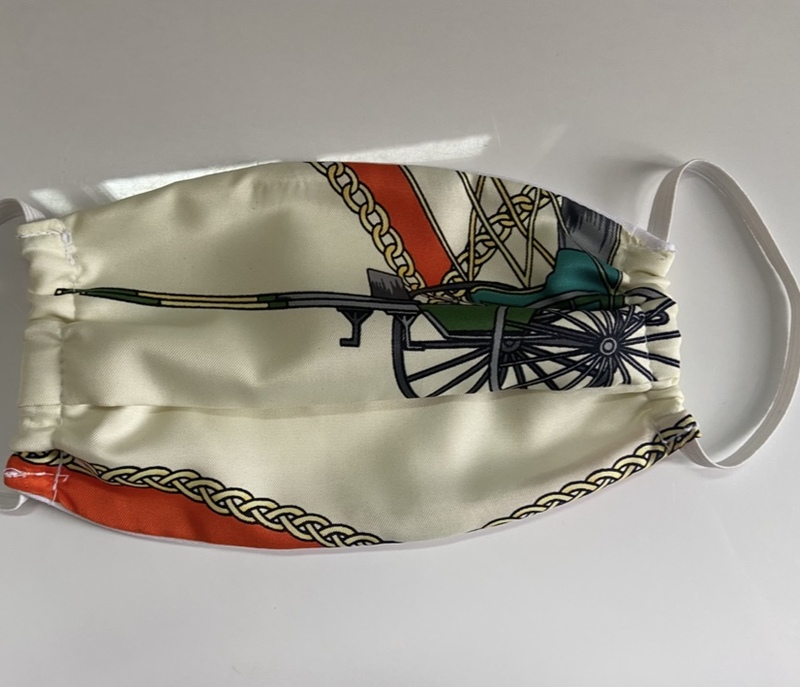
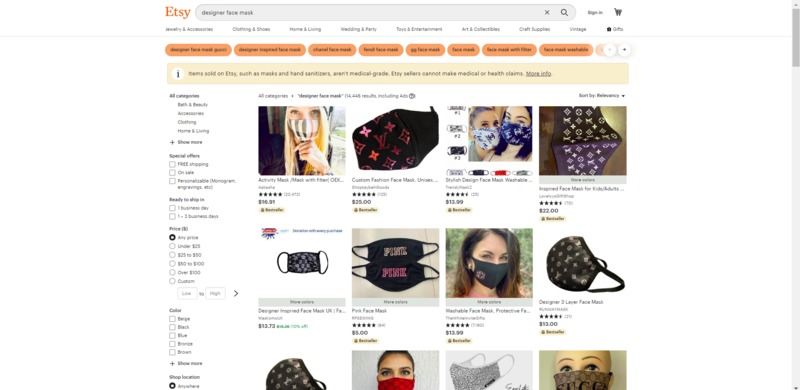
What has been most fascinating to me are designer face masks produced by individuals, not by these large fashion labels. During this pandemic, most major luxury brands are not selling face masks. Instead, most “designer” face masks being sold are made by individuals profiting off the prestige or popularity of a brand. For example, on Etsy, where searching “designer face mask” yields 14,000 items for sale, people are selling “designer-inspired” or “stylish design” face masks covered in logos by companies such as Louis Vuitton, Gucci, or Chanel. Another example is face masks created using actual designer fabric, which seem to be much less common than the designer rip-offs. One of my neighbors who owns and runs a high-end boutique created a small batch of face masks using vintage designer fabric from similar brands like Hermes and Louis Vuitton. When my mother and I ran into her on a walk, as she showed us the masks, she half-joked to us that we needed a “going-out” mask, a simple mask for going providing protection that you don’t mind getting messed up, and a “social” mask, a “fancy” mask like hers meant to be seen by others. I have not seen any “social” masks or designer masks myself being used out in the world (granted, I try not to leave the house as much as possible), but the popularity of designer masks can be clearly seen online.
The fact that most of these “designer” masks are projects made by small creators is incredibly fascinating to me. The social capital that comes with owning something with designer logos is so strong that it is persisting during a time that people are going out of their way to create designer-rip offs for products that are not even on sale right now. I initially thought that because the pandemic we are living through is such a “time of exception” that people would be so concerned with just surviving that any social capital that comes with owning luxury clothing would be eschewed, but instead people are finding new ways to flex their wealth. Because most of these designer-logo masks sold by individuals are affordable for almost everyone, it will be interesting to see as time goes on how the amount of social capital that comes with owning one of these masks changes.
-
05/14/2020
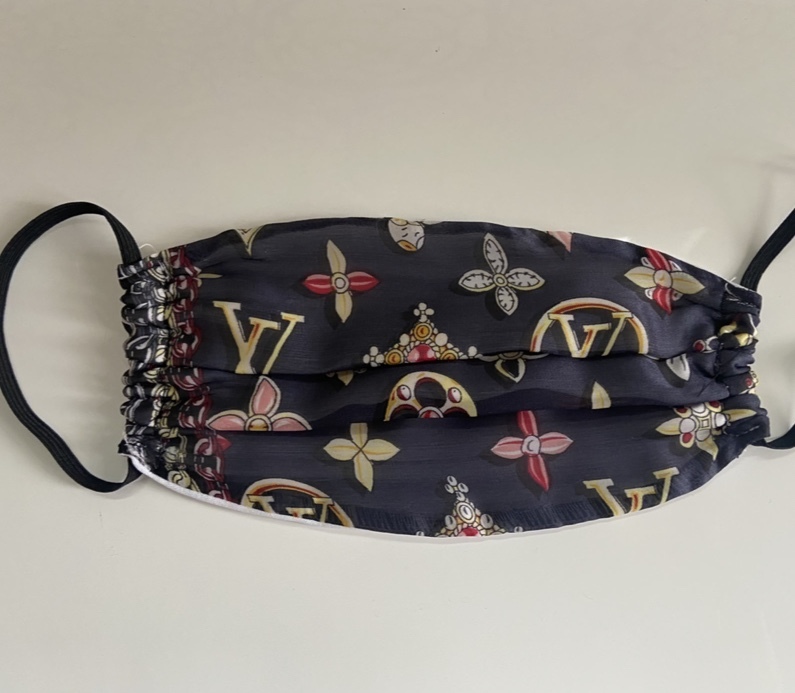
A mask made by a small boutique in St. Louis using vintage Louis Vuitton fabric. My mother liked the mask, but thought the logo-covered fabric was "too extra."
Reilly Dunne, Fordham University, SOCI2800
-
05/14/2020
A mask made by a small boutique in St. Louis using vintage Hermes fabric. Like Hermes's Birkin bag, I do not know if I would ever feel comfortable using this for its intended function.
Reilly Dunne, Fordham University, SOCI2800
-
04/02/2020
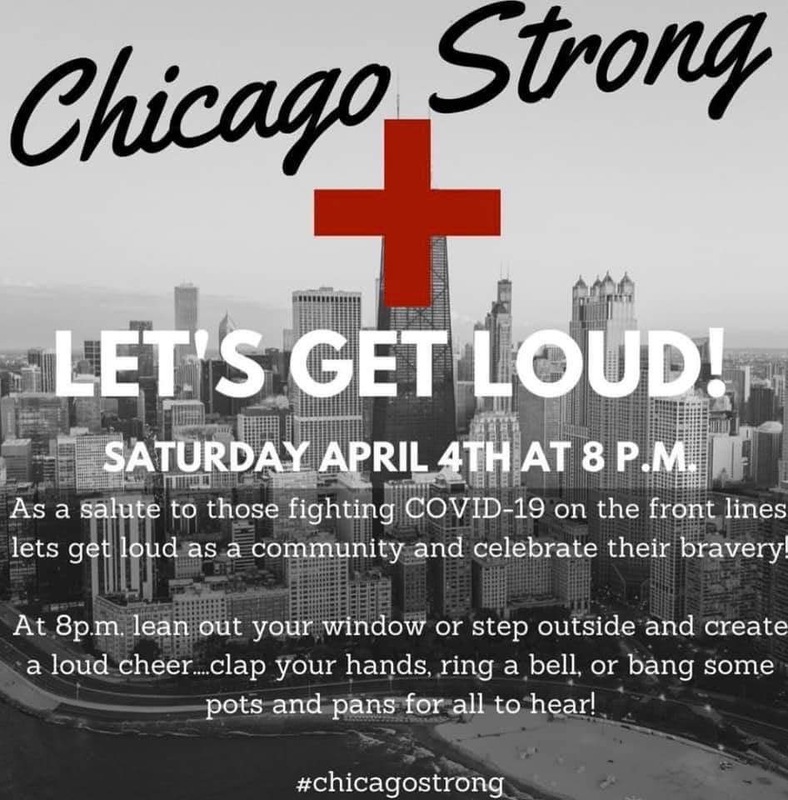
This is an image that that tells us in our stay at home order to show support for our healthcare workers celebrate there bravery by leaning out of our window or stepping outside and creating some noise at the same time 4/8/2020 at 8pm to show support.
Photo poster of what to do to show support in Chicago for our Healthcare workers
-
05/14/2020
A screenshot of the top results out of 14,000 listings for the search "designer face masks" on Etsy. Most of these feature knock-off designer logos on masks made by individuals or small companies.
Reilly Dunne, Fordham University, SOCI2800
-

2020-04-26
I am explaining the different things that I was doing during COVID-19 for a week.
Jorge Monfil, Dougherty Family College, HIST 115
-
05/01/2020
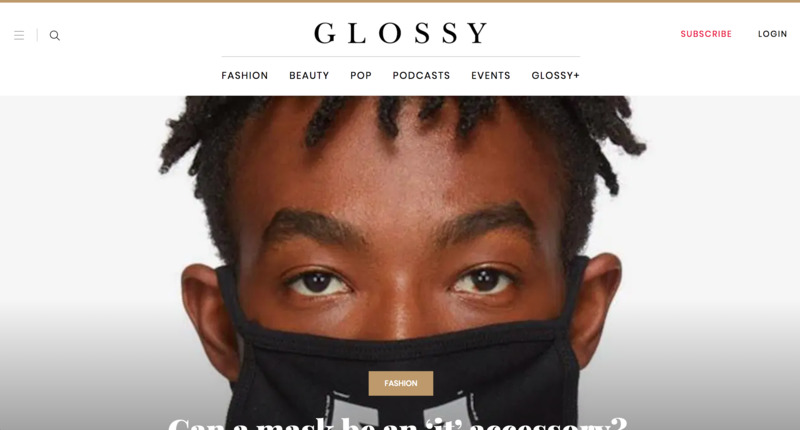
Glossy, a fashion/beauty focused media brand, explores the exploding popularity of masks as a fashion trend, despite the lack of availability of genuine designer face masks. Eugenia Kim, a designer interviewed, "doesn't see anything wrong with using them to complete a look. 'Not all masks are fashion accessories, but mine are.'"
Reilly Dunne, Fordham Unviersity, SOCI2800
-
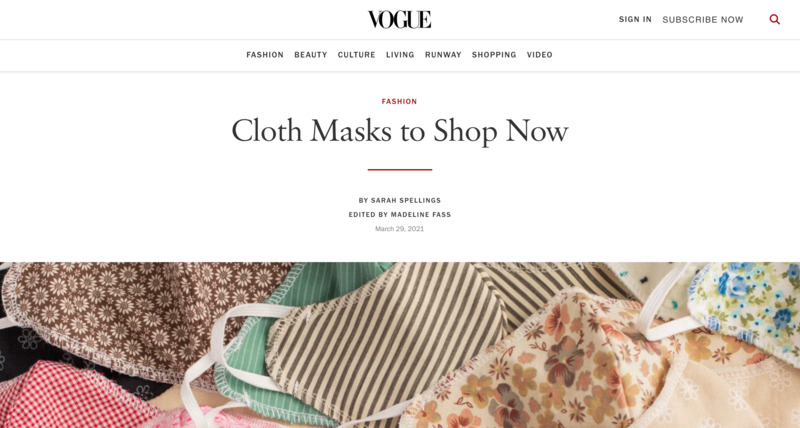
05/13/2020
A list of 100 "of the most stylish masks" available for purchase, such as a $100 satin mask from Proenza Schouler. Vogue notes that "given the prevalence of mask selfies, it's likely that masks will start to become fashion items, rather than merely functional."
Reilly Dunne, Fordham University, SOCI2800
-
05/15/2020
*Original text in "Type:" Essay on the history of federalism and how covid might affect it
-
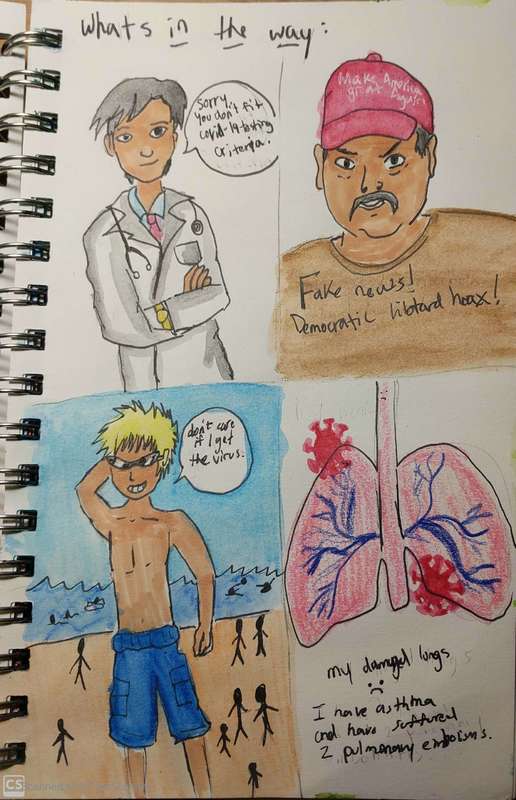
04/19/2020
Describe the image and what it tells us about the pandemic: I created this drawing because my environmental art professor had asked us to draw the world we would like to see and what's in the way. I wanted to go back to school, see my friends and professors again, so I decided to draw what is in the way. I depicted the lack of COVID-19 tests, the people who claim it is a hoax, the people flocking to Florida for Spring Break, and my own personal lung issues that prevent me from being able to take the risk. I'm sure that are many people who feel the same- and it is scary, and I hate the uncertainty. This image shows some of the many obstacles and challenge facing people amid the COVID-19 pandemic.
I made this drawing using paints.
-
2020-05-17
In this story, I talk about how my involvement in politics as an American citizen have evolved and have been shaped by this crisis. I discuss it from my viewpoint, coming from Northern California under Governor Gavin Newsom. I address how certain stat orders have influenced by views on government intervention.
-
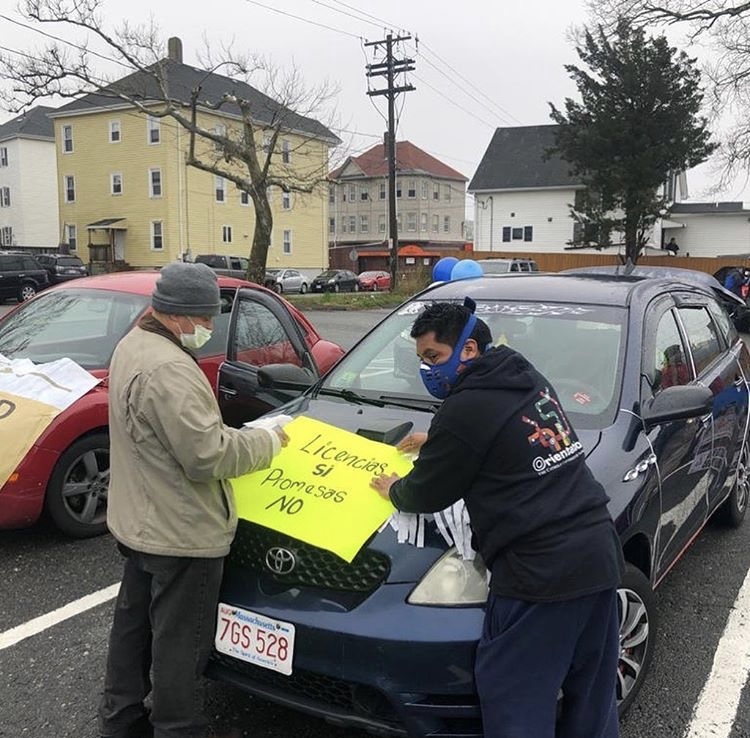
05/01/2020
Families in New Bedford & Worcester showed up today to demand dignity for undocumented workers. While many citizens are receiving stimulus check, have access to healthcare, and are able to access public resources, undocumented workers continue to demand compensation, dignity, and aid during the COVID outbreak.
-
05/08/2020
Short paper on the State of Nevada program on 88.9fm
*Original text in "Crreator" and "Contributor:" I wrote the paper on the state of Nevada KNPR hosted by Joe Schoenmann.
-
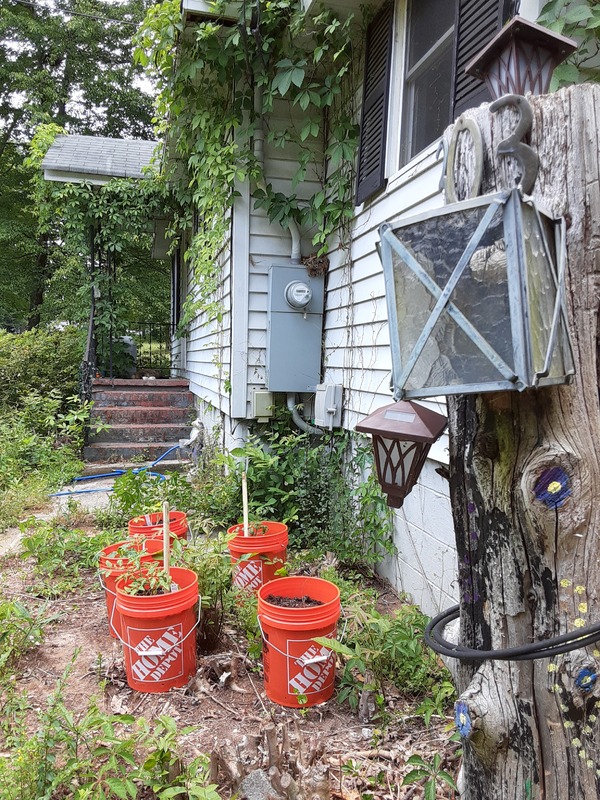
05/17/2020
As worry about the food supply grows and money is more of a worry for the average person, unemployment is at rates so high it is hard for the average person to comprehend, many people have resurrected the World War II tradition of the Victory Garden. This is the garden my partner has started in the front of our home, the sunniest patch on the whole property. My partner lost his job as a direct result of the pandemic and so finds himself with less money and more time. He decided it was a perfect opportunity to try to grow our own food especially since we have already experienced shortages of various items and have no reason to believe that will change any time soon. He is planning on adding several more buckets and though the buckets themselves come from the Home Depot we are endeavoring to shop for plants, soil etc at local nurseries whenever possible so that we keep what money we are spending circulating within our own community.
Photo by Ash Macnamara, Garden by David Herrick
-
05/17/2020
A discussion of how the state of federalism in the US has changed and how this has become evident by the handling of the Covid-19 pandemic.
-
05/05/2020
Federalism in the Times of Coronavirus
Today's smallest and most basic tenets of federalism as well as the different forms that it may take have the largest and most impactful implications for a system of government under stress. Moreover, due to the extenuating circumstances brought about by the COVID-19 Pandemic, the costs of unstable federalist infrastructures are alarmingly high.
-
2020-05-17
#unlv #psc100 #mlphelps
-
05/12/2020
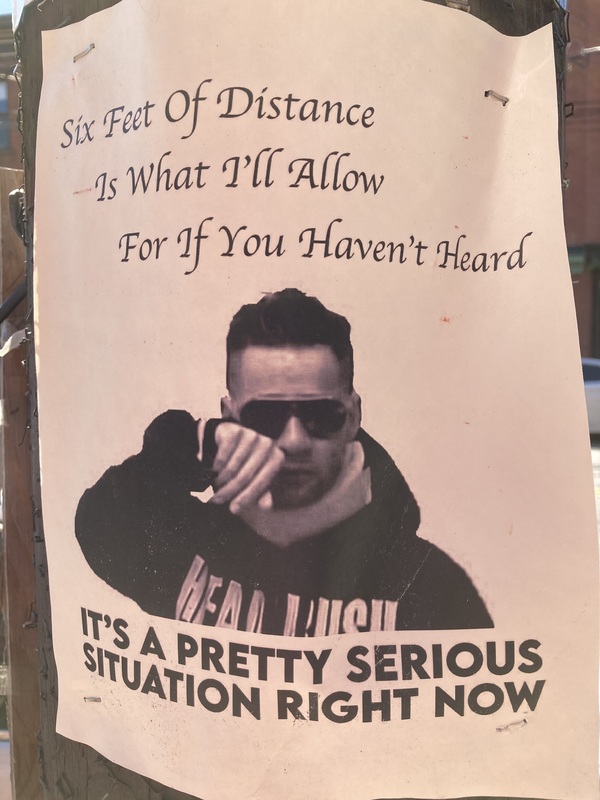
Poster of photo with comic rhyme warning people to be careful.
This is the text on the poster: "Six Feet Of Distance/ Is What I'll Allow/ For If You Haven't Heard/ IT'S A PRETTY SERIOUS SITUATION RIGHT NOW"
Spotted on May 12, 2020
-
2020-03-29
HUM402
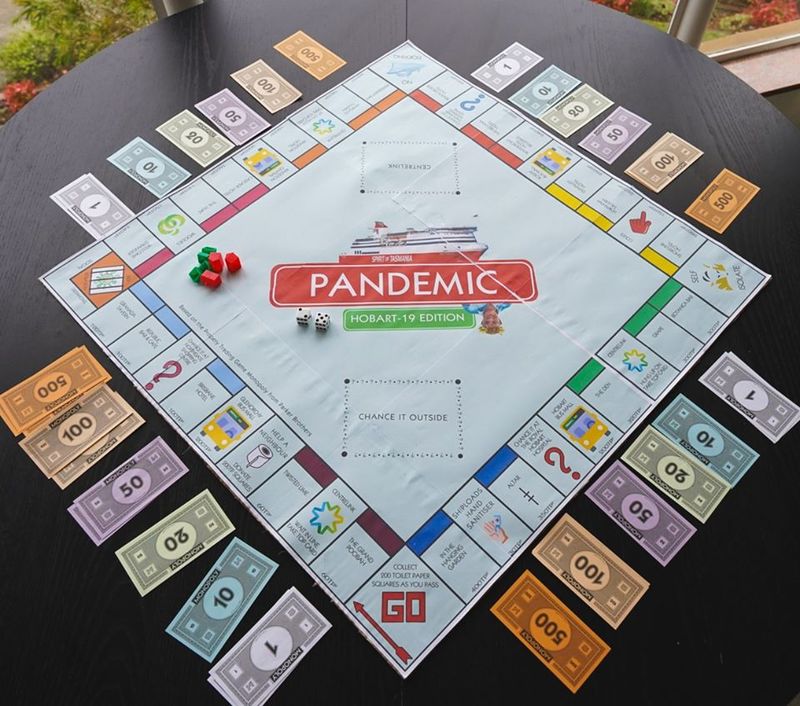
The image depicts the creation of Pandemic Monopoly by a Hobart resident. The homemade board game uses toilet paper as currency, referring to the toilet paper shortage seen across Tasmanian supermarkets. The board game presents players with the opportunity to 'own' key Hobart locations. However, instead of mortgage, houses and hotels, the game allows players to buy hospitals and clinics to place on the properties. Centrelink, the Australian governments social security service, features heavily on the board game, indicating the rise in unemployment due to the pandemic. Whilst being used for comical purposes, the game also critiques the Tasmanian governments early handling of Covid-19 crisis via a chance card, which states "You have a fever, dry cough and Pneumonia to boot but despite having all of the symptoms, you haven't knowingly come into contact with a known carried so they won't test you for Covid-19. The Royal Hobart Hospital sends you home. Get out of iso [isolation] free." This refers to the Tasmanian government in early stages of the Covid-19 pandemic refusing to test individuals who had not been in contact with a known case, or had not left the country.
-
04/22/2020
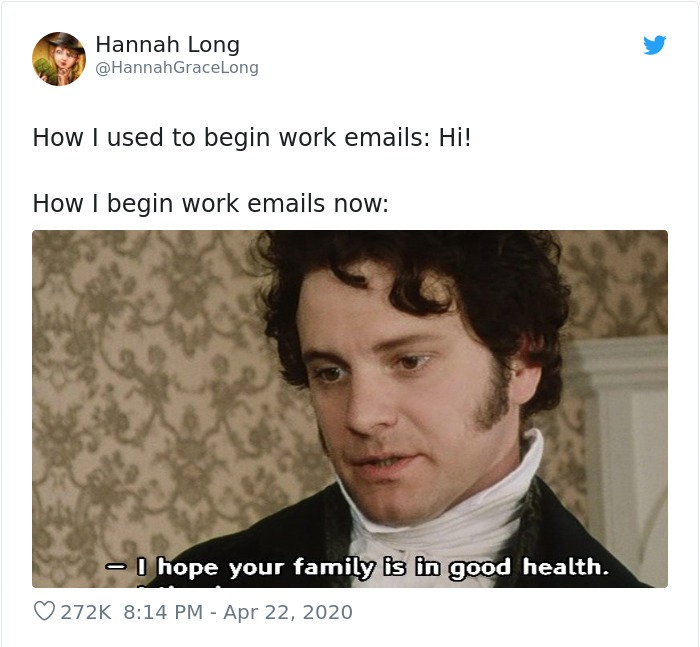
This meme resonated with me because I'd noticed several other aspects of society that reverted to Austen-esque practices during COVID-19. Emails became more like letters; personal and sometimes lengthy. People really began to enjoy walks in pairs again. It forced us all to slow down and consider one another more.
(For unit HUM404)
Creator: Twitter user Hannah Long / @HannahGraceLong using a still from the BBC's 'Pride and Prejudice' miniseries.
-
2020-03-27
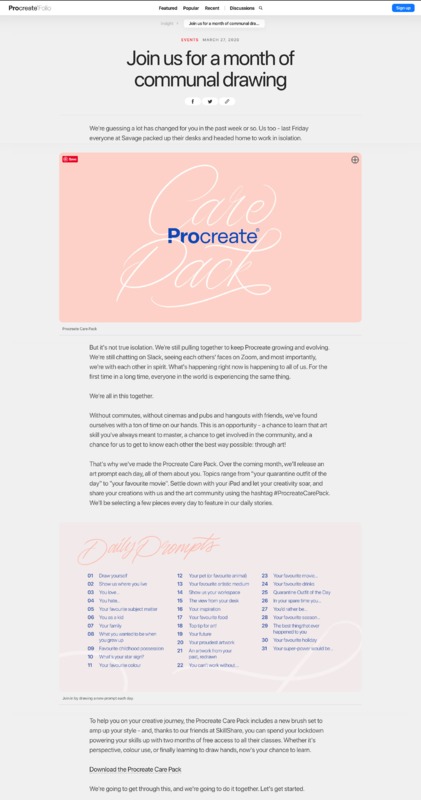
Procreate is the bestselling iPad app for artists. When lockdown began in Australia, they launched a month-long campaign to encourage people to draw every day, and share their artwork with the community. The idea behind the Procreate Care Pack was to respond to the situation in a positive way, and keep people connected with one another through an isolating time. It resonated strongly with Procreate artists all over the world.
-
04/10/2020
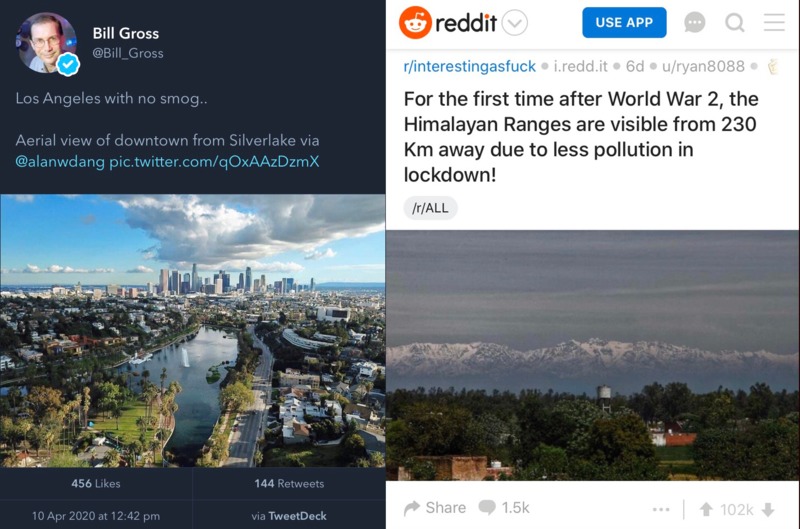
These are two examples of a type of photograph that began appearing all over social media during April 2020. At that point, isolation and quarantine measures had been in place in many parts of the world for weeks or even months. The sudden reduction in traffic had a notable effect on the clarity of the atmosphere in these places. The Los Angeles photo is striking because LA is known for being under a yellow haze of smog to the point where a yellow tinge is associated with the city. The Himalayan Ranges image is striking because it reveals something that was previously invisible. There haven't been many upsides to COVID-19, but the demonstration of how it is within our power to drastically reduce air pollution is a powerful message.
(Posted for class HUM 404)
Creator: (Possibly) Bill Goss and Unknown
-
2020-03-25
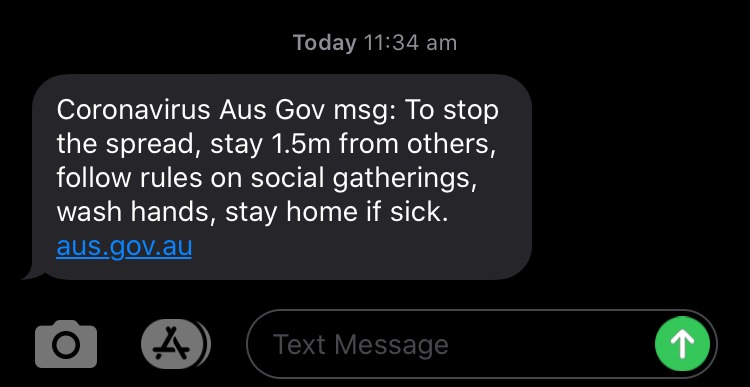
The Australian Government sent out a very curt mass text on the 25th of March to warn Australian citizens to follow COVID-19 guidelines. I chose this item because the timing and brevity was viewed by many as 'too little, too late'. It's a reflection of the fact that it took our government a week or two to absorb and act on the seriousness of the situation - not long before this message came out, the Prime Minister had still been encouraging people to attend football matches in high-capacity stadiums. Though the government eventually recognised the risk, and acted more decisively than some other countries, a large chunk of credit must go to Australians with the foresight to begin acting in advance of government instruction. By the time I received this message, my workplace had already been shut down to a work-from-home situation for a full two weeks, and the University of Tasmania's campuses had been shut down for five days.
(HUM404)
-
05/09/2020
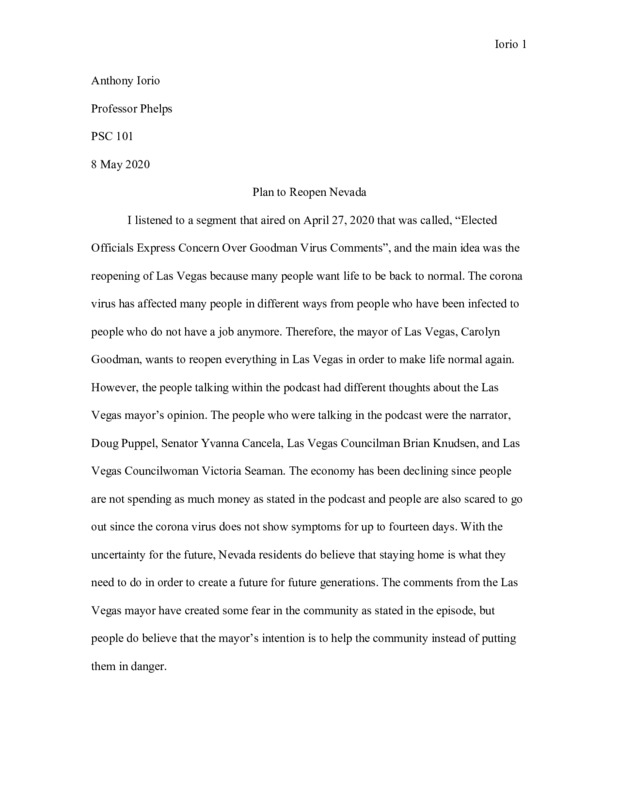
Summary of radio episode about the corona virus affecting Las Vegas. *I created the summary and the original information is from Nevada Public Radio. *Nevada Public Radio. *Radio episode so like a podcast. #unlv #mlphelps #psc100
-
05/16/20
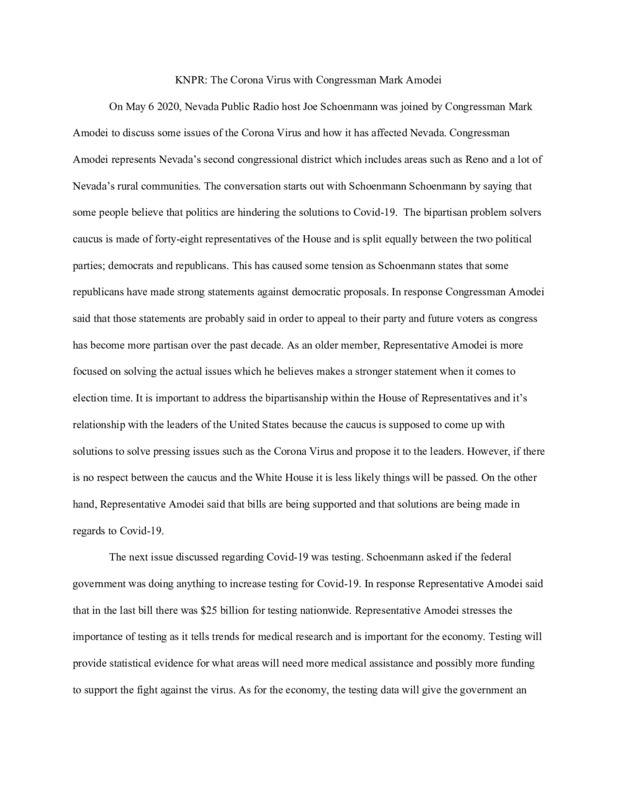
It summarizes an interview by Nevada Public Radio about the Corona Virus with Congressman Mark Amodei. #unlv #mlphelps #psc100
-
2020-05-17
Maya Martinez
Dr. Phelps
PSC 401D-1001 State Politics
May 14, 2020
Federalism in the Wake of the Coronavirus
The United States’ founders initially established a system that granted all authority to the states and none to the federal government, in an attempt to protect against tyrannical executives; when this system of government failed, more authority was granted to the federal level of government, with the caveat of the 10th amendment, which is commonly known as the “states’ rights” amendment. It must have been inconceivable at the time to imagine five different types of federalism would emerge from the founders’ decision to divide power in the United States the way they did.
The five types of federalism are dual federalism, cooperative federalism, centralized federalism, new federalism, and ad hoc federalism (Greenblatt and Smith). Dual federalism lasted from 1789 to 1933. It was the variety of federalism that distinctly separated responsibilities and jurisdictions, with federal and state authority in clear layers, like chocoflan. Cooperative federalism was the backlash against dual federalism, occurring once it became clear the federal and state levels of government would always end up overlapping and muddled, never following the clear layers dual federalists advocated for. It lasted from 1933 to 1964. The Great Depression was one of cooperative federalism’s biggest developers as well, as local and state governments relied heavily on the federal government’s money and programs to support their people, granting more authority to the federal government in exchange. Centralized federalism was the next version of federal to take place, occurring from 1964 to 1980; this was a shift of power to the federal government, where grants limited the restrictions placed on states, but the amount of money the federal government gave states as well. New federalism occurred as republicans attempted to limit federal authority and return power to the states, from 1980 to 2002. The last and most recent phase of federalism began after in 2002 and is ongoing at the moment; this is ad hoc federalism. Ad hoc federalism is when the federal government either supports federal authority or states’ rights theory depending on which party is involved.
The United States under Covid-19 is still in ad hoc federalism. The governor of Nevada instituted a mandatory stay at home order at the end of March, and like other governors, did not sway at the prodding of a president who only desired for the economy to open up without any concern about citizens’ lives. Economic growth is typically touted by both parties, but when it’s combined with a lack of concern over others’ well-being, it is a desire of the Republican Party. An obvious example of the U.S. still being in ad hoc federalism has been the president at first claiming that governors should be the ones in charge of the pandemic response, until he wanted to open the economy, then started talking about how the president was the most significant person in the country (Borger). Trump was obviously bouncing between federal and state responsibilities based off of what policy suited him and his party, which can also be seen in his preferential treatment of Republican states asking for supplies and resisting assisting blue states (Geltzer). Responses from the federal government, like the $1200 stimulus checks, were largely passed through bi-partisan efforts in Congress and had very little to do with Trump. Clearly, this is one executive who doesn’t know how to handle a pandemic, not that anyone should be surprised. States are lucky enough to have governors smart enough to collaborate to purchase supplies together and not let the president divide them, however, states having to take most of the action has led to a highly uneven response to the pandemic that could only occur under federalism. While it is good to imitate states that have flattened the curve early on like Washington, more unitary governments like South Korea have handled the crisis so quickly, it’s become clear there are advantages to centralized power during times of emergency.
Work Cited
Borger, Gloria. “Trump Wanted States to Take the Lead on Coronavirus. Until He Didn't.” CNN, Cable News Network, 13 Apr. 2020, www.cnn.com/2020/04/13/politics/borger-analysis-federalism-trump/index.html.
Cook, Nancy, and Dan Diamond. “'A Darwinian Approach to Federalism': States Confront New Reality under Trump.” POLITICO, www.politico.com/news/2020/03/31/governors-trump-coronavirus-156875.
Diamond, Martin. “The Federalist on Federalism: ‘Neither a National Nor a Federal Constitution, But a Composition of Both.’” The Yale Law Journal , vol. 86, no. 1273, 1977.
Geltzer, Joshua A. “Perspective | Trump's 'Corona-Federalism' Pits States against Each Other. It's a Disaster.” The Washington Post, WP Company, 8 Apr. 2020, www.washingtonpost.com/outlook/2020/04/08/trump-corona-federalism/.
Glick, Noah, et al. “Novel Coronavirus In Nevada: April 8-14.” KUNR, www.kunr.org/post/novel-coronavirus-nevada-april-8-14#stream/0.
Greenblatt, Alan. “Federal-State Relations.” CQ Researcher, vol. 28, no. 16, 27 Apr. 2018.
Haffajee, Rebecca L., et al. “Thinking Globally, Acting Locally - The U.S. Response to Covid-19: NEJM.” New England Journal of Medicine, 7 May 2020, www.nejm.org/doi/full/10.1056/NEJMp2006740.
Law, John. “How Can We Define Federalism.” Perspectives on Federalism, vol. 5, no. 3, 2013.
Smith, Kevin B., and Alan Greenblatt. “Chapter 2 Federalism.” Governing States and Localities, 7th ed., CQ Press, 2020, pp. 23–47.
Wilson, Chris. “Here's How Quickly Coronavirus Is Spreading in Your State.” Time, Time, 13 May 2020, time.com/5814139/coronavirus-state-data-tracker/.
-
2020-05-17
N/A
-
2020-03-26
N/A
-
05/03/2020
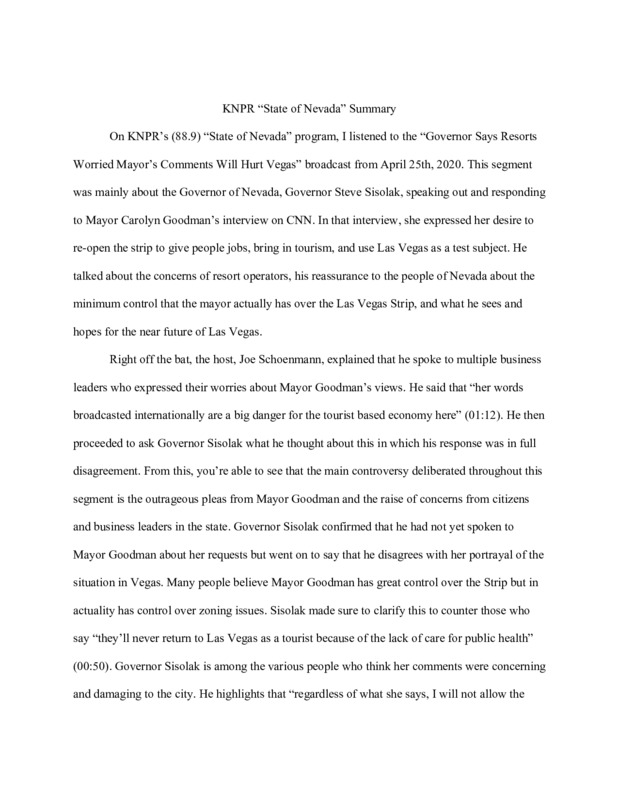
A summary on Governor Sisolak's response to Mayor Goodman's CNN interview #unlv #psc100 #mlphelps
-
03/12/2020
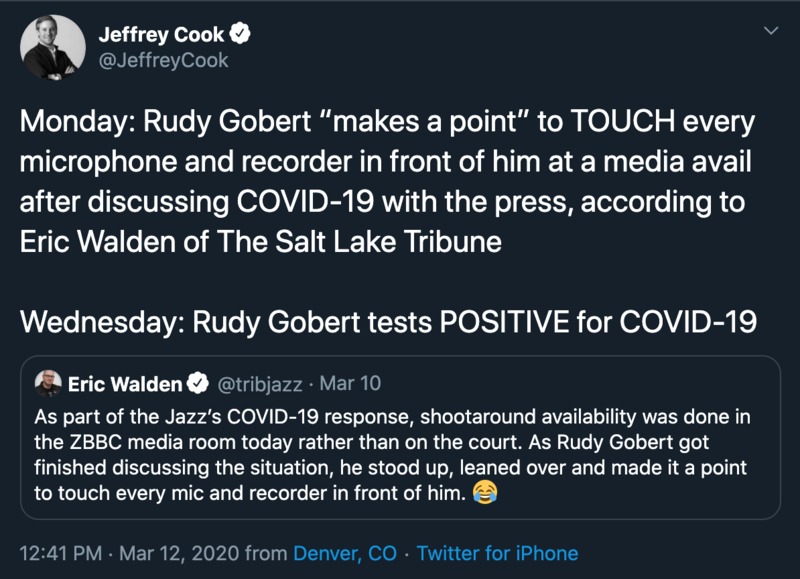
In March, during the early days of the COVID-19 outbreak reaching Europe, Australia, and the USA, some people were still taking the risk less seriously than others. Twitter has a nose for irony, and a lot of people picked up on what happened to basketballer Rudy Gobert. In early March when the NBA was still denying the need to shut down the season, he touched every microphone and surface he could reach to mock the possibility of COVID-19. A week later, he was sick with it, and the NBA season was called off.
Twitter user Jeffery Cook (@JefferyCook)
-
2020-05-11
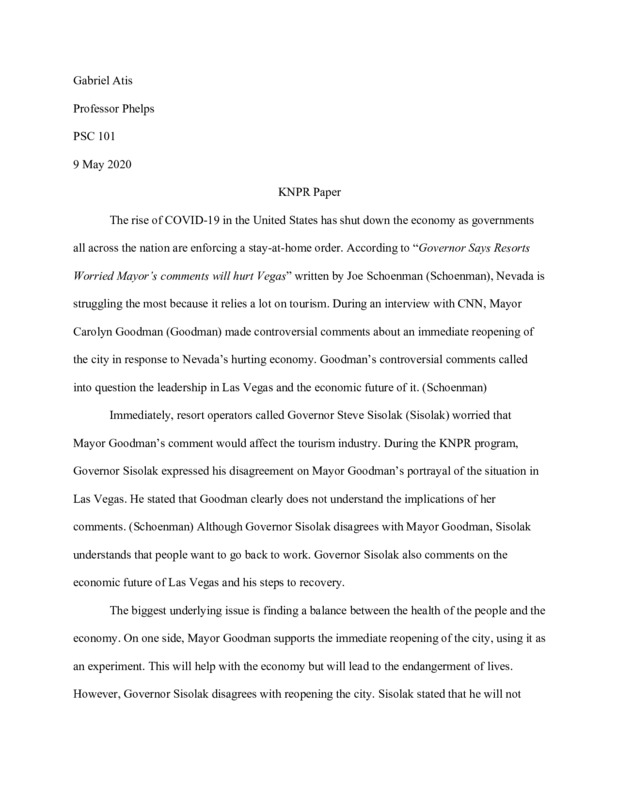
Governer Sisolak response to Mayor Goodman's statement about reopening the city of Las Vegas.
-
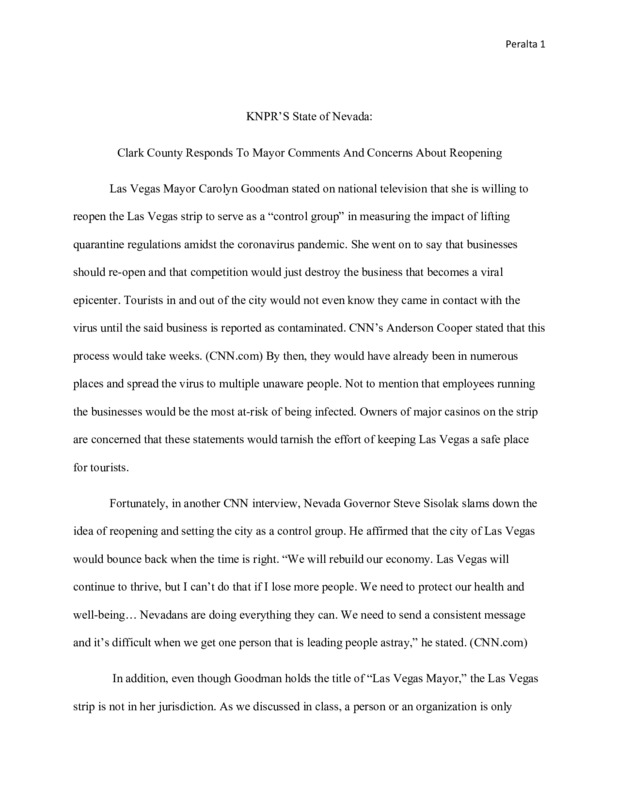
05/09/2020
It is a recap/review of Las Vegas City's reaction to the pandemic. #KNPR #StateofNevada #unlv #mlphelps #psc100
-
05/15/2020
#PSC401D #mlphelps #UNLV
-
05/14/2020
#unlv #PSC401D #mlphelps