-
2020-04-24
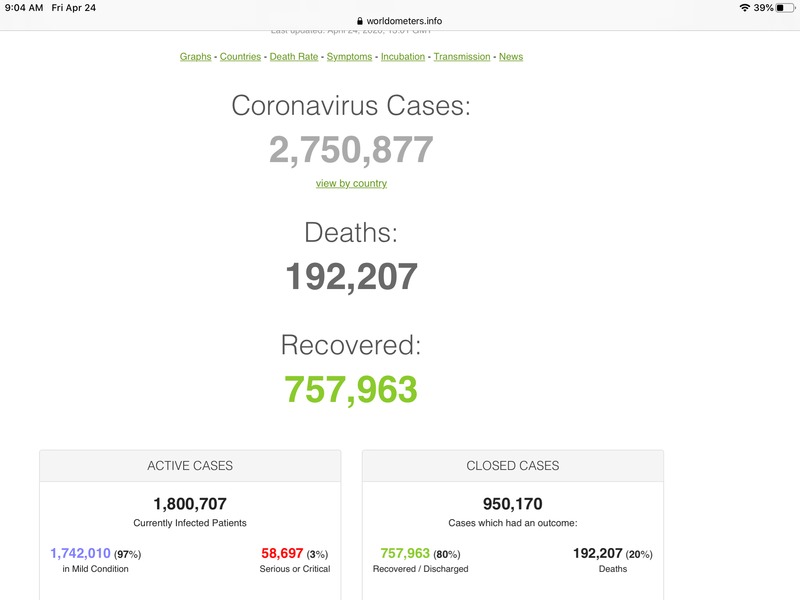
As new numbers come in, Worldometer updates its page and by inference shows what a deadly impact the virus is having worldwide. The facts seem clear until one remembers how they can only show the recordable tip of the nightmare iceberg.
-
2020-04-21
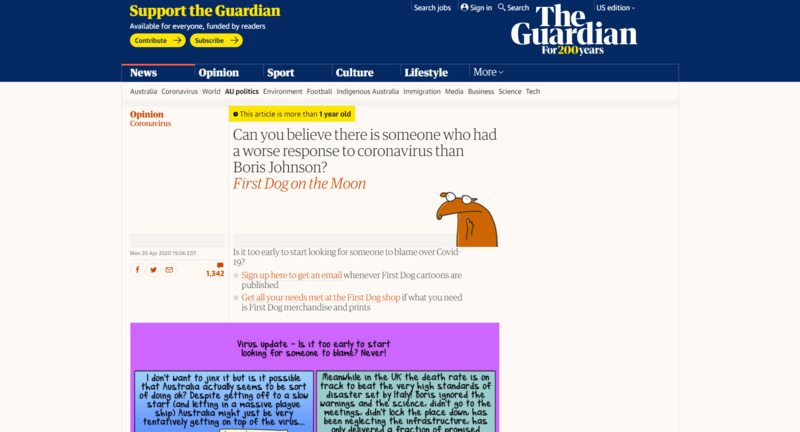
Cartoon inthe Guardian
-
2020-05-24
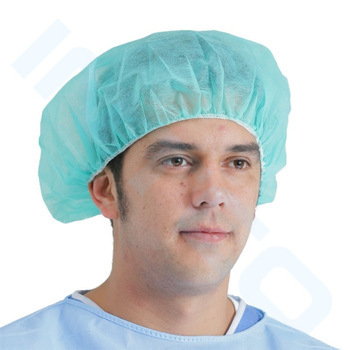
These photographs explain how someone can be taken from you so fast, as I said earlier Analei did not pass, she is very fortunate because of how many people have been losing their lives due to COVID-19. When I heard the news I freaked out I called her mother and asked her if she was okay, the crazy part is she thinks she got it at a party she went to which what’s weird is that I went to it as well, I was fine and she wasn’t, I personally felt guilty and I was really sad for days and made sure she was okay, since so many people have been getting tested for corona virus the government were very low on test, which meant she had to wait and thankfully found out it was certainly positive, a week has gone by and she was starting to get better, I was so glad. The second photograph is a picture of a doctor, and this shows how every nurse, and doctors have risked their lives for us every day and you start to really see who’s the hero.
*The primarily responsible for making this resource would be me, Sofia __________ I am coming to everyone as a human to make sure everyone is safe and healthy
*In this time, March 2019 was the month of our graduation into becoming adults and into college students ready for a life, I put a photograph of my friend Analei who was recently tested positive for COVID-19, she is a amazing person and usually most of the bad luck always comes to her for some reason.
*Analei _________ and Sofia __________ also her mom ___________
____________
*The genre of this resource is to show how someone can be taken from you so easily, (even though Analei did not pass) we all had a bit of a scare when we heard the news, her mom took this picture of her as a graduation announcement, little did we know this would happen in our world.
-
2020-04-19
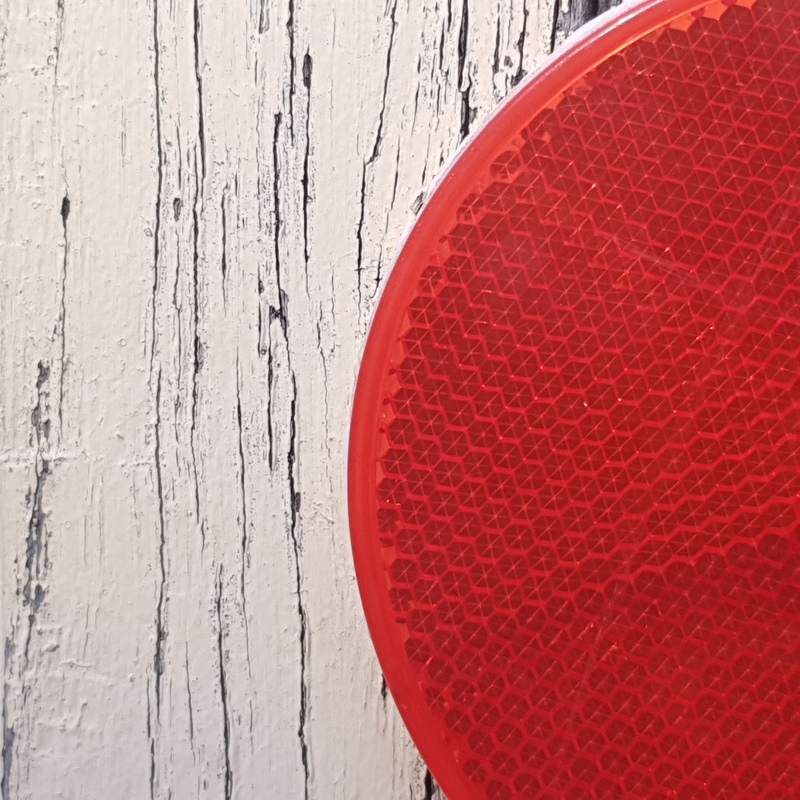
Sydneysiders are allowed to leave home for exercise and essentials. Sporting activity has ceased so the streets are overflowing with people, prams, and dogs that have suddenly discovered the joy of walking.
I seek out quiet places, but it is tedious to walk for the sake of walking, so I give myself little projects to make it more interesting. Last Sunday (a glorious Autumn day in Sydney), my goal was to find primary colours in a bushland park. There were yellow leaves and a blue pillar near the entrance, but no sign of red in my hour-long walk - until I came across this small reflector on a post in the car park. Mission accomplished!
-
2020-04-21
Being apart shows how much we need to be together. Sarin Moddle reflects on what this temporary period of physical separation costs us, and what it can teach us.
“No kapa haka tonight, whānau.”
The words jarred me. Nearly every Wednesday for two years I’d been ending my night in a beautiful wharenui at Unitec’s Te Noho Kotahitanga Marae. This simple weekly ritual – a rising tide of voices coming together to sing waiata after our night school language classes – had saved me so many times before, a potent balm when other parts of my world were crumbling.
I came to the marae that night in search of that feeling. Exactly one week prior, the first signs of the impending collapse of the live music industry were coming to light. The hairline cracks had widened so quickly that, in the space of seven days, it seemed like everyone I worked with – close friends, most of them – was staring down the barrel of #canceleverything and zero income as far as the eye could see. It was early days and our industry was alone in this, our concerns financial only. But trauma is trauma, and I knew what I needed: voices lifted in unison. Shared space, shared intention, the whole greater than the sum of its parts.
It is apparent, now, that our ability to come together in such ways is going to be off the table for a while. Even once we’re released from sheltering-in-place, once we’re allowed outside of our household bubbles, the act of gathering in groups is likely to be under various forms of siege for months or years to come. Some communities, where the imperative to exist collectively is structured into daily life, will feel the impact of this immediately; for others, it will come as an awakening.
We’re discovering how much we need to physically be with other people at the exact moment we’re being told we can’t have it.
*
At 35, the only other reference I have for shared experience on a global scale is 9/11. At the age of 17, my world stopped at the edges of the North American continent, so as far as I was concerned, the “whole world” was feeling the same trauma. I’d never felt shared grief, shock and uncertainty on a scale that large. In my corner of the globe, we responded as a collective: first gathering in prayer, vigil and moments of silence, and later in anti-war protests that filled the streets with – again – a rising chorus of voices. We processed it all together, in the company not only of our friends and family, but in the presence of strangers with whom we suddenly shared common ground.
When words fail us, it is our mere physical presence with one another that gives us solace
In the days following the early waves of Covid-19 news – when it was still just private-sector responses, minor travel restrictions, event caps – life was a blur of human contact. My community’s reaction to that shock and uncertainty was to process it with each other. We spent hours in friends’ lounges, ruminating through happy hours, taking long walks, and drinking endless amounts of coffee while strategising our survival over café tables. There were entire conversations punctuated only by the shaking of heads, there were so many hugs. Proof that when words fail us, it is our mere physical presence with one another that gives us solace.
Fast-forward 48 hours, past the border closure and nationwide mandate to shelter in place, and suddenly all those measures of comfort were off the cards.
*
When I speak with Mohamed Hassan about what isolation means for him, the first thing he reflects on is the irony of a community so brave that local mosques kept their doors open in the face of terror threats only to have them forced shut by Covid-19. He’d travelled to Christchurch in early March ahead of the one-year anniversary of the terror attacks. “When I spoke to people down there,” Mohamed recounts, “they were saying, ‘It doesn’t matter what happens, we’re not going to stop coming together and we’re not going to stop worshipping and we’re not going to stop building this community together.’ And two weeks later, all these mosques are being closed down, not just here but all across the world.”
The ban on public gatherings strikes at the very heart of Islamic life, which – like many religions – “is very deliberately laid out as communal activities,” he says. And daily prayer, the anchor around which Islamic life revolves, is only ever performed alone as a last resort. He explains that there is a very specific imperative to pray in a group and in a mosque, before adding, “That communal sense of worship is very much at the heart of how we understand our religion, and also how we understand the way our societies are structured.”
Faced with curtailing the spread of Covid-19, Muslim leaders worldwide are grappling with the question of how to reconcile a moral imperative to be together in the face of a public health imperative to stay apart. “Muslims around the world,” muses Mohamed, “they're having to figure out what happens now that we don't have these mosques, we don’t have these centres where we can connect to one another, where we can see each other regularly. And it isn’t really anything that we’ve had to come across before,” at least not as a global community. The questions that leaders are asking, Mohamed says, are big ones: “Is it right to close a mosque in these times, is it right to tell people not to come in for Friday prayers, which are fundamentally a part of our beliefs?”
“I don’t know if people are going to be able to come up with other ways of being able to fill those spaces or make these connections with one another.”
*
Sense of belonging is a human psychological need right up there with food and shelter. We innately seek community and connection with others, and it has tangible outcomes on our mental and physical health. As neuroscientist James Coan commented recently in The New Yorker, “Our brains have learned from brutal evolutionary lessons that social isolation is a death sentence.” This isn’t really news; neither is the knowledge that sharing a room feels very different from sharing a screen, although we’re not always able to articulate why. The task we’re confronted with now is how to give our brains the sense of connection they need – not simply for this moment, but for when we inevitably return to it in future.
Millennia ago, our ancestors were bound together for material survival. These days we bind ourselves to others through work, worship and leisure – and for many, when these physical spaces shut down, the activity within them becomes impossible as we knew it. The closure of art spaces is heartbreakingly explored in another piece pulished on The Pantograph Punch by actors and theatre-makers; the absence of gym spaces, suspensions of sports teams and cancellations of competitions leave a similarly gaping void for many.
Like many coaches and trainers, Richie Hardcore had been modifying his Muay Thai kickboxing team’s training over the weeks leading up to the Level 4 alert to accommodate social distancing – no sparring, no sharing equipment, no contact drills. It was a way of eking out as much time as possible for the team to be together. Closing his club for the first time in two decades, while inevitable, still took an emotional toll on everyone. When you operate like family, the breakup of that unit is hard.
“I've had young people come in the gym and they’re going through breakups or their boyfriend’s being abusive to them or their girlfriend’s left them or just life is confusing for them, and they want to talk [to someone].” Team relationships are unique in that they breed a particular intimacy between people who don’t necessarily maintain contact outside of the gym. Does he think those kinds of conversations will happen outside of the face-to-face opportunities afforded by training together? “In my case, yes, but I think words on the screen through Instagram still don't carry the weight of touch, talk, connection… to not be able to give them a hug or punch them in the arm or give them a wry smile or laugh or dry the tears, it’s not the same, you know.”
*
Back at kura pō, on the night of no kapa haka, shared teatime also disappeared. Our programme coordinator sticks his head into our classroom to let us know that from now on we should each bring our own kai to eat ourselves. He apologises, and tells us it’s only temporary until all this Covid-19 stuff is over, “then we can all go back to being Māori again.”
For some Māori like Amy Bassett, the rhythms of daily life on her marae reflect the importance of the collective: “Whatever is happening, if it’s a tangi or a wedding or a wānanga, everything’s moving around that thing, so you’re always in service of something greater than yourself. Everyone has something to do and if you don’t have something to do, you’re almost set apart from everyone. Having a role to play gives you your mana in the place.”
The inability to carry out tangihanga – the rites for the dead – is a fraught and painful consequence of the Level 4 restrictions. Māori communities are grappling with how to rethink tikanga for one of the most important sets of cultural protocols in te ao Māori. In the Far North, this was a very early consideration at Bethany Edmunds’ marae, where whānau have been asked to modify tangihanga and “to be completely self-sufficient in these times.”
The notion of self-sufficiency in the face of the most acute human loss – death – is a pragmatic but wrenching one. One of my first thoughts when Aotearoa went into Level 4 lockdown was, “What happens when someone dies now?” I have grieved alone, an ocean away from anyone else who knew that extinguished life. Skype did not cut it. I have never wanted anything more than to be in the same physical space as other people who also shared the loss of this specific person.
The question lingers: to what degree can we feel the sense of belonging, like part of a greater whole, when we’re prohibited from being in the same room as anyone outside our ‘bubble’?
*
You’ve gotta admit, though, we’re trying. We’ve got online group workouts and virtual cocktail hours and Facebook Live church services, we’ve got endless Zoom conversations with friends and Twitch houseparties. There have never been more options available to conquer the distance between ourselves.
But they’re imperfect tools at best. They presuppose you have people you can call on, and that you’re comfortable doing so. The interactions are inorganic: only one person can speak at a time, there are no sidebar conversations naturally spinning off from the group. There are technical glitches: faces freeze, audio lags, people unintentionally talk over one another. These all seem like minor inconveniences but they add up quickly when the virtual is our sole source of human contact. Our brains, used to processing a wide array of contextual information drawn from surroundings and subtle changes in body language, are being asked to work exponentially harder in environments devoid of that context, and will find it harder to feel comfort. Virtual communication is a lifeline in these times: necessary, but not sufficient.
That’s because the reason that all these online tools of communication were designed was to facilitate one thing and one thing only: conversation. The point of praying together, training together, cooking together, grieving together, is not to talk, although that’s often a byproduct; the point is to share experience in the presence of others. If the most intimate connections are the ones that don’t require words, then any tool reliant on words will always fall short. And most achingly, we haven’t figured out how to sit in silence with one another on the other side of a screen yet.
Richie likens it to what we eat: “We all need nourishing meals for our physical wellbeing, but often we get junk food because we’re in a hurry. And I think it’s the same with human connection. We feel a bit connected through Instagram and Facebook and Tinder and all these sorts of things, but they’re not really what we need. They can be a nice add-on to human connection, or augment it, but when it’s your sole source of nutrition, it’s not very good.”
*
The physiological reality to all of this is that when we are stressed or uncomfortable, we seek oxytocin (the ‘cuddle hormone’) release through human touch. And when we feel lonely, it’s a biological warning sign to seek out other people for survival. Under lockdown, self-isolation, shelter-in-place, alert Levels 2 through 4, whatever you want to call them, our go-to options to alleviate our discomfort are off the table. Compounding that feeling is the fact that we can’t really see the end of this thing; we don’t know how long we’re stuck with these feelings for.
In some ways it feels like a wake-up call, a glimpse down the extreme end of the path we’re currently on. More people in the world live alone than ever before. In cities, the closer we live to our neighbours, it seems, the less likely we are to actually know them. We’re all in constant communication on our devices but rarely do we actually hear each other’s voices on the Devices Formerly Known As Cell Phones. There’s even a recognised condition – hikikomori – of literal hermitude in favour of exclusively online interaction, originally identified in Japan but now being recognised around the globe.
“We’ve finally isolated ourselves to the point that we have to sit in our houses by ourselves, and not be around others, we’ve finally atomised society to the nth degree,” Richie points out. “I think this is a real time for us to really stop and pause and look at the world that we’ve built.”
Mohamed sees things differently. “As Muslims, we’re having to take on these challenges together. We're going to be starting the month of Ramadan together, we're going to be ending it together. And all of us, as a globe, are going into this unknown territory together. There's a lot of comfort in that.”
Perhaps this is how we survive until we can gather again: ritual. Doing the same thing at the same time – apart, together. Common experience may not be the same as shared experience but it’s as close as we can get.
*
If we take anything away from this strange time, I hope it is this: that when these restrictions on human contact are eased, we remember how deeply we needed more than a screen. That we needed each other in the flesh. That we sought that flash of recognition in another person’s face: I see you, and we are in something together. That we are part of something bigger.
Writ large, this is precisely the notion that is required to carry us through.
-
2020-04-24
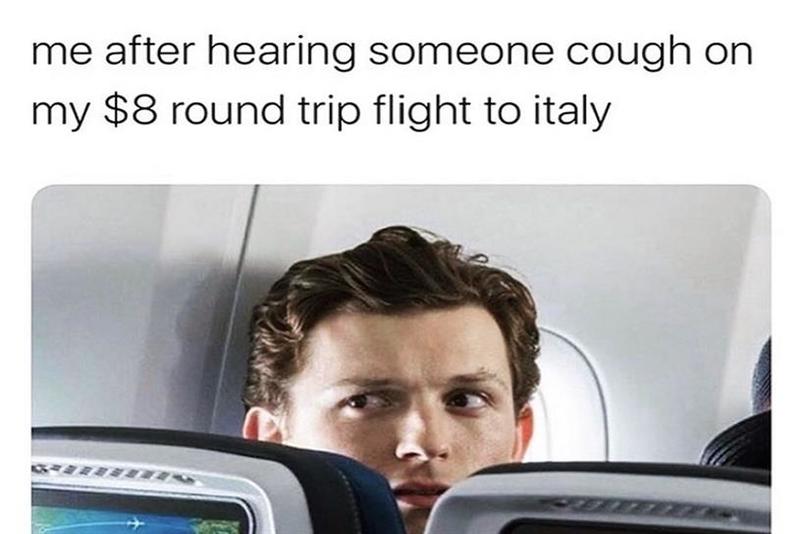
This meme explores the temptation of very cheap flight options at the risk of getting very sick. It is a very light hearted form of humor that plays on the millenial and Gen Z love of travel..
-
2020-04-24
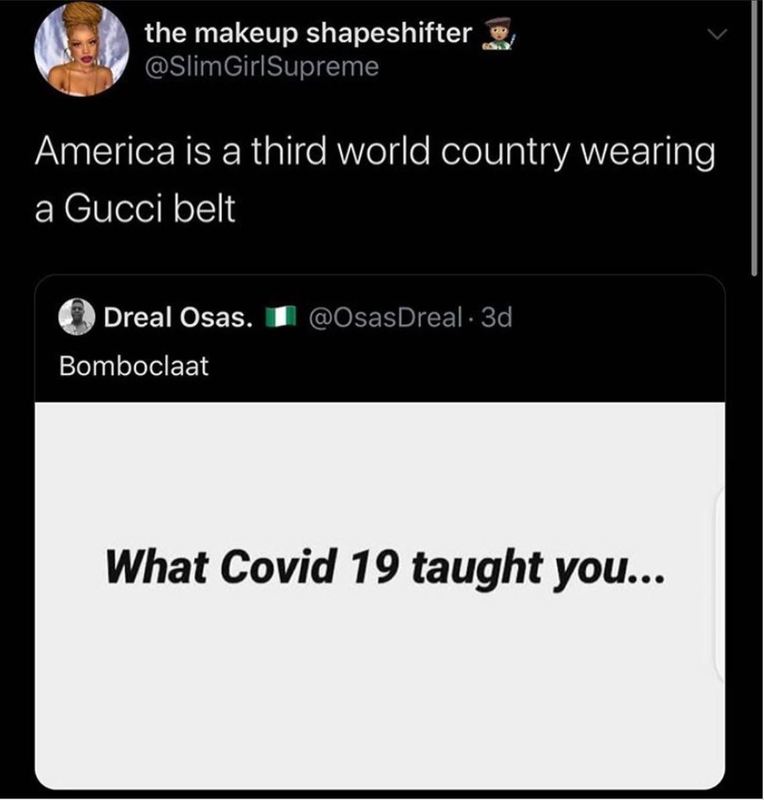
This is a meme that dissects how the United States is handling the COVID-19 pandemic. This is one of those memes that is funny but hits really close to home because it makes the viewer realize a harsh reality. Of course, we have more resources and options than a third world country. However, the way our country is handling this situation is not optimal.
-
2020-04-09
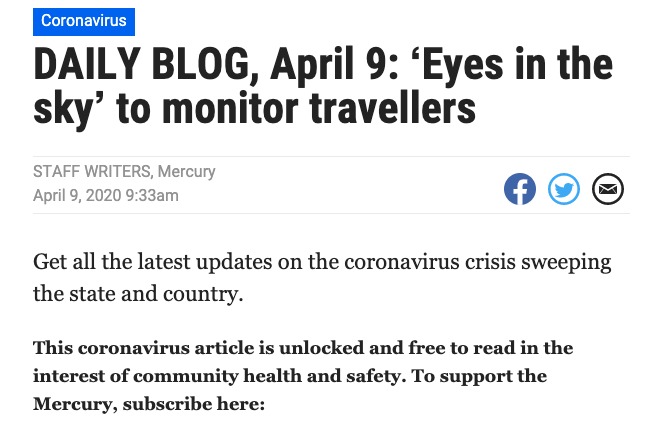
The Mercury (online) published on its daily coronavirus blog an article entitled, “'Eyes in the sky' to monitor travellers.” The article informed the public that helicopters would be used over the coming Easter long weekend to ensure Tasmanians were adhering to social distancing and lockdown laws.
HUM402
-
2020-04-24
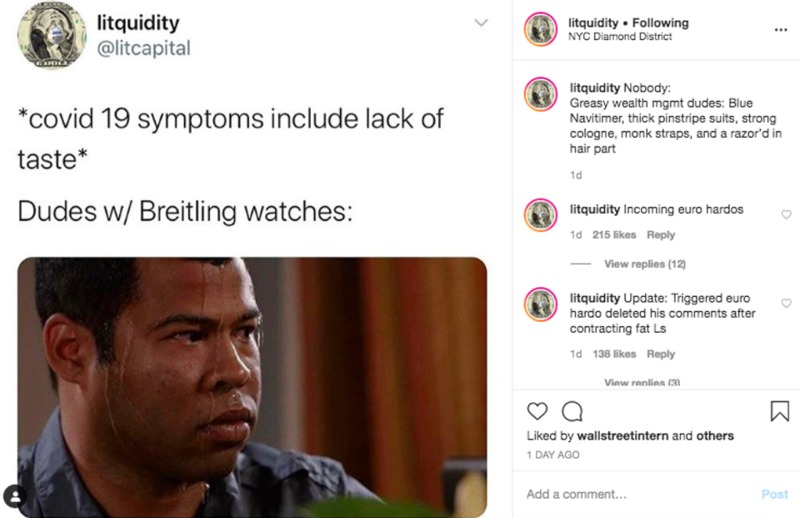
This meme plays upon the double meaning of the word 'taste'. This type of meme that makes fun of people's preferences in terms of food/products has become very popular. It has been used in reference to drinks, clothes, technology, food, and more. It is a very light hearted form of humor, and distracts from the severity of the pandemic. #FordhamUniversity #VART3030
-
2020-04-23
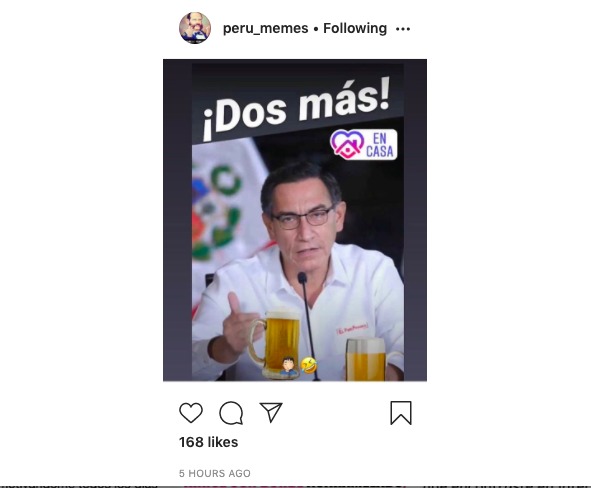
Peru extiende la cuarentena 2 semanas más hasta el 12 de mayo de 2020. Este meme se burla de la expresión "una cerveza más, y allí se acaba, que refiere a un frase normal entre la gente tomando.
-
2020-03-25
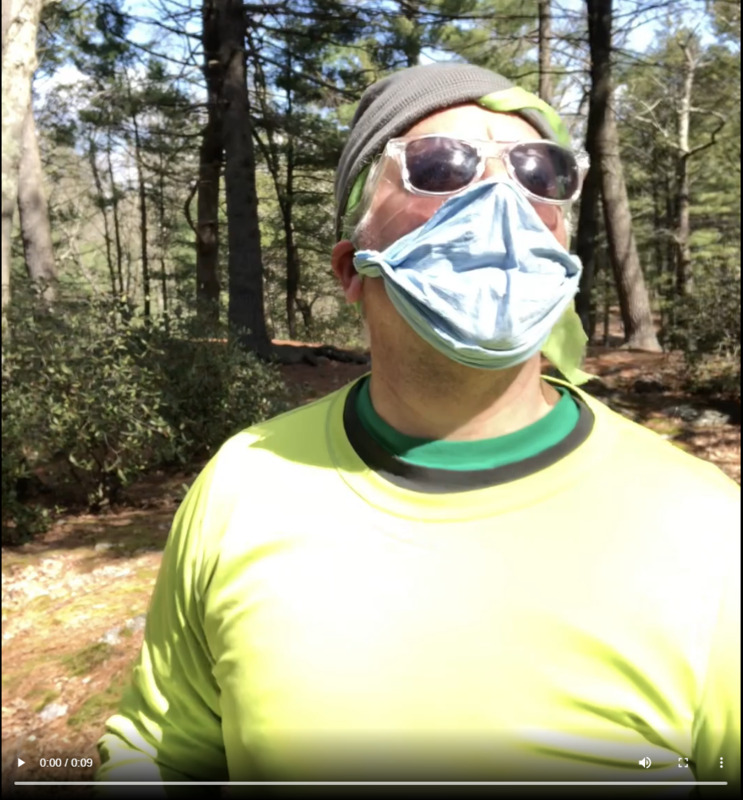
During the quarantine, used some manic energy to make a brief mask-woods-dance dedication to Juice WRLD, a young, incredibly talented rapper from Chicago lost to substance abuse in Jan 2020.
-
2020-04-18
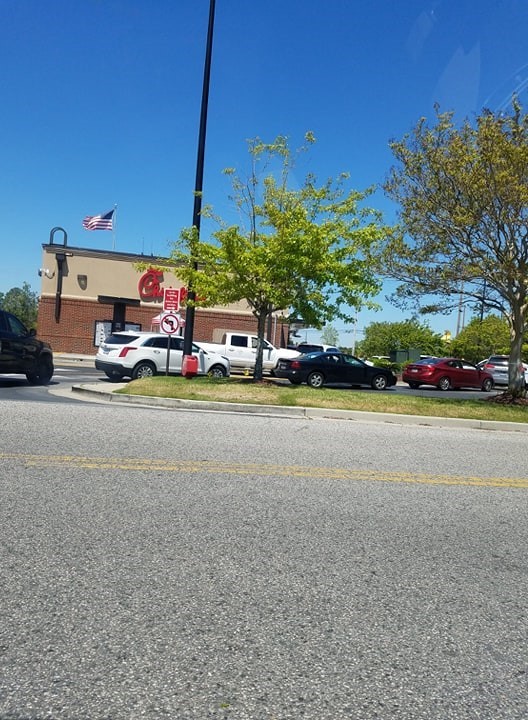
This is a picture of the Chick-fil-a drive-thru in North Myrtle Beach, South Carolina. In an effort to abide by social distancing rules, I avoided going out to public places for the past two weeks but needed a small reprieve from isolation and went to get lunch on April 18, 2020. While the restaurant is usually very busy, I had never seen it this busy. The line wrapped around the building and out into the road into the turning lane leading to their parking lot. Although I am not a traditionally patient person, I realized that everyone was going through a similar experience and we were all in search or some sense of normalcy, or at least a chicken sandwich. I learned to be patient that day and appreciate the fact that Chick-fil-a was open when many places are not. Patience is something I think we have all learned in this process and I found it ironic that a fast food restaurant could teach me something I have struggled with almost thirty years. Taking the time to be appreciative of what we do have is far less exhausting than focusing on what we are without.
-
2020-04-16
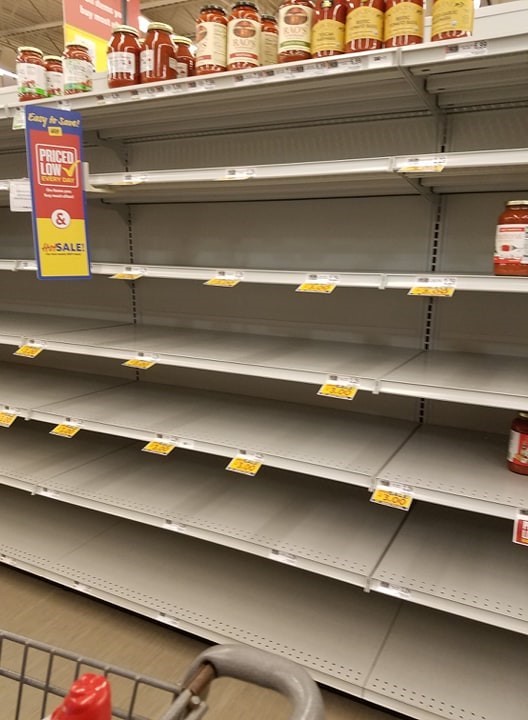
This was a photo of my local grocery store pasta sauce isle on April 16th. I know I have probably seen a dozen photos of the same or similar situations, but this really made me think about not only how I took the availability of items for granted, but also the people who work there and their frustration as well. Many grocery store workers are experiencing frustration and dread at work because of shopper irritation and frustration over unavailable items. There were obviously several choices left, but not what I usually use. That made me reflect on how we as a society become so entrenched in our own routine that we often forget the challenges that others experience all over the world and the complete unavailability of necessities that we take for granted. Shortages are a challenge to all of us and this has made me far more respectful of that fact and all those that are impacted by them.
-
2020-04-23
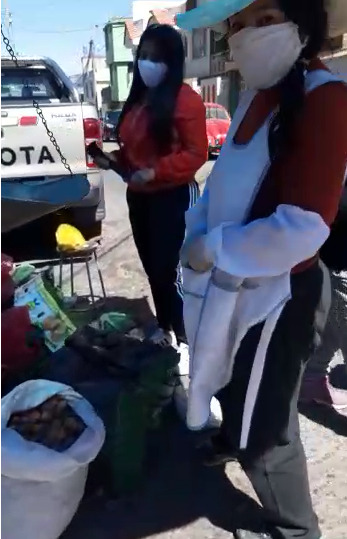
En Peru exactamente en la ciudad de Arequipa los mercados grandes en los que se comercializa frutas o verduras a menor precio solo pueden abrir 4 días a la semana por lo que algunas personas salen a vender algunos productos frente a los mercados en el video se puede observar a personas vendiendo huevo, eucalipto, carne de cerdo, papa, cebolla entre otros.
-
2020-03-12
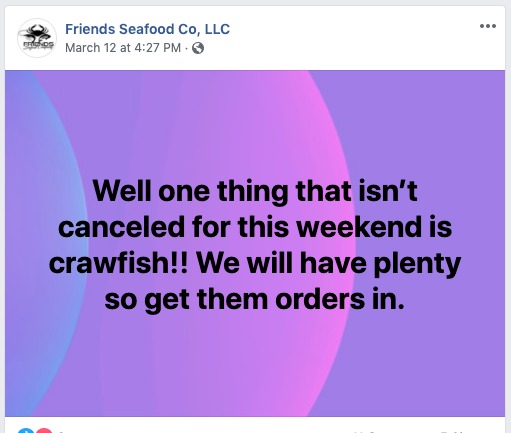
Chase Bruner, local firefighter, and seafood business owner offers fresh seafood to the community and delivers straight to your door during the stay at home order.
-
03/22/2020
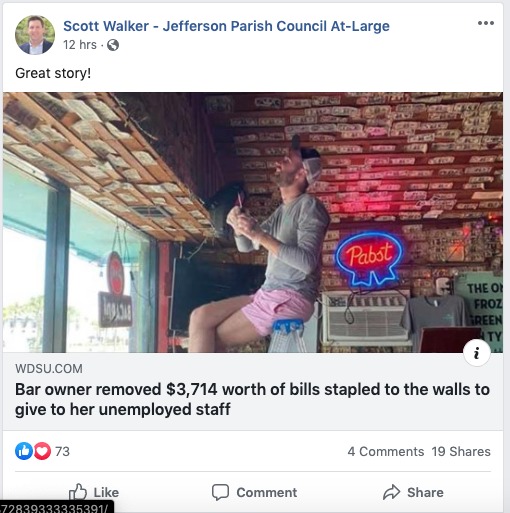
Bar owner uses money stapled to the walls of bar to pay unemployed staff.
-
2020-03-20
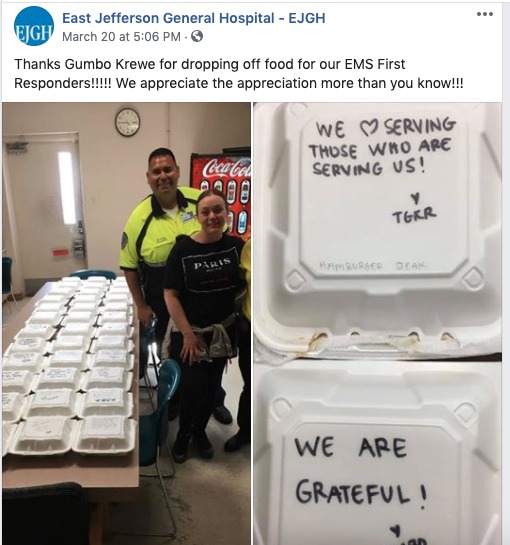
East Jeff thanks the Gumbo Krewe for providing food to the EMS First Responders.
-
2020-03-24
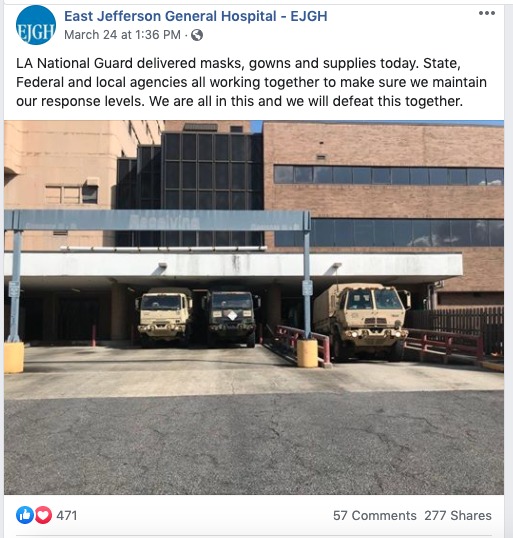
National Guard brings much needed PPE to local hospital
-
2020-03-13
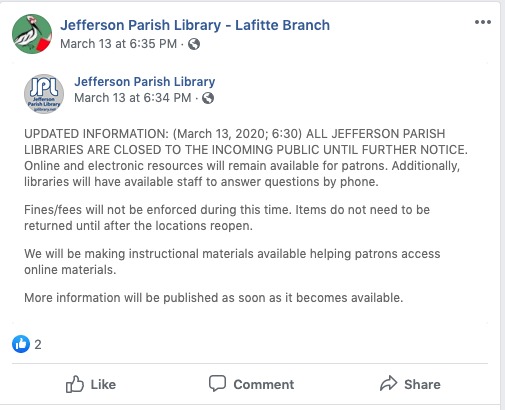
Libraries to be closed due to COVID-19 pandemic.
-
2020-04-07
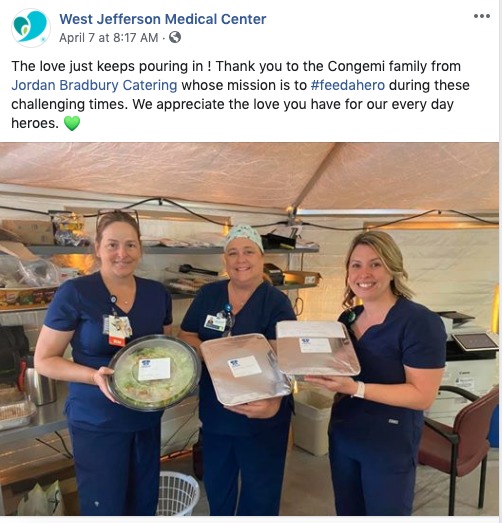
West Jeff giving thanks #feedahero during the pandemic.
-
2020-04-07
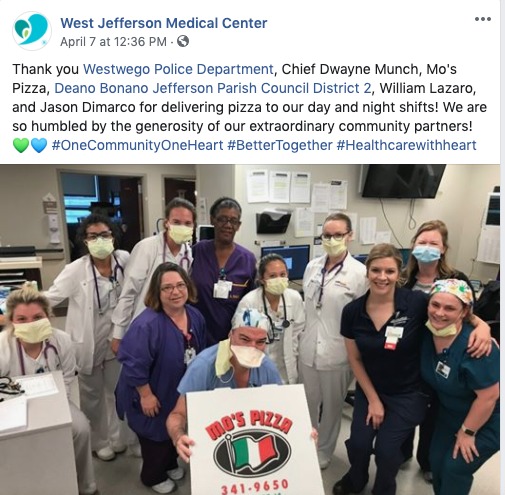
Local businesses provide food for frontline workers
-
2020-03-24
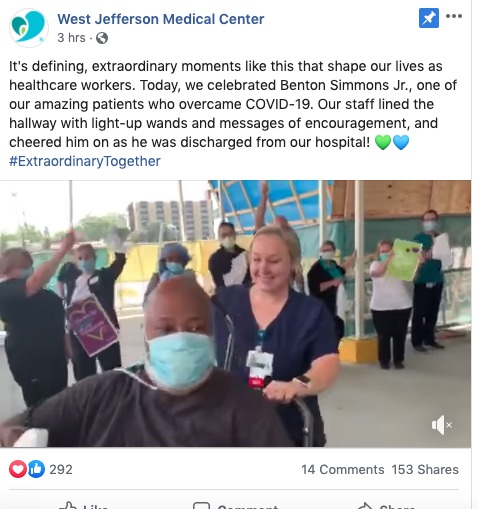
West Jefferson Medical Center celebrates the first patient to recover from COVID-19.
-
2020-03-24
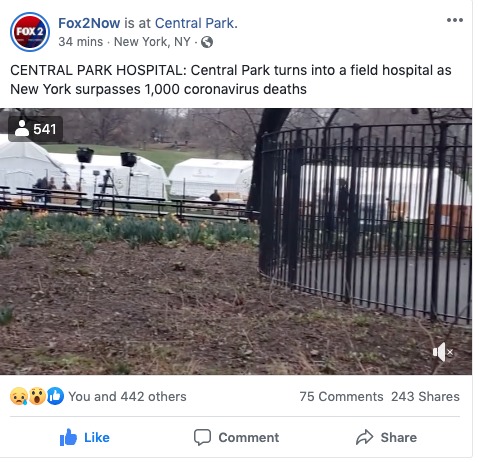
Hospital tents set up in Central Park in anticipation of medical facilities overcrowding in Manhattan, a major epicenter of the COVID-19 pandemic.
-
2020-04-03
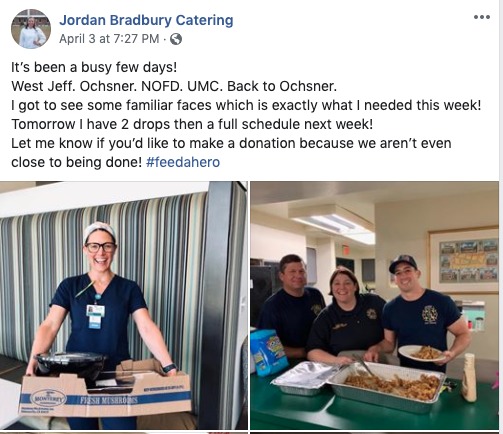
Jordan Bradbury Catering feeds West Jeff, Ochsner, NOFD, UMC during the pandemic.
-
2020-04-24
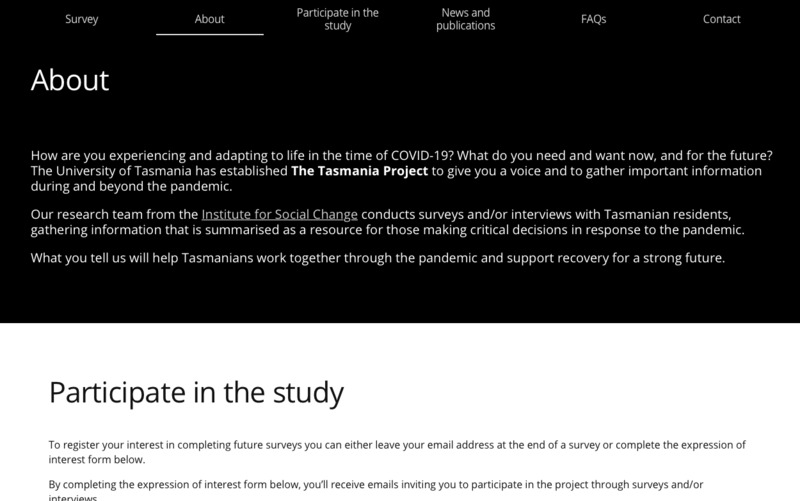
Project to gather information during and beyond the pandemic.
-
04/21/2020
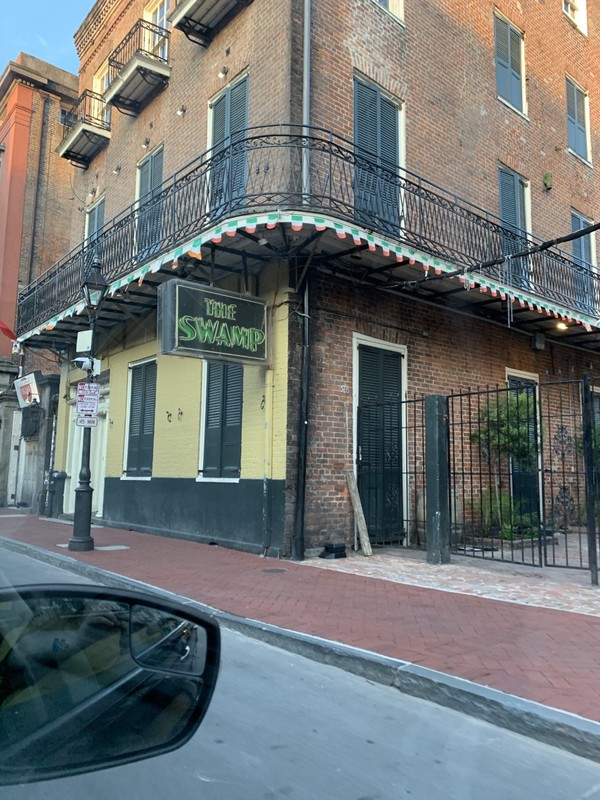
The Swamp remains temporarily closed during the COVID-19 pandemic.
-
2020-04-21
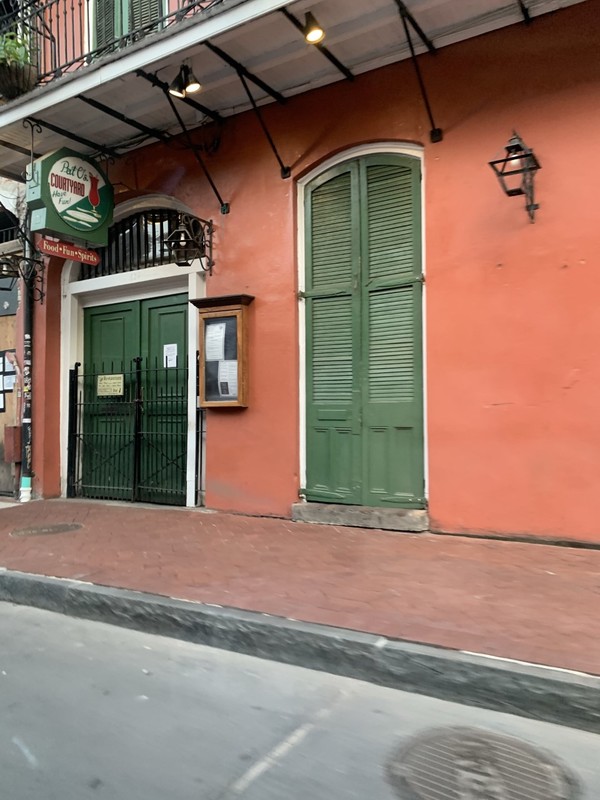
Pat O'Brien's remains closed as COVID-19 continues to sweep through New Orleans.
-
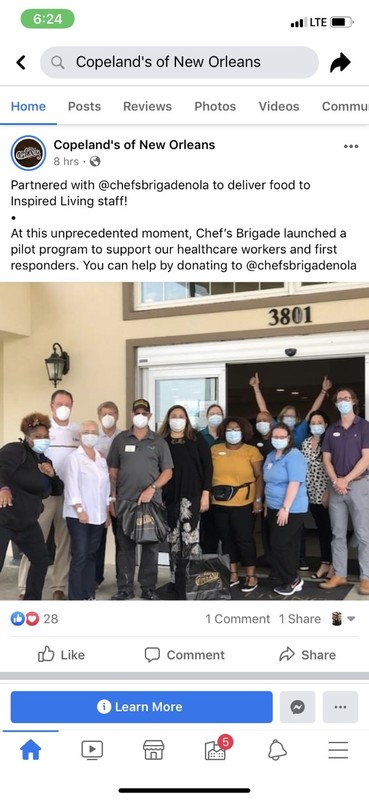
2020-04-23
The post reads exactly: "Partnered with @chefsbrigadenola to deliver food to Inspired Living staff!
At this unprecedented moment, Chef’s Brigade launched a pilot program to support our healthcare workers and first responders. You can help by donating to @chefsbrigadenola."
-
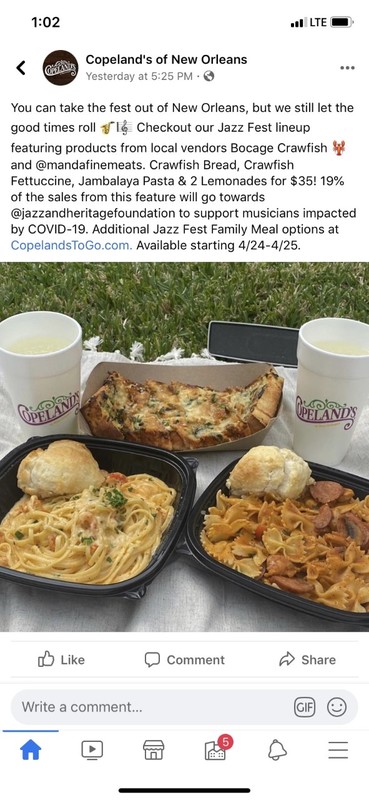
2020-04-22
Copeland's of New Orleans keeps true to Jazz Fest time in New Orleans and offers a full Jazz Fest food lineup. The post offers a link to additional meal options. The restaurant offers 19% of proceeds to the Jazz Fest musicians.
-
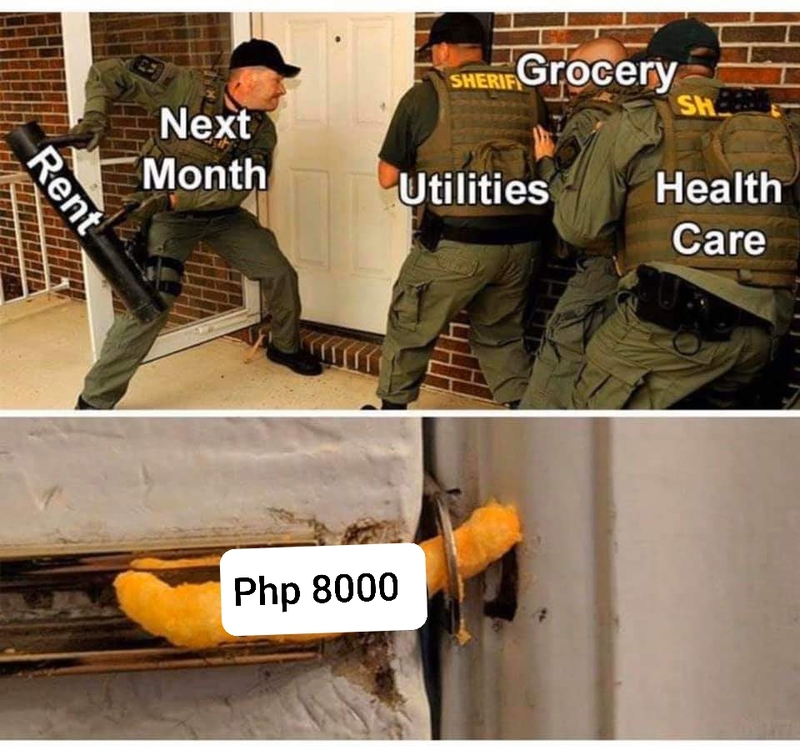
2020-04-19
The image is a satire of how the 8,000 peso stimulus check is not enough for most Filipino families' needs and so I have been asked by my friend to create this meme to show that it really is not enough because we think the same thing.
-
2020-04-23
The coronavirus has taught me something important. It can be difficult to see God in a world that is fraught with confusion, despair, hopelessness, and uncertainty. When I first found out that the second half of my freshman year of college was taken from me, my world was rocked. My faith was rocked. Before COVID-19, I felt like my faith was on a firm foundation, and more importantly, I felt close to God. All of that changed as soon as I arrived home. That firm foundation was now one of uncertainty and disappointment. The closeness I felt like I had with God was now gone. In reality, I never felt farther from God in that moment. I was overwhelmed by disappointment and confusion after realizing that I wasn’t going to get the dream ending of my first year in college. I wasn’t going to see my closest friends for a while. All I could see and focus on was everything that I lost.
As the days passed, I started to see glimmers of hope and joy. I started to work on being intentional about looking for God in my day-to-day. Now, I see God working in me with the unexplainable peace I now carry that everything will eventually work out. I see God in the encouragement and intentionality shown by my friends during a time where it’s easy to hide. I see God in the joy I feel as I write hand-written letters to my friends, even though they aren’t with me anymore. I see God in the laughs that my family shares as we enjoy the most heavenly chocolate chip cookies that I make for dessert. These examples may seem insignificant, but I have found rest in these moments because I have faith that God is working in and through them.
The coronavirus taught me that it can be difficult to see God in our world right now. But God taught me that He is right in the middle of all the pain, uncertainty, and loneliness I am feeling. He has taught me to be gentle with myself. That it’s okay to feel sad. That it’s okay to feel lonely. That it’s okay to not be okay sometimes. And that it’s okay to not be productive all the time. But even in the midst of all of those feelings, He is right there with me, and I trust that He is going to redeem all of the pain I am experiencing and turn it into something beautiful. I may not be able to see it right now, but I have faith that I will see it, and I’ll be so thankful for it. As a result, my faith will come out stronger than it ever has been before.
-
2020-04-19
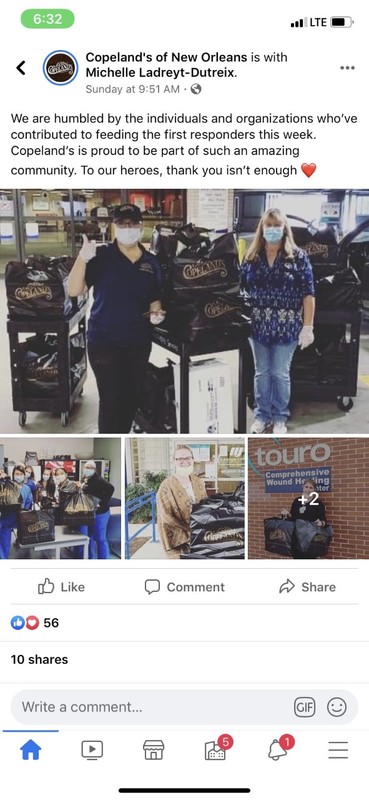
The post reads exactly: "We are humbled by the individuals and organizations who’ve contributed to feeding the first responders this week. Copeland’s is proud to be part of such an amazing community. To our heroes, thank you isn’t enough ❤️"
-
2020-04-23
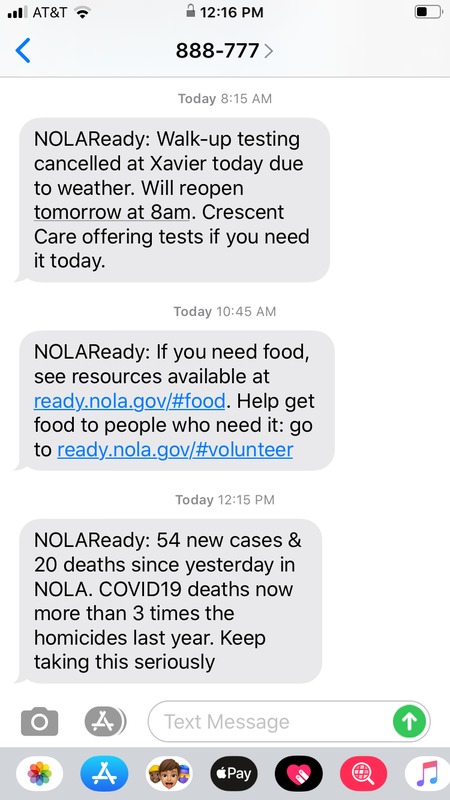
When I realized I was going to be quarantined in New Orleans for the foreseeable future, I signed up for texts from the mayor. These three, sent within hours of one another, suggested an evocative sketch of the landscape that is New Orleans, encapsulating both the threats we face and the ways we respond to them. The first text was about the morning's severe weather (often a threat in New Orleans), which disrupted Covid testing. The next was about how we can help those facing the threat of food insecurity. The last compared the death rate from Covid to the city's homicide rate (which tells you as much about violence in the city as it does about the pandemic).
I was talking on the phone last night with a friend who said she's heard a lot more gunfire in her Bronx neighborhood than usual. She said she worried about an increase in violence as the pandemic widens existing inequities in our country and people become more desperate.
-
2020-04-21
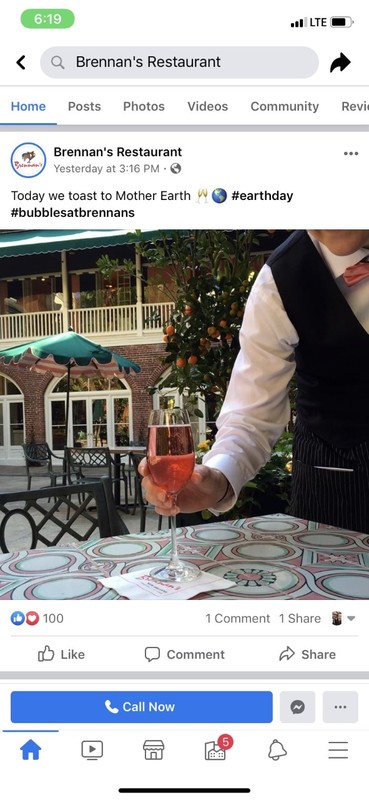
The post reads exactly: "Today we toast to Mother Earth! #earthday #bubblesatbrennans"
-
2020-04-17
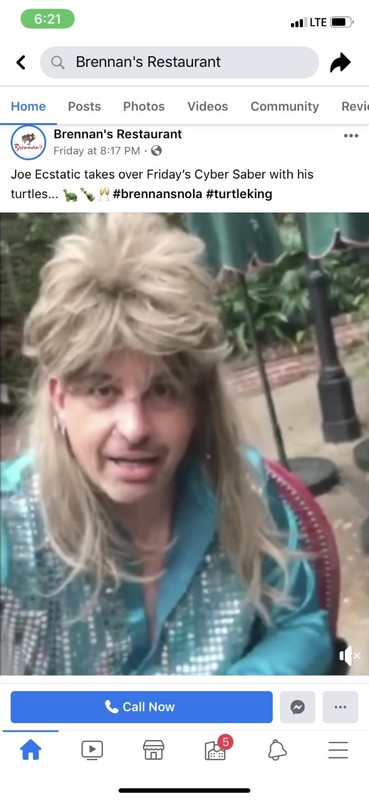
Brennan's Restaurant offers a funny parody of the Tiger King with the restaurant's own Joe Ecstatic during pandemic closure.
-
2020-04-14
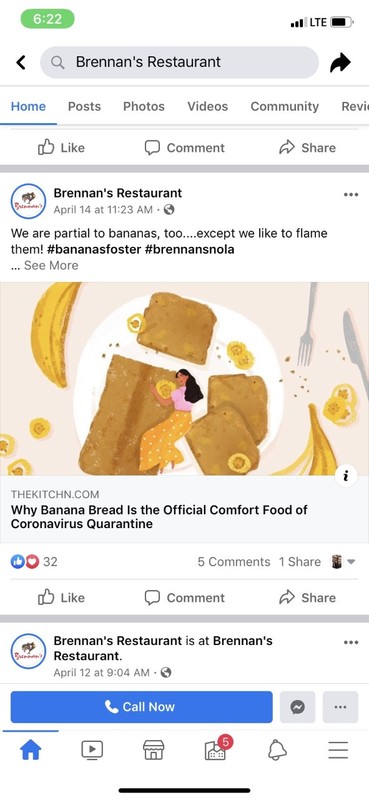
Brennan's Restaurant shares an article discussing why banana bread is the official comfort food of Coronavirus quarantine.
-
2020-04-12
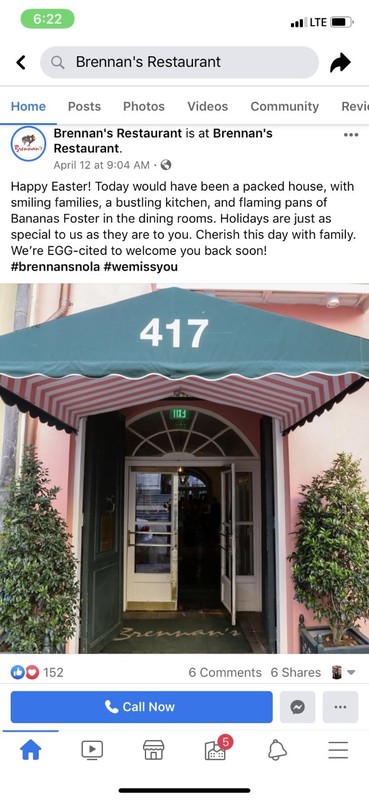
Brennan's Restaurant wishes patrons a Happy Easter and promotes cherishes quality time with family.
-
2020-03-17
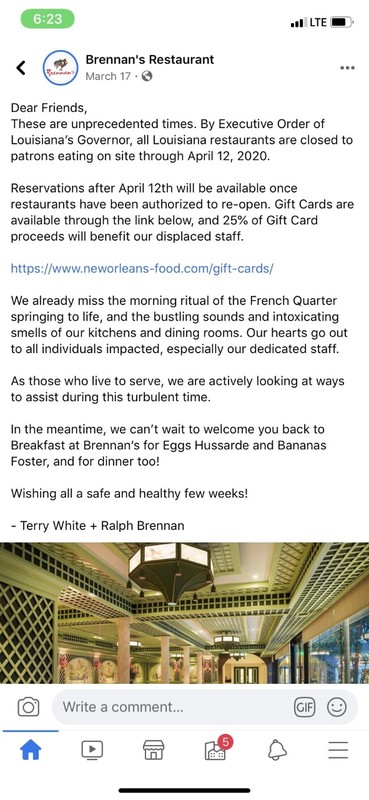
Brennan's Restaurant in the French Quarter announces closure of the restaurant due to Governor Edwards' executive order. The restaurant offers gift cards of 25% off to support displaced staff.
-
2020-04-22
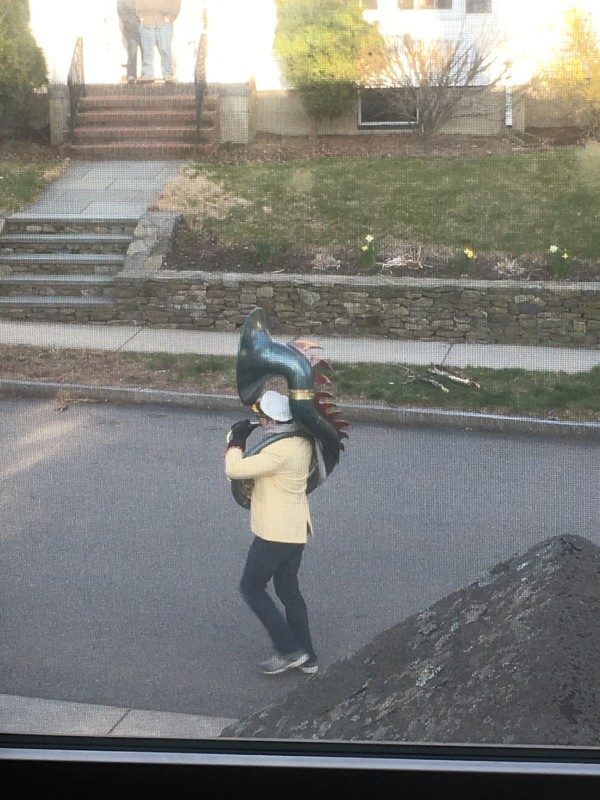
This gentleman has been sighted a few times marching around Watertown, MA. He first passed my window on April 2nd and he returned on April 22nd. At first I thought that his sousaphone was decorated to be a dragon, but I later learned from a NBC Boston News story that it is a Loch Ness Monster. He plays songs like "When the Saints Go Marching In" and "Somewhere Over the Rainbow." I was delighted to see him and told everyone I know about his one-man parade. It truly felt like something out of the TV show M*A*S*H.
-
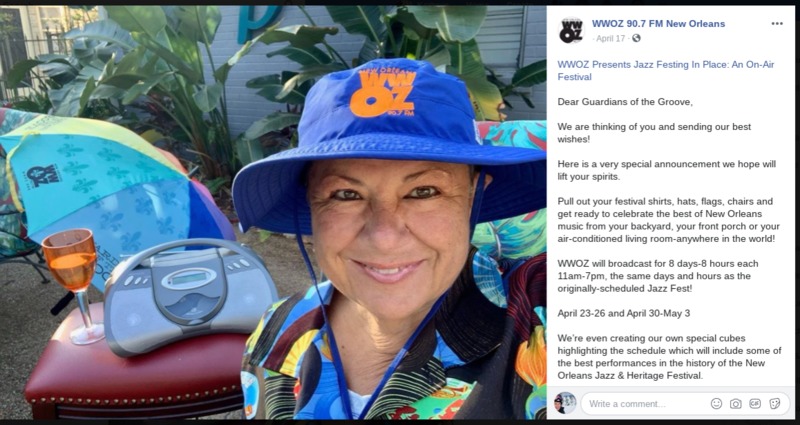
2020-04-17
WWOZ, a local New Orleans Radio Station, announces plans to air recordings from past Jazz Fests on the days that Jazz Fest was supposed to occur before COVID-19 cancellations.
-
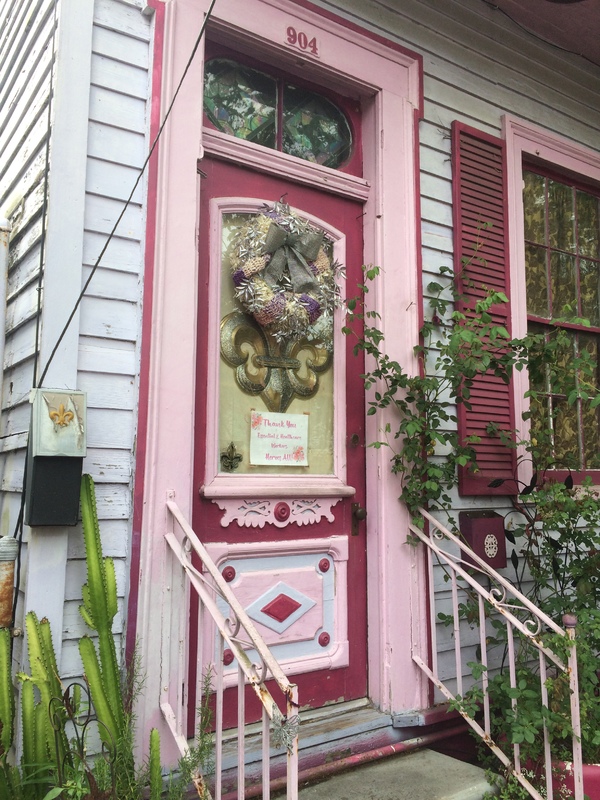
2020-04-23
A poster displayed on a house in New Orleans reads: "Thank You Essential & Healthcare Workers. Heroes All!"
-
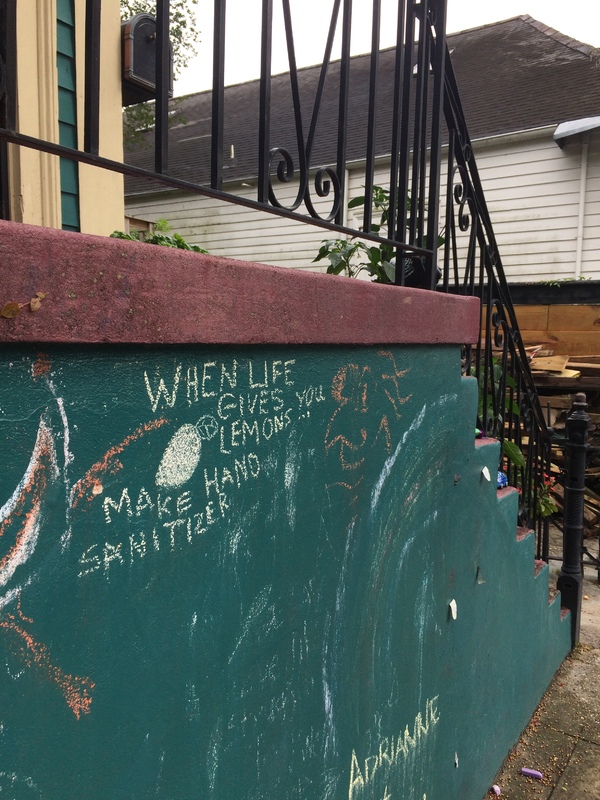
2020-04-23
Chalk left outside a house encourages walkers-by to decorate the residence wall. One inscription reads: "When life gives you lemons... make hand sanitizer."
-
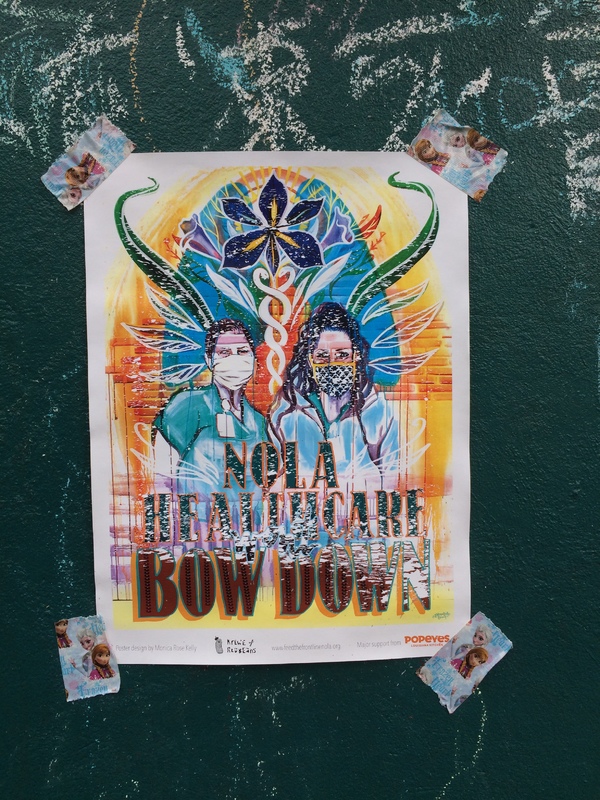
2020-04-23
A poster created by a local New Orleans artist Monica Kelly for "Feed the Front Lines NOLA!" a program created by The Red Beans Krewe that hires out-of-work musicians to deliver large orders of food from local restaurants to doctors, nurses, and first responders during the COVID-19 pandemic.
-
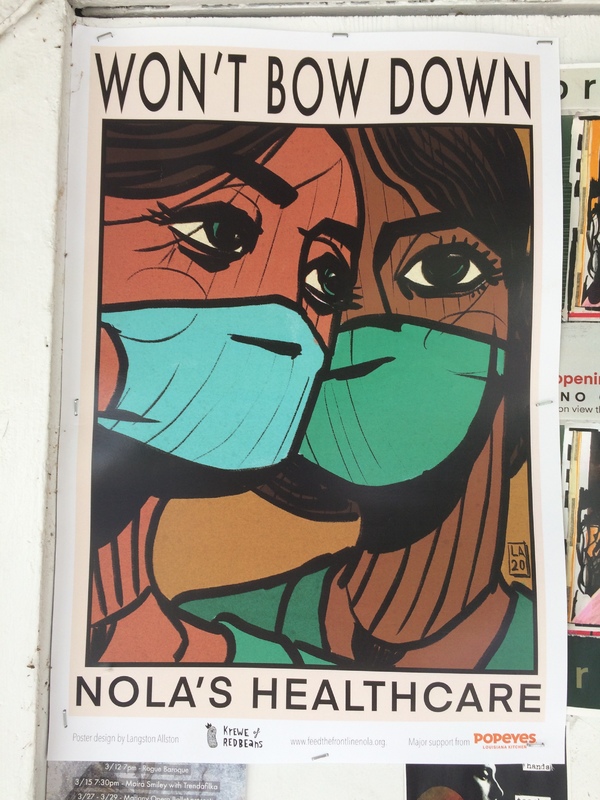
2020-04-23
A poster created by a local New Orleans artist (name not listed) for "Feed the Front Lines NOLA!" a program created by The Red Beans Krewe that hires out-of-work musicians to deliver large orders of food from local restaurants to doctors, nurses, and first responders during the COVID-19 pandemic.
-
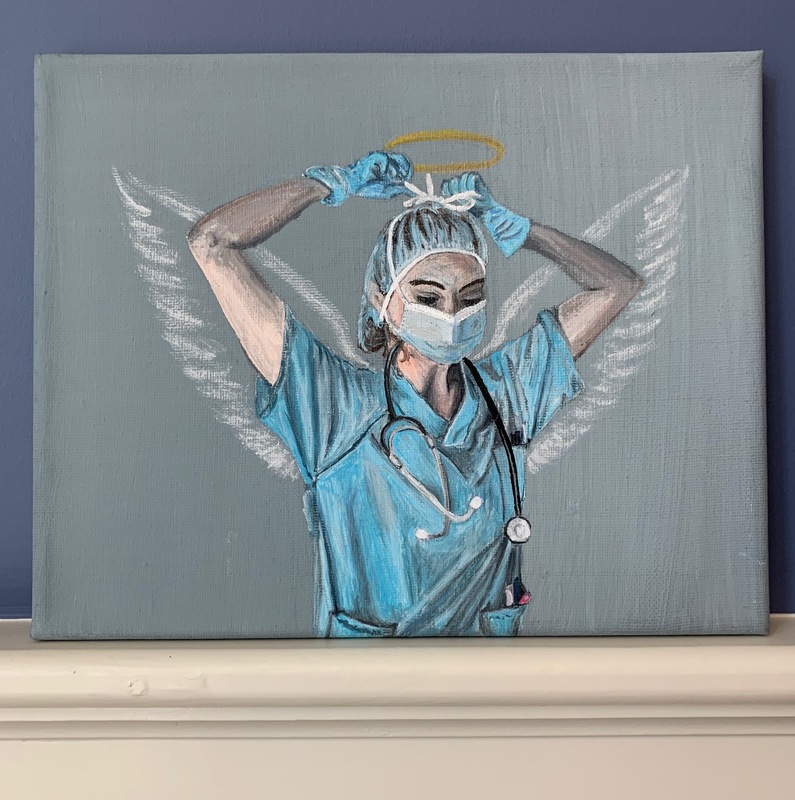
2020-03-01
A tribute to the healthcare workers at Emerson Hospital in Concord, Massachusetts.
*Lucy Jimenez (senior at Concord Carlisle High School in Concord, Massachusetts - studying nursing at UPenn class of 2024)
-
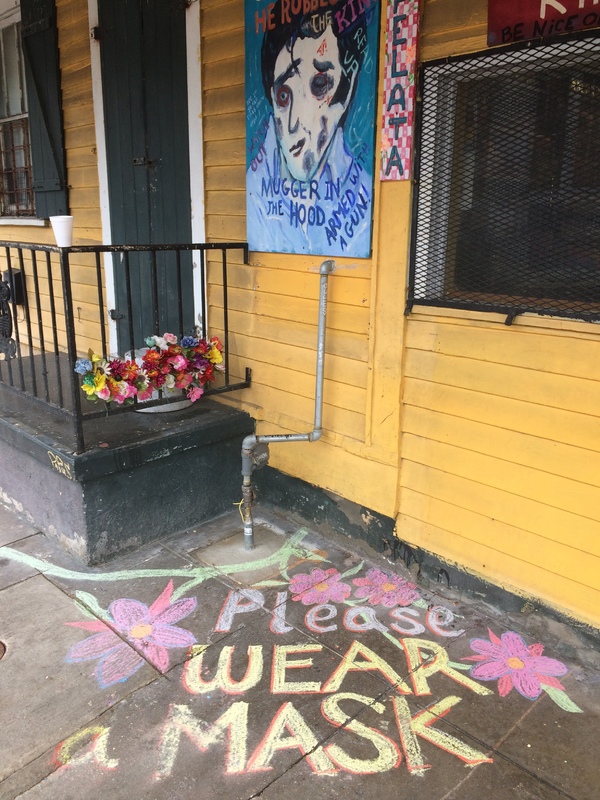
2020-04-23
Outside of Frady's One-Stop Food Store, a chalk inscription reminds the public to wear a mask during the COVID-19 pandemic.
-
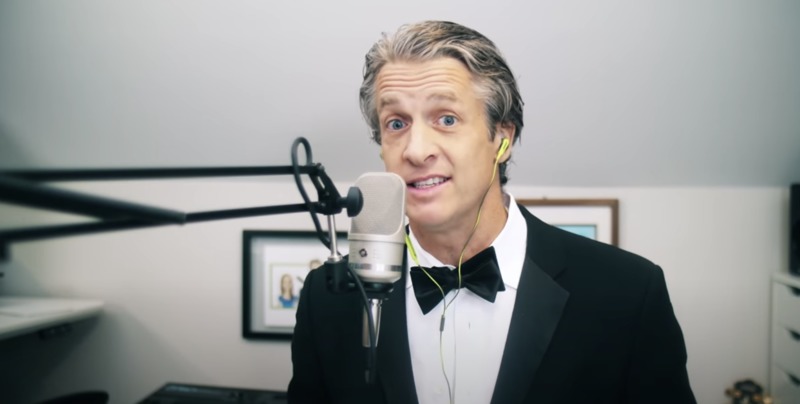
2020-04-22
The comedy family known as the Holderness Family posted a video remaking Disney songs into songs about quarantine. Quarantine entertainment has varied but this is a creative outlet for families and it's entertaining for viewers. #NortheasternJOTPY
-
04/16/2020
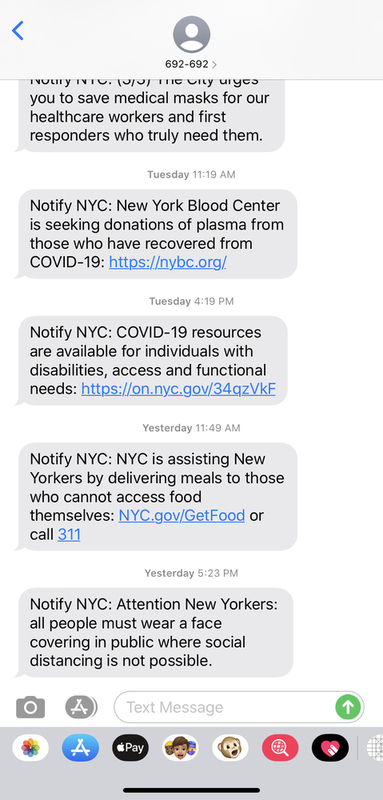
Text alerts related to NYC COVID response
-
04/07/2020
The world has been upended by a novel coronavirus, and all we want to do is to return to normal. But how can that happen, and when? Today on What’s New, Stephen Flynn, Director of Northeastern University's Global Resilience Institute and expert on the resilience of societies talks about the long road back after enormous tragedies.
-
2020-04-23
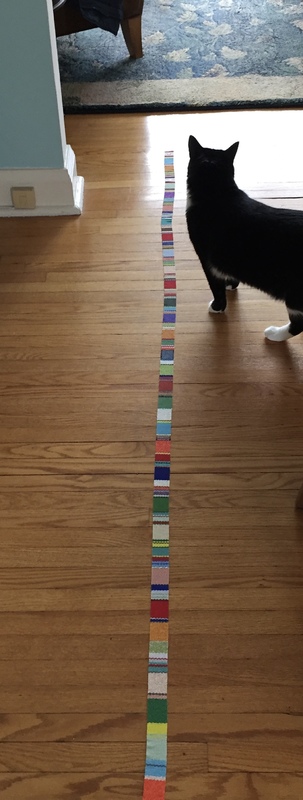
Beaded at about 3 hours a day (= 3 inches), Covid both recorded the passage of time and provided diversion, though truth be told, I’m rather enjoying this time out. There are various event and day markers built into the strand that also provide memory points in its construction.